
According to Wikipedia, there are 41 living species species belonging to 14 genera in the family Felidae (the “cat family”). One genus, Leopardus, includes (or included) eight species of small cats, among them the ocelot and Geoffroy’s cat. But now the genus has three more species—two subspecies were elevated to species rank and, excitingly, a brand-new species, L. tilcayo, was just discovered in Bolivia and described in the Current Biology paper below (click the headline to read):
No, they didn’t find a new subspecies, which is often what these announcements say, but they found a new full species of cat, at least as far as I, “Mr. Speciation,” can judge. Ergo, there are now 43 species of cats. If you know your cats, try writing down as many species as you know. It’s a good party game (LOL), but I bet you can’t get even half of them.
First, credit to the scientists. Click to read the Current Biology article, which is woefully bereft of photos (but I’ve added some below):

From the paper:
Etymology
This species is named after the local name “tilcayo” used for this felid, which is widely known in the Bolivian Yungas zone. The name is treated as an unchanged noun in apposition.
Vernacular name
We propose “tilcayo” as the English common name, preserving the traditional local designation in recognition of its cultural and regional relevance.Diagnosis
Leopardus tilcayo differs from L. pardinoides by its shorter pelage, lower contrast pattern, more expanded and irregular open rosettes, less bushy tail, and the absence of broad and complete caudal bands (see Data S1). It differs from L. tigrinus by its larger and more irregular flank markings, longer and fuller tail, and irregular caudal blotches. It differs from L. guttulus by its larger, more heterogeneous markings, lower dorsal contrast, and relatively longer tail. L. tilcayo can be distinguished from other Leopardus taxa by a large number of molecular characters. In the nuclear genome, among the 29,288,951 transversion variants, on average 1,392,646 sites differentiate L. tilcayo from L. t. antisuyo and 1,491,301 sites differentiate L. tilcayo from L. pardinoides. For simplicity we provide a list of diagnostic mitochondrial DNA sites (see Data S1).
Description
L. tilcayo is a small felid with a head-body length of 425–505 mm and a tail length of 250–265 mm. It has a light brown dorsum, darker along the mid-dorsal ridge and paler toward the limbs. The pelage is characterized by relatively large, irregular, dark brown to black rosettes, mostly open or partially closed, on a light brown to beige background. The rosettes do not coalesce. A detailed description is provided in Data S1.
In light of the fact that the tilcayo seems to abut the distribution of L. tigrinus antisuyo, but maintains significant morphological and genetic differences from it, I think the designation of the tilcayo as a new and full biological species is valid.
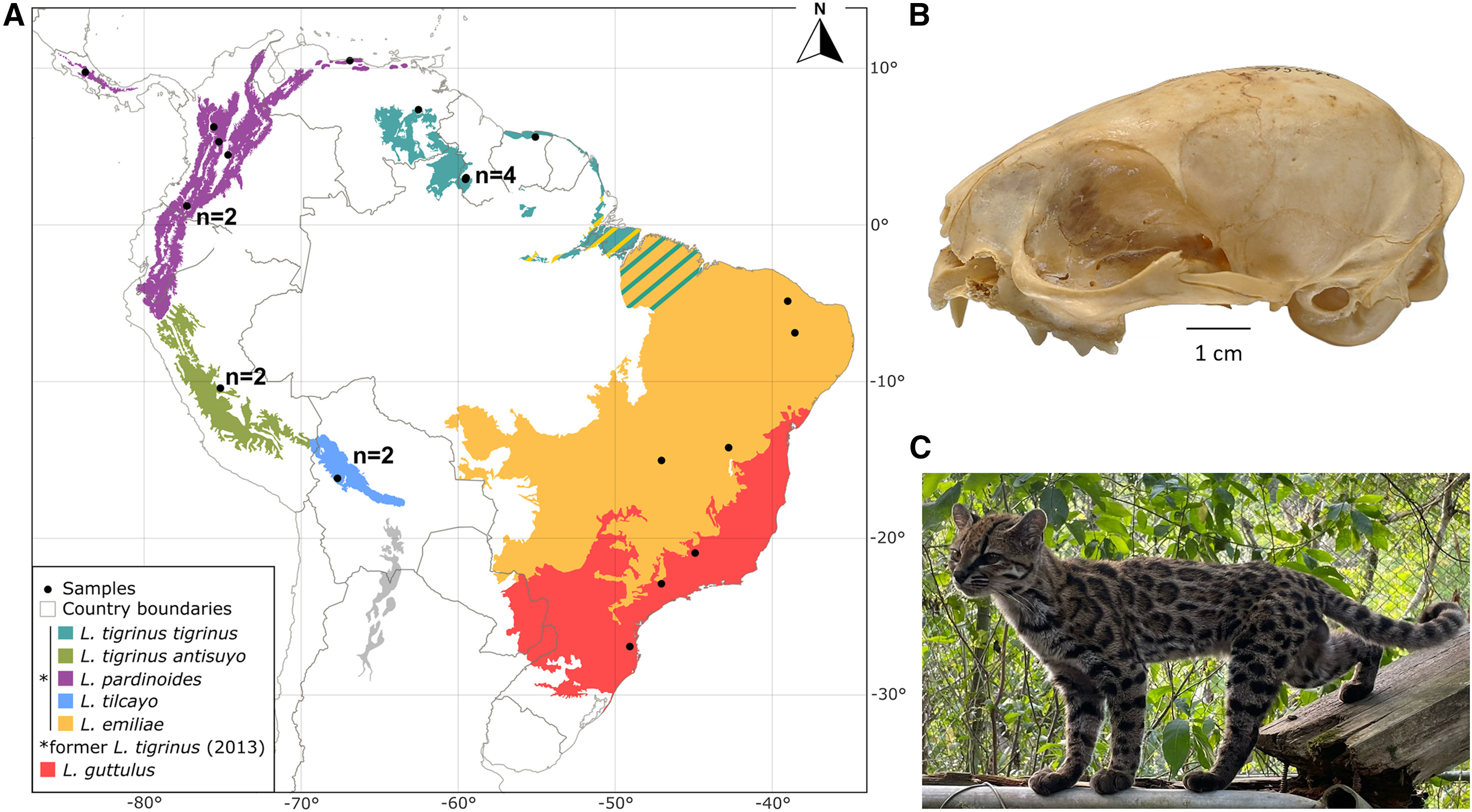
Below from the paper is a map of the species range compared to that of other conspecific species, a skull of the oncilla L. tigrinus tigrinus, and, in (C), a photo of the new cat, which was captured alive, and, according to the paper, released in healthy condition.
The authors also elevated two known taxa to species rank, L. emiliae and L. pardinoides. As you see, the three new species were formerly lumped as L. tigrinus (figure A below shows only one group elevated to species rank, which is discrepant with the other phylogeny in the paper, showing two species elevated plus the newly discovered L. tilcayo).
The closest relative of the tilcayo is, according to molecular analysis, the trio of L. trigrinus tigrinus and its sister L. tigrinus antisuyo (subspecies of the oncilla), as well as their sister species, L. pardinoides, the clouded tiger cat. Notice that the species distribution forms a ring around the Amazonian rainforest. This is not, I think, a “ring species.”
Pictures are few and far between, but here’s a tweet and a video showing more about this small (three-pound) cat:
BREAKING NEWS: New cat species just dropped! 🧪What is a tilcayo, exactly? Well, it's a small wild cat in the genus Leopardus and a member of the tiger cat species complex, but it is NOT a tigrina, oncilla, kodkod, Geoffroy's cat… http://www.nationalgeographic.com/animals/arti…
— Jason GRIZZLED Bittel (@bittelmethis.bsky.social) 2026-09-17T15:50:16.709Z
Here is the publicity in popular media. Click to read each article. I’ll quote from only the National Geographic article.
From National Geographic. This is the best source because, if you click on the link, you’ll start off with a video of the new species:

A quote:
In 2016, Paola Nogales-Ascarrunz, a biologist and National Geographic Explorer working in Bolivia, received a call from a local wildlife sanctuary that had just been given what they described as “a weird cat.” It came from a local man who found it as a kitten on a road near a forest. The man took the animal home, believing it to be a domestic breed. But after about a year of living with the clearly wild animal, he realized it would be better off at a sanctuary.
As the lead scientist and founder of the Bolivian Felids Research Program (Programa de Investigación de Félidos Bolivia), Nogales-Ascarrunz was intrigued. The animal had a small, scrunched-up face, short and round ears, and long whiskers. It was, indeed, too small to be a housecat, and, most notably, it was covered in leopard-like spots. So she went to visit the creature at the Senda Verde wildlife sanctuary on the subtropical flank of the Bolivian Andes.
“I took a hundred pictures of it,” remembers Nogales-Ascarrunz. “I was so fascinated.”
What she couldn’t know at the time was that this curious cat had a secret. It would become the first new species of felid (i.e. the cat family) discovered in over 100 years, according to a study published today in the journal Current Biology. What’s exciting is the discovery is not a validation of a species proposed in the distant past, nor a previously recognized subspecies raised to species status—which are both more commonly reported and important findings. No, this cat was something totally new to science.
At the time though, Nogales-Ascarrunz assumed the unusual cat was a member of the species Leopardus tigrinus. Sometimes called tigrinas, oncillas, tigrillos, or little spotted cats, this species was described back in 1775 from a single illustration of an animal seen in French Guiana and was subsequently presumed to exist across Central and South America, including, at the time, Bolivia.
. . .It would take another few years before Nogales-Ascarrunz developed her skills in genetic analysis to the point where she could investigate the mystery cat’s genome with any accuracy. Then, working with Eduardo Eizirik, a geneticist at Pontifical Catholic University of Rio Grande do Sul in Brazil, and study co-lead author Jonas Lescroart from the University of Antwerp, the team was able to find its distinct place on the cat family tree.
In their paper, the researchers propose the cat should be known as Leopardus tilcayo, in honor of the word local people know it by. “We asked the local people, ‘Why do you call it tilcayo?’” says Nogales-Ascarrunz, who is herself from Bolivia. “And they said, ‘I don’t know! My grandpa called it tilcayo, so I call it tilcayo.” (The name does not appear to mean anything particular in Spanish or the Quechua language spoken in Bolivia.)
So far, all scientists can say is that L. tilcayo lives in Bolivia’s Yungas forest ecoregion, which lies on the eastern slope of the Andes Mountains. But as to what these cats eat or get eaten by, how they reproduce, and many other facets of their day-to-day lives, much mystery remains. “So many basic things are not known,” says Nogales-Ascarrunz, who is co-lead author of the new study.
But the discovery is monumental, and not just because it’s the first new cat discovered since the pampas cat in 1923. The new paper doesn’t just name a new species; it redraws the cat family tree to have a lot more branches than previously thought. What’s more, the researchers hope the methods used to identify L. tilcayo may soon be used to find even more cat species spread across the world, and even transform how we protect them.
From Reuters:

From the BBC:

By the way, there are a paltry 37 species of wild d*gs in the family Canidae, and the morphology of wild cats, as I said in my New Yorker “Cats vs. Dogs” talk, is far more diverse than of wild dogs. That shows that, at least in nature, there is no lack of genetic variation in cats. Why, then, are domestic dogs so much more variable in size, shape, and behavior than domestic cats? My hypothesis, which is mine, is that wild dogs are almost always social animals, while wild cats, with the exception of lions, are almost always nonsocial. To me this means that the behavior of canids is more malleable than is the behavior of cats, which in turn means that the gray wolf (a social wild canid) had the genetic variation to be bred by humans into different breeds doing different things. Cats, I think, don’t have that kind of genetic variation, and they remain solitary and (largely) untrainable. Remember that many dog breeds were artificially selected to do different jobs, explaining their greater diversity of morphology, size, and behavior than what we see in domestic cats.
h/t: to the many readers who sent me links to announcements of the new cat.
Thank you for posting the original source. It’s rare when a new mammal is described. Yes, geographical distribution suggests that the two species have evolved isolating mechanisms that prevent or severely limit hybridization: good species! And, such a beautiful cat!
Well, I guess I’ll double the number of comments here. . .
That New Yorker Cats vs. Dogs debate must have been a lot of fun! The jury must have been rigged though, since dogs won. 🙁 (I mean no disrespect to dogs. It’s not their fault that they’re not cats.)
This new cat is certainly appealing. I guess, from the fact that the finder turned it into the reserve, it is not quite ready to share the hearth. I hope the population numbers are healthy.
When a new animal of any size is discovered these days, it is almost always, I think, classified as endangered or even critically endangered, for the rather obvious reason that if the population weren’t tiny, it would have been discovered earlier. From what I understand, this isn’t necessarily the case for this particular cat, as it was actually relatively well-known to the local people, hence the tilcayo name, but not to science. Perhaps the assumption was that tilcayos were just more individuals of one of the related species. Anyway, here’s hoping that tilcayos are numerous enough that the species can survive into the distant future.
It was rigged and the editor, David Remnick, was the moderator and clearly biased towards d*gs. When my short talk was interrupted by problems with the projector, he refused to give me extra time so I could finish. I don’t like the dude.
It’s gorgeous.
I want one! Just kidding, but I would really like to know what it was like for the guy who kept it as a pet for a year. How was its behavior so different from a domestic breed that he was convinced to take it to a sanctuary? Did it attack him? My cat attacked me all the time when she was a kitten.
The only question is how long before people start trying to poach them for the exotic pet market.
Gorgeous cat, very special!
Thank goodness they recognized the species in time to protect it.
Nice theory about cats vs dogs!
But what about lions? They’re social. So even if the generic cat species is solitary, don’t lions show that it should be so hard to breed house cats, say, to be social? The genetic distance doesn’t seem so far.
The house cat came from a nonsocial species that is distantly related to lions, and every other cat species is solitary That suggests to me that the ancestral condition is solitary and there might be some lack of genetic variatioon (or lack of a selective environment) favoring sociality. All dog species are social
Yes, but my point was that it lions were bred (by natural selection) from the ancestral asocial species to be social, then it doesn’t seem like too big a stretch to think we could breed house cats to be social.
I suppose one could argue that the ancestral species had a standing variation of genes related to sociability and that now that variation is gone in house cats, with only the solitary genes remaining.
What a beautiful cat. I hope researchers discover more cat species in the area.
The photos make the new species kitteh look kinda grumpy… But lovely. Still lovely.