
We can keep going for two days after this, but if you got photos, please send ’em. Thanks.
Today’s batch is from Ephraim Heller, continuing his photos from a recent trip to Namibia. Ephraim’s captions are indented, and you can enlarge his pictures by clicking on them. Don’t miss the chameleon with its tongue extended!
Today I continue my series on a May-June 2026 visit to Namibia. I’m organizing the posts by habitat, in the order of our visits, so that you get a sense of the ecosystems. My last post focused on the Namib desert. This post focuses on my next destination, Swakopmund, a cold, fog-covered town along the Namib desert’s Atlantic coast.
Annual rainfall is less than 20 mm, but the town experiences ~180 days/year of thick fog, generated offshore when the cold Benguela Current contacts warm desert air. The fog typically settles in the early morning hours and burns off by mid-morning. The fog provides moisture that enables some vegetation to grow in a strip along the ocean. In addition, there is a small, brackish estuary at the mouth of the ephemeral Swakop River that supports marine birds. This photo, taken with my iPhone on an after-dinner stroll from a restaurant to our hotel, gives you a sense of the fog:

A herd of dromedary camels (Camelus dromedarius) grazing along the shoreline often startles visitors to Swakopmund. Dromedaries are not native to Africa. The species was domesticated on the southeastern Arabian Peninsula about 4,000 years ago and has not occurred naturally in the wild for nearly 2,000 years. They were imported to Namibia by the German colonial troops in 1889 for use as military pack animals in what was then German South West Africa. The animals I saw grazing along the shore are used by a local company for tourist rides. This is a handsome individual:

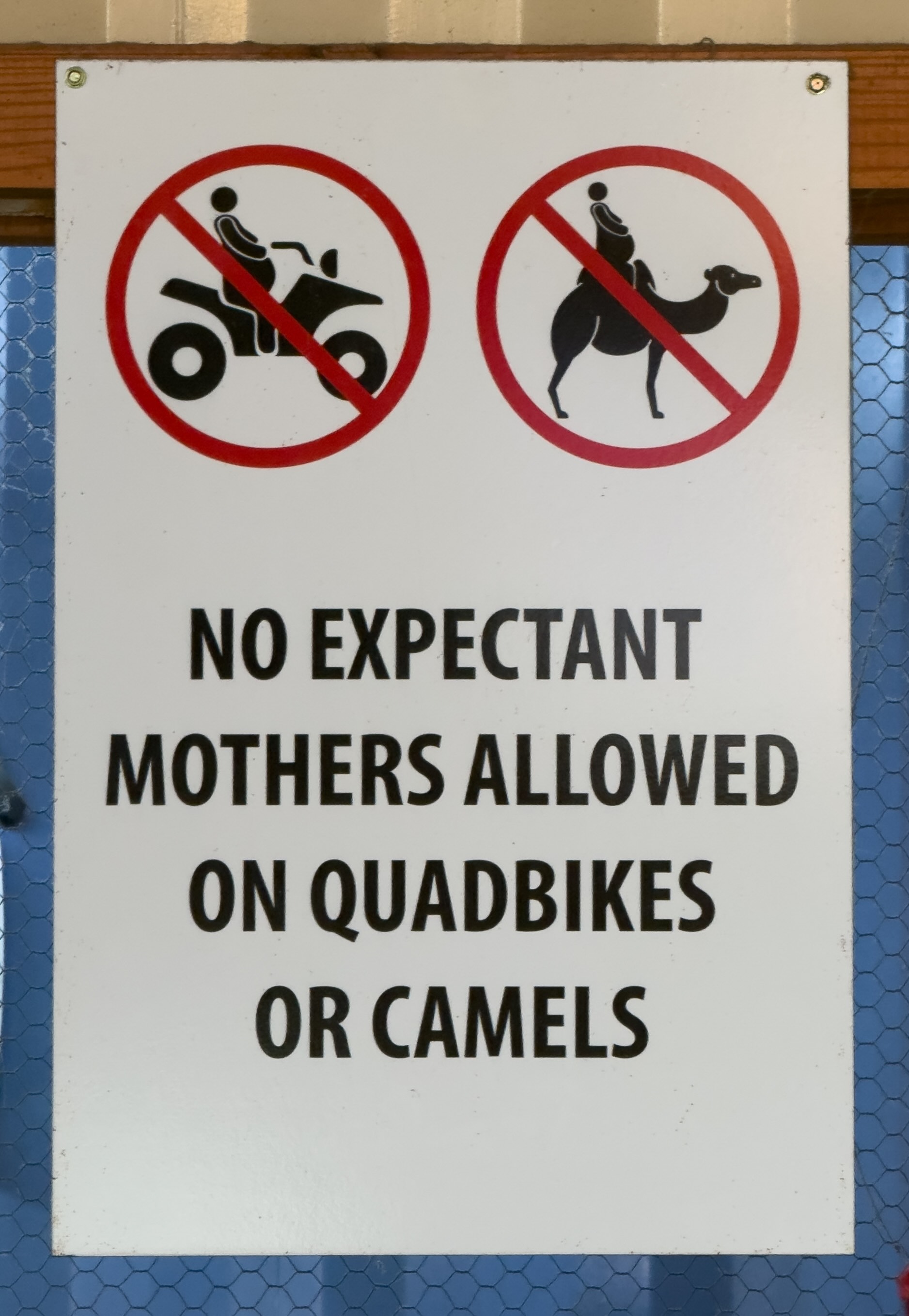
However, not everyone gets to ride the camels:
The most impressive aspect of our stay in Swakopmund was a short “living desert” safari. A guide took us on a walk and drive in the sand dunes immediately around the town. Where I saw pristine sand, the guide saw the telltale marks of animals burrowed in the sand.
The first individual he unearthed was a desert sidewinding adder (Bitis peringueyi), a small, ambush predator. The one he found was about 15 cm (6 in) in length. The eyes are positioned on top of the head rather than on the sides, adapted to allow the adder to bury itself in loose sand, leaving only the eyes exposed at the surface while waiting for prey. Prey includes sand lizards and barking geckos, which also provide most of the adder’s water needs. I took these close-up photos with my macro lens – kids, don’t try this at home:

Next, our guide uncovered a buried Namib sand gecko (Pachydactylus rangei), certainly the most charismatic of the desert critters. The large feet with webbed toes are good for running on loose sand and for excavating burrows. They burrow into dunes by day to escape the heat, emerging after dark to hunt insects and spiders.

These geckos also emerge during fog events and allow droplets to condense on their skin, then lick water from their own faces and bodies. In 2021 researchers reported that P. rangei produces a neon-green biofluorescence under UV and moonlight conditions using a new mechanism in terrestrial vertebrates. I wish I had known this at the time so I could have photographed them under moonlight. Regardless, these are clearly very happy creatures:

Of course, no visit to the Namib desert dunes is complete without a FitzSimon’s burrowing skink (Typhlacontias brevipes). The FBS is blind, legless, just a few inches long, and spends its entire life burrowed in the sand. The species has reduced eyes without eyelids and no visible external ear openings. It detects prey (ants, termites, ant-lions, and small beetles) by sensing the vibrations they produce when moving through sand:

Finally, our living desert guide found surface critter: a Namaqua chameleon (Chamaeleo namaquensis). The Namaqua chameleon is one of the largest chameleons in southern Africa (up to 25 cm or 9.8 in), and unusual in the family for being terrestrial rather than arboreal. In the early morning, this chameleon darkens to near black to maximize heat uptake; as body temperature rises, it lightens toward grey-brown to reduce absorption. Water is obtained through the diet, from morning dew, and through hygroscopic skin that absorbs moisture by capillary action (wow!). Nasal salt glands excrete excess sodium chloride and potassium, allowing salts to be processed without renal water loss:

The eyes can move independently, looking in different directions:

The tail is shorter than those of arboreal chameleons, and has lost its prehensile abilities:
The guide had some mealworms with which to entice the chameleon. It’s tongue was so fast its movement was hard to see with the naked eye:

Now for the birds. First up, a colorful common waxbill (Estrilda astrild):

Next, a common but lovely speckled pigeon (Columba guinea) with an excellent hair stylist and makeup artist:

A portrait of another common but colorful bird, the helmeted guinea fowl (Numida meleagris). This one looks pensive:

We took a tourist boat cruise to see the Cape fur seal (Arctocephalus pusillus pusillus) colony near Walvis Bay. The Cape fur seal population along the southwest African coast is estimated at 1.5 – 2 million animals, roughly two-thirds of which occur along the Namibian coast.
Cape fur seals are eared seals (family Otariidae) rather than true seals. Unlike true seals, which move on land by undulating their bodies, otariids can rotate their hind flippers forward and walk on all four limbs, giving them considerably more agility.
During breeding season, bulls fight to establish territories and maintain harems of 5 to 25 females. A bull may lose nearly half his body mass over the six-week breeding season without leaving his territory to feed. Mothers leave their pups on shore while they feed in the ocean. When they return to shore, mothers and pups find each other by making unique vocalizations, amazing in colonies of tens of thousands of animals.
Seal colonies on land are predated by black-backed jackals and brown hyenas, who target pups. At sea, they are preyed upon by white sharks and killer whales. Here’s a photo from the boat:

I’ll have more cape fur seal photos in a future post.
Our guide on the boat feeds fish to the great white pelicans (Pelecanus onocrotalus). While I don’t support baiting, one of the pelicans landed on the boat for its free meal, enabling me to get this portrait:

That is an arresting thought – and picture –
the fog
… wow…
BTW thanks all you RWP contributors, always looking but not commenting as often as I should… a real inspiring regular service!
You’re welcome. Preparing Jerry’s RWPs gives me an opportunity to learn about all these interesting critters. I love it.
What a fantastic set.
I thought the prohibition picture was to prevent fat people from riding, before I scrolled down to see the wording.
Thank you, Mark!
Just incredible! The herps! The birds!
The Dromedary. My late mother-in-law, when she was in her 90’s and still sharp as a tack, was given a cognition test wherein she had to identify various pictures. One was a one-humped camel, which she immediately identified as a dromedary. I’m can’t help but think that the answer sheet listed it as a “camel,” and that my mother-in-law failed the question.
That’s an hilarious story. Thanks for sharing it.
These are exciting photos. That desert sidewinding adder would have made me turn around. The skink too is a bit of a scary creature. It’s wonderful to see these very different critters. Thanks for sharing from a place I am not familiar with.
Before photographing the adder I asked the guide how closely I could safely approach. His expression clearly indicated that he thought I was non compos mentis.
Wow. Fantastic again Mr. Heller. How do you get so close? Particularly those nervy, jumpy little critters.
I’ve always been curious about Namibia, a country that breaks the stereotype of failed African state. Seems they do quite well there.
thanks for the excellent pics,
best
D.A.
NYC
Some of these little critters really do let me come close with my macro lens. Of course, you don’t see all the photos I missed because the subject ran away!
Thanks, Ephraim!
A belated thanks for sharing these.