
Dean Graetz has come through with a set of images from the outback of Australia. His notes and IDs are indented, and you can enlarge his photos by clicking on them. Dean has added links to two videos, one of them his.
And send in your wildlife photos! Once again, this is the last batch I have.
Australian Landscape Images
Being geo-patriots, we frequently travelled and camped in the remote Australian Outback, aka ‘The Bush’, which is about 70% of the continental area. Our interest was landscapes – their vista, and the living and fossil lifeforms they contained. Here is a series of landscape photos chosen by their appeal summarised as one word.
Bliss
Dusk: Site chosen on extensive plain – see horizon. A table set for two, one-saucepan meal on gas burner, and swags (bedroll) to be positioned and occupied last. A near cloudless sky with dry airmass promises a dome of stars all night. Bliss!:

Beginning
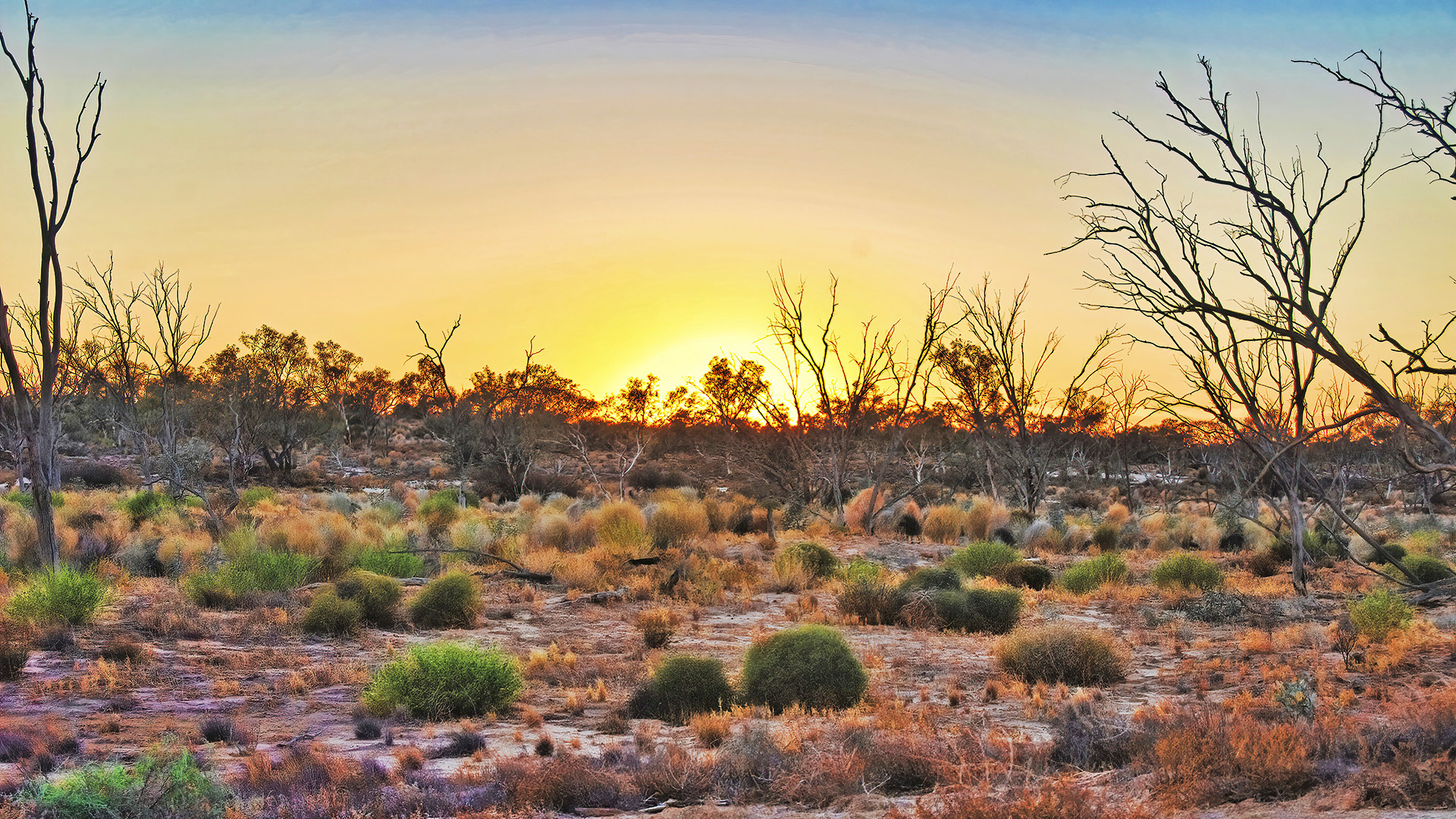
It is always entrancing to witness the silent illumination and transient colours of a landscape as our world turns to the Sun. Always, you see detail and colours that you didn’t appreciate during the previous dusk. This is a sandy bed of a large but ephemeral creek – a great campsite. The stark, dead (Eucalypt) trees germinated with the 1974 floods only to be killed by a wildfire some 20 years later. Such is life:
Reboot
A ‘Spinifex’ (actually Triodia) grassland wildfire: hot and lethal, reducing all in its path to ashes. This hummock grassland type covers about 25% of the continent. Ignited by lightning or people, such fires are frequent. With the first rain post-fire, the Triodia regenerates from seed and roots, faster than competing woody plants. So, repeated fires – burning your neighbours – is a sustainable way to persist:

Success
Heavy rains in 2009 triggered a massed pelican breeding. Thousands of birds gathered at one location, mated and successfully bred. More details are here. Success in this time-dependent gamble is shown by the chicks (darker heads) are now as large as the parent birds. All life is a Game: If you win , you stay in the Game:

Bugger
A feral camel (Dromedary [Camelus dromedarius] single hump) enjoying an uncommonly lush grassland. Imported in the mid-1800s, camels facilitated the exploration and settlement of Outback Australia. Displaced by motorized vehicles in the1920s, instead of a bullet, they were abandoned to die out. But they didn’t. Then a couple of hundred camels is now a large feral population of at least 600,000 damaging pests – a significant multi-million dollar problem. In the Southern Hemisphere, a well-intentioned action resulting in a disastrous outcome is widely known as a Bugger, made famous by this Toyota video:

Mute
A rock engraving, a graphic message from a pre-literate time, meticulously pitted on a vertical rock face. What can be inferred from it? In order of certainty, it was done by a male, likely over a working period of 3-5 days, at least 10,000 years ago. In spite of much speculation, we cannot ever really know the message or the audience, a realization that sometimes evokes a puzzling tinge of sadness:

Harsh
The Pilbara region is Australia’s harshest landscape. It is hot –(recorded 160 consecutive days of above 100°F (38°C)), and essentially water- and treeless, and rendered unfriendly by the swarm of small spiny hummocks of Spinifex (Triodia). Yet prospectors and geologists continue to search here for mineral riches. After we found the rocks containing a fossil stromatolite, dated at 3.4 billion years, and then thinking about Deep Time, we forgot about the current temperature and Spinifex spines:

Serenity
Why do we find a slow-flowing river so timeless, relaxing and peaceful? In 1925, two men, Jerome Kern and Oscar Hammerstein, wrote their explanation as the words of the song ‘Old Man River’. A truly timeless contribution to our culture that you are probably silently singing right now:

Awe
This image captures a mind-stretching contrast in ages between the biological world and the geological world. In the foreground are several species of ephemeral plants – bright, colourful, with a life spans of months to a year or so. In the background, the blood red rocks looking sharp edged and resistant, are dated at more than 2.5 billion years. The smallest units of geological dating, millions of years, are beyond the reckoning of biologists, yet life was present on earth when those background rocks were being formed. The Deep Time of Life is right up there with the Rocks:

Me
A densely painted gallery in Arnhem Land, northern Australia. The gallery contains older figures – devil-devil figures (LHS), a python and several crocodiles (Middle) – all overpainted by numerous, modern (less than 100 years) ‘hands’. The ‘hands’ are not stencils or imprints. They are deliberate drawings infilled with colour. The overall impression of the modern ‘hands’ layer is just exuberant happiness celebrating ‘Me’, ‘Look at Me’, by the many painters who contributed. No deep cultural significance just an expression of the ‘joy of life’ in vivid colour. The longer you scan this image, the more surely you will smile:

Renewal
It was a hurried camp selected in falling light with the best site option being a desert track in the sea of (flowering) Spinifex. All that is forgotten now as you slowly wake in the golden light of a quiet and calm dawn, along with the smell of dew-dampened sand. Life is good!:

An amazing tour. Thank you Dean.
Incredible!
Beautiful. Those red rocks from the Late Archean are common around the world. Around 2.5 billion years ago, naturally occurring iron in the rocks were oxidized around the world to bright red as the metabolic process of Cyanobacteria raised oxygen levels above a threshold. Earth has never been the same since.
Norman, That is why my wife and I have an interest in the Deep Time of our country. Neither of us are geologists, just interested and curious individuals. For example, the discovery of zircons dated at 4 billion years (Jack Hills), having a measurement older than planet Earth, is challenging.
Interesting that Mars is red too.
The Australian outback has a unique magic for sure, but best to go in August (late winter) to avoid the vast swarms of flies.
Wonderful! Thank you for sharing.
Supreme beauty of the “Bush”.
Very nice photos and commentary. 600,000 camels in the Australian bush? That’s new to me! I guess there are no natural predators…
I had no idea about the camels, either. What a magnificent post, Dean!!
Btw, what’s a geo-patriot?
Marilee, it is a word I made up to describe someone who has a deep and enduring love of his/her country. Not just the social and political characteristics , but the natural ‘bones’ of the land, the landscapes, skies, wetlands and coasts. The expression ‘My Country’ has meaning for most Australians.
Wonderful! I have been and lived all over the world but have not yet made it to Oz or NZ.
And how do they know that the engraving was done by a male?
Jared, In Aboriginal society today, and assumed in the past, women do not count. Women were not allowed to paint or view paintings done by men, often with the threat of death. The ‘dot’ paintings flooding the market now (since 1969) are ‘woman’s’ paintings, the dots preventing ‘secrets’ being exposed.
Pictures that make me want to visit.
Many years ago I viewed two very well painted scenes of the Australian bush. One at dawn and one at dusk, both of the same scene. Hypnotic.
The artist was Rolf Harris who later became famous of other things.