
Here’s an example of how indigenous peoples, on the basis of their superstitions and religion, try to control modern technology or how it’s used and science. In this case, reported by CNN (click on screenshot below), a commercial enterprise is taking some small amounts of human remains (presumably ashes, though it’s not clear) to the Moon, in violation of no Earthly statute. But because this presumably pollutes the moon, sacred to the Navajos, the tribe would like it stopped. And the White House, which isn’t in charge of this mission (it’s a private commercial venture), is holding a meeting to deal with this vexing problem. (They are not, of course, on the side of the rocketeers).
Click to read:

An excerpt:
The White House has convened a last-minute meeting to discuss a private mission to the moon — set to launch in days — after the largest group of Native Americans in the United States asked the administration to delay the flight because it will be carrying cremated human remains destined for a lunar burial.
If successful, the commercial mission scheduled to launch Monday — dubbed Peregrine Mission One — will be the first time an American-made spacecraft has landed on the lunar surface since the end of the Apollo program in 1972. But Navajo Nation President Buu Nygren said that allowing the remains to touch down there would be an affront to many indigenous cultures, which revere the moon.
“The moon holds a sacred place in Navajo cosmology,” Nygren said in a Thursday statement. “The suggestion of transforming it into a resting place for human remains is deeply disturbing and unacceptable to our people and many other tribal nations.”
How can you respond to this except to say, “Sorry, too bad. Those aren’t even Navajo remains being sent to the Moon, and why should we cater to your superstition?”
And, in fact, and amazingly, that’s how the company responded (bolding here and below is mine):
The private companies providing these lunar burial services, Celestis and Elysium Space, are just two of several paying customers hitching a ride to the moon on Pittsburgh-based Astrobotic Technology’s Peregrine lunar lander. The uncrewed spacecraft is expected to lift off on the inaugural flight of the United Launch Alliance’s Vulcan Centaur rocket from Florida’s Cape Canaveral Space Force Station.
Celestis’ payload, called Tranquility Flight, includes 66 “memorial capsules” containing “cremated remains and DNA,”which will remain on the lunar surface “as a permanent tribute to the intrepid souls who never stopped reaching for the stars,” according to the company’s website.
“We are aware of the concerns expressed by Mr. Nygren, but do not find them substantive,” Celestis CEO Charles Chafer told CNN.
“We reject the assertion that our memorial spaceflight mission desecrates the moon,” Chafer said. “Just as permanent memorials for deceased are present all over planet Earth and not considered desecration, our memorial on the moon is handled with care and reverence, is a permanent monument that does not intentionally eject flight capsules on the moon. It is a touching and fitting celebration for our participants — the exact opposite of desecration, it is a celebration.”
But of course the Biden Administration has its knickers in a twist, as the Navajos are indigenous peoples and therefore sacred. And they’ve objected before, again without fruit:
This isn’t the first time Navajo Nation has expressed concerns about burials on the moon. In a December letter to NASA Administrator Bill Nelson and Transportation Secretary Pete Buttigieg, Nygren referred back to NASA’s Lunar Prospector mission, which in 1999 deliberately crashed a spacecraft into the moon carrying the remains of former astronaut Eugene Shoemaker.
“At the time, Navajo Nation President Albert Hale voiced our objections regarding this action. In response, NASA issued a formal apology and promised consultation with tribes before authorizing any further missions carrying human remains to the Moon,” Nygren said.
I didn’t know about Eugene Shoemaker, but the “remains,” described by Wikipedia, were some of his ashes:
On July 31, 1999, some of [Shoemaker’s] ashes were carried to the Moon by the Lunar Prospector space probe in a capsule designed by Carolyn Porco. Celestis, Inc. provided the service—at NASA’s request—commercially, making Shoemaker’s ashes the first private delivery to the lunar surface.
But NASA isn’t in charge of this mission; it’s described as “one customer among many paying to put technology and cargo on Astrobiotic’s lunar lander.” So NASA can grovel all it wants before the Navajos, but they lack authority. And believe me, NASA is groveling. For example, Joel Kearns, NASA’s deputy associate administrator for exploration, said this:
“American companies bringing equipment and cargo and payloads to the moon is a totally new industry — a nascent industry — where everyone is learning,” Kearns said. “We take concerns expressed from the Navajo Nation very, very seriously.”
That is virtue signaling of the first water. Would they take concerns about the Vatican if any of those ashes belonged to former Catholics? Again, Celestis brushed off the concerns about the sacredness of the Moon:
“No one, and no religion, owns the moon,” Celestis’ CEO told CNN. “If the beliefs of the world’s multitude of religions were considered, it’s quite likely that no missions would ever be approved. Simply put, we do not and never have let religious beliefs dictate humanity’s space efforts. There is not and should not be a religious test.”
But the Navajos deny below that they own the Moon. Of course, what they think they own is control of what gets sent to the Moon:
Ahasteen argues that Navajo Nation’s intent isn’t to claim the moon.
“We’re saying be respectful. We’re turning the moon into a graveyard and we’re turning it into a waste site,” Ahasteen said. “At what point are we going to stop and say we need to start protecting the moon as we do the Grand Canyon?”
The last point is the only one worth considering: what kind of stuff are we allowed to dump on the Moon? But whatever concerns enter into such a discussion, religion should not be one of them. Worry about ecology, spying, polluting a not-fully-explored planet, yes, of course. But do not stifle technology in the name of nonexistent gods or “sacredness”. For religion worships fictions, but science tells us what is real about the world. Yes, I “respect” people’s desire and ability to practice their own religion, but they don’t have the right to foist their faith on others. And that’s what the Navajos are doing when trying to prevent ashes from being sent to the Moon.
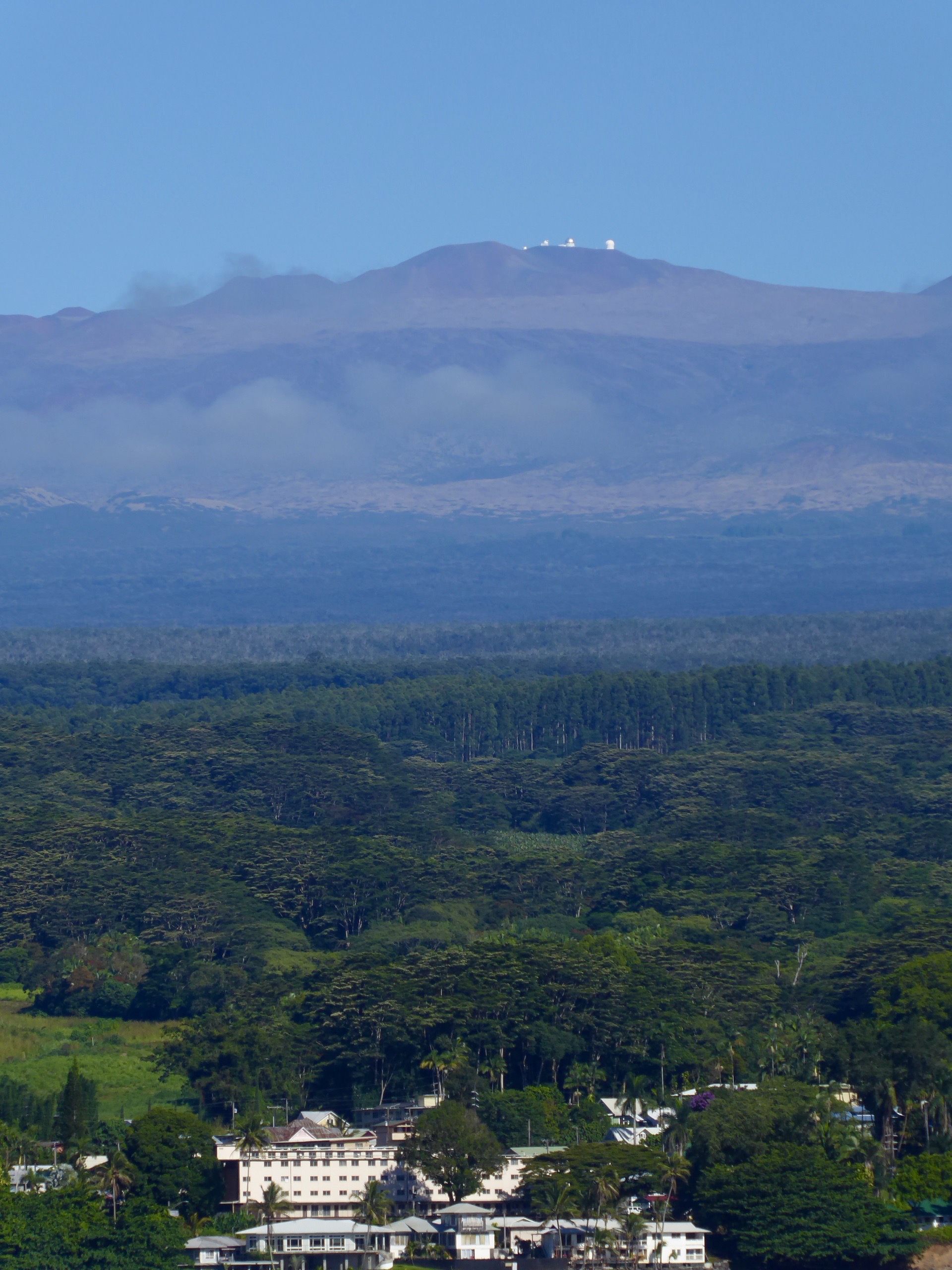
It’s especially pernicious to use religion to try to block scientific knowledge. Mauna Kea, a mountain on Hawaii’s Big Island, is perhaps the best place in the world to place telescopes, as it’s high and clear, but the indigenous Hawaiians have for years tried to block, with some success, the placement of scopes on the mountain. Your opinion may differ, but mine is that the mountain isn’t really sacred, and if it doesn’t formally belong to the native people but to the government or state, science should take precedence over sacredness, particularly in a such a great site for science like Mauna Kea. After all, they’re not proposing to put a telescope on the spire of Notre Dame!
Here’s a photo I took of Mauna Kea with its telescopes in 2019:
Celestis’ CEO Chafer speaks plainly. I like him. 😀
Yes, I’ll bet he surprised the Navajo guy, used to being grovelled to. You’re going to have to do more of that if you want to mine lithium from Nevada.
He does, though he still used too many words. Two is all I’d need, the second being ‘off’.
I confess to considerable sympathy for the Navajo position here. That is, I don’t think that ashes (or anything) should be put on the moon except for a good reason. Earth orbit and beyond Earth is currently a free-for-all, but I don’t think it should be. We (collectively) should regulate it for the benefit of all (likely we will at some point, it’s only a matter of when).
I agree with Jerry that the Navajo religion is not a good reason for a veto, but then the desire of some to have their ashes on the moon carries no weight with me either, and nor does the desire for dosh of the Celestis CEO. If a company wanted to scatter ashes of its clients in (say) Antarctica, I hope it would be instantly disallowed (and it likely would be).
It would be. And I’d like the Moon kept as pristine as possible, so that’s why I said the Navajos had one good point. But their main point is that the moon is sacred, and that’s not a good reason for doing ANYTHING.
OK, in that case we agree. Just to add, there’s very little natural decay processes on the moon. Anything put there will last for tens of millions of years unless some other human goes there to remove it. Even footprints from the Apollo astronauts could last for millions of years (very slow change from micrometeorites being the main ablation mechanism).
The micrometeorite turnover time is a lot shorter than that – probably only a few thousands of years. Not that different to the survival time of DNA in a (thin-walled) metal capsule exposed to unfiltered cosmic rays.
Say what you want about the atmosphere, but it is a fairly effective radiation shield. Reasonably comparable to 10m of water, or 3~4m of rock (depending on the rock).
Of course, landing another spacecraft (say, full of tourist politicians) anywhere near (tens of km) to the Apollo sites would greatly accelerate that erosion, from the material ejected by the landing retrorocket plume excavating material, which would then come back down with the energy it was ejected with.
Yes – NASA do have people working on this. It’s a real problem for any base you want to return to.
The idea that the moon is sacred is just lunacy.
🙂
Hank Hill to his son Bobby “Bobby, everything is sacred to a Native Indian.”
When everything is sacred, nothing is sacred. It’s just a control strategy.
That’s fair. If the moon was regulated for the benefit of all, and the regulations could create something like Arlington National Cemetery on the moon, the Navajo would still object. I guess that’s the problem with their *religious* objection.
An objection to leaving trash and debris from crashing Shoemaker’s ashes onto the moon (or leaving Apollo poop as Robert notes @ 3) also makes sense. But that’s not the problem the Navajo are raising. And they have their own problems much closer to home.
https://www.nhonews.com/news/2021/may/04/talking-trash-series-focus-illegal-trash-dumping-n/
What about mining metals from the asteroids (or from the moon) if that should ever become necessary and cost-effective for the green revolution?
Agree that the first task is to reject the religious objection. But do you think there would ever be global unanimity about leaving the solar system pristine if there was a good humanistic reason for chipping away at pieces of it or depositing nuclear waste on it. Presumably the costs of getting more than a few grams of ashes to the moon, or bringing more than a few grams of dust back, makes this a practical non-issue, but many Europeans probably thought settlement of the Americas would never be practical, either. Good thing the regulatory spirit hadn’t replaced Right of Conquest back then.
I added an “… except for a good reason” qualifier, so if we collectively decide to mine the moon then ok. It’s a free-for-all with no regulation at all that I dislike.
The Grauniad had a piece about lunar exploitation a couple of days ago: https://www.theguardian.com/science/2024/jan/06/moons-resources-could-be-destroyed-by-thoughtless-exploitation-nasa-warned
Excellent comment.
In addition to your remarks, I find the whole idea of putting ashes on the moon to be utterly silly.
Yes, I thought so, too.
There are bags of human poop on the moon, left by the Apollo astronauts to shed weight before ascent. Did the Navajo complain that that was desecrating the moon?
I doubt they even knew about it. It certainly wasn’t something Walter Cronkite mentioned.
:o)
if I was addressing these nattering nitwits & their religious anxieties I’d say, “I’m sorry you feel this way,” and ignore them afterwards.
In a way, even I regard the moon as “sacred”. I bet lots of people feel that way.
But everyone knows that wouldn’t matter — unless identifying intersectionally with some obvious (i.e. racially categorized and therefore by application of the correct racism) group that has the correct definition “sacred” (again, knowable only by application of the correct racism) — almost as a means to claim ownership of the moon.
And yes – what’s the deal with a business delivering random sh17 to the moon? The hell.
Sort of like a business springing up to bring tin from Cornwall to the bronzemakers in the Levantine, or spices by camel to Venice. Or to fly mail. Seller + buyer = good or service.
I s’pose that could apply to asteroids too, which I don’t see a fundamental moral problem with the mining of.. not the moon…
But human remains?… Weird … I suppose that is the heart of this – a spirit of something in conflict…
Indigenous peoples around the world have learned a few magic words to get what they want or make certain claims, and “sacred” is the most affective.
I am sorry for that situation, but I see no way that the moon will not be further desecrated. There is already old equipment up there and even human poop (I didn’t know that!). Its desecrated already. Like we have desecrated the earth in innumerable ways. So this effort is nothing more than an attempt to get the U.S. and a corporation to dance to their tune since in no way does it prevent desecration.
If some other space-faring country gets the same idea about sending human ashes to the moon (like China and India), you can bet that they won’t even discuss it with the Navajo.
Just another religion trying to impose their dogma on everyone else.
As I’ve mentioned before, I offer the University of Washington the opportunity to go beyond land acknowledgements and actually incorporate Matauranga Salish into the science curriculum. For example, courses in Astronomy, Geology, and Geophysics could include the following Indigenous sacred insights regarding the moon: “In this traditional story from the Snoqualmie people, the cunning Blue Jay ventures out to bring Snoqual the Moon—the Transformer, who has been kidnapped by the Dog Salmon people and taken to the Sky world—back to Earth to help prepare for the humans to arrive. As Blue Jay was changing the Earth, and before he entered upon his work of giving light, Moon created the various peoples and all the rivers as they are now.”
The only response needed is “The mission makes no religious changes to the moon.”
Just because there is some crap (literally) on the moon now doesn’t mean we should just go ahead and trash the place further.
But of course the religious objection is untenable. What if Jesus said “thou shalt not desecrate the moon”, engendering endless debates about what would constitute desecration? While at the same time Islam threatened to unleash their jihadists to torture and kill anyone who placed anything on the moon not sanctioned by Allah?
The impossibility of recognizing the Navajo request is blindingly obvious. The objection will likely be overruled, as even though indigenous rights are in the spotlight these days their population is just too small. Which is not to say that another basis won’t be found for barring the transportation of the ashes.
But what if it were a Christian or Muslim demand?
That is a very good question! They’d still probably do it, but they would be a lot more hoopla and debate.
Oh dear, it looks like the Navajo curse might have worked: https://www.bbc.co.uk/news/science-environment-67915696
Yes, also in the NYT
https://www.nytimes.com/2024/01/08/science/vulcan-rocket-launch-moon.html
The list of people with bits of their ashes or other detritus on board is interesting.
“Among the people whose remains are on this final journey are Gene Roddenberry, the creator of Star Trek; his wife, Majel Barrett, who played Nurse Chapel on the original television show; and three other actors on the show: DeForest Kelley, who played the medical officer Leonard “Bones” McCoy; Nichelle Nichols, who played Uhura, the communications officer; and James Doohan, who played Montgomery Scott, the chief engineer.
One of the capsules contains samples of hair from three American presidents: George Washington, Dwight Eisenhower and John F. Kennedy.”
No idea who you’d get the hair from!
I wonder what those who are bothered by a sacred moon think about Musk’s Tesla Roadster zipping around space. Or what about the 5,500 tons of orbiting space junk? I guess the moon is sacred, but space isn’t.
So indigenous mythology runs up against the religion of commercial exploitation? How much does it cost to send Granny’s ashes to the moon so she can shine down on you? Qui bono?
“The moon holds a sacred place in Navajo cosmology.”
What the hell is that? How about the Navajo Nation desecrating cosmology with claims like this?
“We’re saying be respectful. We’re turning the moon into a graveyard and we’re turning it into a waste site,” Ahasteen said. “At what point are we going to stop and say we need to start protecting the moon as we do the Grand Canyon?”
Except that plenty of Navajo remains contaminate the Grand Canyon.
OK, I’ll grant that it would be nice to minimize the long-lasting mark of human activity on otherwise pristine environments. We recoil at trash piles of oxygen bottles on Everest, casinoes next to Niagara Falls, pollution in the deep ocean, etc. with good reason. I actually despise graveyards with their gaudy monuments, hopelessly trying to preserve the vestiges of dead egos for a little longer and would prefer that the land they occupy was used for something better. So we should minimize degrading our environment, even aesthetically, with human vanity projects.
That said, Sedona Arizona in the desert Southwest US – one of the most beautiful places on the planet – has been completely defaced and desecrated by morons who stack rock cairns on every square inch of the place, precisely because visitors practice Navajo (and other cultures’) spiritual claptrap. I say level them all, let the spirits and prayers dissipate, and restore the natural beauty of special places. m
“I say level them all”
Let’s go! I’ve been railing against the cairns for decades. Remember when they used to mean something? And I don’t mean something religious!
When I was a kid, there was a Jehovah’s Witness kid in my grade 10 class. I was the only kid in the class who would talk to him because I was also a bit of a weirdo, being an atheist and all. 🙂 He claimed that if Man ever set foot on the Moon, the Universe would immediately cease to exist as God would never tolerate such an intrusion on the heavenly domain. Somehow, the space program managed to proceed apace without a huge government investigation into the JWs objections.
Many JWs also thought that the world would end in 1975:
https://en.m.wikipedia.org/wiki/Jehovah%27s_Witnesses#Continued_development_(1942–present)
The Jehovah’s Witnesses tried to spin the moon landings into evidence of the existence of Jehovah: https://archive.ph/0dFJj
“Sorry. Too bad” (Coyne, 2024). The moon doesn’t fall under the jurisdiction of the Navajo Nation. I hope that the Biden administration doesn’t decide that the moon is under its jurisdiction, either. There are reasons to avoid putting earth-sourced materials on the moon—and one of them is to keep it as unpolluted as possible to enable further scientific study. So, putting ashes up there might not be a great idea. But religious objection is not a good reason.
Coyne, J. 2024. Online document. https://whyevolutionistrue.com/2024/01/08/the-navajo-nation-tries-to-prevent-human-ashes-from-being-sent-to-the-moon/#comments.
Probably too late. The Biden administration (and those that came before) allows people to put all kinds of crap into space, the most egregious of which is currently the Starlink system. Don’t be surprised if, in a few years, an Amazon logo visible from Earth appears on the Moon.
We humans tend to give unusual symbolic status to the dissociated molecules of cremains — even for those people who take pleasure in dumping the contents of cremation urns into a toilet. It’s kind of like homeopathy for the dead, with the molecules somehow “remembering” the deceased person.
I once worked for a mortuary, and I often saw the bodies of deceased people transformed in the flames of the mortuary’s crematorium. For 10 years I lived on the mortuary’s associated cemetery, which is situated in rolling, forested hills next to open space land.
I was happy for the “sacred” status of the cemetery because it allowed me to live in a quiet place uncontested by the normal hubbub of civilization. At night I was the only person in the hundred-plus acres of the cemetery and its surrounding land, with coyotes, deer, owls, and other non-human life being my frequent nocturnal companions.
But the Navaho objection to cremains on the Moon is ridiculous. It now appears that the projection of religious authority over celestial bodies beyond Earth has become faster than light.
• • •
The case of Eugene Shoemaker is a study of interesting coincidences. His Ph.D degree (Princeton, 1960) was about the Barringer Crater in Arizona. He proved that the crater was caused by an impact from a small asteroid, and not from terrestrial vulcanism, which was then the prevailing idea.
(That impact — about 50,000 years ago — might actually have been witnessed by the early arrival of some humans on the North American continent. Maybe.)
But Shoemaker became relatively famous for drawing attention to the imminent impact of a comet on Jupiter (1994), the first time such a dramatic celestial event was to be witnessed by modern civilization.
And Eugene Shoemaker actually died by impact (in 1997), having crashed into a car on a blind curve in Australia — where he was to study another impact crater.
That a portion of his cremains impacted the Moon (in 1999) seems a fitting end to the story — so far — and much more symbolic than most ordinary scatterings of human ashes. If anyone had claim to a small portion of the Moon, it was certainly Shoemaker’s family and friends, not the Navaho.
And Eugene Shoemaker actually died by impact (in 1997), having crashed into a car on a blind curve in Australia
It wasn’t a collision, it was a vehicular hug.
Given that (some of) Shoemaker’s ashes are already on the Moon, it’s presumably already desecrated in the eyes of the Navajo, so what’s the point of them complaining again now?
Gosh, I need to watch my language, don’t I?…
As it is with many DEI showdowns, the Navaho representative objecting to cremains on the Moon seems to be another case of some people trying to gain control & authority, however far-fetched the effort. Of course, I sympathize with the continuing plight of native tribes, but there are limits to my compassion.
Did the “Crem” (as we call them this side of the pond) also accommodate the “sky burials” which some (how many?, for how long?) “First Nations etc” tribes practised. (Which were also practised in Britain, most likely, more recently than the Americas have had a human population.) That would definitely have brought in the coyotes, raptors etc.
I know of no officially sanctioned practice of “sky burials” in the U.S. involving the exposure of a deceased human body to the elements. Maybe they’re allowed on tribal lands? (I doubt it.)
I did participate in the scattering of cremated remains over water, and I provided information to some clients who were interested in arranging for the scattering of ashes from an airplane. My wife scattered the ashes of her first husband over Clouds Rest in Yosemite National Park, where he loved to hike.
(I think it remains technically illegal to scatter human ashes in the park, but it’s not easy to police such a practice.)
I’ve long had a fun fantasy about my own death and burial, which, of course, is very unlikely to happen in the way I imagine. It goes like this:
I am on the International Space Station for some useful scientific reason … but I die there, either because of a mechanical accident, impact by a meteoroid, or I’ve had a fatal medical issue like a heart attack.
Because I’d thought about it, I’ve left instructions to deorbit my body over nighttime California. My family and friends would be alerted to the time, and so they would be able to see my fiery reentry as a meteor entering the atmosphere.
“There goes Jon…”
So, my “cremation” and “burial” would happen at one and the same time.
But even if I had left such instructions, I’m sure NASA wouldn’t honor them, for a variety of reasons — technical, cost, and, of course, “ethical.” The firestorm of public outrage would be hotter than my reentry. Or so I’d think.
Plus, of course, at some point the space colonisation (yep, that “dirty” word) effort is going to get to the point of re-cycling human waste and plant waste into “soil” for the hydroponic/ agriculture food growing systems. In this context, the “human waste” would include bodies.
All that lovely biochemistry and mineral goodness is too good to burn up.
Cremation would also be a waste of energy. Assuming humanity survives the multiple potential existential “filters” it will likely face in the next few decades, I think it will eventually colonize and settle the entire Solar System, including the spaces between planets and their moons. It would then take a much larger “event” than otherwise to extinguish humanity and Earth’s other DNA lineages.
I have no problem with the term “space colonization.” I think of it in a biological and ecological sense. Humanity is the active agent on this planet that has — incidentally — evolved to be able to purposefully spread Earth life beyond Earth. And if there’s one thing associated with life, it strives to survive.
In an attempt to counter some of the anti-technological sentiment that I saw during the 1960s and 1970s, I created a bumper sticker that emphasized the word “colonize”:
https://x.com/Jon_Alexandr/status/1404137075939581952
And we’ve hit the “discussion depth” limit in the blo^H^H^Hwebsite. We no longer get the option to reply to each other’s messsages, but have to un-thread them like this.
I don’t have a problem with “colonize” as a concept. All the previous examples have taken the position that, regardless of ability to speak or cross-inseminate, the important thing about whether any inhabitants counted as “human” was the religion they held. Or the language the spoke, if you were ancient Greek. That would struggle to get acceptance these decades, and if we did find a speaking inhabitant in space, the implications would give every linguist and religionist rather severe conniptions about actually having to work for a living.
I only really see one existential crisis for humans : having no option but to plan for building your children’s environment before pausing contraception. On Earth, people are still profoundly upset about doing that. In space, it would be unavoidable. Solve that problem, and the universe is humanity’s oyster.
That would involve overturning or taking a mental stranglehold on the overriding imperative of evolution for the last few gigayears, so it’s going to be hard. And I suspect that is why Fermi could meaningfully ask “Where is everybody?”
It’s probably just me, but I’m puzzled by your comment in this thread that you posted January 9, 2024 at 1:03. Could you restate what you wrote about humanity’s singular existential crisis? I’m having trouble parsing it.
People seem (I don’t know for sure) to have children, then try to fix the environment (food production, living space, energy resources, security) to try to correct the imbalances they’ve created, instead of improving the environment before having their desired child or children.
All humanity’s other environmental crises depend from putting that cart before the horse.
It seems to me that people who figure they will have children will arrange their lives with that prospect in mind — they will learn how to gather resources and then they will gather those resources. It seems that living in space will require more planning for children, but is it really that different from what happens on Earth?
In the 40-some years that I’ve been attending to the question, the substance of those “arrangements” have amounted to hoping that things will work out. I’ve never had that belief, so have never considered fertility as anything other than a dangerous problem to be managed.
I must admit that I gave up looking for change over 20 years ago.
“Hope” is not engineering.
Well, I’ve given up on trying to parse your statements, G-A.
Legally I regard the Moon in a similar manner to Antartica in status and personally would not like it be turned into some crass tourist (death)trap as Oceangate did with Titanic.
Only those worthy of the honor like Jim Lovel should have the privilege of being laid to rest there.
I understand the sentiment. I hate crass commercialism and its resulting aesthetic effluents, even if people aren’t being actively exploited or abused.
But I am very suspicious of any legal efforts to limit what people and society can do, most especially if those activities don’t actually harm people. There would need to be good reasons other than some vague idea of “honor” or some personal “dislike” to limit the dreams of people who see great potential in human expansion beyond Earth.
In any case, the Moon is not Antarctica, nor the bottom of the ocean. The Moon, the planets, and space itself all offer much more than just places for tourists to visit temporarily, or for places to lay their bodies to rest. The Solar System is rich with possibilities for the expansion of life.
I agree with this, though — as much as possible, humanity should protect the exiting ecosystems and libraries of life on Earth, including in Antarctica, in the oceans, and everywhere else on the planet.
I only said it was in a similar legal standing. And it was a “final frontier” back in the day as space is now.
They don’t allow ashes on Mt Everest. Partly cultural, but also to prevent everyone from dumping their mothers up there, Disneyland has the same problem!
I would object to ashes being dumped on Mount Everest only if it impacted on the albedo of the snow, which could accelerate melting and affect the local ecology. Otherwise it’s just some added minerals, and very much less in quantity than what the winds waft there (and remove) naturally.
What’s the problem if someone’s ashes are occasionally scattered on the mountain? Who would know the difference? Do you think that would be desecration of a sacred place? I don’t think so. Isn’t that like the nonsense of what the Navaho representative is saying?
The “legal standing” of the Moon and the rest of the Solar System is yet to be determined. The current vague international laws regarding space and the Solar System are, at best, just a beginning for future negotiations. By default, those who actually go there will have the most say.
I don’t much care about Disneyland. In fact, I think the park would benefit from having a designated place where people could scatter the cremains of their loved ones, if that’s what would give them a sense of peace and belonging. Disneyland should take note!
Well, we can’t put them there anyway. I don’t care why, all I said is we can’t.
I see no real problem, only perhaps the notion it may become some crass dumping ground for our dead.
As for the “legal standing”, yeah, it’s not written in stone, but the closest thing we have is basically similar to Antarctica in theory.
* Correction: “… as much as possible, humanity should protect the existing ecosystems and libraries of life on Earth…”
(Although, “exiting” is all too real a description, unfortunately.)
Decided — I am arranging for my ashes to be sent to the Moon, whatever it costs!
Just to piss these indigenous bullies off. It is pure power ploy — they try to dictate what others can/cannot do, all the way to the outer space.
Remember ‘Occupy Wall Street’? Our version in Vancouver, BC had a garbage barrel. It was made ‘sacred’ by a couple of Indigenous women. The garbage barrel was now a holy flame or some such thing. Occupy Vancouver people screamed human rights abuse when the fire department shut down the garbage burning barrel – I mean the sacred flame – as a fire hazard. Good times.
Last year a walker died in a forest park near me: the “gorge loop track” in Palmerston North, New Zealand. It’s much used by the nearby city population for recreational walks and good exercise as it’s a short steep hike through shady forest. The local Iwi (Maori tribe) decided to close it – not just a day or two for respect which I could understand – but for a whole month.
I asked why from the council and DoC (departent of conservation) but none had a reason other than it was called for by the Iwi to give the forest “time to heal”.
FFs. Every time something dies in the forest we should be shutting it down then. No mention of who popped their clogs or why. At the same time a commercial harbour in south Island suffered a death by drowning – didn’t shut that down for weeks on end.
It’s just some inflated ego having a power trip. And in the meantime, 1000s of walks of amazing physical and mental health benefit cancelled. Thanks indigenous knowledge.
If Edward Teller were around, we could remove the problem by removing the moon.
In complete agreement with Dr Coyne. It could be argued (not by me) that the 12 Apollo astronauts’ solid waste that was left on the moon (it wasn’t just hammers, cameras, scientific experiments, etc.) “desecrate” it even more. I am glad the CEOs have respectfully pushed back on this.
Don’t worry; the point is moot, since it is impossible to travel to the moon. I once saw a website by the Hare Krishna movement in which Swami Whatsisname (George Harrison’s guru) said that the moon landings were fake, since the moon is too far to reach; it is even farther than the sun. Yes, atheist scientists will tell you that the moon is closer, but ancient Hindu scriptures say that the sun is closer, so there.
He didn’t explain how eclipses happen .
I always wondered if George believed this.
It doesn’t look as if this mission will prove the swami wrong. The space craft is in trouble and probably won’t reach the moon.
https://www.nature.com/articles/d41586-024-00038-3
A staggering waste of resources and and an aggravation of Earth’s pollution to shoot anyone’s remains to outer space or the moon. I can’t see anything but thin & flimsy rationales for this.
There’s nothing “staggering” about sending a few grams of ashes to the Moon. It’s a symbolic gesture that got a piggyback ride on a privately developed lunar lander designed for a scientific mission in the first test flight of a big new rocket. But it certainly took a lot more planning and private cost to arrange than the scattering of ashes in one’s backyard.
I’m reminded of similar complaints after astronaut Ronald McNair took a small saxophone with him on a Space Shuttle mission. The weight of his instrument had no meaningful effect on the cost of the mission. And it was well within the margin of error for the safe launch of a spacecraft that weighed four and a half million pounds.
Weightless McNair and his sax on the Shuttle:
https://www.blackhistory.mit.edu/archive/ron-mcnair-plays-sax-space-1984
A detailed back story:
https://oxfordamerican.org/magazine/issue-107/the-wonder-of-it-all
There’s nothing “staggering” or polluting about the launch of a few grams of ashes piggybacked on a privately developed lunar lander designed for a scientific mission in the first test flight of a big new rocket.
I’m reminded of similar data-free complaints after astronaut Ronald McNair brought a small saxophone on a Space Shuttle mission in 1984. The sax had no effect on the cost of the launch, and the weight was infinitesimal for a vehicle that pushed four and a half million pounds.
Weightless McNair and his sax:
https://www.blackhistory.mit.edu/archive/ron-mcnair-plays-sax-space-1984
A detailed back story:
https://oxfordamerican.org/magazine/issue-107/the-wonder-of-it-all
What’s the point of sending human ashes to the moon?
It’s symbolic, with a different meaning for each case involved. There’s plenty written about it, so it’s not a secret.
A small sample of Clyde Tombaugh’s ashes are on the New Horizons spacecraft, which reconnoitered the Pluto system and a Kuiper Belt Object. He discovered Pluto, so the symbolism is obvious. Even more interesting, his ashes are the only ones that are currently en route to leave the Solar System entirely.
(Will the Navajo object to the desecration of the entire night sky?)
https://x.com/AlanStern/status/1747702274888262043
If someone wants to do something with his own money and doesn’t hurt anyone, that’s all the point there needs to be. What’s the point of opera? (I like opera, but live-performance classical music needs state subsidies to survive so it’s not my own money.)
I don’t know. We can ask the people who want to send their ashes to the moon. They get to make up their reasons, and their reasons need not make any sense to us. As for those who are dead, we can always talk to them through Carissa Schumacher. If the people are not willing to talk, we can always ask Carissa to ask Jesus, who must surely know because he knows everything.