Readers’ wildlife photos

January 8, 2026 • 8:15 am

It’s been a while since we had some photo from evolutionary ecologist Bruce Lyon at UC Santa Cruz, but he came through yesterday with some lovely photos of DUCKS! Bruce’s captions and IDs are indented, and you can enlarge his photos by clicking on them. It comes in the form of a letter to me:

Dear Dr Coyne

Please step away from the duck. Don’t hurt the duck. I have a friend who is a doctor and who can help you (PhD and he studies ducks). He can help your duck syndrome (yes there is such a thing).

While you are waiting for help to arrive, here are some photos to calm your frayed nerves and stop the incessant paddling.

The photos were taken at Neary Lagoon, a city park near my home. It is the best place to see wood ducks (Aix sponsa) locally. They hang out in the wetlands in the park and often fly over to feed on settling ponds at the nearby sewage treatment facility. Delicious! The park also has lots mallards (Anas platyrhynchos).

The wood ducks are often hidden from view—they perch on branches in dense vegetation at the edge of the lagoon. But sometimes they come out and paddle around, giving nice views. Ducks pair up earlier than many other birds and many birds are in pairs but some are courting.

Darwin famously said that peacocks made him feel ill—”The sight of a feather in a peacock’s tail, whenever I gaze at it, makes me sick!” (expressed in a letter to his friend Asa Gray). The peacock’s ornamentation is so crazy complex that Darwin found it hard to explain. Sure, sexual selection explains why animals are ornamented, but this is just crazy. I feel the same way about male wood ducks, but I feel awe instead of nausea:

This male was courting a female that was perched above him out of frame. He would do head tilts while puffing out part of his plumage:

The courting male photographed mid head tilt. Note his fanned out buffy flanks with the nice black and white edging. Clearly, fanning out a specific part of the plumage like this suggests that is an important part of the display:

A lovely female wood duck but not the object of the above male’s desire:

In fact, the above male, who was courting a female perched out of sight above him, often pecked at the female that was sitting right next to him. Perhaps she was interested in him, but the attraction was not mutual:

A male wood duck on the water:

Not far away, mallards provided great opportunities for getting flight shots. I like this one because the out-of-focus males in the background add a pleasing element:

Flight shots can be challenging but these mallards made it easy. They wanted to roost on the floating walkway in the marsh and would swim up close to the walkway and bob their head rapidly up and down a few seconds before launching into flight. Made it easy. Here is a female mallard approaching the railing:

Readers’ wildlife photos

January 7, 2026 • 8:15 am

It seems that one reader or another always comes through when we run out of photos. (But after today, we’ll be in that situation again!)  The helper today is Pratyaydipta Rudra, a statistics professor at Oklahoma State University. Pratyay’s captions and IDs are indented, and you can enlarge the photos by clicking on them. Pratyay and his wife Sreemala have a big bird-and-butterfly website called Wingmates.

There was a terrible ice storm in North-Central Oklahoma in October, 2020. It was extremely cold, raining all day, and the trees were having a hard time surviving with all the ice on them. Several trees fell in our neighborhood, and a lot of others lost big branches. The birds had a tough time. It was good to see that the tough little Yellow-rumped Warblers were quite resilient. This particular bird was actually quite active hopping around the icicles to catch insects (frozen food?). Here’s an image of it posing with a catch.

Yellow-rumped Warbler (Setophaga coronata) with a spider catch:

The icicles on the branches and the leaves created some interesting shapes with “frozen hearts” and “ice covered pecans” abound! Everything was quite photogenic, but it was hard for the birds.

A Fox Squirrel (Sciurus niger) navigating the icy terrain:

I found several hungry Yellow-rumped Warblers jumping around among the icicles.

Northern Mockingbird (Mimus polyglottos):

Eastern Bluebird (Sialia sialis) in the rain:

Chipping Sparrow (Spizella passerina):

As this was not enough, a huge snowstorm rolled in 3 months later which nearly killed off all our local bluebirds. I have not seen a storm like that one in Oklahoma, but that’s for another day.

Readers’ wildlife photos

January 6, 2026 • 8:35 am

This is it, folks: the end of the photo line—unless some readers step up to send in good wildlife pictures.

Today we have a diverse batch of photos from Richard Pieniakowski, but not much information about them though I suspect they’re from British Columbia. Richard’s short captions and IDs are indented (I found the binomials), and you can enlarge the photos by clicking on them.

Bald Eagle (Haliaeetus leucocephalus):

American Black Bear (Ursus americanus):

Belted kingfisher (Megaceryle alcyon):

Castle Rock:

“Caught in a moment of time” [read the bus sign]:

Common garter snake (Thamnophis sirtalis):

Closeup of common garter snake:

Epic sky:

Grasshopper:

Great blue heron (Ardea herodias):

If readers don’t send in more photos, I’ll shoot this duck*:


*Just kidding; it’s an AI drawing.

Readers’ wildlife photos

January 5, 2026 • 8:15 am

Ec0logist Susan Harrison from UC Davis answered my plea for photos, and her submission today, which is the last in the tank, happens to be her 100th contribution to this site.  Kudos to Dr. Harrison, though she still has a ways to go to match the site record of John Avise.

At any rate, please follow Susan and send in your good wildlife photos. Her text and IDs are indented, and you can enlarge the photos by clicking on them.

Black Rails on a King Tide

“…The size of a sparrow and nearly impossible to see without tremendous effort… Beware confusion… Typically rare even in proper habitat. Incredibly difficult to locate even when vocalizing within mere feet of an observer; stealthily dashes around at the base of dense grass like a ninja.”  — eBird

“One of the most elusive birds in an elusive family… infamously difficult to see…. In some places, bird clubs organize field trips that search specifically for them… during particularly high tides when water levels force these small birds to the edges of marshes.”     —  All About Birds  

“Epic flooding from king tides leaves Marin County roads under water, businesses damaged”  — ABC7 News, Jan. 2, 2026

The new year began for me with the self-imposed challenge of seeing a Black Rail, Laterallus jamaicensis.  Like many other birders, I’d only ever heard one, and even that had not been easy (it entailed kayaking to a delta island where one had been heard by a boat-borne birder). Two factors were in my favor in early 2026:  the near-record high tides of Jan. 2, and the company of conservation biologist Steve Beissinger, who knows all about Black Rails in California.

We spent the morning in China Camp State Park in Marin County, across the Golden Gate from San Francisco, where shallow marshes of pickleweed (Salicornia pacifica) line the western edge of the Bay.  While Steve hadn’t studied Black Rails here, it’s a well-known place to seek them.

Over the course of 90 minutes, we watched as meandering streams and ponds swelled, water puddled on the road and then cascaded over it, and entire marshes disappeared as the shore migrated inland.   Joggers, cyclists, and drivers paused in confusion along the inundated pavement. We later learned this was the region’s highest tide since 1998.

Flooded main road of China Camp State Park:

After some exploring, Steve paused where a low, shrub-lined embankment beside the road offered rails a covered exit ramp from the water:

While we watched the waters rise, Snowy Egrets (Egretta thula) and Great Egrets (Ardea alba) avidly hunted for flood-displaced prey.  We hoped NOT to see a Black Rail in the beak of an egret!

Egrets, mainly Snowy:

Raptors including White-Tailed Kites (Elanus leucurus) took advantage of the hunting opportunity as well (although this particular rat-murderer was seen on my drive home).

White-tailed Kite:

Finally, we saw a rail fly in and dive under the Coyote Bushes (Baccharus pilularis) just in front of us.  It turned out to be a Virginia Rail (Rallus limicola), robin-sized and with a longer and more colorful beak than a Black Rail.

Virginia Rail:

But with further searching under these bushes, we found two tiny, dainty Black Rails, as well as a second Virginia Rail!   All four were foraging within the dense tangle of branches, undisturbed by their human admirers a few feet away. We were very fortunate indeed to get these closeup views.

Black Rails:

One Sora (Porzana carolina), a larger and more swimming-prone rail, circled nearby.

Sora:

Steve and the magic Coyote Bushes:

Readers’ wildlife photos

January 3, 2026 • 8:15 am

We have a new contributor but also a longtime reader and a planet ecophysiologist, Howie Neufeld of Appalachian State University.  I met him when I gave a seminar at that beautiful school high in the mountains.  Howie’s captions and IDs are indented, and you can enlarge his photos by clicking on them.

Fall is the busiest tourism season in the Southern Appalachians. While most people come to see the fall color display by the trees, there are also numerous wildflowers that present at the same time. Here is a sampling of those flowers and trees for your enjoyment. All photos taken with a Google Pixel 7 phone.

Numerous goldenrod species bloom late summer into the fall. The species shown here is either Solidago canadensis or S. altissima. If altissima, then all are hexaploids. In the Midwest, you can find diploids, tetraploids and hexaploids. My student Katie Krogmeier showed that Midwest and eastern hexaploids differ in morphology and physiology, perhaps because they are neopolyploids (recently evolved after the polyploidy event). Why there are no diploids or tetraploids in the East is a mystery:

Closed Gentian (Gentian clausa), a species that flowers in the fall. Only insects strong enough to force petals open can pollinate these plants (usually bumblebees in the genus Bombus):

Blue Wood Aster (Symphyotrichum cordifolium) is common along trails. Younger disc flowers are yellow and attract more pollinators than the older red ones. The same phenomenon is found in White Wood Aster (Eurybia divaricata), which also flowers late in the year. Coevolution at its best:

Galax urceolata, also known as beetleweed, is a native evergreen understory herb. Leaves exposed to bright light when it is cold turn red by synthesizing anthocyanins and will green back up when it warms in the spring. The leaf in the foreground had another leaf shading one side, which is why that portion is still green. The tough leaves are often used for table decorations in restaurants and the species is subject to poaching. Our research on Galax can be found in this paper (click here).

Witch Hobble (Viburnum lantanoides) is common at moderately high elevations in the mountains of NC – this one from Elk Knob State Park. Branches that touch the ground can root, creating a tripping hazard, hence, its other name, Hobblebush. Its leaves have this splotchy pattern of anthocyanin accumulation, but eventually the entire leaf turns a deep reddish purple:

Witch hazel (Hamamelis virginiana) flowers in October when it can be cold. Flowers may be pollinated by a wide variety of flies and and small bees , while at night it may be the Winter Owlet Moth (Actronicta hamamelis), which can raise its body temperature on cold days by shivering, enabling it to seek out flowers. It detects them by volatiles released from the flowers.

American Beautyberry (Callicarpa americana) has unusual, purple-colored fruits in the fall. A recent study (click here) showed that species with purple fruits are the best at attracting seed dispersers:

American Mountain Ash (Sorbus americana) grows above 4,500’ elevation in NC, like this one on the Rough Ridge Trail on the Blue Ridge Parkway. Numerous bird species and mammals such as deer, bears and squirrels feed on the bright red fruits:

Sourwood (Oxydendrum arboreum), shown here near Linville Falls off the Blue Ridge Parkway, produces leaves with a deep red color in early fall while the seeds hang down in elegant white sprays, making for a distinctive contrast in colors. Locals make sourwood honey when the trees flower in spring:

Beechdrops (Epifagus virginiana), are nonphotosynthetic parasitic plants that feed off the roots of beech trees. They are common in the fall but often overlooked because they blend in with the forest floor, as these do here at Elk Knob State Park. Claude dePamphilis (click here), now at Penn State University, has shown that this species has a greatly reduced chloroplast genome compared to photosynthetic flowering plants: an example of the ultimate evolutionary dictum – use it or lose it:

This is Chinese sweetgum (Liquidambar formosana) growing on the campus of Appalachian State University in Boone, NC. This ornamental variety and the native species (L. styraciflua) produce leaves showing a variety of colors, ranging from green, to yellow, to orange to red and ultimately to deep purple. Dr. Nicole Hughes and her students at High Point University are studying this phenomenon. Curiously, L. styraciflua, though it ranges from New England to Mexico, is not found in the mountains of western NC.:

Red Maples (Acer rubrum) produce vivid red leaves in the fall. The anthocyanins, which are produced in the fall, may act as a sun shield to protect leaves from excess light when cold. This may allow leaves time to withdraw nutrients back into their twigs for use next spring. William Hamilton, the theoretical evolutionary ecologist, offered an alternative theory in 2001 (click here) that fall leaf colors act as honest warning signal to warn insects to avoid such trees because they are chemically well defended. You can read more about the adaptive significance of fall leaf colors here (click here):

Ginkgo (Ginkgo biloba), as seen here in Boone, NC produce brilliant yellow leaves in the fall, a result of high retention of carotenoids and the production of 6-hydroxykynurenic acid, which only occurs as the leaves turn yellow (click here). This may help disperse excess light energy to protect the leaves, similarly to how anthocyanins do for red leaves. Ginkgos also drop most of their leaves in just one night after a cold snap, the coordination of which is not well understood:

Fall colors surrounding the Linn Cove Viaduct on the eastern flank of Grandfather Mountain, first explored by Andre Michaux in 1794 and later by Asa Gray in 1843. This was the last section of the Blue Ridge Parkway, completed in 1987 because Hugh Morton, who owned Grandfather Mountain, did not want the Parkway to damage the slope, and it took quite a while to design this section. It is now the most popular section of the Parkway:

Sunrise at Beacon Heights rock outcrop along the Blue Ridge Parkway, just east of Grandfather Mountain. In the foreground is the Wilson Creek Area, which is part of the Wild and Scenic River System, while the Linville Gorge Wilderness Area is adjacent to the south:


Readers’ wildlife photos

January 2, 2026 • 8:15 am

UC Davis Math professor (emerita) Abby Thompson sends some (mostly) intertidal photos, but from Hawaii rather than California. Abby’s captions are indented, and you can enlarge her photos by clicking on them.

We got to spend ten days before Koynezaa in Kauai, thereby missing some torrential northern California rains.    So here’s a little Hawaiian wildlife:

A not-great iphone photo:  This drama played out on our hotel walkway.  We came across a father explaining to his son that this was a momma snail taking care of her baby, a charming but inaccurate description.  In fact the “baby” is the voracious and carnivorous Rosy Wolfsnail (Euglandina rosea) which was introduced to combat the “momma” African Giant Snail (Lissachatina fulica), also an introduced species.  The result has been the extinction (by the wolfsnail) of some 8 species of endemic Hawaiian snails.  The Giant Snails (well, perhaps not this one in particular) are thriving.  The road to hell, etc.:

Cellana sandwicensis (yellow-foot ‘Ophi):

Arakawania granulata (Granulated drupe; [a gastropod]):

Actinopyga varians (Pacific white-spotted sea cucumber) Not the most attractive creature- and there are a lot of them.    They’re about 8” long and seem to just lie about.:

Colobocentrotus atratus (Shingle urchin). These very cool urchins make it look like a fleet of miniature spaceships have landed on the rocks:

Exaiptasia diaphana (pale anemone):

Gyractis sesere (colonial anemone):

Monetaria caputophidii (Hawaiin snakehead cowrie). Not sure where the snakehead part comes in:

Sunset behind the palm trees (iphone photo):

Most photos were with an Olympus TG-7, in microscope mode.

Readers’ wildlife photos

January 1, 2026 • 8:15 am

We start the new year with clouds, which, though some say they’re loaded with bacteria (and created by the bacteria as a means of dispersal), we’ll consider nonliving atmospheric phenomena.  This montage could be called, “I’ve looked at clouds that way,” and comes from reader David Jorling in Oregon.  David’s captions are indented, and the photos can be enlarged by clicking on them.

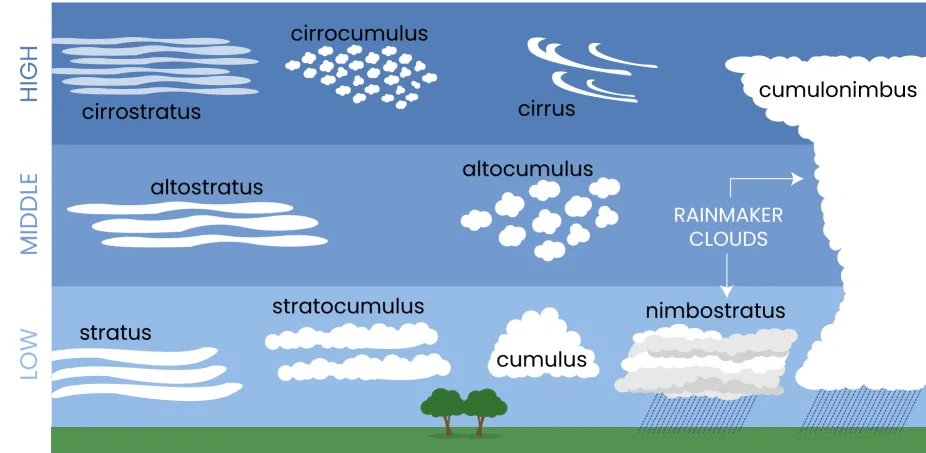
First of all here is an overly simple chart that I used to identify the clouds:
UCAR/L.S. Gardiner


As to these three photos, the first was taken at Mary S Young State Park while I was walking my dog.  These are “cirrus” clouds which, as I understand it, means there are strong winds in the upper atmosphere:

As to the following two pictures, which were taken from my yard amongs the Douglas Fir Trees.  My best guess (and perhaps one of your readers has more expertise is that these are a mixture of cirrostratus and cirrocumulus clouds.  perhaps in a state of transition:

More pictures taken from my yard. Again my best guess as is cirrrostratus clouds:

Perhaps these are in transition from cirrostratus to cirrus:

My suspicious is that these are Cirrostratus transitioning to cirrus:

This one was taken at sunset near Timberline Lodge on Mt Hood. They may have appeared lower perhaps because I was at about 6000 feet elevation instead of about 300 feet where I live. So my suspicion is that these are either cirrocumulus or altocumulus clouds:

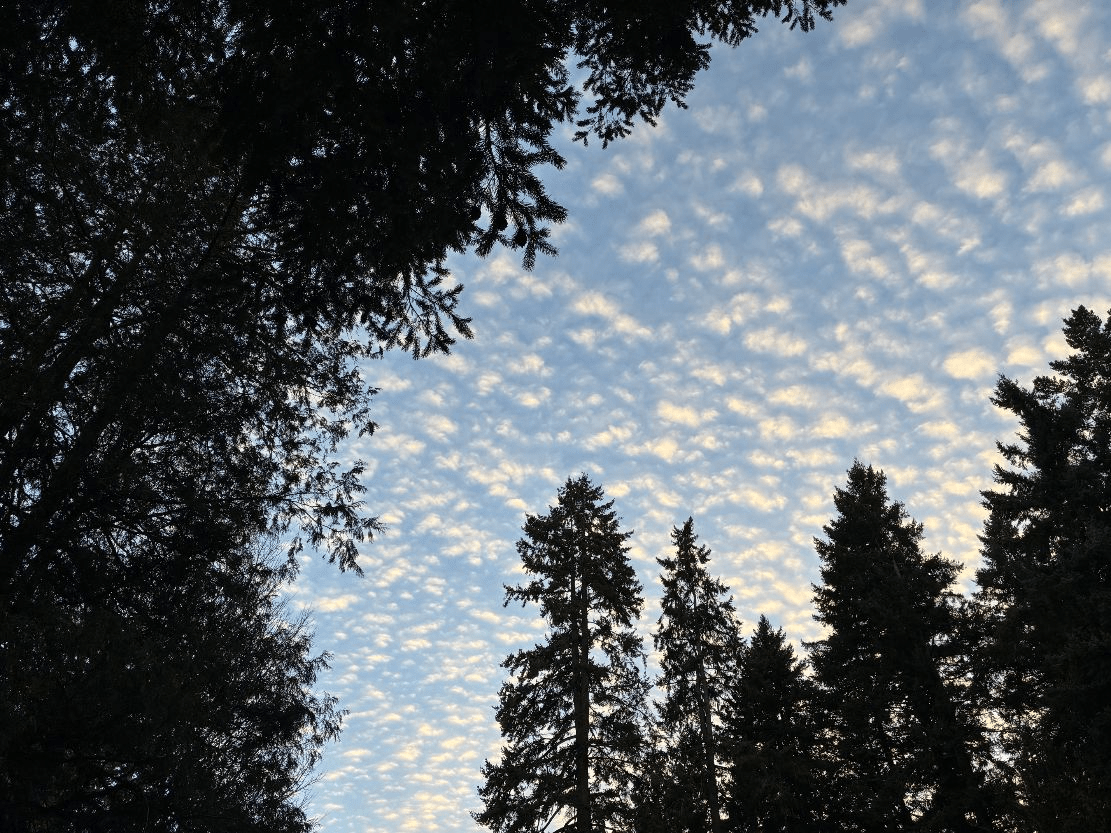
This is a picture from my yard toward some neighboring Douglas Firs and assorted evergreens.  I suspect these are cirrocumulus clouds:


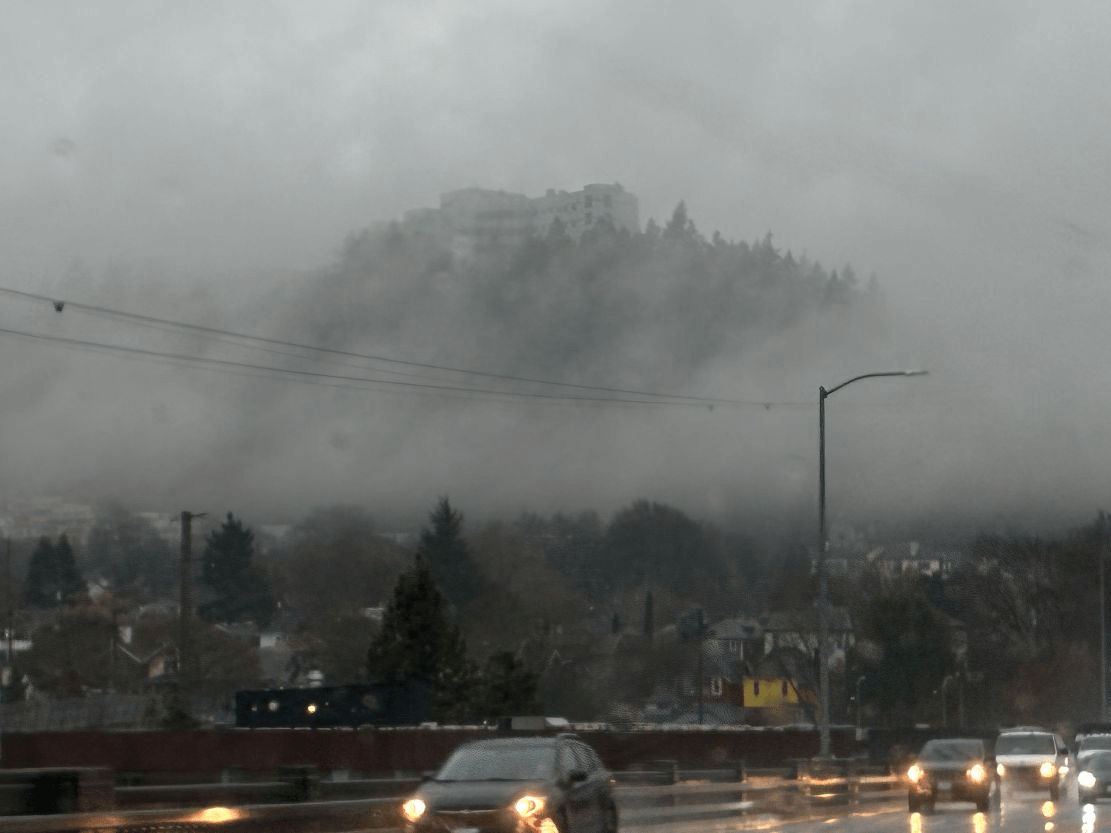
This is a picture I took from my car during a nationally forecast “Atmospheric River”. (In Oregon we call it “Rain”.) The picture was taken westbound on the Ross Island Bridge.  The building above the Stratocumulus cloud (in Oregon we call it a “Fog Bank”) is one of the buildings of the Oregon Health Sciences University, which is the main medical school in Oregon: