Readers’ wildlife photos

April 7, 2025 • 9:00 am

Don’t forget to send ’em if you got ’em. Thanks!

These are additional photos from reader Loretta Michaels trip to the tropics (part 1 is here).  Her IDs and identifications (the binomials are from me) are indented, and you can enlarge the photos by clicking on them. Some of the IDs weren’t supplied, so readers are welcome to try their hand.  From Loretta:

These were taken in Oct/Nov 2024 on the Upper Amazon in Peru, as part of a boat trip around the region. If you wanted to add this to my description, I use a Sony DSC-RX10 M4 (a fantastic camera that for some reason Sony has discontinued, much to the disappointment of fans.)

Osprey (Pandion haliaetus):

Amazon Green Kingfisher:

Amazon Kingfisher (Chloroceryle amazona):

Sloth:

Horned Screamer (Anhima cornuta):

Unidentified  butterflies:

Juvenile caiman:

Neotropic cormorant (Nannopterum brasilianum) on left, not sure on right:

Blue-and-Yellow Macaw (Ara ararauna) :

Three more: The first one is a rare hybrid of a white-fronted capuchin and a red uakari (Cacajao sp.); when we visited a village, an old lady was caring for this juvenile, and said it had just shown up one day.  Our guide was amazed, he’d never seen one.  The other two are poison dart frogs:

Readers’ wildlife photos

March 27, 2025 • 8:15 am

Mary Rasmussen lives in Chicago, but has photographed plenty of wildlife. Her photos are below, with her captions and IDs indented. You can enlarge the photos by clicking on them.

My Backyard on the Chicago River

My little yard in a lively neighborhood of Chicago backs up to a branch of the Chicago River. This is not the coveted motor-navigable part of the river. This part of the river is channelized, often clogged with debris, and across the river are canyons of apartment buildings. As a kid we rode our bikes to the river but were warned to stay out of it. It was considered pretty much an open sewer. That is changing.

From GROK: “Fish species that vanished from the river—like largemouth bass, bluegill, and even otters—have returned, with biodiversity surveys noting over 70 species now present, up from just a handful decades ago. The river’s still not pristine (urban runoff and legacy pollutants like PCBs linger), but it’s clean enough that people kayak, fish, and even swim in it—things unthinkable a generation ago.

So, yeah, it’s gotten a lot cleaner—less a sewer, more a living river. Still a work in progress, though.”

It is a hopeful sign of spring when the shopping carts are thawing from the ice.

Coyotes (Canis latrans) are pretty common here and they can make some real racket howling. This fellow is checking for spilled birdseed.

When there are no birds at the feeders and the yard is quiet I check for hawks. Cooper’s hawks (Astur cooperii) are frequent visitors. Sometimes they perch on the backs of our lawn chairs.

Lots of white-tailed deer (Odocoileus virginianus) too. I saw this young deer a little after dawn eating my violets. They can easily leap over the chain link fences and go from yard to yard:

Eastern cottontail rabbits (Sylvilagus floridanus) eat almost everything. It’s good they’re so cute.

There is a family of raccoons (Procyon lotor) that lives in a hollow branch of a Cottonwood tree along the river. The branch overhangs our yard and makes for lots of entertainment.

It was over 90 degrees on this day and there were at least 3 or 4 raccoons in that branch. It must have been stifling:

American Crows (Corvus brachyrhynchos) are often in the trees or on the power lines in the backyard. One day they were making such a fuss I went out to see what was happening. It was fledging season and I thought they could be upset about a neighbor’s cat moving through the yard:

The animal was moving so slowly through the grass that I went inside, grabbed my camera, and realized that it was not a cat. It went under the fence, turned around and stared at me. Not afraid. I checked the photo and realized it’s an American mink! (Neogale vison) They are making a comeback along the river. I’ve seen them twice in my yard since then:

This female wood duck (Aix sponsa)came last year to check for spilled seed under the feeders. I hope to see her and her mate this year:

Per Grok: “Urban wildlife diversity often surpasses that of farmland because cities, despite their challenges, are heterogeneous landscapes. They offer a mosaic of habitats—gardens, vacant lots, forest fragments, and even business parks—that can support a range of species, from songbirds to small mammals like foxes. Research from the last decade shows that urban areas can have higher or comparable mammal diversity to wild spaces, especially when green spaces are preserved.”

For fun I also asked Grok (X’s A.I. app) to create an image of my spirit animal. Grok checks the internet and creates an animal based on what it finds or information that I give it about myself. This is what it gave me. I’m not sure about the hat, but an owl is better than I expected. This was done with Grok 2. Grok 3 seems to generate less personal images:

I use a Nikon D500 camera with a NIKKOR 200-500mm lens.

Readers’ wildlife photos

March 26, 2025 • 8:15 am

Reader Mark Otten sent in some lovely photos taken by his wife Dianne. Mark’s (or Dianne’s) IDs are indented, and you can enlarge the photos by clicking on them.

These photos were taken by Dianne over the last 3 years in various locations in the greater Cincinnati, Ohio area.

Great blue heron (Ardea herodias) in a rock divide between two constructed ponds.

Female northern flicker (Colaptes auratus) showing the brightly-colored underside of the tail feathers typical of the eastern “yellow-shafted” form:

Spotted sandpiper (Actitis macularius):

Yellow-billed cuckoo (Coccyzus americanus):

In July, 2023 a limpkin (Aramus guarauna), normally resident in Florida, the Caribbean, and Central and South America, showed up at a county park in the northern suburbs of Cincinnati.  It stayed around for about 2 weeks causing quite a stir among local birders.  Limpkins feed mostly on freshwater snails and mussels:

This female killdeer (Charadrius vociferus) and her mate used an existing ring of rocks along the margin of a walking path to make their nest.  Her four eggs are visible directly below her:

A killdeer chick a few days after hatching:

Male American kestrel (Falco sparverius):

The same kestrel a few minutes later with a grasshopper meal:

In 1979 there were only 4 confirmed nesting pairs of bald eagles (Haliaeetus leucocephalus) in Ohio, all of them along Lake Erie. Eagles have since become a familiar sight in many locations.  A 2020 survey by the Ohio Department of Natural Resources recorded more than 700 eagle nests throughout the state.  This one, and its mate, have been nesting in a county park (about 11 miles north of downtown Cincinnati) for the last several years:

A family of red foxes (Vulpes vulpes) denned under the porch of a nearby church in 2022.  We were able to observe and photograph the adults and pups over several evenings.

One of the adult foxes with a light snack.  I’m not sure of the species, maybe a mockingbird:

There were at least 4 pups.  These 3 were playing in the lawn in front of the church:

We first observed this piebald white-tailed deer (Odocoileus virginianus) fawn in June, 2023 but were not able to get a good photo until late July.  The fawn was observed off and on until November, 2023.  We have not seen it since:

Piebald white-tailed deer fawn and (presumably) its sibling”

Readers’ wildlife photos

February 14, 2025 • 8:15 am

Please send in your wildlife photos! Do I have to beg? Very well, then, I’m begging.

Today we have some photos by ecologist Susan Harrison: mostly birds but two mammals and one astronomy picture. Her captions are indented, and you can enlarge the photos by clicking on them.

More miscellany of early 2025

It’s been a turbulent time at work and a slow time for birdwatching, so it’s challenging to come up any wildlife photos, let alone ones with a theme.   But here are a few more random sights from around Davis, California in January – early February 2025.

Overwintering Snow Geese (Anser caerulescens):

American Beaver (Castor canadensis) in the local stream:

Mountain Bluebird (Sialis curricucoides), an uncommon overwintering bird around here, hunting crickets in a plowed field:

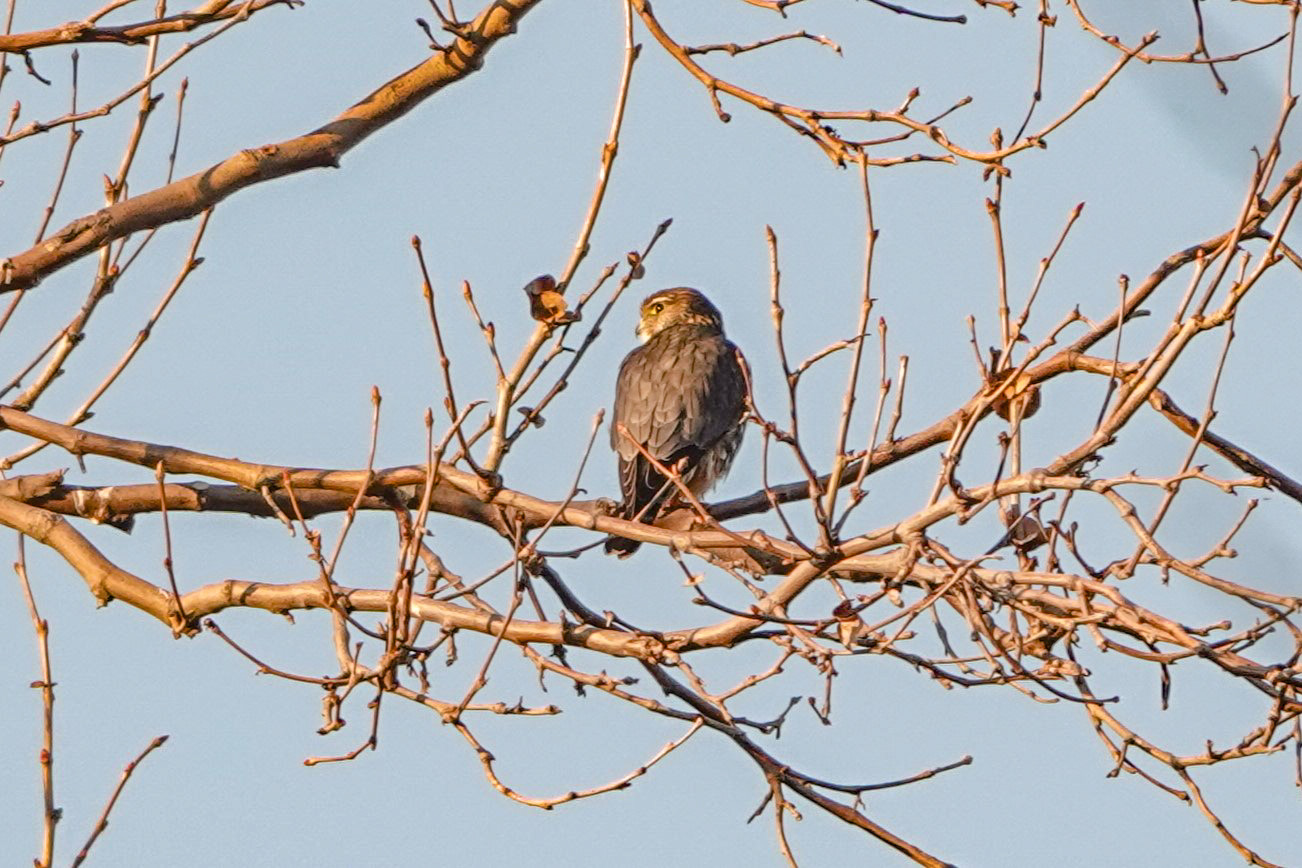
Merlin (Falco columbarius), distinguished from the similar-sized American Kestrel by having a white eyebrow instead of a black mustache (as birders call the vertical facial stripe):

American Kestrel (Falco sparverius) for comparison:

Miniature goats (Capra hircus), seemingly puzzled that the human is looking up into trees rather than bringing them carrots:

Horned Larks (Eremophila alpestris), which always look to me like they’re searching for someone’s lost keys:

American Avocets (Recurvirostra americana), in which females have more upcurved bills than males, possibly giving them different feeding niches:

Killdeer (Charadrius vociferus), inexorably drawn to stony surfaces like gravel roads and railroad beds:

Cinnamon Teal (Spatula cyanoptera) pairing up, Northern Shoveler (Spatula clypeata), and a rear-end view of a Northern Pintail (Anas acuta):

Mixed ducks flying away, as they are—sadly but for good reason—very shy of humans:

Savannah Sparrow (Passerculus sandwichensis), a drab little bird with not much to fear from a human:

And finally, though I’m no celestial photographer, the Moon being approached by Mars:

Readers’ wildlife photos

February 7, 2025 • 8:15 am

Save for Robert Lang’s collection of pictures from Brazil’s Pantanal, we’re short on wildlife photos from other readers; this, in fact, is the last non-Langian post we have.  Please send your good wildlife photos if you have some. Thanks!

Today’s short installment is from reader Bill Dickens, whose captions are indented. Click on the photos to enlarge them. We’d also like a reader’s ID of the hawk.

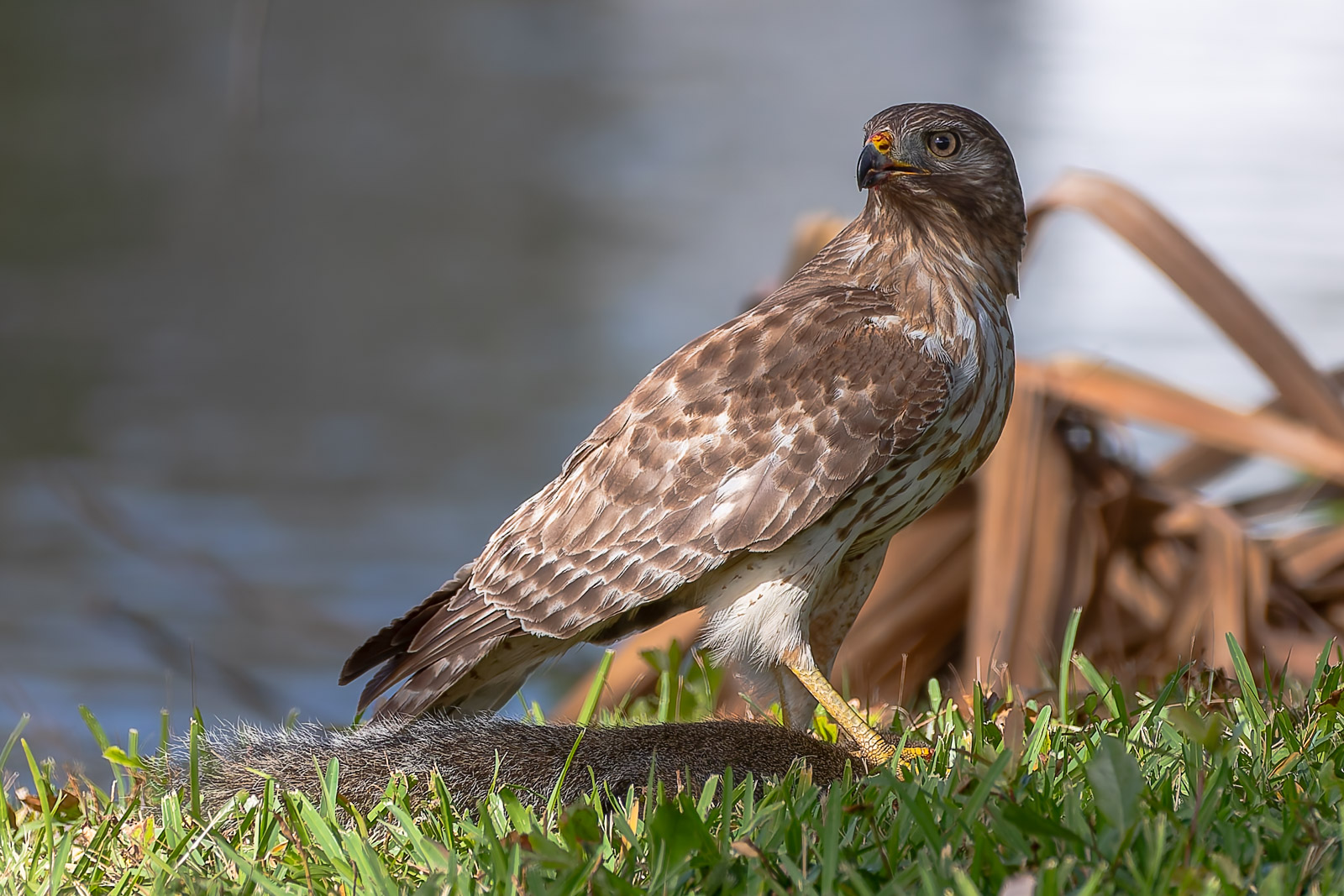
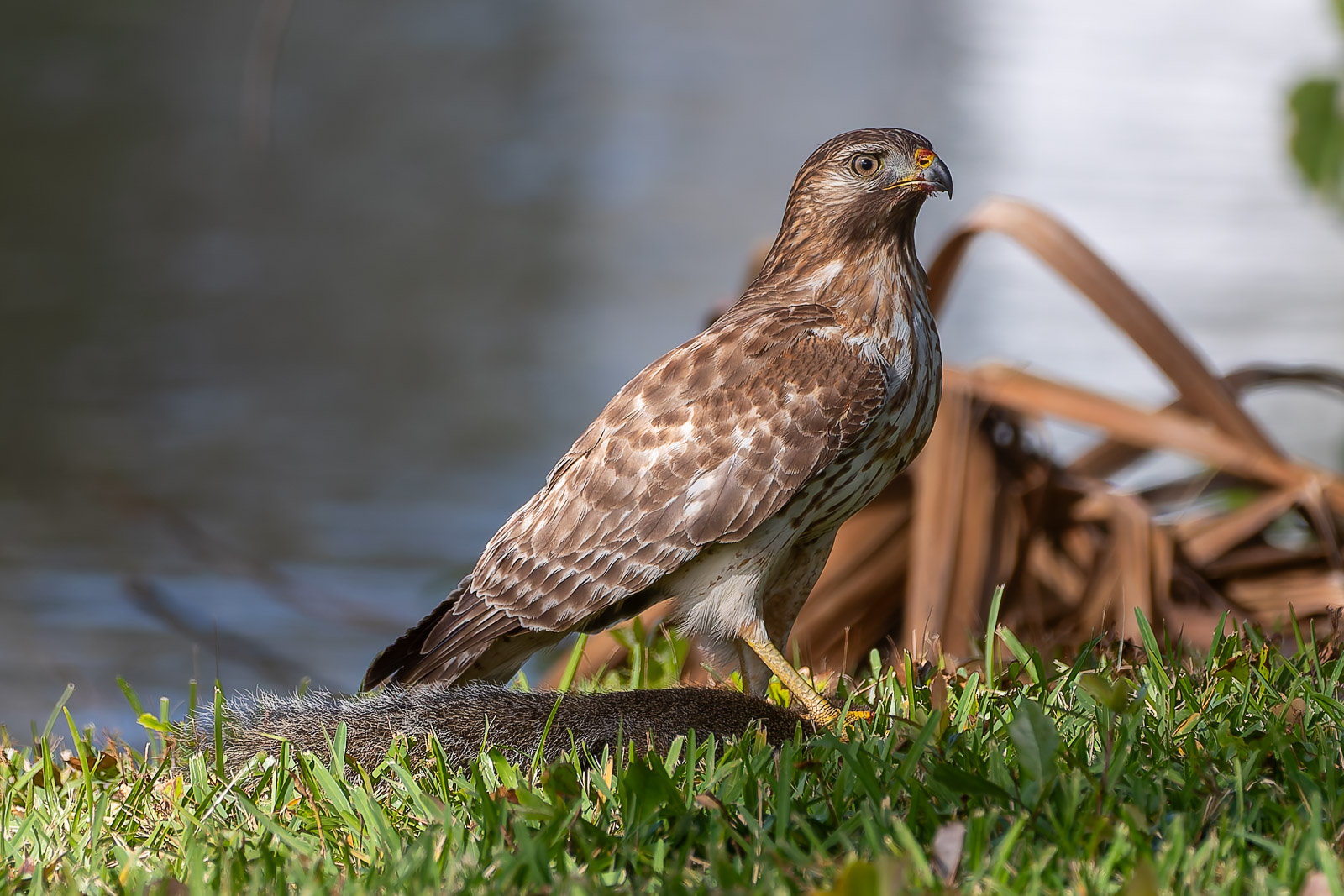
A hawk has been dropping my yard recently. A couple of days ago it got a squirrel which it consumed on my back lawn. Another squirrel, which I took to be its mate, was racing around and close to the hawk while it was perched in the tree observing it’s catch. I took this to be an attempt to distract the bird.

I’m not entirely sure which species. The most common species here are Red-shouldered, Red-Tailed, and Cooper’s Hawks. I go back and forth on each of these. It has vertical banding on the chest. I think Red Shouldered or Red tailed are the most likely but I’m no expert.

The fourth photo captured by my home security system shows the banding on the wings.

Readers’ wildlife photos

February 1, 2025 • 8:15 am

Well, save for the many contributions in line from reader Robert Lang, we have a dearth of wildlife photos; so please send yours in.

Today’s photos come from Uwe Mueller and were taken in the central western area of Germany. Uwe’s captions and videos are indented, and you can enlarge his photos by clicking on them.

All of today’s pictures I took last Sunday on a walk near my place in the Bergisches Land. I had hoped for some fog in the morning which always makes for good landscape photos, but it was not to be. Instead we just had a cold day with a bit of haze:

Looking like an Aurochs, but this is actually Heck cattle, an attempt of breeding back the Aurochs, started in the beginning of the 20th century.

A house sparrow (Passer domesticus) sitting in a hedge and calling but not showing himself. I stood about 5 feet away from him and each time he called I answered with „Yes“. After a few minutes of back and forth he seemed to be curious what all this was about and he came out of the inner hedge and sat on top of it where I could take this photo with the Tamron 70-180mm. This was a funny exchange:

Another house sparrow that I shot on a tree with the Sony 200-600mm lens.

A European robin (Erithacus rubecula):

A Common kestrel (Falco tinnunculus). I see them only rarely here so this was another lucky shot:

Two Egyptian geese (Alopochen aegyptiaca) flying by. They are neozoa in Europe but already quite common:

A Grey wagtail (Motacilla cinerea) in the creek running through our local forest that I had photographed a few days before but only from a distance and in low light. So I went to the same place and quietly sat down, hoping to see it again. I didn’t have to wait for very long when the bird appeared and meticulously searched the water for food. The light still wasn’t great but the wagtail came closer and closer, doing its thing and wagging its tail, until I could take a bunch of decent photos:

A Great tit (Parus major) taking a bath in the ice cold water of the creek. Brrrr…:

A very lucky shot of a Eurasian goshawk (Astur gentillis) that I took when I was on my way back home. At first I only saw a big flock of feral pigeons circling through the sky which is not very common behaviour as they usually stay close to the houses in our vicinity. Then suddenly I saw three or four birds quickly rushing towards me and passing by maybe 50 feet away. This happened so fast I couldn’t tell what kind of birds they were but I yanked my camera upwards and shot. Only when the birds had disappeared and I looked at the camera display to check what I got I saw that one of them was a goshawk having a pigeon in his claws. Unfortunately it is not the sharpest shot, but with that image motif and only the second time in several years that I saw this bird I’m not going to complain:

All in all, a very successful day for a bird photographer. OK, less so for the pigeon in the last shot.

Readers’ wildlife photos

January 25, 2025 • 8:15 am

I have only a few more batches of photos, so please send yours in if you have good ones. Thanks!

Today’s bird photos (and one mammal) come from regular Susan Harrison, an ecologist at UC Davis.  Susan’s IDs and captions are indented, and you can enlarge her photos by clicking on them.

Going About Their Business

This set of photos — my 75th for WEIT — emphasizes animals who are doing a little more than just sitting around.  All of these were taken near Davis, California, in January 2025.

Western Bluebirds (Sialis mexicana) in my backyard on New Year’s Day, checking out a years-old and not-yet-used nest box.   Perhaps I’ll become a bluebird landlady at last!

Great Blue Heron (Ardea herodias) stalking, pouncing, extracting its prey in a clump of vegetation, and finally swallowing its meal.  Light reflected from the ripples caused the striking “lava lamp” effect on the bird:

Black-necked Stilts (Himantopus mexicanus) creating a DNA strand pattern with their legs:

Golden-crowned Kinglet (Regulus satrapa) digging for goodies in the bark of a Valley Oak (Quercus lobata) festooned with Oak Apple Galls (Andricus quercuscalifornicus):

Ruby-crowned Kinglet (Regulus calendula) fleeing and flashing a bit of his fiery crown:

Sharp-shinned Hawk (Accipiter striatus) preening and fluffing:

White-tailed Kite (Elanus leucurus) heading west with the sunset:

Great Horned Owl (Bubo virginianus) striking a catlike pose:

American Kestrel (Falco sparverius) hovering against a strong wind:

Loggerhead Shrike (Lanius ludovicianus) pausing from its murderous work, with a backdrop of snowy Sierran peaks:

Eastern Fox Squirrel (Sciurus niger) glaring at an annoying photographer: