Why Evolution is True is a blog written by Jerry Coyne, centered on evolution and biology but also dealing with diverse topics like politics, culture, and cats.
Today’s photos are of lizards, come from Ephraim Heller, and were taken in Trinidad and Tobago. Ephraim’s captions and IDs are indented, and you can click on the photos to enlarge them.
Many people have said to me “the hummingbirds are nice, but what about the lizards of Trinidad and Tobago?” Perhaps not literally true, but grant me poetic license. Preparing this post gave me an opportunity to learn about lizards. Trinidad and Tobago is home to about 49 species of lizards in 11 families in 4 clades.
Clade #1: T&T is home to four iguanian families (Iguania): Dactyloidae (anoles), Iguanidae (iguanas), Polychrotidae (polychrotids), and Tropiduridae (treerunners). Iguania are characterized by visual communication (dewlaps, crests, color change), fleshy non-forked tongues, and sit-and-wait predatory behavior, along with various osteological arrangements.
The green Iguana (Iguana iguana) possesses a parietal eye, a small, pale scale on the top of the head that is a photosensory organ, connected to the pineal gland via its own nerve pathway. It cannot form images, but it detects changes in light intensity and shadow, giving the animal an early warning system against aerial predators approaching from above. It also contributes to circadian rhythm regulation and thermoregulation, which is particularly important for a reptile that ferments its food. Green iguanas eat leaves, relying on a hindgut microbial fermentation system to break down plant fiber.
Green iguanas have a social structure. Dominant males hold territories that contain smaller males, females, and juveniles, with larger males claiming better display perches and more access to females. During mating season males shift toward red or orange hues, becoming more conspicuous; a defeated male that loses his territory returns to a dull brown within hours and holds this color until he reclaims his position.
This one is angry with me:
Trinidad has only one native anole, the leaf anole (Anolis planiceps). Other species are introductions that arrived from other Caribbean islands, likely through human commerce. When a leaf anole detects a threat it can run bipedally, a behavior seen in a number of small lizards and interpreted as a burst-speed adaptation.
Here’s an unidentified anole. Perhaps a reader can identify it:
Gekkota are distinguished primarily by their feet and eyes. Most geckos have adhesive toe pads with microscopic hair-like structures (setae) that generate van der Waals forces, allowing them to cling to smooth surfaces. The eye is typically large with a vertical or elliptical pupil, and the eyelid is fused into a fixed transparent scale (the “spectacle”) rather than a moveable lid.
I photographed the northern turnip-tailed gecko (Thecadactylus rapicauda). The name comes from the tail, a fat-storage organ. It is also detachable: autotomy (self-amputation) serves as a predator-distraction mechanism. The regenerated tail is typically wider at the tip than at the base, allegedly looking like a turnip. One cool but useless fact: this gecko is able to lick the transparent scale covering each eye.
For completeness, here’s a bit of information about the two lizard clades that I did not photograph.
Clade #3: there are two species of Amphisbaenia in the family amphisbaenidae. These are legless worm lizards. Adapted for living underground, the key distinguishing features are: annular (ring-like) body scales arranged in complete rings around the body, which no true lizard possesses; a highly consolidated, rigid skull adapted for head-first burrowing, with the two sides of the skull fused to form a battering ram; vestigial or absent eyes covered by scales; no external ear openings; and reduced or absent limbs in most families. They move using a unique accordion-like rectilinear locomotion rather than lateral undulation. Sadly, I have no photos of worm lizards as they live underground.
Clade #4: finally, there are three scincoid families (Scincoidea): Scincidae (skinks), Teiidae (teiids), and Gymnophthalmidae (microteiids). Scincoidea is defined primarily by molecular phylogenetics, not by a single morphological characteristic. Bony plates underlaying the scales are present in skinks, giving them their characteristic armored, smooth texture.
Welcome to Thursday, April 16, 2026 and Save the Elephant Day. Here’s a group of elephants (don’t know the formal term) digging for water in a lake bed in Kruger National Park (photographed in August of 2024). The cute thing was that the mother would dig a hole and then let the babies drink first.
The bunnies (Eastern Cottontails) are out! On my way to work I passed by two furry lumps standing like statues only about ten feet away from me. They were bunnies! I silently moved away from them to allow them to forage. An iPhone photo:
Readers are welcome to mark notable events, births, or deaths on this day by consulting the April 16 Wikipedia page.
Da Nooz:
*At It’s Noon in Israel, Amit Segal describes the talks between Lebanon (not Hezbollah) and Israel as a “resounding success”:
The highest-level direct talks between Israel and Lebanon in history have concluded with neither side getting what they wanted. Regardless, the summit was a resounding success.
Lebanon entered the negotiations hoping to achieve an immediate ceasefire, reportedly threatening to walk away from future talks unless this condition was met. Israel, meanwhile, came to the table demanding a concrete commitment and a clear timeline for the disarmament of Hezbollah north of the Litani River. While neither delegation walked away with their demands fulfilled, further talks are already confirmed. As U.S. Secretary of State Marco Rubio noted after the meetings, this will take time; the talks “are a process, not an event.”
In statecraft, as in life, you cannot expect others to treat you with respect if you do not first respect yourself. For the first time in decades, Lebanon’s government is asserting itself as a sovereign entity, and for the first time in decades, Washington is officially recognizing it as such. Prior to yesterday, whenever Washington needed something done in Beirut, it dialed Damascus, Tehran, Doha or Riyadh.
The question is whether the government is actually in charge.
The mere fact that the Lebanese government chose to engage in the negotiations is a good sign. Hezbollah Secretary-General Naim Qassem explicitly warned against the summit, labeling it “futile” and declaring it a “stab in the back to the resistance.” Had Hassan Nasrallah issued a similar warning in 2021, his word would have been an insurmountable veto. But two years of relentless Israeli military pressure, coupled with the succession of the significantly less imposing Qassem, has considerably defanged the organization.
Still, breaking the psychological hold Hezbollah maintains over the country requires the Lebanese government to treat it like the paper tiger it has become, rather than the actual tiger it once was.
Israeli Ambassador to the United States Yechiel Leiter addressed the media following the meeting, claiming that the officials on both sides discovered they are actually on the “same side of the equation” and are “united in liberating Lebanon.” Most intriguingly, Leiter suggested that once the security situation is resolved, the two nations “can embark on a harmonious relationship” akin to the Abraham Accords countries.
The penultimate paragraph is the important one. The Lebanese government is largely under the sway of Hezbollah, but the Lebanese people are sick of the terrorist organization. Still, don’t see a ceasefire or disarming of Hezbollah, any more than I see a disarming of Hamas. But it’s a start.
*Michael B. Horn at the Free Press tells us “Your local college is running out of cash.” This is true even at the University of Chicago, where strict budgetary restrictions have been imposed.
I could go on. But there’s one piece of the puzzle that’s received relatively less attention, however: the fiscal health of many colleges themselves. To put it simply, a tremendous number of colleges and universities are on the fast path to insolvency, which stands to quickly transform not only America’s higher-education landscape but also the many communities built around these institutions.
In 2013, the late Harvard Business School professor Clay Christensen and I wrote a piece in The New York Times predicting that within 15 years, 25 percent of colleges would close or merge. The claim rested on patterns observed in other industries where rising expenditures, declining demand, and structural change eventually forced institutions to consolidate or declare bankruptcy and restructure.
Since then, over 15 percent of the 4,724 degree-granting colleges or universities that existed at the time we made the prediction have shut their doors.
Yet college leaders seem not to grasp the scale of the problem and, in public, dismiss the danger to their institutions. Yes, enrollments might soften. Yes, some institutions might struggle. But higher education is resilient. We’ve heard rumors of insolvency before, they would say as they dismissed our claims.
But the math is about to get a lot worse for many schools.
The number of traditional college-age students in the United States is projected to decline for at least the next two decades as the smaller birth cohorts following the Great Recession move through the education pipeline. For an industry built around steady enrollment growth, that demographic shift alone guarantees increasing financial pressure.
But demographics alone won’t determine which institutions survive. The more immediate threat is simpler: cash.
. . . Even assuming enrollments remain steady—an optimistic scenario given the coming demographic decline—more than one-third of the colleges studied have less than five years before becoming fiscally insolvent without significant changes. That means they will have less money coming in annually than they are spending, and will need to start drawing down their unrestricted endowments, or borrowing—if they can—to keep operating. On average, those schools have less than a year before their financial position falls into that territory.
. . .In most industries, leaders would immediately recognize this situation as a liquidity crisis. In higher education, it is often treated as a temporary dip that strategic plans or enrollment initiatives will eventually solve.
That optimism is difficult to reconcile with demographic reality.
The “elite” colleges will fix the problem by belt-tightening, but most schools are not “elite”. Horn offers a number of solutions, including deep-sixing under-enrolled majors or even merging colleges with other colleges. Our own school is going the former route, plus ratcheting back on hiring. No matter what: we are going to see a revolution in higher education, including the inimical effects of AI on all subjects, especially the humanities.
*I’ve always found Bret Stephens’s take on recent wars, be they in Gaza or Iran, quite sensible. His latest NYT column tells us “How Trump can wrap up the war” (column archived here). Stephens offers four suggestions. Excerpts:
First, Trump should put Iran’s regime to a fundamental choice: It can have an economy. Or the regime can attempt to have a nuclear program while trying to control the Strait of Hormuz. But it can’t have both.
“Iran’s central bank has warned President Masoud Pezeshkian that rebuilding the country’s war-damaged economy could take more than a decade,” reports Iran International, an Iranian opposition news site based in London. The bank anticipates up to two million additional people left jobless by the war, along with inflation as high as 180 percent. An inflation rate of over 40 percent was what sparked January’s mass protests. As for the effects of the blockade, the site reports, it would wipe out “an estimated $435 million in daily economic activity,” and force “oil field shutdowns within weeks.”
. . .Second, Trump must bear in mind what precipitated the current crisis with Iran — not its nuclear programs, but the murder ofthousands of Iranian protesters in January. What Iran’s leaders fear more than economic collapse is the wrath of their own people.
Administration policy should be geared to exploit that wrath. That begins by breaking the information blockade the regime has sought to impose through an internet blackout. Fully restoring funding to Radio Farda, the Persian-language service of Radio Free Europe that the Trump administration slashed last year during the tenure of the incompetent Kari Lake would be one place to start. Flooding Iran with additional Starlink terminals — too many for the regime to stop — would be the next. What would not help, by contrast, is to target civilian infrastructure, particularly power plants, whose destruction could only bring misery to ordinary Iranians.
The most important step Trump could take would be to warn the regime publicly — and in a way that gets communicated to Iran’s people — that it will intervene militarily if it again attempts a bloody crackdown on public protests. The United States cannot bring about regime change in Iran. But it can do what it can to tilt the scales in favor of the millions of disaffected Iranians who can.
This is my own main goal of the war: freeing the Iranian people, who want to be modern, from the oppressive theocracy. Two more:
Third, if the regime wants to link the current cease-fire with an end to Israel’s attacks on Hezbollah in Lebanon, then it must itself desist from arming and financing the terrorist group.
The principle is simple: Israel will get out of Lebanon the moment Iran gets out of Lebanon. Failing that, the United States should give Israel a green light to continue degrading Hezbollah’s capabilities until it can no longer initiate wars against Israel, as the group did in 2006, 2023 and again this year. If other states, particularly France as Lebanon’s former colonial power, object to this, they can always volunteer to send their own troops to enforce the U.N. Security Council resolution that Hezbollah has been violating for nearly 20 years.
There may already be French troops among the thousands of UN troops supposedly enforcing the resolution. But they’re doing bupkes. Finally,
Iran could get an end to both war and blockade, full relief from international sanctions, the resumption of diplomatic and commercial relations with the United States and every other benefit that Tehran used to enjoy before the Islamic revolution of 1979. In return, all that would be asked of Iran is to behave like a normal country: no efforts to support armed militias throughout the region, or harbor Qaeda leaders, or send hit squads to kill or kidnap enemies abroad, or declare “death to Israel” and “death to America” as foundational principles of the regime while trying to build nuclear weapons.
Does any of that sound outrageous? Of course not. The outrage is that the regime’s current leaders would almost certainly dismiss the proposal out of hand because ideological militancy, rather than fidelity to the interests of the Iranian people, is what has defined them for the past 47 years.
Aye: there’s the rub. We are dealing with a hard-line Islamic theocracy, and only regime change can bring about Stephens’s goals. As usual these days, I see no solution, though these suggestions are good. But they require the administration to stick to goals other than its own popularity.
*At his Substack site Reality’s Last Stand,” Colin Wright tells us that “The war on biology is far from over.” The war, of course, involves pushback against the (true) binary nature of sex in animals and plants. The article is free, but subscribe if you have the dosh.
The war against biology has not slowed down. Despite the chatter on X that woke ideology is dead or at least in retreat, a brief internet search reveals that activists are still flooding the zone with sex pseudoscience.
Just in the last few weeks, we’ve seen several examples. Princeton anthropologist Agustín Fuentes published a piece in SciencePolitics arguing that government efforts to define sex as a biological binary are based on “falsehoods and erroneous assertions.” IFLScience ran an article claiming there is “no clean definition” of biological sex. The Trans Advocacy & Complaints Collective published a piece insisting that “sex does not fit neatly in boxes.” And now a peer-reviewed paper in BioScience claims that teaching students what the authors call “the diversity of biological sex” makes LGBTQIA+ students feel more included and enjoy biology more.
That last example is particularly concerning, because peer-reviewed articles in scientific journals carry more weight than newspaper think pieces or activist blog posts. They influence how biology is taught, how future teachers are trained, and regularly serve as the basis for public policy.
The BioScience paper presents itself as offering a more “accurate” way to teach about biological sex, but what it actually offers is the same sex pseudoscience activists have been pushing for years. It promotes confusion about what sex is, arbitrariness in how it is defined, and a conflation of exceptions and variations with the category itself.
In reality, the concept of sex (i.e., what defines an individual as male or female) is not complicated. In species that reproduce sexually through anisogamy—that is, by fusing gametes of two different sizes—males are the sex with the biological function of producing small gametes (sperm), and females are the sex with the biological function of producing large gametes (ova). That is what the sexes are. Chromosomes, hormones, genital morphology, and secondary sex traits are all related to sex, but they are not included in the definition of sex. Rather, they are either upstream developmental determinants of sex or the downstream expression of it.
This is the central point the BioScience paper obscures.
. . .But the definitions of the sexes has long been established, with no serious alternative definition of sex in biology that is logically coherent or explanatorily useful. Scientists can debate all kinds of things about sex determination, sexual development, or unusual disorders of development, but the meaning of male and female is not some open-ended philosophical question. Male and female are grounded in reproductive function. The only people who question this or claim the definition isn’t “settled” are those trying to distort biology to fit their radical political agendas. But as I stated in a recent scholarly article, “while biology can and should inform policy, policy preferences should never be used to dictate biology.”
The paper also confuses the definition of sex with the mechanisms that determine sex.
. . . But a manufactured consensus is impossible to maintain forever, because the truth doesn’t just go away. Activists are now increasingly being forced into the kind of direct engagement they have long tried to avoid, because while fashionable sex pseudoscience can sound persuasive on its own, it quickly disintegrates on contact with informed opposition.
I’ve read all these papers myself and yes, they’re sorely misleading. But it’s ideology, Jake! Another area in which politics has pushed science aside is the efficacy and benefits of transgender hormone therapy and surgery. I wrote about that yesterday, and even the AMA can’t decide whether to go with the science (i.e., results as of yet unclear) versus ideology (rah, rah, go transition!).
*On March 18, the Williams Record, the student newspaper of Williams College (where Luana teaches) published an op-ed (“Gender gap in economics department persists despite faculty interventions”) showing that, compared to the sex ratio of student enrollment at the school (52% female) the proportion of women majoring in economics has historically been lower (35% in 2022). Here’s the graph they give:
The tenor of the article is that this “inequity” must be corrected as it reflects a problem that needs correction, implicitly bias against women and explicitly (and patronizingly) ignorance among females about economics. Two quotes from the op-ed:
Professor of Economics Sarah Jacobson told the Record that she has been working to even out enrollment between female and male students in the major since arriving at the College in 2010. “It is difficult to not notice that when you walk into an economics classroom, certain identities are strongly underrepresented … professors notice it, and students notice it,” she said. “While many other STEM fields have gotten more diverse on both race and gender over the last couple of decades, economics has really lagged behind.”
. . . “The idea [in the UWE study] was to try to find out why women were not concentrating or majoring in economics as much as men were,” [Nobel-winning economist Claudia] Goldin said in an interview with the Record. “We discovered it was generally that women thought that economics was mainly about finance and not about people. They didn’t understand what it was really about.”
Well, we know the problem of jumping from inequities to concluding both bias and the existence of a problem that needs to be fixed. The “progressive” view is that, given a “blank slate” view, inequities must be fixed so all groups should be represented in proportion to their existence in a population. The “people verus finance” trope might, indeed, reflect differential interests.
Luana has pushed back on that with the most obvious response for differences between sexes: they could reflect interest, not bigotry. She wrote a response to this op-ed called, “Why sex-ratios in majors might be more than just bias.” An excerpt:
Humans are not blank slates, and many studies show that males and females have, on average, different preferences and behaviors which can affect their choice of major and profession. While some of these differences are influenced by societal norms, others have been molded by a billion years of the evolutionary process of sexual selection. True fairness in representation lies not in achieving parity, but in respecting individual preferences.
The persistent underrepresentation of women in economics (36 percent in the department’s 2023 internal report) is real. But the sources in the article try to explain this “imbalance” by lack of access, lack of incentives, or outright discrimination against women. A more evidence-based explanation should include the awareness that sex differences in educational and vocational preferences have been documented across decades of psychological research.
It is undeniable that society’s incentives and prohibitions guide what is a permissible career path for each sex. However, as someone who studies evolutionary biology, I also note that millions of years of sexual selection have produced average differences in behavior and preferences between the sexes — differences that appear early, are cross-cultural, and persist even in the most egalitarian societies today. Past sexual selection produced not only different body sizes and strengths, but also different behaviors. In mammals, females bear the far higher reproductive costs — pregnancy, lactation, and extended parental investment — while male investment in most species is limited to a brief copulation and sperm delivery. Over millions of years, this asymmetry has favored greater male risk-taking, aggression, and drive for resources — all things that could enhance chances of acquiring a mate.
. . . . Society accepts — without outrage — majors and professions that are heavily female-dominated. Today psychology and biology routinely exceed 60 to 80 percent female nationally, and fields such as nursing and several medical specialties are also overwhelmingly female. We also do not lose sleep over male-dominated professions like policing or trucking. So, why single out economics (and, similarly, political science) for criticism when in fact the overall distribution of majors must balance out to result in an overall 50 percent of women in the College?
There is danger in assuming every inequality reflects bigotry rather than choice.
There should be a name for this fallacy. At any rate, Luana’s fighting it in the trenches.
Meanwhile in Dobrzyn, Hili’s scrutinizing the garden:
Hili: These tulips were a different color last year.
Andrzej: We live in a world of illusions.
In Polish:
Hili: Te tulipany miały w zeszłym roku inny kolor.
Ja: Żyjemy w świecie złudzeń.
*******************
An AI photo made by Mark Richardson with the details (remember Sinead O’Connor tearing up the Pope’s picture on Saturday Night Live? You can see it here.):
Your AI rendition of Trump as Satan on Hili this morning was serendipitous. Plus funny! Last night, while musing about Trump’s battle with the pope, I was reminded of the time in ’92 when Sinead O’Connor ripped a photo of pope John Paul II live on SNL. I watched as it happened, and even though I was an atheist back then and had no truck with religion, I still remember being shocked.
So (mostly to make my wife laugh) I went to ChatGPT’s photo renderer and asked: have Trump rip a photo of the pope like Sinead O’Connor did on Saturday Night Live.
Attached is the photo. Not bad eh? I know the context is off since O’Connor was protesting the Catholic pedophile cover-up and Trump’s protest is just narcissism run amuck, but it was worth the 30 seconds it took to render.
From Masih, who calls out Iranian government official Masoumeh Ebtekarv to Anerson Cooper:
Live on CNN, where you, @ebtekarm_ir, gave multiple interviews to promote the Islamic Republic and called out millions of Iranian women simply for removing their hijab, you once laughed at me when I exposed your hypocrisy, now, I couldn’t hold back my grin as I watched you… https://t.co/JZ82lwhCnmpic.twitter.com/vQUr3pAyRs
From Simon; a good one, referring to when Lydon B. Johnson “lost America” because Walter Cronkite said the U.S. was mired in a stalemate. Simon titles this, “When you lose Sarah Palin.” Indeed!
From Luana; click on the screenshot to go to the most unhinged AI video ever (it can’t be embedded here):
From Malcolm; the amazing reaction time of cats:
Cats are highly skilled predators with a strong instinct to hunt, even if they are well-fed domestic cats.
They have exceptionally fast reaction times, ranging from approximately 20 to 70 ms, significantly faster than humans (around 250 ms).pic.twitter.com/Ykj7cSBhc9
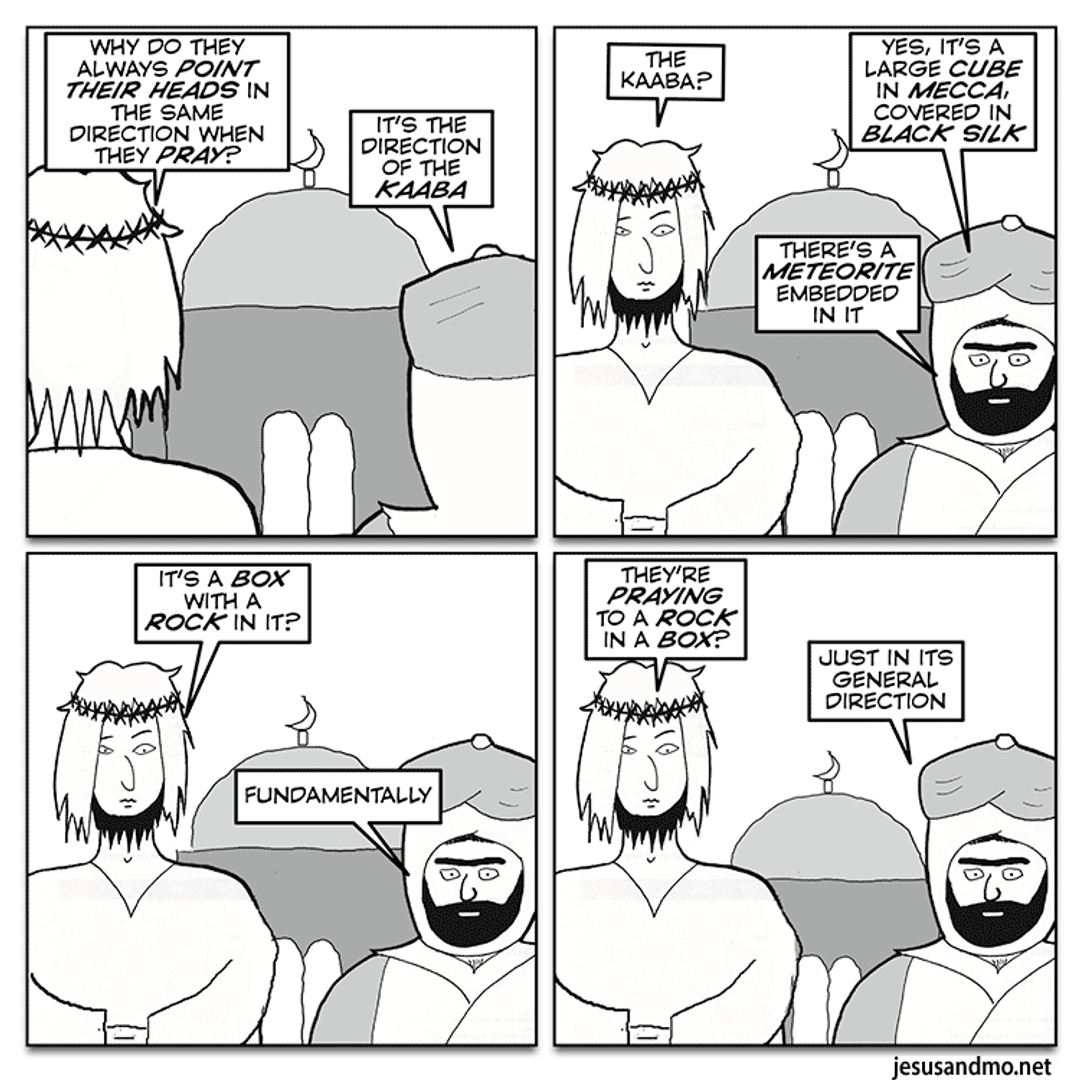
Today’s Jesus and Mo strip, called “rock2“, comes with a note that says this: “An oldie from 2006 today. Next week’s will also be a resurrection.” The artist must be on hols.
Is Mo right about the black silk and the meteorite? Well, at least half right. The Kaaba is indeed covered with a cloth made of silk, but the meteorite is questionable. Here’s what Wikipedia says, along with a picture. (The stone is called Ajar al-Aswad.)
The Black Stone (Arabic: الحجر الأسود, romanized: al-Ḥajar al-Aswad) is a rock set into the eastern corner of the Kaaba, the ancient building in the center of the Masjid al-Haram in Mecca, Saudi Arabia. It is revered by most Muslims as an Islamic relic which, according to tradition, dates back to the time of Adam and Eve.
The stone was venerated at the Kaaba in pre-Islamic Arabia. It is sometimes considered a baetyl. According to tradition, it was set intact into the Kaaba’s wall by Muhammad in 605, five years before his first revelation. Since then, it has been broken into fragments and is now encased in a silver frame on the side of the Kaaba. Its physical appearance is that of a fragmented, dark rock, polished smooth by the hands of pilgrims. It has often been described as a meteorite, but it has never been analysed with modern techniques, so its scientific origins remain the subject of speculation.
Muslim pilgrims circle the Kaaba as a part of the tawaf ritual during the Hajj and many try to stop to kiss the Black Stone, emulating the kiss that Islamic tradition records that it received from Muhammad.While the Black Stone is revered, theologians emphasize that it has no divine significance and that its importance is historical in nature.
Saudi Press Agency (SPA), CC BY-SA 4.0, via Wikimedia Commons
Welcome to a Hump Day (“Середина недели” in Russian): April 15, 2026, and for American’s it’s Tax Day (also known as Income Tax Pay Day), when your federal and state income taxes are due.
Here’s a world map showing al the countries that have a McDonald’s (colors indicate the date the first one opened); gray countries lack McD’s, and black ones, like Russia and Iceland, have apparently ditched them. Africa and the Middle East are also bereft, though South Africa, Egypt, and Morocco have the cheap burger. But McDonald’s is not the world’s largest chain restaurant. According to Wikipedia, that honor goes to the Chinese chain Mixue Ice Cream & Tea, with 45,000 stores!
Own work, original work by:Original: Astrokey44 & Hexagon1Derivative work: Szyslak, Public domain, via Wikimedia Commons
Readers are welcome to mark notable events, births, or deaths on this day by consulting the April 15 Wikipedia page.
Posting may be light for about ten days as I’m going out of town for a week on Saturday; I have tasks to do before that, and there’s an imminent duckling hatch. Persistent insomnia is impeding my ability to write. Bear with me; I do my best.
Questions over the status of the U.S. military blockade in the Strait of Hormuz persisted on Tuesday, as tracking data showed that several ships had passed through the waterway, including some that had departed from Iran.
The blockade, which began Monday afternoon local time, applies to all maritime traffic entering or exiting Iranian ports and coastal areas, the U.S. military said. It remained unclear how American naval forces would enforce the prohibitions, which are aimed at cutting off Iran’s oil income after the United States and Iran failed to reach a deal to end the war. The two sides are observing a two-week truce set to expire April 21.
Some of the vessels that passed through the strait on Monday — both before and after the 10 a.m. Eastern deadline when the Trump administration said the blockade had gone into effect — had departed from Iran, were carrying Iranian products or were under U.S. government sanctions, according to the trade analysis firm Kpler. It was not immediately known whether the ships that had departed from Iranian ports fell within a “grace period” around the deadline, had gained permission to pass or had somehow bypassed the blockade.
Christianna, a Liberia-flagged cargo ship, exited the Persian Gulf through the strait on Monday night, after leaving the Iranian port city of Bandar Imam Khomeini, Kpler said. It said the ship was not carrying any cargo.
Elpis, a methanol carrier, traversed the strait roughly around the time that the U.S. blockade began, according to ship-tracking data. Kpler said that the vessel had been at the Iranian port of Bushehr. The United States had placed sanctions on the ship last year under an earlier name, Chamtang, over its connections to the Iranian oil trade.
Ship tracking data from Bloomberg and Vesselfinder shows movements of several other vessels in and around the strait over the last two days.
I’m curious why the blockade is leaky. On the one hand, we can totally blockad an entire island–Cuba–but aren’t successful in this narrow strait. Why? And how do we enforce a blockade if a ship refuses to obey it. Are we going to shoot it? Board it? Details are missing here, but inquiring minds want to know.
The U.S. military said early Wednesday Iran time that it had completely stopped all commercial trade to and from Iranian ports less than 36 hours after implementing a naval blockade.
President Trump had ordered the Navy to stop any ships from transiting the Strait of Hormuz after weekend peace talks in Pakistan ended with no agreement. But ship trackers showed that several Iran-linked vessels had traveled through the strait after Central Command began its blockade operation on Monday. It was not immediately clear from independent sources if there was any Iranian shipping traffic in the region on Wednesday morning.
U.S. Central Command said more than 10,000 American forces with over a dozen warships and dozens of aircraft were enforcing the blockade, while allowing vessels traveling to or from non-Iranian ports to transit the waterway.
Iran has mostly choked off the strait, a vital passage for global oil and gas supplies, in retaliation since the war started in late February. There are few signs that it is fully reopening despite repeated threats from Mr. Trump.
The president reiterated on Tuesday that Iran was keen to negotiate a deal. He told The New York Post that new talks could take place over the next two days in Pakistan. And he said in a Fox News interview that the conflict was near its end. “I think it’s close to over, yeah, I mean I view it as very close to over,” he said when Maria Bartiromo asked if the war had ended, speaking in a clip from the interview posted on Tuesday night.
Saudi Arabia is pressing the U.S. to drop its blockade of the Strait of Hormuz and return to the negotiating table, fearing President Trump’s move to close it off could lead Iran to escalate and disrupt other important shipping routes, Arab officials said.
The blockade is aimed at raising the pressure on Iran’s already crippled economy. But the officials said Saudi Arabia has warned Iran might retaliate by closing the Bab al-Mandeb—a Red Sea chokepoint crucial for the kingdom’s remaining oil exports.
The pushback is a sign of the risks and limitations of U.S. efforts to pry open the Strait of Hormuz, which Iran shut early in the war by attacking ships in the waterway, cutting off around 13 million barrels a day in oil exports and sending futures prices above $100 a barrel.
Time for a geography lesson. First, from Wikipedia, the nature of this strait: “The Bab-el-Mandeb acts as a strategic link between the Indian Ocean and the Mediterranean Sea via the Red Sea and the Suez Canal. Most exports of petroleum and natural gas from the Persian Gulf that transit the Suez Canal or the SUMED Pipeline pass through both the Bab el-Mandeb and the Strait of Hormuz.” Here’s an enlarged bit of a map from the same article. The blue dot shows the Bab al-Mandeb, with the Strait of Hormuz to the right, off the map. Wikipedia adds this:
The Bab el-Mandeb Strait is 26 kilometres (14 nautical miles) wide at its narrowest point, limiting tanker traffic to two 2-mile-wide channels for inbound and outbound shipments
Iran’s Houthi allies in Yemen control a long stretch of coastline near the Bab al-Mandeb and severely disrupted the waterway for much of the war in the Gaza Strip. Iran is putting pressure on the group to close the chokepoint again, Arab officials said.
“If Iran does want to shut down Bab al-Mandeb the Houthis are the obvious partner to do it, and their response to the Gaza conflict demonstrates that they have the capacity to do it,” said Adam Baron, an expert on Yemen and fellow at New America, a policy institute in Washington.
Iran’s semiofficial Tasnim news agency, which is close to the Islamic Revolutionary Guard Corps, the Iranian paramilitary group that now controls the Strait of Hormuz, said a blockade could lead the country to close the Red Sea gateway.
Gulf states don’t want the war to end with Iran in control of the Strait of Hormuz, their economic lifeline. But many including Saudi Arabia are pressing the U.S. to resolve the issue at the negotiating table and are scrambling to restart talks, regional officials said. Despite the public hard line from both sides, the two combatants are actively engaging with mediators and open to talks if each shows enough flexibility, the officials said.
It’s a damn shame that there are these quirks of geography that happened to be controlled by Iran or its proxies. Every day there’s a new cause for anxiety, and no clear resolution.
“We’re not about to release the peace doves,” an Israeli official told The Times of Israel. As Israel prepares for its most senior in-person engagement with Lebanon in its 78-year history, expectations are being managed.
There is one problem preventing the flight of those doves—the actor that would inevitably attempt to shoot them down, and its continued ability to do so: Hezbollah. The threat the terror group poses was summarized well by a BBC headline this morning: “Lebanon seeks peace, but Hezbollah needs to be convinced first.”
Almost a year and a half after Israel agreed to a ceasefire on the condition that Hezbollah disarm, and three months after the Lebanese Army declared “mission accomplished” in southern Lebanon, Hezbollah remains very much a threat. The Lebanese government still lives in the shadow of its civil wars, fearing that a confrontation with the Shiite terror group would fracture Lebanon’s delicate ethnic coalition.
Whether the negotiations will succeed depends on one question: Is Lebanon entering these talks wishing to reclaim its sovereignty, or is it merely looking to avoid the consequences of having surrendered it?
The talks are a consequence of the latter. After escalating Israeli airstrikes in the country, Lebanese President Joseph Aoun made a public appeal for talks, and with some pressure from a U.S. administration wishing to avoid the disintegration of the ceasefire, Israel accepted. Yet, short of lending these floundering discussions a few more days of life, the bilateral talks will achieve nothing unless a solid plan and an ironclad commitment are made to disarm Hezbollah.
The UN Security Council Resolution 1701 demands that Hezbollah disarms itself. There are several thousand UN forces in Lebanon tasked with enforcing it. They do nothing. Hezbollah broke what cease-fire there was by firing missiles at Israel. The UN should do its job and envorce 1701.
Also, yesterday Israel marked Holocaust Remembrance Day:
It’s Tuesday, April 14, and Israel’s Holocaust Memorial Day. For the past two years, the wail of a siren has signaled a frantic scramble for shelter in Israel. This morning, however, the nation froze. In their cars, on bustling street corners, and within the quiet of their homes, Israelis stood in absolute silence for two minutes to honor the 6 million Jews murdered in the Holocaust.
Here’s a video showing everything coming to a stop:
Does the American Medical Association (AMA) support or oppose the medical gender transition of minors? An ambiguous statement from the prestigious group in February has set off a firestorm of accusations within the AMA and prompted threats of an investigation for consumer fraud by Republican state attorneys general.
The uproar began on February 3, when the American Society of Plastic Surgeons (ASPS) became the first major U.S. medical association to issue a policy statement recommending against gender-transition surgeries for minors. The surgeons’ statement cautioned that there is little quality research on the long-term consequences of performing transition surgeries on young people, such as double mastectomies and genital alteration. The society cited “emerging evidence of treatment complications and potential harms” of such interventions.
In covering this development, The New York Timesreported that while the AMA continued to support treatment for minors seeking gender-related care, it also endorsed the plastic surgeons’ position: “In the absence of clear evidence, the AMA agrees with ASPS that surgical interventions in minors should be generally deferred to adulthood,” read the AMA statement.
For the two months since The New York Times published the AMA’s statement, no matter what the medical society has done—stay silent, deflect, deny, reiterate—the controversy has multiplied.
. . . In the U.S., advocates for medical gender transitions for minors have long cited the mantra that such interventions are supported by every major medical organization. But now two major medical societies have expressed serious concerns about the practice. This comes at a time when some Westerncountries havesharply restricted medical transition of youth, after first ardently embracing it.
It also comes at a time when the Trump administration is seeking to end this medical practice and has threatened to cut access to federal funds to hospitals that perform such transitions. In response, gender clinics and programs at multiplemajorchildren’shospitals have closed recently.
The ongoing controversy at the AMA over what exactly their position is demonstrates how divided the medical field has become over this issue. According to internal video and documentation obtained by The Free Press, the organization’s own top brass can’t even align on its official public stance.
. . .On March 29, Aizuss wrote on the group’s message board that he had addressed the matter “with senior management” and would be discussing it further at the April board meeting. He said that “there continues to be a discrepancy between what the New York Times states they were told and what our communications people say they said.” He added: “If our spokesperson said that the AMA agrees with the ASPS, that was a clear error and was not authorized by the board. He unfortunately does not recall if he used those words.”
For now, as politicians and medical professionals from both sides of the political spectrum are pushing the AMA to take a declarative stand on gender care for minors, the medical society remains in limbo on the matter.
This is a mess, and a mess for one reason only: gender ideology. The AMA statement about deferring interventions until adulthood is based on evidence—or rather, the lack thereof. The controversy at the AMA is ginned up by gender ideologues who simply must have transition surgeries approved for minors, even if the long-term results aren’t in. Is there a mensch in the AMA?
*The WaPo reports that the world’s oldest gorilla has turned 69. (Wikipedia says that “Gorillas tend to live 35–40 years in the wild,” but this is a captive animal, living in the Berlin Zoo.) And there are two species; Fatou is a Western Gorilla (Gorilla gorilla), and, moreover, a member of the Western Lowland Gorilla subspecies, which is Gorilla gorilla gorilla.
The world’s oldest gorilla in captivity turned 69 on Monday, celebrating with a vegetable feast and a shoutout from Guinness World Records.
“In human age, she would be more than a hundred,” said Philine Hachmeister, a spokesperson for Zoo Berlin, where Fatou has lived for more than six decades, becoming a mother and grandmother.
Legend has it that Fatou, a western lowland gorilla, was brought from Africa to the port of Marseille in France in the late 1950s by a sailor who traded her to settle a bar bill. She ended up with a French animal trader, who sold her to the Berlin zoo.
“She’s one of the very few and very old animals that still came from the wild,” Hachmeister said. “Nowadays we send the animals back to the wild and not the other way around.”
While the zoo has been unable to confirm the stories about Fatou being traded in a tavern, they said she arrived at the zoo in what was then West Berlin when she was around 2 years old in 1959.
Decades ago, she was already one of the oldest gorillas in the world, so zookeepers picked a date to celebrate her birthday: April 13. Fatou was first recognized by Guinness World Records as the World’s Oldest Gorilla in 2019, and her story was highlighted again on her birthday.
Hachmeister noted that Fatou has some health challenges in her old age. Her eyesight is weaker, though she can still hear well. She has arthritis and no longer has teeth, so her food (mostly vegetables) is cooked to make it easier to eat. She can no longer eat some of her favorite snacks (blueberries, raspberries and strawberries) because the fruit is too high in sugar.
Fatou’s health is closely monitored by a team of veterinarians and caretakers who have worked to keep her comfortable and happy decades beyond the typical life expectancy of a gorilla in the wild, according to the zoo.
These days this critically endangered species would never be removed from the wild, and I suppose the gorillas in zoos are now bred in zoos. That’s a shame, because these are highly intelligent and social animals whose genes are all about living in the wild. I’m glad they’re taking good care of her, but nowadays these animals should not be on display, even if, as the Berlin Zoo argues, seeing them and their closeness to humans will promote their conservation. That’s bushwah.
Here’s a video of Fatou on her birthday:
Meanwhile in Dobrzyn, Hili and Szaron appear to be at odds, even though they’re friends:
Hili: You’ve stepped over the red line. Szaron: Oh, sorry, I didn’t realize it was there.
In Polish:
Hili: Przekroczyłeś czerwoną linię.
Szaron: O przepraszam, nie zauważyłem jej.
On one side:
Maryam Tahmasbi, daughter-in-law of a Madoumeh Ebtekar a U.S. embassy hostage-taker, living in America, enjoying freedom of choice, freedom of dress, freedom of everything.
On the other side:
Arezoo Badri, shot by morality police for refusing compulsory hijab,… pic.twitter.com/mXjBTjyRz3
Two from my feed. The first one is from Turkey, of course:
At Istanbul Airport, a cat got on an escalator going the wrong way and no matter how hard it tried, it couldn’t reach where it wanted to go 😂 Luckily, a kind man noticed, picked it up, and placed it on the correct escalator . pic.twitter.com/JmYfahxn3p
😂 One groundhog has already accepted his fate and calmly endures the nail trim.
The other… the other is still in denial. Every clip sends his soul straight to his feet.
Waiting for a nail trim is a whole new level of thriller. pic.twitter.com/k2pQ5b7uyr
The NASA live stream is terrific but low on visuals for the mo (nearly 600k ppl watching and the audio is fab). So great to see this brief image of an iphone picture of the moon taken by one of the astronauts.
Welcome to Tuesday, April 14, 2026, and it’s International Laverbread Day. What’s that?, you ask. It turns out that it’s not bread at all but seaweed mush. From:
Laverbread . . . is a food product made from laver, an edible seaweed (littoral alga) consumed mainly in Wales as part of local traditional cuisine. The seaweed is commonly found around the west coast of Great Britain, and the coasts of Ireland, where it is known as sleabhac.[1] It is smooth in texture and forms delicate, sheetlike thalli, often clinging to rocks. The principal variety is Porphyra umbilicalis, a red alga which tends to be a brownish colour, but boils down to a dark green pulp when prepared.
Would you like this for breakfast?
Diádoco assumed (based on copyright claims)., Public domain, via Wikimedia Commons
Readers are welcome to mark notable events, births, or deaths on this day by consulting the April 14 Wikipedia page. National Dolphin Day, National Grits Day (I’ll be eating them in Savannah next week), and National Pecan Day. Remember this clip from “My Cousin Vinny” of Marisa Tomei and Joe Pesci encountering grits in an Alabama diner? Many people spurn the hominy derivative, but I love grits, though not as much as I love Marisa Tomei. She won a Best Supporting Actress Oscar for her portrayal of Mona Lisa Vito in the movie.
There’s a Google Doodle today honoring World Quantum Day.
World Quantum Day, celebrated annually on April 14th (4/14), promotes global awareness and understanding of quantum science and technology. Launched in 2021, the date honors Planck’s constant, a fundamental value in quantum mechanics. Events worldwide highlight how quantum mechanics powers, or will power, technologies like lasers, GPS, and quantum computing.
And here’s the constant:, which connects the frequency of light to its energy:
The Planck constant, or Planck’s constant, denoted by h, is a fundamental physical constant of foundational importance in quantum mechanics: a photon’s energy is equal to its frequency multiplied by the Planck constant, and a particle’s momentum is equal to the wavenumber of the associated matter wave (the reciprocal of its wavelength) multiplied by the Planck constant.
The SI units are defined such that it has the exact value h = 6.62607015×10⁻³⁴ J⋅Hz−1[4] when the Planck constant is expressed in SI units.
It’s Monday, April 13, and there is a cardinal rule in diplomacy: everything that happens before a deal is closed—the threats, the slammed doors, the declarations that “it’s over”—is simply negotiation by other means. Donald Trump’s recent move to blockade the Strait of Hormuz falls squarely into this category.
Even when the strait was effectively closed during earlier military operations, Iranian, Russian and Chinese tankers sailed through unimpeded. Although the U.S. navy could have easily stopped them, increasing the pressure on Iran and its key sponsors, Trump deliberately chose not to escalate. The president was walking a tightrope: maintaining heavy pressure on Tehran without triggering a catastrophic spike in global oil prices. At the time, a total blockade would have instantly removed millions of barrels of oil from global circulation. Now, however, with the countervailing force of negotiations calming the energy markets, Trump has the freedom to ratchet up the pressure.
But this raises a more fundamental question: What is he hoping to get out of this tactic?
As Trump himself has noted on numerous occasions, “Iran has never won a war, but it has never lost a negotiation.” Trump must know that the chances of the Iranians folding and voluntarily surrendering their nuclear program are essentially zero. After all, if the regime refused to concede under direct military pressure, it certainly will not concede at the negotiating table.
Just look at the terms currently being floated in Islamabad. The U.S. is reportedly offering to release a portion of frozen funds and end the war in exchange for a 20-year freeze on enrichment, the removal of enriched material, and free navigation in the Strait of Hormuz without tax payments.
Yet even this remains miles from the Iranian position. Anyone familiar with the region understands that the complete surrender of their nuclear program is the ultimate Iranian red line—one they have never and will never cross. To be fair to the Iranian perspective, latent nuclear capability is their ultimate deterrent; had they already weaponized, Rising and Roaring Lion would have remained permanently on paper.
So why is Trump going down the path of negotiations? There are two possibilities.
The first is legal: The War Powers Act requires American forces to be withdrawn within 60 days of initiating hostilities unless the operation receives formal authorization from Congress. According to recent reports, Speaker of the House Mike Johnson warned Trump that any military operation—even a strictly limited one—would not survive a vote in the Republican-controlled House. Launching a military campaign with a 60-day ticking clock is unfeasible, so entering negotiations may simply give Trump the ability to appear before Congress and declare, “We tried diplomacy; we have no other choice.”
The second possibility is pragmatic: Trump understands he lacks the domestic political support required for an extended military entanglement. By initiating talks, he is attempting to maximize his off-ramps and explore any possible avenue for freezing the conflict, no matter how slim the odds might be.
Note the importance that Iran attaches to its nuclear program. And a 20-year delay is not good enough, for it just stalls the inevitable, and Iran would probably cheat unless there is some form of verified and unannounced inspections. Meanwhile, the poor Iranians are huddled inside, waiting, like us, to see what happens.
The United States and Iran have traded proposals for a suspension of Iranian nuclear activities, but remain far apart on the length of any agreement, according to Iranian and U.S. officials.
During weekend negotiations in Pakistan, the United States asked Iran for a 20-year suspension of uranium enrichment. The Iranians, in a formal response sent on Monday, said they would agree to up to five years, according to two senior Iranian officials and one U.S. official. President Trump rejected Iran’s offer, according to a U.S. official.
Still, the discussions suggested a possible path to a deal, even as the U.S. military began its blockade of Iranian ports.
Officials also said they were discussing a second round of face-to-face talks, but provided no details.
Iran, it seems, is getting the better of Trump, who is fumbling about in the dark.
A U.S. naval blockade of Iranian ports in the Strait of Hormuz was set to take effect on Monday in an effort to raise pressure on Tehran, even as questions surrounded the plan and U.S. allies distanced themselves from it.
The blockade was scheduled to begin at 10 a.m. Eastern time, but the United States had not formally acknowledged that it had begun.
The announcement of the blockade, declared by President Trump on Sunday, rattled the already fragile cease-fire among the United States, Israel and Iran, which began last week. A round of high-level talks over the weekend between negotiators from Iran and the United States, including Vice President JD Vance, ended without a breakthrough.
Now Mr. Trump is seeking to prevent Iran from profiting from oil exports and force its leaders to accept American conditions for ending more than a month of war. Iranian forces have largely barred Western tankers and ships from transiting the strait, the Persian Gulf waterway through which about one fifth of the world’s oil passes. The price of oil has soared by more than 50 percent since the war began in late February.
The U.S. military said that it would block ships “entering or departing Iranian ports and coastal areas” starting at 10 a.m. Eastern on Monday, while allowing other vessels to transit the strait on their way to or from non-Iranian ports. Two tankers linked to Iran — one carrying naphtha, a petroleum product, and the other carrying gas oil — slipped through the Strait of Hormuz on Monday hours before the blockade went into effect.
Earlier on Monday, Iran warned of repercussions. Ebrahim Zolfaghari, an Iranian military spokesman, said Monday that if Iranian ports were threatened, “no port in the Persian Gulf and the Sea of Oman will be safe.” The price of Brent crude, the global benchmark for oil, rose about 7 percent on Monday, to nearly $102 a barrel. U.S. markets opened slightly lower after stocks fell in Asia and Europe.
. . . . Experts on Iran questioned whether a U.S. blockade would force Iran’s leadership to accept terms that five weeks of war and the killing of many Iranian leaders had not. The Trump administration has been insisting on stopping Iranian nuclear enrichment, as well as confiscating stockpiles of enriched uranium they say could form the basis for a bomb.
European leaders, already frustrated by Mr. Trump’s military campaign in Iran, quickly distanced themselves from the blockade, despite his promise “that numerous countries are going to be helping us with this.”
See next comment:
*I can’t help it, but I read the above reportage from the NYT as slanted, emphasizing the problems with the blockade, almost like an editorial that it shouldn’t be done. Granted, Trump is flopping about like a fish out of water, but I want straight news, not slanted news. For example, here’s the Wall Street Journal’s reporting of the same event, put up at about the same time:
The U.S. blockade has officially gone into effect, and there are more than 15 U.S. warships in place to support the operation, according to a senior U.S. official.
The U.S. has an aircraft carrier, multiple guided-missile destroyers, an amphibious assault ship and several other warships in the Middle East, according to Navy and Central Command officials. These ships have the ability to launch helicopters that support boarding operations, and some are capable of marshalling commercial vessels to specific areas to hold them in place.
The warships would likely operate outside the Strait of Hormuz to avoid threats fired by Iran, according to retired Navy Vice Adm. Kevin Donegan. “There are lots of ways you can construct this, and there are a lot of boarding forces in the region now,” Donegan said. “Don’t expect it all to be started at once, this will build. Blockades take time to have an impact.”
. . . .President Trump said any fast-attack ships from Iran that come near the U.S.’s blockade of the Strait of Hormuz would be destroyed. “If any of these ships come anywhere close to our BLOCKADE, they will be immediately ELIMINATED, using the same system of kill that we use against the drug dealers on boats at Sea,” Trump said on social media Monday. “It is quick and brutal.”
The Trump administration has carried out a number of deadly military strikes on boats alleged to be carrying drugs while traveling in the Caribbean Sea and Pacific Ocean.
That seems more like “just the news”. Indeed, for news along I trust the WSJ more than the NYT or WaPo. And indeed, the WSJ is, as rated by the AllSides Media Bias Chart, pretty much in the center compared to the NYT:
President Donald Trump’s posting of a renderingthat appeared to depict him as Jesus drew rare criticism from the religious right, prompting calls for him to take down the post and allegations of blasphemy.
Shortly after posting a screed against Pope Leo XIV on Sunday night as he returned to Washington from Florida, Trump shared an image that appeared to be AI-generated in the style of a painting, depicting him in a longwhiterobe. In one hand was an orb glowing with light; Trump’s other hand rested on the forehead of a man in what resembled a hospital bed — light beaming from the man’s head as Trump appeared to pray for his healing. Patriotic symbols including an eagle, fireworks and the Statue of Liberty filled the frame.
Unlike the post criticizing Leo, whom Trump later said he didn’t like and is too “liberal,” the image evoking Jesus drew swift criticism from some evangelical Christians and conservative Catholics who have otherwise expressed near constant support for Trump’s decisions.
“I don’t know if the President thought he was being funny or if he is under the influence of some substance or what possible explanation he could have for this OUTRAGEOUS blasphemy,” wrote Megan Basham, a prominent conservative Protestant Christian writer and commentator. “But he needs to take this down immediately and ask for forgiveness from the American people and then from God.”
The White House did not immediately respond to a request for comment about Trump’s intent in posting the image. The president last year posted an image of him as pope that appeared to be AI-generated.
And of course you want to see it. Here it is:
I tried to make an AI photo one of Trump as Satan, presiding over Hell, but ChatGPT rejected it on grounds of “violence.” Here’s a version of a Satanified Trump from Grok, which is inferior to ChatGPT at creating images:
An Alberta university broke a Guinness World Record by gathering 682 people in dinosaur costumes at the school’s 60th anniversary celebration.
The University of Calgary, whose sports teams are known as the Dinos, gathered people dressed as various dinosaurs Saturday outside the Taylor Family Digital Library.
The gathering of 682 dinos broke the Guinness World Record for the largest gathering of people dressed as dinosaurs, which was previously set by 468 by the Cox Science Center and Aquarium in West Palm Beach, Fla., last year.
“The old record is extinct,” Ed McCauley, UCalgary’s president and vice-chancellor, was quoted as saying by the Calgary Herald. “This is just a great example of the University of Calgary and our Calgary community coming together to set a world record.”
A Guinness World Records adjudicator was on hand to verify the record had officially been broken.
Here’s the Instagram post. I swear, people will do anything to set a world record. And I have to say that some of the participants don’t look particularly dinosaurian.
Here’s a 2.5-minute video of the event:
Meanwhile in Dobrzyn, Hili has a question about the Pope:
Hili: What does the Pope think about when he prays for peace? Andrzej: He’s probably wondering whether everyone can see it.
In Polish:
Hili: Co papież myśli kiedy modli się o pokój?
Ja: Pewnie zastanawia się, czy wszyscy to widzą.
*******************
Masih describes a second war in Iran: the government against its own people:
“Speed up the executions and confiscation of property.”
This is the order issued by Gholam-Hossein Mohseni-Eje’i. It is nothing less than a death sentence for the children of Iran and a green light to plunder the property of its people.
From Luana, who says she had a pet rabbit as a girl in Brazil, and it was groomed this way by her cat:
Fun fact: In cat world being the one that grooms the other one means they’re the boss.
In bunny world it’s the other way round – the one being groomed is the boss.
So they both are thinking they’re the boss. pic.twitter.com/8yaQMg9y1V
This 11-year-old pair of twins was “selected” by Josef Mengele (these twins were used in horrible experiments and then killed); their mother and sister were gassed to death as soon as they arrived in Auschwitz https://t.co/j6lR69vVYL
Marg Leehane, part owner of Great Bear Lodge in Port Hardy, British Columbia, decided it was worth waking up the guests at 6 a.m. to show them two humpback whales in the bay.TT: bookofcabins
It was 12 years ago when I posted the first video below of Sarah McLachlan singing what is perhaps her most famous song, “Angel.” I came across it again yesterday and decided to pair it with another version. The first one, recorded in her home studio, shows her well-known ability to go between her “chest voice” (normal range) and “head voice” (high notes, like a falsetto or yodeling). It’s a lovely song, and was written by her and usually performed only with her own piano accompaniment (there are a lot of versions on the Internet). My earlier post describes what the song’s about.
When I looked up the song on Wikipedia, I found this:
And of course I hoped that song was on video, too, as I’m a Santana fan. Sure enough, it was, though Santana humbly embroiders the voice and piano with soft accompaniment and a short solo (starts at 2:24). I would have preferred to see him cut loose with an electric solo, but of course it’s not appropriate for this song. Santna’s bit, though, was apparently improvised.
I can’t say that the version with Santana is better than the solo version, but how often do you get to hear two such different musicians play together?
It’s one of the commonplaces that young people who have gender dysphoria (“GD”) will experience both reduced psychiatric problems and reduced suicides if they proceed on to gender reassignment (GR) via “affirmative care”. The suicide claim was dispelled in 2024 by the Finnish investigators given below, who showed that both GD and GR, when compared to controls, do not show increased suicide beyond that predicted from psychiatric problems alone (they used controls). That dispels the common claim by gender activists pushing GR: “Do you want a dead son or a live daughter?” (That’s for transitioning to female gender, but it can be reversed.)
A new paper from the same group, published in Acta Paediatrica, looks not at suicide but psychiatric “morbidity” (psychiatric problems). The study was large, controlled, and takes advantage of the fact that in Finland every doctor visit is recorded for every citizen because of the country’s national health system.
The upshot is simple: children and young people (they used subjects up to 23 years old; henceforth called “subjects”) who sought treatment for GD had significantly more severe psychiatric problems and were referred far more often for “specialist level” treatment than were controls. Those GD subjects were parsed into two groups: those who were given gender reassigment, and those who were not. The conventional wisdom is that if you have GD, then gender reassignment should significantly alleviate their dysphoria, measured by a reduced need for specialist psychiatric treatment.
The conventional wisdom was wrong: gender reassignment didn’t alleviate psychiatric compared to GD people who didn’t get reassignment. The conclusion is that gender reassignment, with its deleterious side effects, was not a good way to improve quality of life, at least measured by the need for psychiatric intervention.
Here’s how the term “gender reassignment” is used in the paper:
Medical GR interventions included masculinising/feminising hormonal treatments, chest masculinisation, and/or genital surgery (vaginoplasty/phalloplasty/metoidioplasty).
These treatments are all irreversible except that removed breasts can be restored by replacements.
Click below to access or download the pdf, or you can see the original paper online here.
As I mentioned, the sample size was large: there were 2,083 GD subjects who presented themselves for treatment, and for each of these subjectsthe investigators chose eight controls, four males and four females matched to the GD subjects by age and place of residence. The final controls numbered 16,643.
Here are the percentage of subjects who sought specialist-level psychiatric treatment between 2011-2019 (differences from 1996-2010 were in the same direction, but far more people who sought GD treatment had a history of specialized treatment in the later period. The authors don’t know the reason for the rise in GD-associated psychiatric difficulties, but it matches the rise in gender dysphoria in other places, including the U.S.
GD subjects
Sought specialized psychiatric treatment before the presentation for GD (“index date”): 47.9%
Sought specialized psychiatric treatment ≥2 years after the presentation for GD: 61.3%
Controls
Sought specialized psychiatric treatment before the presentation for GD (“index date”): 15.3%
Sought specialized psychiatric treatment ≥2 years after the presentation for GD: 14.2%
This shows that GD subjects, whether or not they went on to GR, initially had about three or more times the rate of psychiatric difficulties than did the controls. That is not new, as GD is generally related to psychiatric difficulties, and it’s likely that some people look for gender reassignment as a way to alleviate their gender dysphoria, or even as a way to alleviate general mental difficulties. But GD subjects in general did not in general show a lessening of psychiatric difficulties after their presentation; in fact, the rate was increased by about 13.4%.
The important figures, though, are those showing whether or not GR treatment alleviated psychiatric difficulties. After all, that is the rationale for gender-reassignment treatment, whether it be hormones or surgery. Here is Table 3 from the paper, with the last two columns being the important ones. They’re divided up by sex, and “GR-” means GD subjects not given gender reassignment, while “GR+” means GD subjects who were given gender reassignment. Click table to enlarge; I’ve put a red rectangle around the area of most importance:
This shows that GD subjects, both those who transitioned to female and those who transitioned towards male, did not have a reduction in psychiatric treatment contact (all contact, whether “specialized” or not) after their transition began or was completed. Au contraire: the psychiatric treatments went up sixfold for those transitioning to female genders and 2.5-fold for those transitioning towards male.
If you look at the third and four data columns, you can see the percentages of GD subjects who got psychiatric treatment for GD but who did not go on to reassignment. Curiously, the psychiatric treatment was more frequent in this group than in the group that went on to reassignment, but only before the data of first consultation for GD.
This difference between the third and fourth and the fifth and sixth data points on the first line is curious. But what’s important here is that there is no marked alleviation of psychiatric contacts for GD subjects who went on to reassignment. They continue to consult psychiatrists, and at about the rate of GD subjects who didn’t go on to reassignment. Again, we don’t see the mitigation of psychiatric difficulties in GD patients that go on to surgery or hormones. Since those procedures have deleterious side effects (anorgasmia and pronounced difficulties after surgery on genitals or even breasts), there is not a strong case to be made for gender reassignment of gender-dyphoric patients, at least in terms of alleviating mental illness.
The first two columns show the data for both male and female controls. Since they didn’t have consultations for GD, the “index date” for controls was given as the date that their matched GD subjects first had a consultation. And, as expected, their psychiatric visits were far less numerous than the GD subjects two years after the index date (though the low levels of consultations for GR+ subjects compared to GR-subjects before the index date is still curious, and I may have missed the authors’ explanation).
This is just a cursory interpretation I’ve made after reading the paper twice, and I may have missed some data that feed into the authors’ conclusion below. What’s clear is that GD is associated with psychiatric disorders, though it may not be causal, and that gender reassignment does not improve mental health compared to dysphoric subjects who didn’t get reassigned. All this suggests that “affirmative care” that puts GD subjects on the path to GR doesn’t, at least in this study, have the salubrious effects that are touted—as measured by the intensity of psychiatric treatment. Gender-reassigned subjects continue to suffer from mental disorders at a rate threefold to fivefold that of controls without gender dysphoria, so GR doesn’t come close to giving subjects the mental stability of controls.
The last paragraph of the paper gives what the authors see as the “Clinical Implications” of their results:
Regardless of gender, adolescents suffering from GD present with excessive psychiatric morbidity. Subsequent to medical GR, psychiatric treatment needs appear to increase. It should be noted that in some individuals, medical GR appears to be linked to deterioration in mental health. Possible mechanisms and vulnerable subgroups should be explored in future studies. The effects of medical GR and the expectations of the patient must be addressed before commencing the treatment. The considerable severe psychiatric morbidity prior to contacting the GIS, and its increase over time, suggest that for some of these adolescents, GD may be secondary to other mental health challenges. This underscores the need to thoroughly assess and appropriately treat mental disorders among those seeking GR before and after undergoing irreversible medical treatments. Psychiatric needs must be adequately met.