Administration to Harvard: Fix yourself; Harvard to Administration: STFU

April 15, 2025 • 10:05 am

Four days ago, three members of the Trump Administration (Josh Gruenbaum of the GSA, Thomas Wheeler, acting general Counsel of the Dept. of Education, and Sean R. Keveney, acting general counsel of the Department of Health and Human Services), sent a Big Stick (or a rotten carrot) to the President of Harvard University and the head of the Harvard Corporation (Penny Pritzker, the sister of Illinois’s governor). It was one of those threatening letters that tell a university that they’d better reform—or else. “Else,” of course, is the withdrawal of federal funds. This threat was made to Columbia University, which caved. But Harvard didn’t. I suggest you read the Trump Administration’s letter by clicking on the screenshot below:

This is a Big Demand and covers multiple areas, which I’ll just summarize with bullet points. Quotes are from the letter:

  • Harvard has to fix its leadership, reducing the power held by students, untenured faculty, and by “administrators more committed to activism than scholarship.”
  • All hiring from now on must be based on merit and there will be no hiring based on “race, color, religion, sex, or national origin.”
  • By August of this year, Harvard must have solely merit-based admissions, again without admissions based on ‘race, color, national origin, or proxies thereof.” The “proxies” presumably mean the way universities now get around bans on race-based and similar admissions by asking admission questions like, “describe how you overcame hardships in your life.”
  • Reform international admissions, by not admitting students “hostile to the American values and institutions inscribed in the U.S. Constitution and Declaration of Independence, including students supportive of terrorism or anti-Semitism.”
  • Harvard is to commission an external body to audit the university for viewpoint diversity. Though they’re not clear what “viewpoint diversity” means, it’s obvious that they want more conservative points of view and fewer professors pushing pro-Palestinian points of view
  • Reforming programs with “egregious records of antisemitism or other bias”, including information about individual faculty who discriminated against Jewish or Israeli students or who incited violence
  • Discontinue DEI programs, offices, committees, and the like
  • Students are to be disciplined for violating University speech regulations, and student groups that promote violence, illegal harassment, or act as fronts for banned groups
  • Harvard is to establish a whistleblowing procedure so that noncompliance with the Diktat above can be safely reported.

All this must be started no later than June 30 of this year, and Harvard has to report on its progress every quarter until at least the end of 2028.

Now many of these reforms are laudable (weakening of DEI, effacing any climate of anti-Semitism, mandating the kind of merit-based hiring used at Chicago, etc.), while others are problematic, the most being (to me) assuring “viewpoint diversity” (see Steve Pinker’s quote below). But the most offensive thing about this is the Trump Administration’s attempt to control universities using financial threats.  Many of the people who will suffer by the withholding of government money (probably much of it earmarked for science) are not guilty of these violations, and it’s just a horrible idea to allow the government to demand that universities act this way or that.

Yes, Harvard should have already made some of these reforms, and I know it’s trying to enact some of them, but allowing political forces to control how colleges and universities are run takes one of America’s glories–the quality of its higher education that already attracts students from throughout the world–and turns it into an arm of one political party or another. (It would be just as bad if the Biden administration had threatened universities if they didn’t become more liberal, though of course they already are!). Universities should remain as independent as possible from the vagaries of politics, though of course if politics affects the mission of universities, then schools can speak out.

Harvard responded by giving Trump a big middle finger. Here’s the response from Alan Garber, President of the University, which I mentioned yesterday. Click headline to read:

A quote from the response:

Late Friday night, the administration issued an updated and expanded list of demands, warning that Harvard must comply if we intend to “maintain [our] financial relationship with the federal government.” It makes clear that the intention is not to work with us to address antisemitism in a cooperative and constructive manner. Although some of the demands outlined by the government are aimed at combating antisemitism, the majority represent direct governmental regulation of the “intellectual conditions” at Harvard.

I encourage you to read the [Administration’s] letter to gain a fuller understanding of the unprecedented demands being made by the federal government to control the Harvard community. They include requirements to “audit” the viewpoints of our student body, faculty, staff, and to “reduc[e] the power” of certain students, faculty, and administrators targeted because of their ideological views. We have informed the administration through our legal counsel that we will not accept their proposed agreement. The University will not surrender its independence or relinquish its constitutional rights.

The administration’s prescription goes beyond the power of the federal government. It violates Harvard’s First Amendment rights and exceeds the statutory limits of the government’s authority under Title VI. And it threatens our values as a private institution devoted to the pursuit, production, and dissemination of knowledge. No government—regardless of which party is in power—should dictate what private universities can teach, whom they can admit and hire, and which areas of study and inquiry they can pursue.

Harvard’s letter doesn’t address the specific accusations of the administration’s letter, but simply affirms that Harvard will “nurture a climate of open inquiry,” respect free speech save for the appropriate “time, place, and manner” restrictions, and will “foster and support a vibrant community that exemplifies, respects, and embraces difference.”  There’s nothing about anti-Semitism, viewpoint diversity (save the last claim above), or merit-based hiring.  Garber could have responded, point by point, to what it’s already is doing to meet the demands of the government, but that would simply be playing their game.

And so, the administration began punishing Harvard: last night the Trump Administration struck back by freezing 2.2 billion in funds to the school. (archived here). From the NYT article:

Harrison Fields, a spokesperson for the White House, said universities are not entitled to federal funding. “President Trump is working to Make Higher Education Great Again by ending unchecked anti-Semitism and ensuring federal taxpayer dollars do not fund Harvard’s support of dangerous racial discrimination or racially motivated violence. Harvard or any institution that wishes to violate Title VI is, by law, not eligible for federal funding.”

The university was the first to formally push back against the government’s efforts to force change in higher education.

Hours later, the multiagency Joint Task Force to Combat Anti-Semitism responded by announcing a freeze on $2.2 billion in multiyear grants and $60 million in multiyear contract value to Harvard.

And today’s  NYT reports on Harvard’s decision (archived here) with a few words from Steve Pinker: (h/t Greg). They quote Harvard’s pushback as being “momentous”:

Harvard University is 140 years older than the United States, has an endowment greater than the G.D.P. of nearly 100 countries and has educated eight American presidents. So if an institution was going to stand up to the Trump administration’s war on academia, Harvard would be at the top of the list.

Harvard did that forcefully on Monday in a way that injected energy into other universities across the country fearful of the president’s wrath, rejecting the Trump administration’s demands on hiring, admissions and curriculum. Some commentators went so far as to say that Harvard’s decision would empower law firms, the courts, the media and other targets of the White House to push back as well.

“This is of momentous, momentous significance,” said J. Michael Luttig, a prominent former federal appeals court judge revered by many conservatives. “This should be the turning point in the president’s rampage against American institutions.”

Michael S. Roth, who is the president of Wesleyan University and a rare critic of the White House among university administrators, welcomed Harvard’s decision. “What happens when institutions overreach is that they change course when they meet resistance,” he said. “It’s like when a bully is stopped in his tracks.”

We’ll see if Harvard’s response gives some moxie to other threatened universities. So far Harvard hasn’t been one of them.

And Professor Pinker was quoted giving a good, pithy response:

Steven Pinker, a prominent Harvard psychologist who is also a president of the Council on Academic Freedom at Harvard, said on Monday that it was “truly Orwellian” and self-contradictory to have the government force viewpoint diversity on the university. He said it would also lead to absurdities.

“Will this government force the economics department to hire Marxists or the psychology department to hire Jungians or, for that matter, for the medical school to hire homeopaths or Native American healers?” he said.

I of course agree with Pinker and Garber. Harvard needs to handle its own problems itself, though yes, it has to handle any real problems judiciously but swiftly lest it lose students and its reputation. Already worried Jewish students are applying elsewhere (see here and here).  The government already has the power to step in if Harvard has permitted a climate of anti-Semitism to occur, but I’m not so connected to my alma mater that I can judge that. And Greg Mayer reminded me that withholding money and making demands in this way is NOT legal. As he said:

Findings of punishable error (e.g., Title VI violations) must be made via the procedures specified in the law alleged to have been broken. There’s a lot of  due process involved, including the right of response and a hearing before a disinterested party, before an allegation can become an actionable fact. And even then, only the violating entity can be punished– you can’t take away a botanist’s NSF grant because some dean of student affairs is anti-semitic.

So what the administration is doing is largely illegal, and certainly unethical and counterproductive.  And universities don’t have to obey anything but court orders—not demands from an administration that wants to bully all of those damn elite, liberal schools.

h/t Norman

Did Harvard cave to Trump?

April 1, 2025 • 9:15 am

Recently, Columbia University caved into the Trump administration’s demands that unless the University reformed itself (mostly doing things to dispel the anti-Semitic climate), they would lose $400 million in federal funding. While most of the changes demanded were good ones, I object to the administration using science funding as a club to bludgeon Columbia into compliance. (On the other hand, Columbia wasn’t doing much, but why should science be the field to take the brunt?)  And Columbia’s caving led to the forced resignation of the interim President, Katrina Armstrong.

It’s no surprise, then, that the next target of the administration is that bastion of Lefty Communist Woke Socialism, Harvard University.  Yep, they’re being bludgeoned, too, and also about anti-Semitism. As the NYT reports (article archived here):

The Trump administration said on Monday that it was reviewing roughly $9 billion in federal grants and contracts awarded to Harvard, claiming that the university had allowed antisemitism to run unchecked on its campus.

In a statement on Monday, the administration said that it was examining about $256 million in contracts, as well as an additional $8.7 billion in what it described as “multiyear grant commitments.”

The announcement of the investigation suggested that Harvard had not done enough to curb antisemitism on campus but was vague about what the university could do to satisfy the Trump administration.

“While Harvard’s recent actions to curb institutionalized antisemitism — though long overdue — are welcome, there is much more that the university must do to retain the privilege of receiving federal taxpayers’ hard-earned dollars,” Josh Gruenbaum, a senior official at the General Services Administration, said in a statement.

“This administration has proven that we will take swift action to hold institutions accountable if they allow antisemitism to fester,” he added. “We will not hesitate to act if Harvard fails to do so.”

I didn’t know that, though, when I woke up this morning and found this email from the President Alan Garber, who was also an interim President after Claudine Gay’s resignation but now will be serving as a regular President until 2027.  Read what I got and you tell me: is Harvard about to cave, too? I have bolded the parts that suggest that Harvard will do what the administration wants. Again, Harvard did, I think, need to change to get rid of its antisemitic climate, but I would prefer that it do so voluntarily rather than be forced to.

I’ve bolded the parts below suggesting that Harvard is about to cut a deal with the administration:

I cannot interpret this other than as Harvard capitulating to the administration’s demands. Neither the administration nor Harvard are specific here, and Harvard does admit that it still has a “serious problem” of “antisemitic harassment” (I’m not sure how pervasive the problem still is.)  Indeed, Garber says that he himself has been a victim of antisemitism.  How did that happen? The NYT suggests one explanation:

He may have been referring to a poster showing him with horns and a tail that was displayed by a student group during Harvard’s encampment last year.

There’s a lot more in the NYT piece, so have a look if you’re following the Siege of the Universities.  This is only the beginning!

The Atlantic: A history of protest at Columbia University

March 18, 2025 • 9:30 am

This article in The Atlantic by Frank Foer, former editor of The New Republic (and who attended Columbia) gives a thorough and excellent summary of the history of antisemitic protests at the school. You can probably access it for free by clicking on the headline below, or you can find the article archived here. It’s well worth reading.


You can read the whole thing for yourself, but I’ll give a few quotes. It begins with the recent anti-Semitism at Columbia when Avi Shilon’s class on the history of modern Israel was interrupted by four disruptive pro-Palestinian protestors, two of whom have been expelled and another under investigation.  This, however, is only a small part of the anti-Israel and antisemitic atmosphere at that toxic school, which is cleaning up its act only since the Trump administration took away $400 million in federal funds. (Note, however, that this kind of threat could spread throughout U.S. colleges, and that Columbia also detained, probably unlawfully, ex-student Mahmoud Khalif, who may have only been exercising freedom of speech):

Over the many months of that [Israel/Hamas] war, Columbia was the site of some of America’s most vitriolic protests against Israel’s actions, and even its existence. For two weeks last spring, an encampment erected by anti-Israel demonstrators swallowed the fields in the center of the compact Manhattan campus. Nobody could enter Butler Library without hearing slogans such as “Globalize the intifada!” and “We don’t want no Zionists here!” and “Burn Tel Aviv to the ground!” At the end of April, students, joined by sympathizers from outside the university gates, stormed Hamilton Hall—which houses the undergraduate-college deans’ offices—and then battled police when they sought to clear the building. Because of the threat of spiraling chaos, the university canceled its main commencement ceremony in May.

. . .Over the past two years, Columbia’s institutional life has become more and more absurd. Confronted with a war on the other side of the world, the course of which the university has zero capacity to affect, a broad swath of the community acted as if the school’s trustees and administrators could determine the fate of innocent families in Gaza. To force the university into acceding to demands—ending study abroad in Israel, severing a partnership with Tel Aviv University, divesting from companies with holdings in Israel––protesters attempted to shut down campus activity. For the sake of entirely symbolic victories, they were willing to risk their academic careers and even arrest.

Because the protesters treated the war as a local issue, they trained their anger on Jewish and Israeli students and faculty, including Shilon, some of whom have been accused of complicity with genocide on the basis of their religious affiliation or national origin. More than any other American university, Columbia experienced a breakdown in the fabric of its community that demanded a firm response from administrators—but these administrators tended to choke on their own fears.

Many of the protesters followed university rules governing demonstrations and free expression. Many others did not. Liberal administrators couldn’t or wouldn’t curb the illiberalism in their midst. By failing to discipline protesters who transgressed university rules, they signaled that disrupting classrooms carried no price. By tolerating professors who bullied students who disagreed with them, they signaled that incivility and even harassment were acceptable forms of discourse.

Columbia’s invertebrate President (now ex-President) Minouche Shafik set up an antisemitism task force, which gathered tons of examples of antisemitic behavior. On top of that, four Columbia deans were photographed making fun of Jews on their phones as they watched a panel on Jewish life at Columbia (the deans are all gone now).  The main promoter of all the student activity was Columbia University Apartheid Divest (CUAD), the group to which Khalil belonged. It’s a big group—and a nasty one:

A month later, at the beginning of the academic year, the task force published a damning depiction of quotidian student life. An especially powerful section of the report described the influence of Columbia University Apartheid Divest, the organizer of the anti-Israel protests. CUAD was a coalition of 116 tuition-supported, faculty-advised student groups, including the university mariachi band and the Barnard Garden Club.

CUAD doesn’t simply oppose war and occupation; it endorses violence as the pathway to its definition of liberation. A year ago, a Columbia student activist told an audience watching him on Instagram, “Be grateful that I’m not just going out and murdering Zionists.” At first, CUAD dissociated itself from the student. But then the group reconsidered and apologized for its momentary lapse of stridency. “Violence is the only path forward,” CUAD said in an official statement. That wasn’t a surprising admission; its public statements regularly celebrate martyrdom.

Foer notes the history of keeping Jews out of Columbia, a history that had largely waned when Foer attended the University but was later exacerbated by the work of Edward Said and his book Orientalism. I found this bit interesting:

The story of American Jewry can be told, in part, by the history of Columbia’s admissions policy. At the turn of the 20th century, when entry required merely passing an exam, the sons of Jewish immigrants from Eastern Europe began rushing into the institution. By 1920, Columbia was likely 40 percent Jewish. This posed a marketing problem for the school, as the children of New York’s old Knickerbocker elite began searching out corners of the Ivy League with fewer Brooklyn accents.

To restore Anglo-Saxon Protestant demographic dominance, university president Nicholas Murray Butler invented the modern college-application process, in which concepts such as geographic diversity and a well-rounded student body became pretexts to weed out studious Jews from New York City. In 1921, Columbia became the first private college to impose a quota limiting the number of Jews. (In the ’30s, Columbia rejected Richard Feynman, who later won a Nobel Prize in physics, and Isaac Asimov, the great science fiction writer.) Columbia, however, was intent on making money off the Jews it turned away, so to educate them, it created Seth Low Junior College in Brooklyn, a second-rate version of the Manhattan institution.

Only after World War II, when America fought a war against Nazism, did this exclusionary system wither away.

Shafik’s task force found powerful evidence of a plague of antisemitism at Columbia, but when the task force handed its report to Columbia’s university senate, peopled by pro-Palestinian activists who wanted to be on the Senate, the report more or less died, for the faculty simply didn’t want the report given official approval. (It’s Columbia’s faculty that intensifies the atmosphere of Jew- and Israel hatred.)  Almost no students were ever punished, even the ones who broke into Hamilton Hall, and this leniency towards rule-breaking, pro-Palestinian protestors seems widespread in American universities, even my own—a fact about which I’ve wailed loudly.

Foer accepts the antisemitism revealed by the task force, but also criticizes Trump’s heavy handed treatment of the university which, to be sure, may be the only thing that will cause Columbia to take action. (Remember, the University Senate tried to quash the task force’s findings.) And Foer has no truck with the treatment of Khalil.

But make no mistake about it: the atmosphere of antisemitism lingers, since it was largely promoted by Columbia’s (and Barnard’s) faculty, and it’s so bad that were I a Jewish parent, I would send my kids anywhere but Columbia—even to Harvard! The litany of antisemitic incidents is much longer than I’ve mentioned here, and that’s one reason Foer’s article is worth reading. Nevertheless, he ends on an upbeat note.

The indiscriminate, punitive nature of Trump’s meddling may unbalance Columbia even further. A dangerous new narrative has emerged there and on other campuses: that the new federal threats result from “fabricated charges of antisemitism,” as CUAD recently put it, casting victims of harassment as the cunning villains of the story. In this atmosphere, Columbia seems unlikely to reckon with the deeper causes of anti-Jewish abuse on its campus. But in its past—especially in its history of overcoming its discriminatory treatment of Jews—the institution has revealed itself capable of overcoming its biases, conscious and otherwise, against an excluded group. It has shown that it can stare hard at itself, channel its highest values, and find its way to a better course.

I cannot share his optimism.

CODA: If you want to see how bad things were at Columbia, have a look at this thread reader recounting the pro-Palestinian break-in into Hamilton Hall, where Columbia’s administration is housed (h/t Jez).  It starts this way, and there are a lot of photos (the ones shown are from Getty images in the NY Post article).

🚨NEW: A shocking report from the @nypost announces a new federal investigation into @Columbia after janitors trapped in the Hamilton Hall occupation reported retaliatory harassment for reporting antisemitic conduct. Let’s break it down. 🧵

Lester Wilson and Mario Torres, two janitors who work @Columbia, started noticing an increase in racist and antisemitic graffiti in Nov. 2023. “No matter how many times Mr. Wilson removed the swastikas, individuals kept replacing them with more.”

Mr. Wilson lost track of how many swastikas he had to scrub, while Mr. Torres “pegged it in the dozens”. Despite reporting it to his superiors, @Columbia did nothing, so Mr. Torres started throwing away chalk left in classrooms so the vandals wouldn’t have anything to write with.

“…Torres and Wilson observed masked protesters storm through Hamilton Hall chanting “From the river to the sea, Palestine will be free” and scrawling swastikas as well as other obscene graffiti in the building.” Despite security cameras and ID scanners, @Columbia did nothing.

They’ve now expelled a few students who broke into the building.  The thread is longer, but here are three picture of the break-in and then one of two janitors (both were held hostage by the protestors) defending himself with a fire extinguisher. Note that the cowards all wear masks so they can’t be identified. This is NOT civil disobedience, a form of protest against an unjust law in which those who are arrested are nonviolent and also willing to take the consequences:

Jewish Mammas don’t let your babies grow up to be Columbia students. If somebody had told me five years ago that this would be happening, I would have laughed.

Harvard Law School students vote to divest, boycott, and sanction Israel; University of Chicago investigated for racial discrimination

March 15, 2025 • 12:30 pm

You wanna know why I’m depressed? Stuff like this:

Yep, the Law School at my Ph.D. alma mater is showing a bit of antisemitism (I no longer believe that this is completely about Israel’s actions, because the Law School never had any resolutions about Hamas or its actions). As it says above, “no other international issue has ever been voted on.” Why, then they’re singling out the world’s only Jewish state? No resolutions about Syria, where there was far more carnage? Not on your life.

Here’s the article about it from the Harvard Crimson (click headline to read).

An excerpt:

The Harvard Law School student body voted on Thursday to call on the University to divest from Israel — delivering a decisive endorsement of language that Law School administrators harshly criticized before it went up for a vote.

The resolution, which called on Harvard to “divest from weapons, surveillance technology, and other companies aiding violations of international humanitarian law, including Israel’s genocide in Gaza and its ongoing illegal occupation of Palestine,” passed with 72.7 percent of votes in favor, with 842 students participating. Nearly 2,000 students attend HLS.

The results — announced late Thursday night — mark the second vote by a Harvard student body in favor of divestment. Students at the Harvard School of Public Health voted in June to urge Harvard to divest from Israel, and governments at the Law SchoolHarvard Divinity School, and the Graduate School of Design have all urged divestment. But its passage is unlikely to result in change from Harvard, whose leaders have rebuffed calls for divestment at every turn.

All those misguided students, uninformed about the war but bent on flaunting their virtue! Fortunately, the people who have the power to divest, the administration, aren’t having it. They’re institutionally neutral, like Chicago:

The Law School moved swiftly to distance itself from the referendum outcome.

HLS spokesperson Jeff Neal wrote in a statement that “although it has historically administered leadership elections for student government, and offered to do so again this year, the law school administration played no role in the referendum conducted by student government.”

“As explained in a message to students, the administration expressed deep disappointment with student government’s leadership’s decision to proceed with a needlessly divisive referendum which runs contrary to student government’s stated objectives of ‘fostering community’ and ‘enhancing inclusion,’” he added.

Sadly, Mr. Neal doesn’t know that Jews don’t fall under DEI protection. We are “white adjacent.”

The referendum was first proposed in a petition by Law Students for a Free Palestine, an unrecognized student group, which passed the 300-signature threshold to trigger a Student Government referendum Feb. 18.

Of course Harvard is one of the schools (there are nine total) under investigation by the Department of Justice for allowing a climate of antisemitism to arise (a Title VI violation, I believe). This won’t make it any easier on the school.

More depressing news. My new academic home, The University of Chicago, is one of 45 schools being investigated for racial discrimination. Click below to see the Chicago Maroon article:

An excerpt:

The University of Chicago is one of 45 schools under investigation by the Department of Education for alleged violations of Title VI of the Civil Rights Act, which prohibits race-based discrimination in programs receiving federal financial assistance.

The announcement alleges that the University has engaged in “race-exclusionary practices in [its] graduate programs” through its partnership with the PhD Project, an organization that works to expand diversity in business school Ph.D. programs. Booth School of Business’s Stevens Doctoral Program is included on the Project’s website as a university partner.

The PhD Project, the Department of Education’s announcement reads, “purports to provide doctoral students with insights into obtaining a Ph.D. and networking opportunities, but limits eligibility based on the race of participants.”

By “race-exclusionary,” of course, they mean “violation of DEI strictures”, and, indeed, some of that has been going on here. But since those violations are kept quite quiet, with phone calls used instead of emails (or so I hear), so it’s hard to know what’s going on.  As far as I can see, DEI initiatives are still pervasive at Chicago, (here’s the main website), but I don’t know if they rise to the level that would cause the government to withhold federal money—as they did for Columbia University.

A bit more. The link at “has quietly removed” below tells you how DEI sites are being muted here. However, if we follow the model of other schools, they’re not being shelved but just put into a file cabinet with a different name.

The investigation follows a February 14 letter sent by Acting Assistant Secretary for Civil Rights Craig Trainor, which informed educational institutions and agencies that they had 14 days to eliminate diversity, equity, and inclusion (DEI) programs or “face potential loss of federal funding.”

In the letter, Trainor wrote that universities’ “embrace of pervasive and repugnant race-based preferences and other forms of racial discrimination have emanated throughout every facet of academia.”

Since President Donald Trump’s inauguration in January, the University has quietly removed many mentions of DEI from its websites.

In a statement, the University informed the Maroon that it had received notice of the Department of Education’s investigation.

“The University has been notified that a complaint was filed with the Department of Education, Office for Civil Rights (OCR), and an investigation was opened. The University prohibits unlawful discrimination and will cooperate with OCR on its investigation,” the statement read.

The list of schools being investigated.

FIRE rebukes U Conn’s medical school for compelled speech by confecting and forcing on students a social-justice Hippocratic oath.

January 31, 2025 • 11:00 am

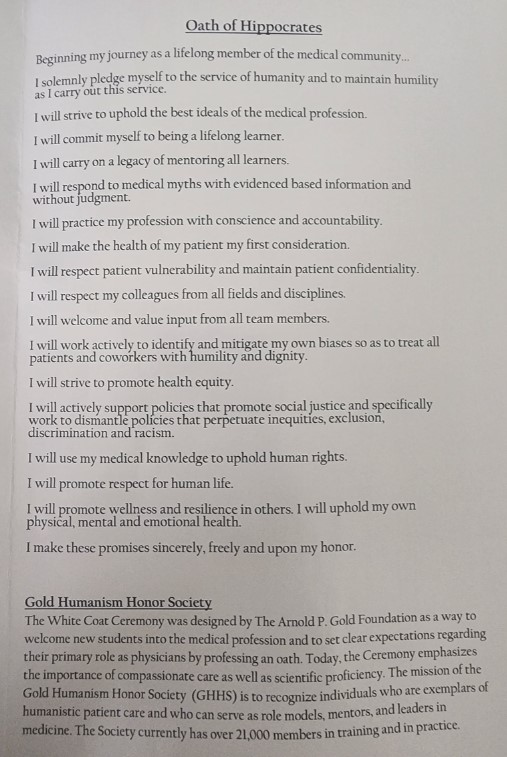
Speaking of FIRE and free speech, I got an email from that organization this morning about how The University of Connecticut has altered the traditional Hippocratic Oath to reflect Social Justice considerations. (It’s far from the only med school that has done this.)  This can be considered compelled speech, which students are supposed to recite even if they disagree with it. You can see the traditional forms of the oath here, and hear the newer one here, starting at 44:12. The students are asked to repeat the oath after the speaker.

The new oath is also transcribed below at the Do No Harm site; I’ve put in a red box the parts that disturbed FIRE:

Here’s the email I got from FIRE:

Incoming medical students typically recite the Hippocratic Oath, a pledge to do no harm to patients. But last August, the University of Connecticut required freshmen medical students to recite an ideologically-charged version of the Hippocratic Oath that reads, in part, 

“I will strive to promote health equity.
I will actively support policies that promote social justice and specifically work to dismantle policies that perpetuate inequities, exclusion, discrimination and racism.”

The school violated students’ First Amendment rights against compelled speech by forcing them to affirm contested political viewpoints. The oath effectively emboldens administrators to punish students who, in their opinion, failed to uphold these nebulous commitments. What, exactly, must a medical student do to “support policies that promote social justice”? If a student disagrees with UConn’s definition of “social justice” or chooses not to promote it in the prescribed way, could she be dismissed for violating her oath?

Today, free speech group FIRE called on UConn to make clear that students may refrain from reciting all or part of the oath without any threat of penalty and will not have to affirm any political viewpoints as a condition of their education at the school.

FIRE Program Officer Ross Marchand: “The constant threat of discipline hangs over UConn students. At any time, administrators could decide that a student has broken the vague, partisan oath that she was forced to take. Even an insufficient commitment to ‘social justice’ could land a student in trouble. UConn prioritized politics and ideology above education and the First Amendment, creating a culture of compulsion and fear.”

Thanks! Check out our letter to the school and our blog post.

The blog post notes this:

In August, UConn required the incoming class of 2028 to pledge allegiance not simply to patient care, but to support diversity, equity, and inclusion. The revised oath, which was finalized in 2022, includes a promise to “actively support policies that promote social justice and specifically work to dismantle policies that perpetuate inequities, exclusion, discrimination and racism.”

This practice is a grave affront to students’ free speech rights. In January, FIRE called the medical school to confirm that the oath is mandatory; an admissions staff member told us it was. We are asking them to confirm this in writing.

As a public university, UConn is strictly bound by the First Amendment and cannot compel students to voice beliefs they do not hold. Public institutions have every right to use educational measures to try to address biases they believe stymie the healthcare system. But forcing students to pledge themselves to DEI policies — or any other ideological construct — with which they may disagree is First Amendment malpractice. This is no different than forcing students to pledge their allegiance to a political figure or the American flag.

. . .   and adds that these “Social Justice Oaths” are not uncommon:

UConn isn’t alone in making such changes to the Hippocratic Oath. Other prestigious medical schools, including those at HarvardColumbiaWashington UniversityPitt Med, and the Icahn School of Medicine, have adopted similar oaths in recent years. However, not all schools compel students to recite such oaths. When we raised concerns in 2022 about the University of Minnesota Medical School’s oath, which includes affirming that the school is on indigenous land and a vow to fight “white supremacy,” the university confirmed that students were not obligated to recite it. That’s the very least UConn could do to make clear that it puts medical education — and the law — ahead of politics.

The letter suggests that taking this oath is not optional but mandatory. From FIRE’s letter from Marchand to Dean Bruce Liang of the UConn Medical School:

FIRE called the UConn School of Medicine Admissions Office to clarify whether the oath, including these additions, is mandatory for students participating in the ceremony. A staff member confirmed that this oath is required for all incoming students. We have also emailed the admissions office to confirm the mandatory nature of the oath but have yet to receive a
written response.

. . . While UConn may encourage students to adopt the views contained in the oath, the First Amendment bars the university from requiring them to do so.  The First Amendment protects not only the right to speak but the right to refrain from speaking. As the Supreme Court has notably held, public institutions may not compel individuals to “declare a belief [and] … to utter what is not in [their] mind.”8 Requiring new students to pledge their loyalty to a particular ideology violates students’ expressive rights, is inconsistent with the role of the university as a bastion of free inquiry, and cannot lawfully be enforced at a public institution. UConn can require students to adhere to established medical standards, but this authority cannot be abused to demand allegiance to a prescribed set of political views—even ones that many students may hold.  Specifically, the school may not compel students to pledge to support or promote concepts such as “social justice” and “equity,” notions that have long been the subject of intense political polarization and debate

You’d think that these deans would know something about the prohibition about compelled speech, but of course they cannot conceive that anybody would opopose the social justice-y bits of their new Oath. They clearly need a lesson in the First Amendment!

Finally FIRE asks for a response in two weeks:

FIRE calls on UConn to make clear that students may refrain from reciting all or part of the oath without any threat of penalty and will not have to affirm any political viewpoints as a condition of their education at the school.
We request receipt of a response to this letter no later than the close of business on February 14, 2025

You can go to this page to send a quick fill-in-the-form letter. I did.

New Executive Order tries to curb colleges’ attempts to circumvent ban on affirmative action

January 22, 2025 • 11:30 am

As you surely know, the U.S. Supreme Court banned race-based college admissions in the highly publicized Students for Fair Admissions v. Harvard case in 2023, (Military academies were an exception.) The vote, along the usual lines, was 6-2 (Sotomayor and Kagan dissenting) when Harvard was the defendant (Justice Jackson recused herself), and 6-3 for the University of North Carolina case.  As Wikipedia notes, the majority opinion, written by Justice Roberts, said this:

Justice Roberts wrote that the Equal Protection Clause of the Fourteenth Amendment applies “without regard to any difference of race, of color, or of nationality” and thus must apply to every person. As such, “Eliminating racial discrimination means eliminating all of it”, adding that “For ‘[t]he guarantee of equal protection cannot mean one thing when applied to one individual and something else when applied to a person of another color. ” Roberts wrote that the affirmative action programs “lack sufficiently focused and measurable objectives warranting the use of race, unavoidably employ race in a negative manner, involve racial stereotyping, and lack meaningful end points. We have never permitted admissions programs to work in that way, and we will not do so today”.

There was vocal opposition by many colleges and universities, who said they were committed to promoting (racial) diversity, though they grudgingly admitted they’d follow the law.  But, as Jonathan Turley points out, they really didn’t. All of us at universities have seen how schools have tried to do an end run the law, including adding admissions essays in which students could tout their race by relating how they overcame difficulties in their past. Turley:

We have previously discussed how universities and colleges openly planned for the final rejection of race-based admissions criteria. Many universities denounced the Supreme Court and pledged to “reimagine” admissions. Medical schools are being encouraged to “pivot” to continue reaching diversity goals for entering classes. More schools are moving to dump objective standardized tests (or make them optional) in favor of more subjective scoring to shield racial criteria for admissions. Others are tweaking essay prompts to shift enhancements based on race.

Roberts himself anticipated some of those efforts in referencing how students could still self-identify as minorities in discussing their views or struggle with racial discrimination.

The use of federal authority to investigate such circumvention could be a major change for higher education. Most schools have resisted transparency or disclosures on such practices and private litigants often find it difficult to get courts to order discovery. This could expose schools to greater public scrutiny.

The question is how the government will address circumventions, such as using essay prompts to reintroduce racial identification. In my view, this would raise serious free speech issues for both schools and students.

The outcomes of this decision were not exactly what you’d expect: according to the NYT, black and Hispanic enrollment declined, but white and Asian enrollment didn’t increase, more students did not disclose their race, there was a HUGE variation in outcomes among colleges, and we have only one year of data to see what shook out.

The free speech issue is one that just arose when Trump issued his new executive order (below the fold) on DEI. I’ve already addressed the elimination of DEI in government, but this order extends it to institutes of higher education. Here’s the relevant part taken from Turley’s column, which reproduces it all:

Sec. 5.  Other Actions.  Within 120 days of this order, the Attorney General and the Secretary of Education shall jointly issue guidance to all State and local educational agencies that receive Federal funds, as well as all institutions of higher education that receive Federal grants or participate in the Federal student loan assistance program under Title IV of the Higher Education Act, 20 U.S.C. 1070 et seq., regarding the measures and practices required to comply with Students for Fair Admissions, Inc. v. President and Fellows of Harvard College, 600 U.S. 181 (2023).

Sec. 6.  Severability.  If any provision of this order, or the application of any provision to any person or circumstance, is held to be invalid, the remainder of this order and the application of its provisions to any other persons or circumstances shall not be affected thereby.

Sec. 7.  Scope.  (a)  This order does not apply to lawful Federal or private-sector employment and contracting preferences for veterans of the U.S. armed forces or persons protected by the Randolph-Sheppard Act, 20 U.S.C. 107 et seq.

(b)  This order does not prevent State or local governments, Federal contractors, or Federally-funded State and local educational agencies or institutions of higher education from engaging in First Amendment-protected speech.

That looks pretty straightforward but, as Turley says, litigation is in store:

However, the greatest contribution could be the exposure of circumvention systems or practices. In his order, Trump wrote that “Institutions of higher education have adopted and actively use dangerous, demeaning, and immoral race- and sex-based preferences under the guise of so-called ‘diversity, equity, and inclusion.’” His order directs all federal agencies to each identify up to nine corporations, large non-profit groups, or institutions of higher education with endowments exceeding $1 billion which are violating civil rights laws.

The agencies are to develop an action plan against “illegal discrimination or preferences.” Those preferences are described as not only violating “the text and spirit of our longstanding Federal civil-rights laws,” but “also undermine our national unity.” The plan is to consider federal litigation and regulatory actions.

The order also instructs incoming Attorney General Pam Bondi and Secretary of Education Linda M. McMahon to issue guidance within 120 days to all state and local educational agencies on how to abide by the 2023 Supreme Court ruling that struck down race-based affirmative action policies. That could prove a major new element for higher education in setting out criteria for evaluating compliance by schools.

This is clearly going to generate intense litigation. The definition of DEI is vague and is likely to draw challenges. For example, organizations will argue that the following line could become dangerously subjective in its application or enforcement:

“Terminate all ‘diversity,’ ‘equity,’ ‘equitable decision-making,’ ‘equitable deployment of financial and technical assistance,’ ‘advancing equity,’ and like mandates, requirements, programs, or activities, as appropriate.”

Such vague terms are likely to draw judicial scrutiny and could sweep too broadly for figures like Chief Justice Roberts. Agencies will need to narrow and add greater clarity on these terms as they move forward with this mandate.

Moreover, while the EO expressly states that it is not to be construed as limiting free speech, these policies and programs could easily contravene that right. Federal contacts will now have an affirmative statement of compliance by organizations, including universities and colleges, that they do not have DEI components.

An affirmative statement of compliance could, I suppose, also be construed as compelled speech.  “Equity” is not defined, and so on. It seems to me that there are better ways to monitor compliance with the Supreme Court’s order.  After all, the Harvard case rested on statistical analysis, interviews, and the like, and showed, at least to the Court’s satisfaction, that Harvard was not complying with standing law (presumably the Bakke case).

Click “read more” to see the order

Continue reading “New Executive Order tries to curb colleges’ attempts to circumvent ban on affirmative action”

The failure of academia: a take by William Deresiewicz in The Chronicle of Higher Education

November 26, 2024 • 10:00 am

The Chronicle of Higher Education is regarded as the most reputable site for news and opinion about American higher education. Not that you’ll agree with everything in it, but the article below, by William Deresiewicz, an author and critic who taught English at Yale for ten years, seems to me the most accurate and eloquent indictment about where American academia has failed in its mission. (Deresiewicz also wrote Excellent Sheep: The Miseducation of the American Elite and the Way to a Meaningful Life, an indictment of Ivy League and other “elite” colleges.)

Nearly all the explanations for Trump’s victory over Harris involve in part a rejection of American elitism and wokeness (they’re connected, of course), and to Deresiewicz, the results of the November 5 election not only show that “the politics of the academy have been defeated”, along with “its ideas, its assumptions [and] its policies and practices,” but also that the rejection of Harris is connected with the public’s rejection of woke academia. As I said yesterday, the public’s respect for and confidence in higher education has dropped in recent years, and dropped quite sharply.

Below is figure from a recent Gallup poll.  If you lump together those Americans who have a “great deal of confidence” in higher education with those having “quite a lot of confidence”, the composite percentage dropped from 57% in 2018 to 36% last year. That’s a substantial fall!  And I agree with Deresiewicz’s view that the reason for this fall is connected with the defeat of Kamala Harris. Despite Harris’s conscious decision to look more centrist after her nomination, it was too late: the Democrats had already established themselves as the Party of Wokeness, with the center of gravity of the party, and Biden) having moved towards extreme Leftist “progressivism”:

Click the headline below to read Deresiewicz’s take:

There are some telling data in the second paragraph, and I’ve bolded the part giving evidence that the wokeness pervading the Democratic party and American universities, whose faculty are overwhelmingly Democratic, played a role in the election:

Some data points: A post-election survey from Blueprint, a Democratic polling firm, discovered that, among reasons not to vote for the Democratic presidential nominee, “Kamala Harris is focused more on cultural issues like transgender issues than helping the middle class” ranked third, after only inflation and illegal immigration. Among swing voters, it ranked first. California approved a ballot measure to stiffen penalties for theft and drug crimes by a margin of 69-31. Los Angeles elected a former Republican as district attorney over the progressive incumbent by 61-38. Alameda County, which covers most of the East Bay including Berkeley, recalled its progressive DA by 63-37. Portland, Ore., elected a former businessman as mayor over the leading progressive candidate by 18 points.

“Among swing voters, it ranked first”! They didn’t ask about the view that “sex in humans is a spectrum,” something codified into law by the Biden administration but not mentioned by Harris, but many voters who rejected the Democrats surely knew about this, too.

Here’s Deresiewicz’s view on how the teachings of elite colleges trickled down to the public, who rejected them on November 5:

Over the last 10 years or so, a cultural revolution has been imposed on this country from the top down. Its ideas originated in the academy, and it’s been carried out of the academy by elite-educated activists and journalists and academics. (As has been said, we’re all on campus now.) Its agenda includes decriminalization or nonprosecution of property and drug crimes and, ultimately, the abolition of police and prisons; open borders, effectively if not explicitly; the suppression of speech that is judged to be harmful to disadvantaged groups; “affirmative” care for gender-dysphoric youth (puberty blockers followed by cross-sex hormones followed, in some cases, by mastectomies) and the inclusion of natal males in girls’ and women’s sports; and the replacement of equality by equity — of equal opportunity for individuals by equal outcomes for designated demographic groups — as the goal of social policy.

It insists that the state is evil, that the nuclear family is evil, that something called “whiteness” is evil, that the sex binary, which is core to human biology, is a social construct. It is responsible for the DEI regimes, the training and minders and guidelines, that have blighted American workplaces, including academic ones. It has promulgated an ever-shifting array of rebarbative neologisms whose purpose often seems to be no more than its own enforcement: POC (now BIPOC), AAPI (now AANHPI), LGBTQ (now LGBTQIA2S+), “pregnant people,” “menstruators,” “front hole,” “chest feeding,” and, yes, “Latinx.” It is joyless, vengeful, and tyrannical. It is purist and totalistic. It demands affirmative, continuous, and enthusiastic consent.

People are fed up, and I don’t just mean people who voted for Trump. . . [The author recounts the story a woman, a black graduate of Berkeley, who called into an NPR station on the air, saying that black people were fed up with being called “racists” when they simply opposed Biden’s policy of nearly open borders.]

Deresiewicz explains why academia (and the Left in general] has become more extreme. The leftward and largely unhinged shift has, he says, been spearheaded by “studies” department and other departments “not answerable to reality”. But as I’ve written frequently, science too, is being colonized by the “progressive” ideology that most Americans reject:

How did things get to this pass? And how did the academy, the school and citadel and engine of this revolution, become so desperately out of touch with reality, including the reality of people’s lives outside the liberal elite, their needs and beliefs and experiences? One answer is that academics tend to live inside a bubble. They socialize with other academics; far more than used to be the case, they marry other academics; and, of course, they work with other academics. When groups whose members are broadly similar in outlook are isolated from external influences, two things happen: Their opinions become more homogeneous, and their opinions become more extreme. Which is exactly what’s been taking place in the academy in recent decades. The ratio of liberals to conservatives has soared, and more of those who identify as left identify as far left. And both of those trends are more pronounced in the fields and institutions that are leading the revolution: the humanities, the social sciences exclusive of economics, the “studies” programs and departments, the schools of education and social work, the elite universities, and the liberal-arts colleges.

He calls these fields “intellectually corrupt”, and while that may seem extreme, the corruption is ubiquitous.  Yesterday one of my colleagues in an elite college went to a talk on “fat studies”, a talk sponsored by Gender Studies. The point the speaker made was that being obese was not a cause of morbidity and mortality, and the data supporting that was a claim that fat is “protective” in rats. But fat rats die more often than normal ones, just like humans. And in humans, if you simply Google “obesity and mortality”, you find a gazillion references about how being too fat can cause considerable health problems and death.  But the Fat Studies speaker simply denied this, saying that science is one of the impediments to fat acceptance. The speaker claimed instead that health problems with human obesity are the result of dieting, not being overweight!

This flat denial of reality—a reality everyone knows—in the cause of ideology is one reason for the intellectual corruption of “studies”. While such a thesis advanced before a biology department would meet with derision, I’m not so sure that the inhabitants would also soundly reject the claim that “there are only two sexes in humans.”

Here’s Deresieeticz’s argument about the disconnect between reality and “studies” programs, which he also lumps with “social sciences exclusive of economics” and “the schools of education and social work”:

The reason that these disciplines can drift so far from reality is that they are not answerable to reality. If an engineer miscalculates an equation, the building falls down. But what would accountability to reality even mean in the humanities, given that their findings are never applied? It’s not like there are going to be consequences for saying something stupid about Shakespeare. In the social sciences, and, less often, in the hybrid “studies” fields, findings are applied, but it isn’t clear that there’s much of a feedback loop there either. How many hypotheses in psychology have been abandoned because they led to bad educational policy? How many gender-studies scholars have rethought their suppositions in the face of the calamity of gender youth medicine? The more a field becomes beholden to theory, or Theory, the further it floats away from empirical observation and therefore correction. The enterprise becomes entirely self-referential, words built on words, a kind of intellectual Ponzi scheme.

These disciplines could be answerable to reality, as instantiated by the claims of the Fatness Studies speaker, but when data contradict their ideological underpinnings, they simply deny the data.

This piece is particularly well written, and I’ll add just two more bits to show that. Do read it if you have any interest in academia and the outcome of this month’s election:

[Academics] might further consider that the majority of Black, Latino, and Asian Americans do not share their politics or ideology; that the people who speak for those communities in elite liberal spaces — not only colleges and universities but the media, the arts, the nonprofits — share the politics and points of view not of those communities but of other liberal elites and therefore do not, in the simplest and most important sense, represent them; that progressives have been promulgating policies in the names of those communities that they reject — for Blacks, police defunding and abolition; for Latinos, lax immigration and border enforcement — and that they reject them for good reasons. That identity is not a very useful way of understanding people’s motivations.

. . . Finally, they might consider that to say that certain people “vote against their interests” is not only condescending but wrong. People know what their interests are. They know it much better than you do. Their interests are the same as everybody else’s: public safety, economic security and opportunity, and on top of that a little dignity, a little respect. And while Trump is hardly likely to advance those goals, the 80 percent of the country that lies below the upper middle class is perfectly justified in doubting whether the Democratic Party, and the elites that run and influence it, will do so either, because for decades they have not. Yes, Trump is appalling, evil, criminal. But the worse he is, the worse the liberal elite must be, if so many prefer him to them.

Deresiewicz says that the solution is for academics to “entertain the possibility that they’ve been wrong, about a lot of things, and for a long time,” but considers that this is unlikely compared to academics “staying the course”, which of course means becoming woker and woker. If you’re fighting against this at a university, as many of us are, you know that while there are some hopeful signs, like the decline of DEI (a decline that will become steeper under Trump), there is little to stop the slide towards denial of the truth in the service of ideology. Since one of the purposes of academia is to discover and promulgate the truth, this will ultimately lead to academics becoming a mockery in the public eye. It’s already halfway there.