Readers’ wildlife photos

September 8, 2025 • 8:15 am

Well, this is about the end for photos: the last full contribution, though I can confect a few others by combining individual photos from various readers. If you have good photos, now’s the time to send them in.

Today’s photos are from the Facebook page (with permission) of Aussie Scott Ritchie, a retired medical entomologist who now travels the world taking fantastic pictures of birds.  He lives in Cairns.  Scott’s narrative and captions are indented, and you can enlarge the photos by clicking on them.

This past 6 weeks (from mid July to late August) featured the annual Cairns Bird Photography competition as part of the Cairns Bird Festival. I spent most of that time chasing local birds to enter in the comp. As is my wont, I concentrated on 3 main themes that I fell into searching for nice bird images. In reality, the birds led the way, and I just followed.

The three themes were 1. Pretty in pink; 2. Fig-parrot sushi train; and 3. finch stampede. Pretty pink? Flowering Pink Trumpet trees (Tabebuia rosea) in the Cairns Cemetery attracted honeyeaters and served as a nice backdrop to relatively dull Helmeted Friarbirds (Philemon buceroides) and Brown Honeyeaters (Lichmera indistincta). I had fun waiting for the birds to pop up for the camera.

A sandpaper fig tree in the cemetery was a sushi train for Double-eyed Fig-Parrots (Cyclopsitta diophthalma) as they chowed down on the messy figs. Serviettes anyone? These cute little birds allowed me to get relatively close, and to capture their interactions with green ants that also loved figs.

Lastly, an animal feedstore near Yorkeys Knob had a swarm of finches, mostly Chestnut-breasted Mannikins (Lonchura castaneothorax), that spent much of their day feeding on spilt grain in the grass. The staff threw grain they had swept up from the floor into the adjacent grass. Finches, Peaceful Doves (Geopelia placida) and the local chooks had a feast! The mannikins would feed in a cluster, then explode into the air at the slightest disturbance. I used the “pre-capture” mode of my Canon R5-2 to capture this tsunami of finches, one of which won “best Bird in Flight” category.

I had fun just getting out and targeting birds across these three themes. Here are some of my favourites images.

Pretty in pink: A Brown Honeyeater out for a morning run:

Pretty in pink: Brown HE, nothing to fear, it’s stingless!:

Pretty in pink: Helmeted Friarbird spots a stingless bee:

Pretty in pink: “What, you think I’m ugly?” Helmeted Friarbird:

Fig sushi bar: A male Double-eyed Fig-Parrot makes a meal out of his fig. These wee birds can be spotted by following the trail of fig crumbs falling from the canopy:

It’s the fig, or the ants!:

Green ants are a constant pain to these cute birds. “Do you think they noticed me?”:

One last little fig!:

Off he goes!:

“Who’s next?” Chestnut-breasted Mannikins drop into the bird seed buffet:

It’s a regular pig out. But keep an eye out for trouble! An incoming vehicle, walking person or flyover raptor spooks these guys:

Trouble spooks the birds. “What the F@*k!” A male mannikin is bowled over by a stampede of finches as they rise as one from the grass. This image won Best Bird in Flight:

Note so peaceful dove. A Peaceful Dove is caught up in the finch tsunami:

Backlit finch tsunami:

A bit of artistic blur:

Readers’ wildlife photos

August 27, 2025 • 8:15 am

Today’s photos come from reader Kevin Krebs, who sent in photos from a trip in British Columbia (part 1 is at the first link below). Kevin’s captions and IDs are indented, and you can enlarge his photos by clicking on them.

The Crowsnest to Osoyoos – Part 2

Princeton to Osoyoos

My previous post left off with a photo of the incredible geology around Hedley, BC on the way to Osoyoos.

Before we get back on the road, let’s talk a little about Osoyoos and why I am drawn to it as a destination every spring.

When most people think of British Columbia, they envision old-growth forests, our rugged coast, and our mountains (and, of course, the incredible Burgess Shale!). Many people, even British Columbians, are unaware we have a xeric shrubland biome only a few hours drive away.

I love the coast — it’s where I cut my teeth as a birder—but the antelope and sagebrush grasslands in the southern BC interior are akin to visiting another country. The flora and fauna are so different that I’m engulfed in a nebula of discovery and confusion. Maybe it’s a way of meditating, of striving to see and hear and smell what is really there.

Grasslands are one of the most threatened ecosystems on our planet, yet receive scant attention: old-growth forests are easy to comprehend, but few of us think about old-growth grasslands. Our primate brains and maniacal culture see only empty fields to be cleared for parking lots and big-box stores. As a result, grassland birds have seen terrible declines for decades, as I’m sure other grassland species have as well.

With that scene set, let’s continue our excursion…

The next stop on the route is the village of Keremeos, the “fruit stand capital of Canada,” where I can find several families of (ridiculously cute) California Quail (Callipepla californica). This male was perched on a branch to keep a keen eye on me.

On the outskirts of Osoyoos is the incredible Nighthawk Hill Grasslands. This year was the first time I explored it. I often return there in my mind when I’m stuck on a crowded bus.

While there, I was lucky to spot three birds I rarely see…

A Brewer’s Sparrow (Spizella breweri) — unfairly described as a “small, drab sparrow” (ok… maybe it’s true, but I always find myself annoyed by our human judgments of other beings) with a complex song. Named after Tomas Brewer, a 19th-century naturist and ornithologist.

Here’s a Lark Sparrow (Chondestes grammacus) that I also spotted at Nighthawk Hill Grasslands. A larger, beautiful sparrow that is the only species in the genus Chondestes. It also has a distinctive song.

A Clark’s Nutcracker (Nucifraga columbiana)! I was absolutely elated to find this bird — I’d never found it before, and it was one of the species I hoped to see on this trip. Closely related to crows and jays, these birds are the primary seed disperser for whitebark pine (Pinus albicaulis). Not a great photo, but it was the best I got without disturbing the bird too much.

This was the second year I saw a Blacked-backed Woodpecker (Picoides arcticus) while visiting Kilpoola Lake Road just outside of Osoyoos. These woodpeckers specialize in foraging in recently burnt forests and bogs with dead trees — their black back helping to camouflage them against the burned trunks.

Uncommon on the coast, Red-naped Sapsuckers (Sphyrapicus nuchalis) are somewhat more common in the interior of British Columbia. Unlike more well-known woodpeckers, sapsuckers drill rows of holes into trees, feeding primarily on the sap that is exuded by the tree in defense.

Continuing with woodpeckers, I was pleased to spend some time with this Hairy Woodpecker (Dryobates villosus). While easy to confuse with the smaller Downy Woodpecker (Dryobates pubescens), a close look at the size of the bill will help pick them apart.

A Calliope Hummingbird (Selasphorus calliope) — the smallest bird native to North America, weighing 2-3 grams (0.071 to 0.106 oz) and measuring 7-10cm (2.8–3.9 in) in length. Breeding from British Columbia to Colorado, they migrate to southern Mexico for the winter.

Simultaneously curious and suspicious, this Yellow-pine Chipmunk (Neotamias amoenus) spent a while checking in on me as I rested by the side of the path.

Another bird that was on my wish-list: a Pygmy Nuthatch (Sitta pygmaea). A small and ridiculously cute bird.

And last, a weirdo bird — the Yellow-breasted Chat (Icteria virens). While quite widespread across North America, Yellow-breasted Chats tend to be shy and difficult to spot. Once thought to be a type of warbler, as of 2017 it was moved to the monotypic family Icteriidae .

That wraps up this post. I hope you enjoyed it, and with a little luck maybe I’ve inspired you to travel somewhere new and to care about landscapes and ecosystems that have been ignored by too many of us.

Readers’ wildlife photos

August 25, 2025 • 8:15 am

Today, mathematician and Hero of Intellectual Freedom, UC Davis’s Abby Thompson has more lovely intertidal pictures from California. Her captions and IDs are indented, and you can enlarge the photos by clicking on them.

The Northern California tidepools are filling with kelp, and creatures are hiding away under it.   Here are some photos while there’s still a bit of summer left.     These are from July, except for the pelicans (August 1). Thanks as usual to experts on inaturalist for some of the IDs.

Tegula funebralis (black tegula): I love these tracks on the sand at low tide; it looks as though the snails are trying to tell us something:

Closeup of the barnacle-encrusted snail from the first photo:

Hesperocyparis macrocarpa (Monterey Cypress). The trunks get stroked by many hands as people pass them on their way down to the beach:

Pelecanus occidentalis (brown pelican): There must have been a large shoal of fish near shore; the pelicans (it seemed like hundreds of them) were going nuts.    Their lethal dives, with those incredible beaks, makes their relation to dinosaurs look very convincing.  The Point Reyes peninsula is in the background:

Family Ammotheidae (Pycnogonid-sea spider): The lumpy white spots on the legs are eggs (what a place to carry them!), which I believe makes this a female.  The males carry the eggs after they are fertilized:

Tenellia lagunae (nudibranch):

The next few photos are through a microscope.  I have an ancient Leitz Wetzlar dissecting scope, with an old iphone precariously clamped over one eyepiece. There must be a better way, but I haven’t figured it out yet.

Diatoms: Genus Isthmia; Lou Jost’s beautiful post on WEIT on the Challenger Expedition and the diatoms they found  was inspiring. It’s disconcerting, as a non-biologist, to look through a microscope at a fluffy, frothy bit of seaweed (the reddish stuff) and see, scattered all through it, these incredibly regular geometric shapes:

Diatoms closeup:

Neosabellaria cementarium ((tiny) polychaete worm):

Phylum Foraminifera: This was a surprise to me, partly because I had never heard of foraminifera, but mostly because it turns out they’re single-celled organisms (like diatoms), so that’s one cell you’re seeing.   Google AI says this about the difference between diatoms and foraminifera: “Diatoms are photosynthetic algae with silica cell walls, while foraminifera are amoeboid protists with calcium carbonate or agglutinated shells.”

There are many more elaborate/complex ones than this one (there’s one that looks a lot like a loaf of challah, for example).   It’s worth googling “foraminifera” and “Ernst Haeckel” to see some amazing illustrations. The Challenger Expedition discussed by Lou Jost also collected and documented foraminifera.  According to Wikipedia, the first picture of one was by “…Robert Hooke in his 1665 book Micrographia”.  This book (available through WikiSource online) has charming sections like: “Of the Teeth of a Snail”, and “Of blue Mould, and of the first Principles of Vegetation arising from Putrefaction”.   The possible foraminifera appears as figure X in Schema 5.   He says (in Observation XI) “I view’d it every way with a better Microscope and found it on both sides, and edge-ways, to resemble the Shell of a small Water-Snail with a flat spiral Shell:” Imagine being one of the first to be able to peer into this world!

The camera for the first six pictures in an Olympus TG-7.

Readers’ wildlife photos

June 16, 2025 • 8:15 am

Today we have photos sent in by Mark Joseph, all taken by one of his friends and reproduced with permission. Mark’s captions are indented, and you can enlarge the photos by clicking on them.

Here are photos from the fourth and last of my photographing friends in the local Audubon group (previous sets can be found here, here, here, and here. Her name is Connie, and these are pictures from the large city park in Grand Rapids, where the group walks every Thursday morning (and where the birds are considerably less exotic than on the birding trips of my other friends). She tends to be more “artsy” and less “birdy” than the others, and has a good eye:

Droplets on a plant:

Mini-icicle:

Patterns in the water on a pond:

But she also takes very good bird (and other critter) photos:
Brown creeper (Certhia americana):

Mallard (Anas platyrhynchos):

Mute swan (Cygnus olor) close to the classic “heart/boat” configuration:

Song sparrow (Melospiza melodia):

Yellow warbler (Setophaga petechia), a serious candidate for the cutest bird in the world (my vote probably goes to the Piping plover, but this guy might just be a close second):

Rose-breasted grosbeak (Pheucticus ludovicianus), male:

Female, sitting on a nest just off of the path; we’ve seen her each of the last three Thursdays (May 22, 29, June 5); there were chicks in the nest on June 12:


American robin (Turdus migratorius) with berry:

American tree sparrow (Spizelloides arborea):

Brown-lipped snail (Cepaea nemoralis), one of her specialties:

That does it for now, but I will come back to my friends (I have lots of great pictures from them). Next time I’ll (re-)introduce myself, explain why I’m not much of a photographer, and present one nevertheless truly astounding picture.

Readers’ wildlife photos

January 25, 2025 • 8:15 am

I have only a few more batches of photos, so please send yours in if you have good ones. Thanks!

Today’s bird photos (and one mammal) come from regular Susan Harrison, an ecologist at UC Davis.  Susan’s IDs and captions are indented, and you can enlarge her photos by clicking on them.

Going About Their Business

This set of photos — my 75th for WEIT — emphasizes animals who are doing a little more than just sitting around.  All of these were taken near Davis, California, in January 2025.

Western Bluebirds (Sialis mexicana) in my backyard on New Year’s Day, checking out a years-old and not-yet-used nest box.   Perhaps I’ll become a bluebird landlady at last!

Great Blue Heron (Ardea herodias) stalking, pouncing, extracting its prey in a clump of vegetation, and finally swallowing its meal.  Light reflected from the ripples caused the striking “lava lamp” effect on the bird:

Black-necked Stilts (Himantopus mexicanus) creating a DNA strand pattern with their legs:

Golden-crowned Kinglet (Regulus satrapa) digging for goodies in the bark of a Valley Oak (Quercus lobata) festooned with Oak Apple Galls (Andricus quercuscalifornicus):

Ruby-crowned Kinglet (Regulus calendula) fleeing and flashing a bit of his fiery crown:

Sharp-shinned Hawk (Accipiter striatus) preening and fluffing:

White-tailed Kite (Elanus leucurus) heading west with the sunset:

Great Horned Owl (Bubo virginianus) striking a catlike pose:

American Kestrel (Falco sparverius) hovering against a strong wind:

Loggerhead Shrike (Lanius ludovicianus) pausing from its murderous work, with a backdrop of snowy Sierran peaks:

Eastern Fox Squirrel (Sciurus niger) glaring at an annoying photographer:

Readers’ wildlife photos

January 1, 2025 • 8:15 am

It’s a new year, this is my 29,848th post since I began in 2009, and we have a new contributor to the photo series: Amy Perry from Indiana. Her photos below, though, are from California.  Amy’s captions and IDs are indented, and you can enlarge her photos by clicking on them.  I have added the Wikipedia links.

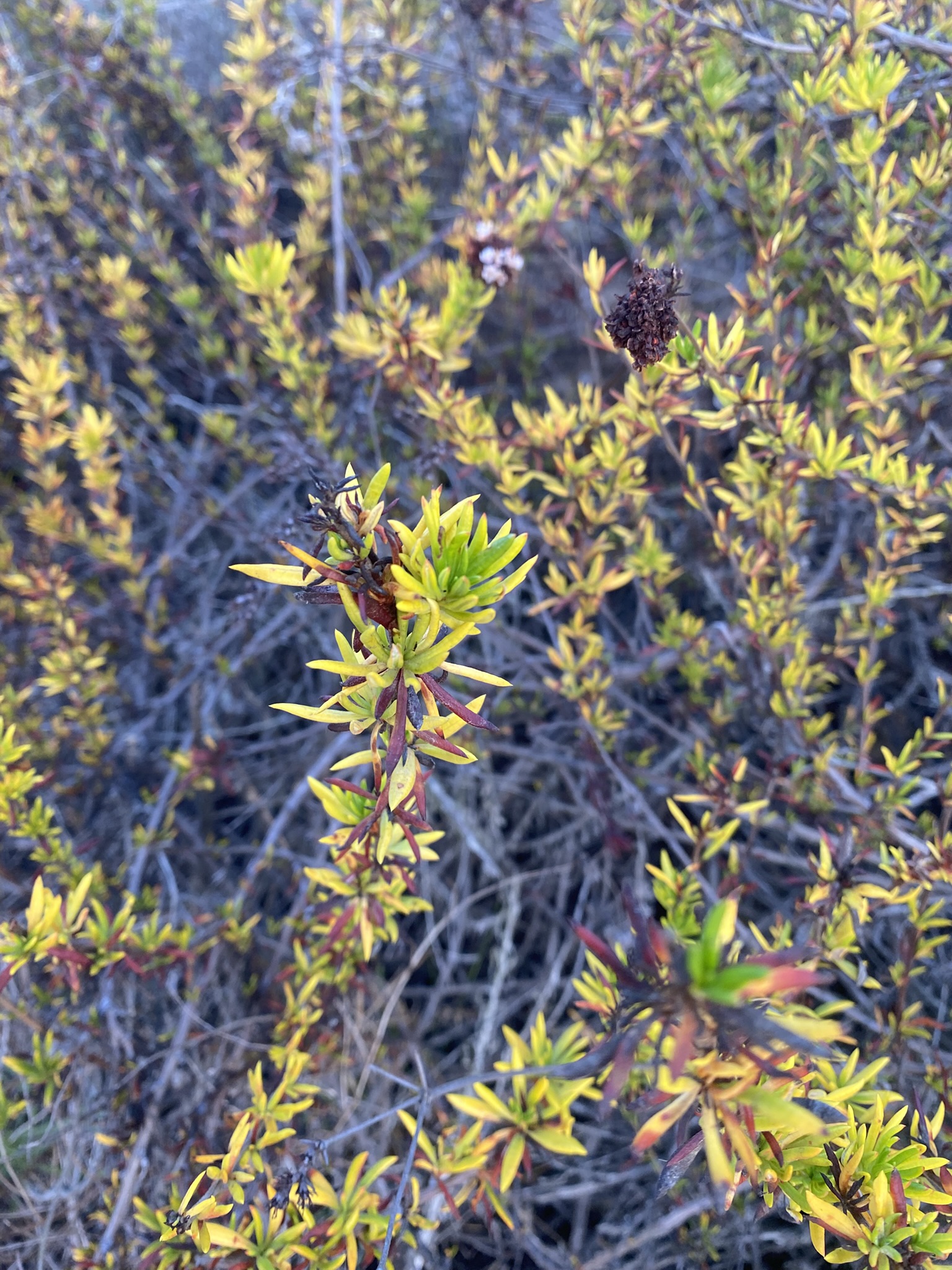
I took a hike in the Torrey Pines State Natural Reserve Extension in the Del Mar neighborhood in San Diego. All the photos except for the three with asterisks were taken there. It is a hilly shrubland with views of the Pacific. All quotations are from the book California Plants: A Guide to Our Iconic Flora, by Matt Ritter. These plants are all in the shrublands section. I didn’t want to use descriptions from Wikipedia because readers could read them for themselves there. I wanted to provide info not easily accessible.

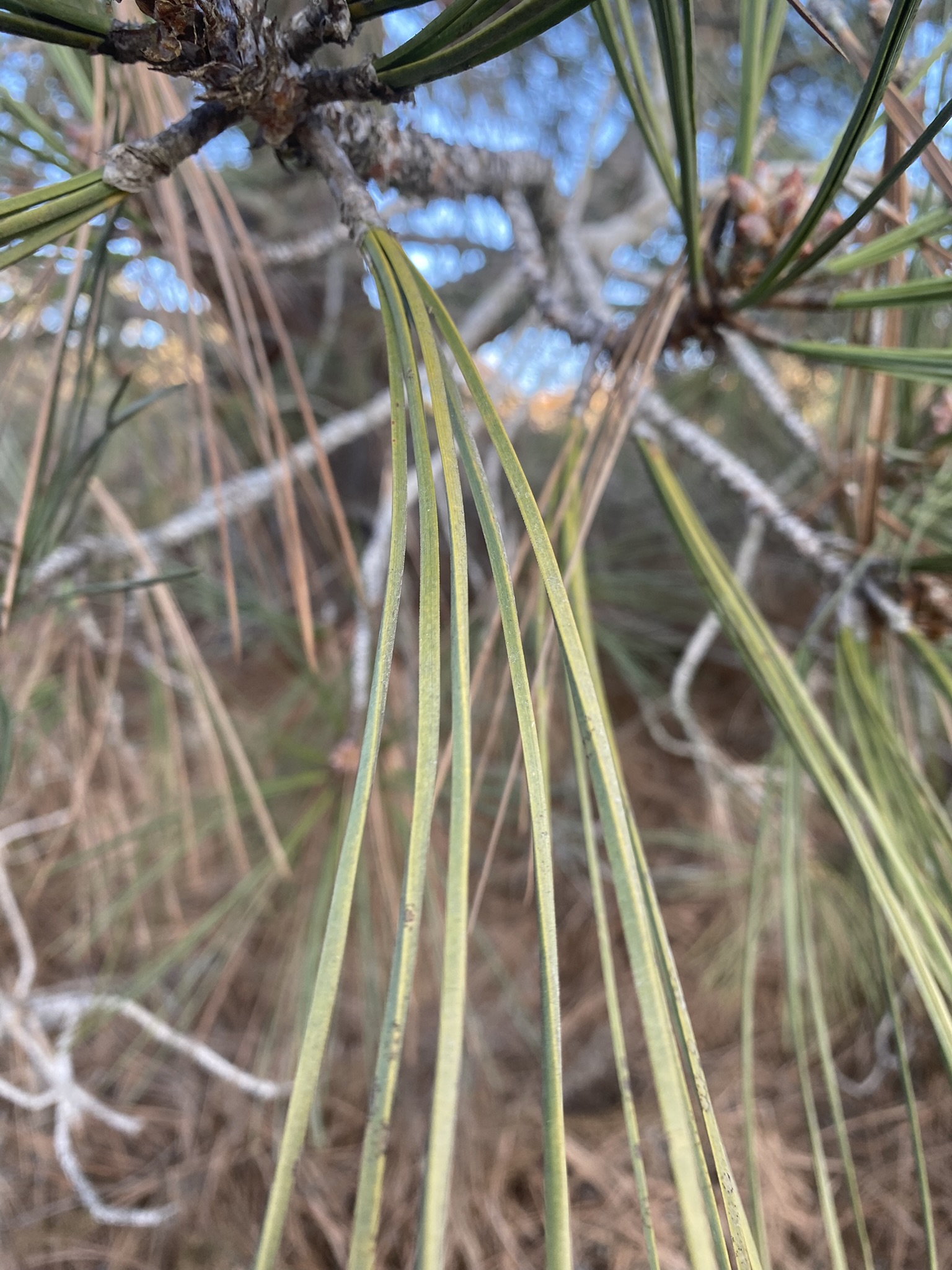
“The Torrey Pine (Pinus torreyana) is the rarest species of pine in North America. There are about 3,000 wild individuals growing along the coast of northern San Diego, almost entirely in Torrey Pines State Natural Reserve…. This species can be distinguished from other pines by its twisted canopy of long gray green needles that are in bundles of five. The name commemorates John Torrey, a 19th century botanist and physician, and an original member of the National Academy of Sciences.”:

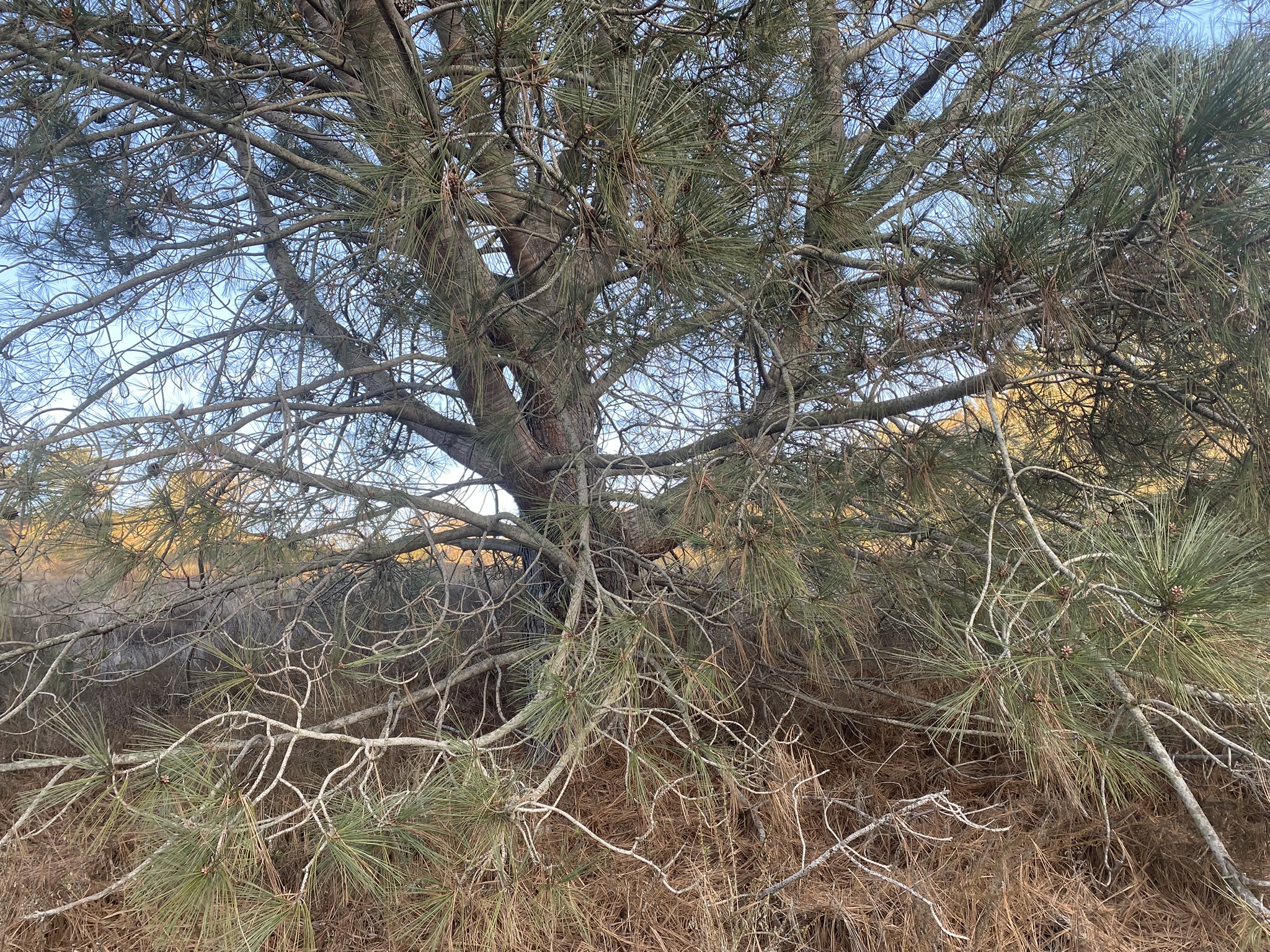
Torrey Pine (Pinus torreyana). Note how gangly and sprawly and chaotic-looking this tree is. Many desert plants are like that:

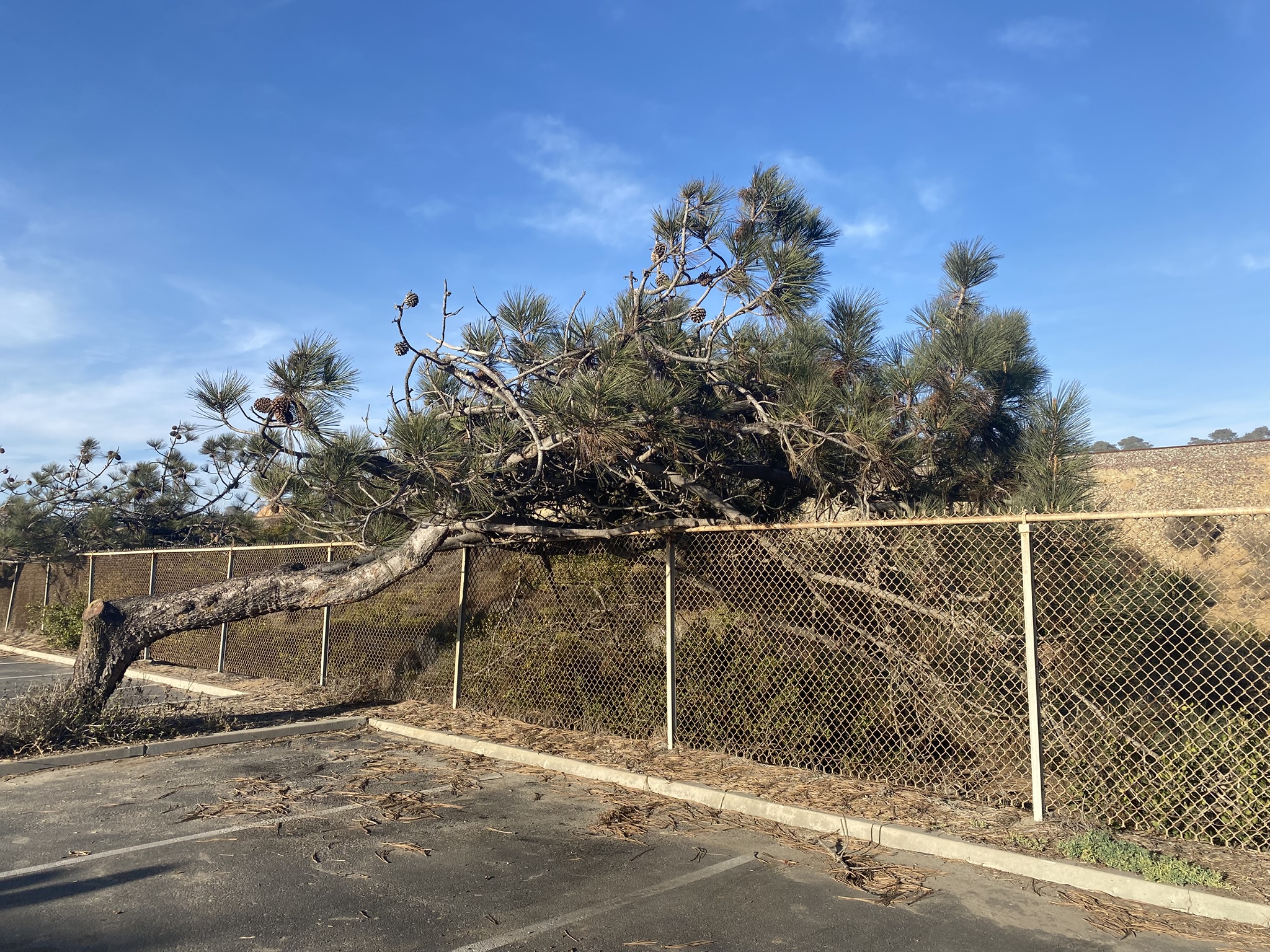
*Torrey Pine (Pinus torreyana) in the beach parking lot. “Trees along the immediate coast grow slowly, battered by ocean, winds and salt spray and sculpted into unusual shapes.” This tree had had part of it cut off, but the remaining part still has a very unusual shape:

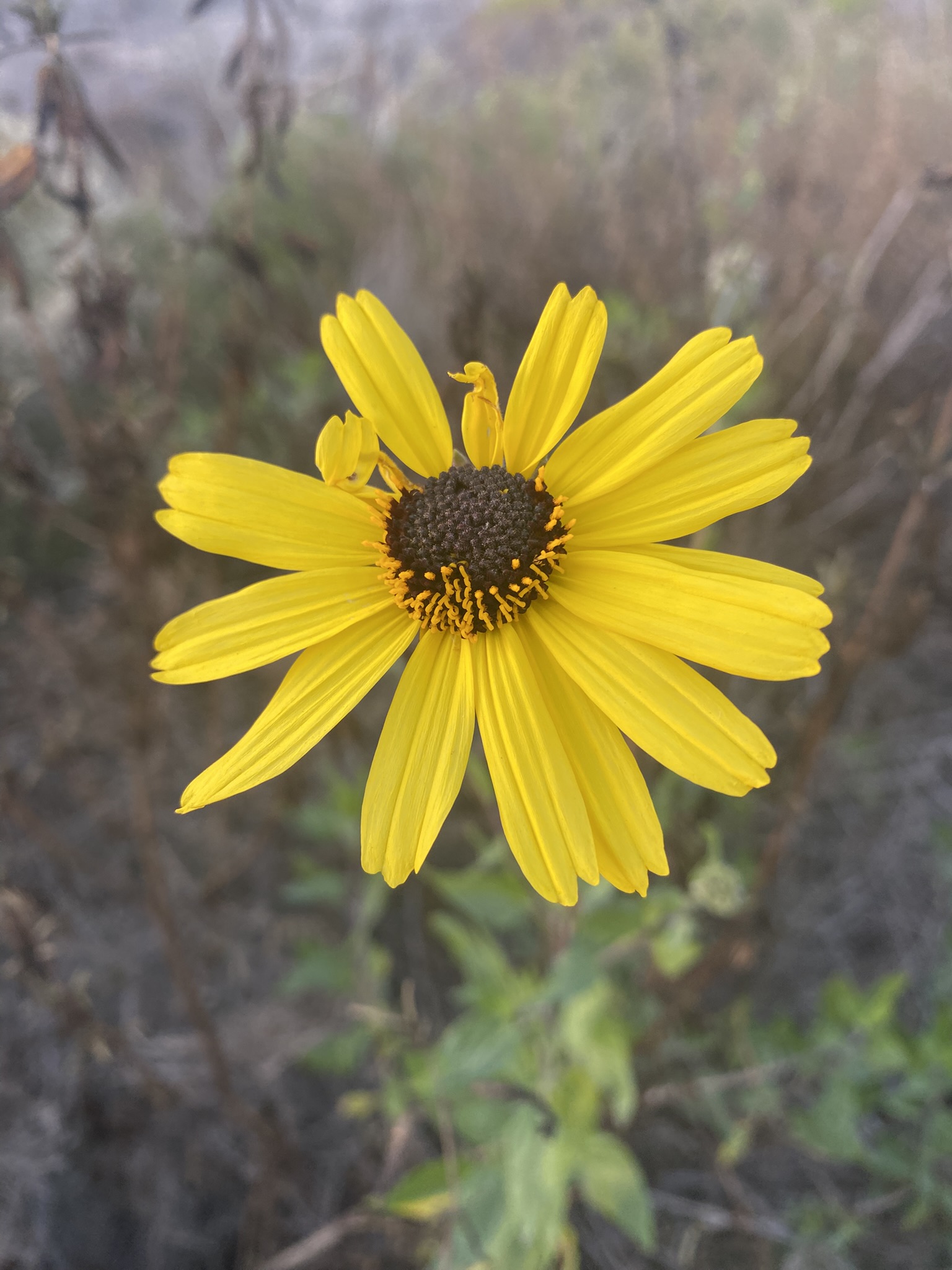
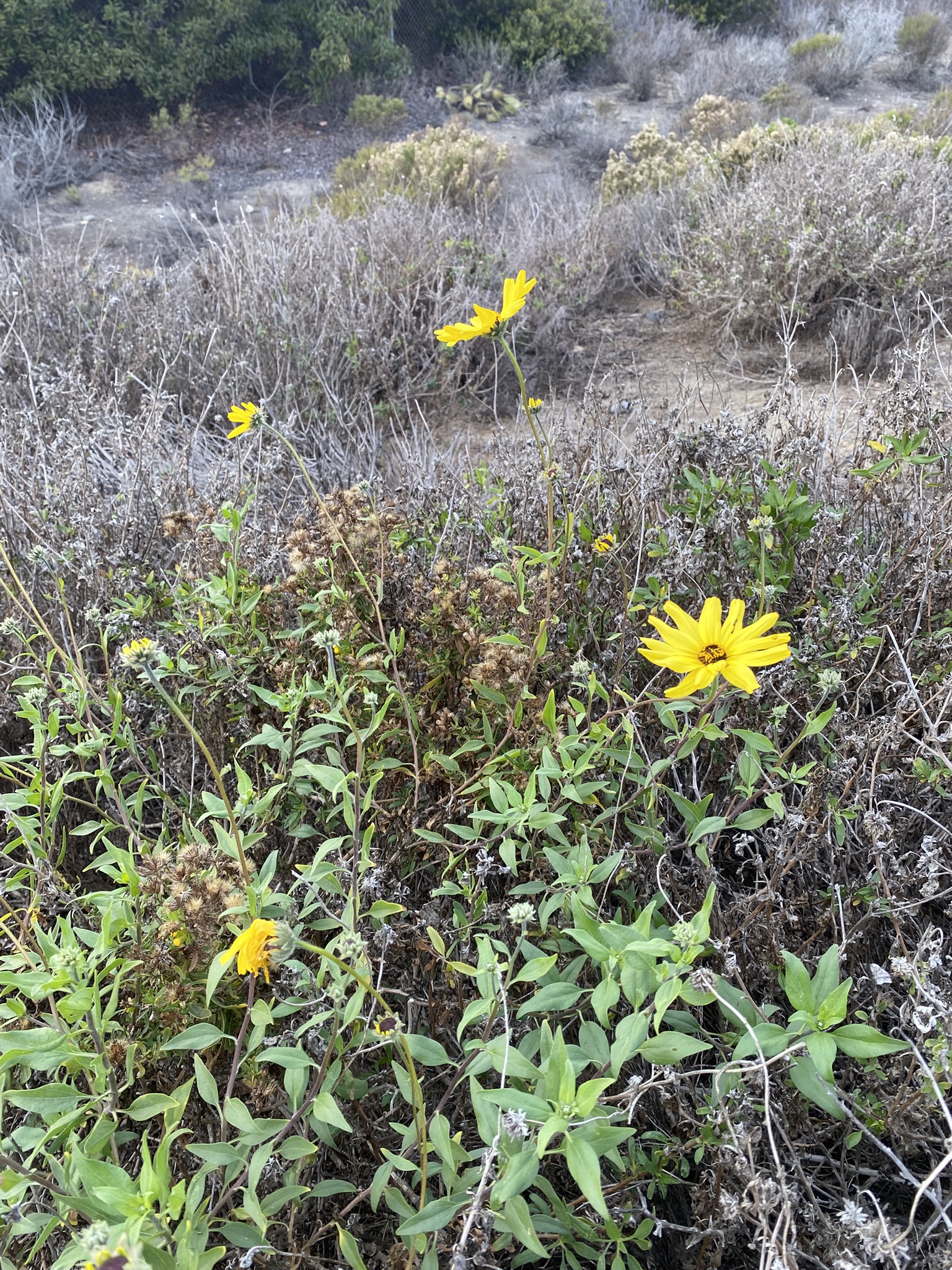
The flower of the California brittlebush (Encelia californica) reminds me of black-eyed Susans in the Midwest. It is one of the very few plants still blooming in the Torrey Pines State Natural Reserve Extension. It is a “non-hairy species that occurs in coastal areas,“ in contrast to plain ole brittlebush, a desert plant that has hairy leaves. The genus name “honors Christoph Entzelt, a 16th century German clergyman and natural historian.”:


California brittlebush (Encelia californica). “The desert variety can produce resin when the stems are scraped, and the dried resin can be burned for incense. In fact, the Spanish common name for this plant is incienso.” It’s unclear whether the coastal variety produces resin. If I had known about the desert variety, I would have scraped the stem of one outside the reserve to find out:

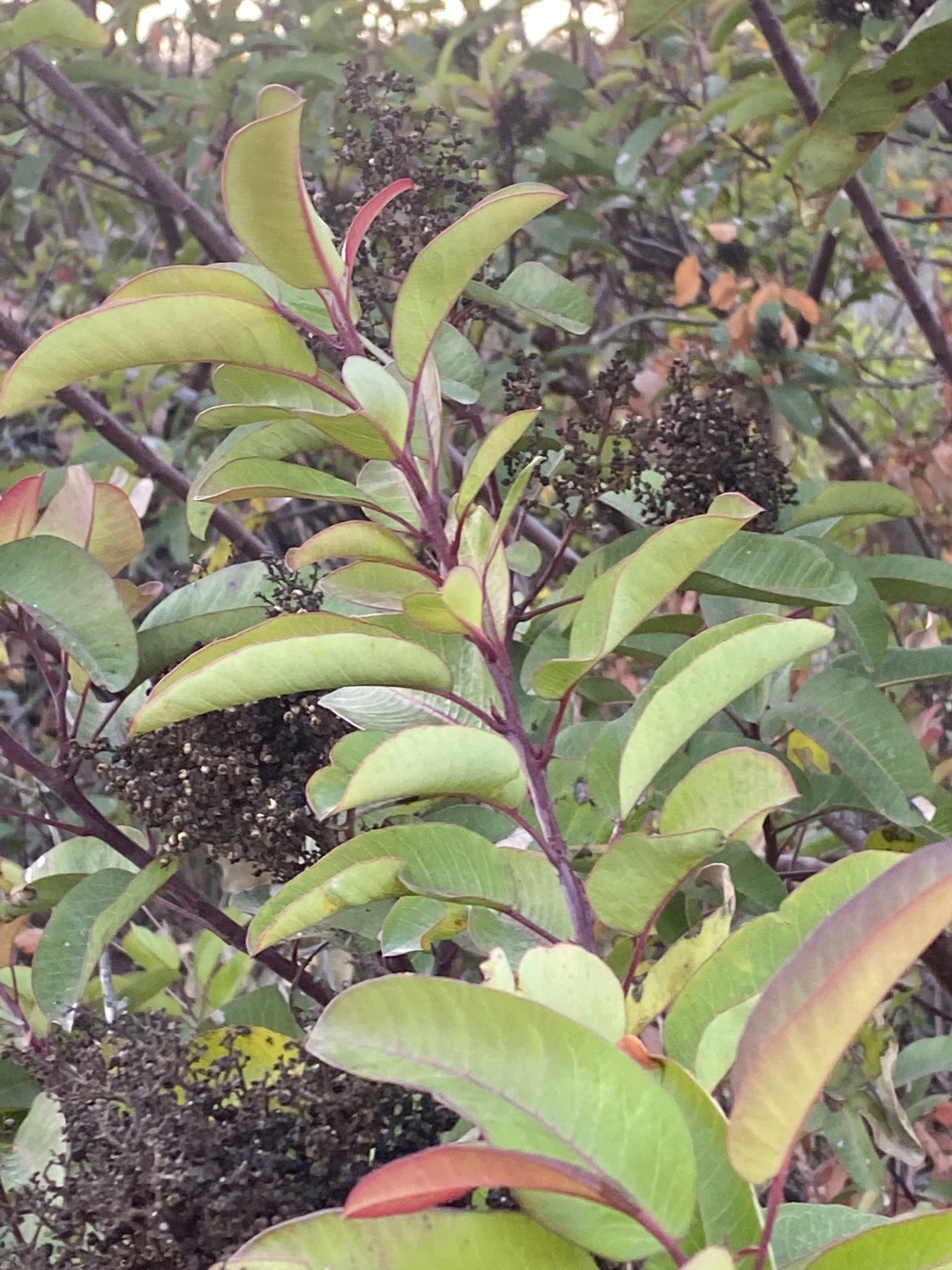
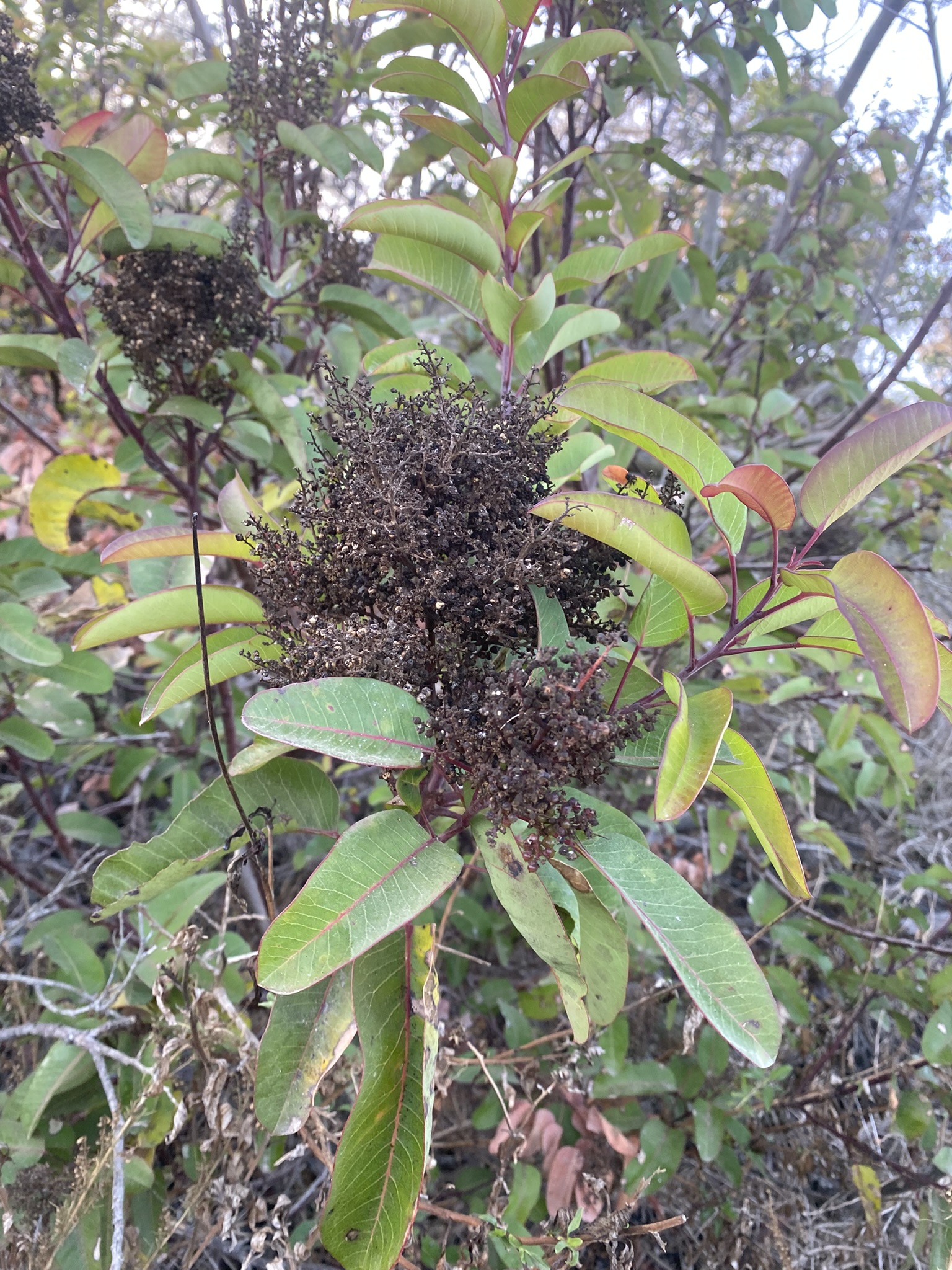
Laurel sumac (Malosma laurina) has “leaves that are folded upward along the mid vein, like a taco, with slightly wavy edges. Malosma means strong odor, for the smell of the cut leaves.” I did not tear a leaf and it’s probably a good thing since I was in a nature reserve. If I had read this botanical guide before I took my hike, I probably would have broken the law and torn the leaf, because I haven’t seen any laurel sumacs off the preserve:

Laurel sumac (Malosma laurina). The shape of the blossoms reminds me of those of the staghorn sumac in Indiana:

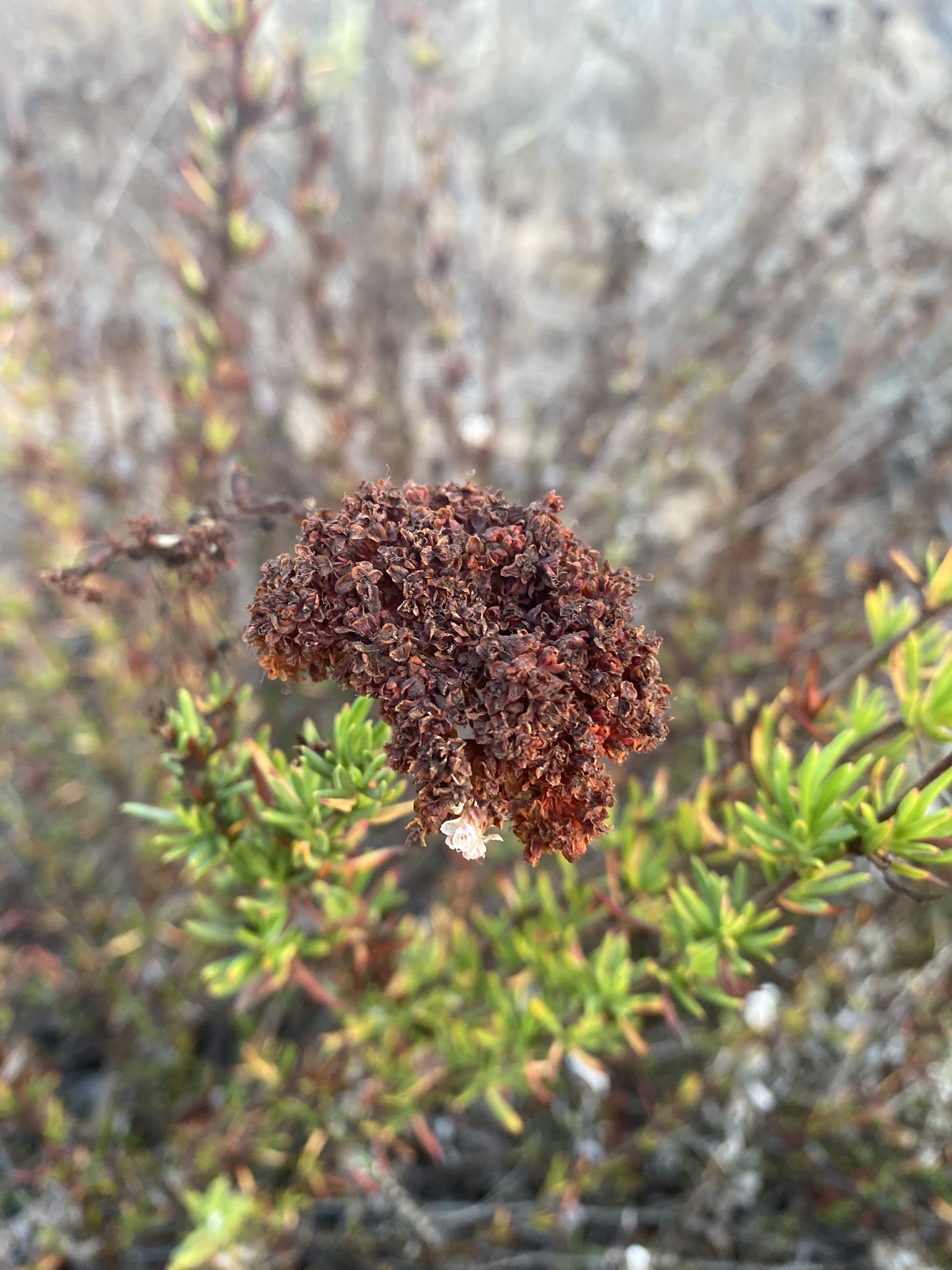
California buckwheat (Eriogonum fasciculatum) is the most widespread species of this genus in the state according to Matt Ritter. “These evergreen leaves usually have margins rolled under, hiding a woolly underside. Eriogona means woolly knees in Greek, referring to the hairy nodes of the first species named in this genus.”:

California buckwheat (Eriogonum fasciculatum). “No part of the plant is especially edible, but the flowers are an important food source for butterflies and honeybees.”:

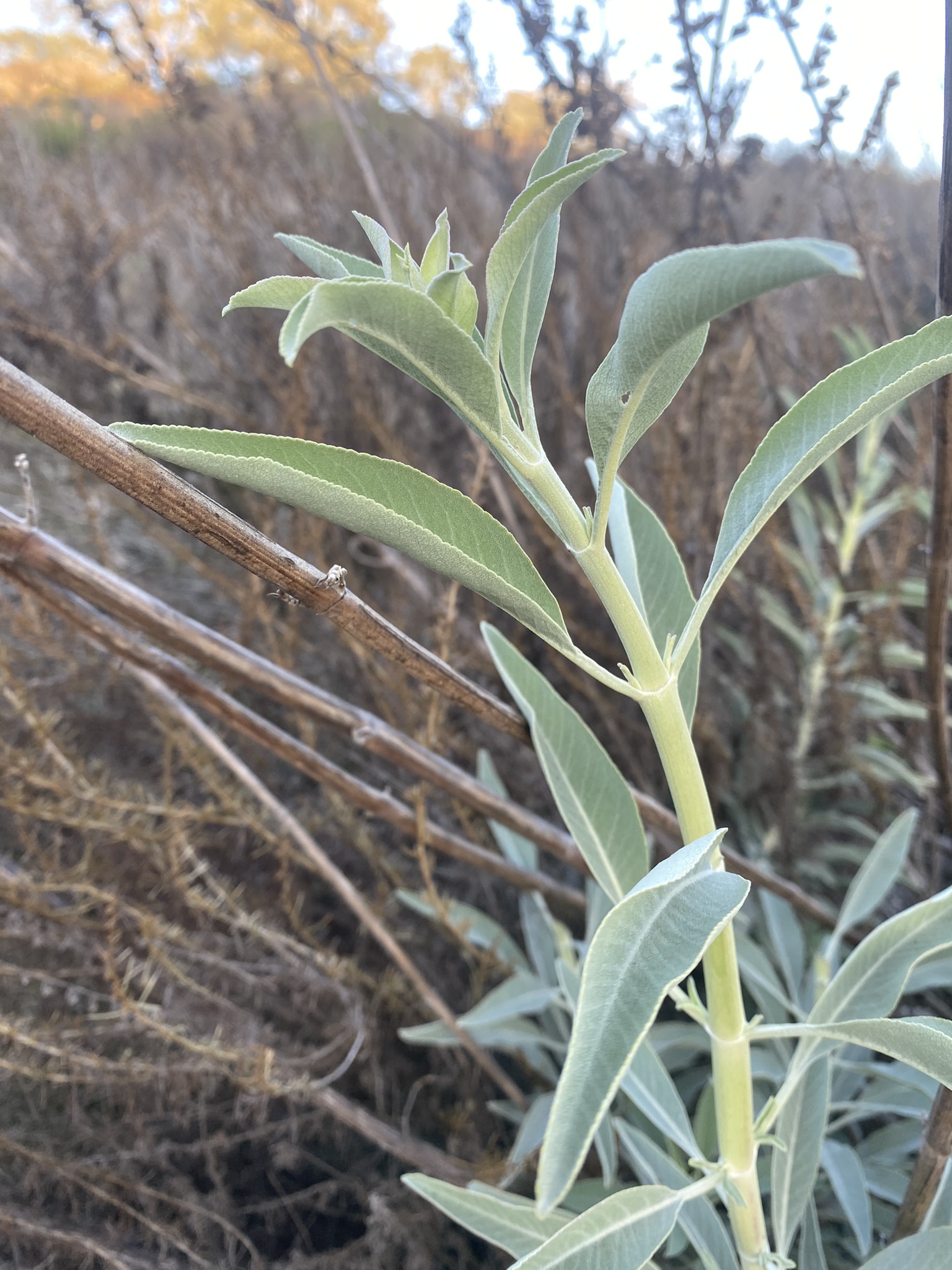
White sage (Salvia apiana). I hope the photo shows the softness of the leaves. “The name salvia is derived from the Latin word, Salvus, meaning safe or well, referring to the medicinal value of members of this genus:


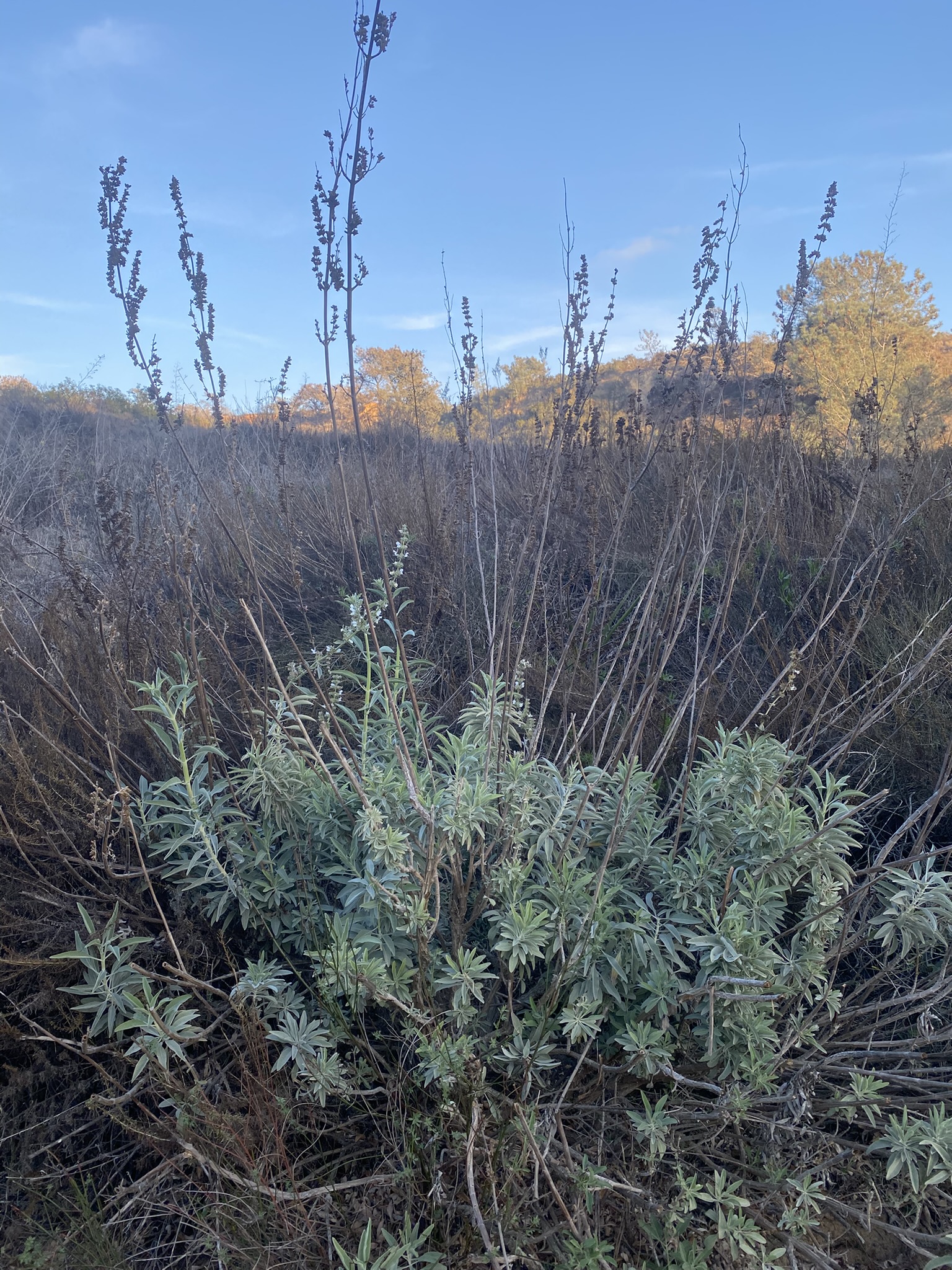
White sage (Salvia apiana). “Most sages in California are drought-deciduous shrubs, commonly found in chaparral and coastal scrub.”:

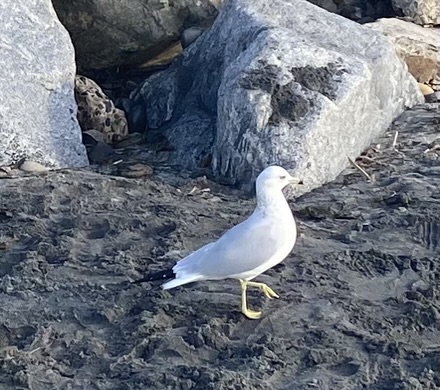
*Ring-billed gull (Larus delawarensis). “Opportunistic feeders” is what the Cornell Lab of Ornithology calls this bird in the book All about birds: California. Usually I see all manner of shorebirds at the Torrey Pines State Beach, North Beach. But one day I didn’t see any birds at all, and another day all I saw were the ubiquitous ring-billed gulls and, further inland behind some mud flats, some killdeer:

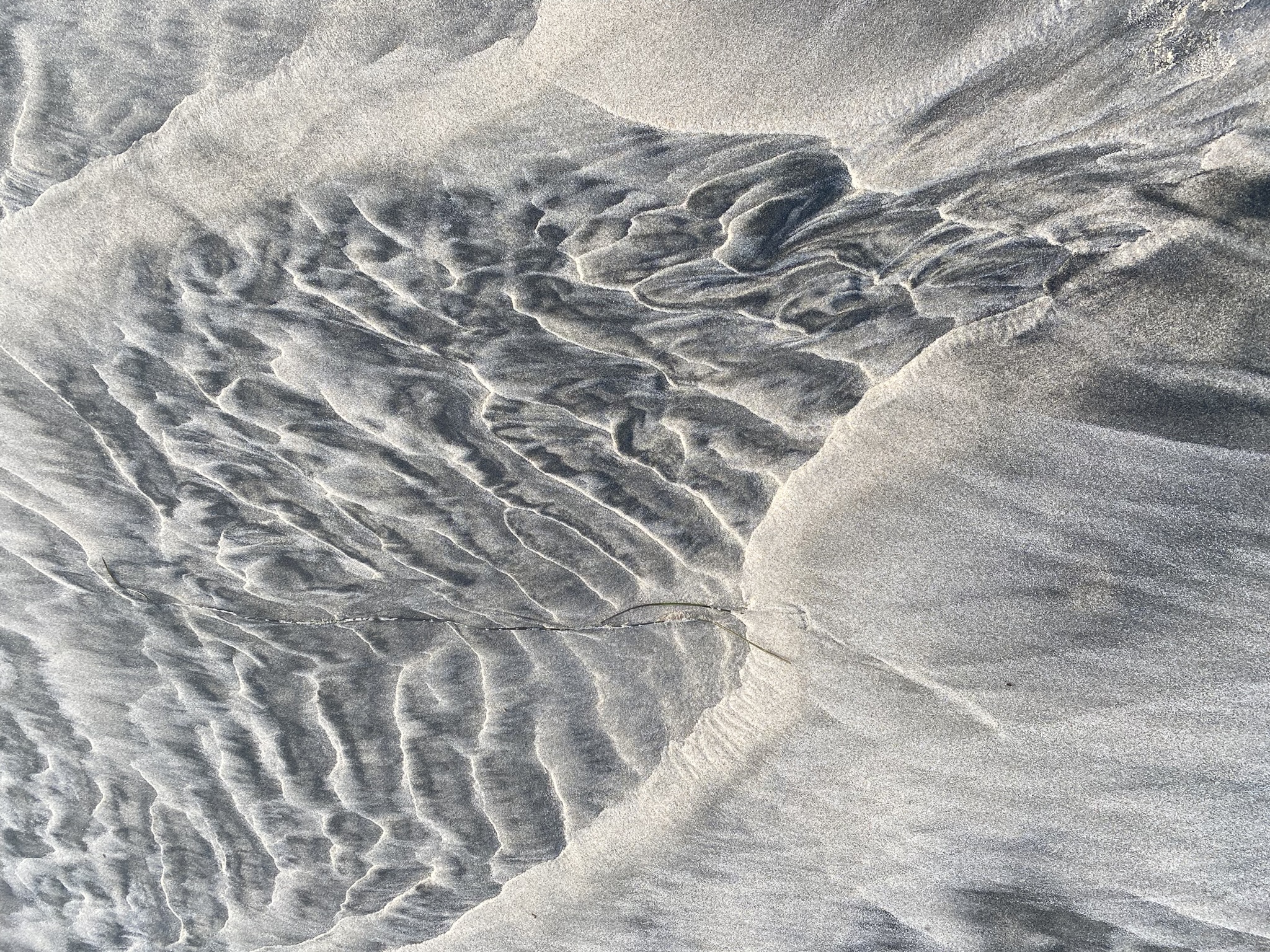
*Marbled effect of waves at Torrey Pines State Beach, North Beach, with a strand of seaweed for size comparison. Each white line is a tiny ledge about 1/8 inch high. I checked because I was curious whether the white was just a differently-colored sand or really a ledge, and the lines were indeed raised ledges.

Readers’ wildlife photos (and videos)

December 21, 2024 • 8:15 am

We’re running low again, folks, so send in any good photos you have. I know you have a lot of free time during the holidays!

Today’s photos, and two bonus videos, come from reader Amy Perry of Indiana.  Her captions and IDs are indented, and you can enlarge the photos by clicking on them.

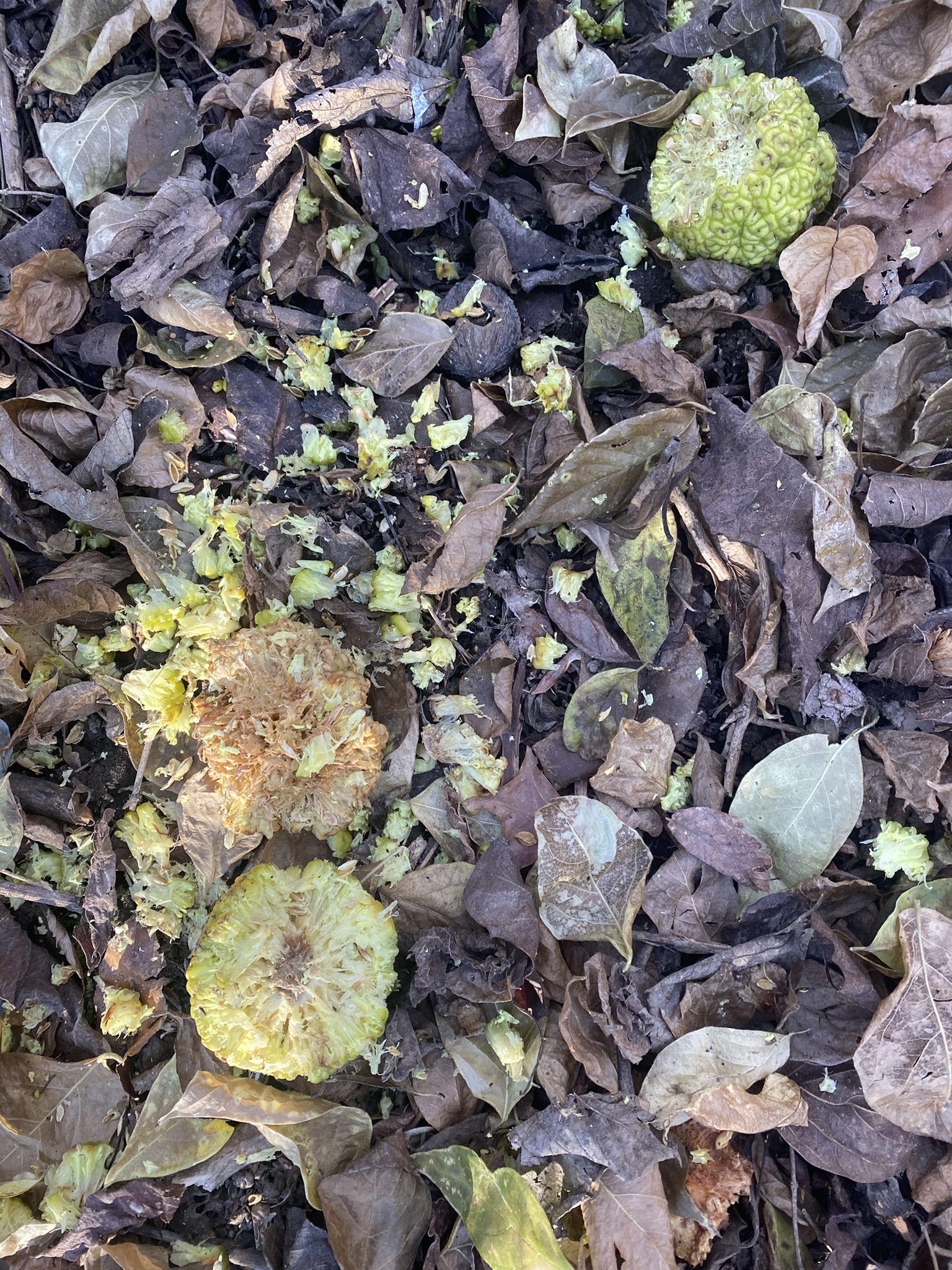
A half-eaten osage orange (Maclura pomifera) in December on the forest floor at Flat Fork Creek Park, Fishers, Indiana. The only animal that Wikipedia says eats these is squirrels. It says they are ineffective seed dispersers. Native to Indiana:

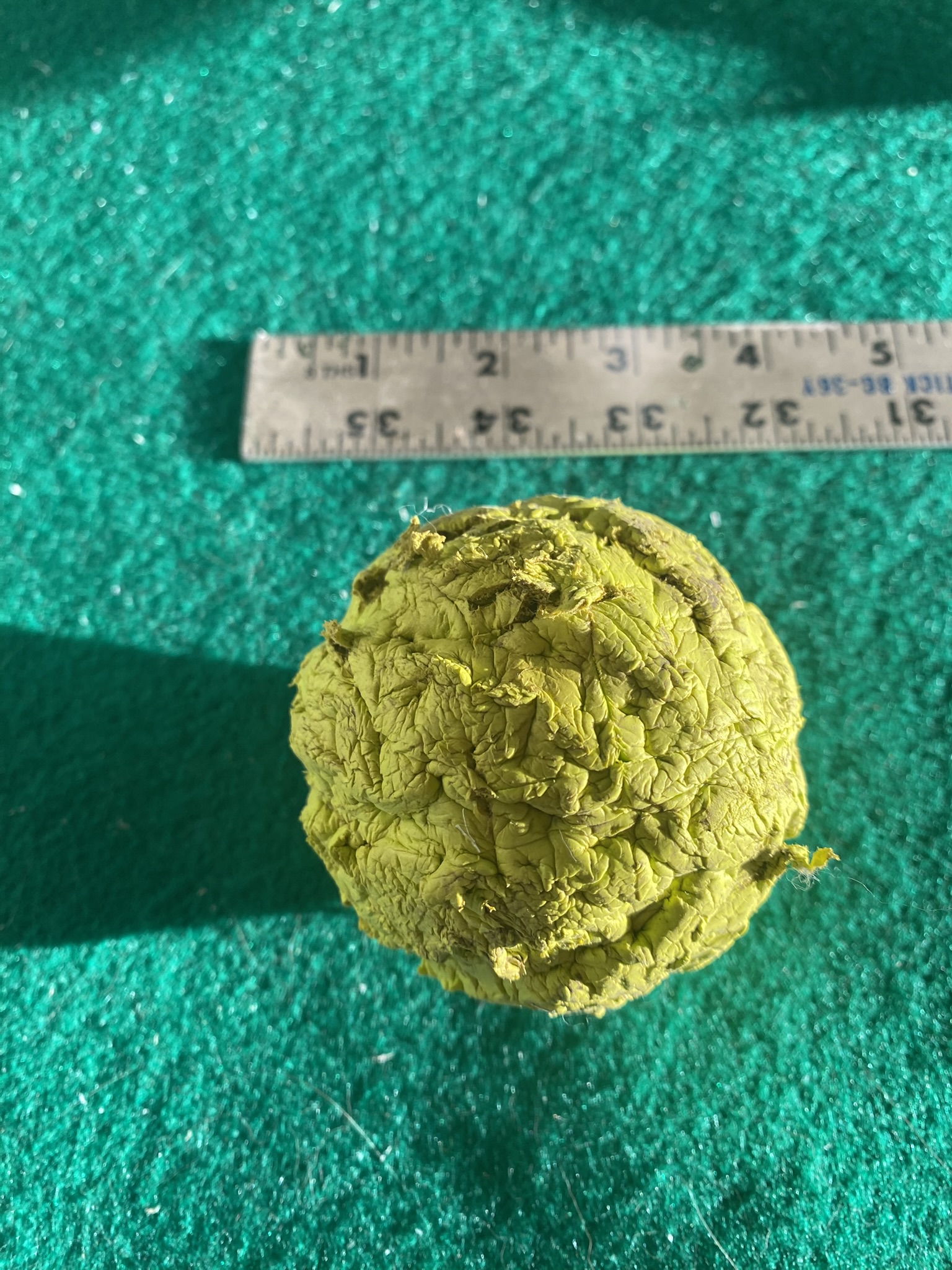
A whole osage orange. They’re also called hedge apples, because people sometimes prune them so they grow really thickly and make a hedge. They’re the size of a softball:

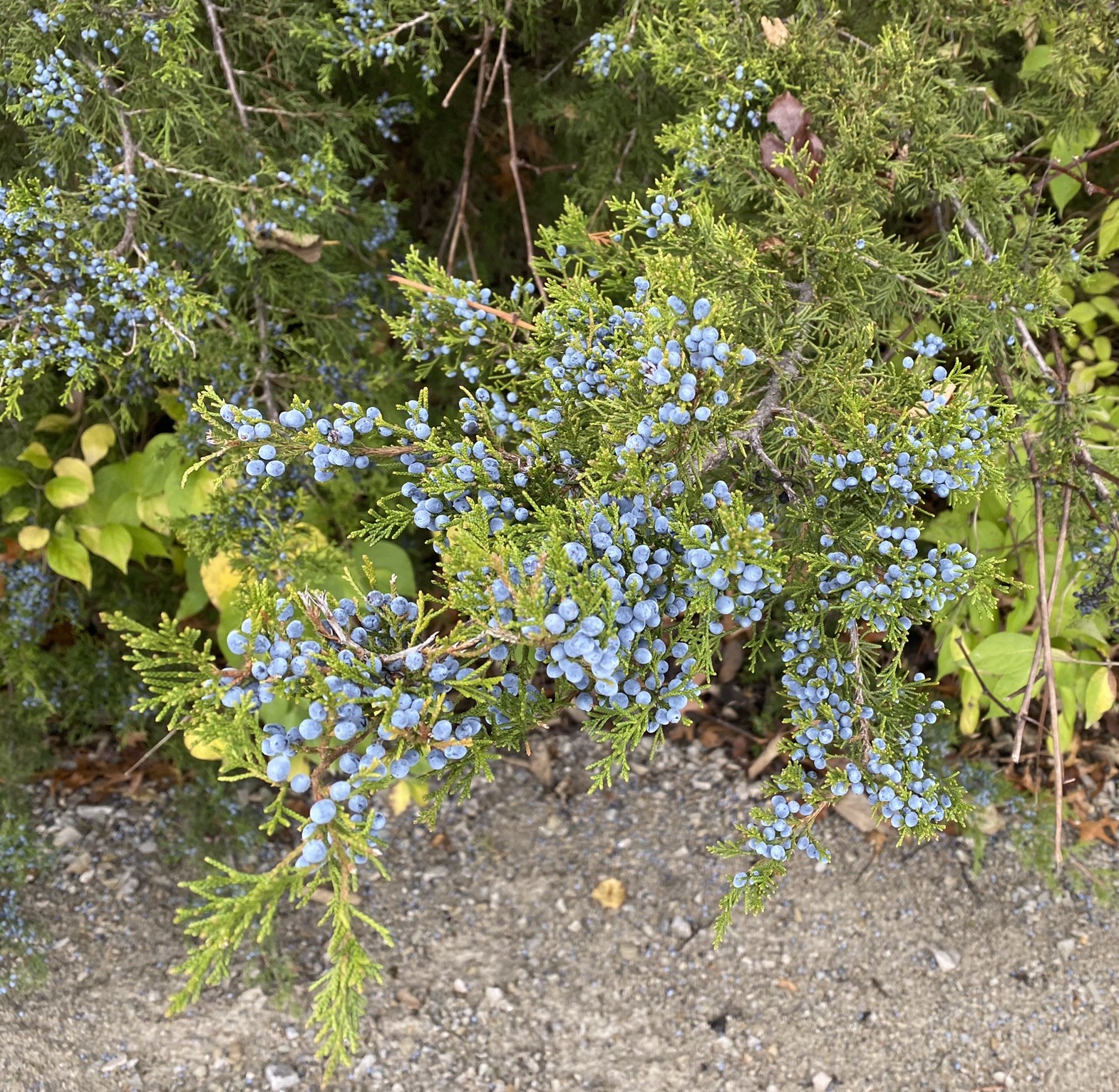
Juniper berries (Juniperus communis) in December along the Nickel Plate Trail, Fishers, Indiana, a railroad turned trail:

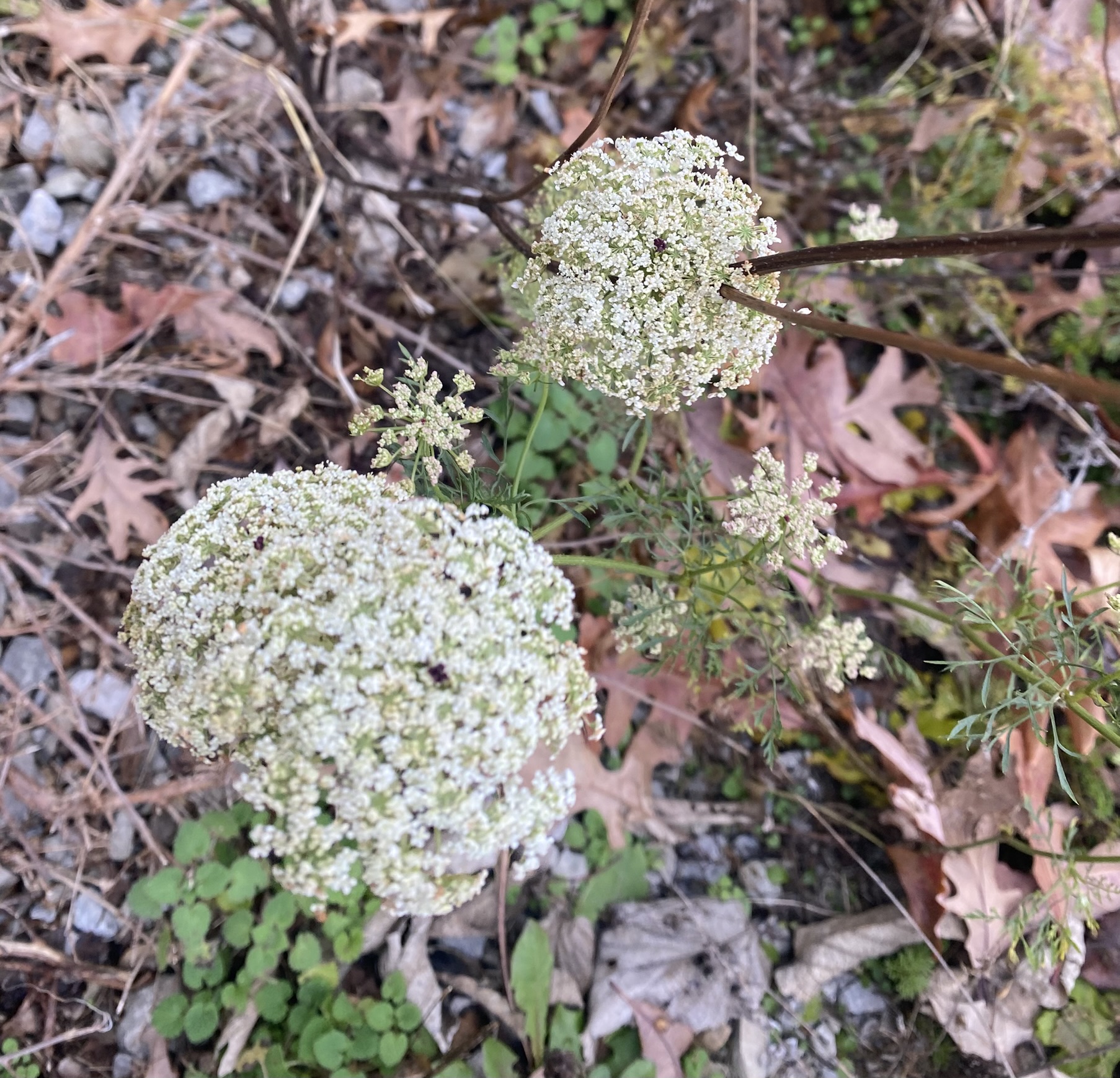
Queen Anne’s Lace (Daucus carota) in December along the Nickel Plate Trail, a railroad-turned trail. 4 shows one in bloom. Sometimes the plant in bloom has a red dot in the middle, resembling a drop of blood from Queen Anne when she was sewing, as the story goes:

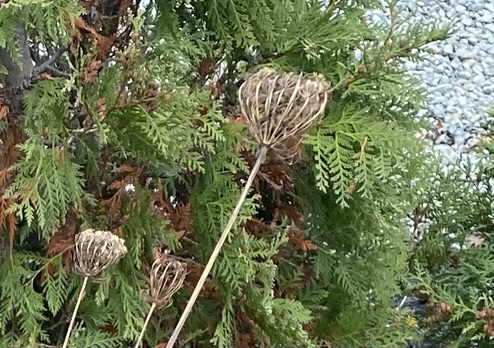
Here’s one curled up after blooming, showing why the flower is sometimes called bird’s nest. As the seeds ripen, the flower curls inward to form a birds-nest shape and turns brownish. Indiana DNR ranks it medium as an invasive, meaning it is not bad enough to warrant regulation in Indiana:

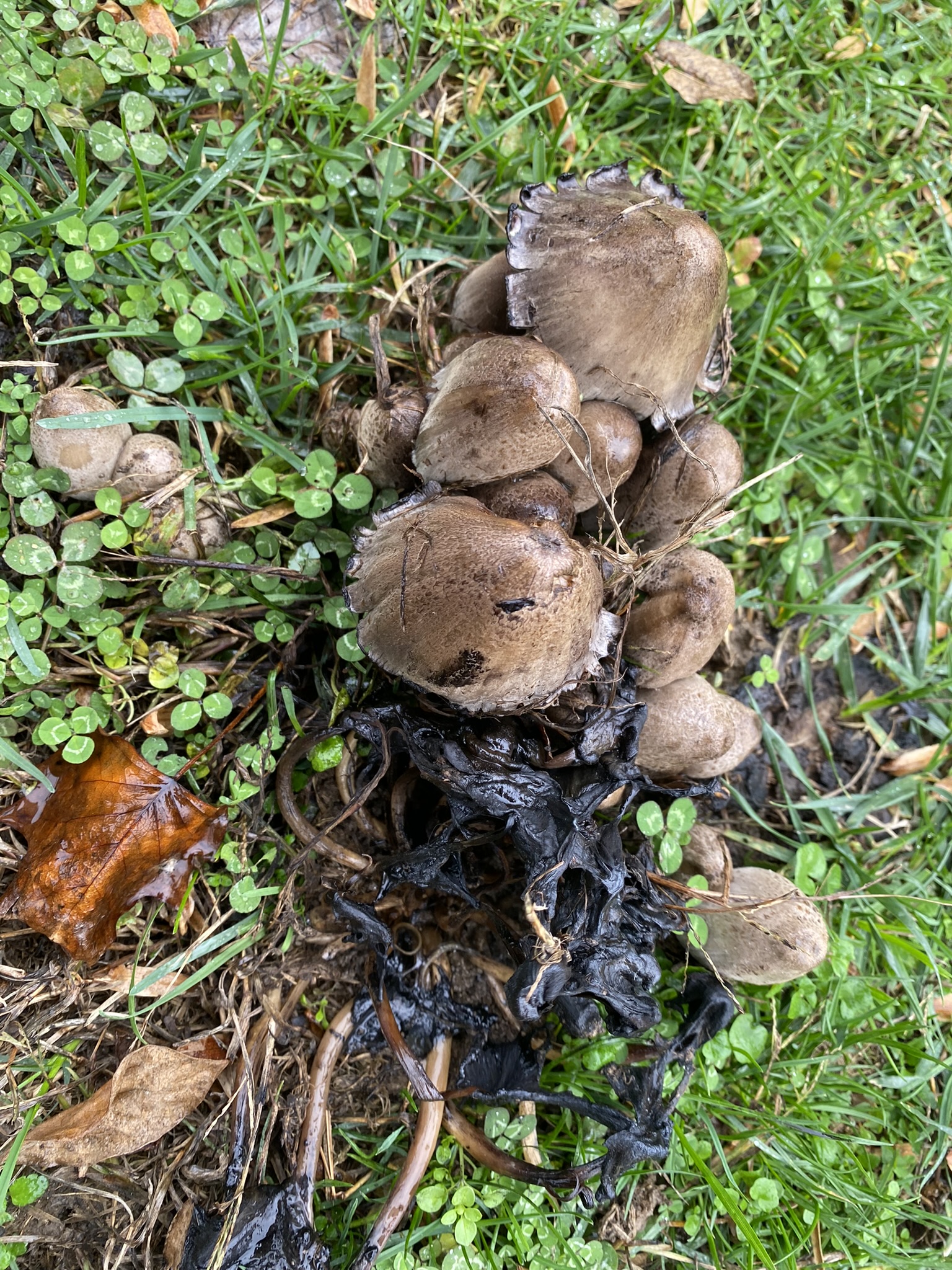
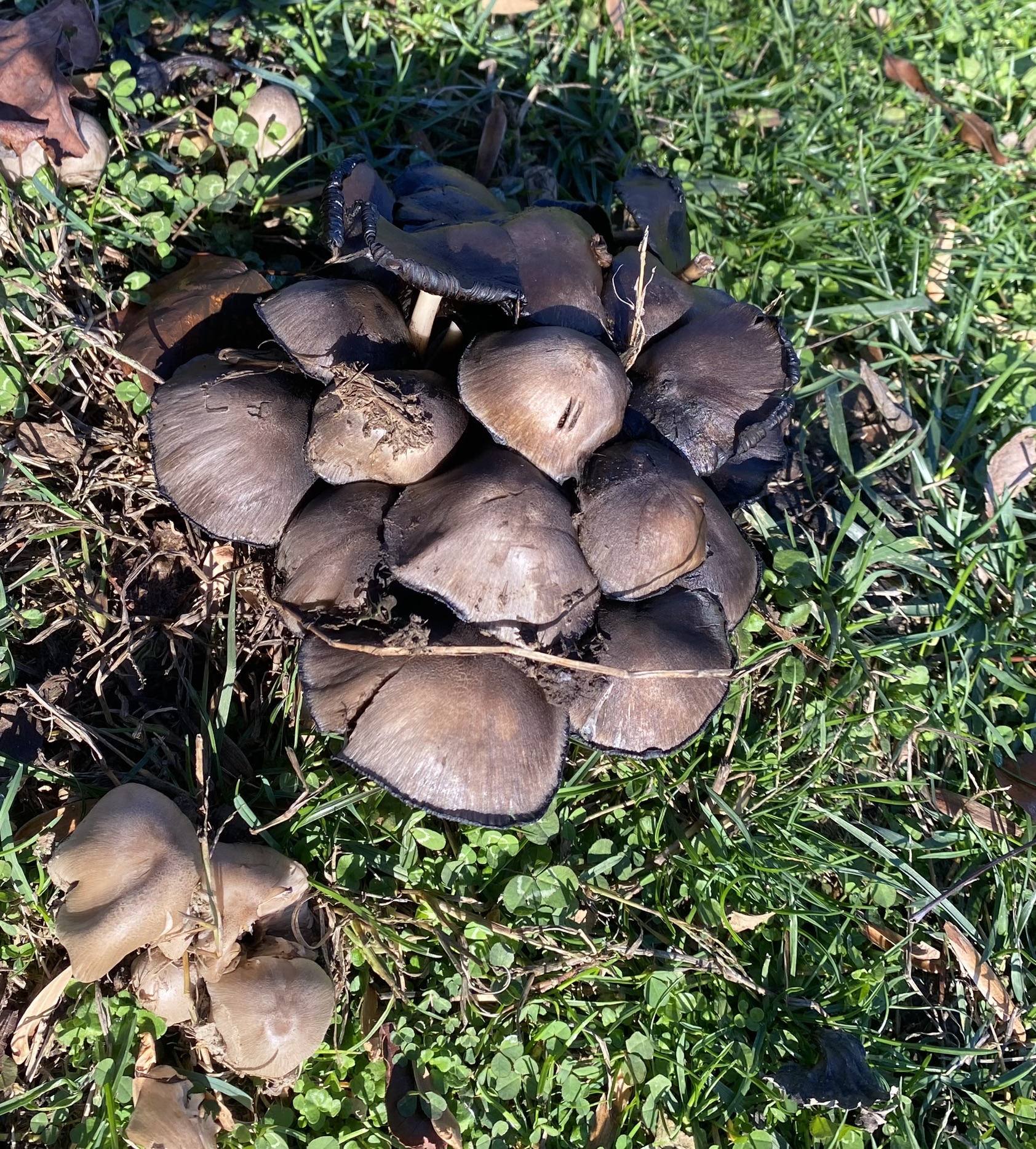
Inky cap (Coprinopsis atramentaria) mushrooms after lots of rain in November in Central Park, Carmel, Indiana. Also known as common ink cap and tippler’s bane (because it’s poisonous when consumed along with alcohol):

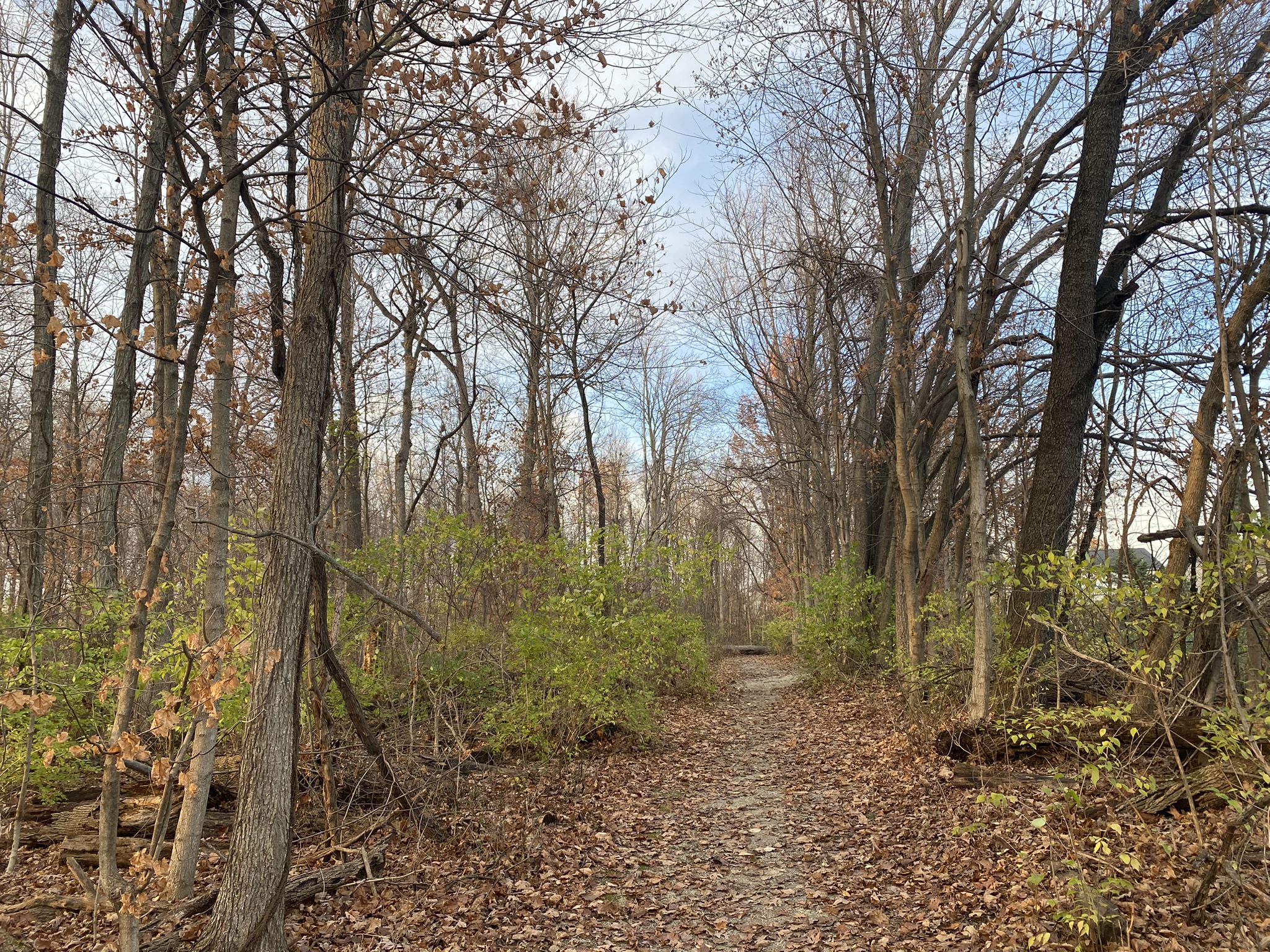
One way that we native plant lovers in central Indiana identify invasive plants is the fact that they are the first to green up in the spring and the last to lose their leaves in late fall. Here is a path in Hoosier Woods in Fishers, Indiana, in November, lined with the Asian bush honeysuckle (Lonicera tatarica, Lonicera morrowii):

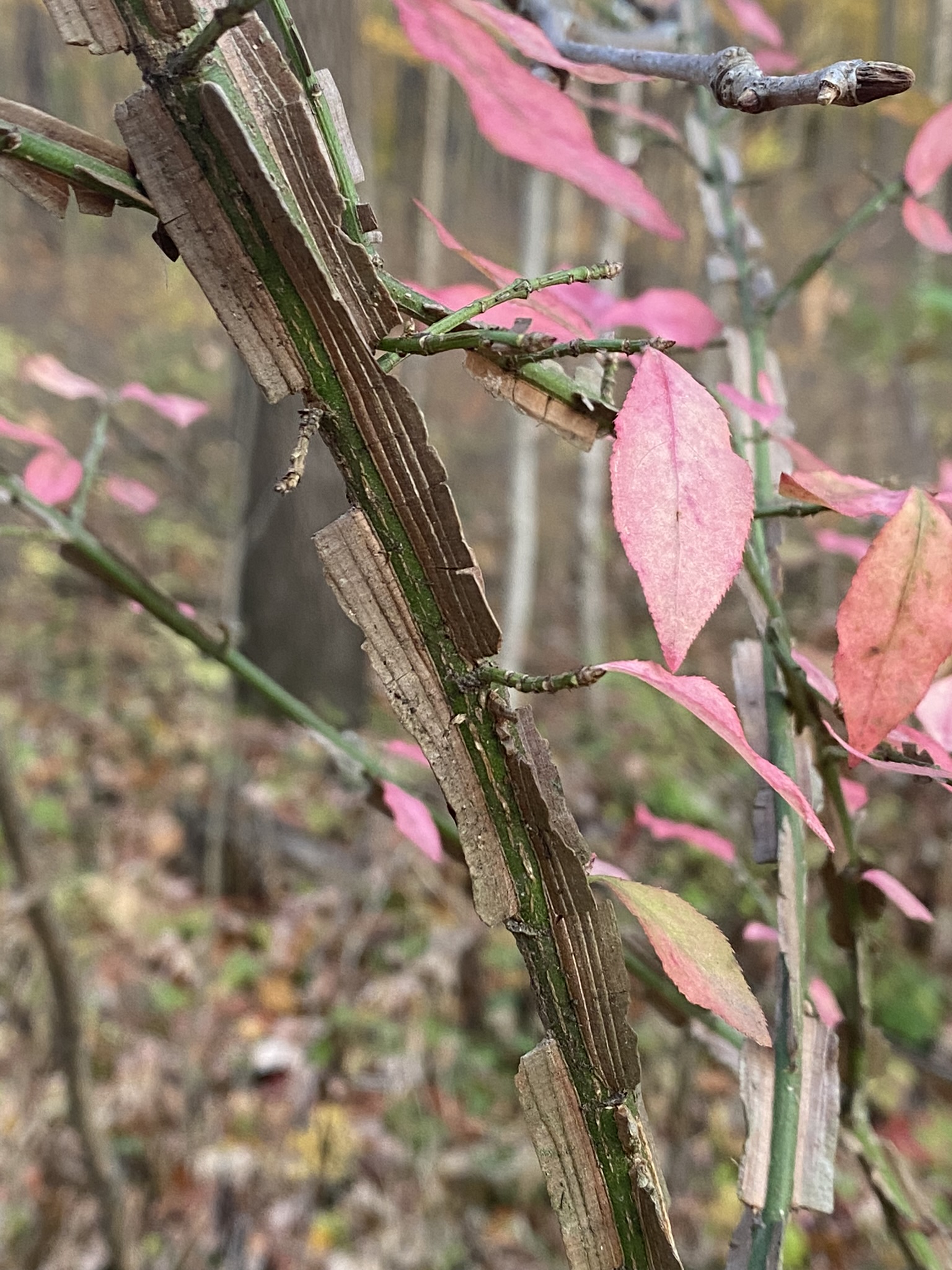
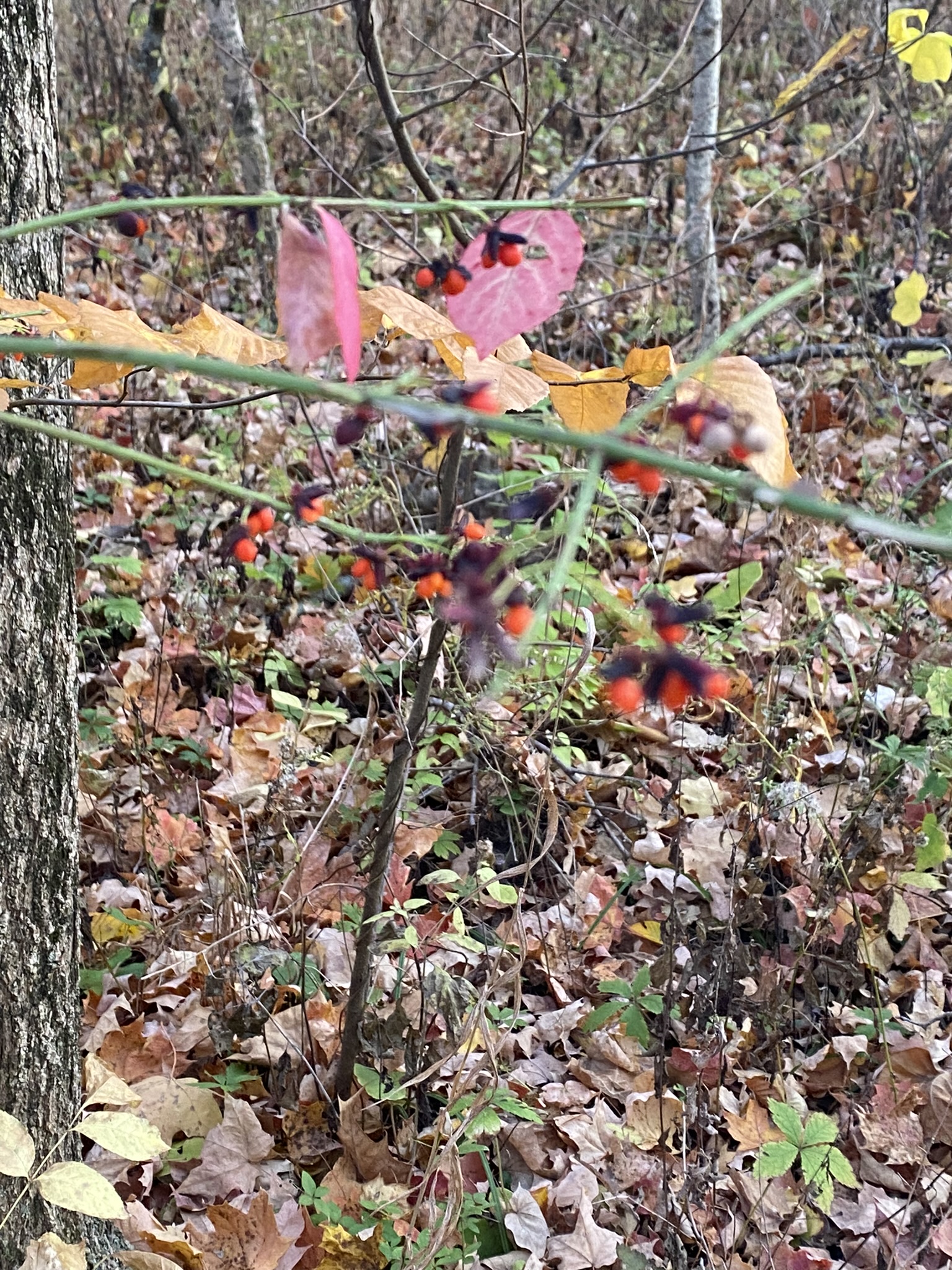
This burning bush (Euonymus alatus) in October deep in Ritchey Woods Nature Preserve in Fishers, Indiana, proves that invasive plants in our yards DO spread even though we don’t see it happen. Birds no doubt planted this one. The deep red leaves, the wing-like (hence alatus) formations on the stem, and the red seeds identify it. Sometimes the seeds are yellow or orange:

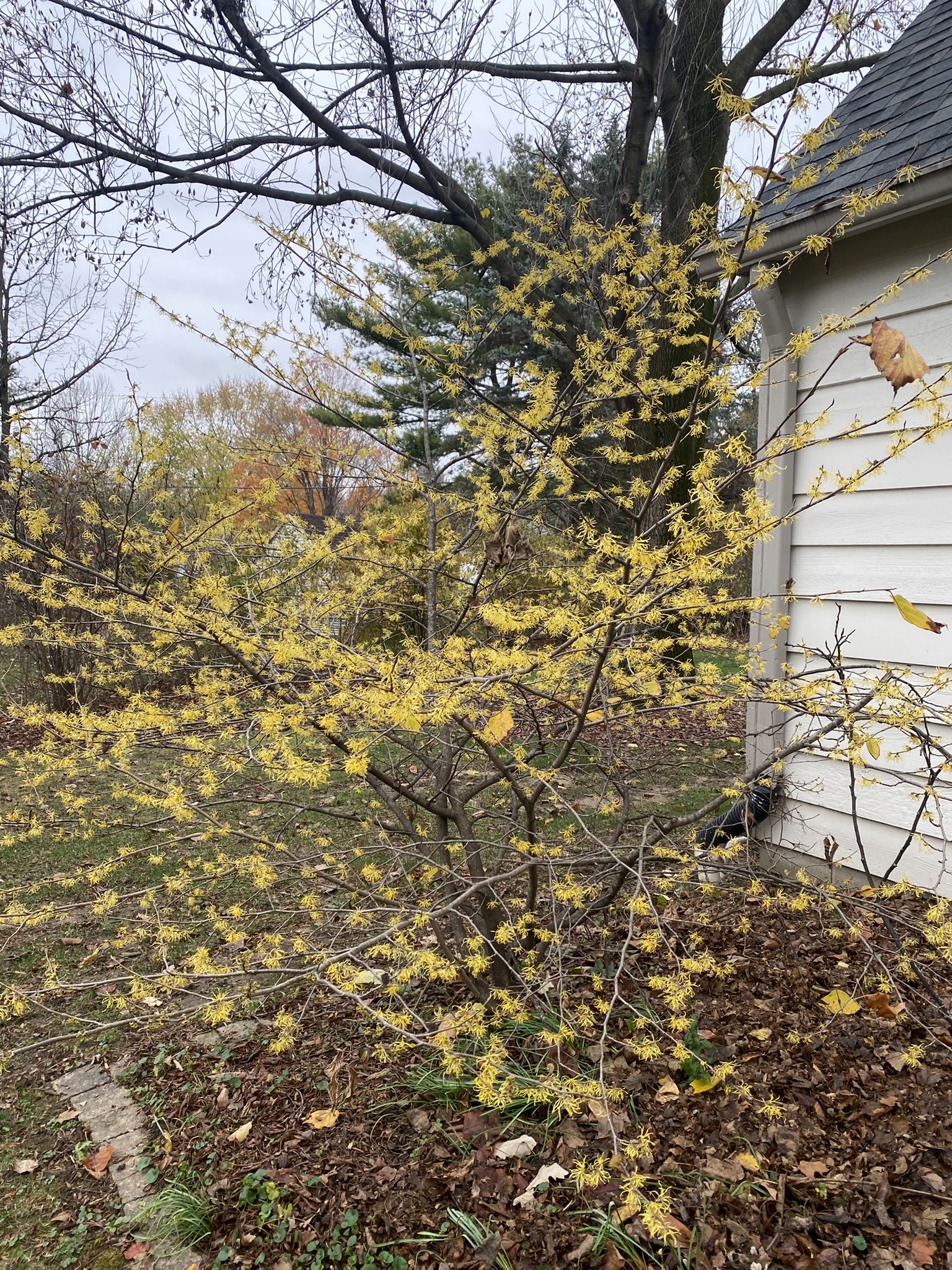
Witch hazel (Hamamelis virginiana) plant in our yard in November in Fishers, Indiana. One of the few shrubs that blooms in the fall. Native to Indiana:

And two videos:

Great blue heron (Ardea herodias):

I crushed the leaf of a cup plant (Silphium perfoliatum) to show its sandpaper-like quality. Note the square stem, a characteristic of that species. The leaves of this species look like giant oak leaves. “At the bottom of the plant, the leaves are huge — to 16 inches long — but the leaves are progressively smaller toward the top of the stem. In full sun, the upright lower leaves turn their edges toward north and south, with the flat surfaces facing east and west, giving compass plant its common name.”–Missouri Dept. of Conservation. Some sources say the leaves do this to avoid the effects of full sun.