An anthropologist justifies female genital mutilation

May 23, 2016 • 10:06 am

The concept of “choice” in a community that has long traditions about the subject of that choice, particularly ones connected with religion, is problematic. How many women “choose” the hijab or burqa in countries like Saudi Arabia, Iran, and Afghanistan, where such clothing is not only connected with religion, but mandated by the government? The fact that places like Saudi Arabia and Afghanistan have morality police to enforce covering, as well as the absence of covering before those countries became theocracies, suggest that many women would not cover themselves without the legal requirements and threat of beating. And even where covering is optional, as in Egypt, many women must cover themselves for fear of looking “non-Muslim,” of disobeying their husbands, or of defying community standards and being ostracized.

So when I read a new piece in The Atlantic, “Why some women choose to get circumcised?” I was wary. How do we know that without religious and social pressure, female genital mutilation (FGM) is a “choice” in the sense of something that would be elected without that pressure?  While FGM has been around for a long time, and is practiced by non-Muslims, it’s been institutionalized (as has veiling) by many branches of Islam. If you think that FGM has nothing to do religion, read Heather Hastie’s column on the Islamic connection.

Khazan is an associate editor of The Atlantic, covering health and gender issues, and she interviews Sheila Shell-Duncan, a professor of anthropology at The University of Washington. The curious thing about the interview is that while Shell-Duncan is part of an initiative to reduce FGM by 30% in ten countries over the next five years, she proceeds to more or less excuse the practice in her interview. And I do mean “excuse”, not just “understand”.

First, an introduction by interviewer Khazan:

For starters, Bettina Shell-Duncan, an anthropology professor at the University of Washington who has been studying the practice in many countries for years, suggests using the term “cutting” rather than “mutilation,” which sounds derogatory and can complicate conversations with those who practice FGC.

She also challenges some common misconceptions around FGC, like the belief that it is forced on women by men. [Not so, though; see below.] In fact, elderly women often do the most to perpetuate the custom. I thought African girls were held down and butchered against their will, but some of them voluntarily and joyfully partake in the ritual. I thought communities would surely abandon the practice once they learned of its negative health consequences. And yet, in Shell-Duncan’s experience, most people who practice FGC recognize its costs—they just think the benefits outweigh them.

Actually, I don’t care who perpetuates the custom, whether it be women or men; I care that society forces the practice on young girls, and that religion not only allows it but in some cases urges it. And changing the word to “cutting” rather than “mutilation” is just semantics. Yes, those trying to eliminate it should just call it “cutting the genitals” to those they’re trying to persuade, but we should realize that it’s still mutilation. It’s as if we tried to sanitize the throwing of gays off rooftops by extremist Muslims as “involuntary defenestration of homosexuals” rather than “homophobic murder.”

And of course if doing something inculcates and integrates you into the culture, you may do it “joyfully”—after all, you’re joining the pack—but do you do it  “voluntarily”? In a culture where it’s the norm, and rejecting it leads to ostracism, what does “voluntarily” even mean?

If that barbaric cultural practice didn’t exist, as it doesn’t in the West (which outlaws FGM), women wouldn’t elect it. Now you’ll say, “Well, of course: if there’s no FGM culture, why would any girl want to do it?” But that’s precisely the point. FGM is a reprehensible practice that is not only medically dangerous, resulting in both short- and long-term health problems, but also, by excising the inner labia and clitoris, severely reduces the possibility of sexual pleasure for women—which is of course its point. (This is the form of FGM that Khazan and Shell-Duncan are discussing.)  A misguided cultural relativism has tended to overlook these issues (and this article shows it), but that kind of relativism isn’t acceptable—not when there are health and sex issues as well as harm to women.

Here’s some of the statements that Shell-Duncan makes in celebrating, or at least excusing, FGM:

The bride came out and joined the dancing. I almost died. I thought she must be on codeine, but she wasn’t. She was joyful. I didn’t understand the joy about this.

But later I remembered that when I gave birth to my first son, I had a very difficult delivery. After my son was born, everyone in the delivery room popped a bottle of champagne. I felt like I had been hit by a Mack truck and they were toasting champagne. But it was a good pain, and that’s what this was. This girl had become a woman.

When I went back two years later, the girl came to me and gave the [pain] pills back. She said, “You don’t understand, this is not our way. And if I didn’t do that, I wouldn’t be a woman now.”

I understood why. And I respected her.

Well, Shell-Duncan’s pain didn’t presage a life without sexual pleasure, either! And as for “respect”, well, that’s a double-edged sword. Admiring someone for withstanding a painful and barbaric practice doesn’t do anything to eliminate the practice. No, you don’t have to shame the girl—that would be counterproductive—but do you “respect” those hyper-Orthodox Jewish women who shave their heads and purify themselves in ritual baths after menstruating? Or those Muslim women who put themselves in cloth sacks, and won’t go out without a male guardian? I’m not sure “respect” is the right word here.

And here’s the rationale:

Khazan: Yeah. So, wow. I guess the biggest question for me is what do they see as the benefit? Are there any benefits?

Shell-Duncan: This is not true everywhere, but there, there it’s not about virginity. It’s not about modesty. And it is in some other cultures. The Rendille are sexually active before they’re married, both men and women. And it’s completely culturally acceptable.

The woman is going to go live with her husband’s family, and it’s part of inclusion among other women whose identity is as a circumcised woman. She’s reliant on her mother-in-law and her husband’s kin. So it’s part of becoming inducted into this female network that’s really important.

Also, for us, we believe that bodies are natural and perfect. Not everybody believes that. Some people in Africa believe that bodies are androgynous and that all male and female bodies contain male and female parts.

So a man’s foreskin is a female part. And for a female, the covering of the clitoris is a male part. The idea of becoming a wholly formed female includes being cut—having any part that is somewhat male-like removed from the body.

Khazan: That actually makes logical sense to me. We have shaving your legs, or wearing makeup. We have weird things that we do that are less painful. But the pain in their case is kind of the “proving yourself” aspect.

Shell-Duncan: Right.

“Sexually active” doesn’t mean, “getting pleasurable sex,” of course. And really, getting inducted into a network via means that are harmful, painful, and dangerous, while understandable, is not necessarily admirable. In some cultures men need to kill an enemy before they’re fully accepted. Is that okay? Further, comparing FGM with shaving one’s legs or wearing makeup is seriously misguided. While those practices may be culturally enforced (I grew up in an era when many women didn’t shave their legs, and I don’t care about that), they aren’t nearly as harmful to the practitioners as is FGM.

Here’s Shell-Duncan’s critique of the feminist argument against FGM:

Khazan: And where is the support for this practice coming from?

Shell-Duncan: The sort of feminist argument about this is that it’s about the control of women but also of their sexuality and sexual pleasure. But when you talk to people on the ground, you also hear people talking about the idea that it’s women’s business. As in, it’s for women to decide this. If we look at the data across Africa, the support for the practice is stronger among women than among men.

So, the patriarchy argument is just not a simple one. Female circumcision is part of demarcating insider and outsider status. Are you part of this group of elder women who have power in their society?

Yes, it’s part of insider versus outsider status, but many barbaric religious practices are. Many see circumcision of Jews as another one of them, as well as putting women in burqas or, in some Mormon sects, marrying young girls and taking multiple wives. And, of course, the religious dictates in favor of FGM come from men, even if women are the “enforcers.” In fact, later in the piece Shell-Duncan admits that men are involved:

Shell-Duncan: If I decide I don’t want to circumcise my daughter, that’s not an individual behavior. I would have to answer to my husband, to my mother-in-law, my mother-in-law would have to answer to her friends throughout the community, my father-in-law would have to answer to people in the community, so there’s societal pressure. So understanding what is a collective decision versus individual is really important. You can go and tell an individual mother what the health risks are and she can believe you, but it doesn’t mean, first of all, that she has the power to make that decision, or even that she has the authority to impart that information to her mother-in-law and other senior people in the society who are the decision-makers. Who wants to be the first one to change? Who wants to be the odd man out?

And there’s this, where Shell-Duncan admits that trying to get women to stop cutting their daughters is a tactic that doesn’t work:

Shell-Duncan: What we’re coming to realize is that programs that target individual mothers are completely ineffective. Mothers are not solely in charge of the decisions for their daughters. We need to be targeting people who are in the extended family, and we know that we need to figure out who are the figures of authority in these families, and who are the influences on them in the community. We need to do male elders, but also female elders.

So why on Earth does Khazan call her piece “Why some women choose to get circumcised?” And why does she have an introduction saying that “elderly women often do the most to perpetuate the custom”?  Shell-Duncan admitted it’s not a “choice” in the conventional sense of the word. There are serious repercussions to not getting cut. Why, then, do both women maintain that it’s older women who are really in charge of FGM? Shell-Duncan seems deeply confused, and her arguments are conflicting.

And here’s her bogus arguments against the medical dangers:

Khazan: What, medically, are the harms? Why are people trying to stop this?

Shell-Duncan: The WHO was able to show a statistically significant association between FGC and certain risks from obstetrical outcomes. Things like infant death, hemorrhage.

There was a study that was done in Gambia—they were looking at the chances of having sexually transmitted infections and pelvic inflammatory disease, and it was positive, but of course, you can’t prove that being circumcised is causal.

Khazan: Do these communities know about the medical consequences?

Shell-Duncan: One of the things that is important to understand about it is that people see the costs and benefits. It is certainly a cost, but the benefits are immediate. For a Rendille woman, are you going to be able to give legitimate birth? Or elsewhere, are you going to be a proper Muslim? Are you going to have your sexual desire attenuated and be a virgin until marriage? These are huge considerations, and so when you tip the balance and think about that, the benefits outweigh the costs.

Let’s not forget the loss of sexual pleasure, which of course these girls won’t know about because they never learn what they’re missing. But do review the World Health Organization’s list of medical harms caused by FGM. When you get a chronic infection or painful scar tissue (and possible obstetric fistulas) from cutting, is Shell-Duncan going to say, “Well, that’s just a correlation; you can’t prove it’s causal.” That is an invidious and willfully ignorant way to excuse FGM. What does it take for her to accept that an infection in the genitals after cutting, which won’t occur in those that don’t have FGM, is caused by FGM?

After all this, Shell-Duncan admits why she’s trying to reduce the incidence of FGM:

Khazan: Do you think it’s a global-health imperative that we work to stop this?

Shell-Duncan: There’s no question this is a global-health issue. In the U.S., adult women are capable of giving consent for surgical procedures. But what would it take to get a woman in an African country to the same position of being able to give consent? Social pressures [in the nations that practice FGC] are so strong that no woman could ever opt out. Everybody would come down on her. That’s the problem. Why can we give consent and they can’t?

There’s more, but you get the ambivalence. We have a conflicted feminist who sees that FGM is harmful, and is trying to stop it, but at the same time is trying to justify the practice, as well as distort its origins and how it’s enforced. Interviewer Khazan, of course, plays right into this, and doesn’t ask Shell-Duncan the hard questions. I applaud Shell-Duncan’s initiative to reduce FGM, but one can see her being drawn into a form of cultural relativism that has the danger of diluting her opprobrium of FGM. At least she’s doing something about it.

Song contest: win a book

May 23, 2016 • 8:15 am

Here’s another song contest. To win, you have to name all of the songs (and artists) that mention the following items (mostly foods, but not all of them). Every song was at least a minor hit, and all are rock and roll (no rap or folk). The winner gets an autographed copy of the new paperback edition of Faith Versus Fact, and if you get the bonus question, you can have a cat drawn in.

I will also ask you to refrain from Googling, please. Some of these songs have been mentioned on this site, and I am looking for people who know their rock lyrics. And if you’re an early riser in the U.S., you are rewarded by having extra time to answer.

I am the final arbiter of the winner, but the first one who answers them correctly (to my satisfaction) wins. The deadline: 5 pm Chicago time TODAY. Only one set of guesses per reader, and they must be in a single comment.

Which songs have these words in them? (Note: the word must be exact; for instances, you can’t use a song that has the word “owls” as an answer for “owl”. 

pineapple

barley (you must name TWO different songs mentioning the grain)

french fries

omelettes

mushroom

owl

decal

Bonus word (for a cat drawing). 

Jew

Readers’ wildlife photographs

May 23, 2016 • 7:30 am

Keep sending in the photos, folks. I’ll be here all year!

Today we have more lovely bird photos by reader Colin Franks (photography site here, Facebook page here, Instagram page here). Note that the photos below are copyrighted by a professional photographer; I have permission to show them here, but please don’t purloin or reproduce them further.

Northern Pintail  (Anas acuta):

7D__27078

Belted Kingfisher – female  (Megaceryle alcyon):

7D__27567

Red-breasted Sapsucker (Sphyrapicus ruber):

7D__28109

Anna’s Hummingbird (Calypte anna):

7D__28200

Ruby-crowned Kinglet (Regulus calendula):

IMG_22982

Spotted Towhee (Pipilo maculatus):

IMG_23056

Dark-eyed Junco (Junco hyemalis):

IMG_23271

Varied Thrush (Ixoreus naevius):

IMG_23326

Monday: Hili dialogue

May 23, 2016 • 6:15 am

It’s Monday, May 23, and in Chicago rain is in the offing much of the week. On Friday through Sunday I’ll be at the annual meetings of the American Humanists here in town, so I’ll see you there if you’re going.  On May 23, 1873, the Canadian government established the “North-West Mounted Polices” the precursors of the RCMP—the Mounties! And on this day in 1934, Bonnie and Clyde were ambushed by police in Louisiana and riddled with bullets, so they count as “deaths on this day.”

Those born on this day include Carl Linnaeus, Swedish biologist and Giver of Names (1707), clarinetist Artie Shaw (1910), microbiologist and Nobel Laureate Joshua Lederberg (1925), and singer Rosemary Clooney (1928). Those who died on this day include playwright Henrik Ibsen (1906), plutocrat John D. Rockefeller (died 1937 at 98), and mathematician John Forbes Nash, Jr., who died on this day last year.

Meanwhile in Dobrzyn, Andrzej and Hili are discussing one of Carl Zimmer’s articles on mice (it talks about how Peromyscus leucopus has evolutionarily adapted to life in urban environments):

A: Did you read about the evolution of city and country mice?
Hili: Yes, of course. But what about mice living at the outskirts of a small town?
P1040278
In Polish:
Ja: Czytałaś o ewolucji myszy miejskich i wiejskich?
Hili: Oczywiście, ale co z tymi, które mieszkają na skraju małego miasteczka?

And out in Winnipeg, Gus, serene and confident (but leashed), surveys his fiefdom. . .

IMG_4922

The Queen: Aretha Franklin

May 22, 2016 • 3:15 pm

The New Yorker is much better on the arts than on the sciences; one example is David Remnick’s article on Aretha Franklin, “Soul Survivor,” which appeared in the April 4 issue. It’s largely about the Queen’s gospel roots, but one of its best features is simply calling attention to some of Aretha’s great performances. Here are two, with Remnick’s descriptions driving me to YouTube in April. (This post has been gestating for few months.)

This is one thing we can do now that we couldn’t before the Internet: stop reading and simply look up the phenomenon under discussion. Some day, perhaps, e-books will have this stuff embedded in them. It’s particularly good when you’re reading about music, comme ça:

By 1971, Franklin was at her peak, with a string of hits and Grammys, but she was also preparing for a return to gospel. In March, she played the Fillmore West, in San Francisco, the ultimate hippie venue. The film of that date is on YouTube, and you can hear her singing her hits, fronting King Curtis’s astonishing band, the Kingpins. She wins over a crowd more accustomed to the Mixolydian jams of the Grateful Dead. And her surprise duet with Ray Charles on “Spirit in the Dark” is far from the highlight.

A few songs into the set, Franklin plays on a Fender Rhodes the opening chords of Paul Simon’s “Bridge Over Troubled Water,” weaving hypnotic gospel phrases between her backup singers (“Still waters run deep . . .”) and the B-3 organ lines of Billy Preston, a huge figure in gospel but recognized by the white audience as the “fifth Beatle,” for his playing on the “Let It Be” album. Just as Otis Redding quit singing “Respect” after hearing Aretha’s version (“From now on, it belongs to her”), Simon and Art Garfunkel forever had to compete with the memory of this performance. Simon, who wrote the song a year before, was inspired by a gospel song, Claude Jeter and the Swan Silvertones’ version of “Mary, Don’t You Weep.” Jeter included an improvised line—“I’ll be your bridge over deep water if you trust in my name”—and Simon was so clearly taken with it that he eventually gave Jeter a check. Daphne Brooks, who teaches African-American studies at Yale, aptly describes the Fillmore West performance as a “bridge” to the “Amazing Grace” concerts that were just a few months away.

And the second, from a concert on January 14, 1972, at the New Temple Missionary Baptist Church in Los Angeles:

Franklin enlisted her Detroit mentor, the Reverend James Cleveland, to sing and play piano, and the pastor Alexander Hamilton to conduct the Southern California Community Choir. The gospel concert in Los Angeles opens with “Mary, Don’t You Weep,” a spiritual based on Biblical narratives of liberation and resurrection, and recorded, in 1915, by the Fisk Jubilee Singers. It is possibly the most wrenching music on the album. Countless performers have recorded the song—the Soul Stirrers, Inez Andrews, Burl Ives, James Brown, Bruce Springsteen—but Franklin, who was never in better voice, seems possessed by it. She delivers a pulsing, haunted version, taking flights of lyrical improvisation, note after note soaring over single syllables. In her reading, the blues always resides in gospel, and somehow this is her version of grace.

Great photographs of 2015

May 22, 2016 • 1:30 pm

Bright Side has 20 photographs that impressed the editors last year. I’ve chosen a few that impress me.  The captions are theirs.

Police d*gs in China queue for lunch.

868605-1000-1448627266-11111
Source.

Cheetahs in the Masai Mara National Reserve, Kenya.

868555-1000-1448627266-10999718_10153111733773992_2607370216598211797_o-1
Source: Muhammed Yousef, National Geographic

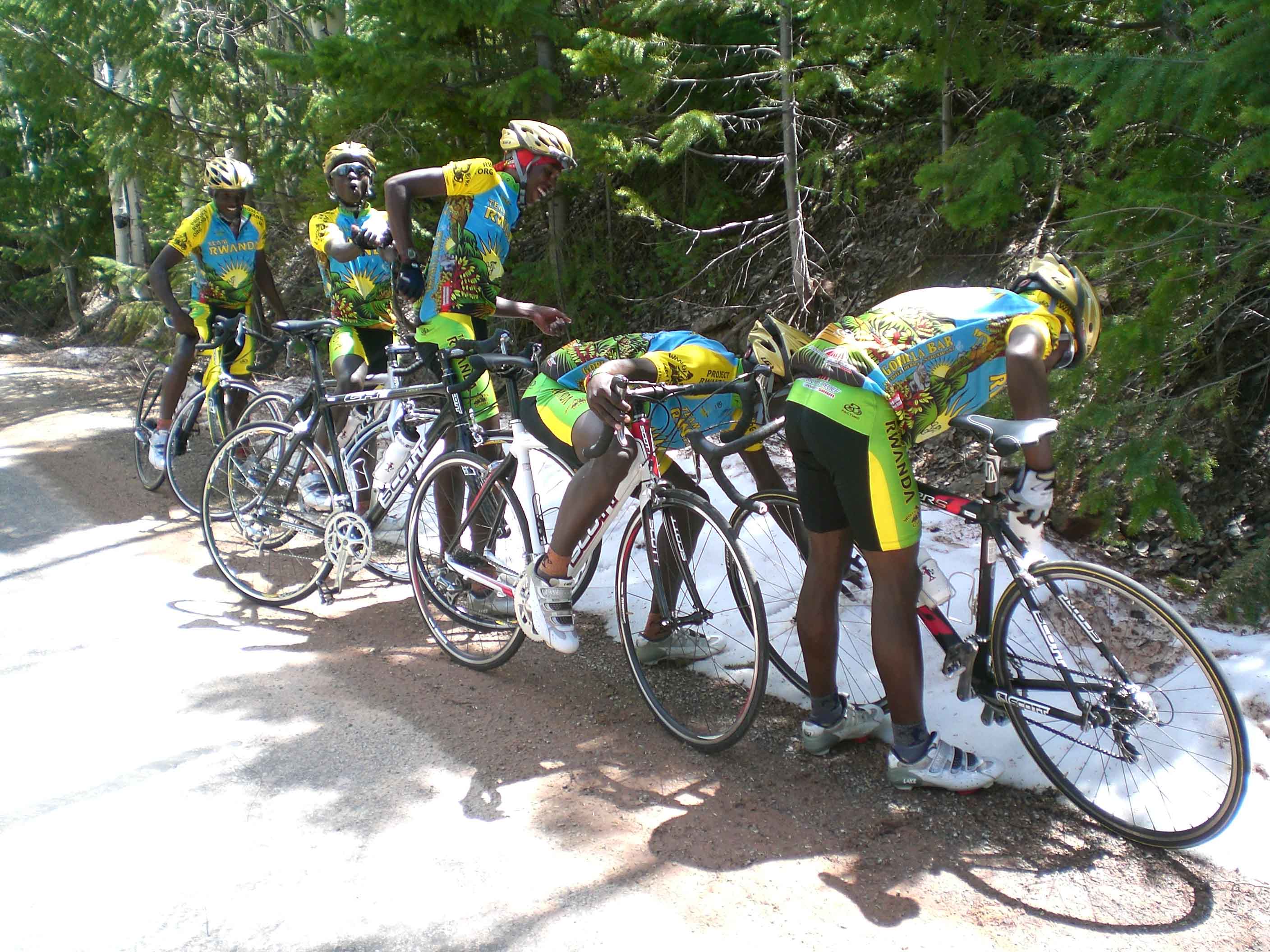
A cycling team from Rwanda sees snow for the first time.

869305-1000-1448627266-C_4_foto_1295133_image
Source.

A herd of sheep pass through a gate.

869055-1000-1448627266-378s_s
Source.

Feeding the “birds” in Ecuador. [JAC: this must be the Galapagos]

868405-1000-1448627266-06
Source.

A cat: the view from below.

868755-1000-1448627266-15579260-R3L8T8D-850-tumblr_nmqymzDooD1t4rq26o1_1280
Source.

The heavens open: Copenhagen, Denmark:

869105-1000-1448627266-4
© Mutley Wallcroft

With Mom.

869555-1000-1448627266-j17-1
Source.

A walrus becomes embarrassed when it’s given a cake of fish for its birthday; Norway [JAC: I’d say “overwhelmed”]

869005-1000-1448627266-3
Source.

The Atlantic: Genes are overrated; science doesn’t progress towards truth. Me: Wrong on both counts

May 22, 2016 • 11:30 am

The Atlantic has a review of Siddhartha’s new book on genetics; the review is by Nathaniel Comfort, a professor at the Institute of the History of Medicine at Johns Hopkins, and carries the provocative title of “Genes are overrated.”

I haven’t yet read Mukherjee’s book, so I won’t comment on its content except to say that the reviews have been generally positive but mixed, as Comfort’s is. I want instead to concentrate briefly on Comfort’s attitude towards science and genes.

One of the criticisms Comfort levels at Mukherjee is that he holds a “whiggish” view of genetics; that is, he sees genetics’ history as being one of progressive understanding. To Comfort, that’s a misleading way of describing science, which, to him, doesn’t progress toward deeper understanding of reality—like building an edifice of understanding—but acts simply as a bulldozer, plowing under theories that are shown to be wrong. Some quotes (my emphasis):

The antidote to such Whig history is a Darwinian approach. Darwin’s great insight was that while species do change, they do not progress toward a predetermined goal: Organisms adapt to local conditions, using the tools available at the time. So too with science. What counts as an interesting or soluble scientific problem varies with time and place; today’s truth is tomorrow’s null hypothesis—and next year’s error.

. . . The point is not that this [a complex view of how genes work; see below] is the correct way to understand the genome. The point is that science is not a march toward truth. Rather, as the author John McPhee wrote in 1967, “science erases what was previously true.” Every generation of scientists mulches under yesterday’s facts to fertilize those of tomorrow.

“There is grandeur in this view of life,” insisted Darwin, despite its allowing no purpose, no goal, no chance of perfection. There is grandeur in a Darwinian view of science, too. The gene is not a Platonic ideal. It is a human idea, ever changing and always rooted in time and place. To echo Darwin himself, while this planet has gone cycling on according to the laws laid down by Copernicus, Kepler, and Newton, endless interpretations of heredity have been, and are being, evolved.

Comfort is correct that science never knows when it’s reached the absolute, never-to-be-changed truth: there is no bell that goes off in our heads saying “ding ding ding: you’re there, and need go no further.” And a true Whiggish view of history—one that implies there’s an inevitable and unswerving path from error to truth, without any dead ends, mistakes, paths toward error, or roadblocks, is also a distortion, one that Matthew also criticized in his review of Mukherjee’s book in Nature.

But this doesn’t mean Comfort is right in arguing that everything we think we know will inevitably be demolished by future research. There are simply some things that are so unlikely to be falsified that we can see them not only as provisional truths, but as nearly absolute truths. A normal water molecule, for instance, has two hydrogen atoms and one oxygen atom. The Earth is about 4.6 billion years old, and life evolved on it, with all tetrapods descending from ancestral fish. Bodies attract each other with a force inversely proportional to the square of the distance between them. DNA is the purveyor of heredity, and in most organisms is a double helix. AIDS is caused by infection with a virus that attacks our immune system. You can all think of a gazillion more such “truths”—asssertions that you’d bet your house on.

Yes, science refines our understanding, and some theories, like Newton’s laws, are found to be special cases of deeper theories, like quantum mechanics. But to say that science is not a march toward truth, but a simple erasure of the false, is not only simplistic, but even a bit tautological: if we keep eliminating what doesn’t stand up, and keep adumbrating new theories, we will usually arrive at a more correct understanding of nature. For example, smallpox was once thought to be due to the wrath of gods. That theory was plowed under by the view that it was spread from person to person, and then to the notion that one could prevent it via inoculation. That, in turn, led to the recognition that the disease was caused by a virus, and then to the preparation of effective vaccines using live, attenuated viruses. The result: we understand fully how to get rid of the disease, and it’s been eliminated from our planet. In what sense is this not due to progressive homing in on the truth? We can use the laws of physics to land probes on comets. In what sense is that not due to a better understanding of how bodies move and interact, and not just a dispelling of what is false?

I see this kind of postmodernism infecting a lot of scientific writing, and it’s misguided; no, it’s simply wrong. 

Comfort also errs, I think, in claiming (as did Evelyn Fox Keller did in her 2000 book The Century of the Gene) that the gene is now pretty much a useless concept, both in definition and in action. (I critically reviewed that book in Nature; pdf available on request.) Comfort:

This handful of errors, drawn from a sackful of options, illustrates a larger point. The Whig interpretation of genetics is not merely ahistorical, it’s anti-scientific. If Copernicus displaced the Earth from the center of the universe and Darwin displaced humanity from the pinnacle of the organic world, a Whig history of the gene puts a kind of god back into our explanation of nature. It turns the gene into an eternal, essential thing awaiting elucidation by humans, instead of a living idea with ancestors, a development and maturation—and perhaps ultimately a death.

. . . Ironically, the more we study the genome, the more “the gene” recedes. A genome was initially defined as an organism’s complete set of genes. When I was in college, in the 1980s, humans had 100,000; today, only about 20,000 protein-coding genes are recognized. Those that remain are modular, repurposed, mixed and matched. They overlap and interleave. Some can be read forward or backward. The number of diseases understood to be caused by a single gene is shrinking; most genes’ effects on any given disease are small. Only about 1 percent of our genome encodes proteins. The rest is DNA dark matter. It is still incompletely understood, but some of it involves regulation of the genome itself. Some scientists who study non-protein-coding DNA are even moving away from the gene as a physical thing. They think of it as a “higher-order concept” or a “framework” that shifts with the needs of the cell. The old genome was a linear set of instructions, interspersed with junk; the new genome is a dynamic, three-dimensional body—as the geneticist Barbara McClintock called it, presciently, in 1983, a “sensitive organ of the cell.”

Yes, gene action is complicated, but the notion of a “gene” is not only not near death, but still extremely useful. Even if many diseases are caused by many different genes, they’re still genes, which I’ll define as “a segment of DNA that codes for a protein or an RNA molecule that regulates protein-coding genes.” In fact, there are many diseases and conditions—Landsteiner blood type, Rh type, Tay-Sachs disease, Huntington’s disease, sickle-cell anemia, color-blindness, and so on—that are caused by mutations in single genes, and can be effectively understood (and used in genetic counseling) by considering them as “single gene traits.” These are said to number over 10,000.

I’ve put at the bottom a discussion from Matthew’s book, Life’s Greatest Secret, about of the notion of “gene” and how it was questioned and then widely accepted.

And why the modern concept of a gene turns it into “kind of god” baffles me. The notion of genes, and of DNA as the molecule that carries them, has been immensely useful, and “true in the scientific sense. Does that make them into “gods”? Only to a postmodernist who resents the hegemony of scientific truth.

As for genes being a “higher order concept”, a “shifting framework” or a “three-dimensional body,” well, that’s not something that I, as a geneticist, am familiar with. Perhaps those concepts are adumbrated in the “science studies” departments—the same places where truths are seen as relative and privileged.

Let me add that most of Comfort’s review is okay, but then at the end he veers off into pomo la-la land. The usefulness of the idea of “genes” will survive: it survived Keller’s attack and will survive Comfort’s. But what I see as damaging is the notion that science doesn’t progress towards some kind of truth, or greater understanding of reality. It mystifies me how anyone familiar with the history of science can say that.

And if genes are overrated, it’s news to me. They are the bearers of heredity, the switches of development, and the coders of bodies. Without the notion of genes, and of the genetic code described so well in Matthew’s latest book, we’d be back in the days before 1900.

________

APPENDIX (!): Excerpts from Life’s Greatest Secret:

For much of the 1950s, scientists had felt uncomfortable about the word ‘gene’. In 1952, the Glasgow-based Italian geneticist Guido Pontecorvo highlighted the existence of four different definitions of the word that were regularly employed by scientists and which were sometimes mutually contradictory. A gene could refer to a self-replicating part of a chromosome, the smallest part of a chromosome that can show a mutation, the unit of physiological activity or, finally, the earliest definition of a gene – the unit of hereditary transmission. Pontecorvo questioned whether the gene could any longer be seen as a delimited part of a chromosome, and suggested instead that it was better seen as a process and that the word gene should therefore be used solely to describe the unit of physiological action.

. . . Although Pontecorvo’s suggestion was not taken up, scientists recognised the problem. The debate over words and concepts continued at the Johns Hopkins University symposium on ‘The Chemical Basis of Heredity’, which was held in June 1956. By this time it was generally accepted as a working hypothesis that all genes in all organisms were made of DNA and that the Watson–Crick double helix structure was also correct. Joshua Lederberg, a stickler for terminology, declared audaciously that ‘“gene” is no longer a useful term in exact discourse’ He would no doubt be surprised to learn that it is still being used, more than half a century later.

. . . The multiple roles of nucleic acids have expanded far beyond the initial definition of a gene as the fundamental unit of inheritance and show the inadequacy of Beadle and Tatum’s 1941 suggestion that each gene encodes an enzyme. As a consequence, some philosophers and scientists have suggested that we need a new definition of ‘gene’, and have come up with various complex alternatives. Most biologists have ignored these suggestions, just as they passed over the argument by Pontecorvo and Lederberg in the 1950s that the term ‘gene’ was obsolete.

In 2006, a group of scientists came up with a cumbersome definition of ‘gene’ that sought to cover most of the meanings: ‘A locatable region of genomic sequence, corresponding to a unit of inheritance, which is associated with regulatory regions, transcribed regions and/or other functional sequence regions. In reality, definitions such as ‘a stretch of DNA that is transcribed into RNA’, or ‘a DNA segment that contributes to phenotype/function’, seem to work in most circumstances. There are exceptions, but biologists are used to exceptions, which are found in every area of the study of life. The chaotic varieties of elements in our genome resist simple definitions because they have evolved over billions of years and have been continually sieved by natural selection. This explains why nucleic acids and the cellular systems that are required for them to function do not have the same strictly definable nature as the fundamental units of physics or chemistry.