This article in the New York Times (click on screenshot to go there) says that the “answer” to the deeply worrisome problem of mass shootings lies in both the number of guns we have, the ease of procuring them, and the ability to get guns in the U.S., like semiautomatic weapons (or ones that can be converted easily to automatics), that can do far more damage than simple rifles or pistols. The article rests largely on a study done in 2005 by Adam Lankford at the University of Alabama, a study I haven’t read.
The study (and article’s conclusion: “The only variable that can explain the high rate of mass shootings in America is its astronomical number of guns.” To demonstrate this, the author (and NYT) show some data, including this correlation between the number of guns (showing how much of an outlier the U.S. is) and the number of mass shooters:

Well, of course this is a correlation, and we all know that correlations don’t show causation, as there are third variables that could increase both, like an increased propensity of Americans to be criminals, which could prompt the acquisition and the using of guns. But that’s taken care of in data below.
Further, if you eliminate the U.S from the graph as an outlier, it’s hard to see much of a positive correlation for the rest of the countries (it may well be there, but you can’t really tell from the plot alone), which is what you need to establish to see if there’s a general relationship between gun ownership and number of mass shootings. You’d also want to control for population size, for what we want is not the number of guns and mass shootings, but the number of guns per person and the number of mass shootings per person.
All this appears to be taken care of in the next bit, which shows this figure:

As you see, the U.S is an outlier along with Yemen, the only country that has a higher number of mass shootings—and also has a high rate of gun ownership. If you remove these two countries, and look at the remaining dots, it’s not clear to me that there’s a correlation here, either, but it’s hard to tell (no statistics are given). But the article also notes that the relationship holds even when you remove the U.S., so I’ll trust Lankford here.
Further, if you look at confounding factors that may explain a correlation without saying that the cause of mass shootings is guns, they don’t appear to be involved. Lankford found, for instance, that there is still a relationship when you control for homicide rates, general criminality (the U.S. “is not actually more prone to crime than other developed countries”) and the rate of mental illness, which doesn’t appear to be higher in the U.S. than in other “wealthy countries”. (How would that cause a spurious correlation? Well, if Americans were more mentally ill than inhabitants of other countries, the disturbed people might go out and get more guns and then use them to kill others, so that the causal factor wouldn’t be availability of guns, though it would still involve gun ownership.) At any rate, countries with higher suicide rates have lower rates of mass shootings, the opposite of what you expect if the rate of mass shootings were correlated with the type of mental illness that lead to suicide.
There are other data as well:
America’s gun homicide rate was 33 per million people in 2009, far exceeding the average among developed countries. In Canada and Britain, it was 5 per million and 0.7 per million, respectively, which also corresponds with differences in gun ownership.
Americans sometimes see this as an expression of deeper problems with crime, a notion ingrained, in part, by a series of films portraying urban gang violence in the early 1990s. But the United States is not actually more prone to crime than other developed countries, according to a landmark 1999 study by Franklin E. Zimring and Gordon Hawkins of the University of California, Berkeley.
Rather, they found, in data that has since been repeatedly confirmed, that American crime is simply more lethal. A New Yorker is just as likely to be robbed as a Londoner, for instance, but the New Yorker is 54 times more likely to be killed in the process.
They concluded that the discrepancy, like so many other anomalies of American violence, came down to guns.
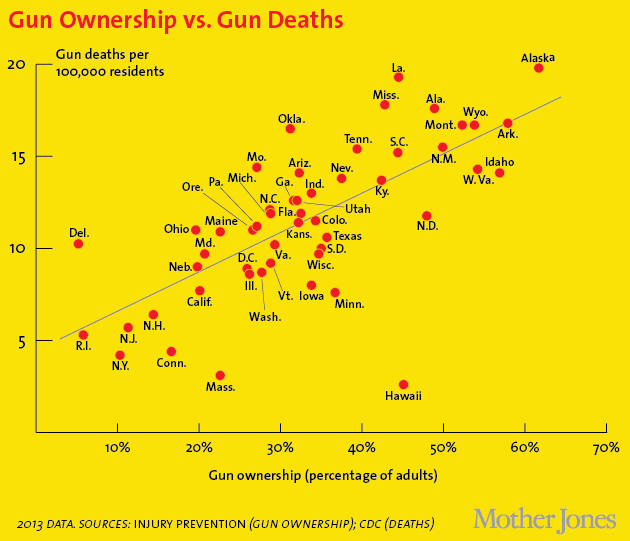
More gun ownership corresponds with more gun murders across virtually every axis: among developed countries, among American states, among American towns and cities and when controlling for crime rates. And gun control legislation tends to reduce gun murders, according to a recent analysis of 130 studies from 10 countries.
This suggests that the guns themselves cause the violence.
You can read the article for yourself, as I don’t want to simply regurgitate the data, but it all points to the fact that the easy accessibility of guns in America, the lack of gun controls, and the kind of guns that we can buy, are the variables that best explain the number (and rate) of mass shootings in America. (Note that this article doesn’t deal with individual homicides, but there are other data on those issues that implicate the accessibility of guns.)
In the end, the problem seems to come down to America’s Second Amendment, which was intended to allow arming of a militia, but has been interpreted (wrongly, I think) by U.S. courts as allowing fairly unrestricted individual ownership of guns—no militia needed. That Amendment appears to have fostered a sense of entitlement that we should have guns—that it’s our right. Barring the Second Amendment, you’d have a hard time justifying that we have a “right” to own such lethal weapons. (I’m always dubious when “rights” are asserted as arguments, but they become prima facie legal rights if they’re in our Constitution.)
Referring to the tighter gun laws of Switzerland (even though they’re second to the U.S. in the rate of gun ownership, the rate of Swiss gun homicides is far lower), the article notes this:
Swiss gun laws are more stringent, setting a higher bar for securing and keeping a license, for selling guns and for the types of guns that can be owned. Such laws reflect more than just tighter restrictions. They imply a different way of thinking about guns, as something that citizens must affirmatively earn the right to own.
The United States is one of only three countries, along with Mexico and Guatemala, that begin with the opposite assumption: that people have an inherent right to own guns.
The main reason American regulation of gun ownership is so weak may be the fact that the trade-offs are simply given a different weight in the United States than they are anywhere else.
After Britain had a mass shooting in 1987, the country instituted strict gun control laws. So did Australia after a 1996 shooting. But the United States has repeatedly faced the same calculus and determined that relatively unregulated gun ownership is worth the cost to society.
That choice, more than any statistic or regulation, is what most sets the United States apart.
And it is that Second Amendment that makes us think we have a right to own guns. Would that we could repeal that Amendment, but of course that wouldn’t end the problem, for we’d still have to legislate firearm laws for each state under the amended Constitution, and in a populace that largely thinks they have the right to have guns. The idea that we have such a right is alien to me, but it’s so deeply instilled in America that the problem seems harder to solve than that of Donald Trump himself, who, after all, will be gone in at most seven years. The article ends on a poignant note, one that shows how deeply sick we are with our guns fetish:
“In retrospect Sandy Hook marked the end of the US gun control debate,” Dan Hodges, a British journalist, wrote in a post on Twitter two years ago, referring to the 2012 attack that killed 20 young students at an elementary school in Connecticut. “Once America decided killing children was bearable, it was over.”