
Saturday: Hili dialogue

May 31, 2025 • 6:45 am

Welcome to CaturSaturday,  shabbos for Jewish cats, and we’re nearly into June. as it’s May 31, 2025.  It’s National Macaroon Day, and don’t mistake the American brand—soft, chewy, and tasty coconut cookies—for the frou-frou French macarons, which are overpriced and not that great.

Here are the real ones:
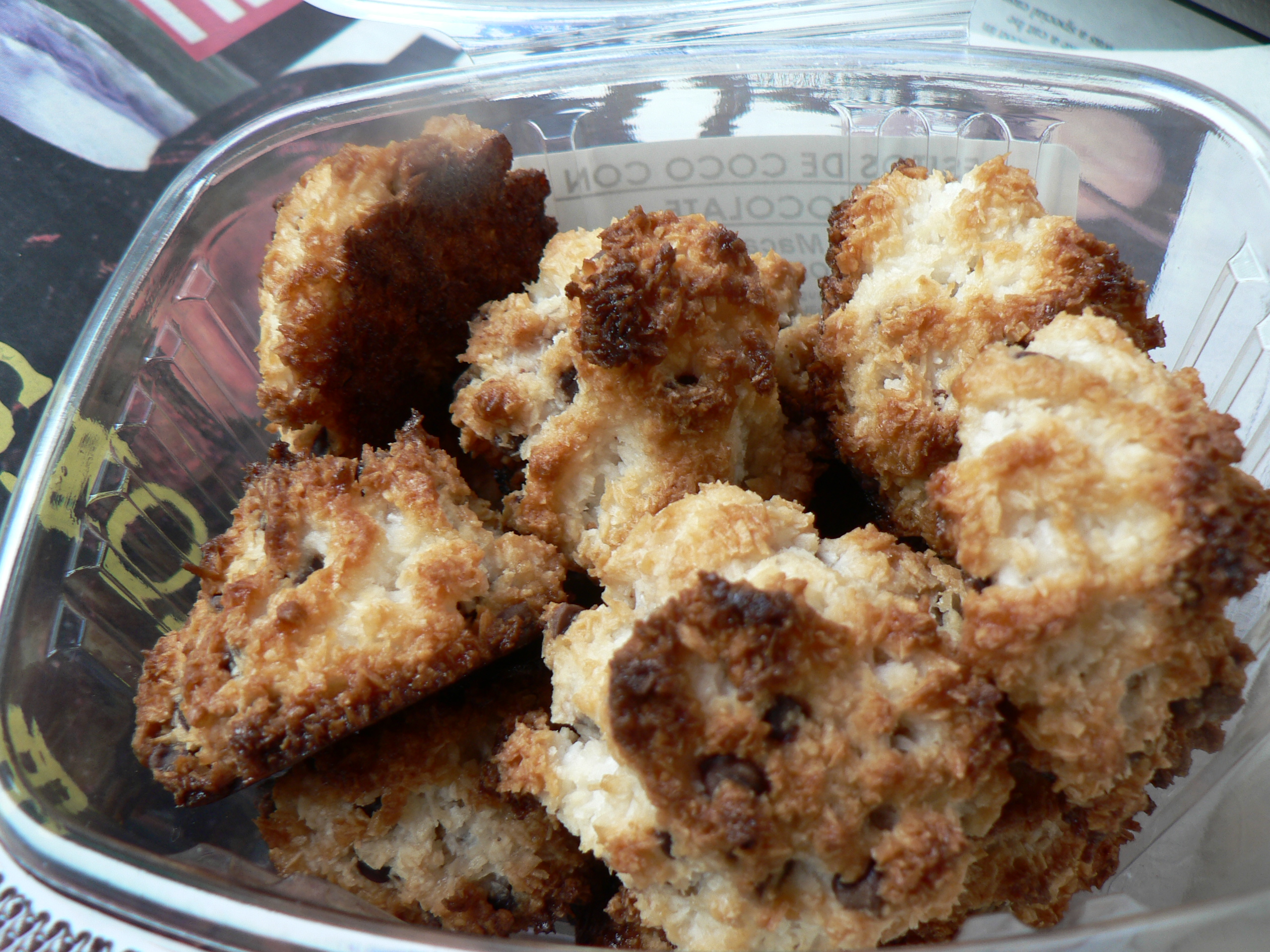
Creative Commons Attribution-Share Alike 2.0 Generic license.

And the overpriced macarons, which seem to have become a culinary fad.

Nicolas Halftermeyer, CC BY-SA 3.0, via Wikimedia Commons

It’s also World Parrot Day and National Meditation Day

Readers are welcome to mark notable events, births, or deaths on this day by consulting the May 31 Wikipedia page.

Da Nooz:

*According to the Times of Israel, Hamas and Israel may be close to reaching an accord that will be accompanied by a cease-fire.

Prime Minister Benjamin Netanyahu told hostages’ families that he principally approves of US special envoy Steve Witkoff’s latest proposal for a temporary ceasefire and hostage deal in Gaza, media outlets reported Thursday, while two sources told The Times of Israel that Hamas is leaning toward accepting the deal, with some reservations.

Accordingly, the deal is not yet final, and negotiations are likely to drag out for at least several more days, the sources said.

According to a copy of Witkoff’s latest proposal, the authenticity of which was confirmed to The Times of Israel by two sources familiar with the negotiations, Hamas would release 10 living Israeli hostages held in Gaza and return the bodies of 18 deceased hostages during a 60-day ceasefire.

In return, Israel would release 125 Palestinian terror convicts serving life sentences, 1,111 Gazans detained since the start of the war on October 7, 2023, and 180 bodies of Palestinians currently held by Israel.

The IDF would also pull back from some areas where troops are currently deployed; the parameters of the pullback would be finalized “during proximity negotiations.”

Netanyahu told hostages’ families during a meeting on Thursday that he was prepared to move forward with the proposal, the Axios news site reported, while Channel 12 reported that he told the families he “principally accepts” the document. However, the TV report also quoted him saying he was “not ready to end the war without eliminating Hamas.”

Meanwhile, right-wing ministers and some hawkish hostage families came out in opposition to the proposed deal, arguing that Hamas was weakened and that now was the time to pile pressure on the terrorist organization to surrender. A decision to accept the proposal would have to be approved by the Israeli cabinet.

This is a lousy deal, as all Israel gets is ten living hostages out of the estimated 20-30 left, plus dead bodies. Hamas gets lots of murderous terrorists released from Israeli prisons, and Israel has to leave part of Gaza. This will still leave Hamas in charge of the territory, and I thought that eliminating Hamas was Israel’s main aim.  Is it still? Remember, Hamas will still have around ten hostages if any ceasefire ends, so there would have to be another deal. All the while the world turns more and more against Israel. I have to say that Hamas played its cards well (taking hostages was very smart of them), but I agree that there can be no peace in Gaza so long as Hamas does not surrender itself as well as all of its hostages. A two-state solution? Not in the offing now.

*We learn from The Free Press that the Democratic Socialists of America are split about whether to condemn the murder of Sarah Milgrim and Yaron Lischinsky, gunned down in cold blood by a pro-Palestinian radical in front of Washington, D.C.’s Jewish Museum (see Nellie’s comment about one caucus of the DSA below).

Last Wednesday, a 31-year-old progressive activist allegedly shot and killed two employees of the Israeli embassy in Washington, D.C., in cold blood. As one of them, Sarah Milgrim, a 26-year-old Jew from Kansas, tried to crawl away, the gunman continued shooting at her.

“Free, free Palestine,” he shouted as police took him into custody.

You would think that this would be easy to condemn. Yet when the New York City chapter of the Democratic Socialists of America said in a statement released last Thursday that they “reject the violence of last night’s fatal shooting,” some members of the political organization revolted.

Almost immediately, a debate broke out in the national DSA’s internal message board for dues-paying members over how to respond to the killings outside the Capital Jewish Museum.

“Is it good to condemn violence against a genocidal apartheid state?” a DSA member with the username “SebastianFG” said in a post. Other members responded to the post with emojis of a heart and applause.

Other DSA members called the statement “horrific,” “hurtful,” and “irresponsible.”

The Democratic Socialists of America is not just a fringe activist organization. Its national membership has skyrocketed in recent years to more than 90,000, riding the wave of Bernie Sanders’s nearly successful primary challenge of Hillary Clinton in 2016. The political organization has since boasted major electoral success with politicians in Congress’s progressive “Squad,” including Michigan’s Rashida Tlaib and New York City’s Alexandria Ocasio-Cortez. The far-left group unendorsed Ocasio-Cortez last year after the congresswoman voted in favor of a resolution affirming Israel’s “right to exist.”

The radical group is deeply fractured over how to respond to last week’s killings of Milgrim and Yaron Lischinsky. (The alleged shooter, Elias Rodriguez, was charged with murder of foreign officials, first-degree murder, and other crimes.)

On one side of the fight within the DSA is the group’s so-called “right wing,” as its critics call it, which believes that the DSA should avoid any association with violence—and either condemn the act or not speak of it at all. This camp includes members who described themselves as a 69-year-old “radical,” a union member from Virginia, and a travel writer based in Louisiana, according to messages reviewed by The Free Press.

Then there are the DSA extremists, some of whom argue violence is necessary for revolution and others who openly celebrate it.

Well, AOC got booted out of the DSA because she wasn’t hard enough on Israel. Note, though, that Rashida Tlaib, who’s beyond redemption, is still a member, and Bernie Sanders, who identifies as a democratic socialist, has been endorsed by the DSA.  Regardless, given this behavior, both should resign from that organization. For crying out loud, nobody deserves to be murdered because they work for the Israeli embassy in Washington!

*And at Quillette, Graham Deseler reviews Ross Douthat’s new book, tendentiously called Believe: Why Everyone Should Be Religious (it was issued by a religious publisher).

. . . religion has been making something of a comeback lately. According to a recent Pew survey, the number of people who identify as Christians—a figure that had been declining for decades—appears to have levelled off, at least for the moment. It hovered around 63 percent in 2019, and that’s approximately where it stands now. In England, church attendance has actually increased among Generation Z. Rather than turning to the Church of England, younger congregants have been joining showier denominations like Catholicism and Pentecostalism. The rise of wokeness and the cult of personality that sprang up around Donald Trump have led some people to speculate that there’s a “God-shaped hole” in contemporary culture. “As religion has receded from people’s lives,” sociologist Jonathan Haidt has explained, “they’re hungrier. As I see it, politics has really taken the place [of religion].”

One of the loudest cheerleaders for the current religious revival is opinion columnist Ross Douthat, a conservative and a Catholic, who for years has used his perch at the New York Times to sing the praises of faith. Douthat has a new bestseller out titled Believe: Why Everyone Should Be Religious, in which he argues that belief in God is not only socially beneficial and emotionally fulfilling—as Thompson, Rauch, and Ali contend—but also scientifically sound. “It is the religious perspective that grounds both intellectual rigor and moral idealism,” he writes. “And more important, it is the religious perspective that has the better case by far for being true.”

Douthat is an intelligent man, and he’s written several well-reasoned books—on the Republican Party, on the decadence of modern society, and on his own harrowing battle with Lyme disease. This is not one of them. He blows past entire branches of science and philosophy in just a few paragraphs, behaving as if he’s solved puzzles that, in fact, he’s barely touched. For instance, the question of why a benevolent personal God would allow good people to suffer has been perplexing thinkers since the Book of Job. But Douthat believes he has that problem licked:

After recounting what he sees as Douthat’s strongest argument (“fine-tuning”, which isn’t that strong), Deseler takes apart more of Douthat’s evidence for God:

Douthat also wonders about consciousness. Scientists have learned an enormous amount about the workings of the brain, he writes, but they are no closer to explaining how consciousness emerges: “Redescribe as you will, reduce as you may, nobody has any idea how or why the physical inputs that go into conscious experience, the stimuli from particular chemicals or light waves or exchanges between neurons, yield the actual experiences themselves.” On top of this mystery, Douthat layers others: “How,” he asks, “can light be both a wave and a particle? How can particles remain somehow ‘entangled’ even when separated by a great distance? And above all—how can human observation be the only thing that transforms quantum contingency into definite reality, wave into particle, probability into certainty?” Douthat’s answer to these rhetorical questions is that mind and matter are entwined because mind precedes matter.

It doesn’t take a degree in either neuroscience or quantum physics to see that Douthat is simply swapping one mystery for another. The hard problem of consciousness has stumped scientists for years, but invoking a divine creator does not provide a satisfactory answer. Douthat could just as well use the word magic to explain the emergence of consciousness. That, at least, would provide a more parsimonious explanation of cause and effect. After all, if conscious minds need a conscious creator, the next obvious question is who created the creator? The same goes for wave-particle duality. Saying the existence of God explains how light can be either a particle or a wave, depending on how it’s observed, is simply a way of dumping the conundrum on the Almighty. Douthat, in short, is postulating a “God of the gaps,” squeezing Him into the crevices that scientific knowledge has yet to fill. In the past, religious apologists have generally been wary of resorting to such arguments because they recognise that the gaps have been shrinking over time as we learn more about material reality. A God of the gaps is, by definition, a God of diminishing importance.

And you may remember this fatuous claim of Douthat:

Midway through the book, he states that the world’s religions are not incompatible with one another. Human history is filled with episodes of religious conflict and bloodshed precisely because they aren’t compatible. The New Testament, the Koran, and the Book of Mormon can’t all be the final revelation. If Brahma, Vishnu, and Shiva are real, Allah can’t be the one and only God. To pretend otherwise is not an empirical position, based on evidence. Nor is it a rational one, based on logic. It’s an act of faith.

Indeed, but Douthat would likely say that it’s better to have any faith rather than none. The man is delusional, making a post facto case to justify what he wants to believe, and it’s embarrassing that he’s allowed to publish this stuff in the New York Times.

*The National Spelling Bee was won with a tough French word (the article is archived here). I bet you can’t spell that word!

After coming in as runner-up during last year’s Scripps National Spelling Bee and bungling an earlier chance to win on Thursday night, Faizan Zaki was given a word that, if spelled correctly, would let him finally win it all: “éclaircissement.”

He smiled and, without hesitation, stated each letter easily, then collapsed on the floor amid a shower of confetti. The 13-year-old of Plano, Texas, didn’t even need to ask for the word’s meaning, “a clearing up of something obscure.”

The stunning win capped a surprising run that took down six finalists and momentarily left the bee’s winner in doubt.

Here are five takeaways from the competition.

The nine finalists were unflappable

Sarv stole the spotlight

The competition almost ended in the eighth round

Mary Brooks had the hardest job of the night [a judge, she had to ring the bell when a contestant misspelled a word]

Faizan finally gets his win [he finished second last year]

Here’s a video of the winning moment.  If you look at the photo in the NYT piece, you’ll see that all the contestants but one appear to be East Asian, which I think is the usual situation.

*As always, I’ll steal a few items from Nellie Bowles’s weekly snark-and-news column in the Free Press, called this week: “TGIF: Scammander in Chief.”

→ The continued reckoning: A postmortem on Kamala Harris’s campaign cited a “perception gap” as one of the reasons she lost, saying voters believed she held positions that she didn’t. “Over 80% of swing voters who chose Trump believed Harris held positions she didn’t campaign on in 2024, including supporting taxpayer funding for transgender surgeries for undocumented immigrants (83%), mandatory electric vehicles by 2035 (82%), decriminalizing border crossings (77%), and defunding the police (72%).” But Harris had, in fact, supported all of these positions. Like, she is on record supporting each of those positions (hereherehere, and here). So it’s not really a perception problem so much as a reception problem, like these ideas are not popular even though I support them. There’s a sense among Dems that people should simply ignore the things that are unpopular and that referencing them is fake news. Like, how dare you talk about the surge of migrants coming through our new open borders thanks to swift changes from the Biden admin. Yes, it’s technically true, but it’s disinformation-coded.

→ Leave Bruce alone: A bar in New Jersey canceled a performance by a Bruce Springsteen tribute band after the real Springsteen called Trump “corrupt, incompetent, and treasonous” while on tour in England. Citing the bar’s MAGA clientele, the bar owner said that a Springsteen cover band would be “too risky at the moment.” And: “Whenever the national anthem plays, my bar stands and is in total silence, that’s our clientele. Toms River is red and won’t stand for his bull—.”

My conclusion: All political groups can be snowflake babies. All men yearn to see blood in the streets. See, I absolutely love Bruce Springsteen, and sure, I find his photo shoots and podcasts with Obama to be a little cringe, as the kids say, but I also don’t care. Politics shouldn’t get in the way of enjoying “Tunnel of Love,” a goddamn masterpiece. I take my neutrality seriously. We’re blasting the new Ye banger in our house right now. Art knows no borders! (Weird, I have no idea why the preschool teachers just requested an urgent meeting.)

→ Things that are not antisemitism: The Democratic Socialists of America “Liberation Caucus” has announced its support for Elias Rodriguez, the suspect arrested for slaughtering two Israeli Embassy staffers outside D.C.’s Capital Jewish Museum last week. Here’s the statement signed by the DSA Liberation folks and a bunch of others: “As imperialism has made the entire world its battlefield, it is justified to fight it, by any means necessary, without regard for geography.” And: “[T]here must be consequences for genocidal [Z]ionist imperialism, and those consequences are righteous.” Chants of resistance is justified are the new cool thing in Chicago. And the major anti-Zionist protest group Unity of Fields is officially transitioning into “A MILITANT FRONT AGAINST THE US-NATO-ZIONIST AXIS OF IMPERIALISM.” Militant means their plan is to kill more. So, anyone who has ever said the Passover prayer that ends with Next year in Jerusalem, well, we’re all fair game. The killings are anti-Zionism, though, not antisemitism, write mainstream lefty thinkers. It just happens to be that Judaism keeps bringing up Israel. Have you considered not saying prayers? And a leader of the Palestine Writes festival is posting about how there is no such thing as the Jewish people. You learn new things every day.

Meanwhile in Dobrzyn, Hili is tired of being Editor-in-Chief of Listy and would rather rest:

Hili: We have to make a careful plan.
A; What plan?
Hili: How to break away from work.
In Polish:
Hili: Musimy to starannie zaplanować.
Ja: Co zaplanować?
Hili: Jak się oderwać od pracy.

And a photo of Szaron:

*******************

Frim CinEmma:

From The Dodo Pet:

From Meow:

Masih is still quiet, but JKR is reliably vocal. Here she points out the phenomenon of lesbians who are demonized for not wanting to hook up with transwomen who say they are lesbians:

From Michael: BIG CAT HUG!

From Jez: a Jewish MIT grad offended by a blatantly anti-Jewish graduation speech (this moronic speaker doesn’t seem to realize that Hamas is the truly genocidal organization). The kids can’t help themselves!

And here’s the offensive speech. The speaker certainly helped Gaza (LOL)!

From Malcolm, a pensive cat (sound up):

One I reposted from the Auschwitz Memorial:

Gassed to death upon arriving at Auschwitz, this Dutch girl was only seven.

Jerry Coyne (@evolutionistrue.bsky.social) 2025-05-31T09:46:03.709Z

Two posts from Dr. Cobb. About the first one he simply says, “True”:

The only thing flat earthers fear is sphere itself!🌎 😆🤙

Photography by Douglas 🍁 (@darkwaterphotos.bsky.social) 2025-05-29T12:21:31.494Z

The article notes that these are a white-fronted goose and a Canada goose, which have mated and produced eggs.  There were six eggs, two of which hatched, but no goslings could be found. The other four were duds.

“These are two totally different species of goose. But for some reason, they paired up – and they even produced eggs.”

Matt Novak (@paleofuture.bsky.social) 2025-05-30T04:06:10.013Z


Guest post: does atmospheric chemistry suggest there’s life on another planet?

May 30, 2025 • 10:00 am

Today we have a guest post from reader Coel Hellier, who does this kind of stuff for a living. His text deals with the recent kerfuffle about whether a nearby planet shows an atmospheric gas indicative of life.  I particularly like the details about how scientists go about analyzing a question like this. His text is indented, and he’s added the illustrations.

Is the dimethyl sulphide in the atmosphere of exoplanet K2-18b real?

Everyone is interested in whether there is life on other planets. Thus the recent claim of a detection of a biomarker molecule in the atmosphere of an exoplanet has attracted both widespread attention and some skepticism from other scientists.

The claim is that planet K2-18b, 124 light years from Earth, shows evidence of dimethyl sulfide (DMS), a molecule that on Earth arises from biological activity. Below is an account of the claim; I try to include more science than the does mainstream media, but do so largely with pictures in the hope that the non-expert can follow the argument.

Transiting exoplanets such as K2-18b are discovered owing to the periodic dips they cause in the light of the host star:

And here is the lightcurve of K2-18b, as observed by the James Webb Space Telescope, showing the transit that led to the claim of DMS by Madhusudhan et al.:

If we know the size of the star (deduced from knowing the type of star from its spectrum), the fraction of light that is blocked then tells you the size of the planet.

But we also need to know its mass. One gets that from measuring how much the host star is tugged around by the planet’s gravity, and that is obtained from the Doppler shift of the star’s light.

The black wiggly line in the plot below is the periodic motion of the star caused by the orbiting planet. Quantifying this is made harder by lots of additional variation in the measurements (blue points with error bars), which is the result of magnetic activity on the star (“star spots”). But nevertheless, if one phases all the data on the planet’s orbital period (lower panel), then one can measure the planet’s mass (plot by Ryan Cloutier et al):

So now we have the mass and the size of the planet (and we also know its surface temperature since we know how far it is from its star, and thus how much heating it gets).  Combining that with some understanding of proto-planetary disks and planet formation. we can thus dervise models of the internal composition and structure of the planet.

The problem is that multiple different internal structures can add up to the same overall mass and radius. One has flexibility to invoke a heavy core (iron, nickel), a rocky mantle (silicates), perhaps a layer of ice (methane?), perhaps a liquid ocean (water?), and also an atmosphere.

This “degeneracy” is why Nikku Madhusudhan can argue that K2-18b is a “hycean” planet (hydrogen atmosphere over a liquid-water ocean) while others argue that it is instead a mini-Neptune, or that it has an ocean of molten magma.

But one can hope to get more information from the detection of molecules in the planet’s atmosphere, a task that is one of the main design goals of the James Webb Space Telescope [JWST]. The basic idea is straightforward: During transit, some of the starlight will shine through the thin smear of atmosphere surrounding the planet, and the different molecules absorb different wavelengths of light in a pattern characteristic of that molecule (figure by ESA):

So one observes the star both during the transit and out of transit, and then subtracts the two, and the result is a spectrum of the planet’s atmosphere.

If the planet is a large gas giant with a fluffy, extended atmosphere and is orbiting a bright star (so that a lot of photons pass through the atmosphere), the results can be readily convincing. For example, here is a spectrum of exoplanet WASP-39b with features from different molecules labelled (figure by Tonmoy Deka et al):

[I include a plot of WASP-39b partly because I was part of the discovery team for the Wide Angle Search for Planets survey, but also because it is pretty amazing that we can now obtain a spectrum like that of the atmosphere of an exoplanet that is 700 light-years away, even while the planet itself is so small and dim and distant that we cannot even see it.]

The problem with K2-18b is that the star is vastly fainter and the planet much smaller than WASP-39b. This is at the limit of what even the $10-billion JWST can do.

When you’re subtracting two very-similar spectra (the in- and out-of-transit spectra)  to look for a rather small signal, any “instrumental systematics” matter a lot. Here is the same spectrum of K2-18b, as processed by several different “data reduction pipelines”, and as you can see the differences between them (effectively, the limits of how well we understand the data processing) are similar in size to the signal (plot by Rafael Luque et al):

The next problem is that there are a lot of different molecules that one could potentially invoke (with the constraint of making the atmospheric chemistry self-consistent). For example, here are the expected spectral features from eight different possible molecules (figure by Madhusudhan):

To finally get to the point, I show is the crucial figure below. Nikku Madhusudhan and colleagues argue — based on an understanding of planet formation, and on arguments that planets like K2-18b are hycean worlds [with a liquid water ocean under a hydrogen-rich atmosphere], and from considerations of atmospheric chemistry, in addition to careful processing and modelling of the spectrum itself — that the JWST spectrum of K2-18b is best interpreted as follows (the blue line is the model, the red error bars are the data):

This interpretation involves large contributions from DMS (dimethyl sulphide) and also DMDS (dimethyl disulphide) — the plot below shows the different contributions separated — and if so that would be notable, since on Earth those compounds are products of biological activity—mainly from algae.

In contrast, Jake Taylor analysed the same spectrum and argues that he can fit it adequately with a straight line, and that the spectral features are not statistically significant. Others point out that the fitted model contains roughly as many free parameters as data points. Meanwhile, a team led by Rafael Luque reports that they can fit the spectrum without invoking DMS or DMDS, and suggest that observations of another 25 transits of K2-18b would be needed to properly settle the matter.

There are several distinct questions here: Are the details of the data processing sufficiently understood? (perhaps, but not certainly); are the relevant spectral features statistically significant? (that’s borderline);  and, if the features are indeed real, are they properly interpreted as DMS? (theorists can usually think of alternative possibilities). Perhaps a fourth question is whether there are abiotic mechanisms for producing DMS.

This is science at the cutting edge (and Madhusudhan has been among those emphasizing the lack of certainty, though the doubts have not always been in news stories), and so the only real answer to these questions is that things are currently unclear. This is a fast-moving area of astrophysics and we’ll know a lot more in a few years.

Readers’ wildlife photos

May 30, 2025 • 8:15 am

We’re almost out of photos, so I implore readers to send in their good wildlife snaps. Thanks!

We continue today with part 3 of Ephraim Heller’s safari in Tanzania (part 1 is here and part 2 here). Today we have raptors:

Brief introduction: These photos were taken on safari in Tanzania in April 2025. Most are from the Serengeti National Park with a few from the Ngorongoro Conservation Area. This batch of photos focuses on raptors.

Pale chanting goshawk with a yummy rodent:

Tawny eagleL

Black-shouldered kite with dinner:

This tawny eagle strayed too close to the nest of this black-shouldered kite, who made clear that he is not welcome by attacking the eagle’s eyes:

Common kestrals and lesser kestrels share a roosting tree as evening falls:

A pair of common kestrels.

Marsh owl. About a dozen individuals gathered on the ground at dusk, which was unusual:

Verreaux’s or giant eagle-owl juvenile begging for food from his parents who are in a nearby tree:

Red-necked falcon:


Friday: Hili dialogue

May 30, 2025 • 6:45 am

Welcome to the last Friday of May: It’s May 30, 2025, and June begins in two days.

It’s also Mint Julep Day, celebrating a drink that’s excellent when made with good bourbon and fresh mint: here’s one served in the traditional way, in a frosted silver cup:

Cocktailmarler, CC BY-SA 3.0, via Wikimedia Commons

It’s also National Heat Awareness Day and National Creativity Day.

Posting has been and will continue to be light as I’ve had another bad attack of insomnia, but also because there seems to be adearth of interesting news. Or maybe it’s me. Bear with me, though: I do my best. Today I have a Zoom call and a 1.5-hour podcast to do (more on that later), so don’t expect much today.

Readers are welcome to mark notable events, births, or deaths on this day by consulting the May 30 Wikipedia page.

Da Nooz:

Lots of Trumpy news today:

*After a fractious tenure as head of DOGE, Elon Musk is finally leaving the Trump administration.

Elon Musk, a key adviser to President Donald Trump who oversaw the U.S. DOGE Service, said Wednesday that he is leaving the administration after leading a contentious effort to reshape the federal bureaucracy and slash government spending.

Musk wrote on his social media platform, X, that his “scheduled time” as a special government employee had come to an end.That designation, which exempts him from financial disclosure and conflict-of-interest rules that apply to full-time government workers, also means he is not permitted to work more than 130 days in a 365-day period.

In the post, Musk thanked Trump for the “opportunity to reduce wasteful spending” and said DOGE’s “mission will only strengthen over time.”

A White House official, speaking on the condition of anonymity because they were not authorized to speak publicly, confirmed Musk’s departure and said his offboarding will begin Wednesday night.

A day earlier, in a major break with the president and Republicans, Musk said he did not approve of Trump’s spending bill — officially known as the One Big Beautiful Bill — with its massive tax cuts.

“I was disappointed to see the massive spending bill, frankly, which increases the budget deficit, not just decreases it, and undermines the work that the DOGE team is doing,” Musk said in an interview with CBS News.

Trump — who in February sat alongside Musk for a Fox News interview that saw the two men praise each other effusively — has yet to comment on Musk’s departure, though the president has posted unrelated memes and video on social media since Musk’s announcement.

For weeks, Musk has signaled that he plans to wind down his government work and refocus on his companies. Privately, he has grown frustrated with the challenges of achieving results within the federal government, along with the backlash he has faced — both personally and toward Tesla, his electric-vehicle company, The Washington Post has reported.

Well, all I can say is “good riddance,” but it’ll take years until America heals from the slash-and-burn cost-cutting strategies of Musk in collaboration with Trump.  Musk, the world’s richest man, can go back to blowing up rockets in his futile attempt to put people on Mars.

*Federal judges have blocked many of Trump’s new tariffs, including the steepest ones on China and other countries (article archived here).

A panel of federal judges on Wednesday blocked President Trump from imposing some of his steepest tariffs on China and other U.S. trading partners, finding that federal law did not grant him “unbounded authority” to tax imports from nearly every country around the world.

The ruling, by the U.S. Court of International Trade, delivered an early yet significant setback to Mr. Trump, undercutting his primary leverage as he looks to pressure other nations into striking trade deals more beneficial to the United States.

Before Mr. Trump took office, no president had sought to invoke the International Emergency Economic Powers Act, a 1977 law, to impose tariffs on other nations. The law, which primarily concerns trade embargoes and sanctions, does not even mention tariffs.

But Mr. Trump adopted a novel interpretation of its powers as he announced, and then suspended, high levies on scores of countries in April. He also used the law to impose tariffs on products from Canada and Mexico in return for what he said was their role in sending fentanyl to the United States.

On Wednesday, the Court of International Trade, the primary federal legal body overseeing such matters, found that Mr. Trump’s tariffs “exceed any authority granted” to the president by the emergency powers law. Ruling in separate cases brought by states and businesses, a bipartisan panel of three judges essentially declared many, but not all, of Mr. Trump’s tariffs to have been issued illegally.

Below is a graph that tracks the lawsuits against Trump, taken from The Washington Post, which adds,

President Donald Trump is facing about 250 lawsuits over his executive orders, far more than had been filed at this point during his first term. The unprecedented flood of legal action has stymied many of Trump’s priorities, but judges and appeals courts — up to the Supreme Court — have cleared some to move forward while litigation continues.

Judges have blocked — for now — his efforts to punish law firms and Harvard University, as well as to deport migrants without due process. Courts have allowed Trump to fire independent regulators while litigation continues. On Wednesday, the Court of International Trade blocked the 10 percent tariffs Trump imposed on all foreign products as well as the higher levies applied to imports from several dozen nations.

Most of the rulings are temporary. Their final outcomes will go a long way to shape what Trump is able to accomplish in his second term. Here is our rundown of some of the biggest cases.

*Speaking of China, Secretary of State Marco Rubio (those words stick in my craw) has announced that he’ll revoke the visas of many Chinese students—”aggressively”:

Secretary of State Marco Rubio announced on Wednesday evening that the Trump administration would work to “aggressively revoke” visas of Chinese students, including those with ties to the Chinese Communist Party or who are studying in “critical fields.”

He added that the State Department was revising visa criteria to “enhance scrutiny” of all future applications from China, including Hong Kong.

The move was certain to send ripples of anxiety across university campuses in the United States and was likely to lead to reprisal from China, the country of origin for the second-largest group of international students in the United States.

Mr. Rubio’s brief statement announcing the visa crackdown did not define “critical fields” of study, but the phrase most likely refers to research in the physical sciences. In recent years, American officials have expressed concerns about the Chinese government recruiting U.S.-trained scientists, though there is no evidence of such scientists working for China in large numbers.

Similarly, it is unclear how U.S. officials will determine which students have ties to the Communist Party. The lack of detail on the scope of the directive will no doubt fuel worries among the roughly 275,000 Chinese students in the United States, as well as professors and university administrators who depend on their research skills and financial support.

American universities and research laboratories have benefited over many decades by drawing some of the most talented students from China and other countries, and many universities rely on international students paying full tuition for a substantial part of their annual revenue.

Last year 20% of student visas were granted to Chinese people, and I have to agree with both of the last two paragraphs.  Some of the most talented STEM people in America (in my experience) came from China, and those who stay vastly enrich scientific culture. This is just more Trumpian retribution against China, and retribution that works to the detriment of America. But will the person in the street care about this? I doubt it; they worry more about the price of groceries. But those will rise, too, helping Democrats. I worry a lot about the next Presidential election, but the 2026 midterms will give us a clue about national sentiment. (It won’t give us a Democratic government, though, and remember that Trump has veto power until his term is up.

*Newsweek reports a new policy of massive grade inflation in San Francisco, and you know why (h/t Williams Garcia): all must have prizes!

San Francisco’s public high schools will implement a sweeping change to their grading system this fall, replacing traditional methods with a policy that allows students to pass with scores as low as 41 percent.

The initiative, part of a broader “Grading for Equity” push, is stirring concern among educators, students and parents over academic standards and college readiness.

The context [JAC: I’ve put the gist of the new plan in bold]

Similar policies across other Bay Area districts—such as Dublin, Oakland and Pleasanton—have seen mixed results and strong community reactions. Dublin Unified attempted a pilot of equity grading in 2023, which included removing zeros for missed assignments and awarding a minimum of 50 percent for any “reasonably attempted” work.

That pilot, however, was met with outrage and resistance. Parents created petitions, formed WhatsApp groups and filled school board meetings to protest what they saw as a lowering of standards for their children. The Dublin school board eventually suspended the initiative, though individual teachers were still allowed to use the methods at their discretion.

The experiment in San Francisco comes amid — or despite — a broader rethinking of DEI initiatives after the election of Donald Trump, who ran on a platform of excising what he and many others said were “unfair” equity practices in the government and private sectors.

. . . . The new policy, set to affect more than 10,000 students across 14 high schools, significantly changes how academic performance is measured.

Homework and classroom participation will no longer influence a student’s final grade. Students will be assessed primarily on a final exam, which they can retake multiple times. Attendance and punctuality will not affect academic standing.

The plan was first revealed in the fine print of a 25-page agenda and reported by The Voice of San Francisco, a local nonprofit. The outlet reported that the district is hiring Joe Feldman, an educational consultant known for his book Grading for Equity, to train teachers this summer.

“If our grading practices don’t change, the achievement and opportunity gaps will remain for our most vulnerable students. If we are truly dedicated to equity, we have to stop avoiding the sensitive issue of grading and embrace it,” Feldman said in a 2019 blog post for the School Superintendents Association (AASA).

Feldman’s book outlines how traditional grading can reinforce socioeconomic disparities and proposes alternative strategies for more equitable assessment. According to The Voice of San Francisco, the new system will be modeled in part on the San Leandro Unified School District, where students can earn an A with a score as low as 80 percent and pass with a D at just 21 percent. Under the forthcoming San Francisco policy, a score of 41 percent will qualify as a C.

. . . . Supporters of the policy say it better reflects real student learning by de-emphasizing behavior-based penalties like late work or missed assignments. However, critics warn the policy could harm students who are already on track for college placement.

“Nowhere in college do you get 50 percent for doing nothing,” said Laurie Sargent, an eighth-grade English teacher in the Dublin Unified School District, in a 2024 Mercury News report. “Nowhere in the working world do you get 50 percent for doing nothing. If I don’t show up to work, they don’t pay me 50 percent of my salary—even if I made a reasonable attempt to get there.”

Put me on the side of Laurie Sargent.  There is only one real motivation for this heinous laxness and grade inflation: to make the poorer students, often members of minority groups, look better.  But in the end, I think it will actually hurt those students, for it weakens the meritocracy, hiding those minority students who are standouts, and takes away the incentive from every student to work (how many students will come to class if they don’t have to, and will take exams over and over again until they get a decent score.

*I signed up for emails from Colossal Biosciences, and got one yesterday with good news and bad news. The good news is that the endangered red wolf, reduced to only 14 individuals in captivity, which reduces genetic variation, is part of a Colossal plan to boost the genetic variation. Here’s what they propose.  First, Colossal cloned a “ghost wolf” (a coyote/red wolf hybrid from the wild) that had a lot of natural red wolf genome; the cloning was done using a domestic dog surrogate mother.  Later, the firm plans to insert some genuine red wolf genome (based on DNA taken from captive wolves) into the genome of ghost wolves (see the video here and discussion on the Colossal website here), making Colossal “one step closer to restoring the species”. While this may up the genetic variation in captive red wolves, it’s not clear how much red wolf genome will be boosted in the “restored species”, and I don’t know how serious a problem the lack of genetic variation poses anyway (habitat loss and hunting may be far more serious problems). So we may get more red-wolfish individuals (where will they be released?), but as far as I can see, they won’t be genetically pure red wolves.  We’ll have to wait and see. The project has its good aspects, but, as usual, I think there’s some hype here.

The bad news is that Colossal is STILL referring to the dire wolf as a “de-extincted” ancient animal, despite having admitted previously that they did not bring back dire wolves and in fact produced only grey wolves with 15 DNA edits derived from the dire wolf genome out of 20 total edits.  So Colossal has backtracked bit time.

Here’s a screenshot from the email, followed by a breathless video praising the bogus “de-extinction”.

Here’s a rah-rah video, heavy on the PR and devoid of any caveats.

Clearly, Colossal has decided to dig in its heels and argue that, yes, they have “de-extincted” the dire wolf. They most certainly have not. But the mainstream media has let the public down by buying into Colossal’s hype.

Meanwhile in Dobrzyn, Andrzej gets a rebuke from Hili:

Hili: You made a very bad decision with this gravel.
Andrzej: Why?
Hili: You forgot that cats walk without shoes.
In Polish:
Hili: Z tymi kamykami to bardzo źle wymyśliłeś.
Ja: Dlaczego?
Hili: Zapomniałeś, że koty nie chodzą w butach.

*******************

From Meow:

From Jesus of the Day:

From Strange, Stupid, or Silly Signs:

From Masih: Iran’s built its own version of Hell to scare the bejeezus out of its citizens:

From Luana: Brown has just adopted institutional neutrality, as laid out in Chicago’s Kalven Report. It’s only the 32nd university or college to make this sensible move:

From Malcolm; Person adopts wolf pup (not knowing what it was), person bonds with wolf pup, person releases grown wolf to its pack, but wolf sometimes visits. . .

Two from my feed.  Propaganda at Harvard graduation. Sure, it’s free speech, but it’s misleading and inappropriate free speech.

Should I try this for my insomnia?

One I reposted from the Auschwitz Memorial:

An eight-year old Jewish girl was gassed to death upon arriving at Auschwitz. She was seven.

Jerry Coyne (@evolutionistrue.bsky.social) 2025-05-30T09:33:45.065Z

Two posts from Dr. Cobb.  He finds this first one lovely:

Something a bit different for today's #foxoftheday . Watch some newts , accompanied by a drinking fox's tongue , shared by @urbanponds101 ! Top work !

Chris Packham (@chrisgpackham.bsky.social) 2025-05-28T07:02:58.870Z

Matthew posted this Existential Comics strip, calling it “metaphysics in the morning.” He says that Spinoza comes closest, which is true, but Spinoza, as a pantheist, thought not that God was part of the physical world, but was one with the physical world:

From the incomparable @existentialcomics.com. Spinoza comes closest, obvs. static.existentialcomics.com/comics/Early…

Matthew Cobb (@matthewcobb.bsky.social) 2025-04-13T07:08:29.352Z

Readers’ wildlife photos

May 29, 2025 • 8:15 am

Today we feature some lovely flower pictures from Thomas Webber. Thomas’s captions and IDs are indented, and you can enlarge the photos by clicking on them. (The images are stacked but, at the photographer’s request, I’ve omitted the info for each photo.)

The theme for today’s installment is Lawn Weeds. All the plants shown here are from roadsides, vacant lots, parks, yards, and the University of Florida campus in Gainesville, at the north end of the Florida peninsula. All are mowed from time to time, and as far as I can tell they weren’t planted where I found them. I think I’ve identified all of them correctly to genus, and most to species, but I’ve added the qualifier “cf.” to the species epithets I’m less sure of. I invite corrections.

White clover, Trifolium repens. Individual flowers 8 mm long. Native to Europe and Central Asia:

Oakleaf fleabane, Erigeron quercifolius. 1 cm diameter at full size. Native:

Lyre-leaf sage, Salvia lyrata. 1.5 cm long. Native:

Marsh pennywort, Hydrocotyle cf. umbellata. Individual flowers 2 mm. Native:

Pennywort leaves (2-5 cm) make an arresting pattern when they grow together in a thick mass. This is part of a patch that covered about 25 square meters of a University of Florida lawn:

Wood sorrel, Oxalis cf. corniculata. 6 mm. Native:

Blue-eyed grass, Sisyrinchium angustifolium. 1 cm. Native:

Hawksbeard, Youngia japonica. 1.5 cm. Native to east Asia, now world-wide. The informative article linked here is devoted largely to means of exterminating this plant:

Vetch, Vicia cf. sativa. 8 mm across. Native to Europe and the Middle East, now cultivated and naturalized around the world:

Perennial peanut, Arachis glabrata. 1.5 cm across. Native to South America, cultivated and escaped in the southeastern United States:

False pimpernel, Lindernia dubia. 1 cm across lower petals. Native. These two were among over a thousand that carpeted the bottom of a small seldom-flooded retention basin:

Sunshine mimosa, Mimosa strigillosa. Flower head 3 cm tall. Native:

Peppergrass, Lepidium virginicum. Individual flowers 2 mm. Native:

Thursday: Hili dialogue

May 29, 2025 • 6:45 am

Welcome to Thursday, May 29, 2025, and National Biscuit Day (didn’t we just have a similar day?)  Southern style biscuits (not the British style, which are “cookies” to us) are, as I say constantly, America’s best indigenous breadstuff. Here’s a plate, which would be much improved with sausage gravy or butter and homemade preserves.

“Buttermilk Biscuits” by GbergT is licensed under CC BY 2.0.

It’s also Ascension, International Coq Au Vin Day, and  End of the Middle Ages Day (“Many historians consider May 29, 1453, to be the date on which the Middle Ages ended. It was on this date that Constantinople, the capital of the Byzantine Empire, fell to the Ottoman Empire, after being under siege for almost two months”).

Readers are welcome to mark notable events, births, or deaths on this day by consulting the May 29 Wikipedia page.

Da Nooz:

*Trump and Netanyahu are apparently disagreeing about what to do about Iran. While Trump continues to press for a deal to curb nuclear weapons, Israel may be making plans to strike Iranian sites involved in enriching uranium and making bombs.

As the Trump administration tries to negotiate a nuclear deal with Iran, Prime Minister Benjamin Netanyahu of Israel has been threatening to upend the talks by striking Iran’s main nuclear enrichment facilities, according to officials briefed on the situation.

The clash over how best to ensure that Iran cannot produce a nuclear weapon has led to at least one tense phone call between President Trump and Mr. Netanyahu and a flurry of meetings in recent days between top administration officials and senior Israeli officials.

Mr. Trump said on Sunday that there could be “something good” coming about his effort to limit Iran’s nuclear program in the “next two days.”

Others familiar with the negotiations said that at best there would be a declaration of some common principles. The details under discussion remain closely held and would likely only set the stage for further negotiations, starting with whether Iran could continue to enrich uranium at any level, and how it would dilute its stockpiles of near-bomb-grade fuel or ship them out of the country.

The New York Times reported in April that Israel had planned to strike Iranian nuclear sites as soon as this month but was waved off by Mr. Trump, who wanted to keep negotiating with Tehran. Mr. Netanyahu, however, has continued to press for military action without U.S. assistance.

Israel is not a participant in the negotiations between the United States and Iran. At the core of the tension between Mr. Netanyahu and Mr. Trump is their differing views of how best to exploit a moment of Iranian weakness.

In October, Israel destroyed key elements of Iran’s strategic air defense system, which helped to protect the country’s nuclear facilities. That would enable Israeli aircraft to approach Iran’s borders without fear of being targeted.

I think that bombing Iran’s nuclear sites is an existential necessity for Israel, as one bomb in Israel would pretty much wipe out the whole country, and Iran has said it won’t be hesitant to do that. And don’t think that Iran wouldn’t, even though the Iranian people probably wouldn’t want more war.  A destroyed Israel can’t retaliate.  But if Israel bombs Iran’s nuclear facilities, the U.S. may decide not to sell weapons to Israel. What with Trump being unpredictable. there’s no telling what will happen–either whether there’s a bombing and, if so, how the U.S. responds.

*The WSJ reports that North Korea is getting cash from Americans through a scam involving unwitting American “influencers” who funnel money to North Koreans living abroad.  They use the story of Christina, a Tik Tok “influencer”

Chapman was one of an estimated several dozen “laptop farmers” that have popped up across the U.S. as part of a scam to infiltrate American companies and earn money for cash-strapped North Korea. People like Chapman typically operate dozens of laptops meant to be used by legitimate remote workers living in the U.S.

What the employers—and often the farmers themselves—don’t realize is that the workers are North Koreans living abroad but using stolen U.S. identities. Once they get a job, they coordinate with someone like Chapman who can provide some American cover—accepting deliveries of the computer, setting up the online connections and helping facilitate paychecks. Meanwhile the North Koreans log into the laptops from overseas every day through remote-access software.

Chapman fell into her role after she got a request on LinkedIn to “be the U.S. face” for a company that got jobs for overseas IT workers, according to court documents. There’s no indication that she knew she was working with North Koreans.

The Federal Bureau of Investigation says the scam more broadly involves thousands of North Korean workers and brings hundreds of millions of dollars a year to the country. “That’s a material percentage of their economy,” said Gregory Austin, a section chief with the FBI.

Besides spying, they can also steal identities, and can get a lot of money. Ultimately, of course, the beneficiary is the DPRK, the world’s most oppressive regime.

*In another move that’s likely to be unconstitutional, the Trump administration has paused issuing new student visas.

The State Department on Tuesday suspended foreign students’ visa appointments as it weighs expanded guidelines for screening applicants’ social media accounts, according to an internal cable obtained by The Washington Post.

Experts called it a troubling development in the Trump administration’s campaign against universities that it says foster antisemitism.

“Effective immediately, in preparation for an expansion of required social media screening and vetting, consular sections should not add any additional student or exchange visitor (E, M, and J) visa appointment capacity until further guidance is issued,” which will happen in coming days, the cable said to agency staff. Unclaimed visa appointment times “should be immediately removed from availability.”

The document was first reported by Politico. A senior State Department official confirmed to The Post the accuracy of the cable on the suspension of visa processing.

The Trump administration has led an unyielding battle against universities that it alleges allow antisemitism, most recently attempting to bar Harvard from hosting international students and directing federal agencies to cancel or redirect contracts with the Ivy League school. The government also has orchestrated a crackdown on foreign national students who have expressed pro-Palestinian political beliefs, often citing social media posts and campus protests as grounds for detaining them and revoking their legal status.

Much of these efforts — like Harvard’s certification to admit foreign students and students’ deportations — are mired in legal fights. But the administration has pressed forward to target visa processes.

Homeland Security last month, citing White House executive orders aimed at addressing antisemitism, said it will begin screening noncitizens’ social media accounts for antisemitic content as reason to deny visa and green-card applications — including visa applications from foreign students. The policy change drew backlash from immigration-law and free-speech experts who said it could violate people’s First Amendment rights; the author of the International Holocaust Remembrance Alliance’s definition of antisemitism recently told NPR that the White House has abused the term.

I doubt that this will be found legal, and it’s also inimical to the welfare of the universities and the U.S., as many foreign students stay and enrich the country, and, as I’ve said before, it’s a good thing for the U.S. to help out students from other countries who may go home and enrich their own lands.  Note that “antisemitic content” is the main disqualifying feature, which brings up the First Amendment issue noted above.

*The Washington Free Beacon (who else would do this?) reports the names, photos, and information about the students arrested for storming the Columbia University Library three weeks ago. It’s interesting to see who they are and what their background—including their majors—is:

Below are the names of the individuals arrested on May 7. All but one was charged with criminal trespassing for storming the Columbia library, while the outlier, Hamza Mankor, was charged with misconduct and threatening behavior. The vast majority were students of Columbia or its affiliates, Barnard College and Union Theological Seminary.

I count 21 people. Of these, only one appears to be a scientist (partly majoring in evolutionary biology!), and the rest are mostly humanities students, with many concentrating on social work, psychology, art, history, and the like. The dearth of scientists is striking but, based on my experience at Chicago, where most of the pro-Pal faculty are in the humanities, it rings true.

*Education Week and the WSJ op-ed section report on a Supreme Court decision that is watering down the First Amendment, or at least using a double standard for speech in secondary schools. Frist from EW:

Over the sharp dissent of two justices, the U.S. Supreme Court on Tuesday declined to hear the case of a student who was barred by his Massachusetts middle school from wearing a T-shirt with the message, “There Are Only Two Genders.”

The court’s refusal to take up the issue offers schools no additional clarity for now on student speech that many school administrators perceive as harmful to LGBTQ+ students or other vulnerable populations.

Justice Samuel A. Alito Jr., in a dissent from the denial of review that was joined by Justice Clarence Thomas, said, “This case presents an issue of great importance for our nation’s youth: whether public schools may suppress student speech either because it expresses a viewpoint that the school disfavors or because of vague concerns about the likely effect of the speech on the school atmosphere, or on students who find the speech offensive.”

The case of L.M. v. Town of Middleborough involves Liam Morrison, who was a 7th grader at Nichols Middle School in April 2023 when he wore the “Two Genders” shirt—a message he and his father viewed not as targeting any group, but as a comment on the debate over gender identity, according to court papers.

School administrators, citing concerns for several transgender or gender nonconforming students at the school, invoked a provision of the student dress code that barred “hate speech or imagery that target[s] groups based on race, ethnicity, gender, sexual orientation, gender identity, religious affiliation, or any other classification.”

Morrison was not disciplined, but his father came to school to take him home when he refused to remove the T-shirt. Later, the father told administrators that the shirt merely stated his son’s view “on a subject that has become a political hot topic.” The student was later barred from wearing the shirt with the words “Only Two” covered with a piece of tape with the word “Censored” written with a marker.

Morrison sued under the First Amendment, and you might think they had a case based on how speech in secondary schools is treated (wearing slogans can be banned). But, according to the WSJ, ideological speech was permitted at Nichols Middle School:

Yet [the school] encouraged others to wear “Pride gear to celebrate Pride Month.

But that could offend students who, on religious grounds, are offended by homosexuality. Further, the “two genders” clearly means “two sexes”, and stating that there are two sexes, and only two, happens to be a biological fact. (If the student really meant “sociosexual role” for gender, that would be different, but I suspect that he didn’t.) And I’m sure that a tee-shirt that read “there are only two sexes” would also be banned.  A bit of law from the WSJ:

. . .The touchstone case is Tinker (1969), when the High Court upheld the right of public-school students to wear black armbands to protest the Vietnam War. Nevertheless, the First Circuit Court of Appeals ruled against L. M., saying schools may ban passive speech if the message is “reasonably interpreted” to “demean” anybody’s “characteristics of personal identity,” and if it’s “reasonably forecasted to poison the educational atmosphere due to its serious negative psychological impact,” leading to “substantial disruption.”

There’s a tension between a student’s free speech and a duty to maintain an educational environment, and the First Circuit emphasized that everyone seemed to agree that schools could ban t-shirts printed with slurs: “L.M. conceded that a school could bar a shirt displaying the message ‘All Trans Kids Are Retarded.’”

Yet Justice Alito says the First Circuit’s approach “cannot be squared with Tinker,” in part because the First Circuit simply ratified the views of school officials. The judges first deferred to administrators that the boy’s shirt could be reasonably read as demeaning. Then Justice Alito says the judges deferred to the school’s “speculation about the likely effects of the t-shirts on students—even though L. M.’s speech resulted in no actual disruptions.”

*Speaking of sex, over at Colin Wright’s Substack “Reality’s last stand,” Aaron Kimberley has a somewhat surprising piece called “Sex and violence: What the data on trans offenders really show.” The gist of the piece can be summarized in these plots, which the article explains:

This article explores Canadian data from Correctional Service Canada, individual studies, and large community-based surveys on sexual violence, analyzing conviction and victimization rates across sex and gender identity.

. . . . The charts below visualize conviction profiles based on Correctional Service Canada reports, breaking down assault and sexual assault convictions of women, men, transmen (female), and transwomen (male). For context, the first chart presents the overall proportion of inmates: men make up the vast majority (94 percent) of the incarcerated population, and among the “gender diverse” group, 61.6 percent were transwomen. Trans-identified inmates overall represent approximately 1 percent of the inmate population.

The far higher proportion of male than female inmates is no surprise: men always commit more crimes than women, and part of the reason is likely biology: men take more risks and are more violent. But it’s the second chart that’s surprising:

This chart shows the conviction profiles of inmates in Canadian federal custody, broken down by group. Each bar represents the percentage of individuals within that group who were convicted of a given type of offense—not their share of total convictions across all inmates.

For example, if the bar for men convicted of assault is slightly above 10 percent, that means more than one in ten male inmates had at least one assault conviction. It does not mean men committed 10 percent of all assault crimes.

The sexual assault chart showing a much higher rate of offenses among transwomen (men who identify as women) and biological men among women or transmen is no surprise, as women or transmen (women who identify as men)  commit barely any sexual assaults compared to men.  What’s surprising to me is that transwomen on average are convicted of sexual assault a lot more often than are cis-men, and far, far more often than bioogical women than women, who don’t even show up on the graph. (There are zero biological women or transmen who commited sexual assault.) But why the higher rate in transwomen? Kimberly’s explanation:

The divergence in sexual assault convictions is especially significant when viewed through the lens of biological sex. None of the women nor transmen in the dataset had been convicted of sexual assault. By contrast, 16.9 percent of male inmates and an alarming 31 percent of transwomen had such convictions.

Of those transwomen with sexual assault convictions, 94 percent committed the offenses prior to identifying as transwomen, and 44 percent had prior convictions for sexual offenses. More than half (55 percent) of the victims were women. These patterns strongly suggest that some high-risk male sexual offenders are exploiting gender self-identification policies to gain access to women’s facilities.

This interpretation aligns with criminologist Dr. Jo Phoenix’s analysis of the same dataset and is further supported by international data compiled by Clare B. Dimyon, showing comparable trends in the UK, Australia, and the United States. The concern is not local—it’s universal.

. . .These findings also present a significant challenge to the common belief that circulating testosterone levels is the primary driver of aggressive or sexual behavior. If sexual violence were chiefly caused by elevated testosterone levels, we would expect transmen—females taking exogenous testosterone—to exhibit higher rates of sexual offenses than females in general. Yet none were convicted of such offenses. Conversely, if testosterone suppression reduced the risk of sexual violence, we would expect transwomen with lowered testosterone to offend at lower rates than biological males—but the opposite appears true.

Unless we assume that prenatal exposure to testosterone is solely responsible for these outcomes, the data strongly suggest that sexual violence is not primarily hormone-dependent. Instead, the evidence points to a clear, persistent pattern grounded in biological sex, not identity or current hormone status.

That seems to make sense, and such attempts by biological men to get into women’s prisons may work in Canada, but in the UK you now can’t get into a women’s prison simply by presenting a gender-change certificate.

The other striking feature here is the much higher rate of assault convictions among transmen (biological women) than among members of any other group, especially cis biological women and both cis men and transmen. Kimberly explains this counterintuitive observation this way:

A more plausible explanation considers co-occurring developmental and psychiatric conditions. Gender dysphoria is often associated with elevated rates of autism spectrum disorder (ASD), attention-deficit/hyperactivity disorder (ADHD), and fetal alcohol spectrum disorders (FASD)—all conditions characterized by emotional dysregulation and impaired impulse control. Some research suggests that testosterone may further impair impulse control, potentially amplifying these symptoms in transmen undergoing hormone therapy.

What we may be seeing in this data, then, is a comparison between a subgroup of females (transmen) with high rates of neurodevelopmental disorders—possibly exacerbated by testosterone—and a control group of females with lower prevalence of such conditions and no hormone treatment. Unfortunately, the dataset lacks finer diagnostic details, so this remains a hypothesis that cannot be directly tested with the available information.

That last explanation smacks somewhat of ad hoc-ism, but if the data are as Kimberley presents them, an explanation is needed.  There are other provocative data in this article, but I’ll leave you to inspect them yourself One conclusion that does seem firm, though, is—at least as criminal behavior is concerned—the mantra that “transwomen are women” is false. But that also seems to hold for men and transmen.

Meanwhile in Dobrzyn, Hili is a bit enigmatic (I’m told that “us” means everyone in the world, individually):

Hili: Some say that everything depends on us, others say that nothing depends on us, so how is it?
Andrzej: Conduct an experiment: try not to make any decisions for half a day.
In Polish:
Hili: Jedni mówią, że wszystko zależy od nas, inni, że nic od nas nie zależy, to jak to jest?
Ja: Zrób eksperyment, spróbuj przez pół dnia nie podejmować żadnych decyzji.


*******************

From The Language Nerds:

From Things With Faces, an infant cinnamon roll:

From Now That’s Wild:

From JKR, the decision of the Supreme Court of the UK. Short and sweet:

Titania has tweeted again!

An ineffably sweet tweet from Malcolm:

Two from my feed. First, d*g on a plane!

Is this fair? (Sound up.)

One I reposted from the Auschwitz Memorial:

French Jewish girl was gassed upon arriving at Auschwitz. She was 9 years old.

Jerry Coyne (@evolutionistrue.bsky.social) 2025-05-29T09:50:40.955Z

Two from Dr. Cobb. I think the first statement violates academic freedom, not freedom of speech, as Matthew suggested:

Linda McMahon: "Universities should continue to be able to do research as long as they're abiding by the laws and in sync, I think, with the administration and what the administration is trying to accomplish."

Aaron Rupar (@atrupar.com) 2025-05-28T14:54:10.483Z

A snarky remark:

they’re called hooves, dummy🙄

(@kattsdogma.bsky.social) 2023-08-17T14:27:43.684Z

Not an AI photo!

May 28, 2025 • 11:45 am

I saw a picture of this thing on my Facebook page, and automatically assumed that it–or at least its color–was fake.  But here’s a real photo of the Conehead Mantis (Empusa pennata) from Wikipedia.  An excerpt from the article:

Empusa pennata, or the conehead mantis, is a species of praying mantis in genus Empusa native to the Mediterranean Region. It can be found in Portugal, Spain, southern France, Italy and on the mediterranean coasts of Morocco, Algeria, Tunisia, Libya, Turkey and Egypt.[1] Because of its cryptic nature, or also possibly because of its fragmented, low-density populations, it is rarely encountered in the wild.

They’re incredibly cryptic, as well as patient, as the video below shows:

Frank Vassen from Brussels, Belgium, CC BY 2.0 via Wikimedia Commons

. . . and the head of the male (both sexes have cones):

Raúl Baena Casado from Sevilla, España, CC BY 2.0 , via Wikimedia Commons

A short video which shows the main features. Ah, the marvels of natural selection, which, it seems, can do almost anything.