Why Evolution is True is a blog written by Jerry Coyne, centered on evolution and biology but also dealing with diverse topics like politics, culture, and cats.
This eclectic ZeFrank video was sent to me via reader Keith, who notes that ZeFrank is also on an “educational channel” containing videos that have been bowdlerized for educational use. But this one isn’t on it, and I think we’re all adults here. (“Jerry”, referred to several times, must be the producer.)
The first bit is about nematodes (“roundworms”), which inhabit a variety of environments and have a variety of lifestyles, including gross but fascinating parasites. The discussion of how parasitic nematodes infect insects, using electrostatic charge, is amazing, and the same method is used by ticks and mites. (There’s an ad between 4:22 and 5:38 but it’s for Planet Wild, which has a good mission.)
We then learn that electrostatic fields promote the pollination of flowers by bees. We also see again how bees use thoracic vibration to gather pollen, something that Athayde Tonhasca Júnior wrote about the other day. Finally, we get a lesson on the physics of how hatchling spiders disperse by spinning threads that they release into the atmosphere to drag them away from the hatch site: this is a way of finding a new and possibly better habitat.
As usual, the video is terrific and the science accurate.
Here’s a lovely 52-minute PBS nature documentary that aired in 2011 (h/t Debi). Instead of thinking of turkeys as comestibles today, this will show you how they live real lives in the wild. It’s a wonderful video of a naturalist who, raising a passel of wild turkeys from eggs to adult, is allowed a fantastic and informative glimpse into the lives of birds that nobody thinks about.
After a local farmer left a bowl of eggs on Joe Hutto’s front porch, his life was forever changed. Hutto, possessing a broad background in the natural sciences and an interest in imprinting young animals, incubated the eggs and waited for them to hatch. As the chicks emerged from their shells, they locked eyes with an unusual but dedicated mother.
Deep in the wilds of Florida’s Flatlands, Hutto spent each day living as a turkey mother, taking on the full-time job of raising sixteen turkey chicks. Hutto dutifully cared for his family around the clock, roosting with them, taking them foraging, and immersing himself in their world. In the process, they revealed their charming curiosity and surprising intellect. There was little he could teach them that they did not already know, but he showed them the lay of the land and protected them from the dangers of the forest as best he could. In return, they taught him how to see the world through their eyes.
Based on his true story, My Life as a Turkey chronicles Hutto’s remarkable and moving experience of raising a group of wild turkey hatchlings to adulthood.
YouTube notes that “My Life as a Turkey” premiered on November 16, 2011. There’s more information on this page, inbcluding a Q&A with Joe Hutto.
On July 12, while heading south towards Jan Mayen Island, we got off the ship to take a long Zodiac trip along one of the most amazing animal habitats I’ve seen: Alkevfjellt (“Mount Guillemot”). It is a geological feature that happens to have provided hundreds of narrow rock shelves for one species of bird to nest on. And nest they do, by the hundreds of thousands. From Wikipedia:
Alkefjellet (‘mount guillemot’) is the nesting location for over 60,000 breeding pairs of Brünnich’s guillemots. The cliffs are made of basalt columns up to100 m high, interspersed with a dark layer – a dolerite intrusion. The molten rock, as it intruded caused the limestone in the contact zone to re-crystalize and form marble.
Here’s the ship’s map of our trip again (in this post we’re at number 6), and then a map of the Hinlopen Strait where the cliffs are
You can see that Svalbard is not an island but an archipelago, and we’re in a strait separating two islands.
Wikimedia Commons
First the bird:
The thick-billed murre or Brünnich’s guillemot (Uria lomvia) is a bird in the aukfamily (Alcidae). This bird is named after the Danish zoologist Morten Thrane Brünnich. The very deeply black North PacificsubspeciesUria lomvia arra is also called Pallas’ murre after its describer.
This species was first described by Linnaeus. There are four subspecies, and the one on Svalbard is U. l. lomvia, Here’s a photo of some thick-billed murres in breeding plumage, which is the stage when we saw them:
We cruised along the base of the cliffs in the Zodiac; photography was a bit hard because the water was choppy and it’s hard to photograph birds on a cliff when the boat is rocking and focus changes. Plus there were so many birds (I would guess over 100,000) that it smelled TERRIBLE from guano. But you ignore the smell when there’s a site like this.
Further, we had to be constantly aware of them pooping on our heads. I mostly knelt in the bottom of the rubber boat, and once when I got up from the edge to kneel down, a juicy murre poop landed exactly where I was sitting one second after I left. I was lucky, though a woman next to me was not so lucky and got a good dose of murre excreta on her head.
The birds have only, it seems, about a foot to nest, and I think they incubate eggs right on the rock ledge, without a nest. Wikipedia says this:
Thick-billed murres form vast breeding colonies, sometimes composed of over a million breeding birds, on narrow ledges and steep cliffs which face the water. They have the smallest territory of any bird,[requiring less than one square foot per individual. A breeding pair will lay a single egg each year.[Despite this, they are one of the most abundant marine birds in the Northern Hemisphere.
Here they be:
The cliffs. There must have been more than a mile of breeding birds along the ledges. It’s impossible to estimate numbers; there might have been close to a million.
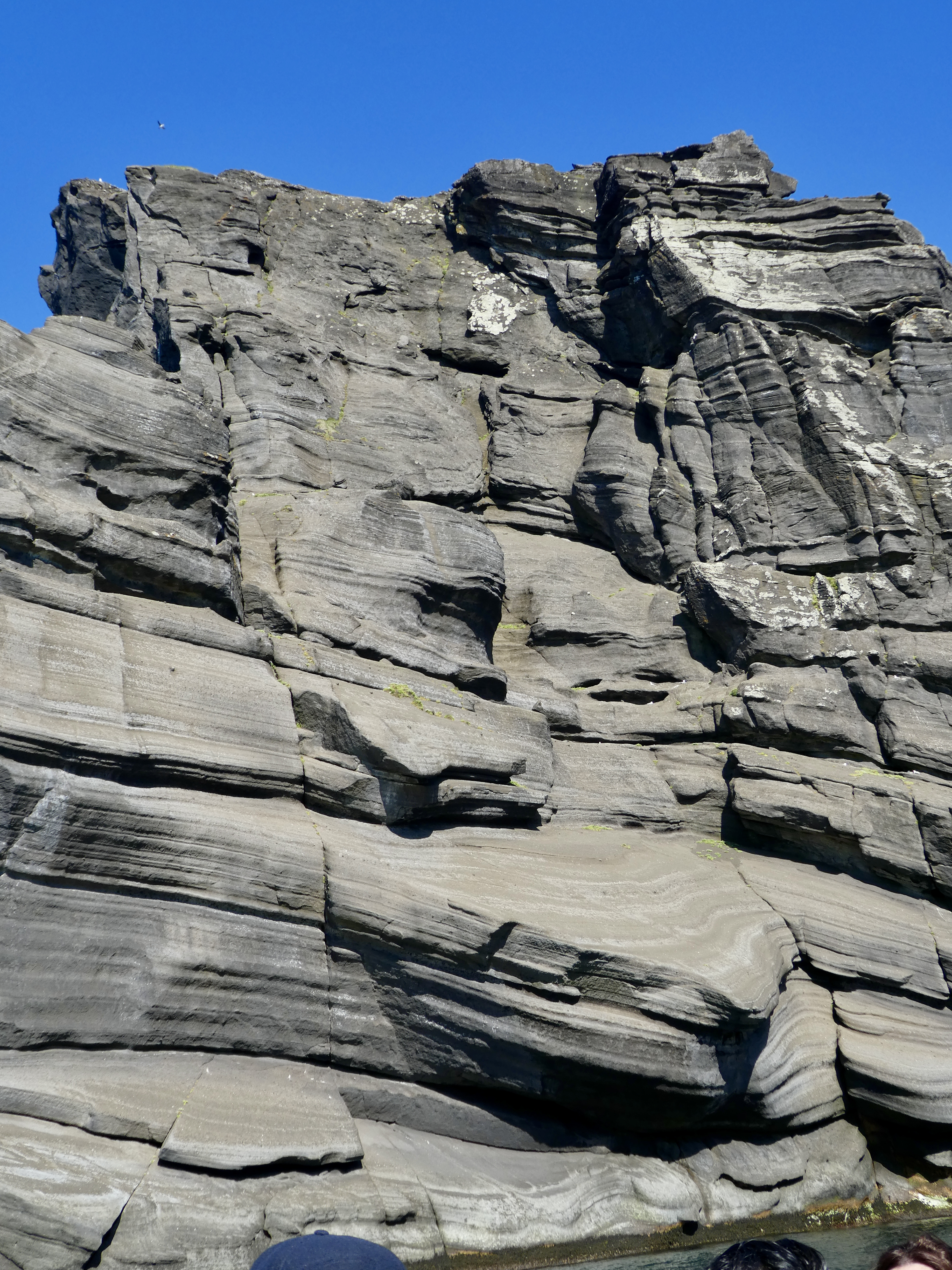
First, approaching the “bird cathedral,” you see a place without many ledges to give you an idea of the geology:
The birds:
These are nest sites! Look how crowded they are:
Less than a square foot per pair! They go out fishing, with one pair staying on the egg, so, as you cruise around, the air above is filled with thousands of wheeling, calling murres. See video below.
Two videos from the ride (filming was tough in a boat with nine other people, all trying to film or photograph):
Thousands wheeling above in the blue air:
This short video shows why I call it a “bird cathedral”. Truly a stunning site. A few days later we saw another murre cathedral on Jan Mayen Island.
Oy, how the ducklings have grown! Remember, today has been only 40 days since they hatched on May 6. In all respects save their inability to fly, they are slightly small adults, though they still hang together as the Brood of Six. Here are some photos and videos taken over the last two weeks.
The pictures and videos below are presented chronologically, and were taken on four days: June 1, 5, 7, and 11. You can see the change in the ducklings over a period of only ten days: they’ve lost most of their fuzz and are mostly feathered, and their wings are getting larger.
Mother Esther, June 1:
More “babies”, if they can be called that. Esther stands on a plant pot and watches her offspring:
On June 1 the ducklings were growing feathers, most notably on their wings.
A video of ducklings leaving the water on June 1 for a postprandial grooming session and then a nap. They are able to leave the water and jump on the pond edge very easily now.
More preening on the same day:
And, after preening, they often form a clump o’ ducklings, keeping warm and together. Esther, as you see, is always nearby. They’re also nibbling at the grass:
A single duckling giving itself a thorough cleaning.
By June 6, the ducklings had developed more extensive feathering, especially on their breasts. They look to me like little dinosaurs, which of course they are:
And they look quite plump after feeding, often with their craws hanging over the edge of the pond. We call these “Dali ducks”. But they are not fat.
The babies dunking themselves on June 6:
Father Mordecai, who hasn’t been around for a few days:
After dining, swimming, diving, and preening, the ducklings plop themselves down for a nap. I love the plopping:
On June 7 we had a bout of postprandial zooming:
Esther the Queen:
Esther always does thorough ablutions, for as mom, she has to be in good condition. (Soon she’ll molt and gradually lose her feathers, replacing them with shiny new ones. This process is gradual so she is not of course bald!)
Meanwhile, Mordecai, when he was there, would drive other ducks out of the pond. Here he subtly but insistently forces Haman the Evil Duck out of the pond:
By June 11 the ducklings had gotten almost all of their feathers, but their wing feathers are small and they can’t yet fly. They’re also a bit smaller than Esther, but not by very much. Here’s one sunning on a rock:
Duckling ablutions:
Dabbling. They seem to get some food from the pond, and I’ve seen them slurping down algae. Here they all seem to have homed in one one area:
Homing as Esther watches:
A big-time case of the zoomies:
A duckling. It’s now hard to tell them from mother, and at a distance you have to concentrate on color (Esther is lighter) rather than on size. There’s just a bit of fuzz near the tail, but otherwise they are fully feathered. I predict they’ll be flying in two weeks.
As a reminder, here are two of them the day they hit the water: May 7:
Here I am hand-feeding a stray hen, who we call “Hoover” because she comes right up to us when we’re sitting and cleans up all the duck food spilled on the ground at feeding time. I felt sorry for her and gave her a handful of food, which she quickly grabbed, one pellet at a time. I don’t really want to feed her, but when a duck looks straight at you with their beautiful faces and liquid eyes, it’s hard to resist. I am not feeding these stray ducks much at all, and they are often gone (eating elsewhere, I hope). Photo by Elsie Holzwarth:
Friday was the one-month anniversary of Esther’s brood hatching, and yesterday was the “monthiversary” of the ducklings venturing into the water from their nest under the tree, a entry that I witnessed. Now the ducklings are large, resembling small, half-fuzzed versions of the adults (see below), and they’re getting their feathers. They are entering the “punk duckling” phase in which they are no longer unbearably cute, but I still love them. In about three weeks they’ll start trying to fly.
Here are some photos and videos taken the last week of May and one or two showing them more recently. They’re all healthy and rambunctious, and I take some credit for keeping them alive, as there is no real food for them in the pond. They get a diet of Mazuri duck chow (now they’re able to eat the adult-sized pellets) combined with mealworms as a special treat.
Just as a reminder, here’s the brood at one day old within 10 minutes after they entered the water (there were seven, but we mysteriously lost one on the first day):
And here is a video from May 30: the brood is now a flotilla of miniature ducks. This is how they come to me when I call them for meals:
A “baby” losing its down and getting feathers, They start growing on the wing and the tail.
After meals, the babies like to disport themselves in the “cold tubs”: leftover plant pots:
A duckling with a few real feathers, also sporting a longish duck bill:
Much of the activity that charms duck-watchers is how they dive, preen, and flap their little winglets after a meal, comme ça:
More partly-feathered little ones. Note the pointy feathers on the tail:
Here’s some of that wing-flapping and dunking that occurs after meals. Onlookers love it when they flap their little wings. In a few short weeks, though, those little stubs will be big, able to carry the ducks high into the sky:
A half-fuzzer scratching himself. This may well be a male because of the greenish-brown color of the distal portion of the bill (females are said to be orange). The color-identification method isn’t fully reliable given that we never see the babies after they’ve developed their adult plumage that enables us to tell them apart.
A favorite activity after meals is jumping onto the east edge of the pond for preening, sunbathing, and snoozing. Esther, ever watchful, stands up. (She does nap sometimes.)
The postprandial sunning-and-preening session. Note the swollen throats; they store food in their esophagus to digest later:
And often, especially when it’s a bit cool, they’ll form a pile o’ ducks:
Here’s the brood splashing and diving after a meal. Esther is the role model:
And the Queen herself, watching over her offspring:
We’re suffering from a power cut in Hoedspruit, and, as I’ve left the park and am resting here just a day before traveling on, I’ll have to type fast to get this finished before my computer loses its battery power. So here are a few things I saw on my last evening and morning game drives in Manyeleti.
Please click on all photos to enlarge them.
First, a shot I’ve wanted to get for a while: a magnificent male Greater Kudu (Tragelaphus strepsiceros) with his spiral horns.
Finally I was able to photograph what I think is one of the most beautiful birds in Africa, the Lilac-breasted roller (Coracias caudatus). It’s widespread through SE Africa, and both males and females have these stunning colors: it’s not sexually dimorphic.
And a male impala with its curved horns:
After nearly 1.5 hours of searching, our guide/driver Dan, following rhino tracks and droppings, made a rare spotting: a large male Southern White Rhinoceros (Ceratotherium simum simum). It grazed peacefully as we sat silently in our vehicle nearby.
From Wikipedia:
The southern white rhinoceros is one of largest and heaviest land animals in the world. It has an immense body and large head, a short neck and broad chest. Females weigh around 1,600–1,700 kg (3,530–3,750 lb) and males around 2,000–2,300 kg (4,410–5,070 lb), with specimens of up to 3,600 kilograms (7,940 lb) considered reliable, and larger sizes up to 4,500 kg (9,920 lb) claimed but not verified.
They can weigh FOUR TONS!
Reduced to between 20 and 50 animals in South Africa in the 19th century by big-game hunting, the population has now recovered to about 18,000 individuals, and some are being bred for release into the wild. Because of poaching to get its horns—used in traditional Chinese medicine—it’s considered “near threatened.” What a crime to kill one of these creatures to get its horns for worthless medicinal purposes!
Notice the birds (oxpeckers) cleaning the beast of parasites like ticks and fleas:
We were excited to get this rare sighting, one of the “Big Five” animals that everyone wants to tick off their mental list.
I wrote Martim for an identification of the oxpeckers, and here’s part of his reply:
Well done both for such a good view of your target lilac-breasted roller and also for seeing all the members of a bird family at the same time. And for the big five of course.
“The oxpeckers are lanky brown passerines that feed on ectoparasites and wounds found on large African mammals. Although elephants and some antelope species will not tolerate them, these birds can often be seen foraging on the other large African megafauna, using their long stiffened tails for support as woodpeckers do while climbing trees. All aspects of their lives are entangled with their mobile large-mammal habitats. Oxpeckers spend the entire day on their hosts, feeding, sunbathing, and snoozing. They even defecate off the side of their perch, and sometimes take a drink at the waterhole while still gripping their hosts’ legs. While breeding, which they often perform cooperatively, they even make their nests out of mammal hair and dung.”
Regarding beautiful birds not so difficult to see, you can now set your sights on the African Paradise-Flycatcher (male). It should be around your camp.
Well, of course I had to look up the African Paradise-Flycatcher (Terpsiphone viridis), and here’s a photo from Wikipedia (this is the male; the species is sexually dimorphic).
Below are the stumpy two horns of this rhino. This is explained by the rangers having previously anesthetized the animals to remove its horns, making it worthless for poaching. Yes, the procedure deprives the circumcised beast of a weapon and an adaptive feature, but that’s more than compensated for by saving the animal from poaching (rhino horns are the object of most South African poaching). Unfortunately, as you see, the horns grow back, though slowly:
At the “sunupper” stop for coffee, we halted by a “dam”: a large pool of water. A herd of Blue Wildebeest came by, drank together rapidly, and then quickly moved off. I suspect they’re wary because they’re hunted by many predators. As Wikipedia notes, “They are a major prey item for lions, cheetahs, leopards, African wild dogs, hyenas, and Nile crocodiles.”
Rhino droppings. They are black—in contrast to elephant droppings, which are brown.
Dan told us that these are wildebeest tracks:
A female elephant and her baby in a matriarchal herd we came upon. This was fairly close to the lodge (about 2 miles away), so I suspect that this is our swimming pool herd. (Elephants cover a lot of distance.)
And, just at the end of our morning trip, I completed my sighting of all the “Big Five” animals by coming across an African Buffalo (Syncerus caffer). This is an old male (probably about 20, says Dan), and the horns have grown together. From Wikipedia:
A characteristic feature of the horns of adult male African buffalo (southern and eastern populations) is that the bases come very close together, forming a shield referred to as a “boss”. From the base, the horns diverge downwards, then smoothly curve upwards and outwards and in some cases inwards and or backwards. In large bulls, the distance between the ends of the horns can reach upwards of one metre (the record being 64.5 inches 164 cm). The horns form fully when the animal reaches the age of 5 or 6 years old, but the bosses do not become “hard” until it reaches the age of 8 to 9 years old.
These older males, expelled from their herd (they are social) are called “dagga boys“, and are testy and dangerous. I heard that a ranger was recently seriously injured but not killed by one of these; the bull had to be shot by another ranger.
Note the oxpeckers, busy cleaning and eating:
You don’t want to mess with these!
Dan pouring coffee at our stop. He’s showing his characteristic humor, and was always laughing. He was a fantastic guide, and much enhanced our trip with his ability to spot animals, his knowledge, and his affability.
Dan has worked as a guide for many years (8 at Manyeleti), and apparently has seven weeks on the job—working 7 days a week from 4 a.m. to about 10 p.m.—and then five weeks off when he can visit his family in a nearby village (he lives in the camp while working). He told me that he was married and had TWELVE children.
Sadly, I had to leave Manyeleti after five days. It’s not cheap to stay at such a place, but I considered the dosh very well spent. Never again, I think, will I get to see a place like this—so dry and barren in winter yet so full of life.
As I waited to be picked up and driven to the gate, the herd of 23 elephants came again to the swimming pool for a drink: the matriarch, a few males, and the rest females or babies. I sat by the water and watched them, fascinated and enchanted as they entwined their trunks for bonding, occasionally bellowed, and filled their bellies with pool water, sometimes squirting it over their bodies. These are highly intelligent social animals and I need to learn more about them.
I could have watched them for hours, but I felt a tap on my back. “I thought I’d find you here”, said Dan, who was carrying my luggage. He knows that I love all of Ceiling Cat’s creatures.
The departure was abrupt, and Rosemary met me at the gate to drive me to my lodgings at Hoedspruit. I’ll be here today, where I’ll go to visit a couple of local villages to help distribute donated food (Rosemary works with them). Tomorrow I’ll begin two one-day trips to the Blyde River Canyon, reputedly one of Africa’s most beautiful sights. Then on to Kruger Park for five days. More pictures will be coming, but there may be a hiatus as I travel about.
********
Jerry’s “Big Ten”:
I think the “Big Five” list, comprising the animals most difficult to kill by spear or gun, is too restrictive, so I’ve expanded it to ten animals. The first five below are the Big Five.
Jerry’s “Big Ten”:
Elephant
Rhino
Leopard
Lion
African buffalo
Giraffe
Cheetah
Kudu
Hippo
and, of course, the African Warthog, of which Ozy is one specimen.
Lagniappe photos (the power was just restored):
The herd of slephants at the pool; I was watching them when Dan gently told me it was time to leave. Note that they come in all sizes (look at the cute baby!) but only two sexes.
A panorama of the swimming pool; note that there are also elephants at the big pond in the distance. Click to enlarge:
The matriarch splashing her body with water to cool off:
The eye of the elephant:
Back in Hoedspruit, which counts as civilization though it’s small. For dinner I ordered a quarter bunny with mutton (medium spicy) to go. Photo by Rosemary.
The video is called “Northstar Garden”, the name of the street on which he lives. Here’s a photo of Jim’s yard.
I live in a small Spanish bungalow by the beach in Southern California. This property has a fairly large patio where I’m able to keep a garden of succulent around the borders and various pots containing fruit trees, flowers, herbs, and seasonal vegetables. Since starting this small garden a few years back, I’ve been impressed not only with the variety of fauna it attracts, but in the beauty of even the smallest plants that thrive in this somewhat harsh beach environment. I love experimenting with different plants every year, and I grow almost everything from seed.
Click to watch (there are lots of flora and fauna along with lovely music). See how many species you can identify.