Why Evolution is True is a blog written by Jerry Coyne, centered on evolution and biology but also dealing with diverse topics like politics, culture, and cats.
We have more photos! Today’s batch comes from Leo Glenn, and were taken in New Zealand. Leo (and his friends’ ) captions are indented, and you can enlarge the photos by clicking on them:
It’s been a long time since I’ve submitted wildlife photos. I just haven’t taken any recently that I thought were worthy of submission. However, my son, Ossian, and his partner, Emma, are enjoying a semester study abroad program at the University of Otago in Dunedin on the southern island of New Zealand, and they have granted me permission to share some of their photos. All of the photos are on the Otago peninsula.
The birds at the waterline are Variable Oystercatchers, Haematopus unicolor. Photo by Ossian Glenn:
Today’s photos are of lizards, come from Ephraim Heller, and were taken in Trinidad and Tobago. Ephraim’s captions and IDs are indented, and you can click on the photos to enlarge them.
Many people have said to me “the hummingbirds are nice, but what about the lizards of Trinidad and Tobago?” Perhaps not literally true, but grant me poetic license. Preparing this post gave me an opportunity to learn about lizards. Trinidad and Tobago is home to about 49 species of lizards in 11 families in 4 clades.
Clade #1: T&T is home to four iguanian families (Iguania): Dactyloidae (anoles), Iguanidae (iguanas), Polychrotidae (polychrotids), and Tropiduridae (treerunners). Iguania are characterized by visual communication (dewlaps, crests, color change), fleshy non-forked tongues, and sit-and-wait predatory behavior, along with various osteological arrangements.
The green Iguana (Iguana iguana) possesses a parietal eye, a small, pale scale on the top of the head that is a photosensory organ, connected to the pineal gland via its own nerve pathway. It cannot form images, but it detects changes in light intensity and shadow, giving the animal an early warning system against aerial predators approaching from above. It also contributes to circadian rhythm regulation and thermoregulation, which is particularly important for a reptile that ferments its food. Green iguanas eat leaves, relying on a hindgut microbial fermentation system to break down plant fiber.
Green iguanas have a social structure. Dominant males hold territories that contain smaller males, females, and juveniles, with larger males claiming better display perches and more access to females. During mating season males shift toward red or orange hues, becoming more conspicuous; a defeated male that loses his territory returns to a dull brown within hours and holds this color until he reclaims his position.
This one is angry with me:
Trinidad has only one native anole, the leaf anole (Anolis planiceps). Other species are introductions that arrived from other Caribbean islands, likely through human commerce. When a leaf anole detects a threat it can run bipedally, a behavior seen in a number of small lizards and interpreted as a burst-speed adaptation.
Here’s an unidentified anole. Perhaps a reader can identify it:
Gekkota are distinguished primarily by their feet and eyes. Most geckos have adhesive toe pads with microscopic hair-like structures (setae) that generate van der Waals forces, allowing them to cling to smooth surfaces. The eye is typically large with a vertical or elliptical pupil, and the eyelid is fused into a fixed transparent scale (the “spectacle”) rather than a moveable lid.
I photographed the northern turnip-tailed gecko (Thecadactylus rapicauda). The name comes from the tail, a fat-storage organ. It is also detachable: autotomy (self-amputation) serves as a predator-distraction mechanism. The regenerated tail is typically wider at the tip than at the base, allegedly looking like a turnip. One cool but useless fact: this gecko is able to lick the transparent scale covering each eye.
For completeness, here’s a bit of information about the two lizard clades that I did not photograph.
Clade #3: there are two species of Amphisbaenia in the family amphisbaenidae. These are legless worm lizards. Adapted for living underground, the key distinguishing features are: annular (ring-like) body scales arranged in complete rings around the body, which no true lizard possesses; a highly consolidated, rigid skull adapted for head-first burrowing, with the two sides of the skull fused to form a battering ram; vestigial or absent eyes covered by scales; no external ear openings; and reduced or absent limbs in most families. They move using a unique accordion-like rectilinear locomotion rather than lateral undulation. Sadly, I have no photos of worm lizards as they live underground.
Clade #4: finally, there are three scincoid families (Scincoidea): Scincidae (skinks), Teiidae (teiids), and Gymnophthalmidae (microteiids). Scincoidea is defined primarily by molecular phylogenetics, not by a single morphological characteristic. Bony plates underlaying the scales are present in skinks, giving them their characteristic armored, smooth texture.
Today we have a potpourri of photos from several readers. Their captions are indented, and you can enlarge the photos by clicking on them.
From Robert Lang:
Every few days I drive up to Altadena to check on the progress of our rebuild. Now, 14 months after the fires of January 2025, the neighborhoods are starting to come back to life again with the sounds of hammering and sawing, but the animals that had come down from the hills still consider the area to be their own. This bobcat (Lynx rufus) wandered into the empty lot next door while I was checking on our own home’s progress:
Although our metal mailbox survived the fire, we’ve redirected all mail to our temporary home for the time being. Nevertheless, people occasionally stuff their own junk flyers into the mailbox. To help dissuade them from their paper spam, this Western black widow (Latrodectus hesperus) has taken up residence on the front of the mailbox. When disturbed, she retreats to her cozy cubbyhole under the handle, which is right where you’d put your fingers if you were going to open the mailbox to stuff something inside:
Seeing eye to eye: this California Ground Squirrel (Otospermophilus beecheyi) and Western Fence Lizard (Sceloporus occidentalis) are trying to decide who gets the top of the rock. Photograph by Merrilee Fellows.
From Todd Martin; a photo taken in, I believe, the Yucatan:
We encountered the ocellated turkey, (Meleagris ocellata), appropriately enough, on Thanksgiving day, I had no idea what it was though and took it for a brightly colored pheasant. It wasn’t posing as nicely, but this picture gives a better sense of the iridescent feathers:
And from Keira McKenzie in Perth, Australia, we have three shots of the willie wagtail (Rhipidura leucophrys):
The first is taken at a neighbour’s place. She feeds him so he comes every morning:
The other two are taken at Hyde Park.
They are called Djiji Djiji in Nhe Noongar language, which is much like the chittering it makes when cross or wary. The Latin name is Rhipidura leucophrys/
Despite being known for their chittering, they are also incredibly melodic. They wag their tails from side to side, but are actually the largest of the fantails.
They are known for their outrageous courage and will take on anything – cats, eagles, hawks, people – and win! Every time 😀
They are an utter delight and common all over Australia (though the ones in my neighbourhood have gone along with the trees – the increasing heat has caused them to stop nesting in my front yard).
And they are tiny. Tiny and mighty 🙂
They are very cute. And fierce with their white eyebrows over their bright black eyes 🙂
From Mark Gregor-Pearse in Texas:
This Great Egret (Ardea alba) was photographed on March 9, 2026, at the Puente Río Cuale in Puerto Vallarta, Mexico, with an iPhone 17 Pro. These large wading birds hunt by remaining perfectly still before striking with lightning speed to spear fish, frogs, and other small aquatic prey. Males and females look nearly identical, so it is difficult to determine the sex from a photo. In the early 1900s, Great Egrets were nearly driven to extinction because their delicate breeding plumes were prized for women’s hats. Public outrage over the slaughter helped launch the modern bird conservation movement:
And a cat from Pratyaydipta Rudra:
I am hoping to send some photos for readers’ wildlife when I get some time. Meanwhile I thought you may enjoy this photo of a stray cat from India (a friend sent it to me). It really wants to experience the “magic”, but alas! It’s too expensive.
In the absence of much of a backlog, I’ve stolen some gorgeous photos from reader Scott Ritchie of Cairns, Australia (his FB page is here). Scott’s captions and IDs are indented, and you can enlarge his photos by clicking on them.
Recently I visited my friends, Karen and David Young in the Crater Lake cabins near Lake Eacham, Atherton Tablelands, west of Cairns. This area is a mega for birds and they did not disappoint. In particular, we got great up close and personal views of our local bird of paradise, bird of prayer, paradise, the Victoria rifle bird.
The male of the species has jet black feathers. However, in just the right light you get a lovely iridescent reflection. The other thing these birds do is dance. It’s an amazing shuffling of the wings while top of stump while throwing their head out and flashing your lovely iridescent blue throat. The immature riflebird is a beautiful brown/rufous color, and they can’t help to practice their dance moves. And of course dad’s gotta come along and join in the festivities.
Also, here’s a few photos of some other creatures that I saw on my little five hour trip to the table lands. I hope you enjoy them.
Male Victoria’s Riflebird (Ptiloris victoriae),in full dance pose. Note the jet black feathers:
Swishes wings sideways, like a flying saucer. Peering above the wings:
But in the right light, iridescent rainbows appear:
I love the cooper and purple sheen on his back:
Meanwhile, youngster, an immature male, practices his dance moves. He leans back, showing off his wild yellow throat:
“Peek-a-boo” Stands up, and swishes his wings back and forth, hiding his head behind them:
Then stands proud:
And then the adult male shows up. I’ll show you who’s boss:
Has he lost his mind?
I’m definitely King of the Stump:
Off youngster goes, only to be replaced by another male!:
And a few other local birds made an appearance. Pacific Emerald Dove (Chalcophaps longirostris):
I have a few batches now, so I’m complacent (never happy!). Today’s photos of Costa Rica come from reader Rachel Sperling. Her captions and IDs are indented, and you can enlarge the photos by clicking on them.
In January I took my first (of many, I hope) trip to Costa Rica. We spent about a week in Manuel Antonio, on the Pacific Ocean side. We took a couple of nature walks in and around Manuel Antonio National Park, and we saw plenty of wildlife. One of these days I’m going to treat myself to a really good camera, but these were all taken with either my mirrorless Olympus or my iPhone camera, which are light and easy to stash in a backpack. I did see a couple of sloths – both three-toed (Bradypus variegatus) and Hoffman’s two-toed (Choloepus hoffmanni), but they were high up in the trees, so I wasn’t able to get a good photo of them. These are the photos I was able to capture:
On the drive from San Jose to Manuel Antonio, we stopped at a creek to view some American crocodiles (Crocodylus acutus):
Then there were these little beasts: the Costa Rican mafia, aka the Panamanian/Central American White-faced capuchin (Cebus imitator). According to our guide, these monkeys can be pretty vicious with animals their own size, and they’ll just riffle through your backpack if you’re not watchful. Someone had to be on guard whenever we went to the beach.
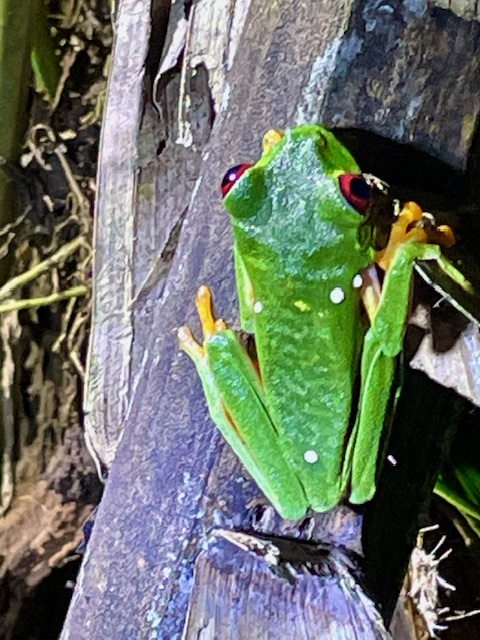
We went on a nature walk in the rainforest at night (with a guide), which gave us the opportunity to see a lot of nocturnal animals. Among them was the Red-eyed tree frog (Agalychnis callidryas):
Black iguana (Ctenosaura similis), at the beach at Manuel Antonio:
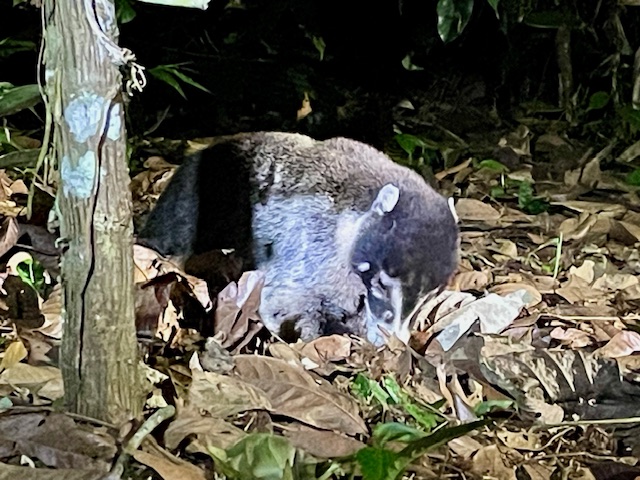
We also saw a coati (Nasua narica), which Wikipedia tells me are diurnal, but it was definitely after sunset and that is definitely a coati. They’re relatives of the raccoon, and our guide told us that a mature one can hold its own against a jaguar. This one wasn’t afraid of us, anyhow:
Back at our b&b, this Black-hooded antshrike (Thamnophilus bridgesi) came to visit me as I read on the veranda a few times. I think it’s a female, though the sexual dimorphism of this species doesn’t seem terribly dramatic. I did see her building a nest:
On my last day in Costa Rica, I heard a tremendous ruckus in the trees outside my hotel in San Jose. I looked and discovered that the trees (American oil palms —Elaeis oleifera —I think) were full of Crimson-fronted parakeets (Psittacara finschi). They were LOUD and they were going to town on those trees. There were too many to count. Fortunately, they quieted down after sunset:
Manuel Antonio National Park from the water. These little islands are bird sanctuaries that tourists are not allowed to visit:
Sunset over the Pacific, near Manuel Antonio National Park:
Finally, I thought you’d like these because they’re jaguar-inspired. We spent an afternoon at a village belonging to the Boruca, an indigenous tribe. They cooked us a delicious lunch, and showed us how they made dyes from local plants, and carved and painted balsa wood masks. The masks were first used to frighten the Conquistadores. Now you can buy them just about everywhere:
Reader Todd Martin sent some photos from the Yucatán (don’t miss the Ocellated Turkey!). Todd’s captions are indented and you can enlarge the photos by clicking on them.
WEIT Yucatán
Here are some photos from a trip in November to the Yucatán in Mexico. The original purpose of the trip was to see Mayan ruins, but the natural beauty of the area turned out to be equally remarkable.
The first few pictures were taken during a boat tour of the mangroves in the Ría Lagartos Biosphere Reserve along the northern coast of the Yucatan Peninsula. The tour began at dawn and we were greeted by the rising sun and a welcoming committee of Monohelea maya, a species of predaceous midge discovered with some fanfare by scientists in 2000 (and with somewhat less fanfare on this very morning by myself):
The reserve is home to many species of birds, the most famous of which is the American flamingo (Phoenicopterus ruber), which can be observed trawling for brine-shrimp in the brackish water:
This is a Magnificent Frigatebird (Fregata magnificens). The male is easily recognized by the bright red throat pouch which looks like a life vest when inflated but actually serves to attract females. The females can be recognized by their frequent calls of ‘Well, if you’re so magnificent why can’t you take out the trash’:
The largest avian species we saw was this haughtily regal Brown pelican (Pelecanus occidentalis):
This is a Neotropic Cormorant (Nannopterum brasilianum) a diving bird sometimes used by the indigenous people of Bolivia and Peru to catch fish:
Hopefully this Wood Stork (Mycteria americana) has a good personality because it is (as my grandmother might have quipped) ‘not conventionally attractive’. It is, however, the only native stork in North America:
The Osprey (Pandion Haliaetus) is sometimes known as a fish hawk because fish make up the majority of its diet (not unlike Kevin Bacon or the singer Meatloaf):
Some birds are naturally elegant like this Great Egret (Ardea alba).In case you want to know how to avoid confusing it with a Snowy Egret … a Great Egret has a yellow bill and black feet, while the smaller Snowy Egret has a black bill and yellow feet:
Green Heron (Butorides virescens). Here’s a fun fact I cribbed from Wiki: “Green herons are one of the few species of bird known to use tools. In particular, they commonly use bread crusts, insects, or other items as bait. The bait is dropped onto the surface of a body of water to lure fish. When a fish takes the bait, the green heron then grabs and eats the fish”:
This American White Ibis (Eudocimus albus) was quite accustomed to people, which allowed me to get a pretty good close-up:
Morelet’s crocodile (Crocodylus moreletii). They look somewhat fearsome, but our one-armed tour boat operator said this one was ‘practically domesticated’”
Yucatan Jay (Cyanocorax yucatanicus) Jays are the noisy, argumentative neighbors of the animal kingdom. They are often described as ‘gregarious’ which I take to mean that they’ll take food from your plate without asking:
Those who frequented Glamour Shots in the 1980’s might confuse this photo with others of the genre, but it’s an Ocellated Turkey (Meleagris ocellata). The bird was the original inspiration for the marketing tag-line ‘taste the rainbow’. Unfortunately the bird is considered ‘Near Threatened’ by the International Union for Conservation of Nature (IUCN) with numbers that are sadly on the decline:
Whoever named the Black Spiny-tailed Iguana (Ctenosaura similis) wasn’t particularly creative, but I’m inclined to give them a pass because … that spiny tail!:
Finally – we stopped by Florida before returning home and my wife couldn’t resist adopting one of those hairless sphynx cats from the local shelter (Alligator mississippiensis). We love him very much, though he does have the unusual habit of sleeping in his water dish:
Sadly, the tank has run dry. To proffer some content today, I’ve dug into my personal photo bank and will post a few miscellaneous shots with brief captions. Click to enlarge the photos
Woman collecting land snails for dinner, São Tomé, 2004:
BBQ dinner at City Market, Luling, Texas, 2004. Brisket, sausage, and the trimmings (beans, potato salad, and the mandatory white bread):
Death Valley and a rare post-rain desert bloom, 2005. Where do the insects come from since these blooms occur only about once a decade? (If you can ID the lepidopteran, do so.)
Usually there is only saltbush and creosote growing on the land, but in a bloom all sorts of flowers emerge from dormant seeds:
A rare Jewish cowboy, photo in the Eastern California Museum in Independence. The last time I went the photo was gone and nobody knew about it or even remembered it. I’d kill to have it:
Doing flies, 2005. This is what I spent most of my time doing before I retired.
Flying onto a glacier at Denali (Mt. McKinley). They were dropping off two climbers in a four-seater bush plane, and I hitched a ride there and back. I got to sit next to the woman pilot. From Talkeetna, Alaska. The peak in the center is Denali.
After we landed on the snow-covered glacier, the pilot had to make a runway to take off from, going back and forth on the snow about ten times to pack it down:
The famous polymorphism of color and banding within the snail Cepaea nemoralis, studied intensively by evolutionary geneticists for years. Despite that work and subsequent population-genetic analysis, we still don’t understand the significance of the variation. For some reason the field was covered with snails; these were on a fencepost. Dorset, England, 2006:
The cottage where poet and author Thomas Hardy was born in 1840 and grew up. Upper Brockhampton, Dorset, 2006.
When Hardy became famous and wealthy, he moved to a house he designed (also in Dorset), Max Gate, where he lived from 1885 until he died in 1928. In the garden by the house are the burial sites of his beloved dogs and cats. Here are two graves of his cats, Snowdove and Kitsy; I was told that they were inscribed by Hardy himself, who had worked as a stonemason when younger, but I can’t vouch for that story:
A draft manuscript of the famous novel Tess of the d’Urbervilles in Hardy’s hand (taken at the local museum):
T. E. Lawrence‘s (1888-1935) final residence the cottage called Clouds Hill. He lived here after he gave up his fame as “Lawrence of Arabia” and served in the RAF under the pseudonym “T. E. Shaw” beginning in 1935, commuting back and forth to the airbase on his motorcycle. The cottage was very spartan, and had no electricity. As Wikipedia notes,
In a 1934 letter to Francis Rodd, Lawrence (who had changed his surname to Shaw) described his home thus:[5]
“The cottage has two rooms, one, upstairs, for music (a gramophone and records) and one downstairs for books. There is a bath in a demi-cupboard. For food one goes a mile, to Bovington (near the Tank Corps Depot) and at sleep time I take a great sleeping bag… and spread it on what seems the nicest floor… The cottage looks simple outside, and does no hurt to its setting which is twenty miles of broken heath and a river valley filled with rhododendrons run wild. I think everything, inside and outside my place, approaches perfection… Yours ever, T. E. Shaw”
Lawrence had an education in the classics, and is one of my heroes as he was both a man of action and a man of learning. Here’s the inscription in Greek over the door above: οὐ φροντὶς (“why worry”), taken from Hippoclides.
Lawrence’s bathtub and shaving mirror:
Lawrence died in a motorcycle crash on May 13, 1935, soon after leaving the RAF. Heading home on his motorcycle, he didn’t see two boys on bicycles ahead of him because of a dip in the road. Swerving to avoid them at the last moment, he crashed his bike, sustained a serious head injury, and died six days later. A study of his death by a neurosurgeon who tended the dying Lawrence eventually led to the use of helmets by motorcyclists.
The crash site is a km or two from Clouds Hill, and my friend and I scoured the road on foot looking for the crash site, now marked by a memorial (I saw no dip in the road). We finally found the stone:
Ironically, there had been a car crash at the site right before we found the memorial:
When he crashed, Lawrence was riding aBrough Superior SS100 motorcycle. Here’s a picture of him from Wikipedia riding one (clearly not the death vehicle) that he called “George V”. If you go to Clouds Hill, you’ll see several of his motorcycles in a small garage.
Lawrence on George V, Wikimedia Commons, author unknown