Why Evolution is True is a blog written by Jerry Coyne, centered on evolution and biology but also dealing with diverse topics like politics, culture, and cats.
Reader Thomas Webber is a new contributor, but his photos of flowers are lovely. Tom’s captions and IDs are indented, and you can enlarge the photos by clicking on them. The images have been stacked, but I removed that information from the captions. On to Tom:
The University of Florida owns and manages a large pine forest near Gainesville for teaching and research. Much of it is a commercial-type pine plantation, with smallish trees all the same age growing in close-packed straight rows.
Another part is managed to restore something like the native pre-settlement forest; in this section the trees are relatively old and widely spaced, and the canopy is fairly open, allowing plenty of light to reach the understory. This forest type has evolved under the influence of fire, and the wildfires have now been replaced by managed burns. The understory is host to an impressive variety of shrubs, grasses, and forbs, many of which are adept at exploiting burned- or other periodically disturbed patches of the landscape. Here is a just a small sample of the wildflowers I’ve encountered there in late summer and early fall this year.
I think I’ve identified all of them correctly to genus, and most to species, but I have put the qualifier “cf.” before some of the species epithets I’m not so sure of. I invite corrections.
Hempvine, Mikania cf. scandens. 2.5 cm. This one has not fully opened:
Blackroot, Pterocaulonpycnostachyum. 7 cm long. I was surprised to find these at this time of year; they are usually spring flowers, but a few emerged in one plot after the mid-summer burn:
Pineweed, Hypericumgentianoides. 3 mm. The flowers are tiny but the plants can be conspicuous; this year they covered a dirt road in one of the less-traveled parts of the forest:
I’ve always longed to go to Zion National Park in Utah, as it’s renowned for its beauty. My friend Phil Ward and I drove there for most of the day yesterday. First, a bit about its geology from Wikipedia:
The nine known exposed geologic formations in Zion National Park are part of a super-sequence of rock units called the Grand Staircase. Together, these formations represent about 150 million years of mostly Mesozoic-aged sedimentation in that part of North America. The formations exposed in the Zion area were deposited as sediment in very different environments:
The dry near-shore environment of the Carmel Formation
Uplift affected the entire region, known as the Colorado Plateaus, by slowly raising these formations more than 10,000 feet (3,000 m) higher than where they were deposited.[54] This steepened the stream gradient of the ancestral Virgin and other rivers on the plateau.
Click the photos to enlarge them. You will find that there are more pictures of chipmunks and people feeding them than there are of the landscapes. Shoot me–I love chipmunks (and all animals).
First, I affirm my credentials as a Zionist. I’m wearing a hat that someone gave me, and it reads, à la the Larry David show, “Curb Your Antisemitism”:
The landscape is stunning, so let’s just look at some photos.
Sandstone cliffs, red but topped with some white sediments:
Even though it’s dry here, plants and even trees manage to eke out a living on the bare rock:
Some of the cliffs are topped with plateaus:
A panoramic view. Definitely click once or several times to enlarge:
There are all kinds of wave patterns in the sedimentary layers:
We had a mild hike up Canyon Overlook Trail (1 mile long) to get to this stunning viewpoint looking down into Zion Canyon.
Below, my friend Phil Ward at the overlook. He’s a Professor of Entomology at the University of California at Davis, and I’ve known him since he arrived there in the early 1980s. His speciality is ants, and although one is not allowed to collect in National Parks without a permit (I used to get one to collect flies in Death Valley), he never leaves home without his ant-collecting kit, which includes ant bait, and that includes cookie crumbs. It turns out that although we couldn’t collect ants, we used the bait to collect chipmunks (see below).
There were at least four species of flowers along the trail. This one is a California fuchsia (Epilobium canum):
Life is ubiquitous and tenacious, even in environments as dry and hostile as Zion. Where water seeps through the rocks, plants and mosses about, and I think this is maidenhair fern (Adiantun pedatum aleuticum).
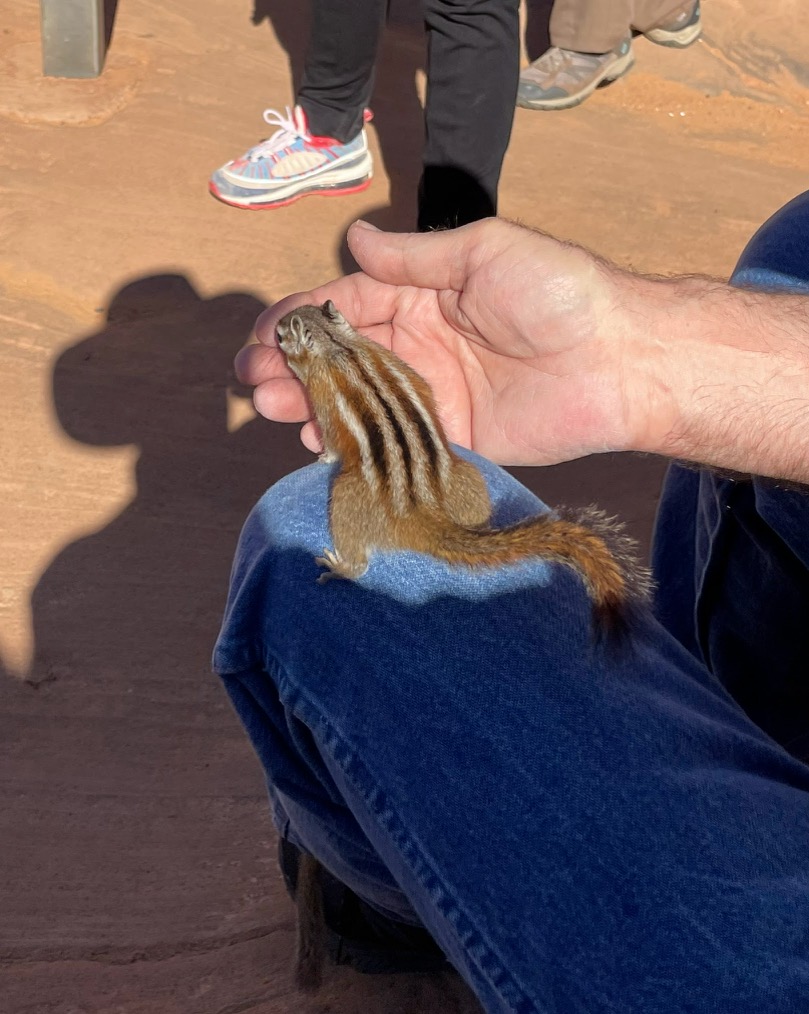
A great treat awaited us at the overlook. Because many tourists linger there for the view, the local chipmunks have learned to hang out there to beg for noms. They are lovely, tame, as fast as quicksilver, and will even dive into your backpack if you leave it open. Phil gave me some ant bait (crumbled cookies), and, sure enough, the chipmunks went all over me to get them. (This reminds me of the Botany Pond Squirrels climbing up m leg for nuts.)
There are three species of chipmunk in Zion; I believe this one is the Uinta chipmunk (Neotamias umbrinus). It’s related to the East’s common Eastern chipmunk (Tamias striatus), and used to be considered the same species, but now it’s been placed in a different genus.
The visitors were entranced by these rodents (they are as light as a feather, and when they climb upon you, it’s barely detectable). And so people pulled out their hiking food and gave some to the ‘munks. Sometimes three or four chipmunks would climb on a person at once. This woman is obviously delighted.
I love people being happy when interacting with animals.
A close-up of a nomming chipmunk:
This woman was part of a group of visiting British tourists. Since chipmunks are exclusively North American, it’s likely that this is her first close encounter with one. Like everyone, she was delighted when they took food. (And yes, I know you’re not supposed to feed the wildlife, but seriously, how can you resist?)
A two-fisted feed:
Look how happy she is! (And, I’m sure, so were the chipmunks.)
A closeup. Phil and I discussed the evolutionary significance of the striping pattern; Phil thought it may be camouflage, but it seemed to me to not yield a very cryptic pattern. Perhaps, I thought, it was for members of the species to recognize each other, but I’ve always been wary of “species recognition” traits because it’s hard to see how they’d evolve (the trait and recognition of the trait must evolve simultaniously). In the end, we decided, “Well, we’re evolutionary biologists, and we could make up a hundred explanations, but how would we test them?”
Look at these little beauties, with their racing stripes, fluffy tails, and huge black eyes!
And a top view. As I said, they are so light—Uitna chipmunks weigh about 67 g, or 2.4 ounces—that you can barely feel them when they climb on you. And, like squirrels, when they take a tidbit from your hand you can feel their tiny claws.
Today, we go to Bryce Canyon National Park, famous for its geological “hoodoes“, tall and thin pillars of rock very different from what you see in Zion. Here’s a picture from Wikipedia:
We have a few batches of photos but I can always use more. If you got good ones, please send ’em in!
Today we have a batch of photos from reader Rik Gern’s home in Austin, Texas, concentrating on the Burr Oak. Rik’s captions are indented, and you can enlarge his photos by clicking on them.
Here is another collection of nine seed photos, this one focusing exclusively on the largest acorns, those from the Burr Oak tree (Quercus macrocarpa).
The cap and nut, or cupule of scales and pericarp are separated here, allowing us to see the points of connection where the tree was able to deliver nutrients to the nut:
An isolated cap (first photo) and isolated nut (second photo). Every large acorn that I took home had the little scuff marks on the nut. I presume they are the result of the seed making contact with the sidewalk after dropping from the tree:
Here is the acorn as a complete unit. The little yarn-like bits at the bottom of the cap were very brittle and crumbled to the touch:
This close-up gives a good view of the burrs on the Burr Oak. They look like tiny icicles and give the acorn a slightly prickly feel when you pick it up, but it’s nothing really painful.
A close up of the remains of style (the tip at the end) for good measure. The nut is more weathered towards that end, presumably because it has been exposed to the elements longer, having been the first part to emerge from under the cupule of scales:
The top and bottom of a less mature acorn, where the pericarp is barely emerging from the cupule of scales:
Last, a view of the inside and outside of empty caps. I tried to play around with this to give it a bit of an Andrew-Wyeth like-feel:
In June, physicist and origami master Robert Lang went on a Center for Inquiry cruise in the Arctic, visiting the isolated islands of that area as well as Iceland. The cruise headlined Richard Dawkins, and I was offered a last-minute berth, but it seemed too late to me, and now I much regret not going. But Robert has sent two batches of photos from tbe trip, and I’ll show the first one—the flowers of Iceland—this morning.
Robert’s narrative and captions are indented, and you can enlarge the photos by clicking on them.
Iceland (and Elsewhere) Flowers
Living and working on the edge of the Southern California chaparral, I have a fondness for pretty wildflowers surviving in harsh places, and a recent shipboard trip from Ireland to Iceland provided a few nice examples of mostly unfamiliar blooms. (All IDs thanks to iNaturalist.)
After leaving Ireland and visiting Scotland, we visited islands with progressively harsher climate (though all are moderated by the Gulf Stream—at least, until the Atlantic Meridional Overturning Circulation breaks down). On Shetland, we encountered Cuckooflower (Cardamine pratensis). It’s native throughout Europe and Western Asia:
Then on to the Faroe Islands. There we found Lawn daisy (Bellis perennis), another common European species of daisy:
From there, on to Iceland, the land of fire and ice! We saw plenty of the latter, but didn’t get close enough to see the former, though we did see plenty of its aftereffects in the geography and hot springs.
Near Höfn, we stopped at the base of one of the many glaciers draining the Vatnajokull ice cap; it ended in a small lake surrounded by scree and glacial till that was mostly bare but dotted here and there with lovely little clusters of flowers, starting with this Alpine cinquefoil (Potentilla crantzii):
Next is Sea thrift (Armeria maritima) (I think—iNat suggests this, but still waiting for human confirmation). It grows all over Europe and is also a popular garden or cut flower:
Moss campion (Silene acaulis) is another lovely cluster of tiny flowers that is common all over the high arctic and tundra:
Another campion, Sea campion (Silene uniflora) has larger flowers and interesting hollow vessels at the base of the flowers. (There was another variety of campion that looked similar in iNat; this one looked slightly closer):
From falling ice to falling water. Another stop was one of Iceland’s famous waterfalls, Goðafoss. There’s a lot of melting ice in Iceland, and it makes for many, many spectacular waterfalls (over 10,000 of them, according to Wikipedia). Here’s one of them:
The waterfall is vast and the vistas are sweeping, but there’s also beauty to be found at our very feet, including some of the biggest dandelion flowers I’ve ever seen. Dandelions (Taraxcum sp.) are found worldwide, but the ones in my yard are pretty tiny; this one and its brethren were something like 2” across:
One of the sights of Icelands is the Dimmuborgir lava field, a landscape of twisted spires of lava that originally formed underwater as upwelling lava tubes. There I saw this Eight-petal Mountain-Avens (Dryas octopetala), whose common and Latin names both make reference to its eight petals. An unusual thing, because it’s a member of the Rosaceae, whose petals usually come in five (unless they’ve been bred for more, like ornamental roses):
Marsh marigold (Caltha palustris) is found all over temperate regions of the Northern Hemisphere. These were growing near a different waterfall, Dynjandi, which is almost unreal: it pours off of the edge of a cliff some 30 meters wide:
Dynjandi:
Last, the Nootka lupine (Lupinus nootkatensis). It’s native to North America, but was introduced into Iceland where it has spread widely. It’s now considered something of a nuisance, but it sure is a pretty nuisance:
Oh no, we’re running low. That’s a poem, but it’s true. Please send in your wildlife photos if you have good ones. Where, for example, has Athayde Tonhasca, Jr. gone with his instructive biology + photo stories.
Well, today we do have photos—a group contributed by ecologist Susan Harrison from UC Davis. Her captions are indented, and you can enlarge the photos by clicking on them.
A hunt for red in October
Here on the West Coast, autumn foliage seldom gets more chromatically intense than yellow to rusty orange. But the arrival of fall around Davis, CA, is heralded by piles of brilliant red tomatoes along the roads. These fruits have struck asphalt upon falling off of trailer-truck bins 10 feet high traveling at highway speeds, and yet many of them remain unbroken. For this miracle we can thank the crop scientists who, in the wake of 1960s farmworker shortages, created a mechanically harvestable tomato that transformed the farm landscape. You wouldn’t want these tough beauties on your salad, but they are cannery fodder:
Contemplating the annual tomatocalypse made me wonder if equally vivid reds could be found in nature at this time of year, when most flowers, fruits, and bright-plumaged birds are gone from northern California and southern Oregon. It took both some searching outdoors and some resurrecting of past photos, but here’s what I found.
Red-Eared Sliders (Trachemys scripta elegans); the large female was being courted by the smaller male, who kept swimming in front of her and waving his claws in her face:
California Fuchsia (Epilobium canum), a fall-blooming favorite of hummingbirds and gardeners:
Manzanita (Arctostaphylos manzanita) stem, with live bark surrounding a lichen-covered dead patch, illustrating how the slippery red bark may be effective at preventing the attachment of other organisms (lichens, insects, fungi…):
Manzanita berries, the bright color of which seems puzzling since the seeds are thought to be mainly dispersed by mammals, which have monochromatic vision; I’ve spared you the ubiquitous sight of berry-packed coyote droppings:
We still have a few batches of photos from readers, but I’m rationing them out. PLEASE send your good wildlife photos. The death of this section would be a blow to me.
Today’s photos come from Rik Gern of Austin, Texas, showing various bits of plants. The captions are Rik’s, and you can enlarge the photos by clicking on them.
Here is a collection of nuts and seed pods found while taking walks around the neighborhood. I have a habit of picking them up, marveling at them, sticking them in my pocket, and then making little displays or shelf decorations with them when I get home. That was starting to get out of hand, so I decided it was time take some pictures of them before cleaning house and returning them to nature.
This exotic item is a Magnolia seed pod (Magnolia grandiflora). It looks very large in these close-up photos, but in reality the body is a little over two inches long and about an inch and a half wide. The stem is one inch long.
This picture makes it look like some sort of strange sleeping mammal:
Here is a cluster that includes the seed pod from a Red Yucca (Hesperaloe parviflora), along with acorns from Post Oak (Quercus stellata) and Burr Oak (Quercus macrocarpa) trees:
Viewed up close, the Red Yucca seed pod almost looks like pale green skin with veins under the surface.
The Pecans (Carya illinoinensis) are the most at home in this collection since the background consists of Pecan bark and leaves. Pecans are very common around here and are fun to harvest in the fall.
This strange looking object is called a gum drop and is a seed pod for the American Sweetgum tree (Liquidambar styraciflua). The seeds are long gone and all that remains is the woody pod. People like to use these as decorations or tree ornaments, and it is not uncommon to see them spray painted or dipped in glitter.
If you squint your eyes it’s easy to see faces in them, so I enhanced the effect by playing with saturation, contrast, and a few other variables to make this grouping look like a spooky wooden caterpillar.
Speaking of faces, here’s a ghostly looking old Black Walnut shell (Juglans nigra) lying among some gum drops, giving the collection an appropriately autumnal feel:
Reader Chris Taylor continue his voyage to Queensland with Part 3 of his narrative (see links to other parts here). Chris’s captions are indented, and you can enlarge the photos by clicking on them:
In this part I will show some more of the Yourka landscape and then give some insight into the work involved in restoring the landscape.
Downstream from the accommodation, Sunday Creek is crossed by the Glen Ruth Road. Just by the crossing there is a series of small pools where the water runs beneath a shady canopy of Paperbarks, Melaleuca quinquinervia:
It was a nice and cool place to sit, next to the creek in these areas.
There were more dragonflies here. This is a Scarlet Percher, Diplacodes haematodes. These are common throughout Australia. Fairly small in size (wingspan about 60mm), they make up for it with their brilliant red coloration:
This one even let me take a portrait too!
Driving back to the accommodation at Sunday Camp, we came across this Agile Wallaby Notamacropus agilis, a species that is found across the northernmost parts of Australia, and into southern New Guinea. This is a robust male, probably 80cm tall, with a tail about the same length. The females of this species are rather smaller. These are quite common across the reserve:
Next to the road was this tall Lemon Scented Gum, Corymbia citriodora, shining in the late afternoon light as the moon rises behind it. This is an area where the Heathy Woodlands are coming back nicely with plenty of recruitment of young plants:
Returning the reserve to something like its former state is not as easy as just letting nature take its own course. There is a lot of time and effort invested in the process. Bush Heritage Australia have a program where volunteers can apply to do some of this work. There are fences to be removed to allow for free passage of the native animals, there are introduced weeds to be eradicated, and exotic animals to be controlled, and on these some reserves fire management to be considered.
Yourka used to be a cattle station. Bush Heritage no longer have cattle on the property, but Yourka being surrounded by other cattle farms, incursions are common. We came across a small mob of these as we drove out to work near the Herbert River. These are probably the Droughtmaster breed:
The Herbert River forms part of the western boundary of Yourka:
Here it runs between steep banks as much as 8m high:
We were there in the dry season. In the wet season, the river will often run bank high – or even spread out onto the flood plain. In December 2023, this region was affected by Tropical Cyclone Jasper. The storm stalled as it came onto the coast, inundating the area from Cooktown in the north to Innisfail in the south as well as parts of the interior. The city of Cairns received 2200mm of rain in 4 days. Yourka would have had much less, but even so the Herbert breached its banks. We found flood damage and debris at least 12m above the creek beds.
Flooding causes a lot of damage, as the volume of water and the vegetation it carries will lay flat -or carry away – any fence. To mitigate this problem some of the creeks are fitted with Flood Fencing.
These are made from sheets of corrugated iron suspended from a wire rope. In the dry season these will stop most cattle from wandering on to the reserve, while allowing other native animals to pass beneath. In the wet season, the pressure of the water flow will just push the panels up and allow the debris to pass without sustaining too much damage.
But in exceptional flows even these fences are just ripped out and tangled and the metal sheets torn and destroyed.
We came to the reserve to work, and one of our jobs turned out to be repairing some of the flood fencing! We are putting the final touches to a fence that crosses Sunday Creek for about 70m and up the banks that are 11m high.
While collecting the materials for the fencing from the stockpile, there is a technique to lifting the metal sheets; I always lift from the far side, so that the metal remains between me and anything that has been hiding underneath.
Sure enough, one of the times that I lifted a metal sheet, beneath it was a snake. In this case it was nonvenomous, but it did reinforce the need to do the right thing – especially when on such a remote reserve!
Spotted Python, Antaresia maculosa. This is quite a small snake, less than 1m long, but this species does not grow much bigger.