Readers’ wildlife photos

June 4, 2026 • 8:15 am

Reader Mark Joseph, inspired by my post on leucistic Australian ducks, went in an example and some other photos. Mark’s captions and IDs are indented, and you can enlarge the photos by clicking on them.

Your post this morning coincidentally arrived as did this photo from a person in our birdwatching group; it’s a leucistic house finch (Haemorhous mexicanus):

And, to give you a small set instead of a singleton, here are a couple of my feeble efforts, all taken with an iPhone in suburban southwestern Michigan. Hopefully, you can use them. I know even less about flowers and insects than I do about birds, so all identifications are courtesy of Gemini.

A zinnia (This specific variety is likely a Zinnia elegans, such as the ‘Canary Bird’ or ‘Benary’s Giant Yellow’ cultivar”) with a bumblebee (“specifically consistent with the Common Eastern Bumblebee, Bombus impatiens). I have enjoyed taking photos of flowers and insects together:

Spotted Knapweed (Centaurea stoebe, sometimes classified as Centaurea maculosa). Unfortunately, it is invasive:

A crabapple tree and a closeup.  This closeup helps narrow it down to a Sargent Crabapple (Malus sargentii) or a Siberian Crabapple (Malus baccata).

Sargent Crabapple (Malus sargentii) or a Siberian Crabapple (Malus baccata):

This is a Big Brown Bat (Eptesicus fuscus) or a Little Brown Bat (Myotis lucifugus).These two species look nearly identical from a distance and are the two most common bats found roosting on residential brick walls across North America.

Brown marmorated stink bug (Halyomorpha halys).When we first moved here and I decided to take some pictures, I got all excited because I was able to get a really good picture. Then I found out it was a stink bug, and invasive to boot. So, not a new species of peacock. But, it’s one of the things evolution has produced. Order Hemiptera, the “true bugs.”

A Shaggy Inkcap (Coprinus comatus), commonly known as a Shaggy Mane or Lawyer’s Wig. The next day the cap is just black goo, and the day after, nothing is left but the stem:

Readers’ wildlife photos

June 3, 2026 • 8:30 am

Leucism, the absence of pigment in all or parts of the body in animals, is a genetic condition often mistaken for albinism (leucistic animals havenormally pigmented eyes).  It’s found in all sorts of animals, from reptiles to mammals, and Scott Ritchie has spotted it in Australian ducks.  Scott sent some pictures, which you can enlarge by clicking on them, and his captions are indented:

The leucistic Plumed Whistling Duck (Dendrocygna eytoni), is back at Hasties Swamp, Queensland, the white one in in middle.  We  have seen it for at least 2 years running. And “he/she” appears to have busy, with at least one (several white light feathers head and breast), and perhaps 3 (2 based on “forehead” feathers) individuals showing leucicism traits. It’s interesting that they were hanging together at the log to the left of the hide.

This last picture is of normal-type duck:


Readers’ wildlife photos

June 2, 2026 • 8:15 am

Do send in your photos if you have good one; we are missing many regulars, though I won’t drop names.

But today we have some plant photos by Rik Gern of Austin, Texas. Rik’s captions and IDs are indented, and, as always, you can enlarge the photos by clicking on them:

Here are some pictures of a mushroom that isn’t conventionally attractive, but is interesting nonetheless. This Hairy Hexagonia ( Hexagoia hydnoides) has been growing on the stump of a Hackberry tree (Celtis occidentalis) in my front yard for some time now.

This mushroom has no stem and hardens over time. I tapped on it, and it appears to have the density of balsa wood.  The underside has striped bands and you can see the small cylindrical spores.

Before it hardened, the mushroom was soft enough for blades of grass to grow through, and poke out the top:

The cap is convex and in addition to being banded like the underside, is covered with small hairs:

This closeup makes the hairs look wet, but they are dry and brittle:

Another closeup gives the impression of a hilly, arid landscape:

The impulse to anthropomorphize must really run deep, because when I look at this picture of two Hairy Hexagonia caps touching I think of courtship and a gentle reaching out!:

I use the app Seek by iNaturalist to identify species, and the next mushroom shows the limits of relying on that app. These popped up on the ground next to the Hairy Hexagonia during a rainy spell. Unlike the Hexagonia, they lasted only a few days. iNaturalist consistently gave me two different answers depending on the vantage point I used when talking pictures. The choices it gave me were Pale Brittlestem (Candolleomyces candolleanus) and Coprinopsis strossmayer, for which I could find only the Latin name, but no common name. Of the two, I’d pick Pale Brittlestem because an image search shows mushrooms that look more like the ones I saw, but it serves a reminder that any identification made thru an app is provisional.

Anyway, I thought the gills on these two looked cool, so I accentuated them a little:

Readers’ wildlife photos

June 1, 2026 • 8:15 am

Today we have pictures from the shore of New Jersey taken by Jan Malik.  Jan’s captions and IDs are indented, and you can enlarge the photos by clicking on them.

Here are a few pictures from my walks on Cape May and Sandy Hook, taken this April.

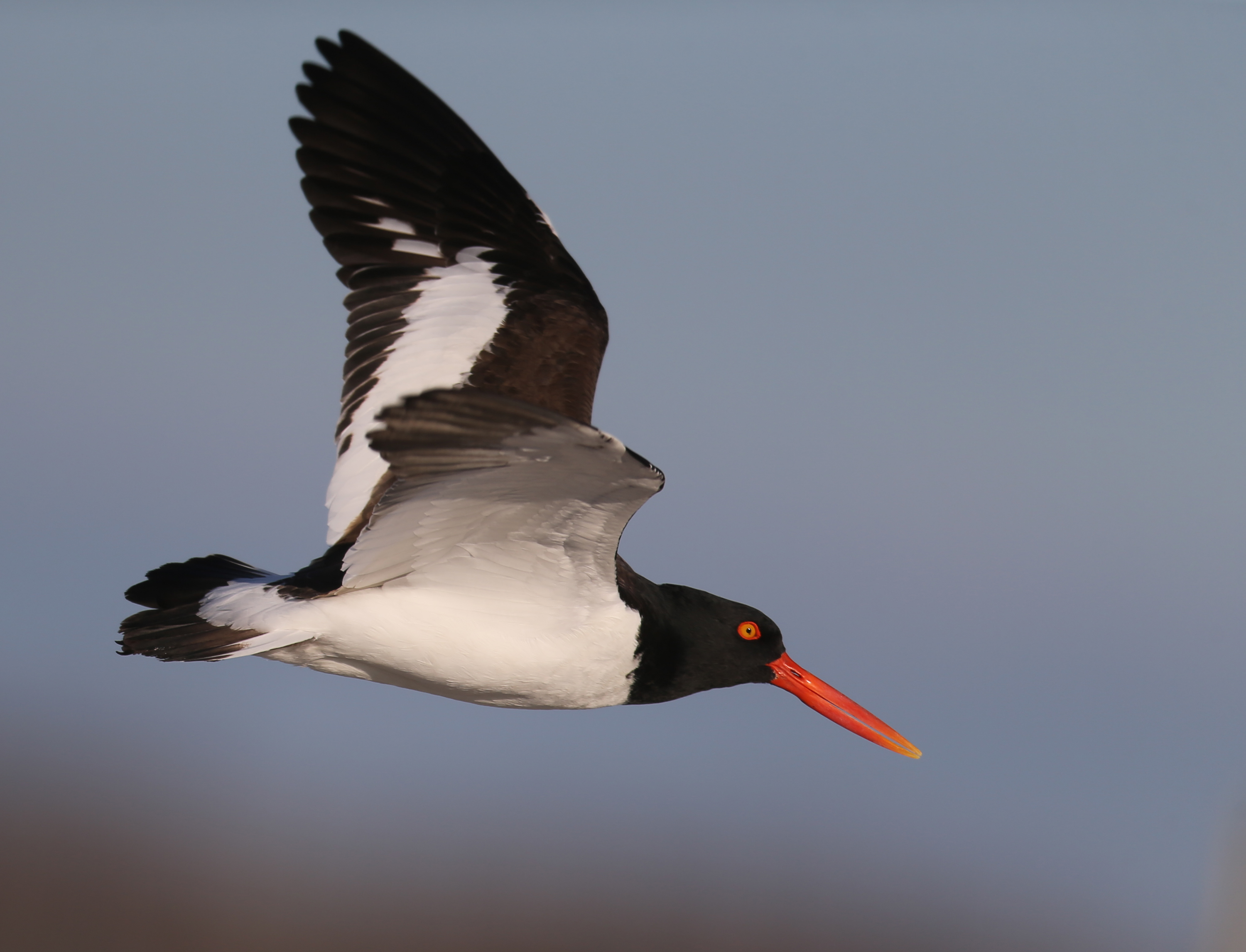
Starting from the Atlantic Ocean (eastern) shore on Cape May, I met this pair of American Oystercatchers (Haematopus palliatus). In Cape May, a section of the beach is fenced off to protect nesting sites for them and for Piping plovers. They are feisty birds and every spring there is a competition for nesting sites; the bird on the right is calling at another Oystercatcher:

The pair took off to drive out the intruder:

The place where I found that pair was littered with the remains of Sand fleas (possibly Emerita talpoida). These fossorial crustaceans normally stay buried in the sand, exiting only when the sand is awash with the shallow tide, but Oystercatchers’ bills are well adapted to dig them out. I think the birds ate only the soft and juicy parts of their telsons, leaving the crustaceans mortally wounded and unable to move:

These Sand fleas are small and difficult to catch alive. That’s what their front end and first pair of legs look like. These crabs dig backwards, starting from their telson, and the front pair of legs is used as a sand anchor:

Another arthropod – the Horseshoe crab (Limulus polyphemus), came ashore, atypically for it, on the Atlantic Ocean side of the peninsula. These are treacherous waters for these spiderlike creatures, for they are easily flipped over by ocean waves and become stranded. They are an interesting part of the Delaware Bay ecosystem and I may share more pictures of them later:

On the Delaware Bay shore of Cape May, there were already many Laughing gulls (Leucophaeus atricilla), which mostly move south in winter but return to their breeding grounds in the spring. They are quite similar to the Eurasian Black-headed gull:

Terns also made their appearance. I think this may be a Forster’s tern (Sterna forsteri) because of the lack of black tips on its primaries and its pure white underbelly, but they are difficult to tell apart from Common terns (Sterna hirundo):

The terns landed on old quay pilings and started courting. There’s no way to tell females from males other than by their courting behavior; males can be slightly larger, but the difference is less than 5%, which is hardly discernible to the human eye:

The courting consists of the two mates trying to look “smug”, with wings drooped, necks extended, and bills pointed toward the sky:

Then there’s the courtship dance and ritual feeding. Here is a fragment of it, taken from a large distance, so I’ve compensated for the lack of pixels by cobbling together this composite. The male presents a fry to the female and then, if she accepts (which is not a given), circles around the female while stomping his feet:

On my way home, I stopped at Sandy Hook, a sand spit where shore gun batteries protecting New York Harbor were once located. It is now a prime nesting site for Ospreys (Pandion haliaetus):

The former Army garrison required many houses for the officers, and these are now excellent nesting sites for Ospreys. Standing in the center of Officers Row (as the area is called), I counted four nests on top of chimneys:

The meadow below the houses was full of American robins (Turdus migratorius) fattening up for the nesting season by preying on earthworms. I know little about annelids, but I’m going to go out on a limb and say it is the common earthworm (Lumbricus terrestris), since it is a favorite prey for robins:

Finally, moving to the class Mammalia, here are Sandy Hook’s harbor seals (Phoca vitulina), congregating on rocks exposed by low tide (the tide was rising so, one by one, the seals were forced to slip back into the water). There are eight seals in this picture, but I counted 15 in total. Their population around the New York inlet has increased in recent years, which may soon put them on a collision course with the fishing industry:

Reader’s wildlife photo (and video)

May 31, 2026 • 8:15 am

We have a short RWP today as there are more posts to come.  First we hear from Robert Lang, who sees a surprising amount of wildlife near his home in the eastern LA “suburb” of Altadena. Robert’s intro is indented, and you can enlarge the photo by clicking on it.

Although every day sees another few housing starts in post-fire Altadena, it’s still mostly empty of people, but after a year that included plenty of rain, the vacant lots are lush with plants—a mix of native coastal sage scrub, invasive weeds, and landscaping gone wild. This temporary rewilding provides plenty of cover for the local wildlife to come down out of the hills and hang out. Yesterday the workers at our site reported that a bear had stopped by and done a walk-through of the framed house (fortunately, just lookie-looing, no damage). Today I did a short hike on the Gabrielino Trail above my old stomping ground of JPL and saw a different (younger) California black bear (Ursus americanus californiensis) just off the trail, and I shot the photo below. . .

. . .  also this video.

This isn’t the bear species on the California state flag, which is the California grizzly bear (Ursus arctos californicus); that was native to this area but was hunted to extinction in the early 20th century. In the 1930s, 28 “problem bears”, California black bears, were taken from Yosemite and released in the San Gabriel and San Bernardino Mountains of Southern California. The black bear species is highly variable in coloration, ranging from black through brown, blond, and even white (the so-called “spirit bears” of British Columbia). Most of the bears we see in Altadena are brown, like this youngster, all descended from the original Problematic Twenty-Eight.

JAC: Here’s the California state flag sporting a grizzly:

Original: Donald Graeme Kelley. Vectorization: Devin Cook, Public domain, via Wikimedia Commons

Readers’ wildlife photographs

May 29, 2026 • 8:15 am

I’m starting to get some new batches of wildlife photos, and I encourage readers to submit their good photos for consideration.

Today’s installment features the photos of UC Davis ecologist Susan Harrison, who recently went birding not too far from Chicago:

Birding in the Upper Midwest

Minnesota and Wisconsin may not be at the top of everyone’s list of nature travel destinations, but do they have darned nice birding?  You betcha!   On a late May work trip to Minneapolis, it was my good fortune to visit some of the Upper Midwest’s riparian forests, wetlands, and restored prairies during spring migration. Friendly people and well-tended parks and nature reserves helped make it delightful.

Large birds….

Sandhill Crane (Antigone canadensis):

Trumpeter Swan (Cygnus buccinator) on a nest:

Great Horned Owlet (Bubo virginianus) in a nest:

Common Loon (Gavia immer):

Common, medium to small birds….

Rose-breasted Grosbeak (Pheucticus ludovicianus):

Baltimore Oriole (Icterus galbula) bathing:

Eastern Kingbirds (Tyrannus tyrannus):

Brown-headed Cowbird (Molothrus ater):

Eastern Towhee (Pipilo erythrophthalmus):

Yellow-bellied Sapsucker (Sphyrapicus varius):

Rarer small birds that were new (a.k.a. “lifers”) for me….

Kirtland’s Warbler (Setophaga kirtlandii), a specialized inhabitant of young Jack Pine (Pinus banksiana) forests, only recently removed from the endangered species list:

Louisiana Waterthrush (Parkesia motacilla), a warbler that lives on the banks of crystal-clear headwater streams in forests:

LeConte’s Sparrow (Ammospiza leconteii), a secretive marsh dweller that sings in the dark and scurries around on the ground:

Henslow’s Sparrow (Centronyx henslowii), a stealthy bird of the region’s much-diminished grasslands  (historical note: it was named by John James Audubon in honor of Darwin’s mentor John Stevens Henslow):

Other exciting Midwestern firsts for me included seeing Greater Prairie-chickens (Tympanuchus cupido) dancing at their lek, and hearing the weird nocturnal songs of Yellow Rails (Coturnicops noveboracensis), Eastern Whippoorwills (Antrostomus vociferus), and American Woodcocks (Scolopax minor).

Readers’ wildlife photos

May 27, 2026 • 8:15 am

Today we have some intertidal photos taken in California by UC Davis math professor Abby Thompson. Abby’s captions and IDs are indented, and you can enlarge her photos by clicking on them.

May is a great month on the California coast, with extreme high and low tides.   Here are some photos from the most recent, excellent, set:

Pollicipes polymerus (Gooseneck barnacles). I’ve shown these, and some relatives, several times before, but they’re amazing animals. In case you think it’s too many barnacles, Darwin spent eight years looking at barnacles.   “Originally planning a brief month-long study to establish his credentials in invertebrate zoology, he became deeply immersed and cataloged every known living and fossil species.”  (Google AI).  I’m not sure what the green is doing here, presumably just growing on top of the animals.   Some relatives of the nudibranchs stay green from what they eat, and retain bits with the ability to photosynthesize, most famously the adorable leaf sheep:.

Dendronotus venustus (nudibranch):

Paciocinebrina lurida (a snail):

Tonicella lokii (flame-lined chiton):

Genus Tegula (maybe) (another snail). There was a hermit crab living in the shell- I didn’t get a good photo of him.    I’m not sure the genus is correct, but the shell was so pretty I wanted to post it:

Nucella ostrina (Northern striped dogwinkle). About the common name—well, it has stripes.   And it’s a “winkle” (a word you have to love), or “little whelk”.  The dog part, I dunno.   They’re very common, and voracious. Some species of Nucella (not sure about this one) can be used to make a deep purple dye, which used to be hard to come by.  There’s a fun account of making the dye here, although I’m afraid many snails must have been sacrificed in the process:

Paradialychone ecaudata (worm):

Limpet, probably Lottia pelta (shield limpet). The little lacy edge is tentacles: “Pallial tentacles are tiny, sensory structures lining the mantle margin (pallium) of limpets. . . The tips and shafts of these tentacles are covered in dense tufts of non-motile cilia, which act as sensory receptors.” (Google AI):

Seagulls at sunset:

As always, thanks to experts on inaturalist for help with some IDs.   Camera is an Olympus TG-7.