Readers’ wildlife photos

November 17, 2025 • 6:15 am

Intellectual hero and UC Davis math professor Abby Thompson again has a batch of lovely intertidal photos for us. Abby’s captions and IDs are indented, and you can enlarge her photos by clicking on them:

The first two pictures were taken on my cellphone at the Berkeley marina, where a friend was taking us sailing. Fortunately for me, the boat needed more than an hour of preparation, which I got to spend lying flat on the dock looking at the marine life growing underneath it. There’s an entire community on inaturalist devoted to observations of such “dock fouling”; it’s an incredibly rich environment. Because all I had was my phone, only a couple of the pictures I took were legible- next time I’ll bring a camera (and hope the boat needs even more work).

Clathria prolifera (red beard sponge). Most sponges can’t be identified from a photo, but apparently this brilliant one is an exception:

Genus Ciona (tunicate). Pretty much any blobby thing you see lying around the beach is some kind of tunicate, an animal with an inflow and an outflow, and usually not too much else to recommend them (unlike, say, clams, which are at least delicious). These at the marina were lovely, however, looking flower-like:

The rest of the pictures were taken in my usual spot on the coast, near or after sunset (that’s when the great winter low tides happen). At night it’s cold, wet, slippery and, of course, dark, which makes things a bit tricky.

Genus Crepidula; Slipper snail – this clings to the rock looking almost like a limpet:

Slipper snail top view:

Order Amphipoda; I liked this guy’s eyes:

   Genus Polycirrus; Spaghetti worm- it’s one worm, with many tentacles. The main body of the worm is curled up and coated in sand:

Dirona picta:  A nudibranch, munching on some matching bryozoans:

Cebidichthys violaceus (Monkeyface eel, or monkeyface prickleback) Despite its common name and looks, this is a fish, not an eel (all eels are fish, but not vice versa). Supposedly delicious, it’s one of the creatures for which I regularly see people foraging. They’re caught by “poke-poling”; a baited wire hook is just stuck into the end of a long pole, and the fishing method is to poke the hook into crevices under the rocks.    One of the advantages of nighttime tide-pooling is that there are a few creatures- this was one- that seem to get stunned by a flashlight, and they stay completely still.  In the daylight you seldom see one of these, and they’re gone in a flash, too quick to photograph:

Anthopleura xanthogrammica (tentative) (giant green anemone) Several species of anemone fluoresce like this under UV light:

For the second group of pictures [after number 4] the camera was my Olympus TG-7, in microscope mode, with a lot of extra lights.

Readers’ wildlife photos

October 30, 2025 • 8:15 am

UC Davis math professor and Hero of Intellectual Freedom Abby Thompson sends us some intertidal photos (with one mammal). Abby’s IDs and captions are indented, and you can enlarge the photos by clicking on them.

And don’t forget to send in your photos!

A late summer entry from the tidepools, including a mystery through the microscope:

First, two handsome chitons:  these are the fellows who cling to rocks like a limpet, and, if dislodged, curl up like a pill-bug to protect their soft undersides:

(Lepidozona mertensii) Merton’s Chiton:

(Mopalia lignosa) Woody chiton:

Genus Themiste (peanut worm); the species is uncertain. The body of the worm lies below the sand.    The tentacles are very active (and very skittish), sweeping in particles towards the mouth:

I’ve posted some pictures of the deer that often come down to the beach before dawn.  The cliffs down to the beach are quite steep in places, and sadly sometimes the deer slip and fall.  This must have been a fawn (based on size).    Skip the next picture if you’re not a nature-tooth-and-claw person:

Dead deer- probably a mule deer, Odocoileus hemionus:

Diaulula odonoghuei (Northern leopard dorid):  This species is typically further north, although I’ve found it here a few times:

The next three photos are a puzzle to me, maybe some readers have a suggestion.   They’re through a microscope. I was looking at bryozoans on a piece of kelp, when I noticed some ring-like things on stems growing out of the bryozoans.    The first picture is a side view showing the stems.   In the second picture you can see the (greenish) rings forming inside one of the bryozoans- the rings seem to turn peachy as they mature.  The final picture shows the mature rings from above.   Inaturalist hasn’t come up with a suggestion so far.     From what I’ve read of marine bryozoans, I don’t think this is part of their reproductive cycle.    A tentative suggestion from the Bodega Marine Lab (thanks!!) is “stemmed diatoms”; the world is a mysterious place:

Triopha maculata– a particularly handsome nudibranch:

Readers’ wildlife photos

September 11, 2025 • 8:15 am

Thank Ceiling Cat we have a few new batches of photos. (I’m always amazed that they do come in!) Today’s contribution are tidepool invertebrates from UC Davis math professor and Hero of Intellectual Freedom Abby Thompson. Abby’s captions are indented, and you can enlarge her photos by clicking on them.

Some final tidepool pictures from the summer.   Excellent low tides will start up again in November.    Thanks as usual to experts on inaturalist for some of the IDs.

The first three pictures illustrate, somewhat graphically, the sex life of mussels (who knew).   Something triggers the simultaneous release of sperm (the white stuff, picture 1) and eggs (the orange stuff, picture 2) into the water (picture 3).    Water temperature is one of the triggers.

Google AI assures me that this event does *not* usually happen at a low tide, but, you know, here we are.    Low tide seems like a not-bad moment to me, since the eggs and sperm can find each other in a small pool, but apparently mostly they are released into open water to meet up as best they can.

Hermissenda opalescens (nudibranch):

Rostanga pulchra (nudibranch):

Superfamily Paguroidea- hermit crab. I’m not sure of the species.    Most hermit crabs move into an empty shell; this one seems to be living in an abandoned worm tube.    There aren’t too many types that can straighten out enough for a tube like this:

Ophiolis aculeata (tentative ID – daisy brittle star). A small-but-lively creature, about an inch across:

Ancula pacifica (nudibranch):

The next three are through a microscope, starting with the favorite food of Ancula pacifica, the nudibranch above, who was munching on it:

Phylum Entoprocta. Each stalk-plus-cup is a separate animal:

Paradialychone ecaudata. A tiny tube worm, very common, but tricky to get a good picture of:

Phylum Bryozoa. Every “flower” is a separate animal. This kind appears as a small patch of white crust on a piece of seaweed:

The beach at around 5:30 in the morning (in July):

Readers’ wildlife photos

September 3, 2025 • 8:15 am

Here are some photos by Peggy Mason, a colleague working away (and kayaking) in British Columbia. Her captions are indented, and you can enlarge the photos by clicking on them. She did not identify all the species, so figure those out yourselves:

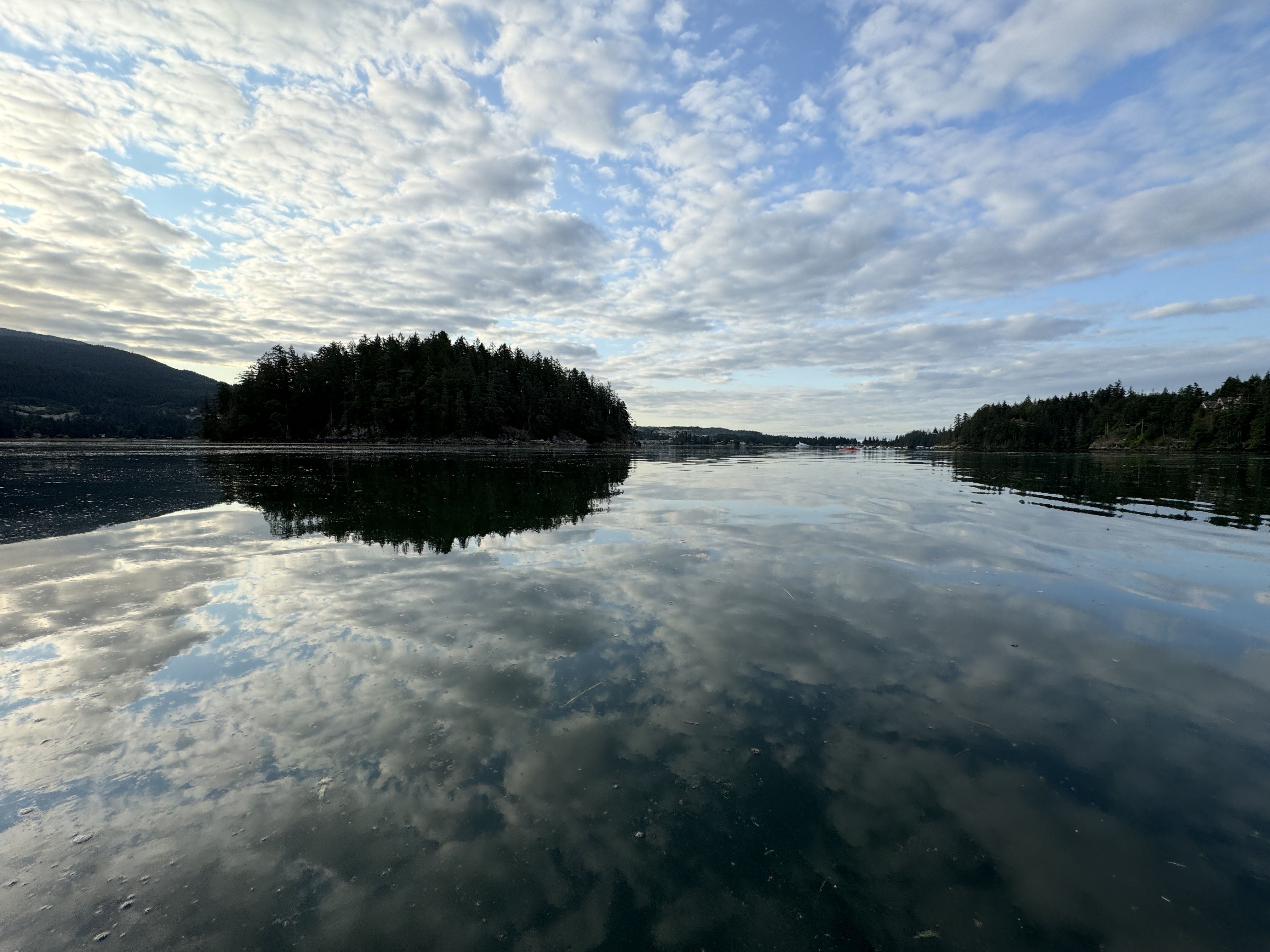
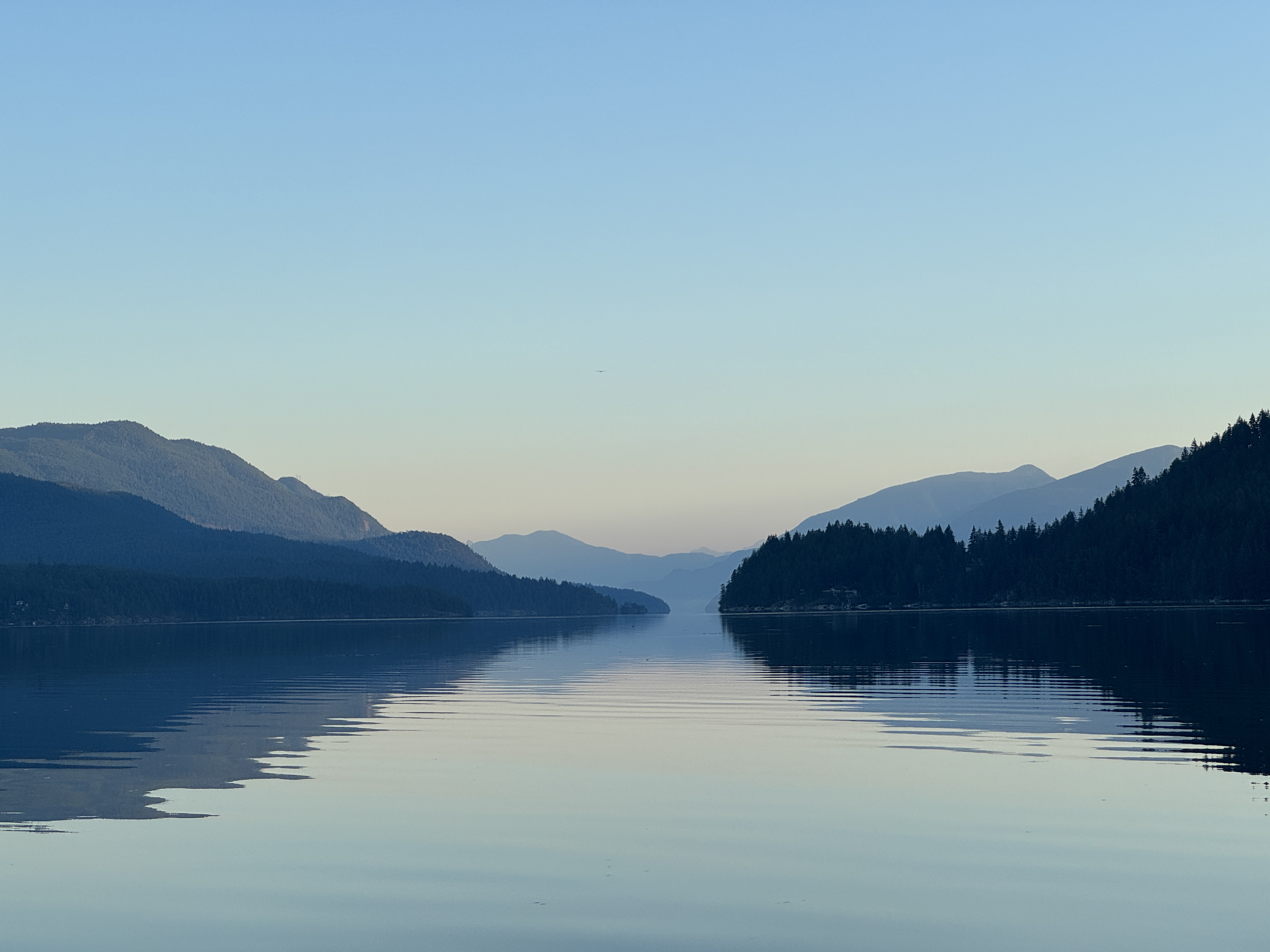
Here are a couple of views of Porpoise Bay. The first is looking south at the town of Sechelt, BC and the second is looking north toward Eggmont and the entrance to the Bay.

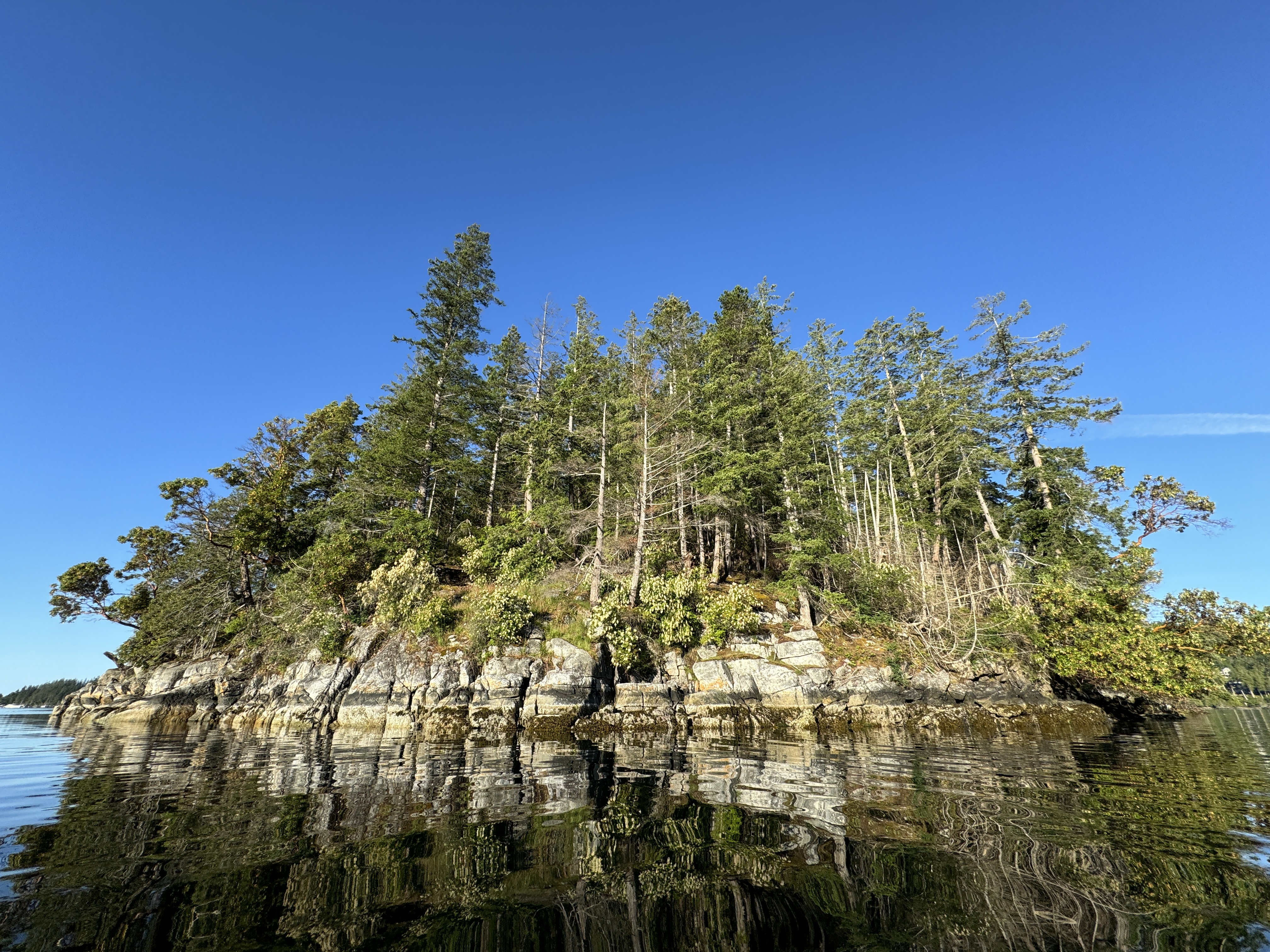
This is Poise Island which has no primates. Only seals, birds, sea stars. Once we saw a deer on Poise, but luckily she swam off the next day:

Egg yolk jellyfish is what we call these. They are big:

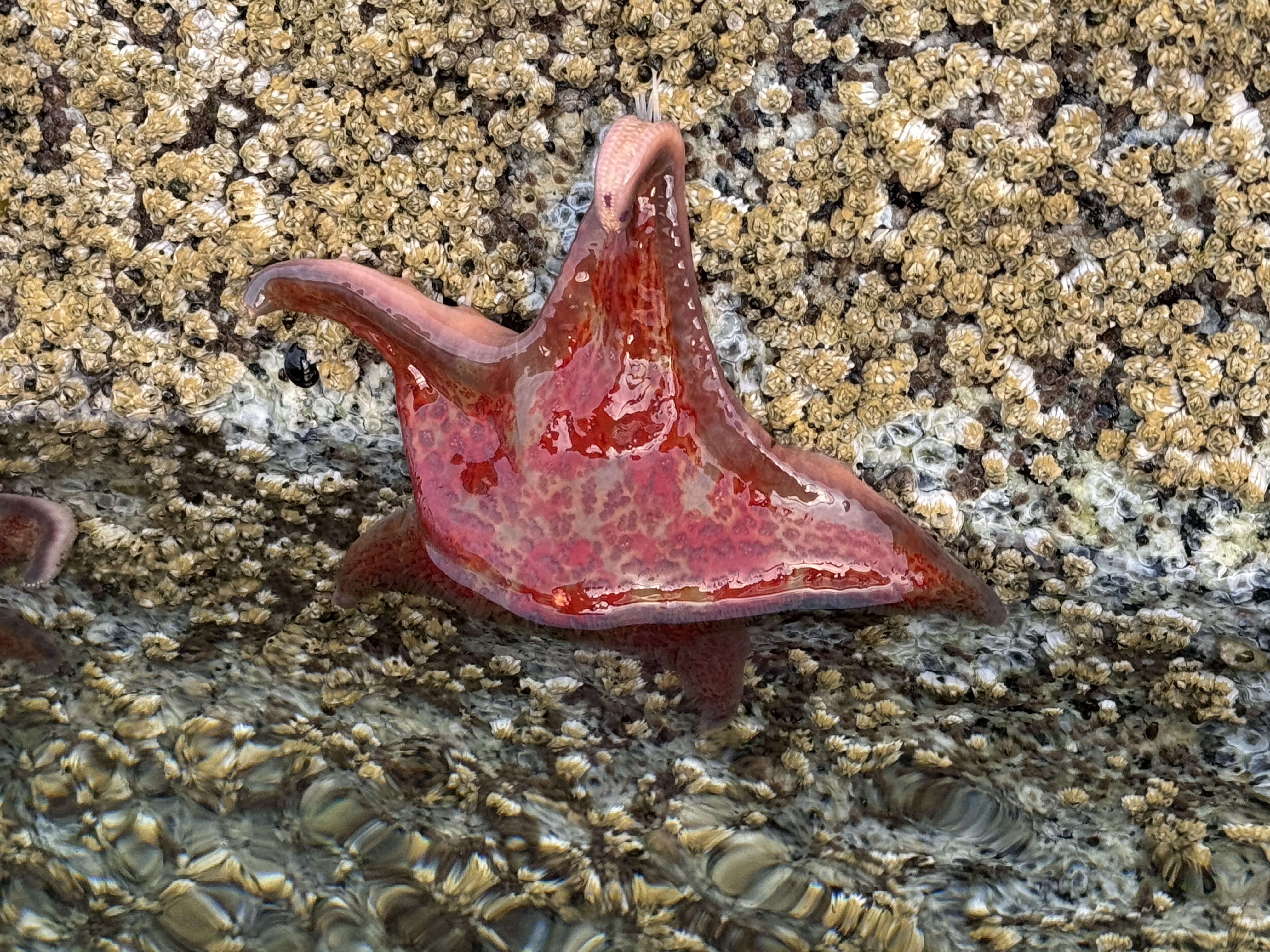
Sea stars abound. It is really common for the ones out of the water to hang an arm or two:

On to the birds. Bald Eagles (Haliaeetus leucocephalus) are everyday birds except in late August and early September when they fly off to the creeks to chow down on salmon:

We hear and see Kingfishers flying every day but they rarely sit still long enough to be photographed, as this one did:

A Great Blue Heron (Ardea herodias), of course:

A Great Blue Heron, flying off, beautiful silhouette:

And finally a seagull. Common and gorgeous:

Readers’ wildlife photos

August 25, 2025 • 8:15 am

Today, mathematician and Hero of Intellectual Freedom, UC Davis’s Abby Thompson has more lovely intertidal pictures from California. Her captions and IDs are indented, and you can enlarge the photos by clicking on them.

The Northern California tidepools are filling with kelp, and creatures are hiding away under it.   Here are some photos while there’s still a bit of summer left.     These are from July, except for the pelicans (August 1). Thanks as usual to experts on inaturalist for some of the IDs.

Tegula funebralis (black tegula): I love these tracks on the sand at low tide; it looks as though the snails are trying to tell us something:

Closeup of the barnacle-encrusted snail from the first photo:

Hesperocyparis macrocarpa (Monterey Cypress). The trunks get stroked by many hands as people pass them on their way down to the beach:

Pelecanus occidentalis (brown pelican): There must have been a large shoal of fish near shore; the pelicans (it seemed like hundreds of them) were going nuts.    Their lethal dives, with those incredible beaks, makes their relation to dinosaurs look very convincing.  The Point Reyes peninsula is in the background:

Family Ammotheidae (Pycnogonid-sea spider): The lumpy white spots on the legs are eggs (what a place to carry them!), which I believe makes this a female.  The males carry the eggs after they are fertilized:

Tenellia lagunae (nudibranch):

The next few photos are through a microscope.  I have an ancient Leitz Wetzlar dissecting scope, with an old iphone precariously clamped over one eyepiece. There must be a better way, but I haven’t figured it out yet.

Diatoms: Genus Isthmia; Lou Jost’s beautiful post on WEIT on the Challenger Expedition and the diatoms they found  was inspiring. It’s disconcerting, as a non-biologist, to look through a microscope at a fluffy, frothy bit of seaweed (the reddish stuff) and see, scattered all through it, these incredibly regular geometric shapes:

Diatoms closeup:

Neosabellaria cementarium ((tiny) polychaete worm):

Phylum Foraminifera: This was a surprise to me, partly because I had never heard of foraminifera, but mostly because it turns out they’re single-celled organisms (like diatoms), so that’s one cell you’re seeing.   Google AI says this about the difference between diatoms and foraminifera: “Diatoms are photosynthetic algae with silica cell walls, while foraminifera are amoeboid protists with calcium carbonate or agglutinated shells.”

There are many more elaborate/complex ones than this one (there’s one that looks a lot like a loaf of challah, for example).   It’s worth googling “foraminifera” and “Ernst Haeckel” to see some amazing illustrations. The Challenger Expedition discussed by Lou Jost also collected and documented foraminifera.  According to Wikipedia, the first picture of one was by “…Robert Hooke in his 1665 book Micrographia”.  This book (available through WikiSource online) has charming sections like: “Of the Teeth of a Snail”, and “Of blue Mould, and of the first Principles of Vegetation arising from Putrefaction”.   The possible foraminifera appears as figure X in Schema 5.   He says (in Observation XI) “I view’d it every way with a better Microscope and found it on both sides, and edge-ways, to resemble the Shell of a small Water-Snail with a flat spiral Shell:” Imagine being one of the first to be able to peer into this world!

The camera for the first six pictures in an Olympus TG-7.

Readers’ wildlife photos

August 6, 2025 • 8:15 am

Ecologist Susan Harrison has graced us with her third batch of photos from Alaska. Her captions and IDs are indented, and you can enlarge her photos by clicking on them.

Alaska part 3:  Kenai Peninsula

This post is the third in a series from a recent bird and wildlife trip to Alaska.  Unlike part 1 (Nome) and part 2 (Utqiakvik), part 3 takes place well below the Arctic Circle, along the Kenai Peninsula south of Anchorage.  The photos are from two boat trips, one that explored the rugged Kenai Fjords and another that meandered across Kachemak Bay.  Please bear with the less-than-perfect results of wielding my camera on moving boats in mixed weather.

Raft of Common Murres (Uria aalge) in front of a seabird nesting island:

Common Murre closeup:

Mixture of Common Murres and Thick-billed Murres (Uria lomvia; also known as Brünnich’s Guillemot) on a nesting cliff.  Jerry recently showed us photos of the latter species in Iceland.   It’s distinguished from Common Murres by the thin white line along the mouth:

Tufted Puffins (Fratercula cirrhata):

Horned Puffins (Fratercula corniculata) at their nest burrow:

Red-faced Cormorant (Urile urile), a rare and perhaps slightly misnamed North Pacific species:

Pelagic Cormorants (Urile pelagicus) at their nests; they are much more widespread than the Red-faced Cormorant, as well as seemingly redder-faced:

Rhinoceros Auklets (Cerorhincha monocerata):

Parakeet Auklets (Aethia psittacula):

Kittlitz’s Murrelets (Brachyramphus brevirostris), a rare seabird considered the “poster bird for global warming” because it breeds next to tidewater glaciers in the North Pacific and Arctic Oceans:

Black Oystercatchers (Haematopus bachmani) and Surfbirds (Calidris virgata) enjoying a rich rocky intertidal zone:

Starfish (or sea stars; Pisaster ochraceus and others) looking healthy and abundant, a welcome sight since their relatives farther south have been decimated by a wasting disease:

Steller Sea Lions (Eumetopias jubatus), a beast in which the male weighs about one ton, twice the size of the female:

Harbor Seals (Phoca vitulina):

Sea Otters (Enhydra lutris) in Kachemak Bay with the town of Homer in the background:

Mountain Goats (Oreamnos americanus) in the Kenai Fjords, where they are most easily seen from a boat. This is the only part of the US where they still occur naturally rather than being reintroduced:

Readers’ wildlife photos

August 2, 2025 • 8:15 am

Today we have some lovely tidepool photos from Intellectual Heros Abby Thompson at Davis. Her captions are indented, and you can enlarge the photos by clicking on them. Thanks to her and other people who sent in photos yesterday. They will all eventually appear.

Some pictures from the late May northern California tidepools, starting with an Anthopleura artemisia (moonglow anemone). I’ve posted several of these; they have strikingly different colors and patterns. This one seemed particularly photogenic:

Anthopleura sola (Sunburst anemone). These are common, large, and occasionally this spectacular, almost fluorescent, green (they all fluoresce under UV light).

Lissothuria nutriens (Dwarf sea cucumber). This looks like a stray chunk of starfish (it was about 1” long).   You can see a few of its tube feet sticking out of the side.   If caught at the right time of day, or tide, the pinkish area on the left side would expand into frilly tentacles (see the next picture from a few years ago).

Lissothuria nutriens (from 2020) showing the tentacles:

Genus Caprella. The caprellid shrimps are everywhere, like a Greek chorus for the rest of the sea life.     This one is pregnant- you can see the eggs in her belly:

Eubranchus rustyus (homely aeolid) nudibranch:

Epiactis handi. This is an uncommon species of Epiactis, named after the biologist Cadet Hand, who was a Director of the Bodega Marine Lab: There is (only) one cluster of these that I’ve found in a cave-like bit of the coast.   It’s distinguished by the beautiful swirling pattern on its disk, and the way sand and other debris adheres to its column, unlike other Epiactis species:

Velutina velutina (velvet shell, a snail):

Geitodoris heathi (Heath’s dorid, nudibranch):

Tonicella lokii (flame-lined chiton) One of the loveliest chitons on our coast, with its snappy pink and blue zig-zag: