Readers’ wildlife photos

August 6, 2025 • 8:15 am

Ecologist Susan Harrison has graced us with her third batch of photos from Alaska. Her captions and IDs are indented, and you can enlarge her photos by clicking on them.

Alaska part 3:  Kenai Peninsula

This post is the third in a series from a recent bird and wildlife trip to Alaska.  Unlike part 1 (Nome) and part 2 (Utqiakvik), part 3 takes place well below the Arctic Circle, along the Kenai Peninsula south of Anchorage.  The photos are from two boat trips, one that explored the rugged Kenai Fjords and another that meandered across Kachemak Bay.  Please bear with the less-than-perfect results of wielding my camera on moving boats in mixed weather.

Raft of Common Murres (Uria aalge) in front of a seabird nesting island:

Common Murre closeup:

Mixture of Common Murres and Thick-billed Murres (Uria lomvia; also known as Brünnich’s Guillemot) on a nesting cliff.  Jerry recently showed us photos of the latter species in Iceland.   It’s distinguished from Common Murres by the thin white line along the mouth:

Tufted Puffins (Fratercula cirrhata):

Horned Puffins (Fratercula corniculata) at their nest burrow:

Red-faced Cormorant (Urile urile), a rare and perhaps slightly misnamed North Pacific species:

Pelagic Cormorants (Urile pelagicus) at their nests; they are much more widespread than the Red-faced Cormorant, as well as seemingly redder-faced:

Rhinoceros Auklets (Cerorhincha monocerata):

Parakeet Auklets (Aethia psittacula):

Kittlitz’s Murrelets (Brachyramphus brevirostris), a rare seabird considered the “poster bird for global warming” because it breeds next to tidewater glaciers in the North Pacific and Arctic Oceans:

Black Oystercatchers (Haematopus bachmani) and Surfbirds (Calidris virgata) enjoying a rich rocky intertidal zone:

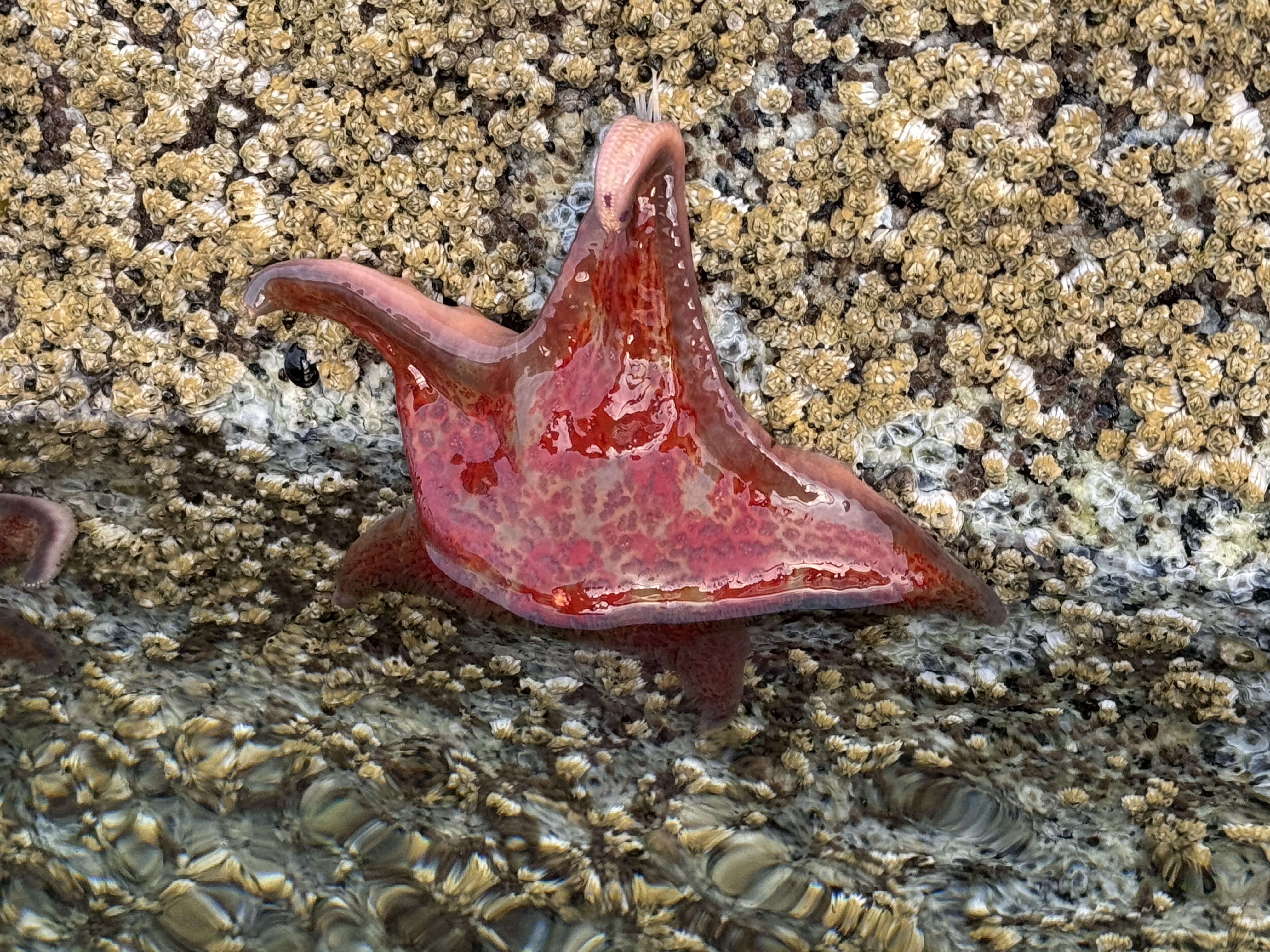
Starfish (or sea stars; Pisaster ochraceus and others) looking healthy and abundant, a welcome sight since their relatives farther south have been decimated by a wasting disease:

Steller Sea Lions (Eumetopias jubatus), a beast in which the male weighs about one ton, twice the size of the female:

Harbor Seals (Phoca vitulina):

Sea Otters (Enhydra lutris) in Kachemak Bay with the town of Homer in the background:

Mountain Goats (Oreamnos americanus) in the Kenai Fjords, where they are most easily seen from a boat. This is the only part of the US where they still occur naturally rather than being reintroduced:

Readers’ wildlife photos

August 2, 2025 • 8:15 am

Today we have some lovely tidepool photos from Intellectual Heros Abby Thompson at Davis. Her captions are indented, and you can enlarge the photos by clicking on them. Thanks to her and other people who sent in photos yesterday. They will all eventually appear.

Some pictures from the late May northern California tidepools, starting with an Anthopleura artemisia (moonglow anemone). I’ve posted several of these; they have strikingly different colors and patterns. This one seemed particularly photogenic:

Anthopleura sola (Sunburst anemone). These are common, large, and occasionally this spectacular, almost fluorescent, green (they all fluoresce under UV light).

Lissothuria nutriens (Dwarf sea cucumber). This looks like a stray chunk of starfish (it was about 1” long).   You can see a few of its tube feet sticking out of the side.   If caught at the right time of day, or tide, the pinkish area on the left side would expand into frilly tentacles (see the next picture from a few years ago).

Lissothuria nutriens (from 2020) showing the tentacles:

Genus Caprella. The caprellid shrimps are everywhere, like a Greek chorus for the rest of the sea life.     This one is pregnant- you can see the eggs in her belly:

Eubranchus rustyus (homely aeolid) nudibranch:

Epiactis handi. This is an uncommon species of Epiactis, named after the biologist Cadet Hand, who was a Director of the Bodega Marine Lab: There is (only) one cluster of these that I’ve found in a cave-like bit of the coast.   It’s distinguished by the beautiful swirling pattern on its disk, and the way sand and other debris adheres to its column, unlike other Epiactis species:

Velutina velutina (velvet shell, a snail):

Geitodoris heathi (Heath’s dorid, nudibranch):

Tonicella lokii (flame-lined chiton) One of the loveliest chitons on our coast, with its snappy pink and blue zig-zag:

Readers’ wildlife photos

June 28, 2025 • 8:30 am

I’m running very low on readers’ wildlife photos, so send some in this week if you got ’em. They may have to wait a while to be posted, but I don’t like to run out. Thanks!

Today’s batch of marine pictures comes from mathematician and intellectual hero Abby Thompson, who loves to photograph  tidepools of California. Her captions and IDs are indented, and you can enlarge the photos by clicking on them. There are some very weird worms here; see especially the last two.

The number of different species of marine worms is incredible, with many of them undescribed.   As one of the experts who is kind enough to help with IDs on inat has said, “so many worms, so little time”.     A remarkable recent paper, started by a student project at the Bodega Bay Marine Lab, documents 11 new species of nemertean worms found in a very small area that has been studied extensively for decades.  So what follows is just a sampling of some of the species found on a short stretch of the Northern California coast.

Pterocirrus montereyensis:

Paradialychone ecaudata:

Genus Thelepus; this medusa-like creature is in the family Terebellidae, called “spaghetti worms” for obvious reasons:

Genus Naineris. It’s hard to pick my favorite among all these worms, but this is a strong contender. The species here is unclear and possibly undescribed. I’ve found just a few of these, in 3-4 very small (like 6”x8”) always-shaded pools in the high intertidal zone.    They appear (as does so much) as a slight pinkish fuzz until they are magnified. There’s a video of one eating here,  The worm transports sand grains to its mouth along those dark channels, then apparently scrapes off the organic material:

This is a worm trifecta from the same tiny pool- Genus Naineris, Paradialychone ecaudata, and a peanut worm, Phascolosoma agassizii– that’s the black-and-white splotchy one:

Genus Aphrodita (sea mouse). From Wikipedia:  “The name of the genus is taken from Aphrodite, the ancient Greek goddess of love, said to be because of a resemblance to human female genitalia.” I think “sea mouse” is a better descriptor, myself.  Its camouflage on the sand is almost perfect.  I included the next picture of its underside so you can actually see it:

Aphrodita, the underside:

Family Phyllodocidae (paddle worm) This tiny guy (about ½”) looked like a miniature dragon:

Serpula columbiana; luckily, these lovely worms are fairly common:

Serpula columbiana (the pink-and-white bit) closing up:

Genus Amblyosyllis; this and the next one are the other contenders for my favorite. They look to me like illustrations from Dr. Seuss.  They’re both undescribed species.  These two are the only ones of this genus I’ve found:

Genus Amblyosyllis:

Readers’ wildlife photographs

June 2, 2025 • 8:15 am

Math professor and Hero of Intellectual Freedom Abby Thompson of UC Davis has sent us some tidepool photos, along with a few birds. Her captions are indented, and you can enlarge the photos by clicking on them.

The first picture is of a pair of foolish birds from my back porch, followed by some Northern California tidepool pictures from late April and May.   The tides the last week of May were among the lowest of the year, occurring at a very unfortunate time of day (near dawn) for those who prefer a leisurely morning, like me.    As usual I got help from people on inaturalist for some of the IDs.

I don’t understand how mourning doves ever manage to reproduce. Here’s a pair pondering building a nest on the extremely wobbly fan hanging from the trellis over our porch. I’ve also seen them trying to nest on the peak of the roof and on a very narrow garden railing.  They give new meaning to the word birdbrain.    I strung up a nice, spacious, secure basket for them right near the fan, which they totally ignored.   They eventually gave up on the fan; they’ve probably found a nice spot smack in the middle of a parking lot somewhere.

On to the tidepools:

Thorlaksonius subcarinatus: This is a species of amphipod, which (I feel like I keep saying this) is tiny, just a bright orange speck. Amphipods are like isopods (the roly-polys in your garden) except they’re flattened vertically instead of horizontally.  The Thorlaksonius part is for sure, the species seems likely correct:

Liparis florae (tidepool snailfish).  About 2” long.  The second picture is a close-up of its weird eye:

Rostanga pulchra (nudibranch). This species eats a bright orange sponge, on which it becomes practically invisible:

(Family) Sabellidae (feather duster worm) It’s not possible even to determine genus from this photo:

Phidiana hiltoni (nudibranch):

I took a picture of the brown-and-white-striped worm (Tubulanus sexlineatus) and only noticed afterward that the photo includes both a nudibranch (Coryphella trilineata) to the right of the worm and a sea spider (Pycnogonum stearnsi) to the left. Tidepools are crowded places:

A little jellyfish, Polyorchis haplus (I think). This one was stranded on the sand, but when plopped into a small pool it started zipping around. The red spots are eyespots:

Acanthodoris nanaimoensis (nudibranch). I don’t see this species very often, and it’s a knock-out:


Camera info:  Mostly Olympus TG-7 in microscope mode, pictures taken from above the water.

Green sea turtle noms jellyfish

May 15, 2025 • 1:38 pm

It doesn’t get stung for some reason! However, one site says this:

The green sea turtle is the largest hard-shelled sea turtle. They are unique among sea turtles in that they are herbivores, eating mostly seagrasses and algae.

I guess it wanted a change.

The species, Chelonia mydas, is endangered and has undergone a steep decline in population size.  It is protected everywhere.

Readers’ wildlife photos

April 8, 2025 • 8:30 am

Today we have a lovely batch of tidepool organisms taken by UC Davis math professor Abby Thompson, who is also a Hero of Intellectual Freedom.  Abby’s captions and IDs are indented, and you can enlarge her photos by clicking on them.

More tidepool pictures from Dillon Beach, CA.   The best tidepooling season is just getting underway.  There are some big tides at the end of April, and they’ll recur through July, with the low tides at ghastly hours of the morning.    These pictures from March were from less painful times of day.   There are a few species I’ve posted before, but they had some especially photogenic representatives this month.

Several of these animals are really (really) tiny, and some are both tiny and fast, so some of the pictures aren’t perfect, but I think they’re interesting creatures.

Phidiana hiltoni (nudibranch).   Posted before, but this one was a beauty:

Genus Ophiopholis (brittle star). Distinguishing species in this genus requires better pictures than this one.  This tiny- about an inch tip to tip- brittle star was on the underside of a rock.    These move fast and gracefully.    They’re in the same phylum as big ochre stars, the sea urchins (see the next two pictures) and sea cucumbers:

Strongylocentrotus purpuratus (purple sea urchin). I know, it’s green, but the juveniles start green and then turn purple.    The next picture shows its mouth on the underside:

Sea urchin mouth:

Family Sabellidae (feather duster worm). Another very tiny creature, visible to the naked eye as just a slight pink fuzz.   This marine worm lives in a tube of its own creation,  and retracts into the tube in a flash if disturbed.  The dark dots at the base of the “feathers” are eyes:

Caesia fossata (eggs from this snail).

Margarites pupillus (tentative ID) I liked the bit of opalescence on the shell:


Coryphella trilineata (nudibranch). Another one I’ve posted before, posing for the camera:

Genus Gnathopleustes (amphipod). Yet another tiny guy.    I’ve found just a few of these, a speck of bright color in the seaweed:

Mopalia acuta (chiton).   The Mopalia species can be hard to distinguish from photos, so this ID should be taken with a grain of salt.    Chitons usually cling to a rock like a limpet, but they can curl into a ball like a roly-poly to protect their vulnerable body if they get dislodged:

Camera info:  Mostly Olympus TG-7, in microscope mode, pictures taken from above the water.

Readers’ wildlife photos

March 5, 2025 • 8:15 am

Today we have tidepool photos by Intellectual Hero Abby Thompson, a mathematician from UC Davis. Abby’s captions and IDs are indented, and you can enlarge the photos by clicking on them.

More tidepool pictures from Dillon Beach, CA,  plus a vegetable.  As usual I got help with some of the IDs from people on inaturalist.   First the vegetable:

This is Romanesco from our local farmers’ market, carefully selected as the most beautiful in the pile. It’s a fractal-ly vegetable; the large spiraling pattern repeats in the smaller spirals which repeat in the even smaller spirals which…..   In a mathematical fractal this goes on ad infinitum, in a vegetable, not so much.  I posted a similar picture outside my office door about 20 years ago and a computer scientist stopped by to ask me how I’d generated the image.   He was disappointed it was an actual photograph of an actual vegetable.

   On to the tidepools:

Hermissenda crassicornis (nudibranch) doing this interesting thing- using the surface tension of the water to “walk” upside down on the surface of the pool.   For some reason they often do this as the tide is beginning to come back in:

An infant Kelp Crab (Pugettia sp.), through a microscope:

Dendronotus venustus (nudibranch). A fractal-ly nudibranch.:

Aeolidia loui (nudibranch) with its eggs, above the water line:

Aeolidia loui:

A baby Ochre Star (Pisaster ochraceus). This was about an inch across.    The adults are the large (usually 6 inches or more), very common orange or purple stars.   For some reason I see the adults (always) and the small babies (sometimes) and not anything in between:

Cuthonella cocoachroma (nudibranch). This picture doesn’t do it justice.     They are quite small (about ½” long), and findable only because the white tips of the cerata (those things on its back) sparkle like gems when they catch the light:

Eudendrium californicum,  a colonial hydroid.    Each “flower” is an animal, and the orange blobs are part of the reproductive structure.:

Camera info:  Mostly Olympus TG-7, in microscope mode, pictures taken from above the water.