New Zealand bans semiautomatic and “military style” weapons

March 21, 2019 • 8:45 am

On March 13, 1996, the Dunblane Massacre took place in Scotland. A man named Thomas Hamilton assaulted a school with four legally-owned handguns, killing 16 children and a teacher (and wounding another 16) before committing suicide. Reaction was swift, and within two years the government had passed two acts banning all handguns in England, Scotland and Wales; the exceptions are “historic and muzzle-loading guns” and a few other types of large “sporting” handguns that are large.

Following the two mosque shootings on March 15, New Zealand has acted even faster. Prime Minister Jacinda Ardern, whom I much admire, just announced that New Zealand is banning not only the sale of semiautomatic weapons, but ownership of them, which will end via a government buyback scheme. (The weapons used in the mosque shootings had, as I recall, been bought legally but modified illegally.)

Tvnz reports (click on screenshot):

Ms Ardern had previously stated that New Zealand would see gun law reforms “within 10 days” of the Christchurch mosque shootings which left 50 people dead. She took six days to act.

“The attacker took a significant number of lives using primarily two guns, assault rifles purchased legally on an A class licence.

“The time for the easy availability of these weapons must end, and today it will.

“In short, every semi-automatic weapon used in the terrorist attack on Friday will be banned in this country,” Ms Ardern said in a press conference this afternoon.

High-capacity magazines and attachments will also be banned along with the “military style weapons.”

Low calibre .22 semi-automatic firearms used mainly for pest control and duck hunting will be exempt.

The Prime Minister also announced a “buyback scheme” will be made available to those who possess any of the now banned weapons.

Wait a tick! Why do you need semiautomatic weapons for pest control and duck hunting? That’s unfair to the ducks!

At any rate, the announcement of the ban and buyback has already appeared on the New Zealand Police website, and you can see the “Hand in Firearms form” here.

It’s telling that the Federated Farmers, Fish and Game New Zealand, and the National Party (an opposition party; Ardern is from Labour) have joined in supporting the Prime Minister in the ban. It’s going to happen, and happen soon.

You know my opinion and my question: the U.S. should do the same, and do we have any good reasons why not? The Supreme Court has interpreted our Second Amendment, designed to enable militias to defend themselves against tyranny, as giving private citizens a right to own guns. An “originalist” like Scalia should recognize that, and everyone should recognize that this interpretation of the Amendment is an unconscionable stretch, designed to satisfy the NRA and gun-happy Americans. At the very least, handgun ownership should be banned in America, and so should semiautomatic weapons.

I can see no justification for America’s love of gun ownership save the oft-repeated claim that if guns were banned, only the “bad guys” would have guns. But we know that self-protection using handguns costs fewer lives than the accidental deaths caused by owning those guns. As the L.A. Times reported, in 2012 the number of defensive “justifiable homicides” using all firearms was 259, less than half of the “fatal unintentional shootings,” which numbered 548. And on top of this, that year saw 8,342 criminal homicides using guns and 20,666 suicides using guns (about half of all suicides). The Times report concludes this way:

So what conclusions can we draw from this? The notion that a good guy with a gun will stop a bad guy with a gun is a romanticized vision of the nature of violent crime. And that the sea of guns in which we live causes exponentially more danger and harm than good. It’s long past time to start emphasizing the “well-regulated” phrase in the 2nd Amendment.

But it’s unthinkable that what just happened in New Zealand could happen in the U.S. For one thing, it goes against the courts’ construal of the Second Amendment, and on top of that it’s unimaginable that the Republican Party would support such action.

The prevalence of guns in America is not constitutionally permissible under any reasonable interpretation of the Constitution, and doesn’t make our citizens safer. Perhaps we can have rifles for hunting, but they should be kept under strict control, as they do in the UK. In the end, New Zealand’s immediate and rational response to gun violence stands in stark contrast to the refusal of our government, in the face of repeated mass shootings, to do anything but wring its hands, offering “thoughts and prayers.”

h/t: Infiniteimprobability

John Paul Stevens: Repeal the Second Amendment

March 27, 2018 • 12:45 pm

If you’re an American, you’ll know that John Paul Stevens was an Associate Justice in the U.S. Supreme Court, serving from 1975-2010. Although a registered Republican, his decisions put him on the liberal side of the Court.  He’s now 97 years old, but is still fired up (if that’s the right word) about the misconstrual of the Second Amendment to the Constitution.  Let us look at Amendment before we read Stevens’s new op-ed in the New York Times (click on screenshot below):

A well regulated Militia, being necessary to the security of a free State, the right of the people to keep and bear Arms, shall not be infringed.

Read it again. The first part gives the rationale for the second, so that the “right to keep and bear Arms” is justified by the need to have a “well regulated Militia”. Militias were quasi-military bodies that the government, in colonial days, used to constitute the armed forces.

For many years, as Stevens notes, the Amendment was interpreted by courts as the government’s having the ability to regulate the possession of arms. That is, the Amendment was construed not as simply allowing Americans to have relatively unrestricted rights to own guns. (For a similar argument, see Garry Wills’s excellent article “To Keep and Bear Arms“, published in 1995 in the New York Review of Books.) Stevens begins by noting the groundswell of support for gun regulation evinced in last Saturday’s demonstrations.

That support is a clear sign to lawmakers to enact legislation prohibiting civilian ownership of semiautomatic weapons, increasing the minimum age to buy a gun from 18 to 21 years old, and establishing more comprehensive background checks on all purchasers of firearms. But the demonstrators should seek more effective and more lasting reform. They should demand a repeal of the Second Amendment.

Concern that a national standing army might pose a threat to the security of the separate states led to the adoption of that amendment, which provides that “a well regulated militia, being necessary to the security of a free state, the right of the people to keep and bear arms, shall not be infringed.” Today that concern is a relic of the 18th century.

For over 200 years after the adoption of the Second Amendment, it was uniformly understood as not placing any limit on either federal or state authority to enact gun control legislation. In 1939 the Supreme Court unanimously held that Congress could prohibit the possession of a sawed-off shotgun because that weapon had no reasonable relation to the preservation or efficiency of a “well regulated militia.”

During the years when Warren Burger was our chief justice, from 1969 to 1986, no judge, federal or state, as far as I am aware, expressed any doubt as to the limited coverage of that amendment. When organizations like the National Rifle Association disagreed with that position and began their campaign claiming that federal regulation of firearms curtailed Second Amendment rights, Chief Justice Burger publicly characterized the N.R.A. as perpetrating “one of the greatest pieces of fraud, I repeat the word fraud, on the American public by special interest groups that I have ever seen in my lifetime.”

Ah, how I long for the Burger court. . .

But how things have changed! And they changed for the worse (and seemingly for keeps) with the Supreme Court’s decision a decade ago in District of Columbia v. Heller, in which the court ruled, by a scant 5-4 margin, that the Second Amendment didn’t need the requirement of a militia: that it gave individuals to have the right to own guns for self defense. (The decision overruled Washington D.C.’s prohibition of handguns and restrictions on rifle storage.)  The majority opinion was written by the odious Antonin Scalia, while Stevens wrote the dissent.

Since then, gun ownership has proliferated, and with it the spate of shootings in nightclubs, schools, and other public places that culminated in last Saturday’s demonstration. The way to cure this, says Stevens, is simply to repeal the ambiguous Second Amendment. Referring to the Heller decision and the Amendment, Stevens argues this:

That [Heller] decision — which I remain convinced was wrong and certainly was debatable — has provided the N.R.A. with a propaganda weapon of immense power. Overturning that decision via a constitutional amendment to get rid of the Second Amendment would be simple and would do more to weaken the N.R.A.’s ability to stymie legislative debate and block constructive gun control legislation than any other available option.

That simple but dramatic action would move Saturday’s marchers closer to their objective than any other possible reform. It would eliminate the only legal rule that protects sellers of firearms in the United States — unlike every other market in the world. It would make our schoolchildren safer than they have been since 2008 and honor the memories of the many, indeed far too many, victims of recent gun violence.

He’s right, for as long as the courts interpret the Second Amendment in the wonky and right-wing way they have, the justification for widespread gun ownership will remain. And there’s no sign that the Court, which is even more conservative now than in Stevens’s Day, will reverse course. The only way to do an end-run around Scalia et al.’s stupid decision is to change the Constitution.

But of course that seems impossible. While there are several ways to amend the Constitution, the usual one is for a proposed amendment to pass both the Senate and the House by a 2/3 vote, and then be ratified by three-quarters of America’s states—all within seven years. (The time limit is why the Equal Rights Amendment, a no-brainer guaranteeing that equal rights couldn’t be abrogated on account of someone’s sex, failed.) Can anyone imagine the Congress even voting to send such an amendment to the States? And can anyone imagine that the ensuing confusion about what would happen with such a repeal would be cleared up before the time limit? And I’m not even taking into account the mouth-foaming, vitriolic, opposition of the National Rifle Association and the power and money it would muster to block such a move.

Stevens’s suggestion is a good one in principle, for it eliminates the Constitutional ambiguities that have led to virtually unrestricted private ownership of guns.  But what would replace it? A farrago of state laws, some even more lax than the ones we have today? Federal laws with even stricter gun regulations?

My own stand on guns is that they should be severely restricted along the lines that the UK has. No handguns, automatic or semi-automatic weapons, justifications and strict controls needed to own any firearm, and private ownership of such arms limited to shotguns and sporting rifles. (The UK of course has a much lower rate of gun violence than the U.S., but gun nuts make unconvincing arguments that regulation and deaths are unconnected.)

I don’t know how this will happen, but I dearly want it to happen, for too many lives have been taken away but morons who cling to their guns—or by innocents who accidentally discharge them. Statistics show that guns do not make people safer, for they wreak more carnage than they do in protecting homeowners.

When the shootings in Florida took place, I hesitantly suggested that perhaps this might mark a turning point in America’s attitude toward guns. And indeed, the demonstrations by young people, which greatly heartened me, made me think that maybe something will happen. But as the days pass, I fear the activism will wane, and we’ll be back to business as usual. In my own city, 499 people have been shot this year (91 killed), and someone is shot every four minutes. Can anyone stop the madness?

Gun legislation turned down by Florida legislature; Dinesh D’Souza mocks students lobbying to get it passed

February 21, 2018 • 9:20 am

Over the past two days, the evening news has featured distraught, angry, and determined Florida students marching on the state legislature, stunned about the 17 students shot by Nikolas Cruz, but bent on ensuring that it won’t happen again. Many of the lobbyists were classmates of the slain students.  I thought to myself, “If anybody can change this country’s attitudes towards guns, it’ll be the young people who were the targets of those guns.” I hoped mightily that Florida, and then the country, would at last begin to respond. Dare I hope that this might be the turning point in the struggle against America’s senseless proliferation of weapons—especially assault weapons?

No chance. As I predicted, we’ll have a brief flurry of anger and calls for new gun laws, and then it’ll be business as usual. Far too many Americans see student lives as collateral damage to the necessary production and ownership of guns. That’s just sick.

Of course Florida turned a deaf ear to those students. As ABC 10 reports, just one day after the students from Marjory Stoneman Douglas High School went to Tallahassee, Florida to lobby for gun control at the state capitol, the House voted down a motion to ban assault weapons like the AR-15 used by Cruz. The vote wasn’t even close: 36-71.  And it’s ASSAULT WEAPONS!  There is no reason to allow these even if you think that the Second Amendment should permit personal possession of weapons for self defense.

The students were devastated, as they should be, watching a bunch of Republicans vote down sensible restrictions on the very gun that had shattered the bodies of their friends. They watched and wept:

And Dinesh D’Souza, odious human being that he is (he’s supposed to be a pious Christian), brutally and cruelly mocked these students on Twitter:

How lame a human being must you be to say things like this? Reader Pliny the in Between adds a comment:


h/t: Grania, Hempenstein

Another school shooting in Florida: At least 17 dead

February 14, 2018 • 5:39 pm

I’ve just heard on the news that at least 17 people (CNN says 16, but another has died) have been killed in a school in Parkland, Florida: the shooter was a former student who has apparently been taken into custody.

What can one say when school shootings like this become an everyday affair in America? (This is the 18th school shooting this year, and it’s only mid-February.) I can’t wish for the dead to come back. All I can do is hope for fewer guns in America, and express deep sorrow to the families, friends, and loved ones of those who were taken too soon.

UPDATE: CNN adds this:

The suspect, 19-year-old former student Nikolas Cruz, is in custody, Broward County Sheriff Scott Israel said. The sheriff said he was expelled for unspecified disciplinary reasons.

The serious stuff: autonomous weapons

November 16, 2017 • 9:48 am

by Matthew Cobb

Not really the usual WEIT fare, and certainly not what I normally post here, but I feel it is pretty important. This is a 7 minute video, ‘Slaughterbots’, about autonomous weapons and what the future could hold. Watch it and be chilled.

The video was made by the Campaign to Stop Killer Robots (once that might have sounded funny). On their webpage, they point out that an intergovernmental meeting is taking place right now:

“Representatives from more than 70 states are expected to attend the first meeting of the Convention on Conventional Weapons (CCW) Group of Governmental Experts (GGE) on lethal autonomous weapons systems on 13-17 November 2017, as well as participants from UN agencies such as UNIDIR, the International Committee of the Red Cross (ICRC)”

They made the video to draw attention to the problem and pressure the GGE meeting which “is not working towards a specific outcome or negotiating a new CCW protocol to ban or regulate lethal autonomous weapons”. Nevertheless, 19 nations have supported a ban on the development of such devices, and the European Parliament voted to ban “development, production and use of fully autonomous weapons which enable strikes to be carried out without human intervention.” Their website explains:

“More than 3000 artificial intelligence experts signed an open letter in 2015 affirming that they have “no interest in building AI weapons and do not want others to tarnish their field by doing so.” Another 17,000 individuals also endorsed this call. The signa tories include Tesla CEO Elon Musk, Apple co – founder Steve Wozniak, Skype co – founder Jaan Tallin, Professor Stephen Hawking, and Professor Noam Chomsky . They include more than14 current and past presidents of artificial intelligence and robotics organizations and professional associations such as AAAI, IEEE – RAS, IJCAI, ECC AI. They include Google DeepMindchief executive Demis Hassabis and 21 of his lab’s engineers, developers and research scientists.”

If the scientists potentially involved in making this stuff are worried, we should all be. How can we stop the future described in the video from coming to be?

Why is the U.S. uniquely prone to mass shootings? The New York Times says it’s guns.

November 8, 2017 • 1:00 pm

This article in the New York Times (click on screenshot to go there) says that the “answer” to the deeply worrisome problem of mass shootings lies in both the number of guns we have, the ease of procuring them, and the ability to get guns in the U.S., like semiautomatic weapons (or ones that can be converted easily to automatics), that can do far more damage than simple rifles or pistols. The article rests largely on a study done in 2005 by Adam Lankford at the University of Alabama, a study I haven’t read.

The study (and article’s conclusion: “The only variable that can explain the high rate of mass shootings in America is its astronomical number of guns.”  To demonstrate this, the author (and NYT) show some data, including this correlation between the number of guns (showing how much of an outlier the U.S. is) and the number of mass shooters:


Well, of course this is a correlation, and we all know that correlations don’t show causation, as there are third variables that could increase both, like an increased propensity of Americans to be criminals, which could prompt the acquisition and the using of guns. But that’s taken care of in data below.

Further, if you eliminate the U.S from the graph as an outlier, it’s hard to see much of a positive correlation for the rest of the countries (it may well be there, but you can’t really tell from the plot alone), which is what you need to establish to see if there’s a general relationship between gun ownership and number of mass shootings. You’d also want to control for population size, for what we want is not the number of guns and mass shootings, but the number of guns per person and the number of mass shootings per person.

All this appears to be taken care of in the next bit, which shows this figure:

As you see, the U.S is an outlier along with Yemen, the only country that has a higher number of mass shootings—and also has a high rate of gun ownership. If you remove these two countries, and look at the remaining dots, it’s not clear to me that there’s a correlation here, either, but it’s hard to tell (no statistics are given).  But the article also notes that the relationship holds even when you remove the U.S., so I’ll trust Lankford here.

Further, if you look at confounding factors that may explain a correlation without saying that the cause of mass shootings is guns, they don’t appear to be involved. Lankford found, for instance, that there is still a relationship when you control for homicide rates, general criminality (the U.S. “is not actually more prone to crime than other developed countries”) and the rate of mental illness, which doesn’t appear to be higher in the U.S. than in other “wealthy countries”. (How would that cause a spurious correlation? Well, if Americans were more mentally ill than inhabitants of other countries, the disturbed people might go out and get more guns and then use them to kill others, so that the causal factor wouldn’t be availability of guns, though it would still involve gun ownership.) At any rate, countries with higher suicide rates have lower rates of mass shootings, the opposite of what you expect if the rate of mass shootings were correlated with the type of mental illness that lead to suicide.

There are other data as well:

America’s gun homicide rate was 33 per million people in 2009, far exceeding the average among developed countries. In Canada and Britain, it was 5 per million and 0.7 per million, respectively, which also corresponds with differences in gun ownership.

Americans sometimes see this as an expression of deeper problems with crime, a notion ingrained, in part, by a series of films portraying urban gang violence in the early 1990s. But the United States is not actually more prone to crime than other developed countries, according to a landmark 1999 study by Franklin E. Zimring and Gordon Hawkins of the University of California, Berkeley.

Rather, they found, in data that has since been repeatedly confirmed, that American crime is simply more lethal. A New Yorker is just as likely to be robbed as a Londoner, for instance, but the New Yorker is 54 times more likely to be killed in the process.

They concluded that the discrepancy, like so many other anomalies of American violence, came down to guns.

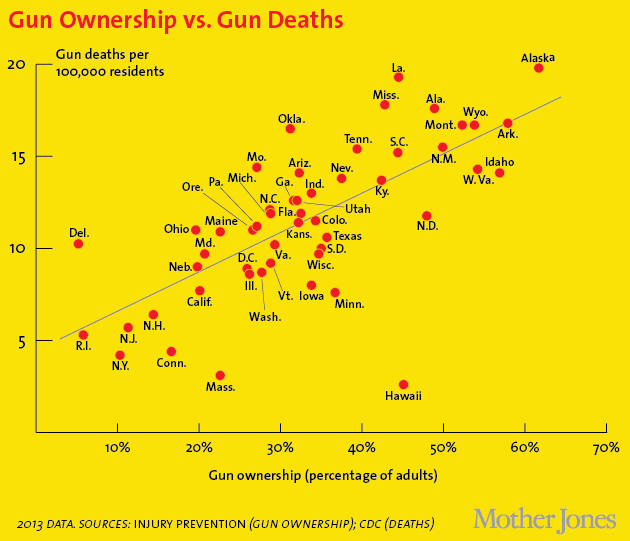
More gun ownership corresponds with more gun murders across virtually every axis: among developed countries, among American states, among American towns and cities and when controlling for crime rates. And gun control legislation tends to reduce gun murders, according to a recent analysis of 130 studies from 10 countries.

This suggests that the guns themselves cause the violence.

You can read the article for yourself, as I don’t want to simply regurgitate the data, but it all points to the fact that the easy accessibility of guns in America, the lack of gun controls, and the kind of guns that we can buy, are the variables that best explain the number (and rate) of mass shootings in America. (Note that this article doesn’t deal with individual homicides, but there are other data on those issues that implicate the accessibility of guns.)

In the end, the problem seems to come down to America’s Second Amendment, which was intended to allow arming of a militia, but has been interpreted (wrongly, I think) by U.S. courts as allowing fairly unrestricted individual ownership of guns—no militia needed. That Amendment appears to have fostered a sense of entitlement that we should have guns—that it’s our right. Barring the Second Amendment, you’d have a hard time justifying that we have a “right” to own such lethal weapons. (I’m always dubious when “rights” are asserted as arguments, but they become prima facie legal rights if they’re in our Constitution.)

Referring to the tighter gun laws of Switzerland (even though they’re second to the U.S. in the rate of gun ownership, the rate of Swiss gun homicides is far lower), the article notes this:

Swiss gun laws are more stringent, setting a higher bar for securing and keeping a license, for selling guns and for the types of guns that can be owned. Such laws reflect more than just tighter restrictions. They imply a different way of thinking about guns, as something that citizens must affirmatively earn the right to own.

The United States is one of only three countries, along with Mexico and Guatemala, that begin with the opposite assumption: that people have an inherent right to own guns.

The main reason American regulation of gun ownership is so weak may be the fact that the trade-offs are simply given a different weight in the United States than they are anywhere else.

After Britain had a mass shooting in 1987, the country instituted strict gun control laws. So did Australia after a 1996 shooting. But the United States has repeatedly faced the same calculus and determined that relatively unregulated gun ownership is worth the cost to society.

That choice, more than any statistic or regulation, is what most sets the United States apart.

And it is that Second Amendment that makes us think we have a right to own guns. Would that we could repeal that Amendment, but of course that wouldn’t end the problem, for we’d still have to legislate firearm laws for each state under the amended Constitution, and in a populace that largely thinks they have the right to have guns. The idea that we have such a right is alien to me, but it’s so deeply instilled in America that the problem seems harder to solve than that of Donald Trump himself, who, after all, will be gone in at most seven years. The article ends on a poignant note, one that shows how deeply sick we are with our guns fetish:

“In retrospect Sandy Hook marked the end of the US gun control debate,” Dan Hodges, a British journalist, wrote in a post on Twitter two years ago, referring to the 2012 attack that killed 20 young students at an elementary school in Connecticut. “Once America decided killing children was bearable, it was over.”


The Atlantic blatantly touts religion: why “thoughts and prayers” are great for stopping gun violence

October 11, 2017 • 9:30 am

The Atlantic continues its downhill slide (I swear, is every good journalistic outlet going to become clickbait?) with a new piece by Katelyn Beaty,”The case for ‘thoughts and prayers’—even if you don’t believe in God.” Of course, Beaty, a believer, slants most of it toward fellow goddies, not atheists. Her author profile describes her as “an editor at large with Christianity Today magazine, and the author of A Woman’s Place.”  They omit the entire title of her 2016 book: A Woman’s Place: A Christian Vision for Your Calling in the Office, the Home, and the World).

So what’s her case for prayer? First, the one for nonbelievers. Beaty describes, tediously, the studies showing that meditation improves calmness and focus, and reduces fear.  That’s been known for a long time. But you don’t have to pray to a god to get those benefits; Zen, or any form of focused meditation, will suffice. So the case for atheist “prayers” collapses immediately. Nevertheless, she continues by arguing that the emotional calmness induced by prayer can lead to political action:

But prayer is not inaction. I would argue that it is perhaps the most powerful form of action you can engage in during a crisis—and that’s true whether you believe in God or not. There are good reasons why prayer remains a daily activity for more than half of all Americans (55 percent), including about one in five religiously unaffiliated people or “nones.” Even for those of us who aren’t sure that God exists and that our prayer can change God, prayer can certainly change us.

. . . But are we really to think that prayer and meditation will help stop gun violence in the United States, even if many Americans aren’t sure there is a God who answers prayer?

Actually, yes—especially in the initial throes of a tragedy. Since prayer aids in clear, calm, and empathetic thinking, if we are going to respond well to complicated issues such as gun control, prayer may be more helpful in leading us toward better policy solutions than would an urgent, fretful, ill-considered response.

The same applies to our elected officials: If we want them to use their power to change gun laws (or tackle any other incredibly complex issue of the day), then we should want them to be engaging with “thoughts and prayers”—although in order to have a positive effect, this does need to be a sincere and regular activity, not just an ad-hoc performance on Twitter. Again, the positive effect on mental and emotional health is there even if they don’t believe that human prayer can change God.

Sounds good, doesn’t it? Notice again that she conflates prayer and meditation, even though the title of her piece mentions not meditation, but “thoughts”—and the mantra “thoughts and prayers” is conventionally used to mean “good wishes and prayers”, not “meditation and prayers”, so she’s again downgrading the atheist bit. Note as well that most people think that “thoughts and prayers” help in themselves—they’re not seen as vehicles to center your mind so you can get on with gun control. Were that true, and given who’s doing most of the praying in America (see below), we’d already have a ban on assault weapons and private ownership of handguns.

More important, though, is her ridiculous claim that prayer and meditation will stop gun violence in the U.S, because “prayer aids in clear, calm, and empathetic thinking”. Well, let’s test that. Which party is the party that most opposes gun regulation? You’d think it would be the party that prays the most, right? That’s not true, of course. Here are data from a Pew “religious landscape” study in 2014. It shows what we already know: Republicans are far more religious than Democrats:

And here’s the frequency of prayer, showing pretty much the same thing. Only 16% of Republicans pray “seldom or never”, but that jumps to 28% for Democrats. 62% of Republicans, but only 50% of Democrats, say they pray daily.

Conclusion: given that Republicans are the main advocates of gun lunacy, as well as the party that deals the worst with “complicated issues” Beaty’s claims are falsified.

That should be the end of it, and the Atlantic’s editors should have consigned Beaty’s piece to the circular file. But Beaty, being a Christian, can’t resist banging on about her theistic God:

Most Americans—nearly three in four—believe that prayer is a direct line to a God who cares about the world and is intimately involved in the lives of all people. In the Judeo-Christian tradition, this God is not the removed watchmaker, who set the natural laws in place and let things run their course, passively looking on as innocents are killed in mass shootings. This God “bends down to listen” and “inclines His ears to hear” the utterances of every person who prays, to quote the psalmist of the Bible. This God is radically interventionist, and can move nations’ leaders to pursue righteousness and justice on behalf of said innocents.

This is no less true in the wake of a tragedy like that in Las Vegas. If you really believe that there is a God who responds to prayer, is intimately involved in human affairs, and could heal this nation’s deep pathologies of violence and revenge, then prayer should be the first thing you do after a mass shooting. Not the only thing, but the first thing.

Beaty doesn’t seem to realize that she’s gotten herself all balled up in theodicy here. If—and given her book, I’m sure she believes this—God really does listen to prayers, and even answers them, and is interventionist in many ways, then you have to ask yourself this: if God is so powerful, why didn’t he stop Stephen Paddock from killing 58 people and injuring nearly 500? Is this some sick divine tactic to make people beg God for gun control? Seriously, any god who is “intimately involved in human affairs”, and had an ounce of compassion, wouldn’t have left hundreds of people dead in our many incidents of mass slaughter, and thousands more bereft at the loss of their friends, family, or loves ones. Beaty’s god is not a kind god, but an evil one: he refuses to stop mass slaughters when he could have. Why, Ms. Beaty? Further, when tested scientifically, prayer doesn’t work (see also here). So if God exists, he’s both nasty and deaf. Beaty has failed miserably in her appeal to both atheists and believers.

h/t: Diane G

p.s. I see that Andrew Seidel, a lawyer for the Freedom from Religion Foundation (FFRF), has written his own rebuttal to Beaty’s ridiculous article. I haven’t yet read it because I wanted to convey my own thoughts here, but now I will; and you can see Seidel’s response at Freethought Now!, the FFRF’s blog.