Readers’ wildlife photos

December 24, 2025 • 8:30 am

This is the penultimate of the two batches I have, so why not get your wildlife photos together instead of snoozing after that big Christmas feast? Today we have the final installment of Holiday Mushroom photos by reader Rik Gern from Austin, Texas. Rik’s captions are indented, and you can enlarge his photos by clicking on them.

Here is the final batch of mushroom pictures taken in northern Wisconsin last September.

I saved this batch for last and am a bit chagrined to send them because most of these pictures are of species I was unable to identify. I’ve been using iNaturalist, but it jammed up a few times. It would seem to identify the genus and species, but then I would get the infamous spinning wheel, which would persist until I exited the application. I thought it was recording the data, but later discovered that it wasn’t. I hope you will be willing to let your more knowledgeable readers weigh in on the species identification. [JAC: yes, please, if you know the species, do weigh in]

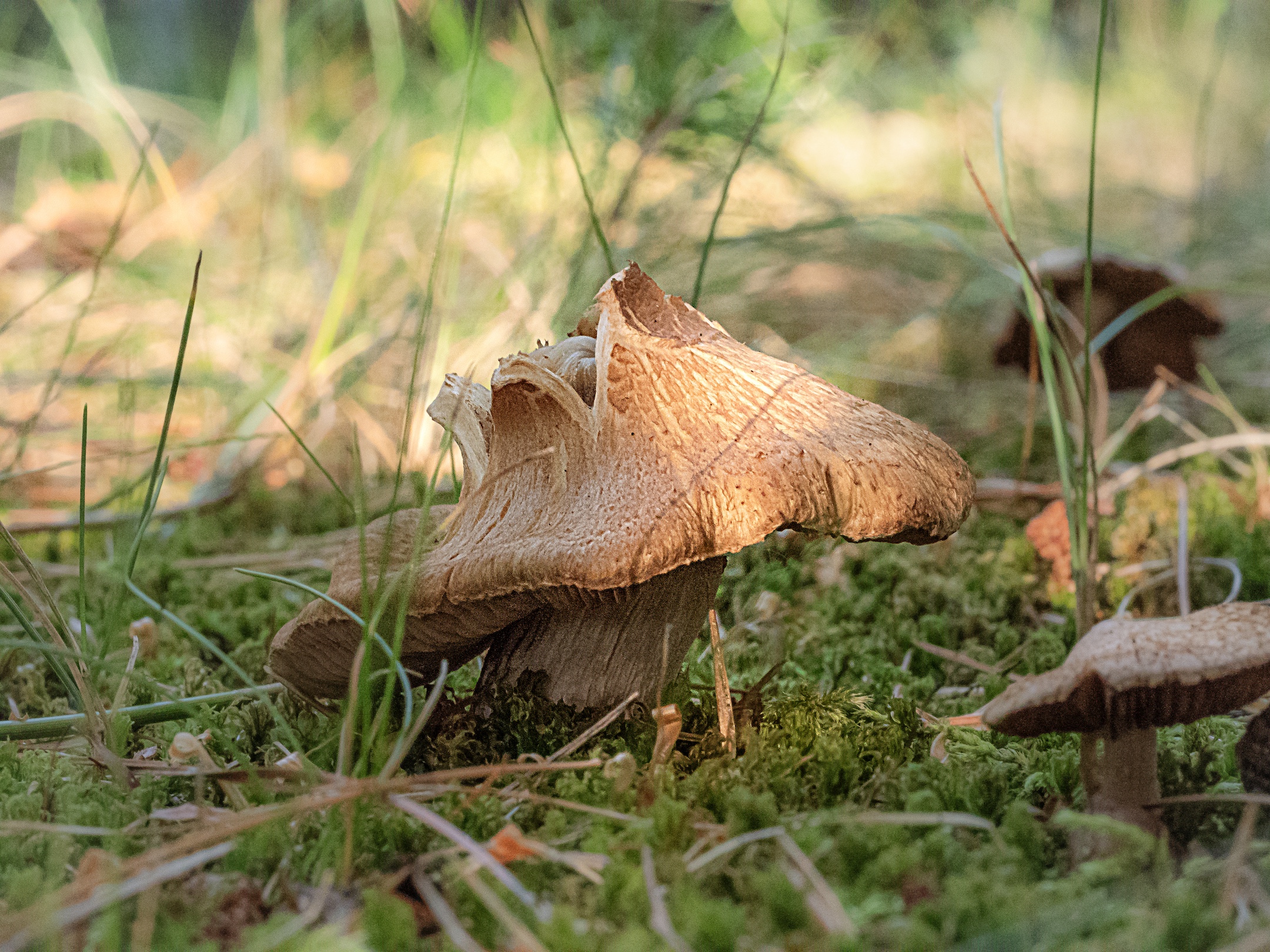
The cap on this mushroom has a woody look. This was the only example I ran across.

This one has nice, delicate looking gills. I think it might be a Destroying Angel  (Amanita bisporigera), but the pictures I saw showed some kind of flap on the stem which this specimen lacks.


Whatever this is, the small cap looks like a cookie dusted with cinnamon.

Something sure found this mushroom tasty!

This mushroom is in an intense tug of war with a thick spider web!

You can see from this image that the web is layered in three sheets.

I’ve see time lapse films of orb weavers weaving their webs, but I can’t imagine how this web was constructed.

Mushrooms are so often associated with psychedelia that I couldn’t resist closing this series by playing with a closeup image of the pores on the underside of the Chicken fat mushroom (Suillus americanus) to give it a trippy psychedelic feel.

Just as an interest in Photoshop led to an interest in photography, the thrill of having pictures on whyevolutionistrue alongside those of learned naturalists and scholars has piqued my interest in learning more about the world of fungi. I’ve been asking friends to recommend books that give a broad overview of fungi. Guide books only make my eyes glaze over and tie my brain in knots, as I don’t seem to have a good mind for that kind of detail, but I can grok the big picture when it’s presented well. There’s a book coming out in May called The Complete Fungi: Evolution, Diversity and Ecology by David S. Hibbit that looks fantastic. I have pre-ordered it, and thought some of your readers might be interested as well, so here is a link.

Readers’ wildlife photos

December 16, 2025 • 8:15 am

Today, courtesy of Rik Gern, we once again enter the mysterious world of fungi. Rik’s captions and IDs are indented, and you can enlarge his photos by clicking on them.

Here is the second batch of photos of Pinewood gingertail (Xeromphalina campanella) mushrooms from Wisconsin’s northwoods.  I tried to focus on portraits of individual mushrooms in this series.

This picture of the gills on the underside of the cap was taken using natural light.

The following two shots utilized a flash. (3-4) I like how they reveal more detail, and the flash sure makes the exposure easier, but something about the lighting doesn’t feel quite right.

This picture was a lot harder to process, but the natural light made it more satisfying:

The last several pictures are all of the same cluster of mushrooms. There was something about this grouping that seemed majestic and it was fun to try to give each shot a different feel:

Readers’ wildlife photos

December 9, 2025 • 8:15 am

Rik Gern is specializing in mushroom photos lately. Here are some photos from Wisconsin, though Rik lives in Austin, Texas. His captions and IDs are indented, and you can enlarge his photos by clicking on them.

Here are some more mushroom pictures from my recent trip to northern Wisconsin. This is the first of two batches dedicated to the ubiquitous Pinewood gingertail (Xeromphalina campanella). These technically edible, but bitter-tasting mushrooms are usually found in large clusters.

Here are some on a fallen tree:

This cluster was found at the base of a living tree:

A closeup of this group of Pinewood gingertails in an old tree stump gives the impression of giant mushrooms at the mouth of a cave!:

These mushrooms growing in the crevice of a tree look like more giants, this time growing on the side of a rocky cliff:

The rest of the pictures are of individual and clustered mushrooms growing on mossy logs. I don’t know what it is about this species that I find so beautiful, but to my eye they represent the Northwoods as much as the ferns and pine trees:

One more batch of these beauties is on the way!

Readers’ wildlife photos

December 3, 2025 • 8:45 am

We’re down to one contributor (fortunately, Rik Gern, who sent today’s photos has several submissions), but I’d appreciate your good wildlife photos if you have them. Thanks!

As I said, Rik Gern, from Austin Texas, sent some photos, and they’re of fungi. Rik’s captions and IDs are below, and you can enlarge the pictures by clicking on them.

Here is a collection of four mushroom species found in Wisconsin’s north woods last September, as identified by iNaturalist.

Our first specimen is an Earthy powdercap (Cystoderma amianthinum). The environment in which I found it was in accordance with Wikipedia’s description (“damp mossy grassland, in coniferous forest clearings”), but an image search made me dubious. Perhaps some well informed readers can weigh in. Whatever its true identity, it was plentiful in mossy clearings.

Next we have three photos of the Funeral bell (Galerina marginata). The name provides a not-so-subtle clue that the mushroom is highly poisonous and should not be consumed.

I love the coloring on the cap of the Fragile brittlegill (Russula fragilis):

The last mushroom in this set, Fly agaric (Amanita muscaria, four photos) is a classic storybook/fairytale mushroom! It’s supposed to have psychotropic effects once you boil away the toxins, but I’ll leave it to the more dedicated cosmic cowboys to test that hypothesis. Judging from the pictures on Wikipedia, I’d guess that his one is the subspecies flavivolvata, known as American fly agaric:

Readers’ wildlife photos

November 29, 2025 • 8:15 am

We now have two more batches of photos in reserve, so I’m feeling complacent (but not happy, which is a rare event!).  If you have good wildlife photos, please send them in.

Today’s photos of fungi come from Rik Gern of Austin, Texas. Rik’s captions are indented, and you can enlarge his photos by clicking on them.

 Here is the first of several batches of pictures of mushrooms taken in northern Wisconsin last September.

The first seven photos are of Mica cap mushrooms (Caprinellus macaceus), so called because the caps appear to be covered with what look like small grains of salt. Like a lot of mushrooms, they grow in clusters on rotting wood. Their soft colors gave the collection a very autumn-like feel.

One of your contributors recently experimented with black and white, and that inspired me to do the same with the last two in the series (photos 6 and 7).

The remaining three pictures are of oddly-shaped fungi. They’re not nearly as common as the mushrooms, but they’re hard not to notice.

The first one is a peeling puffball (Lycoperdon marginatum), and the one that follows is a White coral fungus (Clavulina coralliodes). The puffball must be very young, because the surface turns darker with age and eventually crumbles off, exposing a brown surface.  The Peeling puffball and the White coral fungus were both covered with bits of the soil from which they had recently emerged, but I used Photoshop to remove the schmutz and create idealized images of both fungi:

Unfortunately, I could not identify the final image below, but since there are a lot of deer in the area I’m calling it “Antler fungus” until a better name comes along:


Readers’ wildlife photos

October 18, 2025 • 8:35 am

Bob Woolley of Asheville, North Carolina, sent in some pictures of fungi (one is a lichen, which is part fungus) and a big honking rattlesnake. Bob’s captions and IDs are indented, and you can enlarge the photos by clicking on them.

Here’s a sample of mushrooms I saw on a recent hike in Pisgah National Forest, just north of the town of Old Fort, North Carolina:

Eastern Destroying Angel (uncertain Amanita species):

Chicken of the Woods (Laetiporus sulphureus):

Turkey Tail (Trametes versicolor or close relative)L

Again the ChatGPT identifications:

Green-spored parasol (Chlorophyllum molybdites):

Fly agaric (Amanita muscaria)

Earthfan (Thelephora terrestris):

Red-mouth bolete (uncertain Boletus species):

Sickener russala (Russula emetica):

Goldstalk bolete (Aureoboletus / Boletus auripes):

White polypore (Trametes hirsuta or pale T. versicolor):

Crested coral fungus (Clavulina cristata):

Waxcap (uncertain Hygrocybe species):

A lovely lichen that ChatGPT identifies as “dog lichen,” uncertain Peltigera species:

This is absolutely not a mushroom in any manner whatsoever. It is an enormous timber rattlesnake (Crotalus horridus); in a magnified view, I counted 16 segments to its rattle. We saw this at the edge of the access road to the park as we were driving away:

I know nothing about mushrooms, so I asked ChatGPT to identify them. I can’t promise it got them right!

Readers’ wildlife photos and video

April 30, 2025 • 8:15 am

I am running out of photos, so please send in any good ones you have. Thanks!

Today’s batch is from reader Ken Phelps, whose IDs are indented. There are several photos and then a salacious video of otters at the bottom. Click the photos to enlarge them.

The first shot is a Vanilla Leaf plant (Achlys triphylla) grimly hanging on to life last October.

The deer photos were taken in July some years ago. It was lounging on the unmanicured mossy rock on which our bedroom is perched. It was watchful but unperturbed. The shot labeled Deer Pose was taken through the bedroom French door. A slight reflection gave it a slightly gauzy boudoir look.

z

A close look at the petals of a very yellow flower whose identity I do not recall.

Four mushrooms crowded together:

Ice on a gravelly puddle. Good for a bit of pareidolia:


More in the pareidolia vein. Knobbly ice forming on a rocky outcrop, converted to a B&W negative image. A lot of faces, many of them canine, hidden in there:


Not wildlife, but our older dog Dixie trying to look sorry about making, and then rooting about in, a mudhole in the garden

And listen to the noise of these mating otters! (Sound up!)

Here is a link to a video I took of a pair of river otters engaging in what I assume is conjugal bliss. Filmed while we were moored at the wharf at Newcastle Island, Nanaimo, British Columbia.