What’s the difference between “lunch” and “luncheon”?

February 13, 2026 • 11:00 am

I have been wondering about the question above for a while, as I’ve read quite a few novels lately that use the word “luncheon”, with seemingly no distinction between that word and “lunch”.  I was too lazy to look it up, but, typing it in the search box, I found this short (1.5-minute) YouTube explanation below:

The Oxford English Dictionary agrees (the first meaning is “A large chunk of something, esp. bread, cheese, or some other food; a thick slice, a hunk; = lunch“).  The relevant entry:

There you go. But I still would like to be able to invite a friend to a restaurant for an informal luncheon.  That’s not correct, but it’s fun to say. And, at any rate, I don’t think I’ve heard anyone say “luncheon” lately, even referring to a formal meal. And in fiction it’s used incorrectly all the time.

The world’s three best cuisines

December 29, 2025 • 12:35 pm

In light of the absence of news as well as my recurring insomnia, which has made me unable to brain, I’m posting a list of what I consider the three best cuisines in the world.  What I mean by this is that if I were constrained to eat only one nation’s cuisine for the rest of my life, these are the three I’d choose among.

Now I have experience with all of these on their home turf (and I’m also a decent Szechuan cook), so I know I’d be happy with them. One notable omission is Italian, although it’s only because I’m not familiar with the cuisine and have been to Italy only a handful of times. I suspect if I knew it better, that would be on the list.  Here we go, and in no particular order:

French (all regions)
Indian (all regions, particularly the north where wheat and meat dominate over rice and vegetables, but I would never neglect the great food of southern India as well).
Chinese (again, all regions, though Hunanese and Szechuan are my favorites)

I’ll add that I am not looking for haute cuisine, particularly in France. The dishes that regular people eat are the dishes I want.

Sadly, I see Jewish food as constituting a mediocre cuisine. Yes, some Jewish food is great—latkes, pastrami, and (if you consider it Jewish) cheesecake—but you can’t eat just that for the rest of your life.

Of course you should weigh in below. And remember, this is a purely subjective list, but it is based on considerable experience.

A specimen of French food: a cassoulet:

BrokenSphere, CC BY-SA 3.0 , via Wikimedia Commons

Indian: A biryani, Hyderabad style

Mahi Tatavarty, CC BY-SA 4.0, via Wikimedia Commons

And mapo dofu, one of the glories of Szechuan cuisine (I ate it at the place in Chengdu where it was said to have been created):

This file is licensed under the Creative Commons Attribution-Share Alike 2.0 Generic license

A visit to Christina’s for ice cream

September 30, 2025 • 10:30 am

It is a tradition that when I visit my friends in Cambridge, we all go to Christina’s Homemade Ice Cream, which, in my view, is the best place in America to get the stuff. Not only is it truly homemade on the premises, but it’s fantastic and creamy AND comes in a gazillion flavors. They had 45 flavors of ice cream yesterday and additional flavors of sorbet.

When you see the selection below, you’ll see the difficulty of choosing a flavor.  This time I had a lot of trouble, as they had my favorite flavor (burnt sugar, which is ethereal) but there was so much more!

Some photos:

The entrance, same as in years past:

A panorama of the inside (click to enlarge), which also never changes. (There is only one store.) Betsy can be seen eating at the left side, while the ice cream selection is on the striped board to the right:

Below: the Big Board (click to read)!  There were 45 flavors yesterday. Some of the ones I considered ordering included mango, burnt sugar (the best!), sweet cream (yes, that’s what you taste), ginger, ginger molasses, chocolate lavender, chocolate banana, malted vanilla, banana cinnamon, dulce de leche, chocolate Chinese five spice, and orange pineapple. In truth, I would want them all!

Please put in the comments which ones you’d order (maximum three flavors). You can have them in either a cone or a dish, but cones are drippy and it was hot yesterday. Plus my theory is that you get more if you get it in a dish.

Tim always gets the same thing: mint chocolate chip, and I always razz him about it.  And he gets only one scoop, even when I’m paying!

BORING!

Betsy got two scoops of salted caramel; I consider it a great shame not get only one flavor if you get two scoops, but at least it was an excellent choice of flavor:

My haul: three scoops. From nine o’clock clockwise: sorghum ginger snap, green tea, and adzuki bean.  The sorghum ginger snap was just as you might expect: a superb Indian Pudding of ice cream. And when I get green tea, I always get adzuki bean, as it makes a nice Japanese combination of flavors.  They were all terrific, though I much mourned the absence of burnt sugar. If you go to Cambridge, you must go to Christina’s and get that flavor, which they always have.

Me and my haul.  I’m a happy complacent man! (For a lugubrious Jew, complacency is the highest state of being.)

When you go to Christina’s and order burnt sugar ice cream, tell them that Jerry sent you. They’ll have no idea what you’re talking about.

Cambridge and Boston: more travel photos

September 29, 2025 • 10:06 am

Today is my last full day in Boston/Cambridge, and tomorrow evening I’ll be back in Chicago.

The other day my friends Andrew and Naomi took me to Oliveiros’s a Brazilian steakhouse in Somerville. If you haven’t been to one, they all work the same way. There’s a big salad bar with stuff you largely want to avoid so you can eat more meat, and then the servers bring skewers of freshly-cooked meats to your table, and you indicate which ones you want. It’s mostly beef (sirloin, flank steak, etc.), but also lamb and sausages. They slice a long, thin piece from the skewer and you grab it with your tongs. This can go on forever, or until you’re sated.  If you like meat, it’s a great experience, assuming you pick the right steakhouse—like this one.

Below: a famous pre-drink cocktail, the Brazililian caipirinha. It’s delicious, and here’s Wikipedia’s take:

Caipirinha (Portuguese pronunciation: [kajpiˈɾĩɲɐ]) is a Brazilian cocktail made with cachaça, sugar, lime, and ice.  The drink is prepared by mixing the fruit and the sugar together, then adding the liquor. Known and consumed nationally and internationally, caipirinha is one of the most famous components of Brazilian cuisine, being the most popular national recipe worldwide and often considered the best drink in the country[3] and one of the best cocktails/drinks in the world, having reached third place in 2024, according to the specialized website TasteAtlas.

Cachaça is distilled sugarcane liquor. It differs from rum by being made from freshly squeezed juice of sugarcane, while rum is made from fermented molasses. Cachaça also is not aged as long as is rum.

Doesn’t this look good? It was.

The buffet (aka “salad bar”). In the second photo, my friend Andrew is trying to rile me up by taking all the platanos, or fried ripe plantains. We both agree that that is the only item you should get at the salad bar (I also got a bit of potato salad).  I can eat many, many fried plantains.

Andrew trying to deprive me of platanos. Look at that evil expression!

Where’s the beef?  Here it is, and skewers of various meats keep coming:

A visit to Dorchester the next day, where my hosts Tim and Betsy used to live. (We all lived together on Beacon Street in Boston for my first two years in graduate school, inhabiting the tiny basement of the man who founded the New Balance Shoe company. I then moved to Cambridge and Tim and Betsy to Dorchester.)

Tim needed a pastry cutter to make real Southern biscuits, and we found a lovely, crowded kitchen store in Dorchester. It also sold cat clocks. I used to have one of these, black and looking like Felix the Cat. The tails wag back and forth with the seconds:

Lunch at the Steel and Rye Restaurant in Milton, right across the small Neponset river from Dorchester (Dorchester is formally part of Boston, while Milton is its own town). I had the Italian sandwich: “coppa, salami, mortadella, provolone, shredded lettuce, chili vinaigrette, ciabatta.” Quite tasty.

The restaurant was right by the Dorchester-Milton Lower Mills Industrial District, The old factory buildings remain, especially the one where they made the famous Baker’s Chocolate. They’re now apartment or office buildings, but are still lovely. The area as described in Wikipedia:

The Dorchester-Milton Lower Mills Industrial District is a historic district on both sides of the Neponset River in the Dorchester area of Boston and in the town of Milton, Massachusetts. It encompasses an industrial factory complex, most of which was historically associated with the Walter Baker & Company, the first major maker of chocolate products in the United States. The industrial buildings of the district were built between about 1868 and 1947. They were listed as part of the district on the National Register of Historic Places in 1980, with a slight enlargement in 2001. The buildings have been adapted for mixed industrial/retail/residential use.

Here’s one pair of buildings from 1905 with a nice metal bridge connecting the parts:

Back in Cambridge, you see this sign towering over Porter Square. I’ve not seen the likes of it before. It’s not far from Harvard.

My big doings yesterday consisted of going to the Japanese restaurant Yume Wo Katare in Porter Square. Although the link says “This is not a ramen shop,” it certainly is. (It’s the equivalent to Magritte’s “This is not a pipe.”) In fact, the only thing they serve is ramen.  You get a very large bowl in a delicious, rich, porky and garlicky broth with bean sprouts and pieces of pork (choose two or five big pieces). Your only other choice is whether you want extra garlic (you don’t need it; the broth is plenty garlicky) or a more spicy broth.  It’s delicious, with plenty of hand-pulled noodles and big pieces of juicy pork.  But the restaurant is also known for something else (see below, noting the “dream workshop” on the window):

The inside. I was heartened by the almost exclusively Japanese clientele, which testified to the quality of the ramen. There are no tables—only benches.

Below: my bowl. It was HUGE (I chose the five pieces of pork). I was able to finish everything except a cup or two of broth, but my stomach was absolutely distended: full of noodles sloshing around in broth. I had to take the bus home though it was only a 20-minute walk, simply because I was too full to walk. Needless to say, I had no dinner.

Each customer gets judge by the staff when they’ve finished, rated on how much food is left. I got a “good job!”, but I think everybody gets that.

My giant portion. This was the first time in my life I did not completely empty a bowl of ramen. But I ate all the solids!

The aspect of this restaurant that has made it especially well known is that customers are asked at some point in their meal to tell everyone in the restaurant their Big Dream. (They ask you if you want to recite one when you enter, and if you do they put a placard saying “Dreamer” at your place. ) Three people recited their dreams during my lunch: one woman wanted to visit all of America’s National Parks (there are 63), and a guy said his dream was to participate in an Ironman Triathlon, which includes a full marathon, a 2.4-mile swim, and a 112-mile bike ride. I can’t remember the other dream.

When they asked me as I entered the restaurant if I wanted to recite a dream, I said I was too old to have dreams, but of course that was not true. I still have them, but I am too shy to recite them.

Later today: a visit to Christina’s Homemade Ice Cream in Cambridge, the best place to get ice cream in America.

To the Arctic, part 2: The ship, its amenities, and its food

August 16, 2025 • 9:30 am

I really should describe trips as they happen, but this wasn’t possible on my trip to the Arctic as there was no Internet most of the time. Also, for me the impetus to post wanes after the trip is over. So I apologize for not being able to post in real time, but I’ll put up at least one post a week, and promise to cover the whole trip.

I’ve already posted part 1, recounting our arrival in Svalbard  and a tour of the rather anodyne town of Longyearbyen, the capital of the archipelago, here.  Today I’ll talk about about life aboard the ship, and then onto the landings, glaciers, iceberg, birds, walruses (walrii?), polar bears, and so on. The routine was to get up, eat breakfast at about 7:30 or 8, have a landing or a Zodiac cruise immediately thereafter, go back to the ship to shower and rest a bit, eat lunch, and then have another landing or Zodiac (rubber inflatable boat) cruise thereafter.  There were then a few hours before dinner. After dinner you could stay up as late as you wanted, but, given my insomnia (which largely disappears on trips), I read until about 9:30 pm or so before retiring. I thus missed much of the evening frivolity, which included quizzes, competition, and non-frivolous lectures about the Arctic.  Most lectures were in the breaks during the day, and I attended about half of them.

So on to the ship, the Quark vessel Ultramarine, designed specifically for polar voyages. The preceding link gives you plenty of photos of the ship and its features, and here are the specs:

Although it holds 199 passengers, I think there were about 140 on this trip, matching the number of staff and crew, including crew you never see—those dealing with the engines and other technical stuff.

Here’s the Ultramarine. It’s a lovely ship and I had no complaints about the voyage. I had a spiffy cabin (half price, which is why I took this trip), the food was great, and the staff and crew were uber-friendly.

The first thing one has to do after boarding is find one’s cabin. Mine is below. It was not fancy compared to other cabins, but it was plenty fine for me.  After that I explored the ship before people got settled.

Below: my cabin—spacious, comfortable, and with the essential porthole to see outside. It was light nearly 24 hours a day, and I checked that by waking up around 2 a.m. and looking outside. It wasn’t much different from how it looked at noon.

This cabin is meant for two people sharing a queen-sized bed, and on cruises each person sharing the cabin pays the same (substantial) fare, but I got this to myself for the price of a single person. What a deal!

Looking toward the other end with the essential porthole. There was also a t.v., but I turned it on only once and watched a bit of Cleopatra, which I’d recently read about (Burton and Taylor version).

The bathroom was compact but had all the essentials, including that nice hot shower—essential for washing off the cold and grime after a landing. I am visible, too. The shower is not visible, but to the right:

One of the great pleasures of such a trip is waking up and seeing what the view is outside. (The curtains are tightly drawn at night because it’s light outside.)

Two views as we approached Jan Mayen Island, part of Norway. As I said, it’s usually off limits to tourists but our head naturalist, Sarah, knew one of the military guys who, with meteorologists, are the sole occupants of the island, so we got to have a two-hour landing. More on that later:

The island is dominated by the world’s northernmost active volcano, the Beerenberg, which you can see here. It last erupted (a fissure eruption) in 1985.

The peak of the volcano, to the right (again through my porthole) has a snow plume blowing from it. (More pictures of the island in a later post.)

Iceberg Day! I was excited to see this one morning, and later that morning we got in Zodiacs anc cruised for an hour among a number of weird bergs carved off a nearby glacier.

There are four lifeboats, two on each side, and each is huge, provisioned with clothing, food, and other requisites. Lifeboat drill and issuing of lifejackets is one of the first things you do after you settle in. Note the crane used to lower the boats, which are on deck 4.

The bridge, with the captain in the front. It’s not like you’d expect; there is no wheel to steer the ship, but a knob. And when the ship is at sea, it’s often on autopilot. On this ship, unlike others I’ve traveled and lectured on, you are encouraged to visit the bridge at nearly all times.

Things get busy when there’s manual steering, as when we’re going through sea ice. Sarah, the head naturalist/guide, is at the right, with the captain to her left:

And the knobs that steer the ship. I believe they are duplicates for redundancy.  THERE IS NO WHEEL, MATEY!

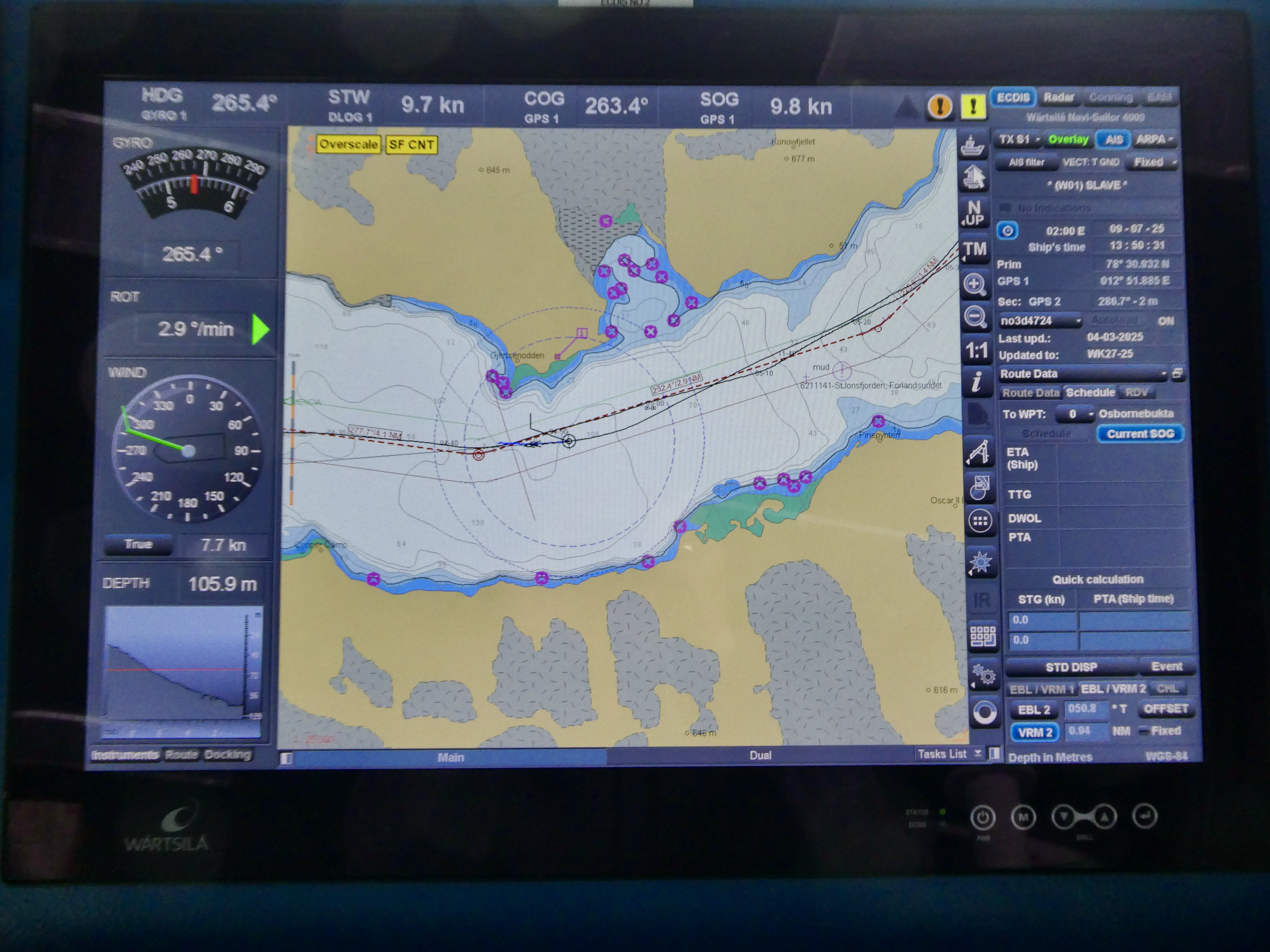
The bridge is full of electronics that display course, depth, surroundings, and so on. Here’s the course display (click all photos to enlarge them).

And here’s the captain, who seemed very young! But I’m sure they wouldn’t put him in charge if he hadn’t proved his mettle. This is taken on the last night of the trip when they have the “Captain’s Farewell”, and all the ship’s personnel parade across the auditorium.  No staff are allowed to drink on the ship, at least not that I saw, so the Captain toasted us with a flute of water.

Part of the parade: the people who make the food: very important people!

The two photos above are in the auditorium, where there are several lectures per day (none by me this time; I was a passenger), as well as the nightly recap and the highly-awaited plans for the next day, which depend on ice, weather, wind, and other factors. Sarah, in charge of the planning, would always have two or three alternatives if we couldn’t do what we wanted. Fortunately, no plans were canceled on this trip: the weather cooperated greatly.

Besides the auditorium, there’s a lovely lounge on Deck 7, with a coffee machine, goodies like cookies and cinnamon rolls set out 24 hours per day, and, when the bar is open, free drinks. I find that i lose my appetite for alcohol when I travel, so I didn’t take full advantage of the booze. I think I had two beers the whole 11-day trip!  There is also a cozy library nook with tons of books about the Arctic and Antarctic (the ship goes south during our winter, when it’s summer in the Antarctic and not much ice to impede traveling). Having been to both areas now, I suppose you could consider me bipolar.

There are screens in the lounge in the front so you can see where we are and the ice and weather conditions.  In slack times, I’d often make my way here, have a cup of hot cocoa and a couple of cookies, and dig into one of the books about the Arctic. And I’d often go on deck to marvel at the scenery or take photos.

Again, you can see many of the ship’s amenities at the Ultramarine link at the top. They also include a sauna, spa, and gym, which I assiduously avoided.

Now on to the feature second in importance only to the scenery and landings, the FOOD.  There are three meals a day, all served in two places: the fancy “Balena” restaurant upstairs, which has buffet service for breakfast and lunch and individual-course service at dinner. There’s also the “Bistro 487,” a few floors up, which serves almost exactly what the Balena serves, but it’s laid out buffet style, three meals a day. I found the Bistro cozier and with better views (fewer tables, all by windows), and a place that was easier to meet people.

So, the menus.  First the Balena’s breakfast menu, displayed outside the restaurant:

Lunch (one menu, two pages):

Lunch, page 2. You can always get a burger if you want

And dinner (two pages):

Desserts are always of great interest to me, and this ship excelled in their quality and variety (see below):

And the Bistro. As I said, the food is pretty much the same as served upstairs, which is expected, but you can serve yourself at all meals. The guy at the end is the Omelet Man who will make you an omelet of your choice at breakfast. One day I asked for my version of a Barney Greenglass special: omelet with eggs, onions, and lox (yes! they had lox!)

Breakfast at the Bistro. Omelet man:

And his wares. In a failed attempt to eat healthy, I had a spinach omelet with vegetables. But there are always freshly scrambled eggs on tap as well. And since there are many Brits, Aussies, and Kiwis aboard, there are sausages, baked beans, blood pudding, and grilled tomatoes, as well as everything else you’d expect for breakfast. I fancied the plain rolls with local butter, which I’d slather with delicious strawberry or lingonberry preserves, which I think were homemade.

Another iteration of my breakfast with fruit, grapefruit juice, a chocolate croissant, a roll, scrambled eggs, and hash browns. So much for eating healthy! But I emphasize that I don’t eat like this at home, where I usually have one meal a day (dinner), along with a latte for breakfast and a light lunch like a grapefruit.

The all-important coffee machine, which grinds the beans on top. I always had two cappuccinos for breakfast. You can see there are eight hot drinks to be had, including cocoa. A waiter was constantly circulating with American-style coffee, but I eschewed it.

LUNCH!  My attempt to create lox and bagel with a schmear:

Most of this is in the Balena restaurant, where I’d often have lunch since it was buffet style. I don’t think I have any photos of dinner, but you can see the Balena’s layout at the Ultramarine link.

Cheese, and lots of it (with crackers). My theory, which is mine, is that Scandinavians like cheese:

The salad bar (only a part of it). There must have been about 20 items you could put on your salad, and always three dressings:

I always started lunch with a salad in my futile attempt to eat healthy. Note the CARBS at the top and some lox that found its way onto my plate:

Salad was followed by another plate, usually light to allow me room for dessert. Here we have some chicken, an unknown food (cottage pie?) at 3 o’clock, a few fries, and spanakopita to the left.

They also offered these luscious stuffed peppers, but I saw them too late—after I’d loaded my plate:

Finally, the crown jewel of the comestibles: desserts. There was always a tray of different fancy desserts, as well as three kinds of ice cream. You need that sugar after a spell among the icebergs! Photos are from both restaurants and from different days.

There is fruit for the timid, but I had my fruit at breakfast:

Bread-and-butter pudding with vanilla sauce. I could not resist!

And the requisite three ice creams, one of them vegan (sorbet, I guess). Here you get a choice of chocolate, pistachio, and apple (vegan) frozen desserts:

I always had at least two desserts, but more often three. Hey, they were small!

Now I didn’t spend all my time eating, nor did I expect this much food, and of such high quality. But it’s vacation, and that means it’s a Free Zone for Gluttony.  In the next photos, I’ll show our landings, glacier cruises on the Zodiac, and animals.

I do recommend the ship highly, and perhaps may take it again. I have a big hankering to go to South Georgia Island, where Shackleton and a few mates went to rescue their crew. But it’s a long haul at sea with nothing in between.  But it has the largest colony of king penguins in the world: 450,000 breeding pairs, or half the world’s population. I need to see that!  They also have many seals and birds, and there Shackleton is laid to rest as well. It’s traditional to have a tot of whiskey by his grave.

Changes in orange juice and other foods coming from the FDA, and not for the better

August 11, 2025 • 11:00 am

Here’s an article from Food and Wine that simply gives more of the bad news that I thought I was avoiding by reading “regular stuff.” Click on the screenshot to read it. The upshot is that foods—and not just OJ—are going to be diluted and their quality reduced, all supposedly in the name of consumer welfare. Yes, I know that government agencies are doing a ;pt worse stuff, but anybody who beefs that this post is trivial compared to that other stuff risks dire punishment, for I post what I want.

As you probably know if you’re American, the Food and Drug administration sets standards for how food is constituted if it’s going to be labeled one way or another.  For example, the standards of “ice cream” specify that it has to have a certain percentage of milk solids and milk fat. That’s why, before I buy ice cream in a store, I inspect the carton to be sure that it’s labeled “ice cream” rather than “ice milk” or, Ceiling Cat help me, “frozen dairy dessert”. (This is, of course, independent of the ever-shrinking volume of containers, like the half gallons of ice cream that have morphed into 1.5 quarts.) So check what’s written on your carton of Breyer’s to ensure that you’re buying ice cream.

Now the FDA is changing the standards for other foods, and of course not for the better. Quotes from the article (indented):

As Food & Wine previously explained, the FDA began setting standards of identity in 1939 to promote “honesty and fair dealing” and ensure the “characteristics, ingredients, and production processes of specific foods were consistent with what consumers expect.”

Back then, the FDA added, companies often sold products “that were represented as jams containing fruit, but the products contained little fruit,” so it established baseline rules for certain foods to be labeled as such. For example, the Oregon Growers explained that “preserves” and “jams” must contain at least “55% sugar and 45% fruit. If a product does not meet these requirements, it must be called by another name.”

With this new update, jam makers may no longer be required to adhere to these percentages if their standard of identity were to go away, meaning your next jar could be more sugar, water, or some other ingredient entirely than mostly fruit.

Be sure to start inspecting your jams. However, looking at a few of mine, they don’t list the percentage of fruit versus sugar: they just give the ingredients in order of predominance, and sugar is first, even in good jams. But how much sugar are you spreading on your toast? The FDA will ensure that it can increase without your knowing. You’d have to write to the manufacturer to find out.

As for orange juice, well, that’s gonna be diluted:

On Aug. 5, the FDA announced that it’s proposing to amend the standard of identity for pasteurized orange juice, which has been in place for six decades, in an effort “to promote honesty and fair dealing for consumers.” It added that the proposed rule change will “provide flexibility to the food industry.”

Why the change now? As the FDA explained, it’s in response to a petition by the Florida Citrus Processors Association and Florida Citrus Mutual, which is asking for the change, as the current standard of identity has a minimum Brix requirement, “a measurement that indicates the sugar content of a liquid,” at 10.5%. It wants to reduce this requirement to a flat 10%. That’s because the state of Florida has been ravaged by citrus greening disease, which has caused a lower crop production as well as fruit that has less sugar than before.

“The FDA’s pasteurized orange juice standard of identity, when originally promulgated in 1963, was carefully constructed to reflect the qualities of U.S. oranges,” the petition by the two organizations states. “It should now be updated to align with the properties of the modern U.S. crop. Without these changes, manufacturers of finished pasteurized orange juice products must increasingly rely on higher Brix imported juice to meet or exceed the U.S. minimum Brix for pasteurized orange juice.”

The FDA further explained that the change shouldn’t affect the taste of orange juice and will have “a minimal impact on the nutrients found in orange juice.”

What a load of bull! The way you reduce sugar, of course, is to add more water.  “The qualities of U.S. oranges” have changed because of the disease and lower crop production. Granted, perhaps a half percent of lower sugar may even be better for some people, but those standards were there in the first place. And you can bet your tuchas that when the disease goes away and they can once again make OJ to the specificiations, they’re not going to go back to the old standards. But wait! There’s more!

Other foods that may have their standards of identity change soon include several types of canned fruits and vegetables, including artificially sweetened canned fruits (apricots, cherries, pears, peaches, pineapples) and select canned vegetables, such as field corn and dry peas. More than a dozen dairy products are included in the list, including low‑sodium cheddar and colby cheeses, along with cream cheese blends, and frozen desserts like goat milk ice cream and mellorine. Milk breads, rolls, and buns are also on the list, as are enriched macaroni and frozen juice concentrates.

Now I don’t know what the changes are, but you can be sure that they are not going to increase the quality of the product. What are they going to do to breads and macaroni? The mind boggles.  The only worse thing that this reduction of food quality is the way they justify it. There’s a quote in the article that apparently comes from the FDA:

“The FDA’s Standards of Identity efforts have helped ensure uniformity, boost consumer confidence, and prevent food fraud. But many of these standards have outlived their usefulness and may even stifle innovation in making food easier to produce or providing consumers healthier choices,” FDA Commissioner Marty Makary added in the July press release. “Antiquated food standards are no longer serving to protect consumers. It is common sense to revoke them and move to a more judicious use of food standards and agency resources.”

Stifling innovation? Giving consumers healthier choices? “Antiquated standards”? Excuse me, but I’d rather have more fruit in my preserves.  This paragraph is a prime example of duplicity masquerading as good intentions.

You can find the new FDA standards here and here, which, I suppose, are driven not by consumer demand but by corporations, and if you want to go through them, see if the changes conform to the explanation above.

Oy! My kishkes!

Out and about Reykjavik

July 20, 2025 • 10:30 am

I have been here only a bit more than two days, so I can’t claim to know Reykjavik, but I have seen a lot of the downtown after two several-hour walks. l It is not a big town: Wikipedia claims that Reykjavik (the world’s northernmost capital of any sovereign state) has a population of just 139,000 as of 2025, and “the surrounding Capital Region has a population of around 249,000, constituting around 64% of the country’s population.”

Summer is tourist season, and so the streets are crawling with visitors like me, and you hear English spoken everywhere.  The fluency of every Icelander I’ve met in English is of course a boon to the visiting Anglophone. All you need is a credit card to survive here, as I haven’t found a place yet, including taxis and coffee shops, that doesn’t take cards, even for tiny purchases. I have $100 in Icelandic krona that I still haven’t spent.
Tomorrow I leave town to go on a bus tour of some of the famous sights of SW Iceland, though I doubt the Blue Lagoon, a famous geothermal spa, will be open because of the recent fissure eruption of a nearby volcano. So it goes.

I’m not yet sure if I’ll make it to the famous Iceland Phallological Museum, devoted to displays of penises, which several readers have suggested I visit. If I go, the highlight will be the plaster cast of Jimi Hendrix’s member as produced by the late Cynthia Plaster Caster (there’s a photo of the junk on her Wikipedia page). But there are also preserved penises and baculums from many animal species. There are no vaginas, and I suspect it would be hard to construct a female equivalent of this museum. I’m told that most of the visitors to this museum are in fact women, though I would have thought that men would predominate, eager to compare their size with that of other species. (There is only one genuine human penis in the museum, a preserved member of a 95-year-old man who swore he employed it sexually until the end.)

In the meantime, here are some random photos I took on my meanderings this morning and early afternoon, with one or two from the day before yesterday.

First, where I am staying: a “guest house” (more like a hostel, which is what it’s called on the sign) north of downtown.  The rooms are small and spartan, but believe me, I’ve seen much worse (viz., India and Turkey). But, like all things Icelandic, they are pricey, even compared to the U.S.  The price (ca. 750 Euro for my five nights) at least includes a breakfast (croissant, roll, jam, butter, orange juice, cheese, and a tangerine) placed in a bag outside my door each morning. To supplement the brekkie, I went grocery shopping at “Bonus,” supposedly the cheapest supermarket in Iceland,

Photos of a more touristic nature (e.g., the cathedral) will follow when I have time to put them up.

My hostel/guesthouse:

My cozy room. There are no amenities like t.v., but I never watch it anyway (even on the ship), and I’m happy with my book and the Internet:

There is a coffee room where you can cook your own food (this makes it more hostel-like than guesthouse-like), but as for getting a decent cup of coffee, it’s well nigh impossible. There is coffee and a complicated machine, but no milk and no spoons that I could find. My first goal, then, was to find coffee on my morning walk.

When I strolled into town, the first thing I saw was a Starbucks, and I was drawn into it as if by Jupiter’s gravity to quaff a large latte. Behold a $10 Icelandic latte below. In contrast to American lattes at Starbucks (which I rarely patronize), it had a design on top. It also seemed larger.

Judging by the prices of burgers, beer, fish and chips, and other items whose prices I’m familiar with, the Icelandic price is usually between two- and three-fold higher than the American.  Now most goods have to be imported here, so that’s understandable, but I’m told that the salaries of locals are not commensurately higher. Perhaps it’s because the country has an extensive social safety net, so people don’t get saddled with stuff like high medical bills, but I’m not qualified to pronounce on economics.

Below: voilà—a $7.66 box of Cheerios in the cheapest supermarket in Iceland. I have no idea what Cheerios cost in America, but I’m sure it’s less than this. If you understand Icelandic, give us the translation below.

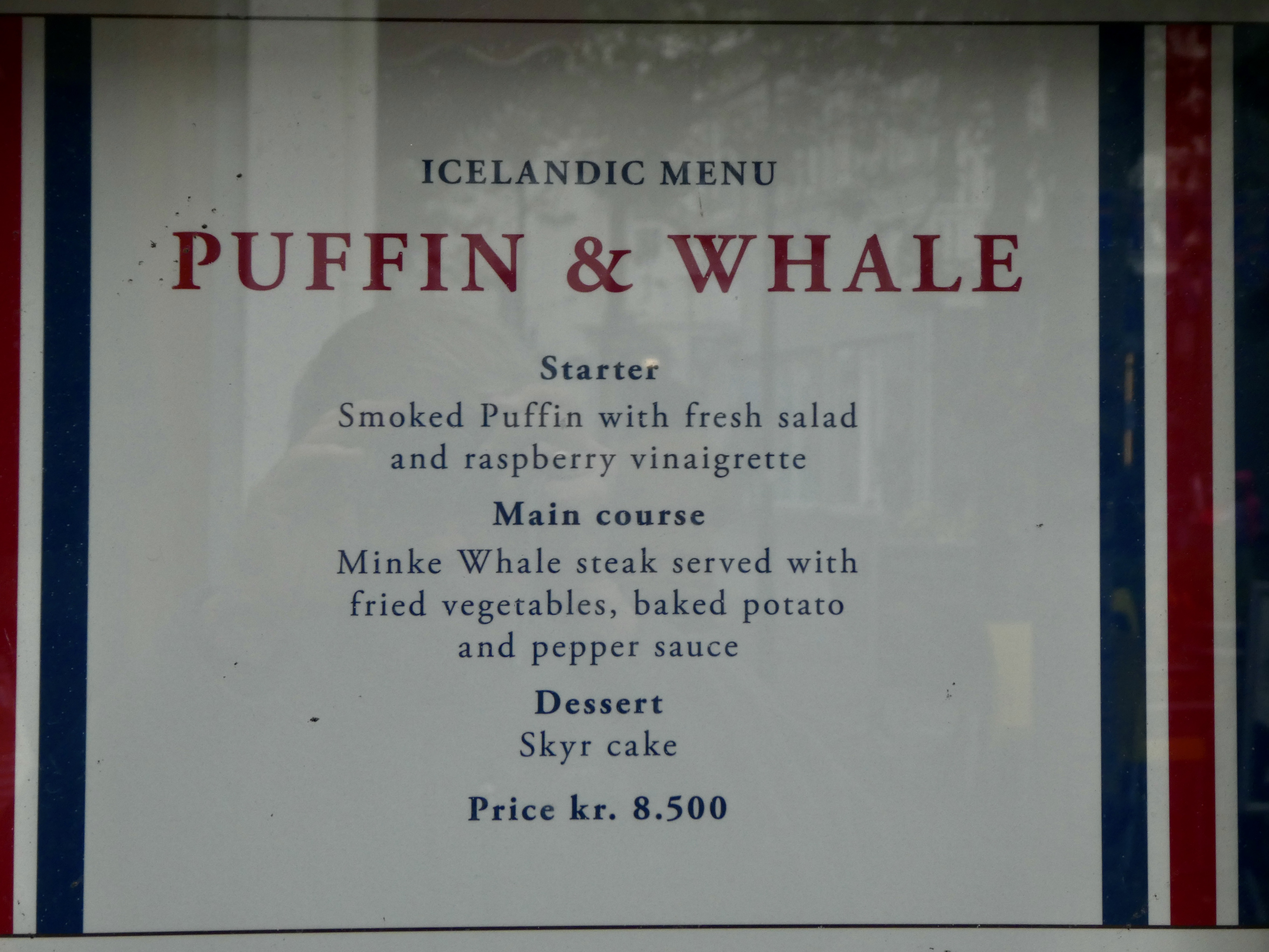
Below: an “Icelandic menu” at one restaurant featuring a SMOKED PUFFIN APPETIZER (Fratercula arctica) and an MINKE WHALE STEAK (Balaenoptera acutorostrata).  Iceland is the only country in the world where it’s legal to hunt puffins, and the species is classified as “vulnerable.” Iceland also allows restricted hunting of whales, with 209 fin whales and 217 minke whales permitted to be killed each year for the next five years. Along with Norway and Japan, Iceland is one of only three countries in the world that allow whaling.

Our ship’s naturalists warned us about menus like this, and of course I’ll stay a mile away from them (n.b.: anyone who tells me that avoiding whale and puffin but eating cow makes me a hypocrite better tread very lightly!)

Skyr” is a smooth Icelandic dairy product described as somewhere between yogurt and curd cheese. I bought a large container of mango skyr to have as dessert.

Two animals I saw on the streets today. First, a lovely gull resting on a cafe table. I don’t know the species, but am sure at least one reader will (identify it in the comments, please):

And a semi-friendly gray tuxedo cat which let me pet it, though it wandered off after a minute or so. It is the first live cat I’ve seen since I left the U.S. Notice that it has the same tough Viking-esque expression as the Reykjavik cat sent in by a reader yesterday.

One of the first things you notice wandering about is the presence of both murals and artistic graffiti.  The former are commissioned, while the latter appear on isolated and hidden walls, but are still more artistic than graffiti murals I’ve seen in the U.S. and Europe.

First, some graffiti, which includes a fearsome felid. This was on an abandoned building:

And the entire side of the building (click to enlarge):

Murals are everywhere, expressing political sentiments or advertising businesses. The artists are given due credit at the lower right of each mural. Here’s one of the former painted by two Ukrainian artists and an artist from Iceland, all honoring Icelandic/Ukrainian friendship and Icelandic hospitality towards displaced Ukrainians:

And the explanation:

. . . and murals decorating businesses:

Two views of a store:

Is this a female Viking? Wings seem to be a leitmotif in these murals.

A vampire mural:

And a lovely bird mural. Again, someone will have to identify it for me:

A rainbow-decorated cafe:

And a nearby brasserie advertising its wares:

Finally, as far as I can see, Reykjavik is not a town of gaudy and expensive houses, though there may be a section for such homes.  Most streets, however, are fairly bare and spartan, though some of the houses are painted bright colors. Since these streets are around the downtown area (and these are typical streets in that area), it supports the view that Icelanders don’t have salaries commensurate with the high cost of living:

Remember, this is a superficial tourist’s take on what I saw as I wandered about. More photos as I take ’em, and the natural history will come after I return to Chicago.