A celebration of Christopher Hitchens by Richard Dawkins, Stephen Fry, Douglas Murray, and Lawrence Krauss

January 1, 2025 • 11:30 am

Christopher Hitchens, whom many of us admire despite occasional differences of opinion, died at only 62 on December 14, 2011.  Lawrence Krauss organized an event with four of Hitchens’s friends, all reminiscing about the Great Lion of Rhetoric. The panel was filmed in London on December 13, 2024—just 19 days ago—and I’ve put the video below.

The intro to the original audio on Krauss’s site Critical Mass:

A year ago, John Richards the head of the Atheist UK approached me about the idea of celebrating Christopher Hitchens with a Hitchmas event, near Christmas, and on or about the anniversary of Christopher’s death, on Dec 15, 2011. I realized that to do it right would require time and organization, and the proper panelists. I was thrilled that Christopher’s friends and mine, Stephen Fry, Richard Dawkins, and Douglas Murray agreed to be part of the event, and that the HowTo Academy, which organizes wonderful events in London, several of which I had done before, agreed to coordinate the logistics with The Origins Project Foundation. A year later, the sold-out event happened, and we decided in advance to record it appropriately, with 5 cameras, and to have Gus and Luke Holwerda, who directed and filmed The Unbelievers, and with whom I began The Origins Podcast, edit the final product.

The YouTube notes:

Join us for Hitchmas, a special event celebrating the life, legacy, and ideas of the legendary Christopher Hitchens. Recorded at the Royal Geographical Society in London, this thought-provoking evening features a stellar panel of friends and intellectuals: Lawrence Krauss, Richard Dawkins, Stephen Fry, and Douglas Murray. Together, they share personal reminiscences, engage in lively discussion, and tackle modern issues with the wit and courage that Christopher Hitchens epitomized.

The evening opens with tributes from each panelist, exploring Hitchens’ enduring impact as a writer, orator, and fearless defender of reason. From heartfelt anecdotes to reflections on his literary heroes like George Orwell and P.G. Wodehouse, the panel paints a vivid picture of Hitchens’ intellect, humor, and humanity. The conversation transitions into a dynamic roundtable addressing contemporary cultural and political challenges, including religion, free speech, and the rise of “woke fundamentalism.” Audience questions add another layer, sparking debates about morality, truth, and the timeless relevance of Hitchens’ insights.

This unique celebration of Hitch’s life blends humor, deep thought, and passion, culminating in a poignant reflection on friendship, courage, and the pursuit of truth. Whether you’re a longtime admirer of Christopher Hitchens or discovering his work for the first time, this event offers a powerful tribute to a remarkable man who continues to inspire millions.

Just click here to see the video, or click on the screenshot below (YouTube won’t let me directly embed the video).

Richard and Lawrence read their pieces, which are both lively, but Murray and Fry speak of Hitch extemporaneously, or at least without notes.  I won’t summarize the reminiscences as you need to hear them yourself.

The four in memoriam pieces end at 35:16 and it’s on to discussion, with Lawrence asking each person to react to a statement by Hitchens. Fry waxes eloquent on the question we all have: “What would Hitchens would say about wokeness?” Douglas Murray, a defender of Israel, is asked to respond to some quotes from Hitchens attacking Zionism.

At 1 hour 4 minutes in, the panel answers questions submitted on social media.

In the end, this is one of the few discussion videos I’d recommend watching in toto. 

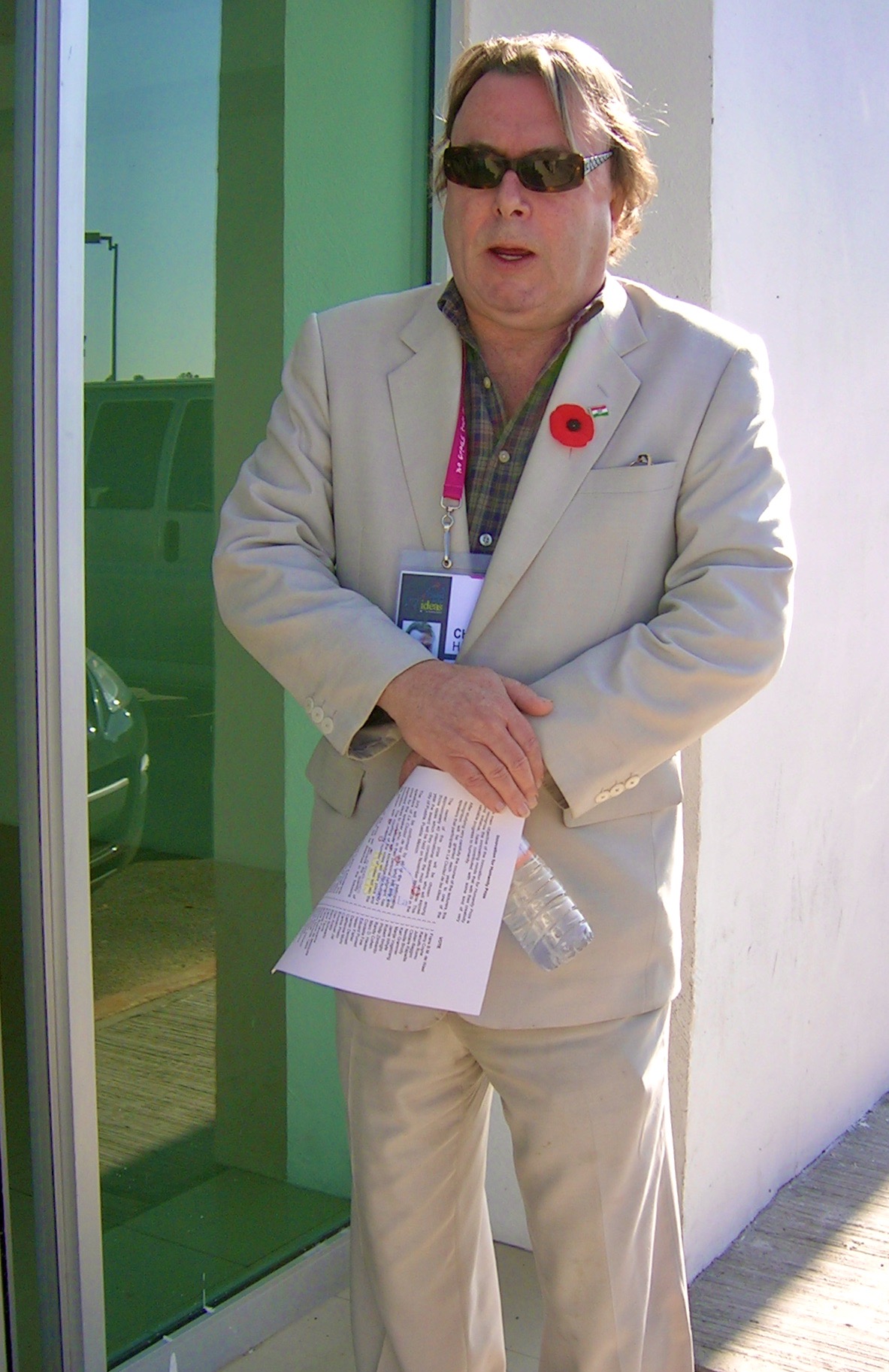
I met Hitchens only once, on November 6, 2009, at a meeting in Puebla, Mexico.  My bus was heading back to Mexico City, but when I saw him grabbing a ciggie outside the venue, complete with poppy and what I”m told is a pro-Kurd lapel pin, I leapt off the bus to introduce myself.  I never do stuff like that, but this was Hitchens!  He remembered me from something I’d written, but the bus was leaving and our discourse was very brief. Here’s a photo I took from the bus:

Dawkins discussion in Chicago: a brief summary

September 22, 2024 • 9:15 am

Last night I went to Richard Dawkins’s appearance at the Chicago Theater as part of his “The Final Bow” tour: the last time, he says, he’s going on the road to do lectures. (After here he goes to Los Angeles, San Francisco, Portland, and Vancouver, winding up in Old Blighty with talks at Oxford and Coventry.) I suppose that Richard, now 83, figured he was too old to be traipsing around on a five-week tour, but he also has a new book to promote and discuss, The Genetic Book of the Dead: A Darwinian Reverie.

The event last night was mixed: redeemed almost entirely by the presence and eloquence of Dawkins himself. As far as I can see, this tour, organized not by the Richard Dawkins Foundation (RDF) but a commercial outfit, was thrown together at the last minute, with the format being an initial ten-minute “warmup” lecture unrelated to the discussion, and then an interchange between Richard and a selected interlocutor, who happened last night to be journalist Jessie Singal.  In my view, it was not a great choice to enlist both Singal and the introducer, Angel Eduardo (now an editor with FIRE).  They weren’t even announced until a few days before the event, something that the RDF wouldn’t have done had they hosted this event. And neither person performed as well as I expected.

Eduardo talked for ten minutes about the divisiveness of online discussions, and how we should always assume the best intentions of our opponents, as well as characterizing their arguments as strongly as possible (“steelmanning”) instead of giving distorted views of their arguments (“strawmanning”). He bemoaned the nasty tone of much online argument. But these points have been amply made others like by Dan Dennett, and the hand-wringing about divisiveness, while pointing out a real phenomenon, was anodyne: we’ve heard it a million times before. I just wanted to get to the discussion between Singal and Dawkins, which lasted about an hour. You don’t need a warmup act for Dawkins.

Singal’s expertise in biology is limited to gender issues, and so the biology part of his questions concerned Richard’s views of transgender issues, and although the audience might not have known them, they do now. Richard asserted, for example, that it’s simply wrong for a man to identify as a woman and immediately, for example, to start competing in women’s sports. It was good to hear that pronounced with such authority from the stage, though I have no idea whether the audience questions took Richard to task about this (I had to leave after the discussion to catch a train).

Richard was also asked about having his 1996 “Humanist of the Year” award revoked because of the first tweet below:

Shame on the American Humanists for this! Richard was simply puzzled about why changing gender is applauded but changing race is demonized. He was especially baffled because, he said, gender is a spectrum, and it’s much easier to sell the claim that you’ve changed genders (without drugs and surgery, that is) than to claim that you’re actually a member of a race you weren’t born into. This in fact is the subject of Rebecca Tuvel’s famous Hypatia article that caused such a fracas when it was published, and yet it’s a valid subject to discuss. (In fact, I’ve discussed it here.) I still don’t understand why it’s okay to change genders but not races—especially, as in the case of Rachel Dolezal, her identification as black (she was born white) seemed to be an honest one.

At any rate, perhaps the audience didn’t know this, but in my view Singal, who actually crowdsourced most of his questions to Richard from friends and others, sorely neglected Richard’s book itself (I wonder if he’d read it) in favor of asking a series of largely unrelated questions—questions about life on other planets and the future of humanity.

Richard did get in a few statements about evolution. One was an eloquent description of how cuckoos parasitize the nests of other species and mimic the eggs of their hosts, who will reject eggs that look “wrong.”  This had led to the enduring mystery of how each cuckoo manages to lay eggs that mimic those of its host, given that each female lays only one kind of egg but different cuckoo females parasitize diverse species of birds, and yet the different egg-types of female cuckoos (“gentes”) manage to remain egg-color specific despite mating with males who carry genes for other egg color. Why doesn’t a female carry both her color genes and different color genes from the male, producing intermediate eg that would be rejected by the hosts?

When I first heard about this years ago, I immediately thought of a solution: the egg-color-and-pattern genes must be on the female’s W chromosome. In in birds females are “heterogametic” WZ and males are “homogemetic” ZZ—unlike in mammals, in which males are XY and females XX. Thus, in cuckoos, the W chromosome is passed on exclusively from mothers to daughters, and no genetic material on that chromosome is mixed with DNA from males. This could ensure that a female lays only the same type of egg as her mother, no matter with whom her mother mated. (Females imprint on the nests of their hosts, and thus return yearly to the same species of host to lay their host-mimicking eggs.) We don’t yet know if this is the answer, but I suspect it’s correct, and we’ll find out within a few years.  Richard clearly became excited when describing this, and I was sad that this was about all the evolutionary biology he discussed in detail. Most of the “discussion” was simply Richard answering a series of diverse questions from Singal. Singal was more interested i, for example, n whether humans would somehow be made of metal in the future, and whether there was life on other planets—a tired old subject.

But what redeemed the discussion was Richard’s ability to take any question, no matter how many times he’d heard it, and make the answer fresh and interesting. So, with the exoplanet life question, he didn’t just saym “yes, there are millions of planets that could support life, so it must exist somewhere else”. Rather, he added that there were likely several barriers to producing technologically advanced life elsewhere in the universe (without technology to produce radio or light waves, we wouldn’t know if such life existed). The barriers, which Dawkins said were of several types, included the origin of life (probably pretty easy given that life evolved very soon after Earth cooled down), and then harder barriers like the evolution of a eukaryotic cell, the evolution of multicellularity, and then the evolution of a multicellular species with the smarts to produce technology.

Singal apparently didn’t have the acumen to ask Richard what I would have: a problem with his thesis that I wanted to explore. The thesis of The Genetic Book of the Dead is that we can reconstruct the environments of our ancestral species simply from knowing their DNA sequences. We simply sequence a species (ours is done, of course), look at the genes we have, figure out what those genes were involved in when they were active, and from that going on to conclude which adaptations our ancestors had. Ergo, we might conclude what kind of ancestral reptile, or what kind of ancestral fish, our ancestors were, and thus what environments they lived in.

There are two problems with this.  We can certainly use DNA sequences to reconstruct family trees, confirming our conclusion (already known at from morphology, fossils, and development) that yes, we’re evolved from fishy and reptilian ancestors. But trying to suss out the environments of those ancestors from DNA sequences is probably futile. For one thing, we don’t know what most genes actually do, and thus would be stymied since we don’t know which ancestral DNA constituted adaptations to the environment,—and if so, what kind of adaptations.  More important, most of the ancestral DNA we still have has been overwritten by the endless churning of natural selection, so even finding out what deep ancestral genes we had would be nearly impossible today. That’s the first question I would have asked Richard after he described the thesis of his book.

But perhaps this is just the biologist in me kvetching. Yet somehow, having known Richard for years, I think he’s most energized when discussing his first love, evolutionary biology and its wonders, and less energized when answering questions like “Would you like to be immortal?” (His answer, “No. I love life, but the prospect of eternity is frightening. Still, I’d like to have 200 years.”)

But one of the last questions from Singal was good: “If you died and found yourself in Heaven, and could get answers to three questions that have puzzled you, what would you ask?” Richard’s answers:

“How did life on Earth originate?”
“What is consciousness?” (I presume he means what neuronal configuration gives rise to subjective sensations, or “qualia”.)
“Is there ‘advanced’ life in other places in the Universe?”

The audience applauded these answers, which were good, though I’m sure Richard’s been asked this before. (I would probably have thought of the first and third, but not the second.)

I just thought of another question I would have asked him. (I may have even asked this during the few times I’ve been part of an onstage discussion with Richard.)

“If you were put in a time machine, and could be transported back to one location for one day, hoping to answer a question about biology, and were given only a paper and pencil to record what you say, when would you choose?”

(You couldn’t say “I would like to be there when life originated”, because in a day you couldn’t answer that question. But you could go back and look at things like dinosaurs or hominin ancestors.)

My conclusion: go see Richard if you get the chance. There are only a few more stops on his tour, and tickets are available. No matter who questions him, he will be giving good answers—and often funny ones. But really, the organizers of this tour should have thought better about who to enlist as interlocutors and “warm-up” acts. (To their credit, though, Masih Aliejad was one warm-up.)  And they shouldn’t have chosen these people at the last minute.

If you go, and if you’ve bought VIP tickets, bring your Dawkins books, for he’ll autograph as many as you have (no duplicate books, though, and you have to have shelled out for those VIP tickets. Still, when else are you going to get him to autograph his books?)

Meanwhile at the Democratic National Convention. . .

August 22, 2024 • 9:00 am

I’m off to the Blyde River Canyon today and most of tomorrow, so posts will be nonexistent or thin for a few days—save for Matthew’s postings of the Hili Dialogues.  I’ve largely avoided reading the news, as I find it depressing and not conducive to a relaxing vacation, but two readers sent me stuff about the Democratic National Convention that is taking place in Chicago.  I’m glad I’m not there.

Here’s one item that epitomizes the wokeness I fear is metastasizing in the body of the Democratic Party: a land acknowledgement to open the convention. I was sent a link to the video below, which YouTube describes as follows:

Two citizens of the Prairie Band Potawatomi Nation — Zach Pahmahmie, tribal council vice chair and Lorrie Melchior, tribal council secretary — gave the land acknowledgement Monday at the Democratic National Convention in Chicago, where Kamala Harris will step into the spotlight not as a running mate but at the top of the ticket.

And the video:

My response to these things is always the same: they are performative gestures signaling the virtue of the organization, but accomplish nothing. If the Democratic Party really does acknowledge that the lands on which the convention is taking place was stolen from Native Americans, why don’t they try to compensate the Potawatomi Nation for the theft? (Land in Chicago is expensive!)

Granted the speaker notes that the Interior Department placed some of their tribal lands into a trust, making the Potawatomie “the only federally recognized tribal nation in Illinois in 175 years.” But did any individual get land or cash?

And there are the expected pro-Palestinian protests. Here’s one where an American flag gets burned (legal speech), but a guy who tries to put it out gets jumped on and pushed away.

This shows the divisiveness that plagues America, and that I fear will appear again on campus this fall.

I can’t find an article someone sent me relating that the Convention has given pro-Palestinian protestors far more space than pro-Israeli demonstrators, who have apparently been pushed far away from the site, but I do remember reading that somewhere. In the meantime, the Washington Post reports this:

. . . pro-Palestinian activists have won small but notable concessions at the Democratic National Convention that, three days into the event, have largely headed off any major eruptions of anger or division. Organizers have provided space for a panel to discuss Israeli-Palestinian conflict and for a vigil for Palestinians killed in Gaza [was there a vigil for the dead Israelis, including now six more hostages?], and several high-profile speakers have demanded an end to the war from the stage.

Those concessions have helped defuse the issue, but most critical has been the emergence of Vice President Kamala Harris as the Democratic nominee. Harris, in her public comments, has emphasized Palestinian suffering notably more than President Joe Biden has and held Israel more directly responsible for the high civilian death toll and the slow pace of humanitarian aid. In addition, her campaign has ramped up its efforts to engage with those calling for a change in U.S. policy.

This wokeness and anti-Israeli sentiment does of course worry me about Harris and the election, to the point where I’ve been contemplating not voting for President at all (there’s no question of me voting for Trump, who I think is unstable and dangerous). But make no mistake about it: if Harris wins, Israel is in for a hard time, with some Israelis even regarding Harris as an existential threat to their country. I’m hoping that they’re unjustly worried.

And I’m hoping the centrist Democrats will push back on the party’s new cooling toward Israel.  Above all, Democrats have to realize that a permanent cease-fire now is a victory for Hamas, and that the IDF has been more careful than any army in history in trying to reduce civilian casualities. Blame the deaths of Palestinian civilians not on Israel, as have Harris and Biden, but on Hamas, which actually wants the deaths of its own civilians as part of its strategy to win the world’s favor. And Hamas seems to be succeeding, even among Democrats.]

Finally, I wish that Harris would have some interviews or press conferences before the election; it’s surprising to me that’s she’s had exactly none. We all know why that is, of course, but Democrats resolved to support her will find some reasons why no such events are required.

If Democrats share “the contagious power of hope,” as Michelle Obama said in her speech, then my hope is that the Democratic party stops its movement towards its “progressive” wing.

Anyway, these are some early-morning thoughts before I take off to see the wonders of nature. Please discuss them but, as always, be civil to your fellow commenters and to your host. Debate is fine; insults are not.

Discussion thread: politics or other matters

August 19, 2024 • 11:15 am

I’ve generally been avoiding the American news, but I know readers are following it, especially since the Democratic National Convention, whose conclusion is foregone, has started in Chicago. (I’m glad I’m not home, as there will be tons of protests and disruption. I had enough of that in 1968.)

So here’s a discussion thread about politics, or anything else you want to get off your chest. I’ll start it off with a headline from today’s NYT. I dare not even mention my own views any more, as I’ll be given a hiding for saying that I don’t want to vote for either Presidential candidate, and be told off for thereby helping Trump (a misguided view for sure).

Click on the link below to read, or find the article archived here. I’ll give an excerpt. Talk about the election, politics, or anything you want.

An excerpt:

When Hillary Clinton ran for president in 2016, she had more than 200 distinct policy proposals. Four years ago, Joseph R. Biden Jr. had a task force write a 110-page policy document for his White House bid.

Now, Vice President Kamala Harris does not have a policy page on her campaign website.

A last-minute campaign born of Mr. Biden’s depreciated political standing has so far been running mainly on Democratic good feelings and warmth toward Ms. Harris, drafting off legislation and proposed policies from the man she is hoping to succeed.

Democrats’ problem for most of this year appeared to be Mr. Biden himself, rather than his policies. For more than a year, as his poll numbers sank, his aides and loyalists insisted that his legislative record and priorities were viewed favorably by Americans and would ultimately carry him to another term.

Ms. Harris is now testing that original theory — but with a younger, more spirited messenger.

On policy, she has essentially cherry-picked the parts of the Biden agenda that voters like most while discarding elements like his “Bidenomics” branding on the economy. She has emphasized what allies call the “care economy”: child care, health care and drug prices, which directly affect voters’ lives.

The link to the whole article is above.  Didn’t Harris propose some kind of ban on high grocery prices?

As I said, you can talk about anything here, not just politics, but do not diss other commenters or your host, and BE CIVIL. (If you’re a newbie, I recommend reading the posting rules.

Have fun! I’m off to see the animals.

Dawkins talks to Kathleen Stock

July 14, 2024 • 12:00 pm

Here we have a 55-minute on-on-one conversation between Richard Dawkins and Kathleen Stock conducted during the “Dissident Dialogues” conference in NYC last May.  Here’s a précis of Stock’s background from Wikipedia:

Kathleen Mary Linn Stock OBE is a British philosopher and writer. She was a professor of philosophy at the University of Sussex until 2021. She has published academic work on aesthetics, fiction, imagination, sexual objectification, and sexual orientation.

Her views on transgender rights and gender identity have become a contentious issue. In December 2020, she was appointed Officer of the Order of the British Empire (OBE) in recognition of services to higher education, a decision which was subsequently criticised by a group of over 600 academic philosophers who argued that Stock’s “harmful rhetoric” contributed to the marginalisation of transgender people. In October 2021, she resigned from the University of Sussex.  This came after a student campaign took place calling for her dismissal and the university trade union accused the university of “institutional transphobia.” A group of over 200 academic philosophers from the UK signed an open letter in support of Stock’s academic freedom.

After tons of opprobrium and threats, Stock resigned from Sussex in 2021. The book that caused a lot of the trouble is Stock’s Material Girls: Why Reality Matters for Feminism. I haven’t read it, but it’s a work of gender-critical feminism, and the topic itself ensured that Stock would be ostracized and deplatformed. I suspect that it’s not a work of “transphobia,” but, like Helen Joyce’s Trans: When Ideology Meets Reality, which I have read, a defense of preserving some spaces for biological women but a work that doesn’t demonize trans people themselves.

I won’t go into the details, but the discussion is largely about sex (she accepts the biological definition based on gametes, which produces a binary) as well as gender. (She also considers a “cluster definition”, in which one combinse secondary sex characteristics, chromosomes, gametes, and other traits to come up with a multivariate definition of “sex”, but properly concludes that it doesn’t work.)

They go on to discussing gender, and Stock dissects the many meanings of that elusive word.  As far as “trans” people go, she says (referring to Jan Morris), Stock says that Morris’s account of what it’s like being a woman was unconvincing (I agree; as it’s based largely on stereotypes). Stock does agree that females transition because they’re unhappy as males, but doesn’t agree that a transwoman is “a woman inside.” She adds that “she has no ambition to stop adults who’ve been through a proper period of reflection” to transition from one gender identity to another; but doesn’t agree that someone who has not medically transitioned should be allowed to define themselves as a member of their non-natal sex.

Stock discusses the “suicide myth”: the idea that girls not allowed to transition have a higher risk of suicide than those who do transition. This is a “myth” because the cohort of adolescent females who want to transition do indeed have a higher rate of suicide, but it could be because of other mental issues and, in fact, there’s no evidence that actual transitioning reduces that risk.

I’ll let you listen to the rest, which includes puberty blockers, the Cass Review, transracialism and so on.

My one disagreement with Stock is that she seems to equate almost all trans women as those who have a “male fetish”: autogynephilia.  I am not an expert, but I suspect that male-to-female transitioning can be caused by a variety of reasons, only one of which is autogynephilia.

In the end, Stock doesn’t seem to be a “transphobe”—someone who hates trans people—but, like others tarred with that slur, she seems pretty reasonable.  She is opposed to the prevalence of affirmative care and to the premature dispensation of hormones and surgery to children or adolescents, as well as to social acceptance of someone who identifies as a member of their non-natal sex as identical to members of that non-natal sex. The latter allows trans females, for example, to compete against biological women in athletics, to occupy cells in women’s prisons, and to display their penises in locker rooms.  In other words, I see her as not hateful, but reasonable and anxious to prevent harm to young people who don’t fully understand the consequences of premature decisions.  And she largely blames adults for this harm.

Steve Pinker on why smart people believe stupid things (and much more)

June 18, 2024 • 11:15 am

Speaking of Steve Pinker (see previous press), Free Press‘s Michael Moynihan conducted a new 43-minute video interview with the man (below), who of course is writing another book. (I swear, Pinker has future books lined up in his brain, like planes waiting their turn to land.)

Here are the YouTube notes:

In the latest episode of Honestly,Michael Moynihan talks to the Harvard professor and cognitive psychologist Steven Pinker.

Pinker is the author of nine books including Enlightenment Now: The Case for Reason, Science, Humanism, and Progress and Rationality: What It Is, Why It Seems Scarce, Why It Matters. He approaches his work with a kind of data-driven optimism about the world that has set him apart from the chorus of doomer voices we hear so much from in our public discourse.

Today, Michael talks to him about why smart people believe stupid things; the psychology of conspiracy theories; free speech and academic freedom; why democracy and enlightenment values are contrary to human nature; the moral panic around AI; and much more.

The discussion begins with a long back and forth on conspiracy theories. Readers will be interested in Pinker’s comments on “the public health establishment”, whose pronouncements were subject to many conspiracy theories during the pandemic; as well as on the theories behind conspiracy theories.  At 12:15, Pinker expostulates on why smart people believe stupid stuff. It turns out that smart people are less likely than others to believe stuff like conspiracy theories, but they are imbued with one common bias (I’ll let you find out what it is, but it’s a bias we all have.)

The discussion then veers to Enlightenment values, which Pinker thinks are “nonintuitive” but still promote progress in the world by dispelling stuff like “magical thinking” (I think that’s his euphemism for religion).  Then it’s onto AI—its benefits and its dangers—a subject that’s very important but still bores me silly.  Those worried about how AI could harm humanity will find plenty of fodder in Pinker’s speculations, though, at you’ll hear, he’s not that worried about those dangers.

At 35 minutes in, Pinker analyzes why people think that there’s a true genocide in Gaza, something contravened by the known facts; he sees the use of that word with respect to Gaza reeflecting both the “myside bias” as well as constituting a “terrible blood libel.”

At the end the discussion turns to the upcoming election, and Pinker emphasizes our lack of knowledge about what will happen between now and November vis-à-vis the lawsuits, and what Trump would do if he does get inaugurated. (Pinker is a big donor to the Democratic party.) He doesn’t however, think there’s enough “hatred of the establishment to allow a civil war to occur,” but does think we should take measures to prevent one, just in case. His final take-home message: “Rely on data and probabilities.”

The opprobrium that’s heaped on Pinker has always baffled me.  Since his arguments are usually based on facts, then if you disagree with him you can simply refute the facts, which isn’t often done. Rather, he’s attacked as a person, often as a horrible person, and since he’s a nice guy I can assume only that critics are partly motivated by sheer jealousy of Pinker’s intelligence and accomplishments.

As lagniappe, I found this NYT article from four years ago, “How a famous Harvard Professor became a target over his tweets“, which you can find archived here. It turns out that, at least back then, the opprobrium came from Pecksniffs trawling his tweets. I wrote about the undeserved tweet-shaming of that time in a popular post called “The Purity Posse Pursues Pinker.”

An excerpt:

Steven Pinker occupies a role that is rare in American life: the celebrity intellectual. The Harvard professor pops up on outlets from PBS to the Joe Rogan podcast, translating dense subjects into accessible ideas with enthusiasm. Bill Gates called his most recent book “my new favorite book of all time.”

So when more than 550 academics recently signed a letter seeking to remove him from the list of “distinguished fellows” of the Linguistic Society of America, it drew attention to their provocative charge: that Professor Pinker minimizes racial injustices and drowns out the voices of those who suffer sexist and racist indignities.

But the letter was striking for another reason: It took aim not at Professor Pinker’s scholarly work but at six of his tweets dating back to 2014, and at a two-word phrase he used in a 2011 book about a centuries-long decline in violence.

“Dr. Pinker has a history of speaking over genuine grievances and downplaying injustices, frequently by misrepresenting facts, and at the exact moments when Black and Brown people are mobilizing against systemic racism and for crucial changes,” their letter stated.

The linguists demanded that the society revoke Professor Pinker’s status as a “distinguished fellow” and strike his name from its list of media experts. The society’s executive committee declined to do so last week, stating: “It is not the mission of the society to control the opinions of its members, nor their expression.”

Richard Dawkins interviews John McWhorter on linguistics and “woke racism”

June 9, 2024 • 12:15 pm

Here Richard Dawkins interviews linguist and author John McWhorter, a person familiar to readers of this site. And most of the 54-minute discussion is about linguistics.

It’s refreshing to hear McWhorter’s enthusiasm for linguistics, and this bit of the discussion goes from the start of the interview until about 37 minutes in. It’s sad that McWhorter has, by his own admission, been more or less drummed out of the fraternity of academic linguists because of his heterodox views on racism. I’m sure, based on this interview alone, that he was a terrific teacher.

At any rate, McWhorter explains why he began studying linguistics (it involves Hebrew), how many times he thinks language originated (McWhorter thinks just once, though he’s not convinced that this is supported by the existence of a “universal grammar” or universal “recursion”: subordinate phrases embedded within phrases). Rather, McWhorter is convinced of a single origin of language by parsimony alone. As to when it originated, McWhorter makes rather unconvincing arguments (criticized by Richard) that Homo erectus could use syntactic language; he’s on more solid ground when he thinks that Africans, because of evidence of their mental sophistication, used language around 300,000 years ago.

They discuss evidence that the FOXP2 gene was implicated in origin of language, and McWhorter is accurate in saying that this theory hasn’t worked out, though he believes, along with Steve Pinker, that the ability to use syntactic language is encoded in our genome.

The discussion of “woke racism” (the title of McWhorter’s well known book, which was originally “The Elect”) begins at 36:40.  Dawkins moves the discussion into why McWhorter considers woke racism a “religion”, even though there are no supernatural beings involved. I’m not particularly concerned whether one conceives of progressive racial activism as an ideology or a religion, for it seems a semantic question. To me the more interesting questions are the characteristics of the movement (Does it promote irrationality? Is it disconnected from reality? Does it promote “safe spaces”, which McWhorter sees as a religious concept?)

The discussion moves to the question of why you are considered black (or claim you are black) if you have any black ancestors, which leads to McWhorter’s assertion that we have to go beyond race as a personal identity.

The discussion finishes with McWhorter pushing back on the “defenestration” of figures like Thomas Jefferson because they were either slaveholders or didn’t denigrate slavery. He sees this demonization as “pernicious for education”, although he agrees that some extreme versions of racism (e.g., Woodrow Wilson) warrants taking down statues or erasing names. And what, he muses, will demonize us to our descendants.

It’s a very good discussion, I think, and shows McWhorter’s passion, eloquence, and thoughtfulness.

Since McWhorter mentions Jamaican patois as a form of English that isn’t recognizable as English, I wanted to hear some of it, so I’ve put the video showing such patois below.

h/t: Williams Garcia