Kerfuffle continues about professor who wouldn’t write a recommendation for a student to study in Israel

September 24, 2018 • 1:20 pm

I’ve written earlier about University of Michigan faculty member John Cheney-Lippold, an associate professor of American Culture who refused to write a letter of recommendation for an undergraduate who wanted to study in Israel. (To be precise, he first agreed but then reneged when he found the letter was for an Israeli program. Cheney-Lippold is a supporter of the anti-Semitic BDS program.) My view was that once Cheney-Lippold had agreed to write a letter—and it would have been a positive one judging by his offer to recommend the student for other programs—he was bound, as a professional duty, to write a supportive letter. His politics aren’t supposed to impede the careers of his students.

I offered that opinion in an email sent to the President of the University of Michigan, to Cheney-Lippold’s chair, and to the several trustees of the University of Michigan. I did not ask that Cheney-Lippold be fired, but rather that the University clarify that a professor’s political opinions should not play a role in whether a student should get a letter of recommendation. So far I haven’t heard back, except for a lame response from Cheney-Lippold’s chair (see below).

Inside Higher Ed (IHE) gives some newer responses to this controversy. The first is the University of Michigan’s own statement, which they then changed, supposedly on grounds of brevity (what a crock!). My emphasis on this IHE report:

The University of Michigan, for its part, issued a statement affirming its opposition to the boycott of Israeli academic institutions, and clarifying that no academic department or unit has taken a stance in support of it.

“Injecting personal politics into a decision regarding support for our students is counter to our values and expectations as an institution,” the university said in a statement issued Tuesday. An earlier statement from the university described the faculty member’s decision as “disappointing,” but that language was removed from the subsequent statement, which a spokesman said was revised for purposes of concision.

Does anybody believe that “concision” excuse?

Then of course professors were interviewed, and of course their views differed, with the Israel-hating ones saying that Cheney-Lippold’s decision was fine. On my part, I would have written a letter had a student asked me to study in Palestine (given, of course, that I could have positively recommended the student on academic grounds). A reader asked me if I would have written a recommendation for a student to work with the Templeton Foundation, which I loathe. My answer was, “Of course!”. To me it’s not a matter of freedom of speech, or of academic freedom, but of professional duty: helping and mentoring your students.

While the American Association of University Professors, which opposes academic boycotts like the BDS movement, didn’t issue an official statement, some of its members gave their opinion, all opposing what Cheney-Lippold did. IHE reports:

“In general, AAUP policy does not address whether faculty are obligated to write letters of reference,” said Hans-Joerg Tiede, the associate secretary of the AAUP’s Department of Academic Freedom, Tenure and Governance. “I think that it’s generally understood that writing such letters falls within the professional duties of faculty members. I also think that it’s generally understood that faculty members may decline to write a particular letter in particular instances, for example, because they believe that they have insufficient information on which to base such a letter. In general, refusing to write a letter of reference on grounds that are discriminatory would appear to be at odds with the AAUP’s Statement on Professional Ethics.”

John K. Wilson, the co-editor of the AAUP’s blog, “Academe,” said, “Writing a letter of recommendation is not like teaching a class; it is a voluntary activity, and not a necessary part of one’s academic work. Professors are given broad discretion to decide how, and if, to write a letter. And they can decline if they think the opportunity is not in the best interests of the student, even if the student disagrees.”

“However, I think it is morally wrong for professors to impose their political views on student letters of recommendation.” Wilson stressed however, that the professor should not be punished. “If a professor was systematically refusing to write letters of recommendation because they are time-consuming and unrewarded in academia, it might be appropriate for colleagues to judge it as a small mark against them on the service criterion. But a singular case like this certainly should not be punished in any way,” he said.

Cary Nelson, a former AAUP president and an opponent of the movement to boycott Israeli academic institutions, argued on the other hand that the professor could be punished. “What the professor did violated the student’s academic freedom — the right to apply to study at any program anywhere in the world,” said Nelson, a professor emeritus of English and Jewish culture and society at the University of Illinois at Urbana-Champaign.

Nelson said he believes it is a violation of professional ethics for a professor to decline to write a letter for a student on the basis of politics. A faculty member has the right not to write a recommendation, but not based on political objections to the university or nation in which the student is interested in studying, or the student’s own politics, Nelson argued.

I agree with all of these people, including about the lack of punishment. IHE also got dissenting statements from those who participate in boycotts of Israel. You can read their pathetic rationalizations for yourself, but here’s one:

Reflecting a different view, David Klein, a professor of mathematics at California State University, Northridge, and a member of the organizing collective of the U.S. Campaign for the Academic and Cultural Boycott of Israel, argued it was the professor’s prerogative not to write the letter. Klein, who opposes study abroad programming in Israel, said he agreed with Cheney-Lippold’s decision.

“First of all, a professor has a right to decline a request to write a letter of recommendation under any circumstances: that’s a choice a professor makes about a student and a goal. In this case I think it’s the ethical thing to do. The study abroad program for Israel is really a propaganda program to legitimize the apartheid system in Israel and I think it’s proper for a professor to object to participate in that,” Klein said.

Once someone starts using the words “apartheid state” with respect to Israel, while ignoring the much greater “apartheid-ness” of Palestine (actually, I don’t like the use of that word outside the topic of South Africa), you know they’ve jumped the shark. If any state is an apartheid state, it’s the Palestinian territories, but of course these mushbrained Lefties ignore that.

But enough. Here’s the tepid response to the letter I wrote(see it here) from Cheney-Lippold’s chair, Alexandra Stern. Note that my letter already said that the University of Michigan and its departments do not have positions on divestment. apparently Dr. Stern not read what I wrote:

Dear Dr. Coyne:
 
Thank you for your message. 

Our department does not have a position on BDS (nor does any other department at this university). University of Michigan has long opposed boycotts and has made official public statements to this effect in 2013 and 2017.

The University’s official statement regarding this matter can be found here.

Warm wishes,

Alex

Reading the last link, I do find something a bit heartening (I’ve put it in bold):

University of Michigan statement
Sept. 18, 2018

Injecting personal politics into a decision regarding support for our students is counter to our values and expectations as an institution.

The academic goals of our students are of paramount importance. It is the university’s position to take all steps necessary to make sure our students are supported. In this particular situation, the student has asked that we respect this as a private matter.

While members of the University of Michigan community have a wide range of individual opinions on this and many other topics, the university has consistently opposed any boycott of Israeli institutions of higher education.

No academic department or any other unit at the University of Michigan has taken a stance that departs from this long-held university position.

The university’s approach has been stated publicly by university leaders, including this statement from the president and provost in 2013 and this statement from members of the university’s governing Board of Regents in 2017.

Maybe they can have a quiet word with Dr. Cheney-Lippold about his university’s “values and expectations.”


My letter to the University of Michigan: why a professor can’t refuse to recommend students on the grounds of political disagreement

September 20, 2018 • 1:15 pm

As I reported earlier today, John Cheney-Lippold, an associate professor of American Cultural Studies at the University of Michigan refused to write a letter of recommendation for an undergraduate to study in Israel—after first agreeing to do so and then finding out it was Israel. Cheney-Lippold subscribes to the anti-Israel Boycott, Sanctions, Divestment movement (BDS) and thus considered withdrawing his offer to write as a demonstration of his personal ideology. In contrast, I considered this a dereliction of duty, not a demonstration of academic freedom. It hurts a student’s career, wishes, and prospects in order to supposedly preserve one’s ideological purity. It is one’s JOB as a faculty member to write letters for students.

I would write for any student that I felt I could support on academic grounds, regardless of where they wanted to study. I would, for example, gladly write a letter for a student to study in Palestine or even North Korea if that is what they wanted (I would, however, warn them about what might happen in North Korea!).

Accordingly, I have sent the letter below to The President of the University of Michigan, to the trustees, and to the chairman of Cheney-Lippold’s department, described as supportive of his stand. I am not asking for Cheney-Lippold to be fired, but for professors to be told to do their job. I’ve also copied one letter to Cheney-Lippold himself. The addresses of all these people are public, and I’ve put them below should you wish to tender your own opinion, whatever it may be.

Dear  ,

I have read in both the Washington Post and The Michigan Daily that associate Professor John Cheney-Lippold in the Department of American Culture has refused to write a letter of recommendation for an undergraduate student to study in Israel because the professor, a supporter of the Boycott, Divestment, Sanctions (BDS) initiative against Israel, feels that such a recommendation violates his political beliefs.

Dr. Cheney-Lippold is also a member of the American Studies Association that also supports the BDS. As far as I know, no department at the University of Michigan, nor the University itself, have formally endorsed BDS.

While Dr. Cheney-Lippold has every right to promulgate his support of BDS, and write about it as a faculty member or private citizen, I object strongly to his using his political beliefs to refuse accommodating a student who wishes to study in Israel. What he is doing is in fact hurting that student’s career in favor of his own politics, and this clearly abrogates his duties as a faculty member. His job is to help his student by writing recommendations—or, if he feels the student is unqualified for the position, to either refuse to write or let the student know that his letter won’t be supportive. The latter is clearly not the case here, as Cheney-Lippold offered to write other recommendations for the student.

What we have, then, is not a case of academic freedom, but a dereliction of duty.  Throughout my career I would write letters for students regardless of whether I agreed with the program for which they applied—unless I felt I could not write a strong letter on academic grounds. In the latter situation, I would inform them and let them choose whether they wanted me to write.

Imagine what would happen if a professor could refuse to recommend students because he or she didn’t agree with the politics or nature of the program to which the student applied. Many professors feel that America itself is a racist and imperialistic country. Could a professor then refuse to recommend a student for any program in America? Or for any job in law enforcement, given that many feel that American law enforcement is a bastion of structural racism? If a professor is an atheist, is it okay with the University of Michigan for that professor to refuse to recommend a student for study in a religious university or school of theology? One can think of many more examples, and where do you draw the line? When does it become okay to refuse to write letters for students on the grounds of one’s personal beliefs?

I have written a longer account of this issue on my website, which has over 56,000 subscribers: you can find that account here: https://whyevolutionistrue.com/2018/09/20/michigan-professor-rescinds-offer-to-write-student-a-letter-of-recommendation-after-he-discovers-it-was-for-study-in-israel/

So far the response of the University of Michigan to this clear dereliction of duty has been tepid. I would hope that you could impress on your faculty their need to fulfill their academic duties regardless of their personal beliefs, and tell them that refusing to help students advance their careers because that help violates one’s dislike of Israel—or any other country—is not a demonstration of academic freedom, but a violation of one’s contract with the University.

Cordially,
Jerry Coyne
Professor Emeritus
Department of Ecology & Evolution
The University of Chicago

Sent to:

Alexandra Minna Stern, chair of American Culture, University of Michigan:  amstern@umich.edu

John Cheney-Lippold, Associate Professor, Dept. American culture: jchl@umich.edu

Mark Schlissel, President, The University of Michigan: 

Regents: University of Michigan:

Michael J. Behmmjbehm@umich.edu

Mark J. Bernstein: mjbern@umich.edu

Shauna Ryder Diggs: srdiggs@umich.edu

Denise Ilitch: dilitch@umich.edu

Andrea Fischer Newman: afnewman@umich.edu

Andrew C. Richner: richner@umich.edu

Ron Weiser: rnweiser@umich.edu

Katherine E. White: kewhite@umich.edu


Michigan professor rescinds offer to write student a letter of recommendation—after he discovers it was for study in Israel

September 20, 2018 • 10:30 am

This is the equivalent of deplatforming a speaker after he or she has been invited to speak. In fact, it’s worse, for it involves impeding a student’s career because of an associate professor’s ideological stand.  The professor is in cultural studies (of course), John Cheney-Lippold in the Department of American Culture at the University of Michigan. And the story is reported in both the Washington Post and the student paper, The Michigan Daily; click on the links below to read (h/t: Rodney).

Washington Post:

The Michigan Daily:

From the report in the Post:

The clashing visions turn on a reference letter, one of the most valuable currencies of the teacher-student relationship. At the University of Michigan, the letter of recommendation is now also a tool in the protest against Israel, as John Cheney-Lippold, a professor of cultural studies, this month rescinded his offer to write on behalf of his student’s semester abroad at Tel Aviv University. [JAC: The Michigan Daily identifies the student as “LSA junior Abigail Ingber”; “LSA” stands for “The College of Literature, Science, and the Arts”.]

His decision, first reported by the Michigan Daily campus newspaper, newly tests the line between opposition to Israel and hostility to Jews, while marking the latest chapter in the bitter debate about the movement known as BDS — Boycott, Divestment and Sanctions. The movement seeks the end of Israeli occupation of “all Arab lands,” the full equality of Arab-Palestinian citizens of Israel and the right of return for Palestinian refugees as stipulated in U.N. General Assembly Resolution 194.

. . . a query from a student arrived [in Cheney-Lippold’s box] in August. The student’s request was a standard one, made of professors around the world. After a back-and-forth, in which he asked for a clearer deadline from the student, identified by the Michigan Daily as a junior at Michigan’s College of Literature, Sciences and the Arts, Cheney-Lippold agreed to write on her behalf for a study-abroad program.

But when he received the form letter, Cheney-Lippold realized that he had missed a key detail. His student’s desired destination was Israel, whose academic institutions he has pledged to boycott as a way of protesting the state’s treatment of Palestinians. Cheney-Lippold is a member of the American Studies Association, whose members in 2013 voted by a ratio of more than 2 to 1 to endorse BDS.

Cheney then wrote the student this email response declining to recommend her (but offering to recommend her for other programs). Here’s his response, posted on the Facebook page of the University’s “Club Z”, a pro-Zionist organization that in turn obtained the email from another faculty member to whom Cheney-Lippold sent it:


Cheney-Lippold is a member of the American Studies Association, which has endorsed the BDS (Boycott, Divestment, Sanctions) movement, which is committed to ending Israeli occupation and, as is pretty clear, wants to eliminate Israel as a Jewish state (the founders’ statements were clear on this, it supports the “right of return,” and its supporters chant “Palestine will be free from the river to the sea”).  However, Cheney-Lippold’s statement that “many university departments have pledged an academic boycott against Israel” is simpy wrong: no department at the University of Michigan, nor the University itself, support the BDS movement.

Cheney-Lippold argues that refusing to write the letter is in fact an act of academic freedom in support of his beliefs:

He had been careful in wording his email, wanting to impress upon the student that his decision was not personal. He rewrote the message twice to perfect its tone. But the choice was otherwise a simple one. “It was about consistency,” he said. “If I believe in this, I have to exercise my will as a professor.”

“If a union asks me not to buy a grape from a certain producer, or not to cross a picket line, I would support that,” he said. “It’s the same thing here. Following requests from Palestinian and Jewish activists, I find the boycott against Israeli state institutions to be a very useful way to put pressure where I can as an academic.”

His support for the boycott — an international protest that has been criticized as inhibiting academic freedom and free expression — did not interfere improperly with his student’s plans, he noted. Nor has his involvement been inconsistent with his teaching duties, he said, but rather is protected by his academic freedom. “I can’t prevent a student from going to Israel,” Cheney-Lippold reasoned. “But everybody has the right to withhold something, and I chose to exercise that right based on what the movement needs from me as a solidarity activist.”

. . . The reason [his email to the student] touched a nerve, he suggested, is not just because of the vexed debate over the Israel-Palestine conflict but also because of a misunderstanding of free speech and a professor’s role. He argued that rising tuition means a college education is increasingly understood as an investment, and a letter of recommendation as something owed to a student as a consumer. “Michigan’s brand is being stained right now,” he said.

That is a crock.

While I support Cheney-Lippold’s right to belong to BDS and promulgate its views however he wishes as a private citizen, it is not kosher (forgive the pun) to enforce those views on students in a way that impedes their careers. It’s one thing if he didn’t feel that he could write a supportive letter for the student because of her performance, and in that case he could have told her. But he clearly didn’t feel that way, and thus agreed to write the letter. He also, after he rescinded that offer, said he was happy to write other letters, implying that he could write a supportive letter. Once he agreed to write, though, he was duty-bound to follow through, regardless of what he felt about Israel, because the student wanted to study there as a way to forward her career. It is Cheney-Lippold’s academic duty to write that letter, for it’s part of his job.

If a professor claims the right to not recommend students to study in countries whose policies he opposes, or for programs he opposes, that would lead to chaos. There are, for instance, professors who feel that America is an imperialistic and oppressive state. Should a professor claim that he can’t recommend students for programs in America? Some professors feel that American law enforcement is structurally racist. Should a student not deserve a recommendation for a career in law enforcement? You can imagine many other situations like these, and I can’t imagine any for which I would withhold recommendations. The only reasons I wouldn’t write a letter is if the student wasn’t a good fit for the job, unqualified, or not diligent, and in such cases I would invariably tell the student that I couldn’t write a supportive letter. (Many faculty, however, would just write a letter without telling the student how positive it would be. That’s a matter of taste, though students usually ask for letters only if they’re pretty sure they’ll be positive.)

The University of Michigan’s response has been pretty tepid; here are statements from both papers:

Cheney-Lippold said that he hasn’t met with the “upper echelons” at the university, but that his department chair has been supportive. [Post]

What the bloody hell? His department chair, Alexandra Minna-Stern, should give Cheney-Lippold a trip to the departmental woodshed. And this is from the Michigan Daily:

University Public Affairs released a statement regarding the incident, reaffirming the consistent opposition of boycotting Israeli institutions of higher education. The statement upholds no academic department or unit officially maintains a boycott.

“It is disappointing that a faculty member would allow their personal political beliefs to limit the support they are willing to otherwise provide for our students,” the statement read. “We will engage our faculty colleagues in deep discussions to clarify how the expression of our shared values plays out in support of all students.”

That’s about as tepid a statement they can make. “We will engage in deep discussions. . ” Another crock. The University of Michigan should clarify to its faculty that it is the duty of professors to write letters of recommendations for students whose tone is independent of the professor’s political, religious, or ideological beliefs, and it is up to the professor whether to tell the student that the professor can’t write a positive letter on academic grounds. I will be writing to Cheney-Lippold, to his chair, and to the President and the Regents of the University of Michigan expressing my displeasure with Cheney-Lippold’s stand.

As for the students, the reaction is mixed. The Jewish students of course object, with some feeling that Cheney-Lippold’s act is anti-Semitic. Grania also feels this is anti-Semitic. I won’t go quite that far, but I do think the BDS movement, whose implicit aim is to eliminate the country of Israel, is essentially anti-Semitic, and was organized by anti-Semites. But in this case that’s largely irrelevant.

One student clearly was anti-Semitic, however, as reported by The Michigan Daily:

LSA junior Sophee Langerman said she fully supports Cheney-Lippold’s decision as a boycott, divestment and sanctions activist, but reaffirmed the complexity of the issue and the diversity of opinion among students on campus.

“I believe that this professor is 100 percent correct in his refusal of writing a recommendation letter in support of the BDS movement,” she said. “A trip to Israeli-occupied Palestine would mean the support of the mass murder and oppression of not only Palestinians, but Ethiopian Jews, Mizrahi [Middle-Eastern] Jews, East-Asian immigrants and other non-white minority communities. BDS cannot support that. I would also like to point out that this professor was never under any obligation to write this student a letter of recommendation, and in fact, she got more than most students do by receiving a reply about why he would not participate.”

Even if this student isn’t a Jew-hater, she’s pretty much off the rails. First, note that she considers Israel to be “Israeli-occupied Palestine,” which means she thinks Israel shouldn’t exist.

Further, it is Israel who took in Ethiopian and Mizrahi Jews! And how a student’s study in Israel would lead to the “mass murder and oppression” of those groups, as well as of Palestinians, East Asian immigrants (to where?) and “non-white minority communities” is unclear. I think Langerman is just spouting nonsense here, throwing in every oppressed group she can think of to give some gravitas to her letter. But her claim that visiting Israel will lead to the mass murder of Israeli Jews from Ethiopia and the Middle East is clearly bogus and stupid. This is the result of the unthinking nonsense and propaganda that fills the head of many college students.

Cheney-Lippold


Former Evergreen State police chief files tort claim against the college

July 20, 2018 • 12:30 pm

According to The Olympian, the newspaper of the town where The Evergreen State College resides (TESC), the College is once more facing legal action for the Control Leftism of its students—the unhinged behavior that let the students run amok with baseball bats, prevent the University President from urinating without permission, and that ultimately led to the resignation (with a $500,000 payout) to biology professors Heather Heying and Bret Weinstein.

Now the former chief of police of TESC, who faced a lot of undeserved opprobrium during her tenure, has filed a tort claim against the school. As far as I know, the assertions made about the shameful treatment of Chief Stacy Brown, a woman, are true:

Stacy Brown was Evergreen’s police chief for the 2016-17 school year, when allegations of racism and intolerance on campus erupted into protests and pulled Evergreen into a national debate over free speech on college campuses.

Brown, a target of student protests, left last August to become a Tumwater police officer. She filed a tort claim — a prerequisite to a lawsuit against a state agency — at the end of May alleging college administrators failed to protect her from gender-based discrimination and a hostile work environment.

Brown is seeking $625,000 in damages. Her attorney, Christopher J. Coker, said he has talked with state officials about a possible settlement.

. . . According to the claim, Brown was subjected to “open hostility on an almost daily basis” from students, student employees, faculty and staff. Her tenure got off to a rocky start when protesters disrupted her swearing-in ceremony, blocking the podium and chanting “(expletive) cops!” according to the Cooper Point Journal, the student newspaper.

After that, a faculty member emailed her to say police “were basically fascists” and the disruption was to be expected, according to the claim. Another faculty member told Brown, who is white, that her wearing a uniform and carrying a firearm was meant to “prove she had more ‘privilege’” and intimidate the faculty member, who is not white, according to the claim.

. . . Later a drawing circulated on campus showed Brown in “suggestive clothing, a KKK type hood, and holding a geoduck that appears to be ejaculating,” according to the claim.

According to the claim, Brown told her supervisors about these and other issues but her concerns were ignored. Brown was told because she was a police officer “she should essentially expect to be treated differently and in a hostile manner by both TESC employees and students,” according to the claim.

Brown left a job as a deputy chief with the Lewis County Sheriff’s Office to become chief at Evergreen. After she resigned, she took a job as a patrol officer with Tumwater Police Department and a pay cut of more than $15,000.

As far as I’m concerned, TESC has become a toxic waste dump of a college, a place where the students would rather have the policing done by other students wielding baseball bats than by well-meaning police officers. Chief Brown had no history of being racist, overly aggressive, or quick on the draw. By all accounts she was a serious, responsible, and caring police officer. And that was her crime: simply being the chief of police. We’re back in one bad aspect of the Sixties: accusing all police of being fascists and racists (back in my day, they were “pigs”).

For the University to tell her that she should expect to be treated in a hostile way is a severe indictment of TESC and its invertebrate President George Bridges. And for a faculty member to imply Brown was a fascist is beyond belief. But such is life at TESC. No parent who cared about their kids would want to send them to such a school.

Stacy Brown

UNH professor brags about having disrupted Dave Rubin’s talk

May 26, 2018 • 12:10 pm

Joelle Ruby Ryan is a senior lecturer in women’s studies at The University of New Hampshire, and according to their Twitter profile (I’m using Ryan’s preferred pronoun) is a trans woman.  Ryan teaches these courses: Introduction to Women’s Studies, Gender, Power, and Privilege, and Colloquium: Transgender Feminism. They are (is?) one of the people who disrupted Dave Rubin when he tried to have discourse with the audience at Ryan’s university (see my post here).

And Ryan is bragging about their disruption.  Ryan’s tweet, which includes Rubin’s tweet, is below.

In fact, Rubin was literally begging for discourse, civil or otherwise, but couldn’t have much because of the angry students and professors, some of whom simply shook noisemakers or tried other kinds of interruption.  (See my post here; Rubin’s event also had to be moved because students blocked the original venue.) Regardless of what you think about Rubin, Ryan had no right to disrupt him; Ryan lies about the reason for the disruption, and Ryan unconscionably brags about trying to shut down free speech.

They (and I mean Ryan) shouldn’t be teaching at UNH.  It’s one thing for young students, who perhaps haven’t learned about the First Amendment, to disrupt a talk (although they should still be removed and possibly disciplined); it’s another for a professor—a role model—to brag about it. She of course has the right to brag, but not the right to disrupt, and Ryan’s behavior and subsequent braggadocio is reprehensible.

No, Ryan didn’t “do something right.” In fact, it’s the complete opposite.

More from Lewis and Clark College, Christina Hoff Sommers, and Bari Weiss

March 9, 2018 • 1:15 pm

Just an update about the attempted deplatforming (and disruption) of Christina Hoff Sommers when she spoke at Lewis and Clark College Law School this Monday (see my report, and videos, here). First, the University administration has neither apologized to Sommers nor taken any action to discipline the students who disrupted her talk. (That might come, but I doubt it.) They have not answered my emails, sent to both the college President and the college’s Dean of Diversity and Inclusion, who was at Sommers’s talk and asked her to cut it short so she could take questions from the students (the talk was, of course, getting long because of the student disruptions, which security made no attempt to stop). Those emails asked if the students would be disciplined and why security wasn’t called (you can see them at the first link).

Further, as Sommers noted, the disruptors of her talk were actually students at the law school; campus security (which apparently was there to check IDs but not stop disruptions), limited attendance to the law students:

These are laws students who don’t understand the First Amendment.

Finally, and this is the salt in the wound, the ACLU, through one of its officers,apparently endorsed the deplatforming of Sommers. The ACLU is, of course, the American Civil Liberties Union, a group with a long history of defending civil rights and free speech. (They helped me pro bono when I and four others, in a class action lawsuit, took Nixon and the U.S. government to court for drafting conscientious objectors illegally in 1972. We won, and out of gratitude I volunteered for the ACLU for a while.) In 1977, the ACLU, in fact, defended the right of the American Nazi Party to march through Skokie, Illinois, a largely Jewish suburb of Chicago. They won. They’ve also defended the free speech of many other unsavory characters.

How far they’ve moved! Mat dos Santos, the legal director of the ACLU of Oregon, apparently approved of the letter from a consortium of student groups asking for Sommers’s invitation to Lewis and Clark to be rescinded. Or, at least, he retweeted the letter from those groups, which I believe constitutes approval in this case:

Here’s the original letter in the tweet passed on by dos Santos.

Let’s hope the ACLU of Oregon disavows Santos’s stand against free speech; in a rare move, I actually tweeted that AT THEM!

As for Sommers being called a “fascist,” which is palpably ridiculous, read Bari Weiss’s column on the debasement of terms like “fascist” and “Nazis” by the Authoritarian Left:

An excerpt:

By tossing people like Mary Beard and Christina Hoff Sommers into the slop bucket with the likes of Richard Spencer, they are attempting to place their reasonable ideas firmly outside the mainstream. They are trying to make criticism of identity politics, radical Islam and third-wave feminism, among various other subjects, verboten. For even the most minor transgressions, as in the case of Professor Beard, people are turned radioactive.

There are consequences to all this “fascism” — and not just the reputational damage to those who are smeared, though there is surely that.

The main effect is that these endless accusations of “fascism” or “misogyny” or “alt-right” dull the effects of the words themselves. As they are stripped of meaning, they strip us of our sharpness — of our ability to react forcefully to real fascists and misogynists or members of the alt-right.

For a case study in how this numbing of the political senses works, look no further than Mitt Romney and John McCain. They were roundly denounced as right-wing extremists. Then Donald Trump came along and the words meant to warn us against him had already been rendered hollow.

Orwell warned that the English language “becomes ugly and inaccurate because our thoughts are foolish, but the slovenliness of our language makes it easier for us to have foolish thoughts.” He added, however, that “the process is reversible.”

Will true liberals do what it takes to reverse it? We can only hope so, because the battle against genuine authoritarian threats needs to be waged consistently, credibly and persuasively. For that to happen, words need to mean something. Calling women like Christina Hoff Sommers and Mary Beard fascists and racists only helps the other side.

And yes, I know that Weiss linked to a fake Twitter account in her original column, but that doesn’t invalidate her argument. I’m also aware that she’s been accused of hypocristy—for trying to censor professors when she was at Columbia. For a defense of her actions there (she didn’t censor anyone), read this piece written by a former president of the Foundation for Individual Rights in Education (FIRE):


Because Weiss says things about the Authoritarian Left that they don’t like, they hate her, and are doing everything they can to ruin her reputation—except answer her arguments. Nevertheless, she persists!

Penn faculty and students brutally attack law professor for her conservative op-ed; Dean asks her to take a leave of absence

February 17, 2018 • 11:00 am

Today’s Wall Street Journal contains another tale of university censorship, in this case involving Amy Wax, the Mundlein Professor of Law at the University of Pennsylvania Law School in Philadelphia. The screenshot links to the essay, but it’s mostly paywalled, though judicious inquiry might yield you a copy. The article also notes that “This essay, adapted from a speech that she delivered in December, is reprinted by permission of Imprimis, a publication of Hillsdale College.”

Wax recounts one of those authoritarian horror stories that makes me glad that, when I was teaching, I was at the University of Chicago, which would never pull a stunt like Penn did on Wax.

It started when Wax and Larry Alexander (a professor at the University of San Diego law school, a private Catholic-affiliated university) wrote a joint op-ed in the Philadelphia Inquirer last August. Click on the screenshot to see it (it’s free). The title and photo of John Wayne alone tell you that Wax and Alexander were in for trouble.

It’s a conservative editorial decrying the breakdown of bourgeois values that America had in the 1950’s, and here’s some of the stuff that angered Wax’s liberal colleagues and many students:

That culture laid out the script we all were supposed to follow: Get married before you have children and strive to stay married for their sake. Get the education you need for gainful employment, work hard, and avoid idleness. Go the extra mile for your employer or client. Be a patriot, ready to serve the country. Be neighborly, civic-minded, and charitable. Avoid coarse language in public. Be respectful of authority. Eschew substance abuse and crime.

These basic cultural precepts reigned from the late 1940s to the mid-1960s. They could be followed by people of all backgrounds and abilities, especially when backed up by almost universal endorsement. Adherence was a major contributor to the productivity, educational gains, and social coherence of that period.

Did everyone abide by those precepts? Of course not. There are always rebels — and hypocrites, those who publicly endorse the norms but transgress them. But as the saying goes, hypocrisy is the homage vice pays to virtue. Even the deviants rarely disavowed or openly disparaged the prevailing expectations.

Was everything perfect during the period of bourgeois cultural hegemony? Of course not. There was racial discrimination, limited sex roles, and pockets of anti-Semitism. However, steady improvements for women and minorities were underway even when bourgeois norms reigned. Banishing discrimination and expanding opportunity does not require the demise of bourgeois culture. Quite the opposite: The loss of bourgeois habits seriously impeded the progress of disadvantaged groups. That trend also accelerated the destructive consequences of the growing welfare state, which, by taking over financial support of families, reduced the need for two parents. A strong pro-marriage norm might have blunted this effect. Instead, the number of single parents grew astronomically, producing children more prone to academic failure, addiction, idleness, crime, and poverty.

And you can tell that this paragraph was going to offend many people. By criticizing the cultures of Native Americans, working-class whites, inner-city blacks, and Hispanics, Wax ensured that a tsunami of offense would follow.
All cultures are not equal. Or at least they are not equal in preparing people to be productive in an advanced economy. The culture of the Plains Indians was designed for nomadic hunters, but is not suited to a First World, 21st-century environment. Nor are the single-parent, antisocial habits, prevalent among some working-class whites; the anti-“acting white” rap culture of inner-city blacks; the anti-assimilation ideas gaining ground among some Hispanic immigrants. These cultural orientations are not only incompatible with what an advanced free-market economy and a viable democracy require, they are also destructive of a sense of solidarity and reciprocity among Americans. If the bourgeois cultural script — which the upper-middle class still largely observes but now hesitates to preach — cannot be widely reinstated, things are likely to get worse for us all.

You can judge for yourself whether this is racist or bigoted. It does criticize practices of different cultures, holding up the non working-class white culture as an implicit “model culture”, but it also makes empirically testable statements (e.g., working-class whites have a higher frequency of single-parent families and “anti-social habits”); and it also makes some value judgments that can be questioned (e.g. patriotism is good; “anti-assimilation” culture, a slippery notion, is bad for the U.S.) The essay doesn’t really strike me as particularly thoughtful, but may have some useful points, though they’ve been made many times before. For example, perhaps we should strive to somehow reduce the incidence of single-parent families, though I don’t know how to do that.

At any rate, Wax and Alexander’s (W&A’s) essay deserves discussion, not banning, and those who take issue with W&A’s claims should have attacked those claims, not Wax. One person who responded properly was Wax’s Penn law colleague Jonathan Click, in an essay at Heterodox Academy called “I don’t care if Amy Wax is politically incorrect; I do care that she’s empirically incorrect.” Click addresses and attempts to rebut some of W&A’s assertions, such as the statement that “Everyone wants to go to countries ruled by white Europeans.” Have a look at Click’s essay as well as the comments.

That’s the way to deal with speech you find either incorrect or offensive: argue the facts, point out which claims are based on preferences, and so on. But do not call the writers names or try to shut them down or get them fired.

But the latter is what Wax experienced at Penn. As she states in the WSJ:

So what happened after our op-ed was published last August? A raft of letters, statements and petitions from students and professors at my university and elsewhere condemned the piece as hate speech—racist, white supremacist, xenophobic, “heteropatriarchial,” etc. There were demands that I be removed from the classroom and from academic committees. None of these demands even purported to address our arguments in any serious or systematic way.

response published in the Daily Pennsylvanian, our school newspaper, and signed by five of my Penn Law School colleagues, charged us with the sin of praising the 1950s—a decade when racial discrimination was openly practiced and opportunities for women were limited. I do not agree with the contention that because a past era is marked by benighted attitudes and practices—attitudes and practices we had acknowledged in our op-ed—it has nothing to teach us. But at least this response attempted to make an argument.

. . . Not so an open letter published in the Daily Pennsylvanian and signed by 33 of my colleagues. This letter quoted random passages from the op-ed and from a subsequent interview I gave to the school newspaper, condemned both and categorically rejected all of my views. It then invited students, in effect, to monitor me and to report any “stereotyping and bias” they might experience or perceive. This letter contained no argument, no substance, no reasoning, no explanation whatsoever as to how our op-ed was in error.

Do read that short open letter. It rejects W&A’s claims without giving reasons, and does implicitly urge students to report any further “transgressions”.

Wax reports that another colleague accused her of using “code words for Nazism”. She also quotes Jon Haidt who, in defending some of her claims and her right to speak without bullying, wrote this at the Heterodox Academy:

I said earlier that I think it is important for the academic community to reflect on this case. In the coming academic year, many of us will receive multiple emails from students and friends asking us to sign open letters and petitions denouncing each other. My advice is to delete them all. We already have bureaucratic procedures for investigating charges of professional misconduct. If you think that a professor has said or done something wrong then write an article or blog post explaining your reasons. But every open letter you sign to condemn a colleague for his or her words brings us closer to a world in which academic disagreements are resolved by social force and political power, not by argumentation and persuasion.

Finally, two of the most odious attempts to shut Wax up. First, a deputy dean told her that the open letter was “needed” to get her attention so that she “would rethink what [she] had written and understand the hurt [she] had inflicted and the damage she had done, so that [she] wouldn’t do it again.”

Second, and worse, her own dean at the Penn Law School asked her to take a year’s leave of absence and stop teaching her required first-year course so that the controversy would die down. In response to Wax’s counterargument that he shouldn’t be caving in to the protestors, the dean said that he was a “pluralistic dean” who had to listen and satisfy “all sides.”

No, deans don’t need to be pluralistic in that way. W&A’s editorial in the Inquirer was free speech. It was not “hate” speech, but conservative speech that decried intra-American cultural relativism. If it hurt people, it hurt only their feelings, and, as we know, nobody has a right to not have their feeling hurt by speech. The way to answer Wax was to write counterarticles and take issue with her arguments, not to shut her up and ask her to leave the law school till the dust clears.

She will be a pariah forever now, and that’s a shame. Her message needs to be heard, and her opponents need to muster their arguments. If they can’t do that, they better start thinking hard, for hard thinking and not name-calling is the response that we need, and is what our democracy is supposed to rest on.

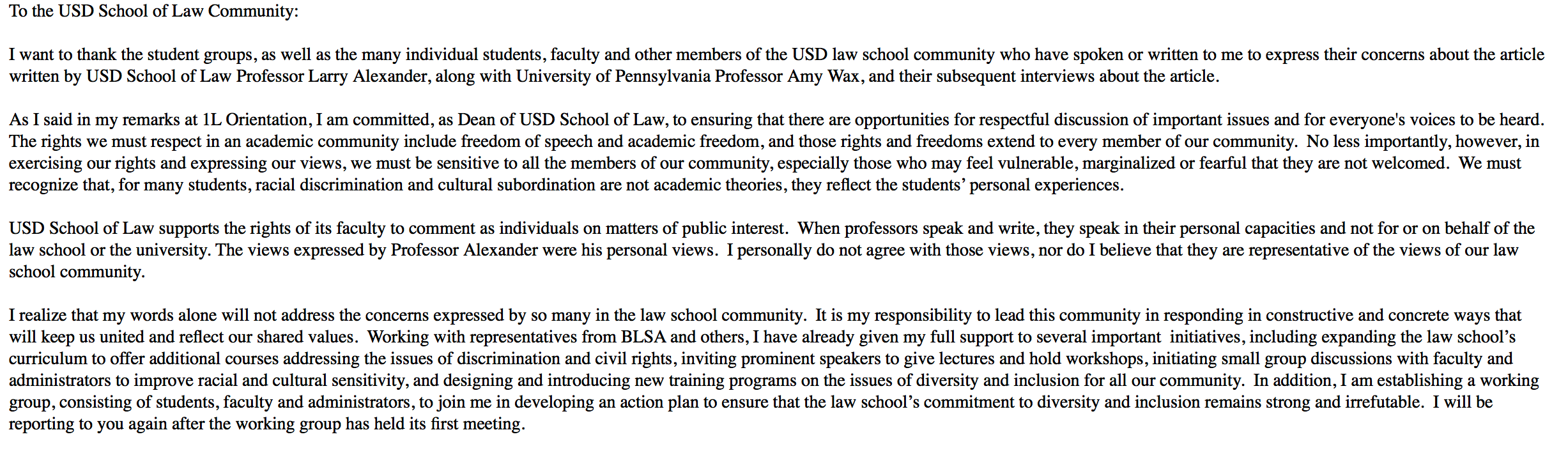
Addendum: Above the Law, a law-school news site, reports that University of San Diego law students have asked their school to ban Alexander from teaching first-year students. (It apparently doesn’t matter what he says in the classroom; he’s been permanently declared an Unperson for that editorial). The Dean of the Law school has issued a statement that, while meekly admitting that Alexander had a right to write the op-ed, genuflects obsequiously to those who objected. The proper response would be like the one my University issued in response to calls to ban Steve Bannon’s upcoming talk. Short and sweet, it basically said that “Every faculty has the right to invite anyone to speak, and we defend that right.”

This all depresses me deeply. Are we really living in this kind of Orwellian world now: a world in which you’re no longer supposed to teach first-year students if you write an op-ed they don’t like? I urge you to read the W&A piece and judge if its authors deserve that fate.

*******

Here’s Wax talking about the controversy. This is not the speech she delivered in December, but it must be pretty similar. This one was given in October of last year at Penn’s Federalist Society.

h/t: cesar