Why Evolution is True is a blog written by Jerry Coyne, centered on evolution and biology but also dealing with diverse topics like politics, culture, and cats.
I now have three batches plus some singletons, and so we’ll have semi-regular photos for a while, at least. Today’s batch of tidal invertebrate photos, and one video, comes from math professor Abby Thompson at UC Davis. Abby’s captions are indented, and you can enlarge the photos by clicking on them. The video is also hers.
April tidepools, and a mystery den.
Starting with a video of a Ctenophore, Pleurobrachia bachei (Pacific sea gooseberry, a ‘comb jelly’). All appearances to the contrary, this is in a different phylum (Ctenophora) from the “jellyfish” of my earlier post, which are in the phylum Cnidaria. The flashing lights are the cilia in the “combs” that run down the sides, used for locomotion. This one wasn’t moving very much, but I was surprised it was moving at all. I picked it up off the sand quite a way above the water line, and dumped it into a shallow pool to take a photo. It seemed to be recovering pretty well from what I thought was death. It’s about the size of a walnut.
Phoronis ijimai(tentative- the white things). This is a species of horseshoe worm, which lives in tubes. I haven’t seen this species before, and it was in an awkward spot, so it was hard to get a good photo. The photo below that is from a few years ago of a worm from the same family, so you can see their general shape better:
Lastly the mystery den. Our entire front yard seems to have been tunneled under, with at least three major entrances- this pair of holes is just one of them. The holes are large, about 10 inches across. We’re dreaming of badgers, would be very happy with foxes, and really hoping it’s not skunks (I love skunks, but not in the front yard). A wildlife cam is the next purchase:
Camera: Olympus TG-7. Thanks as usual to some experts on inaturalist.
The Turkmen Racing Horse Festival is annually held on the last Sunday in April. This year, it takes place on April 26. While it is an important holiday, one of national pride, it remains a working Sunday for many in Turkmenistan, with schools and offices remaining open. Before we plunge into the why of this holiday though, a brief geography lesson. Turkmenistan — not to be confused with the separate nation of Turkey — is a country located in the southwest region of Central Asia. Its neighbors are Kazakhstan, Afghanistan, Iran, and Uzbekistan. It also touches the Caspian Sea, along its western border. Horses are an integral part of Turkmenistan’s history and culture, hence there is an entire season dedicated to horse racing. The pride and joy of Turkmenistan is the Akhal-Teke breed of horse, said to be one of the oldest breeds in the world.
Here’s a one-minute video abut the Festival:
It’s also Alien Day, celebrating the 1979 movie Aliens, and “Alien Day is held on April 26 because one of the planetoids or moons in the Alien films is named LV-426″. Audurbon Day (the illustrator and ornithologist, now in bad odor, was born on this day in 1785), National Pretzel Day, and World Intellectual Property Day (I just got a few hundred bucks because some bot stole from my trade books and got sued).
Readers are welcome to mark notable events, births, or deaths on this day by consulting the April 26 Wikipedia page.
Investigators were working on Sunday to determine a motive in the shooting that sent Secret Service agents rushing President Trump from the stage at the White House correspondents’ dinner, an attack that raised questions about how a gunman was able to get close to one of Washington’s most heavily guarded events.
The suspect, identified by two law enforcement officials speaking on condition of anonymity as Cole Tomas Allen, 31, of Torrance, Calif., was taken into custody after running through a security checkpoint and exchanging gunfire with the authorities inside the Washington Hilton on Saturday night. Officials said he did not reach the ballroom, where Mr. Trump, top administration officials and hundreds of journalists had gathered.
Late Saturday night, federal authorities in the Los Angeles suburbs surrounded a two-story home where records show Mr. Allen lives. Residents gathered nearby on darkened sidewalks as police helicopters circled overhead and law enforcement vehicles with flashing red and blue lights blocked the street.
The suspect was armed with knives, a shotgun and a handgun and had been staying at the Washington Hilton, the interim Washington, D.C., police chief, Jeffery W. Carroll, told reporters on Saturday night. He said that the authorities were still investigating whether the suspect had targeted the president, but that they believed he had acted alone.
Trump and Melania were escorted out of the event. A Secret Service agent was hit, but apparently saved by his bulletproof vest.
President Trump on Saturday called off a trip by two of his top negotiators to Islamabad, Pakistan, just before they were set to leave for talks about a potential deal to end the war in Iran.
“I’ve told my people a little while ago, they were getting ready to leave, and I said, ‘Nope, you’re not making an 18-hour flight to go there. We have all the cards,’” Mr. Trump said in a statement. “They can call us anytime they want, but you’re not going to be making any more 18-hour flights to sit around talking about nothing.”
Steve Witkoff, the special envoy, and Jared Kushner, the president’s son-in-law, had been scheduled to travel to Pakistan on Saturday, along with top aides to Vice President JD Vance. Officials in Pakistan have been mediating between the United States and Iran to try to end more than a month of war in the Middle East.
The cancellation of the trip is the latest sign that Iran and the United States are far from reaching a deal to end the war. A previous trip to Islamabad by Mr. Vance proved unsuccessful, and the Americans appear no closer to achieving the administration’s political goals, including convincing Iran to turn over its nuclear stockpile and curtail its future program. The two sides are also locked in a stalemate over control of the Strait of Hormuz, through which a fifth of the world’s oil supply flows.
Mr. Trump’s decision came after Iran’s foreign minister, Abbas Araghchi, who had been in Islamabad for talks with Pakistani officials, left the country and traveled to Oman. No direct meetings had been scheduled with U.S. officials.
After leaving Islamabad, Mr. Araghchi said in a social media post that he had shared with Pakistani officials Iran’s position on a “workable framework to permanently end the war on Iran.” He did not give details of the latest proposal. “Have yet to see if the U.S. is truly serious about diplomacy,” he added.
Given the distance between the negotiating parties, and the untenable nature of Iran’s demands, right now it seems useless to try negotiating. Let’s see what happens. Prices throughout the world will go up (gas prices in Chicago are already about $5.25 per gallon), so this remains a test of the ability of each side to play a game of what amounts to economic chicken.
*The NYT has an interview with three entitled people (including the wealthy and odious antisemitic streamer Hasan Piker) about why it’s okay to steal from capitalists: “The rich don’t play by the rules. So why should I?” Here we see the antisemitic content streamer Hasan Piker, The NYT Opinion culture editor Nadja Spiegelman (daughter of graphic novelist Art Spiegelman), and New Yorker writer Jia Tolentino discuss the circumstances in which they’d break the law to steal from the rich (see also the Free Press article on this unsavory trio; the NYT article is archived here). There is also a video. We can assume that at least two of these discussants are rich. Piker is a multimillionaire, and The FP says that Tolentino:”lives in a $2.2 million brownstone in the Clinton Hill neighborhood of Brooklyn when she’s not at her second home upstate”, and Grok reports that Spiegelman ears a six-figure income as well as being co-owner of two NYC properties, including a SoHo condo. We can assume they are not starving, but they’re willing to steal—and not always for a good cause.
A couple of quotes:
Spiegelman: Would you pirate music from an indie band?
Tolentino: Is it 2005 and I’m using LimeWire? Because yes.
Spiegelman: I feel like every millennial has at some point.
Tolentino: I mean, I feel like, fundamentally, Spotify is kind of deleterious to the musician livelihood, and I use that, but then I go to the shows.
Piker: Yeah, I’m pro-piracy all the way, like, across the board. Would you pirate a car? Yes. You know, if you could.
Spiegelman: What would it mean to pirate a car?
Piker: It was just a classic thing back in the day. The government-funded antipiracy initiatives would be like: Would you steal a car? I’m like, yeah, sure. If I could get away with it, if it was as easy as pirating intellectual property, I would do it.
. . .Spiegelman: Yeah. Would you steal a book from the library?
Tolentino: Never.
Piker: No.
Spiegelman: Would you steal from the Louvre?
Piker: Yes.
Tolentino: I would not be logistically capable of executing such a fact, but would I cheer on every news story of people that I see doing it? Absolutely.
Piker: I think it’s cool. We’ve got to get back to cool crimes like that: bank robberies, stealing priceless artifacts, things of that nature. I feel like that’s way cooler than the 7,000th new cryptocurrency scheme that people are engaging in.
Spiegelman: Would you steal from Whole Foods?
Tolentino: Yes. And I have, under very specific circumstances. I will say, I think that stealing from a big box store — I’ll just state my platform — it’s neither very significant as a moral wrong, nor is it significant in any way as protest or direct action. But I did steal from Whole Foods on several occasions.
Tolentino steals from Whole Foods (she calls it “mircrolooting”), but only to give the food to others:
Tolentino: But I didn’t feel bad about it at all.
Spiegelman: And was part of it because of how you feel about Whole Foods as a corporation?
Tolentino: Yeah. It already felt like a bit of a compromise. At the time I was like, I had not been to Whole Foods. I had a bit more consumer discipline about where I was spending my money then, and I already felt like I was in the hole, even by shopping there. And it certainly felt, in a utilitarian sense, I was like, this is not a big deal. Right, guys?
. . .Spiegelman: There’s one thing that’s stealing when you are a teenager and you want the adrenaline rush. And part of it is about testing the rules and getting away with something. But what I’m seeing on TikTok and social media is people saying that they’re stealing from Whole Foods not just for the thrill of it, but out of a feeling of anger and moral justification. Because the rich don’t play by the rules, so why should I? And Jeff Bezos has too much money — he’s a billionaire — so why should I have to pay for organic avocados?
My friends and I have started calling this microlooting, because it has a slight political valence to theft, as opposed to just the thrill of getting away with something. Have you noticed this around you online? Have you noticed more people talking about stealing in this way?
Murder, they say, seems justified by many:
. . . Spiegelman: But then when you feel this much anger — and it doesn’t feel like there’s hope for it to be changed in a regulatory way — I think that’s when you get to things like Luigi Mangione, who is accused of killing the C.E.O. of United Healthcare, and there being an outpouring of glee for murder online, because it feels like, finally, someone can actually do something about health care.
I think 41 percent of Gen Z-ers felt that murder was morally justified. But it’s scary to be in a society where people feel that murder is morally justified. And I’m curious how we thread that line.
Piker: Yeah. Friedrich Engels wrote about the concept of social murder. And Brian Thompson, as the United Healthcare C.E.O., was engaging in a tremendous amount of social murder. The systematized forms of violence, the structural violence of poverty, the for-profit, paywalled system of health care in this country — and the consequences of that are tremendous amounts of pain, tremendous amounts of violence, tremendous amounts of deaths. And that was a fascinating story for me, because Americans are very draconian about crime and punishment. They’re very black and white on this issue.
And yet, because of the pervasive pain that the private health care system had created for the average American, I saw so many people immediately understand why this death had taken place.
. . . Tolentino: One thing that should be legal that isn’t — it’s interesting, because I have to regularly explain this stuff to a small child, and have so thoroughly explained to her that some things are against the rules, but they’re OK, depending on who you are. And some things are not against the rules, but they’re not OK. There are so many perfectly legal things I do regularly that I find mildly immoral. Like getting iced coffee in a plastic cup. I find that to be a profoundly selfish, immoral, collectively destructive action. I have taken so many planes for so many pleasure reasons; I have acted in so many selfish ways that are not only legal, but they’re sanctioned and they’re unbelievably valorized, culturally. So, maybe things like blowing up a pipeline, let’s say that.
These are the people who will lead the Revolution, and who are active on the “progressive” Left.
I was placed on an SPLC blacklist in October 2016. The document was called “A Journalist’s Manual: Field Guide to Anti-Muslim Extremists.” My name appeared beside Maajid Nawaz, a reformed radical who ran a counter-extremism organization, and an array of figures also dedicated to combating Islamism and antisemitism, such as David Horowitz and Daniel Pipes. The list handed journalists a ready-made roster of 15 people whose views were to be seen as toxic. But to call it a mere reference guide is to understate what it was.
It was published at the peak of a jihadist campaign of terror against the West. The ISIS caliphate still held territory across Syria and Iraq. Al-Qaeda in the Arabian Peninsula (AQAP) was issuing hit lists of writers and cartoonists in its English-language magazine. In January 2015, two of AQAP’s followers walked into the offices of the magazine Charlie Hebdo in Paris and murdered 12 people, some of them cartoonists whose offense was drawing. Ten months later, a coordinated ISIS cell killed 130 at Paris’s Bataclan theater and the cafés around it. Terror attacks in Brussels, Nice, Berlin, and Manchester soon followed.
This was the climate in which the SPLC chose to publish the names, faces, and affiliations of 15 people it accused of “anti-Muslim extremism.” The list endangered everyone it named. I know the threat of Islamist violence all too well. In 2004, a jihadist named Mohammed Bouyeri murdered my friend and collaborator Theo van Gogh on an Amsterdam street. Bouyeri shot him, cut his throat, and pinned a five-page letter to his chest with a knife. The letter was a fatwa against me. I have lived under armed protection for more than two decades because men with weapons and conviction want me dead—for apostasy; for writing about Islamist-driven antisemitism and the subversive actions of the Muslim Brotherhood and other Islamist groups in the West; for drawing attention to practices such as honor killings and female genital mutilation; for arguing that Muslim women deserve the same protections under the law as other women.
The SPLC considers all of this beyond the pale, and accused me of using “the political bully pulpit to bash Muslims.”
Thus, an organization founded to combat bigotry chose to place me on a list together with others whose lives were already under threat from the same movements, just for having the audacity to combat Islamist bigotry.
Nawaz sued the group, and won. In June 2018, the SPLC settled for $3.4 million and issued a written apology. The field guide vanished from its website. No apology was ever extended to me or to the others unfairly placed on that list.
. . . But ruining reputations was, and remains, only one of many offenses.
In 2000, the journalist Ken Silverstein published a long investigation in Harper’s Magazine describing the SPLC as the wealthiest civil rights organization in America, one whose fundraising had grown to dwarf its legal work. CharityWatch later gave the organization an F for stockpiling donations it did not spend on its stated mission. Tax filings uncovered by reporters in 2017 showed millions in SPLC money parked in the Cayman Islands, the British Virgin Islands, and Bermuda. Think of it for a moment: an anti-poverty organization, headquartered in Alabama, hiding millions offshore while positioning itself as the nation’s moral conscience. That should have ended it. Instead, the donors kept giving, and the lists kept growing.
I’m surprised that Hirsi Ali didn’t sue the SPLC like Nawaz did. The organization apparently ran out of civil rights cases to prosecute, and so began sniffing out what they construed as “hate groups” that didn’t violate anybody’s civil rights.
*Speaking of the SPLC, the conservative National Review says that even if the government charges against it are bogus, “The SPLC was always awful” and “deserves to be shunned and marginalized” (archived article).
A grand jury returned an indictment charging the Southern Poverty Law Center (SPLC) with financial crimes, suggesting that the organization — which claims its mission is to “dismantle white supremacy” and fight discrimination broadly — has secretly paid informants to participate in the groups it deemed “racist” or hateful, as well as organize activities under the guise of these groups, such as the “United the Right” rally in Charlottesville, Va. If the allegations are true, then it means that SPLC has been coordinating some of the very events it raises funds to fight against — and as anyone familiar with the organization knows, it then construes those demonstrations as representative of the entire right-wing coalition.
But here’s a challenge: Engage in a hypothetical and assume, purely for the sake of argument, that absolutely everything alleged in the indictment is completely false. Even if the SPLC neither committed financial crimes nor helped orchestrate bogus “hate” events to create bad optics for conservatives, the organization has long been deserving of ire. The SPLC is societal poison dedicated to disparaging any individual or group perceived as even mildly right-wing. Rather than bashing the SPLC because it allegedly misrepresented its organizational activities and use of funds, we should emphasize that the SPLC misrepresents everything all the time.
For those unfamiliar, the SPLC is well known for awarding the “hate” label to certain organizations or individuals. While these designations might seem negligible, they have facilitated actual hate: Floyd Lee Corkins II was motivated to attempt a mass shooting and “kill as many people as [he] could” at the Family Research Council’s headquarters, in part because he had identified the organization as anti-gay from the SPLC website.
One might have hoped such an awful incident would have prompted the SPLC to reconsider its “hate” labels, and that the mainstream media would refrain from referencing such designations carelessly. However, high-profile publications routinely cite the SPLC-issued “hate” badge as if it is some sort of assessment grounded in a rigorous methodology. An article will read as follows: “[Right-Wing Organization], which has been named a “hate group” by the SPLC, blah blah blah.” (See here for an example about the Family Research Council in the New York Times, which was published after the terrorist attack on the organization.)
The scandal raises urgent questions about the integrity of the SPLC’s broader work, particularly its influential Hate Map, which began as a tool for tracking armed militias and skinhead gangs. Over time, it expanded to include mainstream conservative and religious organizations such as the Family Research Council, Alliance Defending Freedom, Moms for Liberty, and the Center for Immigration Studies. In August 2012, a man named Floyd Lee Corkins walked into the Family Research Council headquarters in Washington, D.C., carrying a gun. A security guard named Leo Johnson stopped him and was shot in the process. Corkins told the FBI he chose his target using the SPLC’s map. The organization never acknowledged what its list had set in motion.
The SPLC promulgates falsehoods — or what progressives might call “misinformation” — not only when borderline defaming individuals and organizations, but in its attempts to refute the claims set forth by those people and groups. In one article, the SPLC insists that “sterilization” is merely “an alleged medical risk” (emphasis mine) of “gender-affirming health care for children,” which is based on “myths, pseudoscience, and flawed historical comparisons to eugenics.” The SPLC further asserts that children are not receiving procedures that would render them infertile, nor does hormonal therapy pose fertility risks. This is difficult to reconcile with the fact that a reality-television show revealed to the world that Jazz Jennings, a male, underwent (botched) surgeries to construct a pseudo-vagina before age 18. Then there’s all the scientific data and personal anecdotes about how hormonal therapy can lead to infertility. Even Planned Parenthood produced materials for students as young as middle-schoolers conceding that puberty-blocking drugs may have long-term fertility consequences, saying they “might change someone’s body permanently, like affecting whether they can get or cause a pregnancy when they are older.” In another post, the SPLC claims that “anti-transgender” and right-wing individuals rely on “junk science” and “disinformation” — ignoring piles of evidence to prove that the so-called studies in support of medicalized gender interventions are not only wrong, but entirely nonsense. (For more thorough descriptions of large-scale scientific reviews on “gender-affirming care,” see some of my reporting here and here and here.)
Like the ACLU (which still does good stuff), the SPLC was once engaged in a honorable mission, but that mission has become ideologically tainted. It’s not clear whether the government’s charges that the organization gave money to informants, enriching the very organizations it was spying on, will hold water. But even if they don’t, the SPLC has outlived its usefulness, and I would be glad if it disappeared.
Three people in California have been sentenced for insurance fraud in a bizarre scam that involved someone dressed in a bear costume damaging luxury cars.
The California Insurance Department said the three used a person in a bear suit to stage fake attacks inside a Rolls-Royce and two Mercedes in 2024, then submitted fraudulent claims seeking nearly $142,000 in payouts from insurance companies. The department called it “Operation Bear Claw.”
Two Los Angeles-area men and a woman pleaded no contest to felony insurance fraud and were sentenced to a weekend jail program, followed by probation, the department said in a news release Thursday. Two of them were ordered to pay over $50,000 in restitution.
A fourth person faces a court hearing in September.
The group is accused of providing several videos from the San Bernardino Mountains of a bear moving inside the vehicles to the insurance companies as part of their damage claims, the department said. Photos provided by the insurance department show what appeared to be scratches on the seats and doors.
AD
A California Department of Fish and Wildlife biologist reviewed the footage and concluded it was “clearly a human in a bear suit,” the insurance department said.
After executing a search warrant, detectives found the bear costume in the suspects’ home, the department said.
A news video showing the suit. Opposable thumbs!
Meanwhile in Dobrzyn, two geezers commiserate:
Hili: Once, the world was better.
Andrzej: Not exactly, but we were younger and stronger.
In Polish:
Hili: Dawniej świat był lepszy.
Ja: Nie bardzo, ale my byliśmy młodsi i silniejsi.
From Masih; four Iranian women protestors waiting to be hanged (for protesting):
These 4 women receive death sentences simply for demanding freedom in Iran and right now sitting in prison, waiting to be hanged.
Where are the left and Liberal in America?
Why are the leaders of feminists movement so quiet?
Where are the progressive leaders?
From Luana: I’m not a huge fan of Francis Widdowson, but it’s wrong, and a violation of free speech (which Canada apparently doesn’t allow) to demonize (and arrest) her for questioning whether the bodies of indigenous people have been buried when there is simply no evidence that this claim is true.
This is a political arrest. There are NO MASS GRAVES of indigenous students.
Questioning the narrative is heresy.
Shut people up by arresting them for trespassing. https://t.co/5RWlmOvyft
From Matthew; Katie Mack is a physicist and science communicator. See the link for the quoted post, which is about relativity being necessary to use GPS satellites accurately.
When Einstein developed general relativity the closest thing to a practical application that could even be imagined at the time was a slightly more precise description of where to look for the planet Mercury in the sky, and yet now we’d all be literally lost without it.Anyway: fund basic research.
Welcome to CaturSaturday, April 25, 2026. I just returned to the office, as our plane to Chicago from Savannah was late because of rain in Baltimore, and I didn’t get to sleep until nearly midnight. I stopped by the duck pond on the way in and found Armon and the undocumented drake, but of course no ducklings, which is too much to hope for. I tried to feed Armon to reward him for his paternal services, but he was too busy chasing the other duck. I didn’t expect to see baby ducks, as I don’t believe in miracles, but the pond looks very empty.
If readers have any wildlife photos, please send them in.
There will be a truncated Hili dialogue today, and perhaps posting will be light for a while as I get up to speed. Bear with me; I do my best.
Readers are welcome to mark notable events, births, or deaths on this day by consulting the April 25 Wikipedia page.
Tensions between Iranian leaders over talks with the U.S. spilled into the open this week, highlighting how difficult it will be for President Trump to secure the diplomatic win he wants to end the war.
The disagreements were apparent in the first round of talks earlier in April. Mediators said Iran became vague when pressed by the U.S. for specifics on issues it had said it was willing to discuss, people familiar with the matter said.
It’s now becoming clearer that there are deep divisions within the country’s leadership over how far to go to strike a deal with the Americans—a concern as mediators scramble to arrange a second round of talks after the U.S. and Iran abandoned a planned meeting midweek amid rising tensions in the Strait of Hormuz.
U.S. envoys Steve Witkoff and Jared Kushner will go to Islamabad for talks with Iranian officials, White House press secretary Karoline Leavitt said Friday on Fox News. Vice President JD Vance will be on standby to travel in case there is progress in the negotiations, she said. Iranian Foreign Minister Abbas Araghchi arrived in Islamabad Friday, but Iranian state media said no meeting was planned.
Tasnim, a news service affiliated with the Islamic Revolutionary Guard Corps, accused the U.S. of telling stories.
“There is basically no negotiation with the Americans at the moment, and Mr. Araghchi’s trip to Islamabad is not to negotiate with the Americans,” Tasnim said.
During the fighting, Iran’s leadership showed unity in its political messaging and maintained tight command and control over its armed forces. But that cohesion appears to be fraying as it turns to the task of securing sanctions relief by cutting a deal with the U.S., which likely will require making difficult concessions.
Clearly, regime change that gives power to the people is not on the table. All we can say is that any agreement between the U.S. and Iran will be difficult. And I don’t think the U.S. should have folded a Lebanon cease-fire into the agreement, for that has nothing to do with Iran save for Iranian support of terrorists in other countries.
A campus event featuring freed Israeli hostage Omer Shem Tov drew the condemnation of UCLA’s student government on Tuesday. In an open letter, the UCLA Students Associated Council said that bringing Shem Tov to speak to students “served to legitimize and normalize” atrocities in Gaza and Lebanon.
Shem Tov, 23, was kidnapped from the Nova music festival in Southern Israel on Oct. 7, 2023, and held hostage in Gaza until his release in a prisoner exchange in February 2025. UCLA hosted him on April 14 for a Yom HaShoah event.
“While we affirm the humanity of all people impacted by violence, we reject the selective platforming of narratives that obscure the broader reality of ongoing state violence,” the student government wrote in the letter, which was addressed to the UCLA administration and UCLA Hillel among others. “Israel is currently continuing to carry out what has been widely identified by human rights advocates as a genocide in Gaza, while also expanding its illegal military campaign into Lebanon.
“In this context, elevating a single narrative, absent of critical political and humanitarian framing, serves to legitimize and normalize these ongoing atrocities.”
Rabbi Chaim Seidler-Feller, UCLA Hillel’s director emeritus, called the statement “completely ridiculous.”
“You can’t present the narrative of your experience without it being called ‘one sided,’” Seidler-Feller said. “There has to be a counter-story to persecution. Is there a counter-story to killing people?”
A UCLA spokesperson defended the groups who hosted the event Wednesday and said the school would “review the process by which the letter was issued.”
“The event’s message was one of resilience and respect for human rights and dignity – a message we support,” the statement in part read.
“We firmly stand against violence of any kind. Omer Shem Tov spoke with students and other members of the community with the Chancellor and Dr. Felicia Knaul in attendance, and the event occurred without any disruption,” the school added. “We will review the process by which this letter was issued. The condemnation of such a peaceful event to share a story of resilience in the face of extreme suffering is antithetical to the values of our Bruin community.”
UCLA Hillel executive director Daniel Gold dismissed the criticism in Tuesday’s letter as antisemitic.
“Hillel at UCLA and Students Supporting Israel UCLA would like to apologize…for absolutely nothing,” he wrote in a statement. “Members of UCLA student government have once again shown they are anti-dialogue, anti-learning, anti-truth, anti-student and antisemitic.”
You can read the UCLA student government’s letter at the link above.
*Meanwhile, it’s encampment season again, and the first participant is Occidental College. It’s not in any news I can find, but Grok has culled this information on the “Rafah to Jenin liberated zone” just set up, complete with tents. Rafah, of course is the southernmost part of Gaza, and Jenin is in the West Bank, so they are encompassing all of the Palestinian territories.
A new pro-Palestinian student encampment was established at Occidental College (Oxy) in Los Angeles on April 24, 2026 (yesterday).
It is organized by groups including Occidental Students for Justice in Palestine (Oxy SJP) and described by participants as the “Rafah to Jenin Liberated Zone” (sometimes called “Rafa to Janine” or “Rafah-Jenin Liberated Zone”), occupying the campus’s Academic Quad—echoing the 2024 encampment site there.
Key Details from Organizer Statements and Videos
Setup and appearance: Tents (green, white, yellow, blue) and a canopy have been erected on the quad amid trees and benches. Protesters (many in keffiyehs, some face-covering, sunglasses, or safety vests) are visible setting up, with Palestinian flags present. Banners include messages like “THERE ARE NO SCHOOLS LEFT IN GAZA” (with imagery of fire, an American flag, and a burning school building) and references to solidarity with Palestine.
instagram.com
Demands: The encampment calls for Occidental’s Board of Trustees to divest from companies tied to Israel/weapons manufacturing (described as “war profiteering” and “genocide”), as well as private prisons and ICE detention centers. Organizers frame it as renewing pressure ahead of a Board meeting, two years after the 2024 encampment. They describe it as building a “transnational community” in solidarity with Palestinians amid actions in Gaza, the West Bank (Jenin), Lebanon, and Iran.
instagram.com
Activities and invitations: On day one, students invited supporters to “sleep in a tent with us,” share meals, or drop off food/supplies. Planned programming includes community self-defense/ICE patrol training, a Torah study, workshops on “academia and genocide,” and discussions of the “student intifada.” One speaker noted campus police threats to involve LAPD but affirmed they are staying.
If you click on the tweet below (h/t Luana), you’ll hear a cowardly woman, face hidden by a keffiyeh, boasting about the encampment at “Oxy”:
🚨 BREAKING: An encampment has sprung up at Occidental College in Los Angeles.
Activists are calling it the “Rafah to Jenin Liberated Zone” and say the encampment is animated by the same “social justice” values Occidental claims to uphold.
*For reasons that aren’t completely clear, the mainstream media has within the last year or so embarked on a campaign to highlight the value of religion. The NYT started a weekly newsletter about religion called “Believing“. It’s written by Lauren Jackson, who claims she’s a nonbeliever, but one who longs for there to be a god. And although she’s supposedly an atheist, her lips are fixed firmly on the posterior of faith, osculating it vigorously. (I read it so you don’t have to.) Now the Washington Post has followed suit with one called “Awakenings, whose motto is “Religion and spirituality are remaking America — and transforming lives. Encounter the new face of faith.”
One episode of “Awakenings” was posted yesterday, by Christopher Beha, a Catholic, former editor of Harpers, and author of Why I Am Not an Atheist (see my critique of his anti-atheism New Yorker article here). His new osculation is called, “I used to be a skeptic. This changed my mind.” (The subtitle is “Skepticism is tearing society apart. Belief is the answer”.) Beha begins by asserting that philosophy has failed to provide us with a shared basis of “certain knowledge,” but of course he’s wrong—he should be looking to science, not philosophy. Then he proposes faith as the nostrum for a fulminating skepticism:
This in turn makes it easier to appreciate the early modern fear of skepticism. The term increasingly calls to mind not just religious skepticism but vaccine skepticism, election skepticism and the army of “truthers” who coalesce around every major news event. These people often proceed not by proposing an alternative view but by “asking questions” that undermine the official narrative and make it difficult to believe in anything at all, which is precisely the skeptical method.
By now the dangers of this approach should be clear. Today’s great epistemic institutions — government, universities, media — face much the same crisis of authority that befell the religious institutions they replaced. While philosophical skepticism promised detachment and tranquility, modern skepticism has curdled into cynicism and despair.
What can be done to address this fact, particularly if the philosophers are right and there is no shared foundation of objective knowledge from which to proceed? Hume once suggested that even the most confident conclusions should be tempered by a “degree of doubt.” Looking around today, I’m more inclined to say that skepticism should be tempered with a bit of belief.
What I’m proposing is not a return to simple credulity or a slavish submission to authority, but rather a recognition that it is not really possible to survive on certain knowledge alone. Every person must take some things on faith, if only to open the door and go out into the world.
True, we take things on faith (like our doctor’s advice), but most often when we are relying on authorities who know their stuff. But here’s Beha’s solution:
My own turn to belief eventually led me all the way back to the church of my childhood. I’m not suggesting that it will take others that far. But perhaps they could do with a bit more belief than modern society encourages. By the skeptics’ own lights, it takes belief to recognize the reality of the world outside one’s head, the reality of other people and the obligations that these realities entail. It takes belief to transcend despair and work for a better future. It takes belief to escape the cynicism and nihilism that seem the default mindsets of the day. It takes belief to put skepticism in its proper place.
Beha doesn’t seem to realize that there’s a difference in “believing” that a virus causes AIDS and a belief that a god sent himself/his son down to earth to redeem human sins by getting crucified. In other words, Beha doesn’t see the difference between belief based on evidence and belief based on wish-thinking). But I’m still puzzled at the MSM’s love of religion? Whence the “God-shaped hole” that needs to be filled?
Meanwhile in Dobrzyn, Andrzej has given the garden (and the house) to the upstairs lodgers.
Hili: Our orchard is blooming again.
Andrzej: Not ours anymore, but it’s still blooming.
In Polish:
Hili: Nasz sad znowu kwitnie.
Ja: Już nie nasz, ale nadal kwitnie.
From Terrible Maps: a mnemoic for memorizing the Great Lakes:
From Jay, a guy playing Kamala Harris ordering dinner:
From Masih, a “human story” that shows how horrible the Iranian regime is:
A nurse in Iran helped wounded protesters. The security forces killed her. Then abused her body. Then used her finger to unlock her phone and sent the images of sexual abuse to her husband.
Listen to her story and please on’t stop talking about Iran.
💔pic.twitter.com/cRhk95uaa7
If you subscribe to the Free Press, read Ayaan Hirsi Ali’s indictment of the Southern Poverty Law Center (here). She was named by them, along with Maajid Nawaz, as an “anti-Muslim extremist.”
“…the SPLC chose to publish the names, faces, and affiliations of 15 people it accused of ‘anti-Muslim extremism.’ The list endangered everyone it named. I know the threat of Islamist violence all too well. In 2004, a jihadist named Mohammed Bouyeri murdered my friend and… pic.twitter.com/FRtsBvDhDQ
American author Ernest Hemingway was undoubtedly one of the most famous cat lovers in the literary world, alongside Mark Twain, who adored cats so much that he avoided people who didn’t share his affection and even rented cats when he couldn’t bring his own on trips.
And one from Matthew, at a science festival in Chile: morning on the Space Shuttle:
"Day 068, Orbit 1054 — Opening the shutters in the morning: what a beautiful way to start the day! 🌍"– @esa.int astronaut Sophie Adenot #εpsilon 🎥 NASA/ESA
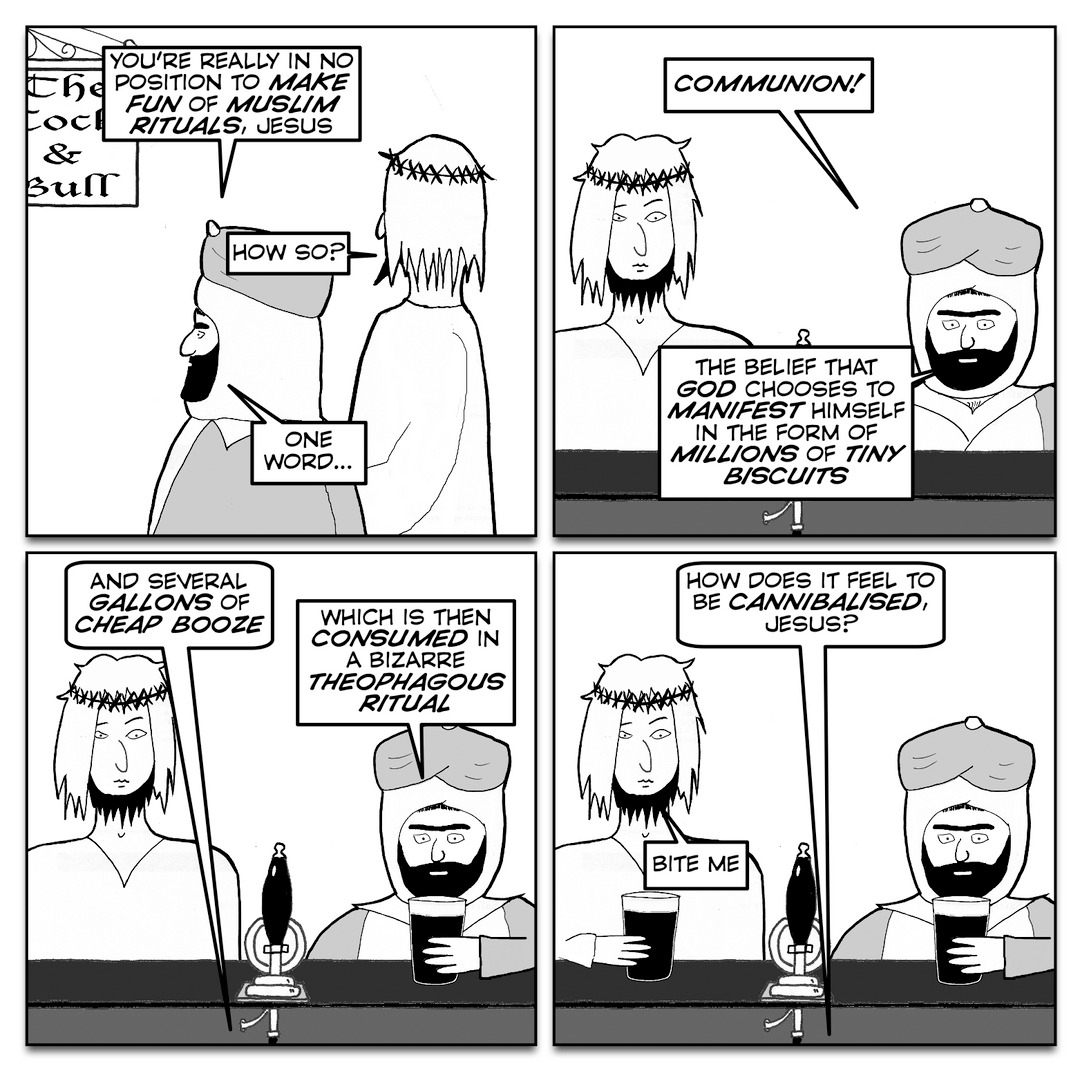
This week’s Jesus and Mo strip, called “bite2”, is new but came out a bit late on Wednesday. In response to last week’s criticism of Islam, Mo now gets the chance to make fun of Christian ritual. He does a good job, but Jesus gets the last word.
It was a lazy day today, with one visit to an architectural/history site and then one big and delicious meal. After we had a leisurely breakfast and did our ablutions, it was nearly 11 a.m. We then walked the ten blocks to the Owens-Thomas House and Slave Quarters:
The Owens–Thomas House & Slave Quarters (originally known as the Richardson House) is a historic home in Savannah, Georgia, that is operated as a historic house museum by Telfair Museums. It is located at 124 Abercorn Street, on the northeast corner of Oglethorpe Square. The Owens–Thomas House was designated a National Historic Landmark in 1976, as one of the nation’s finest examples of English Regency architecture.
. . . The house is notable for its early cast iron side veranda with elaborate acanthus scroll supports on which the Marquis de Lafayette addressed the citizens of Savannah on his visit in 1825.
The house was built between 1816 and 1819, designed by the architect William Jay of Bath and financed and occupied by Richard Richardson. It was then purchased by attorney and politician George Welshman Owens, who was briefly mayor of Savannah and later a U.S. Representative.
The Owens family lived in the house for a while, but after some decades turned it into a boarding house, which is when Lafayette stayed there on his final visit to America on the 50th anniversary of the American Revolution—in which Lafayette played a huge role.
In 1951 the family turned the house over to the Telfair Academy of Arts and Sciences , which still owns it (I visited the other two parts of the Museum on my first day here).
The sign below gives pretty much the same information above.
The front of the house (I forgot to photograph the famous balcony). When Lafayette, an abolitionist, visited Savannah in 1825, the town kept all the slaves inside, along with the free blacks, so they wouldn’t be incited by Lafayette’s antislavery sentiments.
The back garden of the house, designed to be completely symmetrical. In the rear are the slave quarters. This is only part of them: the small house held 12 people, and there were a bit more than 20 enslaved people working for the white residents.
This sign was in the slave quarters, explaining why the guides and many of the signs used the terms “enslaved people” instead of “slaves.”
Inside the quarters, which slept at least twelve people, though many of the enslaved, like the cook and those who took care of the chlldren, slept inside the big house.
The dining room. Food was cooked in the basement, and since there was no dumbwaiter it was carried on trays up two floors from the basement and put in the butler’s pantry before being served.
The butler’s pantry was a small room, with four empty bottles of wine sitting on the sideboard. As the tour moved on, I picked up one of the bottles and saw what’s below: a bottle of Barton and Guestier bordeaux—from 1870! I’d never held a wine bottle that old before. And this chateau is still going strong; it was founded in 1725.
The structural material of the house was tabby, an equal mixture of sand, burnt oyster shells, water, and ash. It was an early form of concrete, and was quite durable. As you see, the tabby was covered with wood paneling.
This room was presumed to be the library/study, though now they’re unsure what all the rooms were used for.
This is presumed to be the oldest son’s bedroom.
And a mirror, at the bottom of which you can see a selfie of Professor Ceiling Cat (Emeritus):
The (presumed) master bedroom, now a word that’s out of favor for obvious reasons (I can’t remember what it’s supposed to be called now).
After the tour we walked home and then got in the car to drive to a restaurant I’d scoped out as a likely prospect: great food, not overly expensive and, most important, Southern. Yes, we went to Erica Davis Lowcountry. It turned out to be all I hoped for, though if you drove by this place you wouldn’t think to go in. But you’d be making a mistake if you didn’t.
We split two appetizers. First, oysters Rockefeller made with local oysters. Wikipedia describes the dish this way:
Oysters Rockefeller is a dish consisting of oysters on the half-shell that have been topped with a rich sauce of butter, parsley and other green herbs, bread crumbs, and then baked or broiled.
There were also collard greens, cream. and Parmesan cheese. It was scrumptious—the first time I’ve had this dish. With all that garnish you could still taste the oysters, and I love oysters. You’d think the dish would be too busy with all the ingredients, but the flavors mingled perfectly.
Another Southern classic: fried green tomatoes, these with feta cheese and balsamic vinegar reduction.
The menu was so full of good stuff (see the link above) that I asked the waiter what she recommended. Without question she mentioned the shrimp, which are local, fresh, and delicious. So I got a half pound of boiled shrimp. They came with clarified butter, shrimp sauce, and two sides (I chose cheese grits and deep-fried okra). And oy, were those shrimp good! I ate the shells, of course, as all good shrimp lovers do.
Tim had the Wassaw redfish, described as “pan-seared redfish filet, garlic beurre blanc, heirloom tomato, stone ground grits, fresh green beans.” He pronounced it excellent.
Betsy had two crab cakes along with green beans and cole slaw. As expected, the cakes were almost all lump crabmeat, with just a small amount of filling to hold them together. With a little bit of the sauce on the crab, it was a Platonic version of this dish.
And my Southern dessert: the third helping of banana pudding I’ve had on this trip—this time served in a Mason jar. This was the fanciest version of all I’ve had. As you can see, it’s topped with whipped cream dusted with vanilla wafer crumbs, with a whole wafer on the side. (Banana pudding sans vanilla wafers is unthinkable.) Then there’s a layer of banana pudding, then a layer of cake, and then a bottom layer of pudding with chunks of banana. This was the best version I had on this trip, and probably the best version I’d ever had. (I’ve eaten it many times, often with BBQ or a meat-and-three plate in the South.)
The meal was terrific, not very expensive, and prepared with great care. I’d recommend this place very highly to anyone who visits Savannah.
Welcome to Friday, April 24, 2026. Today I fly back to Chicago. Normally I would look forward with joy to returning, ready to help Vashti rear her brook of seven ducklings to maturity. This is not to be, however, and I am heartbroken to know that I’ll face an empty pond.
To some it may sound stupid that I’m mourning the loss of our brood of ducklings, but, as the old Jewish saying goes, “Whoever saves one life saves the world entire.” What that means is that if you save the life of any creature, you have saved the world for that creature, who now gets to experience a world it would otherwise lose. That is our situation—seven times over.
Truth be told, I am not energized to write today, and it may be a while before I am. As always, I do my best.
Here, in memoriam to our brood, are three photos taken by Peggy Mason and one by another student. They were sent to me as I didn’t see the brood myself. Whatever happened to them, I hope they found safe harbor.
Readers are welcome to mark notable events, births, or deaths on this day by consulting the April 24 Wikipedia page.
The 10-day ceasefire between Israel and Lebanon, due to expire Sunday, will be extended for three weeks, President Donald Trump said Thursday during the second round of peace talks at the White House.
The announcement of an extension, which had been requested by Lebanon, came as Trump and Vice President JD Vance joined participants of the talks in the Oval Office. Led by Secretary of State Marco Rubio and State Department Counselor Michael Needham, Israel and Lebanon were represented by their ambassadors to the U.S. The U.S. ambassadors to Lebanon and Israel also participated.
Israel and Lebanon had agreed to the extension of “an additional three weeks of, I guess no firing, ceasefire, no more firing. And we’re going to be working with Lebanon to get things straightened out in that country. I really believe it’s something we can do pretty easily,” Trump told reporters admitted to the Oval Office where participants were seated on sofas.
The Israel-Lebanon ceasefire has been only tenuously observed, with reduced but continued attacks by Israel and Hezbollah.
Hezbollah has not officially recognized the pause in hostilities and on Thursday launched its first missile attack on northern Israel since the ceasefire went into effect April 16. The Israel Defense Forces said the missiles had been intercepted.
Israel has continued sporadic bombing attacks in what it says is “self defense” permitted under the ceasefire, and tens of thousands IDF troops occupying southern Lebanon have continued attacks against alleged militants and their infrastructure.
Each side has accused the other of violating the ceasefire.
Note that the talks are with Lebanon, not Hezbollah. The Lebanese government cannot stop the terrorism of Hezbollah, which is why Iran wants these negotations to be part of its own cease-fire settlement. The negotiations will not be successful because Hezbollah’s aim is to destroy Israel, and, Hezbollah has ignored the UN Security Council’s Resolution 1701 from 2006, ordering the group to cease hostilities and disarm. What is Trump thinking? Until Lebanon gets control of Hezbollah—a very slim possibility—there will be no peace between the two countries.
For the first time in the history of the IDF, a part of the defense budget had to be devoted to buying a statue of Jesus. But it was the right thing to do.
The first point is the most obvious: it is a blatant moral failure to desecrate another faith’s holy items. As a matter of history Jews should know how that feels. The conduct of an IDF soldier destroying a statue of Jesus in southern Lebanon is entirely unacceptable, particularly for a military operating as an occupying force.
But if morality didn’t stop this soldier’s actions, I should think practicality would.
If you were to ask any Jew to identify the single most lethal antisemitic trope in history, the answer would undoubtedly be the accusation of being “Christ killers.” Knowing that history, how any Jewish soldier could think that taking a sledgehammer to a statue of Jesus—and filming it—was in any way a good idea simply baffles me.
Thankfully, out of both moral necessity and practical reality, the IDF has taken swift action. The soldier who smashed the statue, along with the soldier who photographed the act, have been dismissed from combat duty and sentenced to jail. Six other troops who were present at the scene and did not act to stop the incident or report it are also under investigation. The IDF has also organized a replacement for the broken statue, which it has returned to the village.
The unfortunate truth is that soldiers will inevitably do destructive, foolish things. That cannot always be prevented. The ultimate measure of an army’s morality is not whether bad actors exist within its ranks—it is how the system holds them accountable.
Here, courtesy of Amit Segal at the site, is an IDF photo of their replacement statue, which has been installed. Although the entire world, including the MSM, has been tarring the whole IDF, and by extension Israel, for breaking the statue, please read the last paragraph above.
And a bit from today’s report, suggesting that Iran’s titular leader may in fact be dead, an ex-ayatollah:
In early April, a joint U.S.-Israeli diplomatic memo, reported by The Times, claimed that Mojtaba is physically incapacitated, completely unconscious, and hidden in a specialized hospital. The memo also noted ongoing preparations for a massive mausoleum in Qom—a subtle hint that the regime is preparing for a funeral.
This week, The New York Times published a detailed investigation based on leaks from “senior Iranian insiders,” claiming the Supreme Leader is sequestered in a highly secure medical hideout. These officials concede he is severely mutilated—awaiting a prosthetic after three leg surgeries and suffering from facial burns that render him largely mute—but insist he remains “mentally sharp.” Conveniently, because all modern electronics are banned around him to prevent Israeli tracking, he is entirely isolated, relying on a slow human chain of motorcycle couriers to communicate with the IRGC generals who are now effectively running the state.
But within Israeli intelligence, a much colder, simpler theory is taking root: Mojtaba is already dead. All that fantastic, detailed intel—even the candid admissions of severe injury in The New York Times—is carefully calibrated Iranian disinformation.
*Over at Quillette, Belgian philosopher Maarten Boudry writes about his awakening on October 7, 2023 in a piece called “What do you think decolonization meant?” (article is archived here).
I was terribly wrong to be so insouciant, as I discovered when 7 October happened. I’m not Jewish and don’t have a personal connection to Israel, so initially I didn’t follow the news very closely. I had relegated the attack to the—regrettably vast—mental category of jihadist terrorist attacks across the globe, failing to grasp that this was, in fact, a full-blown invasion. In my naivety, I assumed that after the massacres in Paris, Brussels, Nice, Berlin, and countless other Western cities, everyone had finally woken up to the true nature of jihadism. When a bunch of Allahu Akbar-chanting fanatics slaughtered innocent young people at a music festival, just as they had done at the Bataclan in Paris, it seemed inconceivable to me that any of my colleagues and friends would condone, rationalise, or even celebrate such acts. And yet that is precisely what happened.
To my horror, within days—even hours—of the attack, when the Israeli army was still fighting off the invaders, I started seeing reactions of excitement and gleeful jubilation on social media. Not from the usual religious maniacs praising Allah, but from left-wing activists at prestigious universities. Academics started breathlessly applying the same framework of decolonisation that I had foolishly brushed aside as amusing but harmless virtue signalling. As the writer Najma Sharif famously posted on X that day, racking up tens of thousands of likes and reposts: “What did y’all think decolonization meant? vibes? papers? essays? losers.”
It was as though she was talking about me. I was one of those “losers” who had been foolish enough to think that decolonisation amounted to little more than papers and essays, along with some harmless but well-intentioned proposals to diversify the philosophy curriculum. If only. What I came to see in the wake of 7 October was something far less benign. Decolonisation operates as a rigid, almost Manichaean ideology that neatly divides the world into evil perpetrators (Western colonisers) and innocent victims (the colonised, indigenous peoples). In this worldview, there is no room for moral ambiguity. Those on the wrong side of the divide are irredeemably rotten and deserve everything that’s coming to them, while those on the side of the angels are completely absolved of any wrongdoing. If they appear to commit atrocities, these are reframed as understandable—perhaps even inevitable—responses to prior injustice. In fact, the more extreme the violence, the greater the wrongs they must have endured.
At one point, many on the Left considered Israel an admirable success story of decolonisation—of an indigenous people driving out the Western colonisers and achieving self-determination in their historical homeland. For a variety of complex historical reasons, however, the Jewish state is now firmly relegated to the side of the oppressors. In fact, Israel is regarded as the settler-colonialist enterprise par excellence, and Palestinians as paragons of victimhood. And that is all the latter-day activists need to know to reach their moral verdicts—which explains why those verdicts came rushing in mere hours into the unfolding event.
That mindset was on full display in a joint open letter at my own Ghent University, published just three days after 7 October. It pointedly refused to condemn Hamas, shifted all blame for the massacre onto “Zionists,” and praised Palestinians for their “tenacity and fierce resistance to racism and settler colonialism,” which the signatories found immensely “inspiring.” The ideological rationale is right there in the letter: “Decolonization is not a metaphor, nor is it only a theory to be used for intellectual clout. It is about supporting the right for self-determination of Palestinians to live freely and with dignity.” It was signed by two thousand academics and students.
An even more revolting open letter at the University of Amsterdam, again with hundreds of signatories, rejoiced that 2023 “will no doubt be the year admired, recorded and studied for the way in which Palestinians steadfastly resisted colonialism, occupation and survived genocide.” The text echoes the same jargon and turns of phrase, as if its authors’ minds had been hijacked by the same zombie virus: “We must stress that decolonisation is not an abstract theory, it is an action, it is a way of being. […] Decolonisation is not a metaphor. […] It is the UvA’s ethical duty to support decolonial endeavors that aim to end colonialism.”
Every one of these academics would describe themselves as “progressive” or “left-wing.” And yet here they were, rallying to the defence of a reactionary death cult that had just committed the largest antisemitic pogrom since the Holocaust, livestreaming their atrocities with GoPro cameras, sadistically calling family members on the victims’ cellphones, ecstatically calling home in triumph to boast of how many Jews they had killed with their bare hands.
If there are two words that describe this species of “progressive”, they are “anti-Enlightenment” and “Manichean”.
The Food and Drug Administration on Thursday approved a gene therapy that can cure a rare, inherited form of deafness. The treatment is the first to restore normal hearing in children who were born deaf.
The maker of the therapy, Regeneron, plans to provide it free to any child who needs it. “We wanted to make a statement,” Dr. George Yancopoulos, Regeneron’s chief scientific officer said on Thursday morning.
The therapy called Otarmeni, is intended for children with otoferlin deafness, a rare form of hearing loss caused by a mutation in a single gene. The mutation destroys a protein in the inner ear that is needed to transmit sound to the brain.
. . . Although otoferlin deafness accounts for just 2 percent to 8 percent of congenital hearing loss, the new treatment “is groundbreaking,” Dr. Dylan Chan, a pediatric otolaryngologist at the University of California, San Francisco, said.
He added, “This is the first time in history that there has been a medical therapy that has enabled deaf children to hear.”
. . .Researchers chose to focus on otoferlin deafness because its cause was straightforward. The otoferlin gene is expressed only in the hair cells of the inner ear. The inner ear structures, including the hair cells, are intact. So to allow patients to hear, doctors simply needed to deliver a working copy of the otoferlin gene.
Otolaryngologists had long thought that injecting a medicine into the inner ear would inevitably damage the delicate cells and membranes of the cochlea.
But children with otoferlin deafness are already unable to hear. Even if an attempt at gene therapy damaged their inner ears, they could still receive cochlear implants.
. . .Kerri M., whose baby, Miles, had otoferlin deafness, said gene therapy “completely changed our lives.” She spoke on condition of anonymity because she wanted to protect her son’s diagnosis from appearing on the internet.
Dr. Shearer said Miles’s hearing loss was so profound that he could not hear a jet engine if it were next to him.
Miles was given the Regeneron therapy on May 19, 2025, when he was 13 months old. At his last visit, his hearing was normal.
. . .Most children who received the gene therapy have had hearing restored, but not all have been as fortunate as Miles. So far, Dr. Chan said, about 80 percent of the patients who have been treated successfully in clinical trials were able to hear well without needing cochlear implants.
Most still needed a hearing aid, but about 30 percent of those who could hear after the treatment were like Miles — their hearing was in the normal range.
The next target for the scientists working on gene therapies to correct deafness is mutations in the GJB2 gene. It causes the most common form of congenital hearing loss in children and accounts for about 20 percent of cases.
This is remarkable, and heartening that the company that created the cure is supplying it for free. Of course most genetically-based diseases are not this easy to remedy, but we are on a thresh0ld of successful gene therapy.
*As usual, I’ll steal a few items from Nellie Bowles’s news-and-snark column in The Free Press, called this week “TGIF: We live in the world we’re in.” The first story about bannng tobacco sales in the UK is true:
→ New job opportunity for Americans: The United Kingdom passed a bill this week to ban the sale of tobacco to anyone born after 2008. The goal is to create a “smoke-free generation.” Anyone born after 2008 will never be able to buy cigarettes or vapes or any tobacco product in the United Kingdom. Ever. Might as well call them the loser generation. Taking cigs away from Brits is like grabbing spaghetti out of an Italian’s mouth. If there’s no cigarette, what are young Brits meant to do with their hands after making a wry and devastating observation? Wave? That’s for the Yanks.
For a kid from the UK, coming to New York and trying a vape is going to be the equivalent of an American going to Amsterdam to try crack and prostitutes. Me, I’m going to travel to London with strawberry vapes sewn into my Levi’s, like an American hero. They said artificial intelligence would take all our jobs, but they didn’t consider that cigarette smuggling would employ 15,000 Americans each year. British teens: Call me!
→ What’s going on with Ilhan Omar’s net worth?: Rep. Ilhan Omar has revised her net worth. Earlier, she filed paperwork reporting her and her husband’s net worth at between $6 million and $30 million. Now, she’s filed new paperwork reporting their net worth to be between $18,004 to $95,000. An easy enough mistake to make! Zeros are confusing. Responding to a letter from the Office of Congressional Conduct, her lawyer said: “As the busiest of people, it is very common for members and their spouses to rely on learned professionals like accountants to make calculations and determinations that appear on public filings. While the error is, of course, unfortunate, there is nothing untoward, and nothing illegal has occurred.” The busiest of people. So busy, somewhere between the personal training and CAIR meetings, they forgot how many more millions they made. Apparently the confusion comes from her husband being involved in so many businesses. All you need to know is that there was some backlash and the husband is worth nothing now. As a scholar of LLCs, my wild guess, if there is a noncriminal explanation, is that the money was put into a new trust or something. So it’s not hers anymore, per se, not exactly.
→ Carrying knives “for a good reason”:
A Kuwaiti man, on trial for allegedly trying to break into the Israeli embassy in London while armed with two knives, regaled the court with tales of his treacherous boat crossings in which he put his “life on the line.” As noted by the BBC: “His defense case is likely to be that he was not trying to enter the embassy for a terrorist purpose, and that he was carrying the knives ‘for a good reason’ unrelated to his activities that day, jurors have been told.” Unless there’s a fish market inside that embassy, I got a few questions about what constitutes a “good reason” in the UK.
Meanwhile in Dobrzyn, Andrzej sounds a familiar note:
Hili: We have to work again?
Andrzej: That’s our lot.
From Masih, with the President mis-sexed in the English translation (there are subtitles):
The President of the German Bundestag [Julia Klöckner] declared with clarity and courage: [S]He does not recognize a regime that blinds women and pierces the bodies of protesters with buckshot. And he made this statement from the podium of the President of the German Bundestag. These remarks were made in tribute to the efforts of Masih Alinejad, for raising global public awareness of the fully armed governmental violence, through which she has become the extension of the voice of millions of Iranians who do not recognize this regime.
The original:
رئیس مجلس آلمان، با صراحت و شجاعت اعلام کرد:
او رژیمی را که زنان را نابینا میکند و بدن معترضان را با ساچمه میدرد، به رسمیت نمیشناسد.
و این حرف را از جایگاه رییس مجلس آلمان زد.
این سخنان در تقدیر از تلاشهای مسیح علینژاد بیان شد، برای آگاهسازی افکار عمومی جهان از خشونتهای… pic.twitter.com/kPQyKTzCHE
— United Against Gender Apartheid (@UAGApartheid) April 23, 2026
From Luana, though the community notes say the quote was mistranslated. The apparently correct translation, which you can see here, is even better.
The first recorded appearance of a cat in Japan is described arriving as an imperial gift, written down on March 11, 889 AD by 22-year-old Emperor Uda on his diary: pic.twitter.com/fw1MsR4PSY
And a turkey named JERRY who loves and protects ducks:
The turkey you see here is Jerry. He never seemed to like living with other turkeys but LOVES the ducks, so we let him move in with them a few years ago. They all get along, in fact Jerry puffs up to protect them whenever a raptor is in the neighborhood. Sometimes found family is the best family! ❤️
It breaks my heart to have to report this, but somehow Vashti and her brood of seven ducklings vanished from Botany Pond sometime after Tuesday morning, and have not been seen since.
I have no idea what happened. They were last seen at the pond during Tuesday’s morning rain showers, with the brood warmly tucked under Vashti’s belly. Now: no ducks—not a trace. The only one left is Armon, who swims disconsolately around the pond and refuses food. He has lost his family.
It was probably not predators: no bodies were found. I’ve ascertained that no workpeople were in the pond during the week. Either someone scared them away or they walked away, something that hasn’t happened before.
Whatever is the case, the ducklings will probably perish, as the nearest body of water is too far away for little ones to walk.
The members of Team Duck and I are devastates. The seven ducklings were healthy, Vashti was being a great mother, and even Armon stepped up to protect the brood. The invading undocumented drakes left the brood alone. Everything promised a great duck season, and I was looking forward to helping the little ones grow up into adult mallards.
That, it seems, is not to be. This portends to be The Year Without Ducklings.