Why Evolution is True is a blog written by Jerry Coyne, centered on evolution and biology but also dealing with diverse topics like politics, culture, and cats.
We made it through a chilly weekend in Chicago, and now it’s the “work week”: today is Monday, November 16, 2026, and it’s National Fast Food Day. Here’s a guy constructing my burger at the Five Guys place in Hyde Park. I’ve stopped going there as the burgers are overpriced, but they do give you huge quantities of fries. The food is good, but at “$20-30 per meal”, it’s too rich for my blood.”
Ian McNeil (1990) holds that “the button was originally used more as an ornament than as a fastening, the earliest known being found at Mohenjo-daro in the Indus Valley. It is made of a curved shell and is about 5000 years old.”
*About a week ago Andrew Sullivan suggested that Trump resign from the Presidency. In his most recent column, “Tear. It. Down.“, he suggests that the new White House ballroom, which we know is HUGE, should be demolished. As I don’t subscribe, I’m not sure if there’s anything more than what you can see at the link, but here’s an excerpt of what you can see:
This deference of public architecture to democratic deliberation is not new. When L’Enfant first presented his idea for a new presidential palace to George Washington, everyone saw it as an auspicious moment. A brand new republic, with a blank page to draw on, and an executive branch to be defined. And the planned palace was indeed impressive: four times the size of the current White House.
And that was the problem. Washington was horrified by the scale of the blueprints. It was more redolent of a monarch’s estate than a president’s house. A contest was then held for a new design, and a far more modest, simple house was constructed — a deliberate rejection of monarchism — with the cornerstone laid in 1792. The most radical change since then was the Truman Balcony, which occasioned a huge fuss, but eventually became accepted.
I grew up abroad in a constitutional monarchy with all its bells and whistles, and found the American president’s abode a near-perfect expression of late 18th-century republican aspirations. Understated, elegant, classical: the power comes precisely from its restraint. And as a Washingtonian, there are few greater pleasures than taking the day to ride a bike around the mall, and take in the majesty and simplicity of the formal architecture.
So I feel real grief right now — yes, grief — as this vile man takes a sledgehammer to this inheritance, as he has to so many parts of our liberal democracy:
This is the photo Sullivan uses; it is uncredited but horrifying.
Look at it: hulking, dominating, out of scale, transforming the entire site, turning the White House into an afterthought. It’s a perfect symbol of what Trump has done to our democracy. He asked no one’s permission, stacked every commission with cronies and hacks, demolished the East Wing with almost no notice, and financed the boondoggle with bribes from major corporate machers, including, yes, Jensen Huang.
The new Trump House is about 90,000 sq ft, compared to the 55,000 of the former White House itself. The monstrousness is not fully clear yet — but as it takes shape some more, and the sheer scale of it sinks in, it will become apparent what this is really about: stamping Trump’s brand on our democracy forever. It might as well have a giant, gold TRUMP banner on it. It’s a monument to autocracy, oligarchy, and corruption.
That’s why I’m not just being rhetorical in arguing that it must be stopped or, if not stopped, torn down as soon as we can. It’s not just the aesthetic offense. It’s that its survival will be a permanent insinuation of Trumpism into our national character and identity. We can expel this authoritarian toxin by elections, as we just did. But we cannot when a deranged autocrat violates a sacred common inheritance to perpetuate his ego long after his death. In bricks and mortar. An eternal monument to autocracy, lawlessness, and corruption.
Tear. It. Down.
Yes, LOOK AT THAT THING! Sullivan goes on to say that he wants it down not just because it’s an “aesthetic offense,” which it is, but because it will stamp “Trump” on America’s House forever: it will be a monument to his autocracy and egotism. And he’s right. Once it’s done, though, will it be possible to tear down?
Effects of a nationwide ground stop on air travel Friday evening, which stranded thousands of passengers and caused widespread delays, have rippled through the weekend, as airlines canceled thousands of flights and airports struggled to recover.
The number of flights facing disruption on Sunday was lower than the day before, according to FlightAware, a flight tracking service, but tens of thousands of passengers still faced snarls. FlightAware said that more than 4,000 flights scheduled for Sunday had been either delayed or canceled as of 10:30 a.m. Eastern. More than 15,000 were delayed or canceled on Saturday.
The air traffic control system, which faced a faulty upgrade that caused communications failures leading to the ground stop, is expected to be back to normal by Sunday night, said Bryan Bedford, who leads the Federal Aviation Administration. Flight schedules could take several days to return to normal.
Federal officials are still trying to determine who is at fault and have called for congressional funding to prevent similar failures. There is no evidence that the problem was caused by a cyberattack, officials have said.
L3Harris, a contractor managing the F.A.A.’s telecoms network, made a standard upgrade at a remote air traffic location, federal officials said Saturday. L3Harris was conducting a routine task — replacing copper wire with more modern fiber optic cable — that was expected to pose no significant disruption to air traffic, said Sean Duffy, the transportation secretary.
But the switch from copper to fiber overwhelmed the system with levels of data it could not handle, prompting widespread communications failures across air traffic facilities that manage the national air space. Alarmed at the scope of the problems, officials issued a rare nationwide ground stop for hours.
No worries, at least for future travel and barring hackers or further problems with fiber optics.
*I usually skip articles about mortality or ageing (too painful!), but the one in the NYT by Roger Rosenblatt, “Thoughts near the end of a life” (he’s 86 or so, apparently not dying), seemed to me better than most. (Article is archived here.under the title, “Late in life, here’s what I know,)
Have I made a ripple with my life? The question every old person asks. Family, yes. Wife, children, grandchildren. Friends, yes. Work? As a writer, who knows? You send things out to an unseen public, like paper boats on water. Do you change a mind, a heart? Abdul El-Sayed, the senator-elect from Michigan, says that his religion teaches that saving one life is like saving all of humanity. The same thought is in the Talmud. That’s the writer’s creed as well.
That’s a Jewish saying that El-Sayed stole; it appears in the Sanhedrin three centures before Muhammad lived and should be credited to that, not El-Sayed, who is antisemitic anyway. But I digress. Changing the minds of other mortals seems to me a poor way to judge a life unless you affect the future of humanity. I don’t worry too much about this, nor about my scientific legacy, which will be superceded by the work of other scientists (some of them in my department!). I’m satisfied knowing that I changed the course of science by getting more people to study speciation, and I don’t need to have made a contribution like discovering the structure of DNA.
More digression: the Sanhedrin story is interpreted at the link this way:
Ignoring the math, the Talmud rules: Even if all of them will be killed, they must not hand over a single soul.
Why? Because each human life contains at its core the very essence of G‑d. As G‑d is infinite, so the value of a human life.
I’m an atheist, so if that statement has any traction to me, it means something different. And it does: to me it means that the saving any life, human or animal, saves the world entire for that creature, who will have a life that it wouldn’t have had without intervention. But on to Rosenblatt:
There is a special kind of usefulness in the extension of empathy toward others, especially those who may feel deserted and alone. Every week or so, I write to one or another friend who recently lost a partner. The usefulness comes from making others feel worthy of your time and attention. In the cold isolations of modern life, to help them feel love or something akin to it.
It was said of Fyodor Dostoyevsky that he had active empathy. In older age one learns the value of that gift, which takes a lifetime to appreciate and apply. Maybe that is how one assesses progress in a life. To grow from self-interest to active empathy, which gives a certain peace
I agree with that, but of course if you want to have the most useful life, according to Rosenblatt, you should be a doctor in a country lacking doctors, for you’d be saving lives that would otherwise be lost. Few of us can be such humanitarians, and perhaps I sound selfish in saying that I envision asking the question on my deathbed and being satisfied if I saw a sufficient amount of this diverse world, both in terms of people, culture, natural history, and geography, and that I didn’t leave the world a worse place than it would have been without me.
This is really the subject for an entire post, so think about it. It’s enough for Rosenblatt that he’s started me thinking about the issue. But when I’m dead I will be gone, so I care nothing about my intellectual legacy. I won’t be around to see it.
*In an article in The Chronicle of Higher Education Review called “My students can’t read,” educator Tyler Jagt, whose present school is isn’t identified, adds to the chorus of professors complaining about functional illiteracy.
Six weeks into the term, I assigned my rhetoric and writing students a 20-page article. It was the same length I had assigned for five years and the same length I had read without complaint as an undergraduate a decade ago. Not one student finished it.
When I asked why, a student answered honestly: It was too long, and she kept losing track of what the paper was about. This was not a remedial class: These were students who had cleared the admissions process and written essays good enough to get them here. Yet a routine academic reading assignment had defeated them.
Every generation of professors has complained that their students cannot read. The lament is usually overblown, but data have caught up to anecdote, and what I am seeing in my classroom is no longer a hunch. There is a measurable, generational collapse in sustained reading and writing, and the academy is responding to it with improvisation and exhaustion rather than the structural overhaul it requires.
. . .TheChronicle of Higher Education’s 2024 investigation found the same pattern across institutions as different as the Stevens Institute of Technology and Wellesley College, where the average SAT exceeds 1400. Nicholaus Gutierrez, an assistant professor at Wellesley, told The Chronicle that the baseline for what students consider a reasonable amount of work has dropped so noticeably that he has cut his readings accordingly; a 750-word essay now strikes many students as long. At Stevens, the science and technology studies associate professor Theresa MacPhail described following the mantra of “meet your students where they are” for so long that she has begun to feel “like a cruise director organizing games of shuffleboard.”
Worse, the national data tell the same story in colder language. On the 2011 National Assessment of Educational Progress (NAEP) writing assessment, which is the most recent comprehensive writing benchmark, only 24 percent of 12th graders reached the Proficient level, and just 3 percent reached Advanced; another 21 percent scored below Basic. The reading side of the ledger is worse, and getting worse fast: The 2024 NAEP results released in September 2025 show 12th-grade reading scores at the lowest level recorded since the assessment began in 1992.
One reason is obvious: the use of smartphones, which themselves impede comprehension. The spread of AI is another reason Jagt gives is this practice, which is growing:
. . . . the practice of pulling “evidence” from disconnected short passages, the same format used on the standardized tests that increasingly determine school funding.
I’ll add that I have some anecdotal experience that jibes with this. When I started teaching Introductory Evolution at the University of Maryland, I asked the students to read On the Origin of Species by Darwin. They did it, though they grumbled. Several decades later at Chicago, when I had less time (half a quarter instead of a semester, I asked them to read instead the abridged Norton edition of The Origin—120 pages instead of the original’s 500. It didn’t fly, and I abandoned that assignment.
How do you fix it? Jagt says he doesn’t have the answer, and even banning smartphones and AI in class won’t work, as they are widely used outside of class. He does have questions like these, though:
If higher education is going to respond to the reading crisis as a structural problem rather than a private burden carried by composition instructors and adjuncts, it has to stop avoiding the following questions: If a majority of incoming students cannot read at a level the curriculum requires, are we admitting students we cannot serve, or offering a curriculum we cannot provide?
Why are first-year writing and reading-intensive general-education courses still the most adjunctified, lowest-paid, highest-load corner of the university, at the precise moment when their work has become the most important work the institution does? What is the responsible institutional response for AI usage: Is it a syllabus statement, or a sequencing principle that requires students to demonstrate the cognitive work themselves before AI assistance is permitted?
All of us realize that fixing this—if it’s indeed fixable at all—will be an onerous task. I’m afraid that colleges have neither the will nor the resources to do this in today’s device-rich environment.
*SpaceX launched another Starship rocket, and the amazing thing is that for the first time the upper stage was caught by a giant pair of pincers (“chopsticks”) as it returned to earth. The booster was also supposed to be caught and reused but had to be aborted and exploded because it appeared to not be on a “catch” trajectory. But the catching of the capsule, shown in the video below, is fantastic, especially because it made 14 complete orbits of the Earth in 22 hours. And the ship launched a bunch of satellites: A report from Space.com (h/t Bat):
SpaceX caught the upper stage of its Starship megarocket for the first time ever today (Nov. 14), a landmark achievement that could unlock the giant vehicle’s immense potential.
Starship launched on its 15th test flight on Friday evening (Nov. 13), rising into the sky from SpaceX’s Starbase site in South Texas. The mission plan called for bringing both of the vehicle’s stages back to Starbase and catching them with the launch tower’s “chopstick” arms — an unprecedented total recovery of an orbital rocket.
That didn’t happen; Starship’s Super Heavy booster diverted to a Gulf of Mexico splashdown on Friday after experiencing a low-fuel alarm. But Ship succeeded in its attempt, notching a huge milestone for SpaceX and its dream of full rocket reuse.
“That was the missing link,” SpaceX’s Dan Huot said during the company’s landing webcast today, his voice thick with emotion. “That was the holy grail of spaceflight, plummeting through fire to be snatched out of the air by steel. We caught a Starship, and now everything changes.”
. . .Many SpaceX employees went outside to watch the vehicle, known as Ship 42, descend through the clouds toward its Starbase launch tower, which the company calls “Mechazilla.”
And they got quite a show: Ship 42 nestled gently into Mechazilla’s waiting arms, while “Baby Come Back” played over SpaceX’s landing webcast.
“This is so incredible to see,” SpaceX’s Jessie Anderson said during the livestream. “One of the most incredible and historic engineering feats of all time has just happened right in front of our eyes.”
Why was this such a big deal? SpaceX had already caught Super Heavy — on three previous Starship test flights, in fact. But it had never tried before with Ship. The upper stage is a tougher target, for it flies higher, farther and faster than the booster. Indeed, on Flight 15, Ship 42 came all the way back down from orbit.
. . .While the double-catch attempt, and the chopsticks success with Ship, were Flight 15’s main headlines, the mission had other objectives as well. One was getting Ship to orbit, which had happened on just one previous Starship launch — Flight 14, which lifted off on Sept. 28.
Ship deployed 26 of SpaceX’s next-gen Starlink V3 broadband satellites in low Earth orbit (LEO) on Flight 14, and it did so again on Flight 15. These 52 spacecraft are the first members of a constellation that will eventually consist of 100,000 satellites, if all goes according to SpaceX’s plan.
Here’s an 11½-minute video explaining everything. The capsule “catch” is at 9:30. It truly is a fantastic achievement.
Meanwhile in Dobrzyn, Hili rests beneath a pear tree, but Andrzej resurrected an old Hili dialogue:
Hili: When did cats domesticate humans?
Andrzej: According to archaeologists, about nine and a half thousand years ago.
Hili: That’s only a theory. The beginnings of civilization are certainly older.
In Polish:
Hili: Kiedy koty udomowiły ludzi?
Ja: Zdaniem archeologów około dziewięć i pół tysiąca lat temu.
Hili: To tylko teoria, początki cywilizacji z pewnością są starsze.
*******************
From Divy:
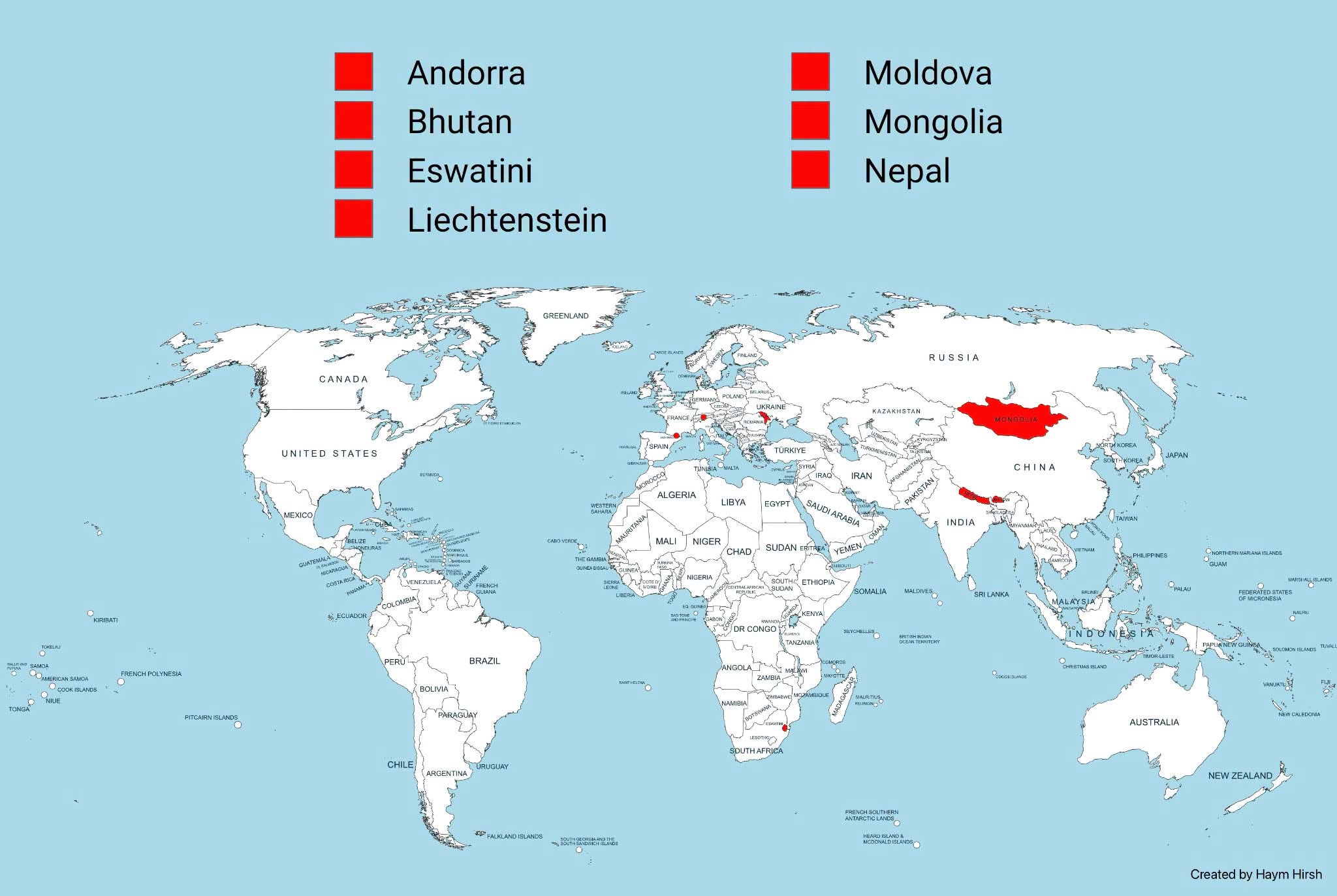
From Terrible Maps. Guess what all these countries have in common. (First answer gets warm congratulations in the comments.)
The University at Buffalo Student Association featured a festival menu for the multicultural event.
The problem?
Calling falafel “Israeli.”
Students were so outraged by the mere acknowledgment that Israel exists that the menu was removed and an apology had to be issued.
For Jewish students, intimidation and identity-based bullying have become normalized where culture is erased, food is targeted, and simply acknowledging Jewish or Israeli identity can invite punishment.
A man turned his window into a special place after he began receiving daily visits from a great kiskadee, which soon started bringing its friends to enjoy it together. https://t.co/v3bq0u2Crl
And one from Dr. Cobb. Look at these adorable Pallas Cat kittens!
Tibetan nature photographer Gaihe Badeng (改合巴登) captured this Aug 2025 video in Zhidoi County, Yushu Tibetan Autonomous Prefecture.This family of manuls (Pallas' cat, Otocolobus manul) is a typical size: 3-4 kittens + mom.I'm going to need a ticket to Tibet & an extra-large backpack, please. 🐈🎒
Winter Quarter my Second Year at UC (1985), I finished midterms and calculated that I had 5,000 pages to read before the end of the Quarter. (Yes, I read them.)
In my first year at engineering school I had two required semesters of Great Books in which we read and had to write reports on the Bible, a couple Greek plays, The Iliad, The Prince, Hamlet, King Lear, Faust, Canterbury Tales, Tolstoy, and others that I don’t remember. And that was for us non-literate engineers!
I don’t think universities can correct students’ inability to focus attention on longer works of literature, unless they begin with remedial courses that train students gradually to increase their ability to read longer works. Maybe reading labs? The problem starts years before freshmen hit campus.
My B.A. (early 1990s) in Middle East politics was reading heavy and a (2002) law degree… forgetaboutit!
A law degree is a HUGE amount of reading, hundreds of cases.
I agree that that monstrosity must be torn down. But good luck with that:
President Donald Trump has described the concrete being used for the White House ballroom project as “nuclear concrete” and “indestructible concrete,” stating that it is the same high-strength material used in nuclear power plants and designed to withstand a nuclear blast.
Key details of what he and his administration have said about the material include:
Strength and Durability: Trump claimed the columns and structure are made with concrete so hard that “you could take a jackhammer and go to those columns and stand there for two days at full blast and you wouldn’t even see a mark”. In earlier remarks from May 2026, he specifically referred to it as “9,000-pound concrete”.
Designed Against Demolition: Trump asserted that the material and steel-reinforced structure are built so tough that future Democratic administrations would find it “practically impossible” or physically unfeasible to tear down or undo the 90,000-square-foot addition.
Legal Defense Arguments: In court filings and statements regarding legal challenges to the project, Trump’s legal defense team similarly argued to the Supreme Court that the concrete-and-steel superstructure has advanced so far with “indestructible concrete” that deconstructing it would be virtually impossible
The claims about the concrete and construction are interesting, but should be taken with a very, very large grain of salt, given his history with contractors that cut corners, used materials that did not meet specification, improperly followed design requirements, and the like. There is a recent case, but a long list in his past, as well.
It may well be that, in this case, the err is to the side of difficult to remove below grade, but everything above grade is likely quite removable, with determination.
THe argument to the court that the structure is ‘virtually impossible’ to deconstruct is interesting, but given the ongoing legal turmoil, and the, honestly, irrelevancy it has as to the legality of the process, might not be taken in the light the defense team intends.
As to methods of deconstruction: Been there, done that on difficult structures. Abrasive chain and oxygen lance are two methods that come to mind (large oxy lance jobs were always interesting), and there are others. Time required? sure. Cheap? Not as cheap as a couple 30T excavators were, but far from impossible, and mostly straightforward.
To me, these statements (Not a lawyer) might be taken as spiteful and willfully defiant to bypass/violate regulations and ongoing legal process.
Early on in Trump’s career, it was suggested, possibly even started, by DJT that his visage should be up there on Mt Rushmore. Given the relative ease he had devaluing The White House, I wouldn’t put it past him to try.
“Preservation architects, including members of the National Trust for Historic Preservation, argue that an addition larger than the primary residence violates basic rules of architectural hierarchy… wings and annexes are designed to frame and defer to the central house rather than visually overpower it. ”
(from AI, Architectural Proportion and Symmetry.)
Of course only the Greatest Ever materials are suitable for his monument. If Trump were a reader he’d enjoy Shelley’s Ozymandias, taking a different moral from the story — inferior workmen and materials betrayed the Great Leader, but his name lives on, so he was a Winner not a Loser.
And Moldavia isn’t ENTIRELY landlocked (check google earth) – some articles on it. They still have a tiny sea frontage, a pinch the width of a few blocks where they’ve put in a port.
D.A.
NYC
ps Sikkim was a country until 1975 until it joined India, presumably in fear of Chinese hegemony. Would love to visit.
I keep getting posts in my feed about the airline shutdown being a scandal, connected to Sean Duffy who was a FOX news co-host before Trump appointed him as Transportation Secretary. It was Duffy who decided to have the local upgrade to fiber optics, I guess to enable communications to be tied to a new AI system, but the older parts of the system could not handle it. And now he is demanding $50 billion to overhaul the system, while formerly there was resistance to a much more modest upgrade and of course the earlier cuts in FAA personnel from Elon Musk and DOGE. And of course Duffy is blaming the Biden admin. for the fracas and not current incompetence.
Rumor here in D.C. is that the DOJ has been ordered to look for any former Olympians in Arkansas who can be charged with felon vandalism of the router.
I don’t know your situation, Brian, and I’m off the market but if I had ANY advice for young men in the dating game my main piece of advice would be: “LEARN TO COOK.”
It is a mating/dating superpower.
best,
D.A.
NYC
Western women convert to Islam mainly for one reason: They want to stop their loose/louche lifestyle of men, drugs and drinking, etc., get some kind of self-discipline and still piss off their parents. And… no kidding.. some just like the aesthetics.
Only s/t like 10-20% stick with it over the long term.
There’s a Five Guys restaurant starting up next to me after two years of renovation from a bank (not unique in NY). EVERYTHING here is too expensive* but I’d like to try it when (if) it eventually opens.
D.A.
NYC
*Come to Manhattan, swoon and faint at the price tags.
Unpopular opinion: the new ballroom needs a similar-sized building on the other side to make the ensemble look balanced. 😳
Unpopular opinion 2: Western countries are sending much too high a fraction of young people to university (it’s too expensive and achieves little for people 30 or 40 percentiles down the ability range). The fraction should be about 20%, and we should achieve that by stopping mollycoddling students and demanding much more of them.
So much to reflect on in this post, but at the risk of breaking Roolz, I’ll keep it short.
The Canada Goose rescue was a beautiful thing. (Even though most of our waterfront parks are covered with Canada Goose p**p.)
And about reading. To today’s students, reading seems to be a burden, which is sad. It would be hard to imagine undergraduates reading Darwin’s Origin of Species. Darwin wrote the book for a general audience, so undergraduate students should be able to handle it. But apparently, they can’t. Maybe they’re too busy texting! Certainly, they’ve gotten used to written material coming in small bites, which I expect is part of the problem.
Are they redeemable? Or is college too late to develop the habit of reading?
As I suggested in a different context on the weekend, universities want to indigenize anyway so they should go for it: abandon reading altogether, and embrace oral culture. Stage plays, radio news shows, soapbox oratory, podcasts. Meet the students where they are.
/s
“We’re sorry Herr Fuhrer that we included a reference to Israel in our recent menu listing. We understand that the Jewish people are vermin and that recognizing their cultural contributions inflicts trauma on the population of the Reich. We’ll be sure to be more mindful in the future.”
OK, I know Israel wasn’t a country when Hitler was in power, but the spirit is the same: forced policing of language and activity to denigrate anything related to Jewish or Israeli history. It used to be uneducated white guys with armbands, now it’s the cool college kids with head scarves.
There’s also this little item reported from the UK at reason.com. Apparently supporting Israel resulted in a visit from the police and having her medical records altered to record her as a ‘vulnerable adult’…
What is it with megalomaniacs and concrete? Nazi Germany left behind a variety of structures that are just too massive to remove–flak towers, bunkers, etc. Some of the Nazi U-boat pens have roofs of 8 meter thick reinforced concrete. Now that I think of it, the ball room does resemble a U-boat pen. Perhaps its interior could be flooded so that the White House could host boat races.
I go through several books per week. Just returned from a weekly trip to the public library. However, public libraries are not the same as what they used to be–the ones in my area are now repositories of multiple types of media (books, videos, games, even art), and also function as community/meeting centers. The younger folks are usually doing homework on their laptops & socializing. I don’t see them reading or checking out books.
About the map: I also vote for landlocked & bordering only up to two other countries. This eliminates Bolivia and some African countries.
Colleges of Education demonized Phonics First for a century, with the most aggressive period being mid to end 20th century.
It was part of the March Through the Institutions, and spearheaded by Paulo Freire. Even when the “Whole Language” activists admitted their way was wrong, the standard has not shifted.
Schools of Ed do not teach new teachers how to teach reading.
I’ve watched the last few seconds of the chopsticks catching the upper stage of Starship at least a dozen times! It’s an incredible engineering feat and I’m in total awe of how SpaceX has been able to design and execute the entire system.
As to the value of a life, or the judgment of one well-lived, I’ll save further thoughts should Jerry devote a post to it. But I will note here that a physician who saves many lives is only the most visible point of that sequence. Of course, we realize the physician generally works with a team of other medical professionals. We less often think of the people who made the entire enterprise possible: those largely unheralded men and women who built and maintain the transportation required to get to that life-saving work; those who supply clean water to sustain the physician’s own life; the others who constructed the electrical grid; still more who fed the entire medical team, from crops and livestock in the field, to processing, to truck and train, and so on.
I feel a passage coming on about unvisited tombs, so I’ll stop now!
https://jmarriott.substack.com/p/the-dawn-of-the-post-literate-society-aa1
Excerpt: ” …it is no accident, that the growth of print culture in the eighteenth century was associated with the growing prestige of reason, hostility to superstition, the birth of capitalism, and the rapid development of science. Other historians have linked the eighteenth century explosion of literacy to the Enlightenment, the birth of human rights, the arrival of democracy and even the beginnings of the industrial revolution.”
The post-literate society we are now entering will presumably move in the opposiote direction. Is this trend already detectable?
In regard to Comment #14: On Youtube, narrators with American accents are particularly likely to mispronounce non-English names—by applying irregular features of English pronunciation instead of simple phonics. Example: reference to the Red army’s 1944 Bagration campaign as Bagrayshun. This tendency to mangle foreign pronunciations might be a result of learning to read by the “whole language” method long favored in US schools of Ed, rather than phonics. In other words, the avoidance of teaching by phonics damages Americans’ later ability to manage other languages.
Andrew Sullivan demands Trump step down due to the massive midterm swing against him. But to be fair, I had to wonder: did Sullivan demand Obama step down in 2010 after an even bigger midterm swing?
Indeed. People have different opinions, and I might disagree very strongly with some opinions. But, except for the most extreme ones, I’m more comfortable with that than with someone who makes use of double standards. An example is the Democratic idea to pack the supreme court when they are in a position to do so, but had the Republicans did the same thing, the scorn would be great indeed.
I really enjoyed the goose video. As a young man on a work trip to Hilversum in Holland I saw something similar nearly 40 years ago and it has always stuck with me. That time it was a young Dutch boy doing the good deed. He was probably just 12 years old or so. He had got right into a lake and he was wading, what was he doing? Suddenly there was a flurry, he was holding up one of those plastic moldings that hold a six pack together, yelling in triumph. He’d freed a swan from misery.






Winter Quarter my Second Year at UC (1985), I finished midterms and calculated that I had 5,000 pages to read before the end of the Quarter. (Yes, I read them.)
In my first year at engineering school I had two required semesters of Great Books in which we read and had to write reports on the Bible, a couple Greek plays, The Iliad, The Prince, Hamlet, King Lear, Faust, Canterbury Tales, Tolstoy, and others that I don’t remember. And that was for us non-literate engineers!
I don’t think universities can correct students’ inability to focus attention on longer works of literature, unless they begin with remedial courses that train students gradually to increase their ability to read longer works. Maybe reading labs? The problem starts years before freshmen hit campus.
Yes. It’s a mistake to make the colleges responsible for teaching these skills.
I read 40 books one quarter at Stanford, half of them in French.
Dr Brydon, which UC did you attend?
My B.A. (early 1990s) in Middle East politics was reading heavy and a (2002) law degree… forgetaboutit!
A law degree is a HUGE amount of reading, hundreds of cases.
How do they teach law these days?
D.A.
NYC
Sorry, University of Chicago. About six years before Jerry got there.
Thanks, so not Berkeley or UCLA.
I agree that that monstrosity must be torn down. But good luck with that:
The only answer is to rename it . . . open for suggestions. Donald J. Trump Institute for Diversity, Equity, and Inclusion? Ukranian Embassy? Help me!
The Obama and Biden Ballroom.
The claims about the concrete and construction are interesting, but should be taken with a very, very large grain of salt, given his history with contractors that cut corners, used materials that did not meet specification, improperly followed design requirements, and the like. There is a recent case, but a long list in his past, as well.
It may well be that, in this case, the err is to the side of difficult to remove below grade, but everything above grade is likely quite removable, with determination.
THe argument to the court that the structure is ‘virtually impossible’ to deconstruct is interesting, but given the ongoing legal turmoil, and the, honestly, irrelevancy it has as to the legality of the process, might not be taken in the light the defense team intends.
As to methods of deconstruction: Been there, done that on difficult structures. Abrasive chain and oxygen lance are two methods that come to mind (large oxy lance jobs were always interesting), and there are others. Time required? sure. Cheap? Not as cheap as a couple 30T excavators were, but far from impossible, and mostly straightforward.
To me, these statements (Not a lawyer) might be taken as spiteful and willfully defiant to bypass/violate regulations and ongoing legal process.
Early on in Trump’s career, it was suggested, possibly even started, by DJT that his visage should be up there on Mt Rushmore. Given the relative ease he had devaluing The White House, I wouldn’t put it past him to try.
“Preservation architects, including members of the National Trust for Historic Preservation, argue that an addition larger than the primary residence violates basic rules of architectural hierarchy… wings and annexes are designed to frame and defer to the central house rather than visually overpower it. ”
(from AI, Architectural Proportion and Symmetry.)
Of course only the Greatest Ever materials are suitable for his monument. If Trump were a reader he’d enjoy Shelley’s Ozymandias, taking a different moral from the story — inferior workmen and materials betrayed the Great Leader, but his name lives on, so he was a Winner not a Loser.
The map: landlocked countries bordering on two countries???
Sharp!, but are you sure Bhutan does not have a border with Sikkim?
Is Sikkim internationally recognized as a country?
Ah, it is a state of India (per google search).
And Moldavia isn’t ENTIRELY landlocked (check google earth) – some articles on it. They still have a tiny sea frontage, a pinch the width of a few blocks where they’ve put in a port.
D.A.
NYC
ps Sikkim was a country until 1975 until it joined India, presumably in fear of Chinese hegemony. Would love to visit.
According to google maps the last 20 yards to the sea in the southwestern part of the Moldavian border close to the sea belongs to Ukraine.
When i lived in China in the 80s, Sikkim had country status, on maps at least. I hadn’t even heard of it before then, but I was young.
I keep getting posts in my feed about the airline shutdown being a scandal, connected to Sean Duffy who was a FOX news co-host before Trump appointed him as Transportation Secretary. It was Duffy who decided to have the local upgrade to fiber optics, I guess to enable communications to be tied to a new AI system, but the older parts of the system could not handle it. And now he is demanding $50 billion to overhaul the system, while formerly there was resistance to a much more modest upgrade and of course the earlier cuts in FAA personnel from Elon Musk and DOGE. And of course Duffy is blaming the Biden admin. for the fracas and not current incompetence.
Rumor here in D.C. is that the DOJ has been ordered to look for any former Olympians in Arkansas who can be charged with felon vandalism of the router.
😹😹former Olympians.
Also heard Mayor Pete B being blamed🙀
Learning to make home-made food improved my life intangibly – and also tangibly – like, as in — moolah.
That is, learn to use commercial food strategically – or, ideally, replicate it.
Always something new to find. “Today” is always the best day to start – food is literally vital.
🥄🥖🍴
I don’t know your situation, Brian, and I’m off the market but if I had ANY advice for young men in the dating game my main piece of advice would be: “LEARN TO COOK.”
It is a mating/dating superpower.
best,
D.A.
NYC
Can confirm 🥖😁🍷
/AccidentalBiblicalEmojiReferences
But to show a girl your cooking skills you’d have to get her to your apartment, which is goal achieved already so why waste time cooking?
They are landlocked? And don’t tear down the ballroom! You would end up having to build an another one. Ballrooms are essential for good government.
Ukraine seems to have gravely crippled Kerch Bridge in Crimea.
Western women convert to Islam mainly for one reason: They want to stop their loose/louche lifestyle of men, drugs and drinking, etc., get some kind of self-discipline and still piss off their parents. And… no kidding.. some just like the aesthetics.
Only s/t like 10-20% stick with it over the long term.
There’s a Five Guys restaurant starting up next to me after two years of renovation from a bank (not unique in NY). EVERYTHING here is too expensive* but I’d like to try it when (if) it eventually opens.
D.A.
NYC
*Come to Manhattan, swoon and faint at the price tags.
Unpopular opinion: the new ballroom needs a similar-sized building on the other side to make the ensemble look balanced. 😳
Unpopular opinion 2: Western countries are sending much too high a fraction of young people to university (it’s too expensive and achieves little for people 30 or 40 percentiles down the ability range). The fraction should be about 20%, and we should achieve that by stopping mollycoddling students and demanding much more of them.
So much to reflect on in this post, but at the risk of breaking Roolz, I’ll keep it short.
The Canada Goose rescue was a beautiful thing. (Even though most of our waterfront parks are covered with Canada Goose p**p.)
And about reading. To today’s students, reading seems to be a burden, which is sad. It would be hard to imagine undergraduates reading Darwin’s Origin of Species. Darwin wrote the book for a general audience, so undergraduate students should be able to handle it. But apparently, they can’t. Maybe they’re too busy texting! Certainly, they’ve gotten used to written material coming in small bites, which I expect is part of the problem.
Are they redeemable? Or is college too late to develop the habit of reading?
As I suggested in a different context on the weekend, universities want to indigenize anyway so they should go for it: abandon reading altogether, and embrace oral culture. Stage plays, radio news shows, soapbox oratory, podcasts. Meet the students where they are.
/s
“We’re sorry Herr Fuhrer that we included a reference to Israel in our recent menu listing. We understand that the Jewish people are vermin and that recognizing their cultural contributions inflicts trauma on the population of the Reich. We’ll be sure to be more mindful in the future.”
OK, I know Israel wasn’t a country when Hitler was in power, but the spirit is the same: forced policing of language and activity to denigrate anything related to Jewish or Israeli history. It used to be uneducated white guys with armbands, now it’s the cool college kids with head scarves.
Or in the case of Hunter College and several others, having Muslim student presidents and vice-presidents.
Sorry, I feel a need to fix your last sentence, Darryl.
“…now it’s the college kids who think they’re cool with tea towels on their heads.”
There’s also this little item reported from the UK at reason.com. Apparently supporting Israel resulted in a visit from the police and having her medical records altered to record her as a ‘vulnerable adult’…
https://reason.com/2026/11/16/brickbat-too-curious/
What is it with megalomaniacs and concrete? Nazi Germany left behind a variety of structures that are just too massive to remove–flak towers, bunkers, etc. Some of the Nazi U-boat pens have roofs of 8 meter thick reinforced concrete. Now that I think of it, the ball room does resemble a U-boat pen. Perhaps its interior could be flooded so that the White House could host boat races.
I go through several books per week. Just returned from a weekly trip to the public library. However, public libraries are not the same as what they used to be–the ones in my area are now repositories of multiple types of media (books, videos, games, even art), and also function as community/meeting centers. The younger folks are usually doing homework on their laptops & socializing. I don’t see them reading or checking out books.
About the map: I also vote for landlocked & bordering only up to two other countries. This eliminates Bolivia and some African countries.
Colleges of Education demonized Phonics First for a century, with the most aggressive period being mid to end 20th century.
It was part of the March Through the Institutions, and spearheaded by Paulo Freire. Even when the “Whole Language” activists admitted their way was wrong, the standard has not shifted.
Schools of Ed do not teach new teachers how to teach reading.
I suspect that your comment would be truer if you were to remove the last word…
Yes, the Schools of Ed don’t teach teachers how to teach math, either.
I’ve watched the last few seconds of the chopsticks catching the upper stage of Starship at least a dozen times! It’s an incredible engineering feat and I’m in total awe of how SpaceX has been able to design and execute the entire system.
As to the value of a life, or the judgment of one well-lived, I’ll save further thoughts should Jerry devote a post to it. But I will note here that a physician who saves many lives is only the most visible point of that sequence. Of course, we realize the physician generally works with a team of other medical professionals. We less often think of the people who made the entire enterprise possible: those largely unheralded men and women who built and maintain the transportation required to get to that life-saving work; those who supply clean water to sustain the physician’s own life; the others who constructed the electrical grid; still more who fed the entire medical team, from crops and livestock in the field, to processing, to truck and train, and so on.
I feel a passage coming on about unvisited tombs, so I’ll stop now!
https://jmarriott.substack.com/p/the-dawn-of-the-post-literate-society-aa1
Excerpt: ” …it is no accident, that the growth of print culture in the eighteenth century was associated with the growing prestige of reason, hostility to superstition, the birth of capitalism, and the rapid development of science. Other historians have linked the eighteenth century explosion of literacy to the Enlightenment, the birth of human rights, the arrival of democracy and even the beginnings of the industrial revolution.”
The post-literate society we are now entering will presumably move in the opposiote direction. Is this trend already detectable?
Comment by Greg Mayer
Re the Ballroom:
To modify a phrase often used in skeptical circles: “What can be built without permission, can be taken down without permission.”
GCM
https://jmarriott.substack.com/p/the-dawn-of-the-post-literate-society-aa1
Excerpt: ” …it is no accident, that the growth of print culture in the eighteenth century was associated with the growing prestige of reason, hostility to superstition, the birth of capitalism, and the rapid development of science. Other historians have linked the eighteenth century explosion of literacy to the Enlightenment, the birth of human rights, the arrival of democracy and even the beginnings of the industrial revolution.”
The post-literate society we are now entering will presumably move in the opposiote direction. Is this trend already detectable?
In regard to Comment #14: On Youtube, narrators with American accents are particularly likely to mispronounce non-English names—by applying irregular features of English pronunciation instead of simple phonics. Example: reference to the Red army’s 1944 Bagration campaign as Bagrayshun. This tendency to mangle foreign pronunciations might be a result of learning to read by the “whole language” method long favored in US schools of Ed, rather than phonics. In other words, the avoidance of teaching by phonics damages Americans’ later ability to manage other languages.
Andrew Sullivan demands Trump step down due to the massive midterm swing against him. But to be fair, I had to wonder: did Sullivan demand Obama step down in 2010 after an even bigger midterm swing?
Indeed. People have different opinions, and I might disagree very strongly with some opinions. But, except for the most extreme ones, I’m more comfortable with that than with someone who makes use of double standards. An example is the Democratic idea to pack the supreme court when they are in a position to do so, but had the Republicans did the same thing, the scorn would be great indeed.
I really enjoyed the goose video. As a young man on a work trip to Hilversum in Holland I saw something similar nearly 40 years ago and it has always stuck with me. That time it was a young Dutch boy doing the good deed. He was probably just 12 years old or so. He had got right into a lake and he was wading, what was he doing? Suddenly there was a flurry, he was holding up one of those plastic moldings that hold a six pack together, yelling in triumph. He’d freed a swan from misery.