
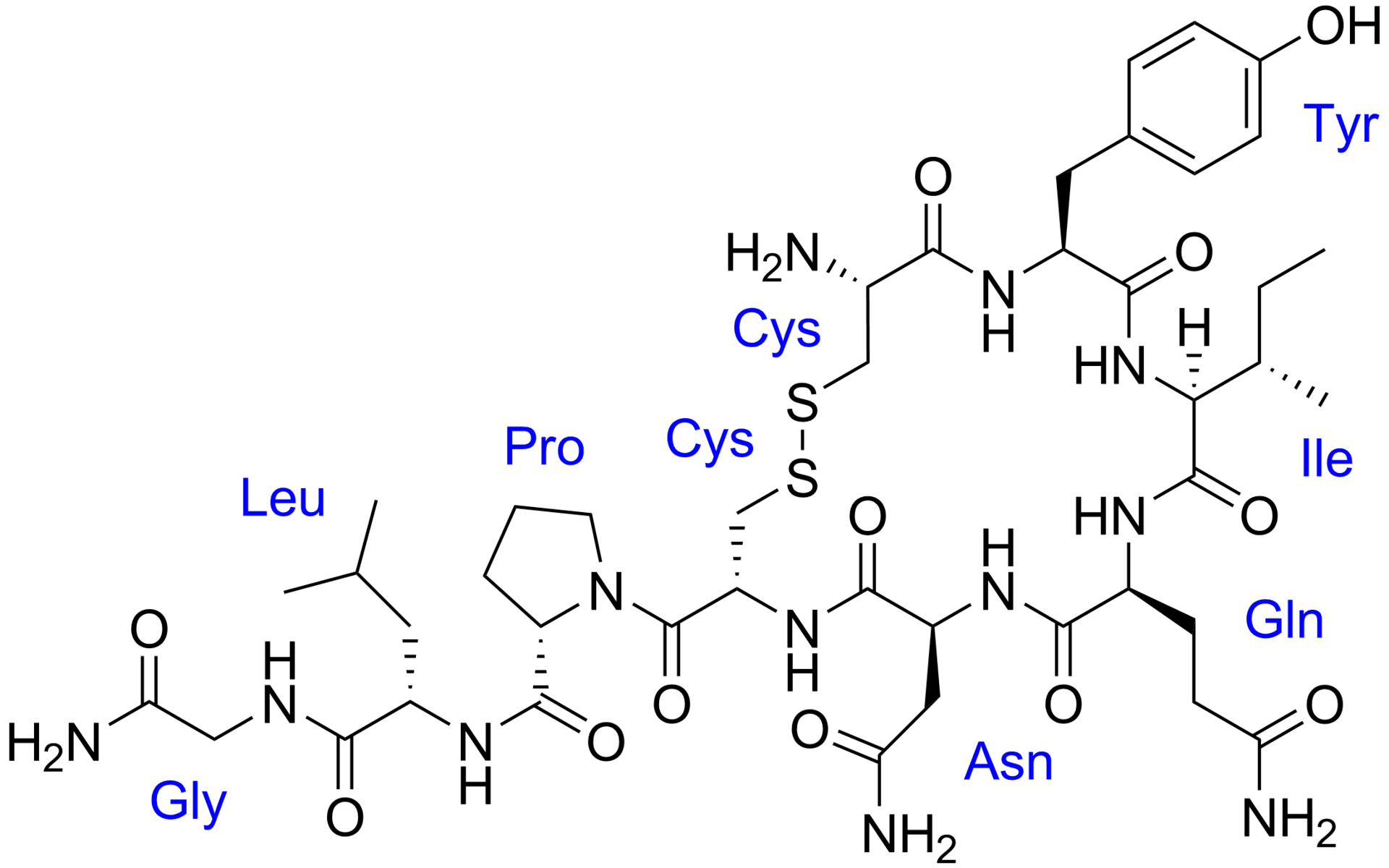
We’re back with another Caturday post with three—count them, three—items of substance, and two of lagniappe. The first one is from The Independent; the “love hormone: turns out to be oxytocin, which has this complex structure (it’s a neuropeptide, with the amino acid residues labeled):
Click the headline to read how the “love hormone” soothes us when we interact with cats:

An excerpt (indented):
Cats may have a reputation for independence, but emerging research suggests we share a unique connection with them – fuelled by brain chemistry.
The main chemical involved is oxytocin, often called the love hormone. It’s the same neurochemical that surges when a mother cradles her baby or when friends hug, fostering trust and affection. And now studies are showing oxytocin is important for cat-human bonding too.
Oxytocin plays a central role in social bonding, trust and stress regulation in many animals, including humans. One 2005 experiment showed that oxytocin made human volunteers significantly more willing to trust others in financial games.
Oxytocin also has calming effects in humans and animals, as it suppresses the stress hormone cortisol and activates the parasympathetic nervous system (the rest and digest system) to help the body relax.
Scientists have long known that friendly interactions trigger oxytocin release in both dogs and their owners, creating a mutual feedback loop of bonding. Until recently, though, not much was known about its effect in cats.
Cats are more subtle in showing affection. Yet their owners often report the same warm feelings of companionship and stress relief that dog owners do – and studies are increasingly backing these reports up. Researchers in Japan, for example, reported in 2021 that brief petting sessions with their cats boosted oxytocin levels in many owners.
In that study, women interacted with their cats for a few minutes while scientists measured the owners’ hormone levels. The results suggested that friendly contact (stroking the cat, talking in a gentle tone) was linked to elevated oxytocin in the humans’ saliva, compared with a quiet resting period without their cat.
Many people find petting a purring cat is soothing, and research indicates it’s not just because of the soft fur. The act of petting and even the sound of purring can trigger oxytocin release in our brains. One 2002 study found this oxytocin rush from gentle cat contact helps lower cortisol (our stress hormone), which in turn can reduce blood pressure and even pain.
Research is pinpointing specific moments that cause the release of this hormone in our cross-species friendship. Gentle physical contact seems to be a prime trigger for cats.
A February 2025 study found that when owners engaged in relaxed petting, cuddling or cradling of their cats, the owners’ oxytocin tended to rise, and so did the cats’ – if the interaction was not forced on the animal.
The researchers monitored oxytocin in cats during 15 minutes of play and cuddling at home with their owner. Securely attached cats who initiated contact such as lap-sitting or nudging showed an oxytocin surge. The more time they spent close to their humans, the greater the boost.
. . . Are cats just less loving than d*gs?
It’s true that studies generally find stronger oxytocin responses in dog–human interactions. In one widely discussed 2016 experiment, scientists measured oxytocin in pets and owners before and after ten minutes of play. Dogs showed an average 57% spike in oxytocin levels after playtime, whereas cats showed about a 12% increase.
This is of course because d*gs have been bred to be worshipful sycophants, while cats retain a measure of independence. At any rate, words to remember:
So, next time your cat blinks slowly from across the sofa or climbs on to your lap for a purr-filled cuddle, know that something invisible is happening too: oxytocin is rising in both your brains, deepening the trust and soothing the stress of daily life. Cats, in their own way, have tapped into the ancient biology of love.
********************
Meet Cleopatra, who, in this 7-minute video, gets groomed for the first time. She’s “severely compacted” rather than matted, with tons of shedded undercoat remaining in her fur. There is a ton of fur. She even gets her nails cut and has a bath, but, with her hoodie and cone, she remains relatively calm. As the groomer says, “[Cleopatra] was an absolute pleasure to work with.”
I don’t know if amost groomers are this kind and thorough, and of course she knows she’s on camera, but if I had a fur-clogged moggy I’d take her to this person.
********************
This article, from MetLife Pet Insurance (click screenshot to read) is full of useful information. Which states are “dog states” versus “cat states”? Which cities have the most of the best pets versus d*gs?
Here’s the method behind the survey, and realize that the same is not all that large. Also, determining the “leaning” of cities and states is done by using Internet searches, which is dubious. But let’s assume for the time being that the results are fairly accurate:
This survey, conducted by Fractl on behalf of MetLife on July 7, 2026, gathered responses from 1,005 U.S. adults to settle America’s dog-versus-cat divide and uncover how pet preference aligns with personality, lifestyle, and relationships. Respondents had an average age of 42; 50% identified as men, 49% as women, 1% as nonbinary, and under 1% declined to specify their gender. Generationally, 35% were baby boomers or Gen X, 47% were millennials, and 18% were Gen Z. Of those surveyed, 84% were pet owners: 39% owned a dog only, 24% owned a cat only, and 21% lived in multi-species households with both a dog and a cat, while 16% had no pets at the time of the survey.
In addition to the survey, Fractl analyzed Google search volume data from June 2025 to May 2026 to determine each state’s and major city’s dominant pet preference. The research reviewed 84 dog- and cat-related search terms, organized into 40 matched dog-versus-cat pairs (such as “puppy adoption” vs. “kitten adoption” and “dog park near me” vs. “cat cafe near me”), across all 50 states, the District of Columbia, and 55 major metropolitan areas.
Because dog-related terms out-search cat-related terms nationwide, researchers measured each location’s relative lean, meaning its share of paired dog searches compared with the national average, rather than raw volume, so that a “Dog State” or “Cat State” leans relative to the rest of the country rather than in absolute terms. Researchers weighted all 40 pairs equally and excluded four unpaired terms (“dog leash,” “dog walker,” “cat litter,” and “litter box”) that had no cross-species counterpart, to keep the index balanced.

*********************
The main results:
Mississippi, Wyoming, and South Carolina are America’s most dog-obsessed states, led by Mississippi, where dog-related searches run 120% above cat searches.
- Washington, Rhode Island, and Massachusetts are America’s most cat-obsessed states, anchoring a cat belt across the Pacific Northwest and New England.
- America splits 27 dog-leaning states to 23 cat-leaning states, plus Washington, D.C., a near-even national divide.
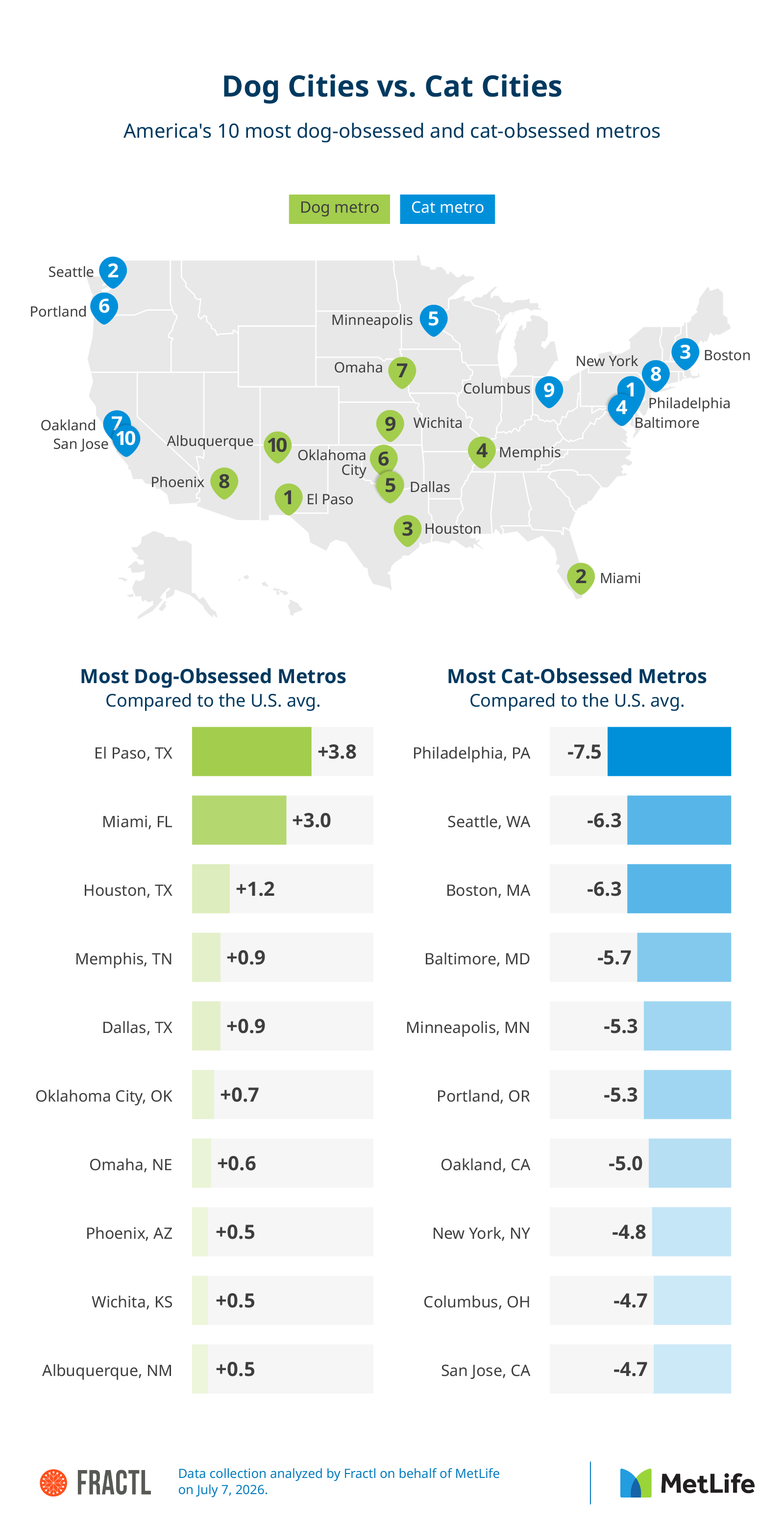
- El Paso, TX, is the most dog-obsessed metro in the country, and Philadelphia, PA, is the most cat-obsessed, with big cities leaning far more feline than the states around them.
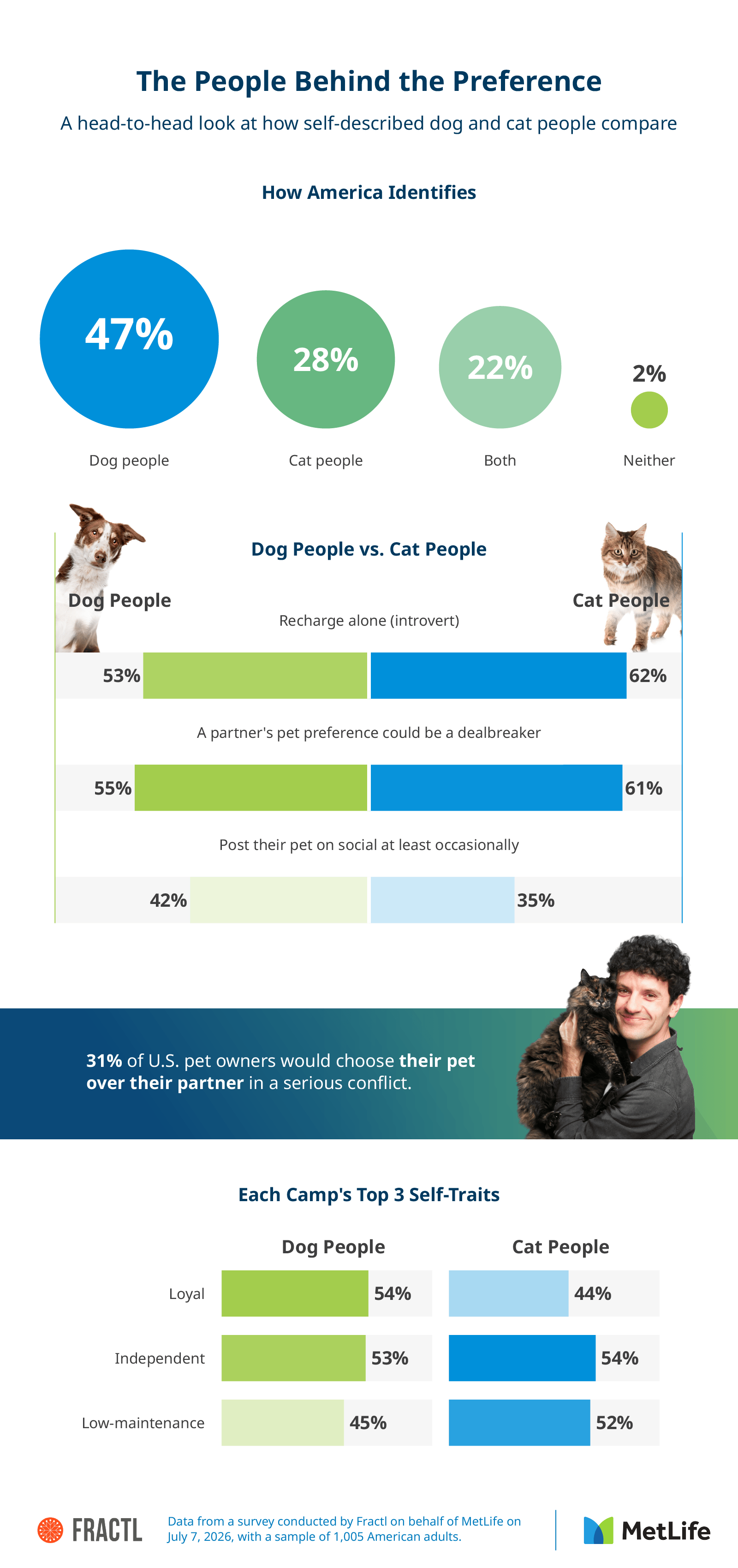
- Americans call themselves dog people over cat people by nearly 2 to 1 (47% vs. 28%).
- Nearly 1 in 3 U.S. pet owners (31%) would choose their pet over their partner in a serious conflict.
- Over 1 in 2 U.S. adults (57%) say a partner’s pet preference could be a dealbreaker, and 18% say a partner must share their preference, no exceptions.
The last result surprised me the most! Here’s the geographic split, which leads me to believe, to my satisfaction, that, compared to Republicans, Democrats are more likely to own cats than dogs: Somebody should do the correlation between percentage of Democrats versus percentage of cats (and ditto for Republicans). From the site:
Mississippi is the most dog-obsessed state in the country, where dog-related searches run 120% above cat searches. A dog belt runs through the Deep South and Mountain West, while a cat belt stretches across New England and the Pacific Northwest. Each state’s lean index below shows how far its dog-versus-cat search mix runs above or below the national average, with positive scores leaning dog and negative scores leaning cat.
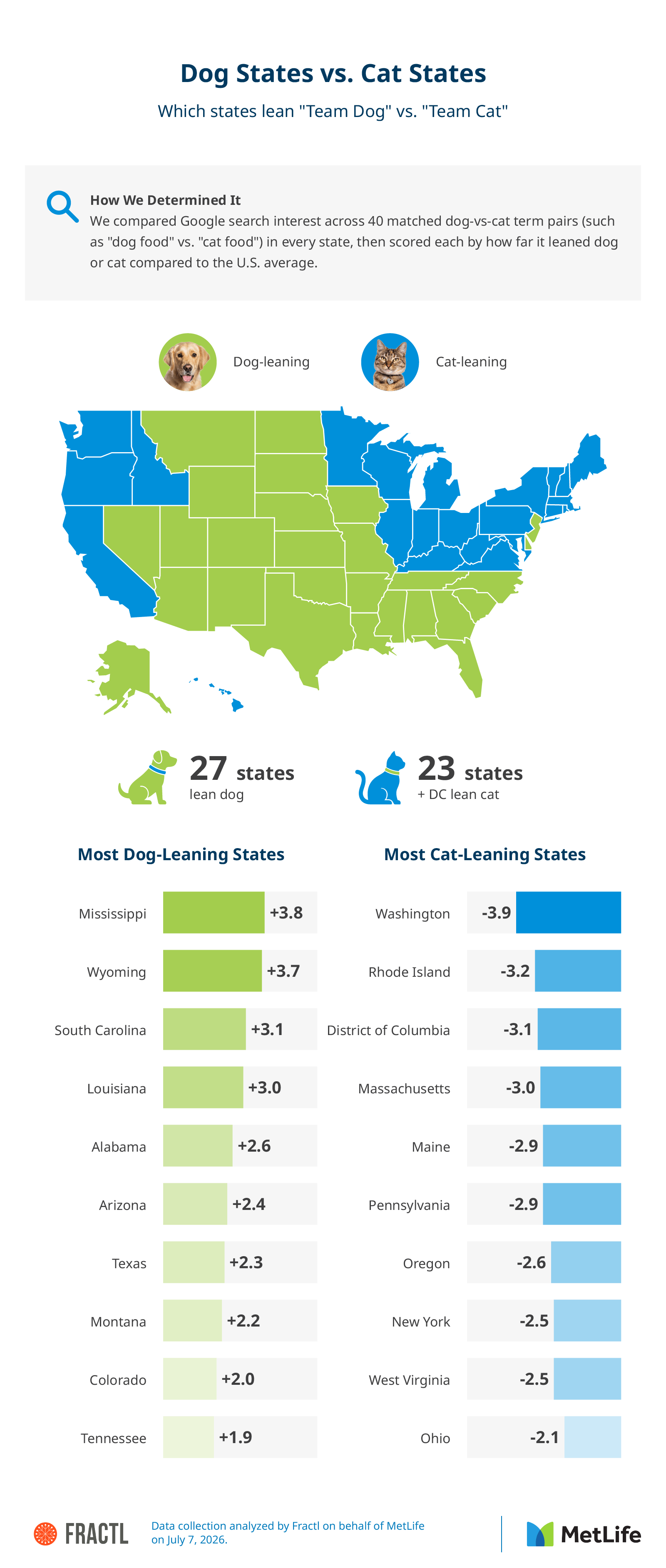
The East and West coasts have a relatively higher ownership of cats than do the middle-of-America states and the South.
And for cities:
El Paso is the most dog-obsessed metro in the country, with dog-related searches 135% above cat searches. The strongest dog metros cluster across the Sun Belt and South, mirroring the dog belt at the state level.
Philadelphia is the most cat-obsessed metro, and the cat list is dominated by coastal and tech hubs. Cities also polarize more than states. The most cat-obsessed metro leans nearly twice as feline as the most cat-obsessed state, so the divide sharpens in urban America.
And some psychology and behavior. I’m surprised that people post more on their dogs than their cats, but not that cat people tend to be more introvert-ish and judgmental about their partner’s pet preferences.
Make what you will of these data, and post it below.
**********************
Lagnaiappe:
Click below to learn how the police removed a bunch of ice to reach a cat (now named Cadence) trapped behind an ice machine (the news story is also on Chicago’s WGN news site):
More:
I can’t guarantee that this is real video, but I hope so:
Owners couldn’t figure out why the cat wasn’t sleeping in its bed.. then they saw this..🐈🐾😊 pic.twitter.com/D6a0a2ynkI
— Posts Of Cats (@PostsOfCats) January 27, 2025
h/t: Nicole, Erik
HA! i was talking to my sister last week and trying to describe the video that you posted at the end. Now I can send it to her!
Excellent piece on oxytocin and cats. Do the slow blink thing to elicit the oxytocin response. Rub the cat’s belly the wrong way to elicit the evisceration response.
I watched the entire cat grooming video. That groomer is amazing and the cat is tolerant. Once her skin stopped itching (the cat’s skin, that is) she seemed to like much of the grooming ritual.
Interesting survey results! I’m a bit surprised that Washington State is a cat state, as it seems to be dog heaven. Almost no one goes out without a dog. A young mother in my neighborhood pushes a stroller with a toddler, has a young boy by her side, a baby in her arms, and—wait for it—a big Labrador retriever on a leash alongside. Most communities have off-leash dog parks—usually occupied. And, despite signage meant to discourage the practice, people take their dogs into stores, even grocery stores. What can you do? Nothing.
I see cats outside with their owners rarely. I saw one on a leash last week. Last year I saw one being carried in a soft carrier by a couple out for a walk. But it wasn’t a cat. The cat was a rabbit.
So, if Washington State is a cat state and so many people are out and about with their dogs, there must be an even larger contingent of homebodies holed up indoors with their cats. Do they ever come out?
Happy Caturday!
I live in Seattle and am a cat person, and I know numerous other cat people here. Yes, d*gs are more visible, but I think that’s mostly because dogs have to be walked. So you see them out and about with the owners in a way that you will not see cats, who most of the time refuse to cooperate with a leash initiative. Our cat takes care of his exercise needs on his own (mostly).
Then there’s the barking. Dogs routinely announce themselves, often loudly and sometimes for an excessively extended duration. You can be a block away and still be aware of the presence of a dog over there. Walk past a yard containing dog and you likely will be aware of it every step of the way.
Interactions with cats are just different. They are smaller than most dogs, and those that are even allowed outdoors tend to prefer discrete solitary reconnaissance missions. (Not to mention that their excretory needs don’t involve the owners having to scoop their poop off the neighbor’s lawn). Walk past a yard in which a cat is resident and you may be observed every step while being none the wiser.
So… I don’t know if the methodology for this survey is sound, but I do think that the “eye test” for relative popularity can be quite misleading.
My oxytocin levels have risen! Thanks, Jerry!
Interesting caturday. Thanks!
I was on Team Dog when I was growing up. Then as an adult, when I had both dogs and cats, I joined Team Cat. What I enjoy most about cats is that they have such varied and interesting personalities, while dogs – and this is no slur on them – are basically all the same: Pant, pant, bark bark, I love you, there’s a leaf! where’s the food?
Perhaps the lack of an oxytocin response explains why one of our cats never wanted to sit on our laps or be petted, despite always wanting to be near us.
I admire how the young person in the “Cat would not sleep in its own bed” feature barely flinched when the cat first jumped on the pillow. Once, When I was a wee little tike , a cat landed on me while was flat on my back and my reaction was enough to roust the neighborhood.
I too watched the entire grooming video. It sparked memories of my cat Sofi. She was a long-hair who hated being brushed. I tried combing her as soon as we got her as a young kitten and she fought back immediately. Groomers would tell me when I picked her up not to bring her back again. Otherwise, she was extremely affectionate. I miss her!
I lived in Alexandria VA for a short while. I realize it’s not DC, but dogs everywhere. We lived in an area with many apartment buildings, but people still loved their big dogs. Retrievers all running around in a big field when people got home from work. Small and medium dogs too. You couldn’t take a walk down the sidewalk without dodging dozens of dogs. Guess the cats are all inside.
Very sweet video of dog and child getting their nightly oxytocin fix. Easy to believe it’s real.
I had long ago come to the conclusion that the majority of cat “owners,” especially those who had more than one cat, were Democrats since that has been my experience for decades. Some friends have had both cats and dogs; they were also mostly Dems. But the died-in-the-wool strictly dog people were almost without exception Republicans.
Cleopatra must be a very mellow cat, as most of mine would not have put up with that experience in such a calm manner. That groomer was certainly patient with her, which would have helped.
The oxytocin piece was enlightening and explained experiences I’ve had with some of my cats. One of them, Sammy, was semi-feral when I took him in about 6 years ago. He’s long-haired, and although he was always rather reclusive, I tried to get him accustomed to brushing, but he wasn’t interested. Last year, when I was finally able to get him to the vet, he had to have 15 teeth pulled; his recovery took a long time. He also probably has cerebellar hypoplasia, although the vet was not able to diagnose that. Sammy decided that brushing might not be all bad, so we developed a routine where I sat on the floor, and he came up between my legs to get brushed. By now he loves it and waits for me to brush him every morning – at which point he purrs, does the slow blink, and the oxytocin is obviously flowing for both of us. To get to that place with a formerly fairly wild cat is such a reward and is one of the reasons I will always love cats.
I like the site but is there a way to filter out cat content? Please?
Yes Do not read the cat content Or you can not read the website
The geography of cat and dog people is fascinating. I’m not quite sure how to interpret it. I know several people who like all animals and own both cats and dogs.
🐈🐕
Thank you for another lovely Caturday!
I have a long-haired cat who HATES being combed or brushed. I have to sneak it when she’s napping or watching TV. Her fur is matted, though she does groom herself, but not everywhere. Whenever I can brush/comb her I get LOTS of fur.
I had one other longhair (RIP), and he LOVED being brushed. He would purr and purr (oxytocin!) and beg to be brushed. He was also very particular about his self-grooming. His fur was magnificent.
I watched a few other videos at Cleopatra’s groomer’s site, and the groomer is kind and patient with all her felines. I need to find a groomer like her for my cat.
“Nearly 1 in 3 U.S. pet owners (31%) would choose their pet over their partner in a serious conflict.
Over 1 in 2 U.S. adults (57%) say a partner’s pet preference could be a dealbreaker, and 18% say a partner must share their preference, no exceptions.”
This is obvious to every cat staff.
Not that anyone asked, but for any who are just casually acquainted with peptide structure and who are scratching their head over the oxytocin structure, that Glycine(G) is the C-terminal residue. The carboxyl group is amidated, which is why at first glance it appears to be the N-terminal residue.
Like many peptide hormones, it is produced in a longer, precursor form, and is proteolytically excised from that. Just C-terminal to the glycine is a di-basic sequence, Lys(K)-Arg(R). A protease that recognized dibasic sequences clips after the Arg, and so partly-processed forms have been detected with the KR sequence retained. By memory, another enzyme that recognizes the GKR sequence clips that but leaves the alpha-amino nitrogen from the Lys, making the glycine C-terminally amidated.