
Just recently we were talking about chirality (“handedness”) in the molecules of life: organisms use only L amino acids in proteins and D sugars in the DNA ladder, although opposite-handed molecules exist. Why is this? For a while chemists have been trying to create a preference in “one handed” molecules via chemical reactions. And the two who just won the Chemistry Nobel Prize, Kenso Soai and Henri Kagan, succeeded. The Nobel Prize site gives a brief explanation:
The Royal Swedish Academy of Sciences has decided to award the Nobel Prize in Chemistry 2026 to Henri B. Kagan and Kenso Soai “for the discovery of non-linear effects and autocatalysis in asymmetric organic synthesis.”
Henri Kagan discovered a new way of manipulating chemical reactions, allowing a greater excess of one of the mirror images to be created than was previously assumed possible. His discovery has been revolutionary for chemists who develop reactions for the manufacture of pharmaceuticals, flavours, scents and new materials.
Kenso Soai designed the first chemical reaction in which only one of the potential mirror images was formed. Other than life itself, no one had ever achieved this feat. The Soai reaction is one of the most spectacular chemical experiments ever conducted.
And Science gives a bit more explanation:
Molecules can exist in mirror images of themselves—left- and right-handed versions. Yet the stuff of life, from the amino acids in our proteins to the sugars in DNA, has evolved a preference for one-handedness, or chirality. Why this asymmetry arose has long been a mystery, because ordinary chemical reactions tend to produce equal amounts of the two mirror images.
Today’s Nobel Prize in Chemistry honors Henri Kagan of the University of Paris-Sud and Kenso Soai of the Tokyo University of Science for discovering how chemistry can break that symmetry—and for providing clues to how life’s one-handed chemistry might have emerged.
“Their discoveries led to a chemical reaction that spontaneously, without the involvement of other chiral molecules, creates only one mirror image,” Heiner Linke, chair of the Nobel Prize Committee for Chemistry, said at a press conference this morning where the award was announced. “This is the first time this had happened since the processes that led to the chirality of life billions of years ago.”
For decades, drugmakers had struggled to create chemical reactions that would produce a one-handed form of a drug—a problem because mirror-image forms of the same drug molecule can have very different biological effects. For example, the right-handed drug Darvon is an opioid painkiller, whereas its left-handed form, Novrad, is a cough medicine. (The names are mirror images of each other as well.)
Chemists had long assumed that the handedness of a catalyst—a compound that speeds up a chemical reaction—would be transferred linearly to the molecules it produced. But in 1986, Kagan showed that wasn’t necessarily so. When left- and right-handed versions of a catalyst were mixed, he found, they formed combinations that behaved differently: Some barely drove the reaction at all. As a result, a small imbalance in the catalyst could produce a much larger imbalance in the product—a phenomenon known as a nonlinear effect. The discovery gave chemists a new way to drive reactions with a preference for one particular molecular handedness.
Soai put the idea into practice. In 1995, he showed that a reaction could amplify a tiny initial excess of one mirror image. Starting with just 2% excess, he ended with 87%. He continued to look for ways to improve, and in 2003, he demonstrated a reaction that could snowball on itself, amplifying a tiny, chance imbalance between the two mirror images, until more than 99% of the product had the same handedness.
“Taken together, the groundbreaking discoveries by Henri Kagan and Kenso Soai have reshaped our understanding of molecular chirality, how it is created, amplified, and transmitted,” prize committee member Peter Somfai said at the press conference.
We don’t yet have a theory why, say, L-amino acids predominate in life, but it could have been due to an initial tiny asymmetry that was amplified in the way described above, making one kind of amino acid more available for protein synthesis. As we discussed recently, “mirror life” made of opposite-handed molecules, like D amino acids, might pose dangers to the planet.
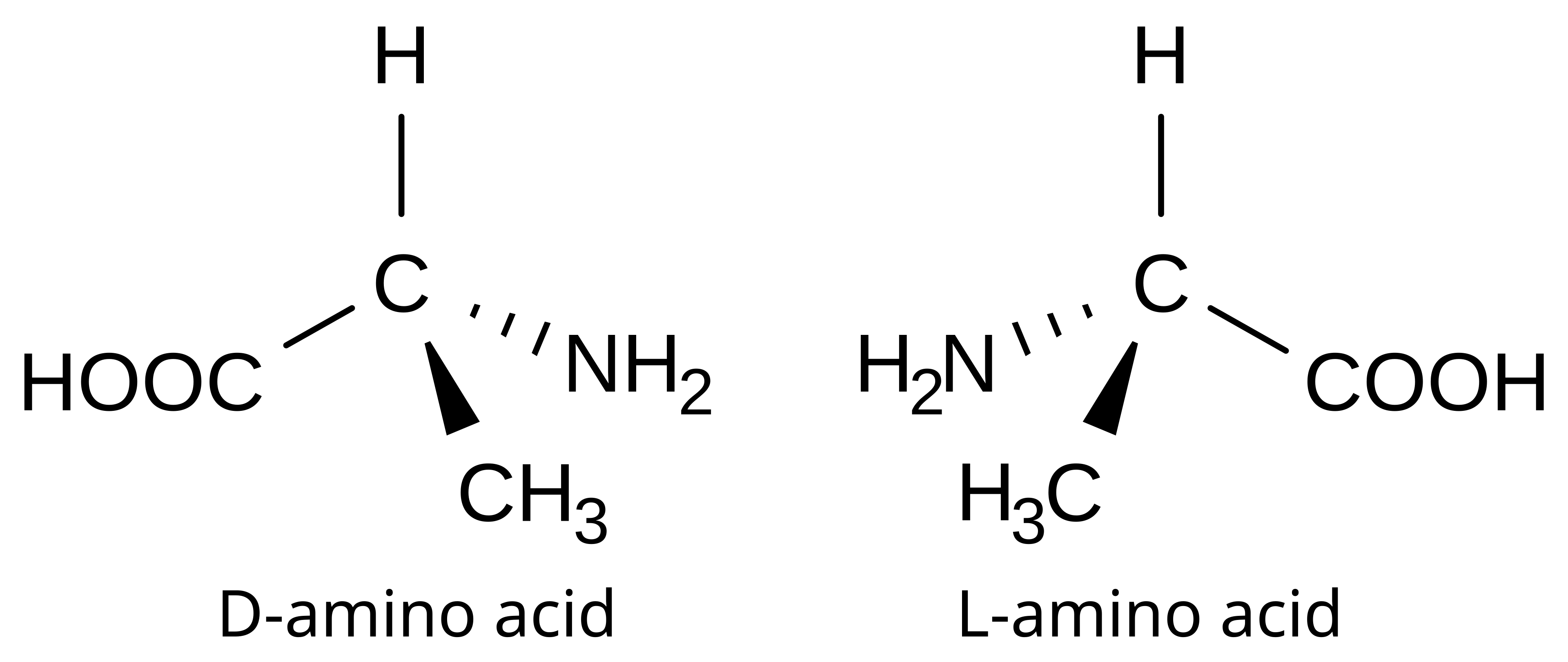
Here are the two mirror-image forms (called “isomers”) of the amino acid alanine, which cannot be superimposed on each other.
By the way, we don’t yet have 20 entries in our guess-the-Nobels-in-Literature-and-Peace prize, and if we don’t get to that limit before the deadline (5 p.m. Chicago time today), the contest is canceled. What a sad site this has become!
FYI, I am a lurker on this site and have been for a better part of the past year. I forget how I chanced upon it but I am a regular. The reason I share this is to rebut (at least partially) your comment on how this is a sad site! It is not.
While I did see your invite for the contest on Nobels earlier in the week, I did not participate for I didn’t feel qualified — I am not an academic or close to these fields. Just a curious person. Thank you for posting
I would have put in an entry, but the ones for which I can rationally make a guess are not part of the contest. But, I threw my two cents (rounded to zero, due to the loss of the penny) in, worthless as my guesses are
Fascinating that this particular prize went to people who worked on something I’ve actually heard of: the sinistrality of amino acids in biological systems. (I now read that sugars are mostly dextral. Had no idea.) I never worried about this molecular asymmetry much, thinking that I could always chalk it up to a random quirk that took place early on the chemical pathway toward the emergence of life. But I’m glad that others have continued to worry about it. It could still be just a random quirk, but maybe not.
I do worry, not daily but once in a while, about the possibility of engineering bacteria or viruses that have the “wrong” chirality. Maybe such microbes will be harmless because they won’t be able to infect their left-handed doppelgängers. But maybe not. It’s the maybe not that I worry about.