Why Evolution is True is a blog written by Jerry Coyne, centered on evolution and biology but also dealing with diverse topics like politics, culture, and cats.
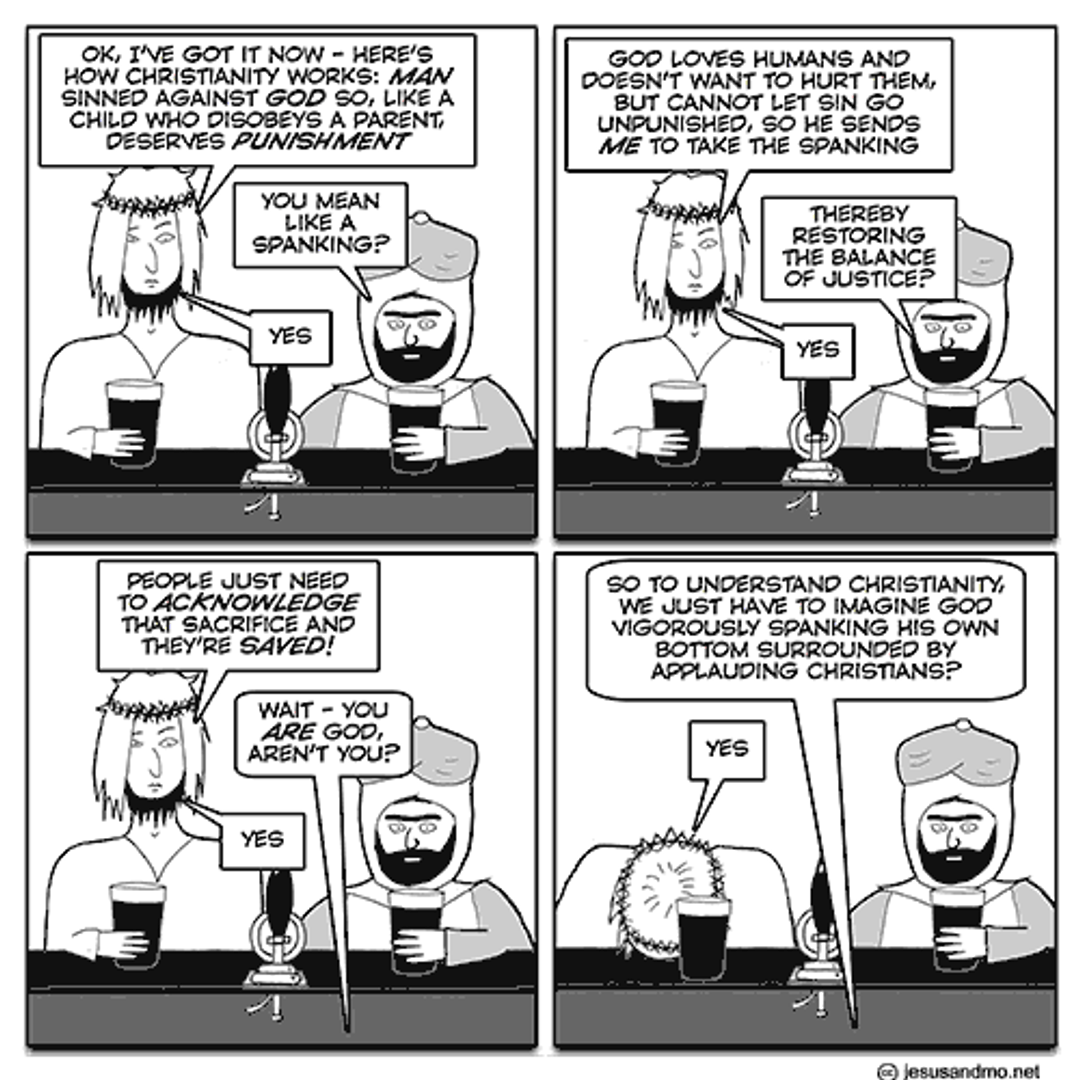
We have another “Friday Flashback from 9 years ago.” The concept of substitutionary atonement—something that Hitchens used to beef about—has always confused me, as it simply makes no sense. By killing his own son, who is really part of himself, God gave us all the possibility of going to Heaven. Whaaaat?
The other day I showed photos of a mallard hen who came to the pond on Wednesday and whose bill markings were strikingly similar to that of Vashti, the hen who departed with her brood of seven a week before last Tuesday. Her behavior, her immediate bonding with Armon, and bill markings all combine to identify her as Vashti, whose brood likely perished after her exit. So it’s bittersweet that she returned again: sadness for the ducklings loss combined with joy and confidence that she’ll breed again. If she does, can we keep her here this time?
Anyway, I attach a few more photos showing a match between Vashti’s bill markings (taken before she fled) and the markings of the “new duck”. Some people were dubious about the hen’s identity, but I’m going with Vashti.
Vashti’s bill is distinguished, on its top side, by a black patch, then a break before the tip, which is again marked with black. Here it is:
Vashti again:
Top of the bill and left side new duck. Notice the two black patches extending ventrally from the left side of the top marking—same as above.
Top of the bill and right side, new duck
The top is a match, and, as I showed last time, so is the right side. Here’s the right side of the new duck again. Notice the match with the photo above: a black patch on the side with a line of speckles to its rear:
New duck, right side:
Given the huge variance in pigmentation of bills among hens, which you’d have to see for yourself to appreciate, the above is enough for me. Our new hen is Vashti. But I’ll also show the left side, for which the photos are not quite as good.
Vashti, left side of bill. There are not many markings but a few black dots below the nostril:
New duck, left side of bill. Notice the line of about five dots below the nostril—same as above.
It’s Vashti, who clearlymade her way back to the familiar pond after losing her brood. There is ample time for her to nest and incubate her eggs again, so I am feeding her a lot to prompt that. She’s bonded with Armon, who never left the pond, and they are showing bonding and courtship behaviors. I am pretty sure she will nest and breed again.
This would not be the first time we’ve had double-brooding here. When Honey stole Dorothy’s brood, getting a batch of 16 to take care of, Dorothy eventually re-nested and produced her own brood, which she did rear to fledging.
Here’s a classic photo of Honey with her mixed brood of 16, half of them ducknapped. She was a great mome, and all of these ducklings fledged. “But isn’t that evolutionarily maladaptive?”, you ask. Perhaps, unless Dorothy and Honey were related. I have no idea if they were, but I think it’s simply a case of a maternal instinct that was coopted, like humans adopting unrelated babies.
Well, brothers and sisters, friends and comrades, this is the last batch of photos I have. If you’re feeling generous and have some good wildlife photos, well, you know what to do.
Today’s lot comes from Ephraim Heller: they are manakins and tanagers from Trinidad and Tobago. Ephraim’s captions are indented, and you can enlarge the photos by clicking on them.
Today we have photos of manakins and tanagers that I photographed on my February visit to Trinidad and Tobago.
The three manakin species in these photographs all engage in lekking. Females choose a partner at the lek, mate, and then depart to build a nest and raise chicks entirely on their own. Males contribute only sperm. This behavior places intense sexual selection pressure on males, driving the evolution of exotic plumage, acrobatic movements, and multi-male performances. I make no comment on potential parallels in human behavior.
Blue-backed manakin (Chiroxiphia pareola) males engage in cooperative lekking. Two males — typically an older dominant individual and a younger subordinate — perform a dance in which they jump over each other on a branch. The female observes, and when she is sufficiently engaged, the subordinate male withdraws and the dominant male completes the mating. In these photos you see one of the males perched on the lekking branch and then performing the jump.
JAC: Here’s a video showing a related lekking species, the Blue manakin (Chiroxiphia caudata) and their remarkable courtship dance. Look at those males lined up, each trying to show he’s a better jumper than the others!
Each white-bearded manakin (Manacus manacus) male clears a small patch of forest floor down to bare earth and maintains one or more bare sticks above it as perches. The display involves rapid leaps between these sticks and the ground accompanied by a shockingly loud cracking sound – it sounds like someone snapping their fingers right next to your ear. It’s produced by the wings connecting above the back, which is enabled by a limb muscle, the scapulohumeralis caudalis, that is the fastest skeletal muscle in any vertebrate. Here you see two white-bearded manakins perched on their lekking branches and preparing to jump to the ground.
JAC: I also added a video of the white-bearded manakin courtship:
The golden-headed manakin (Ceratopipra erythrocephala) male’s lek display includes a “moonwalk” in which it slides backward along a perch. Sadly, I didn’t observe the moonwalk. In these photos the male has the bright yellow head, and you can see a female behind the male in the second photo.
JAC: Here’s a golden-headed manakin male courting, though I can’t really say it’s a “moonwalk.” They also pop their wings.
This gorgeous bay-headed tanager (Tangara gyrola) stopped me dead in my tracks. It has microstructures in its feathers that scatter light to intensify its hues. In addition, a hidden layer of white or black feathers beneath the outer plumage acts as a reflective backing, boosting the brightness and saturation of the visible colors:
The palm tanager (Thraupis palmarum) is one of the most common birds in Trinidad. The second photo is of the nest, which was conveniently located in a planter on our hotel’s balcony:
White-lined tanager (Tachyphonus rufus) males are glossy black, while females are rufous.
I accidentally hit “publish” instead of “save” when I was preparing today’s Hili dialogue (most of it got done yesterday afternoon), so subscribers might have gotten an incomplete email yesterday and none today.
If you want to read the completed one, click on the screenshot below.
Welcome to the Lusty Month of May! It’s May 1, 2026, and we should all be singing this song from “Camelot”. This version of “The Lusty Month of May’ comes from the stage cast and is sung by Julie Andrews, who unaccountably declined to appear in the movie and was replaced by Vanessa Redgrave.
Apparently the British equivalent, “No Trousers Day,” was three months ago, and a lot of people rode the tube sans trousers (“pants” in the UK means “underpants”). Here’s a video:
A picture of the returned Vashti. What a sweet hen! Pictures will follow shortly to address the doubters.
Readers are welcome to mark notable events, births, or deaths on this day by consulting the April 1 Wikipedia page.
Da Nooz:
*I don’t like redistricting–creating new Congressional districts and often new seats in the House–unless it’s based on changes in population size and density. There are mathematically sophisticated ways of redistricting that divide up states based purely on population numbers. Now, however, it’s often done to create ethnic “voter equity” or to increase one party’s seats in Congress. I don’t like either form of gerrymandering, and now, according to the NYT, the Democrats are regretting having started the process a decade ago.
Their party began a major push for independent commissions to draw congressional districts after President Trump and Republicans swept into power in 2017. Democrats, panicked about Republicans’ structural gains after the 2010 census, succeeded in enacting such commissions in Colorado, Michigan and Virginia, while Republicans mostly kept politically minded state legislators in charge of drawing maps in red states.
Now Democrats are finding that their old good-government policies have become bad politics.
Their idealistic push for fairness is, it turns out, no match for the Republicans’ maximalist redistricting effort. The independent commissions that Democrats pushed for eight years ago, along with ones in Washington State and California that predated Mr. Trump’s rise, have complicated the party’s redistricting fight.
After the Supreme Court’s ruling on Wednesday to further weaken the Voting Rights Act, a decision likely to lead to a rush of new maps before the 2028 election if not this year, blue-state Democrats are finding themselves regretting that they had sought to give away redistricting power to outside commissions.
“One of the lessons of the Trump era is a failure of imagination about how many norms they would break,” said Phil Weiser, the Democratic attorney general of Colorado who backed his state’s independent redistricting referendum in 2018 and is now supporting a ballot initiative to undo it. “You could say we should have been thinking ahead. We didn’t foresee this.”
At Mr. Trump’s urging, Republican lawmakers in the last year have redrawn congressional maps to help their party in Texas, Missouri and North Carolina. Democrats responded in California and Virginia by asking voters to undo past referendums that created independent redistricting bodies. In both blue states, voters agreed.
Then came the events of this week, when the Supreme Court ruling appeared to give Republicans new opportunities and Florida Republicans passed a new map designed to flip four Democratic seats.
I repeat: there should be no redistricting except to balance population sizes among Congressional districts. The Republicans started the latest round of violating that principle, but now the Democrats are catching up. It’s the tragedy of the commons, with the commons being states. Who knows what effect this will have on the midterms. I still think the House will flip to Democratic in November, but I’m not betting on it.
Louisiana Gov. Jeff Landry (R) told Republican House candidates Wednesday that he plans to suspend next month’s primary elections so state lawmakers can pass a new congressional map first, according to two people with knowledge of the calls.
The move follows a Supreme Court decision earlier in the day that found Louisiana had unlawfully discriminated by race when it created a second majority-Black congressional district under legal pressure. A new Louisiana map would position Republicans to gain one or two seats in the midterms as they fight to hold their narrow majority in the House.
A spokesperson for Landry declined to comment on his plans for the primary. But the governor, along with Louisiana Attorney General Liz Murrill (R), said in a statement Thursday that the Supreme Court’s decision no longer requires the state to hold “congressional elections under the current map.”
“Yesterday’s historic Supreme Court victory for Louisiana has an immediate consequence for the State,” Landry and Murrill said in the statement. “We are working together with the Legislature and the Secretary of State’s office to develop a path forward.”
The 6-3 decision limited a key provision of the landmark Voting Rights Act and could lead to Black Democrats across the South losing their House seats. Most states are unlikely to be able to redraw districts in time for the November midterm elections, but Louisiana could be one of the exceptions.
Election officials sent ballots to overseas voters weeks ago. It’s unclear whether the governor’s suspension would apply only to primaries for the six House seats, or include other elections, including the heated Senate primary that pits Sen. Bill Cassidy (R) against Rep. Julia Letlow (R). Louisiana has six House seats, two of which are held by Democrats.
If Landry suspends the House primaries but not other contests, primary voters would have to go to
Here are Louisiana’s congressional districts, which are clearly gerrymandered. If you go to the article link above, you’ll see they match almost exactly the area with a proportion of blacks above 50%. Apparently the Republicans want to dismantle that, pronto.
Maine Gov. Janet Mills on Thursday dropped her bid for the U.S. Senate, pointing to a lack of campaign funds to keep up in one of the most competitive races in the country that quickly became a reflection of an internal party debate over which candidates can win in high-profile contests.
The move now thrusts political newcomer Graham Platner, an oyster farmer almost no one knew a year ago, as the expected Democratic front-runner against longtime Republican Sen. Susan Collins, whose seat Democrats are targeting in their effort to win control of the closely divided Senate.
“While I have the drive and passion, commitment and experience, and above all else – the fight – to continue on, I very simply do not have the one thing that political campaigns unfortunately require today: the financial resources,” Mills said in a statement. “That is why today I have made the incredibly difficult decision to suspend my campaign for the United States Senate.”
. . . Mills, a two-term governor and longtime Maine politician, was seen as one of Democrats’ top 2026 recruits when she entered the Senate race last year. She had the backing of Senate Minority Leader Chuck Schumer and prominent left-leaning advocacy groups hoping to unseat Collins in the chamber, which has 53 Republicans, 45 Democrats and two independents who caucus with the Democrats.
. . . Meanwhile, Schumer and Democratic Senatorial Campaign Committee Chair Sen. Kirsten Gillibrand, both of New York, said they would work with Platner to defeat Collins.
“Our North Star is winning a Democratic Senate majority, and over the past year, Senate Democrats have carved out multiple paths to do that,” their statement said.
Two male runners who were discovered fraudulently competing on behalf of female colleagues in a top South African marathon have been disqualified and could face two-year bans from the event, along with the two women.
The two women runners swapped their bibs with the two men, who both finished within the top 10 in the women’s half-marathon at the Two Oceans Marathon in Cape Town last Sunday, initially denying those slots to two female runners.
But the cheating was discovered by a marathon board member, and the men were disqualified from their 7th and 10th place finishes. Two women were belatedly recognized instead.
Larissa Parekh was accused of having Luke Jacobs run on her behalf, and Tegan Garvey was accused of having Nic Bradfield run on her behalf, marathon board member Stuart Mann said. All four runners face disciplinary action that could include two-year bans from the event, Mann said.
The annual Two Oceans race is one of South Africa’s iconic marathons and includes a 56-kilometer (34.7-mile) ultramarathon and a 21.1-kilometer (13.1-mile) half-marathon. The event attracts over 16,000 participants and finishing among the top 10 is a significant achievement for most runners.
Click the screenshot to go to an Instagram report. One of the men posted a picture of himself (below) on social media wearing a woman’s bib, which revealed the deception. I guess that both men and women ran together, which might make it harder to detect that the two imposters were in fact men. What it shows, of course, is the average advantage that biological men have over biological women in sports. The women who gave their bibs to men should be banned for at least two years.
*A gigantic Steller sea lion (Eumetopias jubatus) named “Chonkers” is grabbing all the headlines in San Francisco. where he’s often found chilling on Pier 39.. Weighing in at a full ton, he’s twice the weight of the usual California sea lions (Zalophus californianus).
San Francisco’s newest star isn’t part of a show, and you won’t find him at the ballpark or the basketball court, but he’s large and in charge – literally.
“Chonkers,” an estimated 2,000-pound Steller sea lion at Pier 39, is attracting visitors from far and wide.
“He’s massive,” Linda Helkin of Brisbane, Australia, said Tuesday. “Just lying there, didn’t have a care in the world.”
“Chonkers” is noticeably larger than the California sea lions that usually hang out at Pier 39. Large adult male California sea lions generally weigh between 800 to 1,000 pounds, while Steller sea lions are about double in size.
“Chonkers” has been hanging around Pier 39 for the last month or so. According to the Pier 39 harbor masters, he’s come to visit occasionally over the last few years.
Pier 39’s Sheila Chandor said he’s likely here now because the bay offers plenty to feed on.
“Right now, the fact that he’s staying this long means that there’s a lot of food source close by to where we are,” Chandor said. “It’s a good sign. It means the bay is healthy, we’ve got plenty of fish around.”
According to the harbor masters, the best time to get a look at “Chonkers” is in the morning until roughly 9:30 a.m. and in the later afternoon and evening. During the middle of the day, he’s usually out in the bay fishing.
Here’s a video. Look at that chonk!
Meanwhile in Dobrzyn, Hili is attentive to the garden, but I suspect she’s speaking metaphorically:
Hili: The same thing again.
Andrzej: What do you mean?
Hili: Weeds grow faster than grass.
In Polish:
Hili: Znów to samo.
Ja: Co masz na myśli?
Hili: Chwasty rosną szybciej niż trawa.
Masih applauds the expulsion of the Iranian football chief from Canada. I’m not sure I agree that sports should be a political football (pardon the pun).
Iran football chief expelled from Canada in airport showdown over IRGC ties!
I welcome the deportation of Mehdi Taj from Canada sends alongside millions of Iranians because we are united against sportswashing.
From Luana. It’s Springtime at the U of C, and the pro-Pals have created their parallel university, complete with public prayers:
🚨 Day Three of UChicago’s “Popular University” featured ICE intervention training, a student repression panel with recently arrested students, a Rojava reportback, “Palestine Before 10/7″ with FJP, and “Anti-Black Structural Violence + Radical Resistance.” pic.twitter.com/Fvm34Fj3eI
🚨 Day Two of UChicago’s “Popular University for Gaza” has professors teaching “Iran War + US Empire,” the Grenadan Revolution, ICE resistance, political prisoners in “Babylon,” and more.
From J. K. Rowling, who noticed that people have trouble saying that the Golders Green attack in London affectsed Jews. Even mentioning the affected group is apparently verboten:
Why do leaders of the Greens have such difficulty naming the particular demographic likely to be most ‘shaken’ and ‘affected’ by two men from their community having their throats cut on a London street? pic.twitter.com/sKMA4p1bre
After writing the lyrics to "Song of the Murdered Jewish People," this Jewish poet, Ithak Katzenelson was himself gassed. You can hear the song here: http://www.youtube.com/watch?v=HrWQ…