
Today we have the seventh installment of Ephraim Heller’s July trip to Brazil. Ephraim’s captions are indented, and you can enlarge the photos by clicking on them.
These photos are from my July 2025 trip to Brazil’s Amazon river and the Pantanal, the world’s largest tropical wetland area and the world’s largest flooded grasslands. Today I include photos of miscellaneous critters not otherwise categorized.
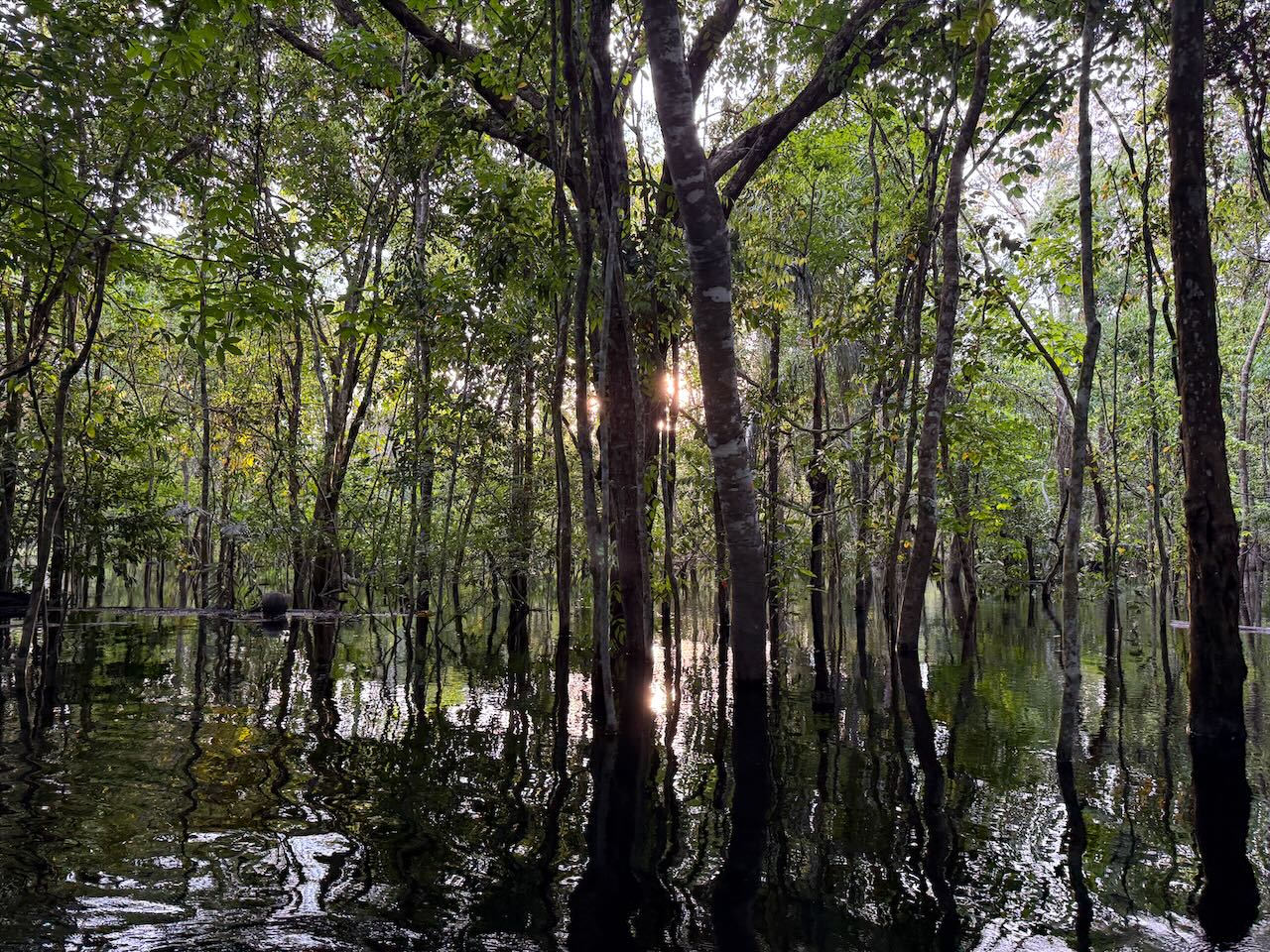
The Amazon is undammed (although there are many dams on its tributaries) and during the rainy season the river overflows its banks to flood endless forests in its watershed. One of the memorable activities of our trip was canoeing through a forest:
Amazon river dolphin (Inia geoffrensis), also known as the pink river dolphin. They are born grey and acquire their pink color with age. Their final hue is influenced by many things, including behavior, diet, and how close their capillaries are to the skin. They can modify the shape of their melon (the bulbous forehead structure) to change the direction, size, and frequency of their echolocation pulses. Their brains are 40% larger than human brains, likely explaining why they do not use social media:

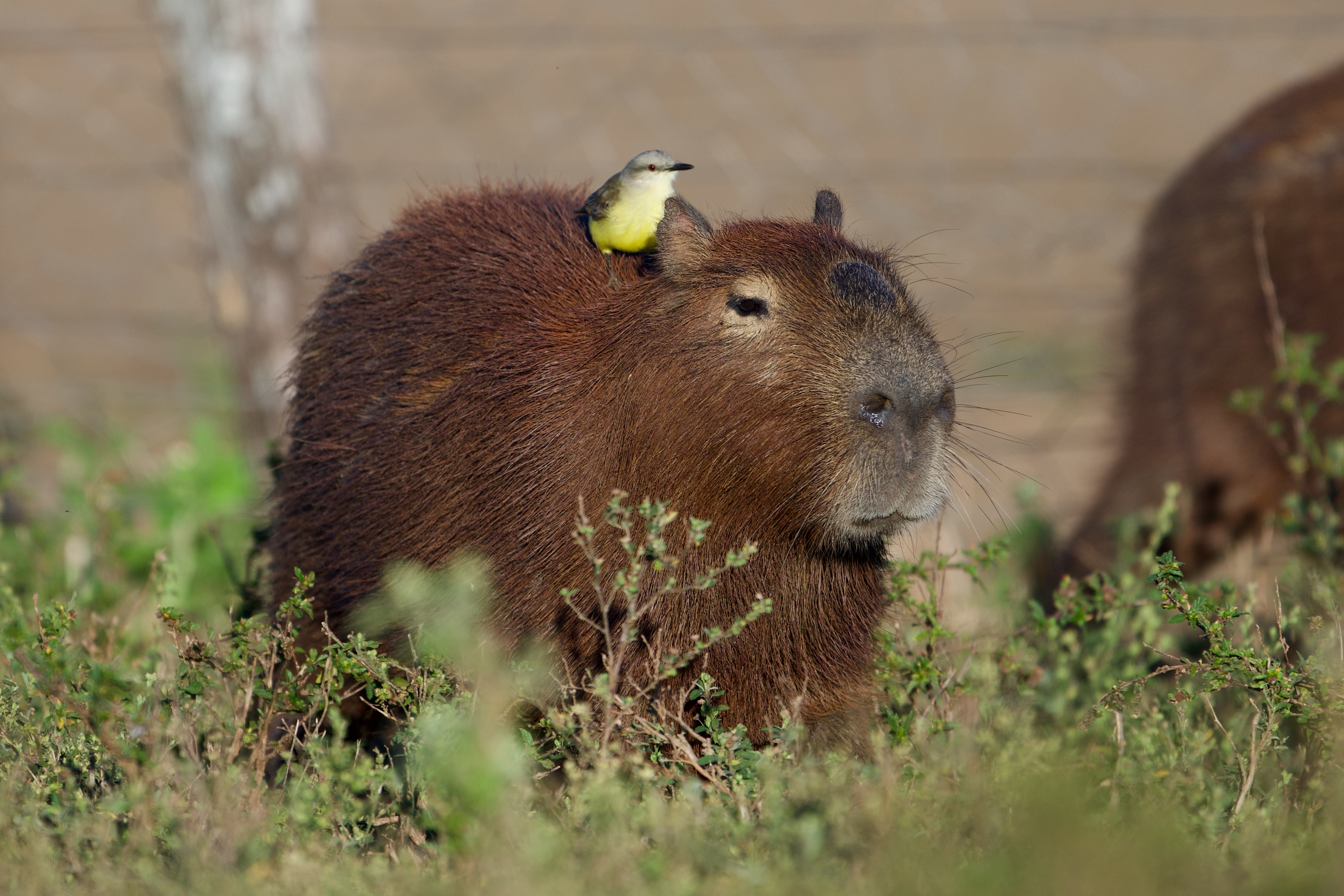
Capybara (Hydrochoerus hydrochaeris) and cattle tyrant (Machetornis rixosa). The world’s largest rodent. Capybaras practice autocoprophagy, consuming their own protein-rich morning feces to maximize nutrient extraction from their cellulose-heavy plant diet. This behavior, combined with their ability to regurgitate food for re-chewing (similar to cattle), allows them to efficiently digest tough grasses and aquatic vegetation. Delightful:
Giant river otter (Pteronura brasiliensis). These are the apex predators of South American rivers. They are the most vocal of the otter species and possess a rich vocabulary. They recognize each other using throat markings that are unique to each individual. They require about 9 pounds of fish daily. While I consider our North American river otters to be cute, I found the appearance of the giant river otters to be disturbing, with crazed, sinister eyes and a somewhat Frankensteinian build. When not hunting and eating, the otters we observed spent a lot of time literally beating the bushes on land. Perhaps a reader can explain this behavior?:


Polka-dot tree frog (Boana punctatus). The polka-dot tree frog represents the first documented case of fluorescence in any amphibian species, discovered when researchers observed their bright blue-green glow under ultraviolet light. This fluorescence is produced by three unique molecules, hyloin-L1, hyloin-L2, and hyloin-G1, found in the frog’s lymph tissue, skin, and glandular secretions. These compounds belong to the dihydroisoquinolinone family and represent a completely new chemistry for animal fluorescence:


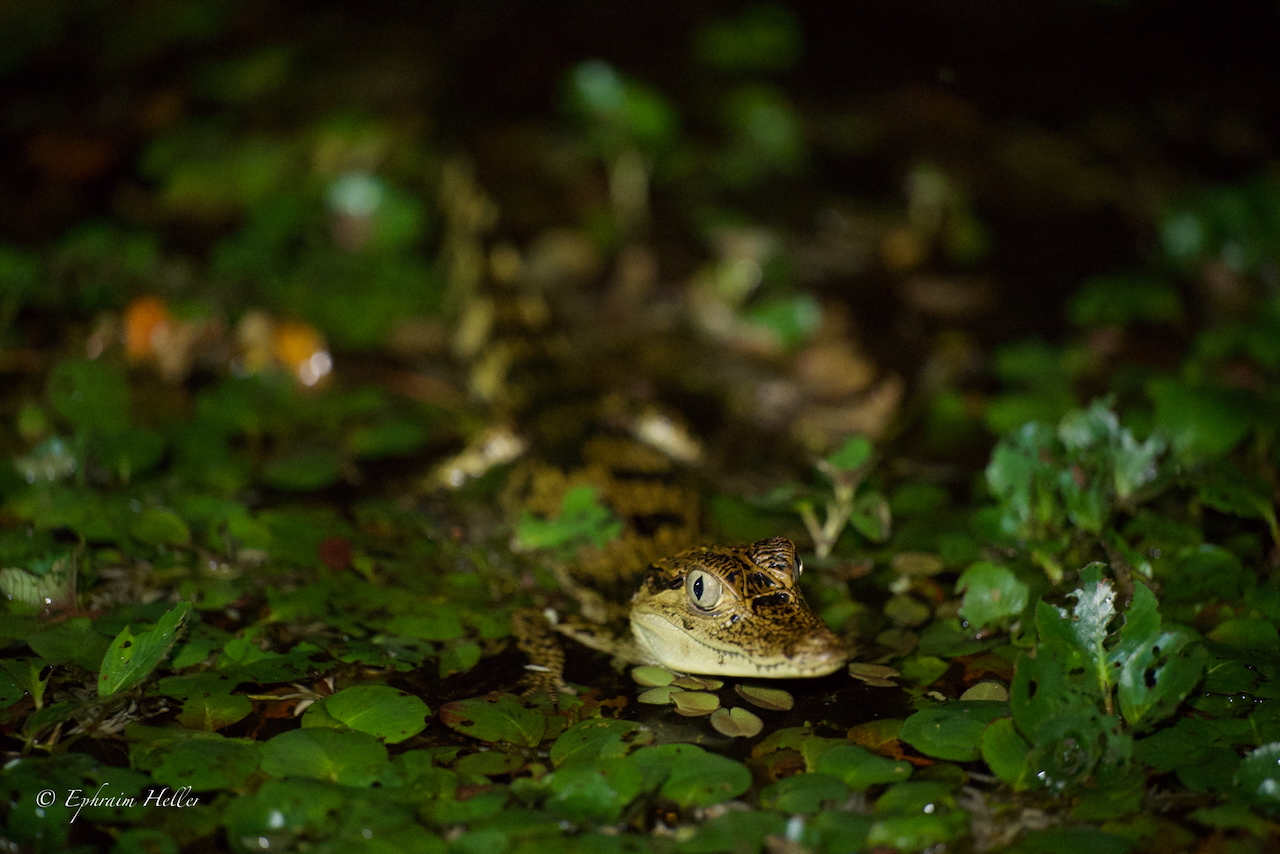
Finally, a baby spectacled caiman (Caiman crocodilus). Spectacled caimans use nine different vocalizations and 13 visual displays to communicate. Males also communicate by moving their tail to a certain position, such as making it vertical or arched. Juveniles vocalize when in distress and adult females emit calls to warn young of threats. This is one of the few nighttime flash photographs I took with which I am happy:
A reprise I think – I was under the impression that our trip to Pantanal was over, but here is a delightful surprise!
Jerry had indeed announced that the previous set of photos was the final batch, but that was one of his AI hallucinations. I have more bird photos coming!
Great photos and commentary. What a memorable trip!
The “brush beating” of the otters is really interesting. We have Giant River Otters here in Ecuador as well, but I have never heard of this behavior here. I wonder if this is a local adaptation? On the other hand, these otters are very rare here. Maybe such interesting behaviors are unlikely to be noticed except in the Pantanal where they are so easy to observe. Did it look like they were eating anything while doing it?
Readers may misinterpret the deep-red dolphin….. the color shown here is caused by looking through tannins in the water rather than the color of the dolphin itself.
Interesting story about the frog. I wonder if many small frogs have this same fluorescence, and this species is just the first one that people bothered to look at. Do you know if this frog species was singled out by testing lots of frogs? The only frog I ever tested, Nymphargus anomalus (a glass frog), had a bright aqua blue fluorescence, especially its bones.
Thanks for the detailed comments.
The otters were not eating while on land. They were scurrying around in an almost hyperactive manner and rubbing against foliage. Perhaps they were scent-marking? Or surveying for predators?
Yes, the deep color of the dolphin is in part due to the tannins in the water. I should have mentioned that.
I’m not a frog expert, so I’ll refer you to a few links on the fluorescence of these frogs:
https://www.pnas.org/doi/10.1073/pnas.1701053114
https://www.nature.com/articles/nature.2017.21616 (behind a paywall, unfortunately)
https://www.biologicaldiversity.org/news/media-archive/a2018/diversity_huffpost_3.21.17.pdf
https://news.mongabay.com/2017/03/worlds-first-fluorescent-frog-discovered/
https://www.fieldmuseum.org/blog/adorable-polka-dot-frog-has-party-side
https://www.chemistryworld.com/news/fluorescent-frog-first-down-to-new-molecule-/2500541.article
Many thanks for the additional information. I wonder if there an otter “catnip” plant?
Thanks also for the links to the articles about fluorescent frogs. I will enjoy reading them.
I am looking at the PNAS paper now. My fluorescent frog looked exactly the same color as the middle frog in their Fig 1c. I believe they mislabeled that figure in their legend. I think the emission filter for the left frog in Fig 1c was 516nm, and the emission filter for the center frog was 435nm, the reverse of what the legend says. Also, the bones of their frog fluoresced more strongly, just as in mine. I think this is an argument against their claim that this fluorescence has evolved for signalling. I am also surprised by their claim that the fluorescence makes up 18%-29% of the light coming off the frog in moonlight or twilight. Fluorescence in nature is usually at least an order of magnitude dimmer than the incident light that excites it. I still have to read that part.
Another weird thing about the PNAS paper: it seems that their main photo of the frog’s fluorescence, Fig. 1A, is not correct. It is not a photo of the frog’s fluorescence, as claimed, but rather is filtered to show just the green part of the fluorescence, as in the left photo of their Fig 1C (which is incorrectly labeled).
If I am right, then this frog has fluorescence identical to mine, aqua blue rather than green. My frog was the only frog I have ever tested. It is very unlikely that I happened to choose the only other fluorescent frog in the world. More likely, there is nothing particularly special about it, and frog fluorescence is probably a very widespread phenomenon that had simply been overlooked or under-reported.
Interesting. I don’t have the knowledge to assess any of this, but I’m intrigued by why there are so many errors in the paper.
Adorable caiman is indeed adorable.
Great pix, thanks! I was unaware of the Amazon River Dolphin. I want one.
Ooooh. Me too.
Very nice. Love them all, but especially the polka-dot frog. And what would an Amazon River Dolphin do if it were as smart as people? Would it become expert at echolocation? (Oops, already is.) Would it figure out a way to exit the water and live on land? Would it start a war with the sinister Giant River Otters? (Is it the otter that’s a giant or is it the river?)
Yes, those responsible for naming the giant river otter should have consulted an editor. The name is ambiguous!
The fluorescence in those frogs is very cool. I found the structures here. Clearly not fusions of amino acid side-chains as with the Green Fluorescent Proteins, but the one in G-1 is clearly an adduct with a decarboxylated arginine.
Just able to see this great post now. That giant river otter is indeed monster like. Otters are usually so adorable but this one is more dinosaur looking.
Thanks for such great and informative photos.
Great pix and commentary!
Great photos and also a great commentary. Thanks for sharing.