
I have been here only a bit more than two days, so I can’t claim to know Reykjavik, but I have seen a lot of the downtown after two several-hour walks. l It is not a big town: Wikipedia claims that Reykjavik (the world’s northernmost capital of any sovereign state) has a population of just 139,000 as of 2025, and “the surrounding Capital Region has a population of around 249,000, constituting around 64% of the country’s population.”
Summer is tourist season, and so the streets are crawling with visitors like me, and you hear English spoken everywhere. The fluency of every Icelander I’ve met in English is of course a boon to the visiting Anglophone. All you need is a credit card to survive here, as I haven’t found a place yet, including taxis and coffee shops, that doesn’t take cards, even for tiny purchases. I have $100 in Icelandic krona that I still haven’t spent.
Tomorrow I leave town to go on a bus tour of some of the famous sights of SW Iceland, though I doubt the Blue Lagoon, a famous geothermal spa, will be open because of the recent fissure eruption of a nearby volcano. So it goes.
I’m not yet sure if I’ll make it to the famous Iceland Phallological Museum, devoted to displays of penises, which several readers have suggested I visit. If I go, the highlight will be the plaster cast of Jimi Hendrix’s member as produced by the late Cynthia Plaster Caster (there’s a photo of the junk on her Wikipedia page). But there are also preserved penises and baculums from many animal species. There are no vaginas, and I suspect it would be hard to construct a female equivalent of this museum. I’m told that most of the visitors to this museum are in fact women, though I would have thought that men would predominate, eager to compare their size with that of other species. (There is only one genuine human penis in the museum, a preserved member of a 95-year-old man who swore he employed it sexually until the end.)
In the meantime, here are some random photos I took on my meanderings this morning and early afternoon, with one or two from the day before yesterday.
First, where I am staying: a “guest house” (more like a hostel, which is what it’s called on the sign) north of downtown. The rooms are small and spartan, but believe me, I’ve seen much worse (viz., India and Turkey). But, like all things Icelandic, they are pricey, even compared to the U.S. The price (ca. 750 Euro for my five nights) at least includes a breakfast (croissant, roll, jam, butter, orange juice, cheese, and a tangerine) placed in a bag outside my door each morning. To supplement the brekkie, I went grocery shopping at “Bonus,” supposedly the cheapest supermarket in Iceland,
Photos of a more touristic nature (e.g., the cathedral) will follow when I have time to put them up.
My hostel/guesthouse:

My cozy room. There are no amenities like t.v., but I never watch it anyway (even on the ship), and I’m happy with my book and the Internet:

There is a coffee room where you can cook your own food (this makes it more hostel-like than guesthouse-like), but as for getting a decent cup of coffee, it’s well nigh impossible. There is coffee and a complicated machine, but no milk and no spoons that I could find. My first goal, then, was to find coffee on my morning walk.

When I strolled into town, the first thing I saw was a Starbucks, and I was drawn into it as if by Jupiter’s gravity to quaff a large latte. Behold a $10 Icelandic latte below. In contrast to American lattes at Starbucks (which I rarely patronize), it had a design on top. It also seemed larger.

Judging by the prices of burgers, beer, fish and chips, and other items whose prices I’m familiar with, the Icelandic price is usually between two- and three-fold higher than the American. Now most goods have to be imported here, so that’s understandable, but I’m told that the salaries of locals are not commensurately higher. Perhaps it’s because the country has an extensive social safety net, so people don’t get saddled with stuff like high medical bills, but I’m not qualified to pronounce on economics.
Below: voilà—a $7.66 box of Cheerios in the cheapest supermarket in Iceland. I have no idea what Cheerios cost in America, but I’m sure it’s less than this. If you understand Icelandic, give us the translation below.

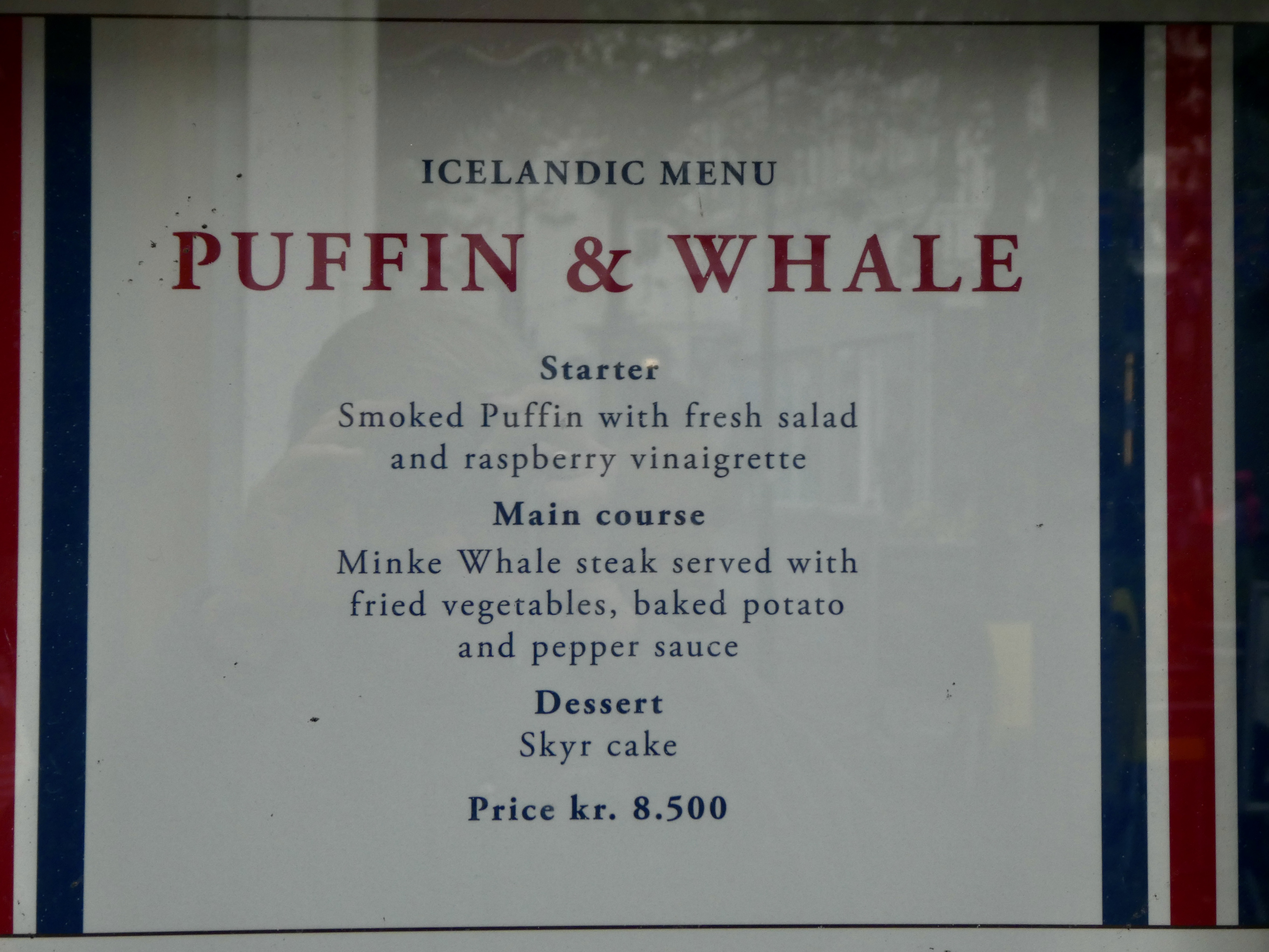
Below: an “Icelandic menu” at one restaurant featuring a SMOKED PUFFIN APPETIZER (Fratercula arctica) and an MINKE WHALE STEAK (Balaenoptera acutorostrata). Iceland is the only country in the world where it’s legal to hunt puffins, and the species is classified as “vulnerable.” Iceland also allows restricted hunting of whales, with 209 fin whales and 217 minke whales permitted to be killed each year for the next five years. Along with Norway and Japan, Iceland is one of only three countries in the world that allow whaling.
Our ship’s naturalists warned us about menus like this, and of course I’ll stay a mile away from them (n.b.: anyone who tells me that avoiding whale and puffin but eating cow makes me a hypocrite better tread very lightly!)
“Skyr” is a smooth Icelandic dairy product described as somewhere between yogurt and curd cheese. I bought a large container of mango skyr to have as dessert.
Two animals I saw on the streets today. First, a lovely gull resting on a cafe table. I don’t know the species, but am sure at least one reader will (identify it in the comments, please):

And a semi-friendly gray tuxedo cat which let me pet it, though it wandered off after a minute or so. It is the first live cat I’ve seen since I left the U.S. Notice that it has the same tough Viking-esque expression as the Reykjavik cat sent in by a reader yesterday.

One of the first things you notice wandering about is the presence of both murals and artistic graffiti. The former are commissioned, while the latter appear on isolated and hidden walls, but are still more artistic than graffiti murals I’ve seen in the U.S. and Europe.
First, some graffiti, which includes a fearsome felid. This was on an abandoned building:

And the entire side of the building (click to enlarge):

Murals are everywhere, expressing political sentiments or advertising businesses. The artists are given due credit at the lower right of each mural. Here’s one of the former painted by two Ukrainian artists and an artist from Iceland, all honoring Icelandic/Ukrainian friendship and Icelandic hospitality towards displaced Ukrainians:

And the explanation:

. . . and murals decorating businesses:

Two views of a store:

Is this a female Viking? Wings seem to be a leitmotif in these murals.

A vampire mural:

And a lovely bird mural. Again, someone will have to identify it for me:

A rainbow-decorated cafe:

And a nearby brasserie advertising its wares:

Finally, as far as I can see, Reykjavik is not a town of gaudy and expensive houses, though there may be a section for such homes. Most streets, however, are fairly bare and spartan, though some of the houses are painted bright colors. Since these streets are around the downtown area (and these are typical streets in that area), it supports the view that Icelanders don’t have salaries commensurate with the high cost of living:


Remember, this is a superficial tourist’s take on what I saw as I wandered about. More photos as I take ’em, and the natural history will come after I return to Chicago.
Those murals are amazing. We have colorful murals in Seattle (I live in an Eastside suburb, not in the city), but they are mostly gang related.
What a menu! I wouldn’t eat Puffin or Minke, but I have to admit that I’d like to know what they taste like.
Andrzej: I wouldn’t eat Minke, would you?
Hili: No, but I’d like to taste on. Is tasting the same as eating?
Obviously this wasn’t a scientific sampling, but I notice a distinct lack of trees on the streets. I noticed long ago in Chicago (whose motto is Urbs in Horto, or City in a Garden), where streets generally have many trees, that, when you come across a block without trees in a neighborhood (not downtown), it looks distinctly shabby in comparison. [Wordpress seemed to eat my comment the first time, so apologies if this shows up as a dupe.]
The city of Toronto motto is “A city in a park.” I agree with your tree sentiments. Trees make all the difference to a street. Without them, you can too easily see a lot of ugly human housing.
The once abundant birch forests of Iceland were very much diminished by the Norse settlers, and regrowth prevented by their sheep.
https://www.icelandreview.com/ask-ir/why-are-there-no-trees-in-iceland/?srsltid=AfmBOopc6ZjdKeIxdPbTObBZfa3L4v33pvuqsWdMfTg775_FY10PZfyO
Indeed, it always bugs me to see movie or TV depictions of Vikings arriving in Iceland to find the desolate treeless landscape of today. Iceland was densely forested when they first arrived.
The Greek isles were once densely forested too, not the bare rocky landscapes of today, and again humans were responsible.
Twenty ounces of Cheerios will cost you just under $5 at Walmart.
And “glutenlaust” means gluten-free.” (They’re oats, right?)
Ugh, this stuff is so disingenuous and borderline fraudulent. “Gluten-free salmon.”
570g of Cheerios costs $6.99 in Canada (ie $5.09USD)
If you can’t get to the Blue Lagoon, the Sky Lagoon is also very nice. If you have the chance, Braud & Co – near Hallgrimskirja – has the most amazing cinnamon rolls. Everything they bake is delicious.
Looking forward to reading. I’ve “looked around” Iceland on googlemaps.
Here’s an overall essay on Iceland and its economy. Interesting:
15 min.
D.A.
NYC
Thanks, David. I was wondering what the country’s economic generator was. I’d thought tourism due to the fascinating geophysical features, but I guess that only takes you so far. Electricity that can’t be exported gets them aluminium smelting and data mining. That’s a trip. I’m particularly intrigued by the data center stuff. Since Trump closed the border, the criminal human trafficking enterprise between Pima County and the Tucson Archdiocese has come to a close. I don’t know where the Catholics are getting their fix ($), but the county has decided to cast its lot into data mining… in the middle of our drought-parched desert! For all the reasons data mining makes sense (excuse the pun) in Iceland (cheap and abundant electricity, cold environment) I can’t think of a more wrong-headed, flagrantly wasteful use of our most highly limited resources. It’s so sick. Anyway, I got off on a tangent there. Thanks for the lesson on Icelandic economics. The other thing I’m curious about is crime and illicit drug use. I’m going to go search for some info on that now.
It is worth a visit just for the Icelandic Skyr!
I have been twice to the Blue Lagoon. I hope it’s open for you as it’s a wonderful experience, especially in the winter, and at night. If you’re looking for suggestions, I have enjoyed the food at The Grey Cat (Grái Kötturinn) and also Fjallkonan in the main plaza.
Not only is bathing in the Blue Lagoon very enjoyable, there is a fine restaurant right next to it. But it is indeed closed due to the eruption – which now can be viewed from a safe viewpoint.
Hi Jerry,
The annual personal income in Iceland was 10.0 million ISK on average in 2024, or about 831 thousand ISK ($6,800) per month.
After the devastating financial crisis of 2008, the Icelandic economy has recovered and the GDP per capital is fifth in the world expressed in US dollars. The krona seems clearly over-valued compared to other more widely traded currencies — maybe the central bank hoards it — but this has no impact on Icelanders paid in krona. If anything it makes imports cheaper for Icelanders to buy but it costs foreign customers more to buy their exports of tourism, fish, and aluminum. Tourism is far and away Iceland’s most important industrial sector. I don’t think they are hurting.
I watched that whole Iceland financial chaos with great interest at the time, Leslie, being a former financier type. It was epic.
What was amazing was how they rescued their economy and enviable standard of living afterwards. And without being sucked into that sweet siren song of the Euro.
(Not dissing the Euro here, it is a tradeoff, profitable for many countries).
But after the disaster they picked up and healed incredibly quickly.
Those 800,000 Vikings are a smart, capable people. Respect.
From what I gather they have a very high level of social trust. Which is always the key.
D.A.
NYC
The bird in the photo appears to be a Great Black-backed Gull (Larus marinus). The bird in the mural? Don’t know!
Is it not rather a herring gull (Larus argentatus)?
I’d say Lesser Black-backed Gull (Larus fuscus). Back and wings appear too light for Great Black-backed (although admittedly light/exposure can be misleading on this feature). But bill and overall shape seem too slender for Great Black-backed. Apparently both species occur in Iceland. Leg colour is definitive when telling the adults apart: pink in Great, yellow in Lesser.
I suspect the bird in the mural is not a “real” species or, if so, the artist has taken some liberties in portraying it.
The three gull species are similar to each other and can easily be confused. However, there are three distinguishing features.
a) The great black-backed gull is the largest and most compact of the gull species and the lesser black-backed gull is the smallest.
b) The dorsal plumage of the herring gull is very dark, almost black. The herring gull has a light gray dorsal plumage. The herring gull’s plumage color is between the other two.
c) Great black-backed gulls have dark pink legs, herring gulls have light pink legs and lesser black-backed gulls have yellow legs.
Unfortunately, the legs are not visible on the photo, and the size cannot be estimated without comparison. Based on the plumage color, I assume it is a lesser black-backed gull.
I have visited Iceland twice and loved everything about it. My husband just bought a box of Cheerios at the store. One gram of Cheerios (Giant) cost 1.1745 cents. The box in Iceland cost 1.34385 cents per gram. Yes, Iceland is expensive but worth every penny.
Iceland is an interesting place for an evolutionary scientist who likes to think about parallels between biological evolution and linguistic evolution. The Icelandic language is famous for how little it has changed from Old Norse. Truly a case of “stagnated” evolution, a linguistic analogue of the coelacanth.
Didja eat the whale, boss? When I lived in Tokyo there was a special whale restaurant in Shibuya downtown with (a tad pricey) whale BBQ. (I didn’t indulge, I like whales).
It was kind of like a nostalgia salon for Japanese boomers who grew up with whale meat school lunches mid-century in the Showa era. Smoking their Mild 7 cigarettes, munching on whale, living their post-war prosperity good times, old school dramas and victories back when “Japan was a serious country” etc. A unique little corner of history.
I’ve read it is tasty, both the nostalgia and the whale.
Puffin is a new one on me, probably tastes like chicken!
Keep reporting, PCC(E) — we’re enjoying “our” trip with you!
D.A.
NYC
Cashless/cashfree economic activity is promoted by ESG incentives.
Digital data-mining of economic activity is needed by the World Economic Forum to implement its controls to direct the correct development of society according to its models.
A small number of entities – “stakeholder” councils – decide what will be correct for society.
Actually, there is a Vagina Museum. It’s in London. I’ve helped to support it by buying interesting tchotchkes from their online store.
Sadly, they’ve bought into gender identity claptrap. From their FAQ: “We believe that defining women by anatomy, as so many patriarchal institutions have done before, would be trans-exclusionary. When we’re talking about women, we say ‘women’, and when we’re talking about vaginas, we say ‘vaginas’.
“We are committed to being gender-inclusive and if you think we’ve slipped up please contact us so we can correct it as best we can.”
They blocked scores of women on Twitter when we criticized their ignorance of what a woman is. They were trying to fundraise at the time. Presumably, the men in dresses will be donating to them.
“Morgunkorn úr heilum höfrum” = “Morning grain (cereal) from whole oats”, or “whole oats cereal”.
I speak Swedish and Icelandic is like a more complicated form of Swedish to me 😉
Once on a very brief stopover flying from Toronto to Frankfurt via Reykjavik, I ran down to the bookshop and bought a teach-yourself Icelandic book and CDs, which I still have.
My daughter and I visited Iceland in 2018 and enjoyed the trip immensely, however it isn’t a cheap place to visit. Food and drink was expensive and I think I paid $16 CDN for a bottle of beer at our hotel. Still, I would love to go there again sometime.
They give you a croissant, jam, butter, and cheese, and no coffee? Isn’t that against human rights laws?
It should be! I need my coffee of a morning!
Never mind data mining – the MMORPG Eve Online was developed and run from Iceland by CCP games – cheap server provision a factor?
Shame about the Blue Lagoon – blue glowing hot pools next to mist shouded steel piped refinery – felt like a Dr Who story from last century!
I would suggest visiting Gullfoss (a giant waterfall) and they geysers. Other waterfalls include Glymur (high, but the volume of water is lower) and Dettifoss. Don’t miss the glaciers! Don’t miss Thingvellir national park!