A scientific Caturday felid: how it got its coat

January 9, 2010 • 8:20 am

by Matthew Cobb

We have discussed the evolution of mammalian coat colour several times on this blog, including here, here and here. It still remains a mystery, mainly because although we know a lot about the patterns involved, and can guess about some of their adaptive advantages, their genetic bases are largely unknown. Using a mixture of classic pedigree studies and molecular genetics, a new paper in Genetics (abstract only unless you have a subscription) has examined the genetic bases of stripes and spots in the domestic cat.

Source: Genetics.

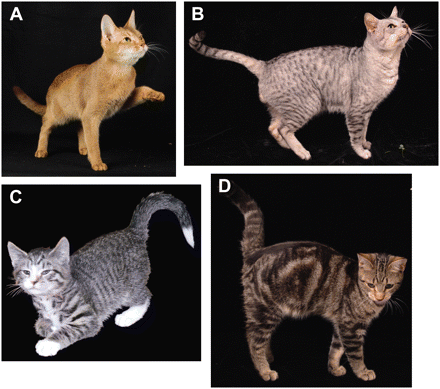
Previous attempts to unravel the genetics of coat colour in domestic cats had come up with the following hypothesis, based on tracking coat patterns down the generations. The character(s) producing the classic tabby (like my cat Pepper) – D in the figure above – is/are recessive to all other forms (the is/are ambiguity is because we have (or had) no idea about the number of genes involved). The dominant form is the unmarked (Abyssinian) form (A), which is dominant over the spotted coat (B), which in turn is dominant over the striped coat (like my cat Ollie – C).

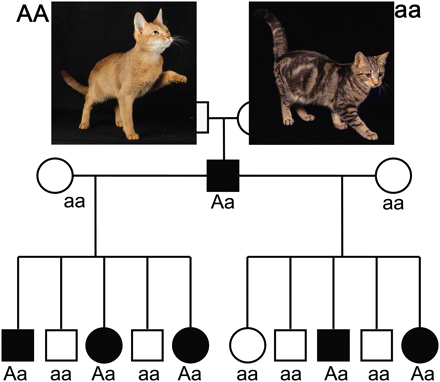
To see how many genes are actually involved in determining cat coat patterns,  the researchers, led by Eduardo Eizirik, now at the Pontifíca Uniservidade Católica de Rio Grande do Sul (Porto Alegre, Brazil), set up a series of mating crosses. The figure below shows the way they studied the basis of the spotted and “ticked” (Abyssinian) variants. They crossed homozygous individuals (aa or AA, respectively), then “backcrossed” their heterozygous offspring (Aa – called the F1 generation), to each of the parental types (only aa in this example) and tried to make sense of what happened in the third generation (or backcross – this is the bottom line on the figure). This is essentially the same procedure used by Gregor Mendel with his peas, over 150 years ago, which led to the foundation of genetics.

Source: Genetics

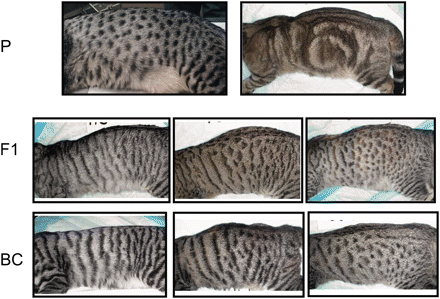
The figure below shows what happened when they tried to work out what genes are controlling the “spotted” coat variant, by crossing it to the tabby version (top line). The offspring (F1) showed a range from stripes to spots to tabby blotches (not shown). The backcross animals sometimes showed complete stripes, including the “mackerel” variant (bottom left).

Source: Genetics

They then used “microsatellite” genetic markers – small sequences of DNA that can be used to track and identify regions of the genome that may be responsible for the character under study. They were able to identify at least three different genes responsible for coat patterns – Tabby, which has two alleles or versions (one producing the mackerel pattern, the other the blotched); Ticked, which has an Abyssinian and a non-Absyssinian version, and one or more genes that alter the mackerel stripes and may also produce the blotched pattern. Furthermore, Ticked can alter the wayTabby is expressed.

In other words, it’s complicated. Which is hardly surprising, in a way – if it was straightforward, cat breeders would have figured it out long ago. What this study has shown is that there are genes involved in coding colour and pattern, that they are not necessarily the same, and that they affect the way each others’ expression. Exactly how this happens – or indeed, what these genes actually do – is unknown. They have yet to be identified at the molecular level.

Intriguingly, some of these genes may have equivalents in other animals, and may help in precisely identifying the genes involved in cat coat colour. For example, a human gene that may be similar to Tabby may be involved in the rare Hermansky-Pudlak syndrome type 2, where patients have reduced skin pigmentation.

Once the genes involved in determining coat colour and pattern in cats have been identified, we will be able to have a stab at understanding how they do what they do what they do. It will also give us the opportunity to study these genes in the 37 felid species that are still roaming the planet. In turn, that may help us understand apparently simpler patterns, such as those seen in tapirs, raccoons and badgers.

Of course, just because different species have similar patterns, that doesn’t mean that they will necessarily use the same genes to produce them. Natural selection “cares” about the phenotype, not the genes that underlie that phenotype. There is more than one way to skin a cat.

[First posted over at the Z-letter.]

Caturday Christmas

December 25, 2009 • 5:49 am

This evolution website has been going for nearly a year, and of course has itself evolved.   Thanks to all the faithful readers for your support and, most of all, your comments, without which this site would just be the lucubrations of a superannuated scientist.  Happy holidays!

Oh, and if you really want a Christmas kitteh overload, HuffPo has posted the 15 best cat videos of 2009, or you can hear a joke about Tommy the cat.

Caturday felid: hitchhiking kitten survives 120-mile trip in undercarriage. Plus bonus door-opening kitteh!

December 19, 2009 • 5:31 am

Every year a kitten gets stuck in the undercarriage of a car, is carried a long distance under horrific conditions, but then all ends happily as the moggie survives and gets adopted.  (We don’t hear about the cats that don’t make it.) Here, just in time for Christmas, is the annual hitching-cat story from KPTV Oregon. Be sure to watch the video , including the mewing kitten, here.

TUALATIN, Ore. — For once, curiosity didn’t kill the cat.  A 3-month-old kitten rode beneath a SUV for more than 120 miles Wednesday. Marc Lichty left Olympia, Wash., in his SUV after finishing up a day of work.  Along the way to Tualatin, he stopped at a rest stop and heard meowing. Lichty, however, couldn’t find any trace of a cat.When he returned home to Tualatin, he stepped out of the car and heard the meowing again, leading him to grab a flashlight. “Sure enough, the cat was up underneath in the spare tire spot up there,” Lichty said.”He shined the light and I just saw this little guy’s face there so we tried to get him out and coaxed him with a little piece of salmon,” said Jenna Lichty, Marc’s daughter. “I pulled him right out.”Sub-freezing temperatures reached the teens in the Pacific Northwest this week, which likely made for a chilly ride down Interstate 5 on Wednesday.”It was pretty cold. I can’t imagine traveling 75 miles down the freeway and it being 20 degrees out,” Lichty said.

Fig. 1.  Tahoe? I prefer “Hitch,” after our favorite atheist.

The cat does not have a micro chip and was not wearing a collar. The Lichtys called Olympia businesses in the area where Lichty was working Wednesday, but they were unsuccessful in finding the owner.  The family has decided to keep the kitten. Now, all they need is a good name.”Well, we’ve got a few floating around,” Lichty said. “Chevy. And there’s Tahoe, Pitch and Lucky. Nothing quite yet.”

Bonus video:

[viddler id=78033a00&w=437&h=333]

Fig. 2.  Imagine what it could do with thumbs!

Caturday felid: a mutant!

November 14, 2009 • 4:59 am

Loyal reader “articulett” sent in a photo of his/her cat, a newly-adopted stray that harbors a well-known mutation. Here’s articulett’s story of the mutant moggie:

I arrived home late from work last Friday, and as I pulled into my driveway, I noticed a strange cat. He didn’t dash away as most strange cats did. Instead he sauntered over to my car as if to say, “It’s about time you got home”. It was then I noticed his curly ears. I had never seen such a mutation. I knew about the “Scottish Fold”, but their ears bent forward; these curled back. I figured that if I gave him some food, maybe he’d stick around for me to study him, but he had bolder plans. He walked right into my home where an effusive dog and a couple of spoiled house-cats lived. He listened patiently to their complaints and smacked the dog on the nose when she got too close. His attitude seemed to be “I’m here–I have queer ears–get used to it.”

I did a little internet searching, and it turns out that there is a type of cat with curled ears called an “American Curl”. This particular American Curl had no collar and hasn’t shown any inclination to leave. In fact, he seems to have installed himself as the “King of Beasts” in my home, and the other occupants are to too flummoxed to protest. His ears give him a teddy-bearish/ocelot look which constantly makes me giggle–at some angles they look like horns, and at others they give the “hollow mask illusion” where it’s hard to tell which part pokes in and which part sticks out.. I adore felines and mutants, so this serendipity-kitty is right up my alley. What’s not to love? (I’ve been avoiding reading the lost ads, because I’m afraid he might be someone’s pet, and I’ve grown very attached to him. — Besides, he’s convinced he lives at my home.)

Curly

Perhaps readers would like to suggest a name? Articulett wanted to avoid “Curly,” of Three Stooges fame, as the name is too obvious. I thought that “Jerry” might be appropriate given that Curly Howard’s real name was Jerome Lester “Jerry” Horwitz. I’ll offer a free autographed copy of WEIT to any reader’s suggestion that is actually adopted by articulett. (Note: there’s no guarantee that he/she will adopt any of the suggestions.)

See here for more information on the American Curl breed, which stems from a single autosomal dominant mutation that arose in 1981.

Caturday felid: the philosophical cat

November 7, 2009 • 8:11 am

by Greg Mayer

Peyton is a WEIT blog regular, who last appeared here in a post by Jerry. This is a picture of her taken by Jerry while visiting me in September. I put up a copy of this photo recently in Jerry’s lab, joining an illustrious group of cats that grace the wall outside his fly room.

Peyton by Jerry
Peyton, the philosophical cat.