Will DEI be dismantled this week in the University of North Carolina System?

May 22, 2024 • 10:00 am

A reader sent me the tweet below (I don’t spend much time on Twitter), but it intrigued me not so much because University of North Carolina (UNC) system spends millions on DEI (that’s not unusual), but because it reports that its DEI policy may be eliminated across all UNC schools this week.  Note that there are 686 DEI positions in the system, with salaries adding up to over $70 million ($91 million if you include benefits).

The article below, from the “Open the Books” Substack site, while a bit rant-y, does give useful information about spending and salaries, even though the UNC system has refused to answer Freedom of Information Act requests from the author.  And the presumably impending end to DEI is also of interest, as it seems to be part of a national trend. Click below to read:

First, the new (the article’s slant is clear):

On Wednesday, the system’s governing board may end the controversial program that institutionalizes bias and prejudice based on neo-Marxist principles and falsehoods.

. . .UNC appears to be joining a group of schools that repudiate the institutionalized bias of “DEI.”

The UNC Board of Governors oversees the entire UNC system. It is expected to vote on a measure this week that would reverse and replace its DEI policy.

This follows an April vote by the Board’s five-person committee on University Governance to dismantle DEI offices.

Last week, UNC Chapel Hill’s Board of Trustees diverted $2.3 million to Public Safety from DEI, as the campus has been embroiled in Pro-Palestinian protests and encampments.

I’ve already reported on the last statement: the diversion of money from DEI to campus cops and security—exactly the opposite of what progressives want.  Here’s how they calculated the payrolls (since the UNC system is part of the state government, salaries are publicly available).

Our audit team at OpenTheBooks.com reviewed official university payrolls after filing records requests and searched university websites for DEI committees and their membership lists. Here’s how the UNC program breaks down:

  • 288 are employed in DEI-related roles listed on the UNC system’s payroll.
  • Another 398 people were found to hold DEI-related roles not shown in the payroll records. Found on university websites, these employees are members of DEI committees, commissions and councils.
  • An additional 80 students were appointed to mostly volunteer DEI roles.
  • Another 66 employees are listed on the university websites for DEI committees but don’t appear in the university payroll – likely meaning the websites are out of date.

We found at least 30 DEI-focused groups steering DEI across the 16 universities. These pulled professors, lecturers, advisors, librarians, directors, and deans out of their academic functions and into efforts to spread DEI policies and principles.

We uncovered empirical evidence that DEI has permeated 300 departments across every aspect the UNC system of 50,000 employees.

For a truly complete picture, we know there is more research to be done. While we compiled a long list, there are indications that even more people are working in DEI-related roles.

Besides the money spent above, the site gives the salaries of the highest-paid UNC system officials connected with DEI, with salaries corrected for likely benefits:

In likely violation of North Carolina’s freedom of information laws, UNC has not acknowledged our April public records request for all university payroll to include all cash compensation (salaries, bonuses, other pay, benefits, etc.). UNC was required to respond, “as promptly as possible.”

After six weeks, the UNC system has only provided a ‘base salary’ payroll list. So, the payroll numbers are most likely 10-15 percent higher than disclosed. For total student and taxpayer cost — tack on another 30-percent for the cost of benefits.

It’s hard not to believe that UNC is stalling here. I wonder why. . .

It’s really a travesty to divert $91 from education to DEI initiatives.  A couple of million would suffice to prevent bias or expand admissions and hiring efforts to try to increase diversity. But “diversity” is invariably a euphemism for “racial diversity”, and while I do want to see that, I also want to see viewpoint diversity, which is the real meat of the college experience: the whetstone against which you hone your ideas.

There’s a lot more in the article, like some of the DEI-related courses taught or certificates conferred, but we’ll leave that for your own reading. The good news is that the UNC system is getting rid of a diversion that is ineffective (though generally well intended) and probably largely illegal.

If you want to see how DEI has been used as a way to eliminate candidates with the “wrong” sociological views, have a look at this New York Post article on how Cornell University has been using diversity statements as reasons to hire or dismiss job candidates. The data—e.g., 21% of candidates for a “hard science” faculty job were rejected based on DEI statements alone—were leaked from Cornell to its Free Speech alliance, which then made it public.

UNC Asheville adopts institutional neutrality

May 21, 2024 • 10:46 am

I didn’t realize this until I read the article below from the Asheville (North Carolina) Watchdog, but apparently the entire University of North Carolina (UNC) system is adopting institutional neutrality à la the University of Chicago’s Kalven Report, put in place in 1967.  About two years ago I reported that the flagship school of UNC, the branch at Chapel Hill, had adopted not only the Kalven Principles, but also the University of Chicago’s Freedom of Expression Principles. The latter guarantees free speech on campus, comporting with the First Amendment but also subject to the University’s “time, place, and manner” restrictions that allow the institution to function.

Institutional neutrality, embodied in Kalven, supports free speech by prohibiting schools, academic units, or departments from taking official positions on political, ideological or moral questions—with rare exceptions that involve issues involving the functioning of our institution. (For an example of our Kalvenish restraint, see this statement by the University after the October 7 attack on Israel and the resultant war.)

So far, over a hundred American colleges have adopted a version of our Free Expression principles, but only a handful adhere to Kalven. It appears to be very hard for schools to keep their gobs shut about political issues of the day, and it’s made worse because students, who often don’t understand the purpose of institutional neutrality, put colleges under heavy pressure to issue statements.

The article below is about that pressure, pressure exemplified by students defending the banners below hanging from the library of the University of North Carolina Asheville (UNCA) library. There are three political ones, supporting Black Lives Matter, LGBTQ+ community, and a land acknowledgment to the Cherokee. The students also don’t understand why UNCA doesn’t take a position on the war in Gaza.

Click any of the items below to read the piece.

What started the debate about institutional neutrality was the removal of the banners above in 2023, along with a Black Lives Matter Mural that was taken down during renovations and not replaced. The Chancellor explained that the banners, and now any statements about the war in Gaza, would be violations of institutional neutrality:

Since University of North Carolina Asheville students began protesting against the war in Gaza in early May, Chancellor Kimberly van Noort has maintained that the university should avoid an official stance on the matter.

“Neither the University nor I, the chancellor, should interfere by taking an official stance,” van Noort wrote in a public update to students and faculty earlier this month. “Institutional neutrality promotes the open exchange of ideas and avoids inhibiting scholarship, creativity, and expression. Compromising this position carries great risks.”

Her adherence to institutional neutrality mirrors other universities’ stances across the country, which have experienced growing protests in the past few weeks. Institutional neutrality also has been applied to other cultural issues on campus, including the Ramsey Library display of Black Lives Matter, Cherokee land acknowledgement, and LGBTQ+ banners – and comes at a time when the university system’s Board of Governors is considering removing Diversity, Equity, and Inclusion positions and offices across the system.

In spring 2023, the banners were removed to allow repainting of the library and were not replaced. At the time, van Noort reported in public updates that the banners suffered from “expected wear and tear” from “time and the elements.”

Van Noort told Asheville Watchdog recently that the decision to not reinstate the banners hinged on institutional neutrality.

“For us to make a decision of privileging some over others is really problematic for a university, where we strive to have this neutral state so students can express themselves,” she said in an interview. “They can express opposition. They can express conflict. They can express disagreement in a peaceful, non-violent, respectful manner, but it’s not the place of the university to take a stance in those conversations.”

Or, as our Kalven report states in a brilliant passage:

The instrument of dissent and criticism is the individual faculty member or the individual student. The university is the home and sponsor of critics; it is not itself the critic. It is, to go back once again to the classic phrase, a community of scholars. To perform its mission in the society, a university must sustain an extraordinary environment of freedom of inquiry and maintain an independence from political fashions, passions, and pressures. A university, if it is to be true to its faith in intellectual inquiry, must embrace, be hospitable to, and encourage the widest diversity of views within its own community. It is a community but only for the limited, albeit great, purposes of teaching and research. It is not a club, it is not a trade association, it is not a lobby.

Here’s more from the newspaper that describes how the whole state system adopted institutional neutrality; it’s a recent development:

The idea of institutional neutrality dates back to the University of Chicago’s 1967 Kalven Committee Report, which argues that university neutrality is important in fostering a diversity of viewpoints. The idea caught steam in 2021 when Vanderbilt’s chancellor Daniel Diermeier advocated for it in pieces for USA TodayInside Higher Ed, and ForbesUNCA’s chief university communication and marketing officer Michael Strysick said.

Strysick said it was a 2017 state law involving campus free speech – and UNC policy – that brought institutional neutrality to the UNC system. The law, born from HB 527, stated “the constituent institution may not take action, as an institution, on public policy controversies of the day.”

The law did not include the term “neutrality” until it was amended by SB 195 last summer. SB 195 requires all North Carolina colleges and universities to remain neutral on “political controversies of the day.”

Last summer, the General Assembly passed another bill, SB 364, using language mirroring the Kalven Report, prohibiting UNC institutions from asking employment applicants to describe beliefs around “contemporary political debate or social action.” A few weeks ago, a UNC System committee approved a policy that would remove Diversity, Equity, and Inclusion positions and offices across the system, if approved by the full Board of Governors on May 23. The committee’s decision sparked a student protest in front of the Ramsey Library.

Student protesters met with Chancellor Van Noort in May, and were advised that taking a stand on the war, or even on DEI, was a violation of institutional neutrality. Students and some faculty don’t like that, because it means that the university doesn’t publicize debatable ideas or political initiatives that students and faculty like. (Yes, DEI is debatable, at least the way it’s used in colleges, though of course bias in university treatment or admissions is illegal.  But DEI goes far beyond simply “color blindedness,” as most of us know.)

Here’s some pushback:

“A big part of the DEI policy is recruiting and retaining students. The system is shooting itself in the foot if we do this because we are not going to be able to recruit,” said Kelly Biers, associate professor of French. “It’s going to drive away high quality faculty and students.”

But of course they can still recruit, though retention of students with lower qualifications will always be a problem. But you can’t give special privileges to students because of their ethnicity (face it, this is not about “viewpoint diversity” but about race and ethnicity). I suppose Biers means that they can’t recruit on the basis of race, which is illegal anyway because of the recent Supreme Court Decision, but of course UNCA can cast their recruiting net as widely as possible, and by all means cast it over students from different social classes and ethnic groups. But the DEI that gives arrant racial preferences, tries to instill guilt in people who are male or white, taints everyone with “unconscious bias”, or requires applicants for jobs to submit DEI statements, will no longer fly.  But truly, I don’t understand how killing the “progressive” DEI while retaining policies against bias and bigotry will “drive away high quality faculty and students.”

There’s more pushback:

Alondra Barrera-Hernandez, student government president and protest organizer added, “It’s important to advocate for this (DEI) on our campus especially because UNC Asheville is a very diverse campus, especially for DEI. It can impact a lot of marginalized students.”

Again, DEI is construed, I suspect, to mean students marginalized because of their race or ethnicity, not because they’re conservatives. But remember that an important part of campus diversity is viewpoint diversity, yet the implicit assumption for “etbnically marginalized” students is the patronizing notion that they all share a common viewpoint.  They don’t, of course, but campuses are looking for the ones that do. They don’t want young versions of Coleman Hughes or John McWhorter.

One more misguided criticism of institutional neutrality, dealing with a student’s reaction after the banners and the BLM mural was removed:

Alumna Lauren Brasswell was the student government president at the time.

“By choosing not to take a stance, the institution is taking a stance on ignoring the historical significance of the harsh realities that marginalized individuals face,” said Brasswell. “This reality does not and should not go against any universities’ mission or values. And, if it does, that institution is and will be a hostile, discriminatory and unsafe environment for any black or brown student, faculty, or staff.”

No, that’s not true at all.  Saying that if a university doesn’t take an explicit stance on a historical or present-day controversy, it’s favoring one side of that controversy is wrong. It’s like saying that if you don’t declare that you have a hobby, you still have one, which is “not having a hobby.”

Again, the University is not the critic but the sponsor of critics.  Students and faculty are welcome, nay, encouraged to publicize their personal views about anything, and the rejection of centuries of bigotry is now enshrined in rules that prohibit academic and personal discrimination in colleges.  With such recognition, the claim that the environment is “unsafe” seems overblown , though of course people may feel unsafe without actually being unsafe.  I wonder how many students of color at UNCA live their lives in fear of constant attack or discrimination? We don’t know; all we have are these assertions.

The only statement by the Chancellor which seems a bit off is this one:

The chancellor would like to see a local art piece instead of the banners and clarified that UNCA has “no intention of lessening or eliminating the University’s commitment to the [Cherokee] land acknowledgement, but to the contrary exploring ways to more permanently honor it.”

If UNCA really wants to honor the commitment that their university stands on lands stolen from the Cherokee, they should either reimburse that group or give the land back. Anything else is performative virtue-signaling that costs nothing to the University oppressors.

At any rate, the article ends with the pro-Palestinian students promising to continue their activities in the fall while planning strategy during the summer. More power to them—so long as they don’t violate University regulations.  I disagree with nearly all of their views, but hey, it’s free speech, and they’re welcome to say what they want, even “Globalize the intifada”, a call for violence that’s legal so long as it doesn’t incite imminent and predictable violence.

And short-term banners or displays from student groups are also okay, but once they’re made permanent they can be regarded as an official position of a university, which is a violation of neutrality.

The University of Toronto encampment has a ceremonial fire; head of Sonoma State University in California suspended for deciding on an academic boycott of Israel

May 20, 2024 • 8:30 am

This message was sent to students at the St. George campus (the downtown branch) of the University of Toronto. The message doesn’t stand out insofar as college actions or capitulation to protestors’ demands, goes, but it does combine two of my favorite subjects: college free speech and indigenous knowledge. Only in two places—Canada and New Zealand—could you find such a mixture.

The students at St. George apparently had an encampment, and students were informed that occupying Tent City (Ville de Tentes) constituted trespassing and they were asked to leave, but the University says it’s also determined to end the encampment peacefully.  Since the students aren’t leaving, the encampment continues.

Click on the headline to read, but go to the May 16 update—the latest one. The ceremonial fire is in the forth paragraph:

Here’s the message:

Dear U of T community,

University representatives met again yesterday with students representing those at the encampment. This meeting is the latest in a series of discussions that have taken place.

The discussion was constructive and productive. Much of the focus at the meeting was on discussing the students’ demands.

The University and student representatives have worked together to mitigate the prior concerns regarding sanitation. Moreover, the ceremonial fire inside the encampment is burning under the careful supervision of experienced Indigenous Firekeepers in a manner that suits the unique conditions of the site. We continue to discuss signs and language and emphasize how important it is that they be consistent with the spirit of peaceful protest.

We aim to reconvene soon. We recognize that our entire community has a stake in this matter. Our next community update will be sent early next week, and all updates continue to be posted on the UTogether site.

Our goal remains the same: to find a peaceful and sustainable conclusion to the encampment on Front Campus as soon as possible, in line with University principles and policies.

Sincerely,

Christine Szustaczek
Vice President Communications

There’s a ceremonial fire! Well, it’s better than some acts of the entented, including violence and defacing buildings. Let’s hope the Indigenous Firekeepers are sufficiently experienced and that the tents aren’t flammable.

As of the next day, the encampment remained; here’s a news video from May 17. The encampment (on the St. George campus) appears to be surrounded by a sturdy fence, which means entry is controlled and there’s a part of campus where non-protesters aren’t allowed or welcome.

The President of the University of Toronto had previously responded to protestors’ demands, but the response was basically “no”: the U of T refused the demands to boycott and break off contacts with Israeli Universities, and also refused to divest from Israeli companies because it adheres to a Kalven-esque principle of institutional neutrality in investing:

. . . . . the University’s Policy on Social and Political Issues with Respect to University Divestment notes in its opening Preamble that “As a general matter, the University does not take positions on social or political issues apart from those directly pertinent to higher education and academic research.” Accordingly, “the University will not consider proposals for restrictions on its investments that require the institution to take sides in matters that are properly the subject of ongoing academic inquiry and debate.” It further notes, as a corollary, that the University’s response to any requests for divestment “must be governed by the fundamental place of diversity of opinion within its community. Except in those situations in which the University must settle on an answer to controversial questions about how best to achieve its academic mission, the University risks abandoning its core values if it takes sides in ongoing debates and is perceived to be advancing a specific political or social position.”

That’s an admirable policy. If only the University of Toronto had the same kind of institutional neutrality for speech and official university policy and announcements!  There are a few more points about investing, like the one below, but they’re above my pay grade.

Notwithstanding the above fundamental points, let me make clear that the investment of the University’s endowment, which is comprised of endowed gifts to the University, is managed by the University of Toronto Asset Management Corporation (UTAM), and does not hold any direct investments in companies. The Expendable Funds Investment Pool (EFIP), consisting of expendable gifts and working capital, holds direct investments in fixed-income products, but not in company securities.

The video above reports that the U of T is pondering creating an institute of Palestinian Studies (a form of bias that may be illegal) and creating two faculty chairs in Palestinian studies. My guess is that these demands won’t be met, though the protesters have given the University a June 30 deadline to meet their demand (or what?)

*************

Note as well that meeting protestors’ demands, including academic boycotts, can be dangerous to one’s career (and, I suspect, will give birth to many lawsuits):

The president of Sonoma State University in California was placed on an indefinite leave of absence two days after he sent an email to the university community announcing that he had acceded to campus encampment organizers’ anti-Israel demands.

Ming-Tung “Mike” Lee issued a statement on Tuesday informing SSU students, faculty, and staff that, after standing for 19 days, the anti-Israel encampment on the university’s lawn had achieved at least one of its goals: an academic boycott of Israel.

He went on to address the new academic boycott:

SSU will not pursue or engage in any study abroad programs, faculty exchanges, or other formal collaborations that are sponsored by, or represent, the Israeli state academic and research institutions. SSU also commits to immediately updating any SSU pamphlets and SSU-hosted websites that may still be circulating or searchable and to remove hosting or linking to any pamphlets, flyers, or brochures advertising the study abroad program where students are encouraged to study abroad in Israel. SSU will make it clear to any students that any such programs are terminated until further notice and not simply suspended.

. . . . California State University chancellor Mildred García, who oversees the state’s public university system, wrote in a statement on Wednesday that Lee’s decision to accede to protesters’ demands had not been approved by any entity with authority over the school.

“On Tuesday evening, Sonoma State University President Mike Lee sent a campuswide message concerning an agreement with campus protesters. That message was sent without the appropriate approvals,” García wrote. “The Board’s leadership and I are actively reviewing the matter and will provide additional details in the near future. For now, because of this insubordination and consequences it has brought upon the system, President Lee has been placed on administrative leave.”

Insubordination!

Jerry Seinfeld’s commencement address at Duke

May 15, 2024 • 8:30 am

Here’s Jerry Seinfeld’s 17-minute commencement address at Duke, which I don’t find nearly as funny as I’ve been told. It may be because he once responded this way when asked about his reported statement that he won’t do comedy at colleges any more:

“I hear that all the time,” Seinfeld said. “I don’t play colleges, but I hear a lot of people tell me don’t go near colleges — they’re so PC (politically correct).”

So he stays pretty much away from politics in this address, something he more or less had to do given the Zeitgeist, but that also took the edge off his humor.  To me, the “funny” bits aren’t funny, and the serious “advice” seems anodyne.

Fall in love with BIC pens and pizza crust? What’s that about?  “Keep your sense of humor”? Yes, but he evinces little of that in his talk.  “Work hard in life”?  Yes, but that’s trite—the stuff of many such addresses. It’s clear that he decided to steer clear of anything that could cause controversy, and the result is a phoned-in and unfunny shtick. It’s a pity. And he didn’t even have to be controversial; all he had to be was funny, but he seemed incapable of that.

Nevertheless, as the NYT reported, there was still some protest.

As Mr. Seinfeld, who has recently been vocal about his support for Israel, received an honorary degree, dozens of students walked out and chanted, “Free, free Palestine,” while the comedian looked on and smiled tensely.

Many in the crowd jeered the protesters. Minutes later, as the last of the protesters were filing out, he approached the mic. His first words were: “Thank you. Oh my God, what a beautiful day.”

In his commencement speech, Mr. Seinfeld was mostly cautious, opting for a tight comedic script interspersed with life advice instead of a full-on response to the protests against his presence.

Well, at least he wasn’t deplatformed because of his support for Israel!

Protests end with removal of Encampment: photos and info from Monday and today

May 7, 2024 • 9:00 am

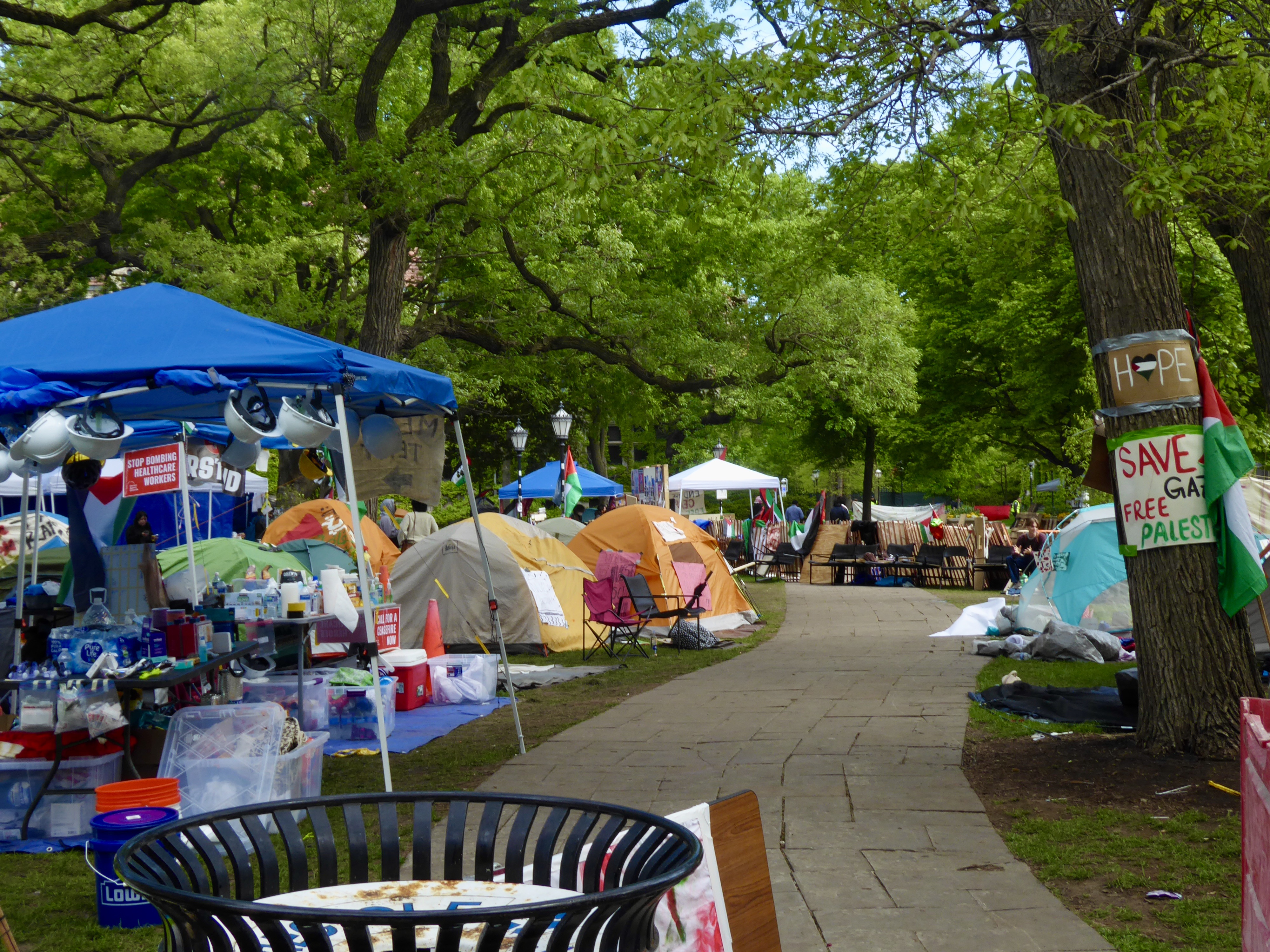
Yesterday the Encampment was fairly quiet, but after the President stopped negotiations with the protestors, an air of doom hung over the pro-Palestinian enclave. In this post I’ll put up some photos, videos, and remarks about the final day of the encampment, and then show what happened this morning.

Here are some photos from yesterday afternoon, the last day (hopefully) of the encampment. The afternoon photos are mine, but the video below is credited to another person.

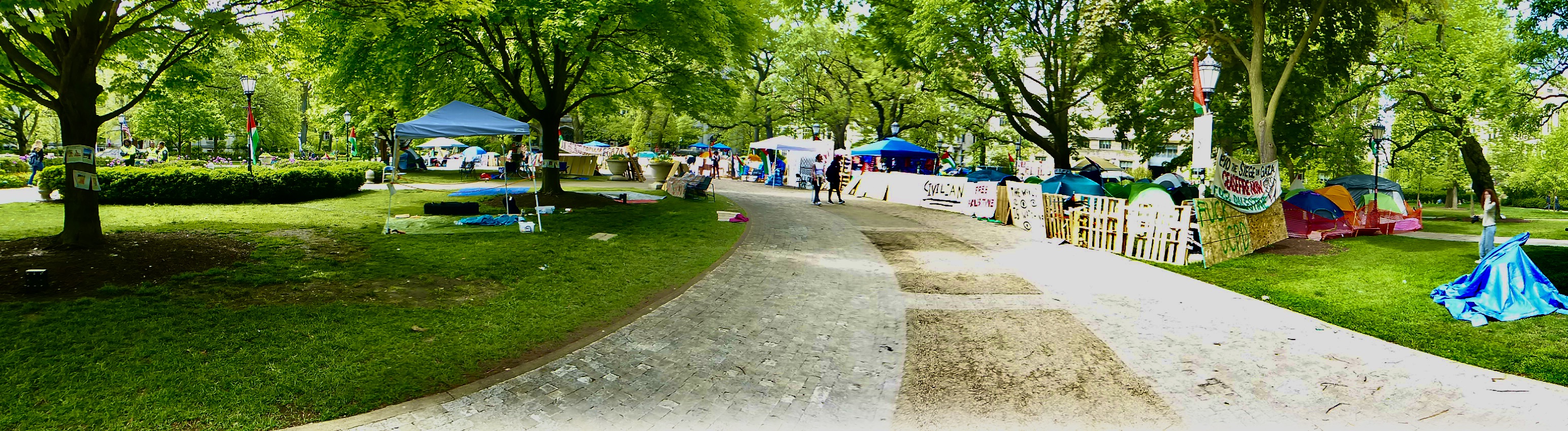
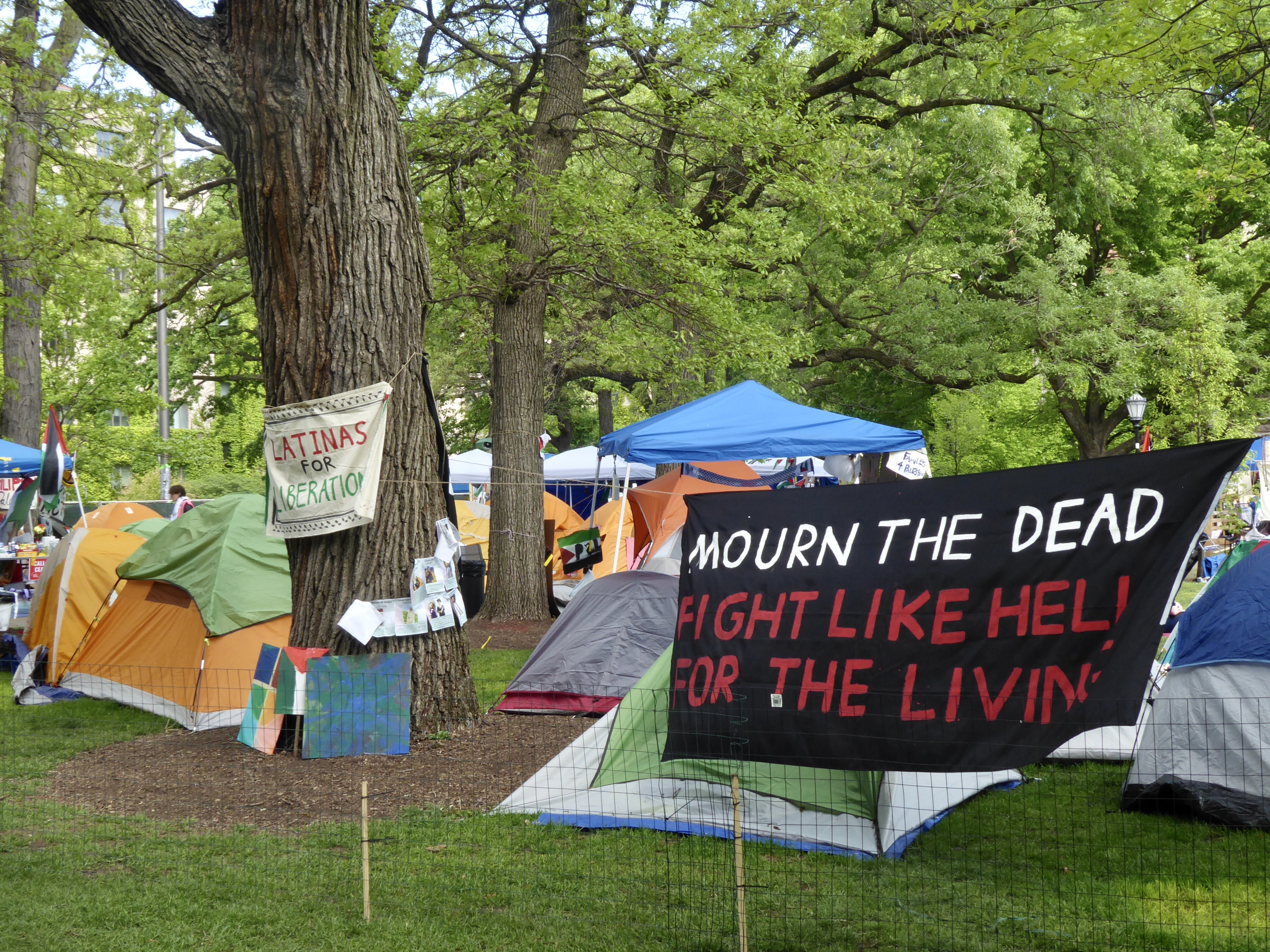
A panorama of the area. Click to enlarge. The encampment is inside the fence to the right, and there were more than 100 tents there.

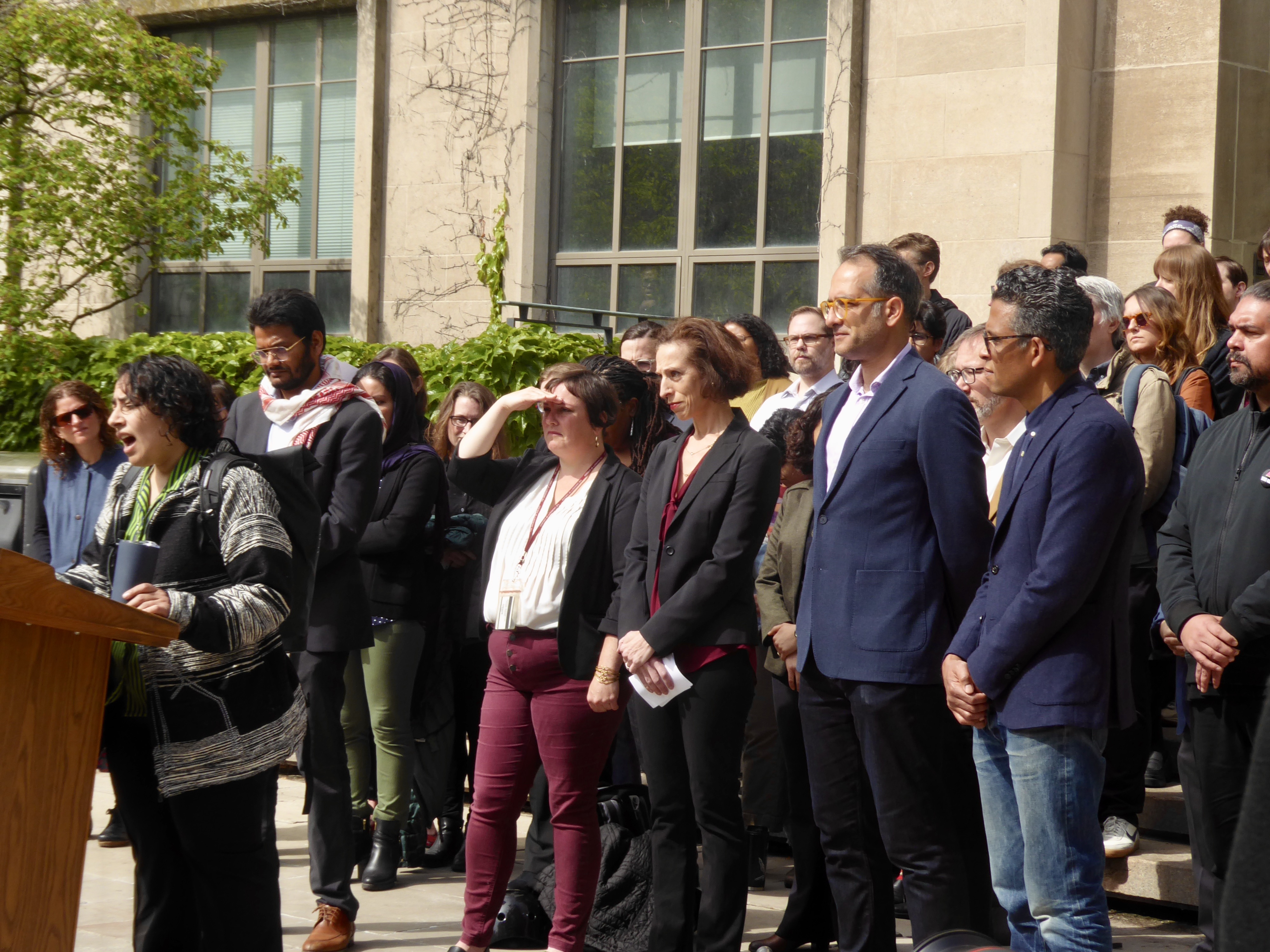
A press conference held yesterday on the steps of the administration building by the pro-demonstrator professors. They argued strenuously that we should leave up the encampment. After all, they argued, it’s free speech. Well, it’s also a violation of campus speech codes.  250 of these people signed a petition to the President defending the encampment. They lost.

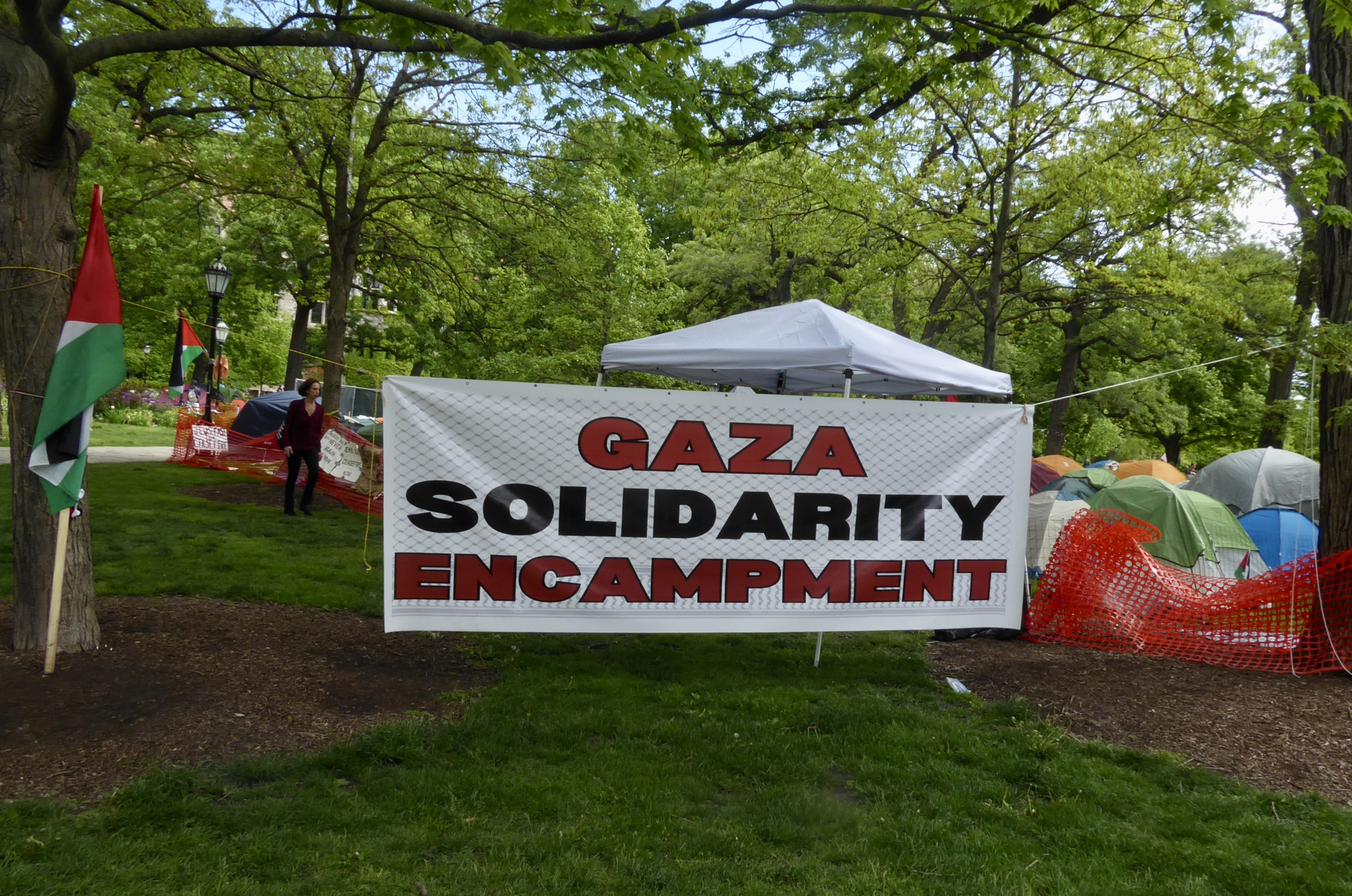
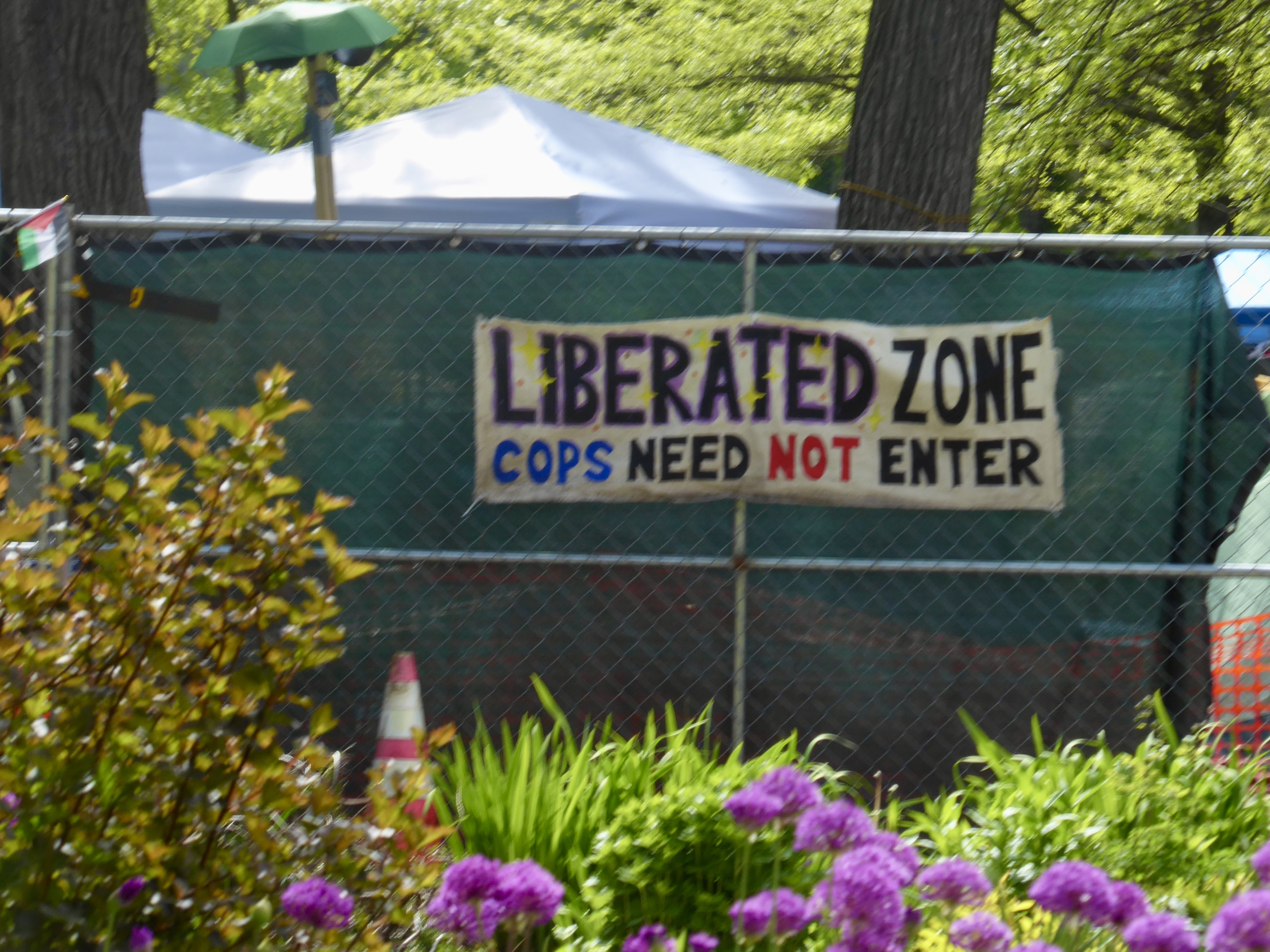
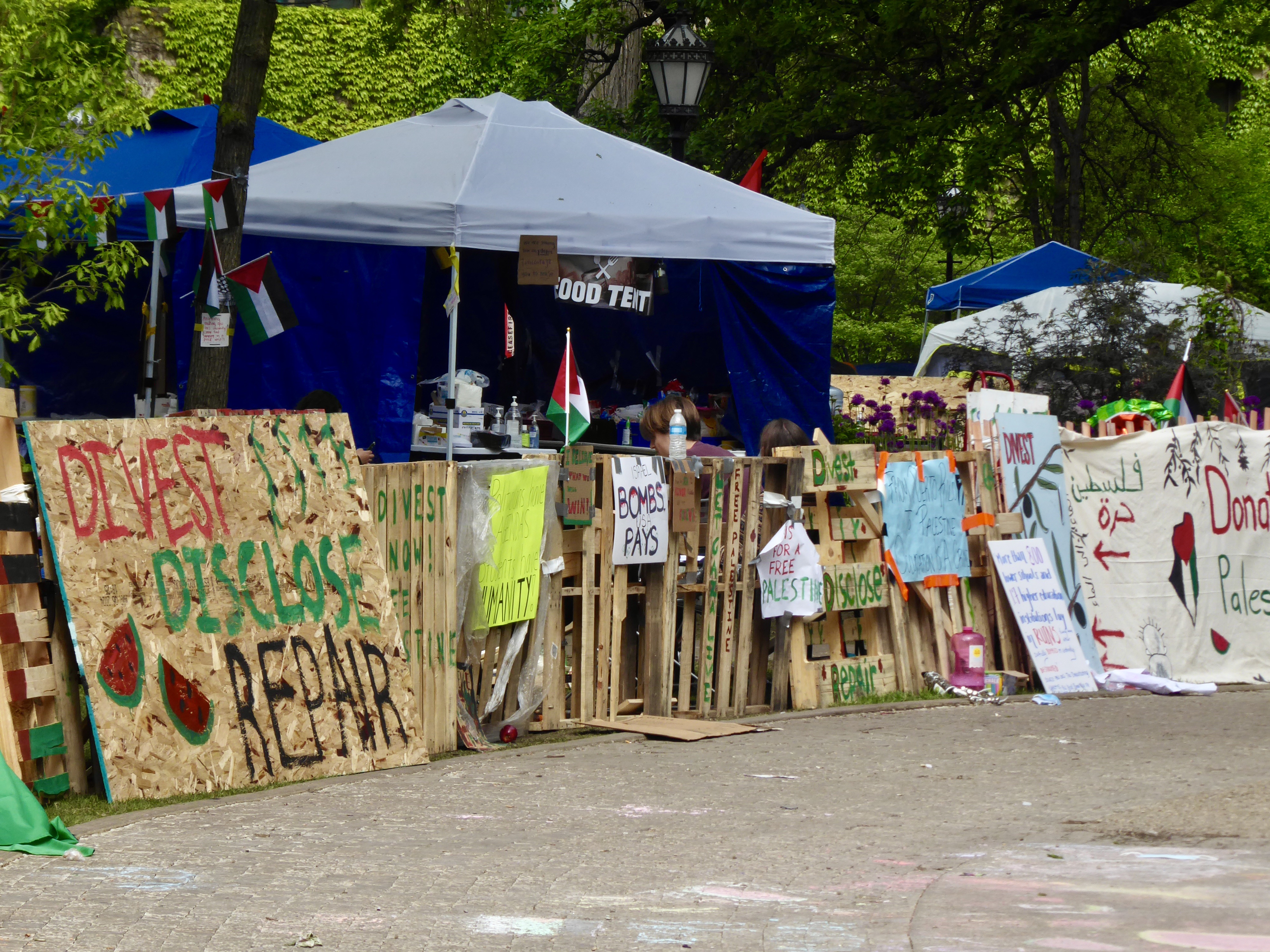
Photos of the last day of the encampment:

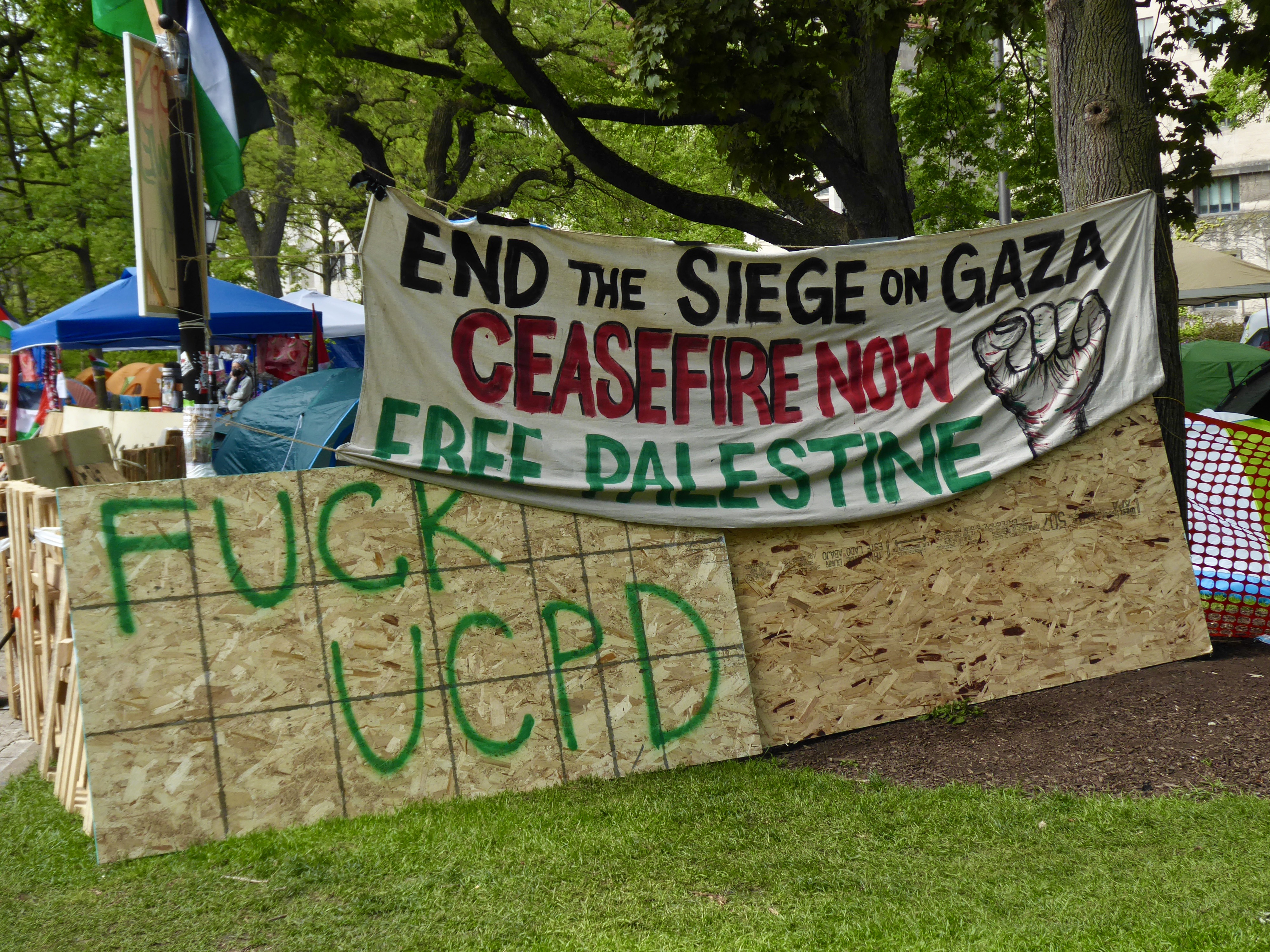
I don’t think the University of Chicago Police Department would like this “Fuck UCPD” sign:

Here are three people being kicked out of the encampment yesterday, apparently for no reason except they “intruded”.  Two of them were harassed by the protesters and given the bum’s rush, while the father of Jonathan (the student who took the film) went in to help them. All three were then hustled out with cries of “Fascists! Go home!”, as you can hear.   Video by Jonathan Zeevi.

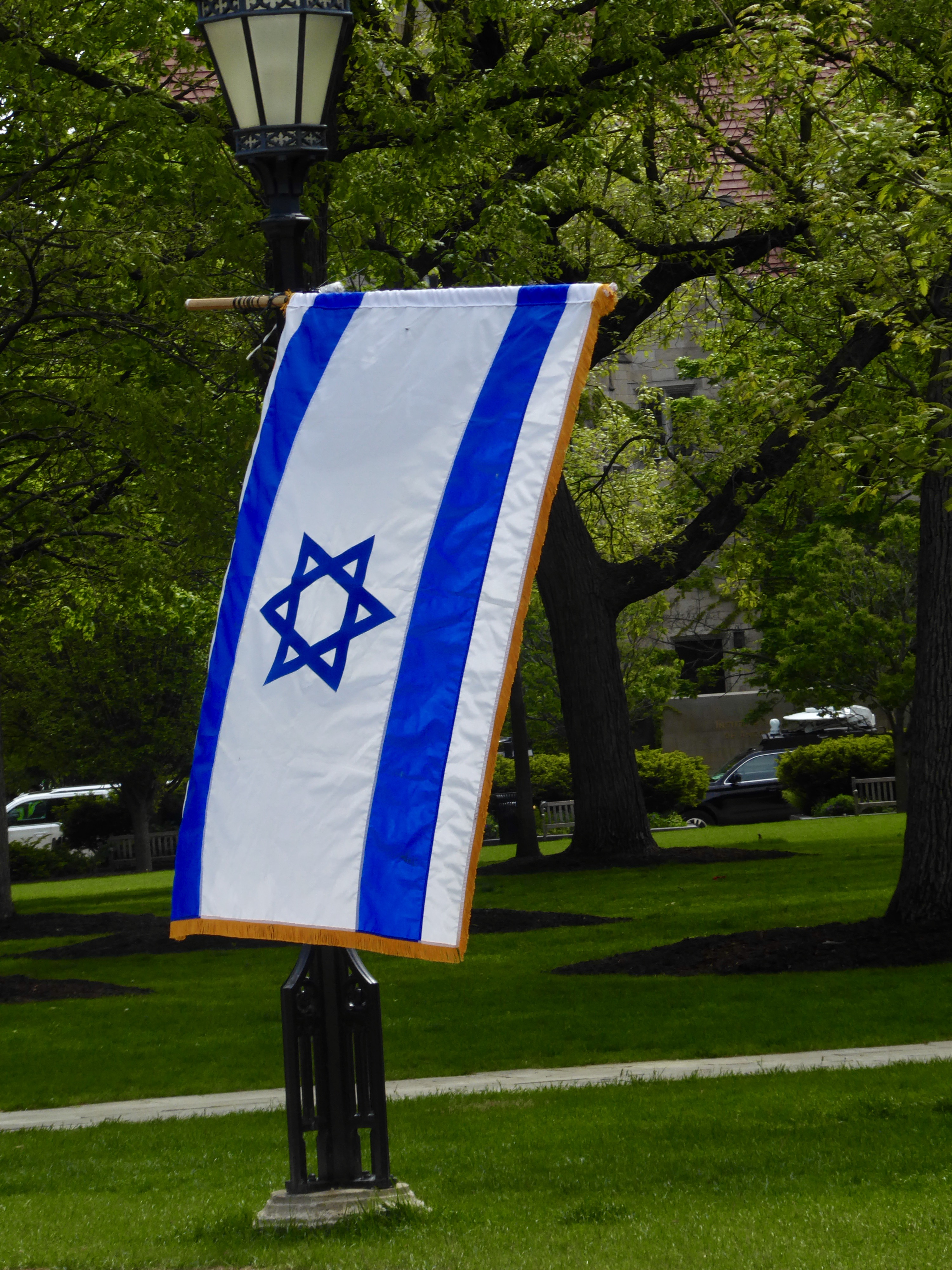
But the police left the Jewish banners and flags alone, as they were placed legally. Am Yisrael Chai!

The dismantling was already beginning when I walked to work about 5 a.m. There were campus cops all over the place, chanting and screaming by the Encampers, and loud shouts by the police clearing the area. Two cop cars were parked on the quad. I’ll let the Chicago Maroon give the details:

At approximately 4:25 a.m. on Tuesday morning, less than an hour after encampment organizers concluded their final rally of the evening, several dozen UCPD officers arrived at the main quad to remove the pro-Palestine encampment. The officers’ arrival came on the ninth day of the encampment, after UChicago United for Palestine (UCUP) launched an encampment on the quad outside of Swift Hall at 10 a.m. on Monday, following in the steps of pro-Palestinian groups at numerous other universities that have set up encampments in recent weeks.

Shortly before UCPD officers sweeped [sic] the encampment, two UCPD cars arrived on the main quad. Protesters were informed over a speaker that “the University of Chicago [did] not permit their assembly in this area,” and that they were “hereby notified that [they were] committing criminal trespass by remaining on… private property without permission.”

“Anyone who fails to comply will be criminally charged,” the speaker announced. “Students who fail to comply with this order will be subject to University discipline and immediately placed on leave of absence.”

Protesters, as they had largely returned to their tents to sleep for the night following the rally, had only minutes to comply with orders before UCPD officers entered the encampment. As UCPD officers overturned the encampment’s tents and barriers, protesters chanted in unison, repeating the phrases they had used during their daily rallies over the past week of the encampment. The Cook County Sheriff’s Office was also observed on the scene amidst the raid.

“More than 40,000 dead! You’re arresting kids instead!” Encampment members chanted in a video reviewed and verified by The Maroon from a protester inside the encampment during the sweep.

In an interview shared with The Maroon, an encampment member asserted that “[UCPD] did not give [encampment members] a clear plan for leaving.

“They came in maybe two minutes after the warning,” the encampment member said. “It’s clear that they waited until after the rally was over. We were at our most vulnerable.”

JAC: Isn’t that the best time to clear the encampment? We don’t want protestors fighting the cops, which is a recipe for violence and injury. The Maroon continues:

Protesters could be heard screaming by Maroon staff as the raid went on. At 4:55 a.m., UCPD ordered press, including Maroon staff, to leave the quad. It is currently unclear how many arrests may have been made, or if there were any injuries.

In a Telegram message, UCUP encouraged protesters who had not been at the encampment at the time of the raid to return to campus to demonstrate outside of the quad. Protesters gathered near the S. Ellis Ave entrance to the quad and chanted at the line of police donned in riot gear, who set up yellow barricades to separate themselves from the protesters.

Officers then handed out slips of paper with instructions on departing the encampment to the protesters who had gathered. The slips were entitled “Final Notice to Students Participating in Encampment on Main Quad,” and were not handed to protesters inside of the encampment in advance of the raid.

“The Deans on Call and University of Chicago Police Department (UCPD) have informed you multiple times that your tents and other items are unauthorized. This is your final warning to leave the encampment.

If you fail to immediately leave, you will be arrested by law enforcement for criminal trespass under the Illinois Criminal Code.

Additionally, failure to immediately leave will result in disciplinary action as outlined in the Student Manual. You will also be immediately placed on emergency interim leave of absence from the University. A student who has been placed on emergency interim leave of absence must promptly vacate University housing, leave campus, cannot participate in student and academic program activities, or use any University facilities, and may not return until the student has been authorized to return from the leave and reenroll.”

The University could not be reached for comment.

Here’s a video taken by illegal encamper and posted on SJP Twitter; you’ll have to watch it on YouTube (click on “Watch on YouTube”):

This statement by the President was issued shortly after the Quad was cleared, explaining why the Encampment had to go.


A similar statement from our Dean of Students and the VP for Safety and Security:

These next photos and videos were taken by several readers of this site.

The protestors after they’d been pushed out of the quad onto Ellis Avenue. They tried to push back into the Quad, but the cops blocked their entry.

The throughway to the Quad that runs beneath the Administration Building, Levi Hall:

The peeved protestors, deprived of their tents and billboards, shouting at the cops blocking their re-entry into the quad:

More: protestors demanding that the cops answer, “Why are you here?” But of course we know whey they’re here: to enforce campus regulations.

“We love you,” they’re crying, though it’s very strange. They’re trying to push back into the quad, but the cops push back using a yellow plastic fence.

Protestors on one side of the fence; cops on the other.

Here, I’m told, are the infamous Weatherpeople, Bill Ayers and Bernadine Dohrn (circled), who were leaders of the Weather Underground (Ayers was a cofounder). They were arrested years ago, but only Dohrn served a bit of time, They got jobs in Chicago, and lately have been hanging around the Encampment to support its members.

The end, a cleared Quad:

Bye, bye, tents!:

I guess not all the protestors took their tents with them, even though they were allowed to.

And here’s a local report from ABC7 News, mentioning punishment of students (but only those who fail to leave).

What’s next? I doubt that these protesters, who are angry and persistent, will give up.  But they won’t be allowed to camp on the campus any longer, and for a while we may have to show University ID cards to get onto campus.

We’re all wondering if there will be punishments for students and “outsiders.”  The cops didn’t apparently ask for IDs as they expelled the Encampers, so I’m not sure how the University will identify those Encampers for punishment. As the President said above, “Where appropriate disciplinary action will proceed.” I’m not convinced, given the history of these protests, that this will occur. But certainly Students for Justice in Palestine, which was a big part of the Encampment and which was already on a warning from the University, should have its status as a Recognized Student Organization revoked.

Student protests will undoubtedly continue, the Jewish students will try to hold their own in the face of the antisemitism that was part of the Encampment, and that’s one form of division that seems irreparable, especially if Israel eliminates Hamas. (Our students should not suffer because of anything Israel does!)

With the faculty divided as well, will things ever get back to normal here? I’m not sure, as antipathy is rife. And our University has certainly had its brand tarnished.

The Jinx Press site has a bunch of tweets, apparently taken by Encampers. Here are a couple (Jinx is clearly pro-Encampment):

It took just three hours from when the UCPD started taking down the camp until the quad was cleared. Kudos to the cops for handling this well and avoiding injury, and also to those workers who had to clean up the mess the protesters left behind.

Harvard warns its encampment

May 6, 2024 • 12:30 pm

This is just to keep up with what different colleges are doing about their Encampments, and this is College #1, Harvard (or, as we used to call it when I was a grad student, “Schmarvard”). A while back, to prevent Encampments, they closed Harvard Yard to all but those who could present a Harvard ID, and just to walk through or go to their dorm.

Nevertheless, the Yard got entented; by the second day, it looked like this (from the Harvard Crimson). That’s a lot of tents. Note the green and white jobbies, but here we also see blue and orange ones. The similarity of colors among tents bespeaks a common funder, but we don’t know who.

(from Crimson): The Harvard Yard encampment expanded as it entered its second day. Despite the Palestine Solidarity Committee heavily promoting the demonstration on social media, the group insisted that they did not organize the encampment. By Frank S. Zhou

The reason wasn’t divestment, but this:

The organizers behind a pro-Palestine encampment in Harvard Yard insisted that the demonstration was not organized by the Palestine Solidarity Committee, a clarification that protesters made amid heightened concerns about the potential for disciplinary action against the PSC and its individual members.

Instead, Harvard Out of Occupied Palestine — an unrecognized coalition of pro-Palestine student groups — is responsible for staging the encampment, according to organizers.

Students established the encampment to protest the College’s decision to suspend the PSC on Monday, after the group allegedly violated the terms of its one-month probation by organizing an unregistered protest on Friday that was co-sponsored by unrecognized student organizations.

According to an internal University document obtained by The Crimson, the PSC did not complete the terms of their probation, despite meeting with the Dean of Students Office multiple times to clarify the College’s policies around organized protests.

But the reason for this post is simply to show you how the interim president of Harvard, Alan Garber (replacing Claudine Gay until they find her successor), responded. He let the Encampent stay for 12 days and then issued the statement below:

The upshot, then, is that Harvard’s been remarkably tolerant of the encampment, despite activities (like the famous Keffiyeh Encirclement that I experienced) that are disruptive and distressing. Harvard wants to have its graduation, which is in the Yard, without the tents and their obstreperous inhabitants, and is announcing that the camp will be dismantled. Garber mentions the reason why all these encampments are illegal: while they can be partly seen as expressions of free speech, they violate the “TPM” requirements (“time, place, and manner”) that the courts have said can be part of free-speech policies on campus.

The gist of Garber giving the Encampment the pink slip is summarized in the last sentence, “Our disagreements are most effectively addressed through candid constructive dialogue, building not on disruption but on facts and reason.”

It’s a good letter, and Schmarvard has indulged its Encampers long enough.

Veritas! Will the University of Chicago have the spine to do what Harvard says it will do?

Oh, and a tweet:

A statement from Dartmouth’s President

May 2, 2024 • 12:40 pm

At last we have the perfect statement from a university president who is strongly pro-free-speech but nevertheless has removed pro-Palestinian encampments from her university. The university was Dartmouth, and the president was Sian Bellock, formerly President of Barnard.

According to Vermont’s CBS station WCAX 3, Dartmouth arrested 90 protestors last night after they’d been warned that setting up a camp would mean that disciplinary action would be “imminent.” The protestors set up their camps anyway. And Bellock acted.

Police officers entered and arrested 90 protesters at a pro-Gaza encampment on the Dartmouth campus Wednesday night.

It started with a few hundred people gathering on the Dartmouth Green at about 6 p.m. Wednesday for a liberation rally. We have been told the group of protesters was made up of students and members of the general community.

According to one student, the protest had been peaceful, but school officials said if a camp was set up, there would be no further dialogue and disciplinary action would be “imminent.”

“We wanted this to be a peaceful protest and we have been peaceful the whole way through, but it’s really been frustrating to see the admin escalate without any justification,” said Calvin George, a Dartmouth senior.

Calvin George is yet another person who doesn’t recognize that “peaceful” protests are not necessarily protests permitted by college regulations, for even protests that are uneventful can impede the speech of others, as it has here (our Jewish students repeatedly have their banners and flags removed) or impede and disrupt the functioning of the university. It is, as Jon Haidt has emphasized, the difference between Truth University and Social Justice University. They can sometimes conflict, as they have during many of the “encampments.” President Bellock explains why below.

It is a wonderful statement, sent to one of my colleagues who has a Dartmouth connection, and it’s been made public.  It emphasizes “time, place, and manner” restrictions, and explains the difference between true civil disobedience and simple disruption accompanied by an unwillingness to take the consequences.

This could be a model for all colleges who are plagued with illegal and disruptive encampments. I wish our administration would use it.