No readers’ wildlife today; instead, we have my own photos from 2004-2006

February 26, 2026 • 9:15 am

Sadly, the tank has run dry.  To proffer some content today, I’ve dug into my personal photo bank and will post a few miscellaneous shots with brief captions. Click to enlarge the photos

Galápagos marine iguana, Amblyrhynchus cristatus, 2010:

Same trip, baby Galápagos sea lion, Zalophus wollebaeki:

Woman collecting land snails for dinner, São Tomé, 2004:

BBQ dinner at City Market, Luling, Texas, 2004. Brisket, sausage, and the trimmings (beans, potato salad, and the mandatory white bread):

Death Valley and a rare post-rain desert bloom, 2005.  Where do the insects come from since these blooms occur only about once a decade?  (If you can ID the lepidopteran, do so.)

Usually there is only saltbush and creosote growing on the land, but in a bloom all sorts of flowers emerge from dormant seeds:

A rare Jewish cowboy, photo in the Eastern California Museum in Independence. The last time I went the photo was gone and nobody knew about it or even remembered it. I’d kill to have it:

Mugging in the Alabama Hills, California:

Doing flies, 2005. This is what I spent most of my time doing before I retired.

Flying onto a glacier at Denali (Mt. McKinley).  They were dropping off two climbers in a four-seater bush plane, and I hitched a ride there and back. I got to sit next to the woman pilot. From Talkeetna, Alaska. The peak in the center is Denali.

After we landed on the snow-covered glacier, the pilot had to make a runway to take off from, going back and forth on the snow about ten times to pack it down:

The famous polymorphism of color and banding within the snail Cepaea nemoralis, studied intensively by evolutionary geneticists for years. Despite that work and subsequent population-genetic analysis, we still don’t understand the significance of the variation. For some reason the field was covered with snails; these were on a fencepost. Dorset, England, 2006:

The cottage where poet and author Thomas Hardy was born in 1840 and grew up. Upper Brockhampton, Dorset, 2006.

When Hardy became famous and wealthy, he moved to a house he designed (also in Dorset), Max Gate, where he lived from 1885 until he died in 1928.  In the garden by the house are the burial sites of his beloved dogs and cats.  Here are two graves of his cats, Snowdove and Kitsy; I was told that they were inscribed by Hardy himself, who had worked as a stonemason when younger, but I can’t vouch for that story:

A draft manuscript of the famous novel Tess of the d’Urbervilles  in Hardy’s hand (taken at the local museum):

T. E. Lawrence‘s (1888-1935) final residence the cottage called Clouds Hill. He lived here after he gave up his fame as “Lawrence of Arabia” and served in the RAF under the pseudonym “T. E. Shaw” beginning in 1935, commuting back and forth to the airbase on his motorcycle.  The cottage was very spartan, and had no electricity. As Wikipedia notes,

In a 1934 letter to Francis Rodd, Lawrence (who had changed his surname to Shaw) described his home thus:[5]

“The cottage has two rooms, one, upstairs, for music (a gramophone and records) and one downstairs for books. There is a bath in a demi-cupboard. For food one goes a mile, to Bovington (near the Tank Corps Depot) and at sleep time I take a great sleeping bag… and spread it on what seems the nicest floor… The cottage looks simple outside, and does no hurt to its setting which is twenty miles of broken heath and a river valley filled with rhododendrons run wild. I think everything, inside and outside my place, approaches perfection… Yours ever, T. E. Shaw”

Lawrence had an education in the classics, and is one of my heroes as he was both a man of action and a man of learning. Here’s the inscription in Greek over the door above: οὐ φροντὶς (“why worry”), taken from Hippoclides.

Lawrence’s bathtub and shaving mirror:

Lawrence died in a motorcycle crash on May 13, 1935, soon after leaving the RAF. Heading home on his motorcycle, he didn’t see two boys on bicycles ahead of him because of a dip in the road. Swerving to avoid them at the last moment, he crashed his bike, sustained a serious head injury, and died six days later.  A study of his death by a neurosurgeon who tended the dying Lawrence eventually led to the use of helmets by motorcyclists.

The crash site is a km or two from Clouds Hill, and my friend and I scoured the road on foot looking for the crash site, now marked by a memorial (I saw no dip in the road). We finally found the stone:

Ironically, there had been a car crash at the site right before we found the memorial:

When he crashed, Lawrence was riding a Brough Superior SS100 motorcycle. Here’s a picture of him from Wikipedia riding one (clearly not the death vehicle) that he called “George V”. If you go to Clouds Hill, you’ll see several of his motorcycles in a small garage. 

Lawrence on George V, Wikimedia Commons, author unknown

Readers’ wildlife photos

February 25, 2026 • 8:20 am

Plant lovers and botanists will be especially pleased by today’s selection of lovely photos from Thomas Webber. Thomas’s captions and IDs are indented, and you can enlarge the photos by clicking on them (recommended).

The theme for today’s installment is Gone to Seed. Here are a few north-Florida flowers shown in their prime and afterward, when their glamor parts had been replaced by seed enclosures, bare seeds, or merely the dried remains of the flower bases. All of them grew within Gainesville’s city limits, at sites from semi-pruned to semi-wild. I think I’ve identified them all correctly to species this time, but I invite corrections.

Frostweed, Verbesina virginica. Individual flowers 1 cm. Native:

These bracts, called phyllaries, surround the bases of the flowers. In late February a few of their papery remnants are still aloft on their brittle four-foot stalks:

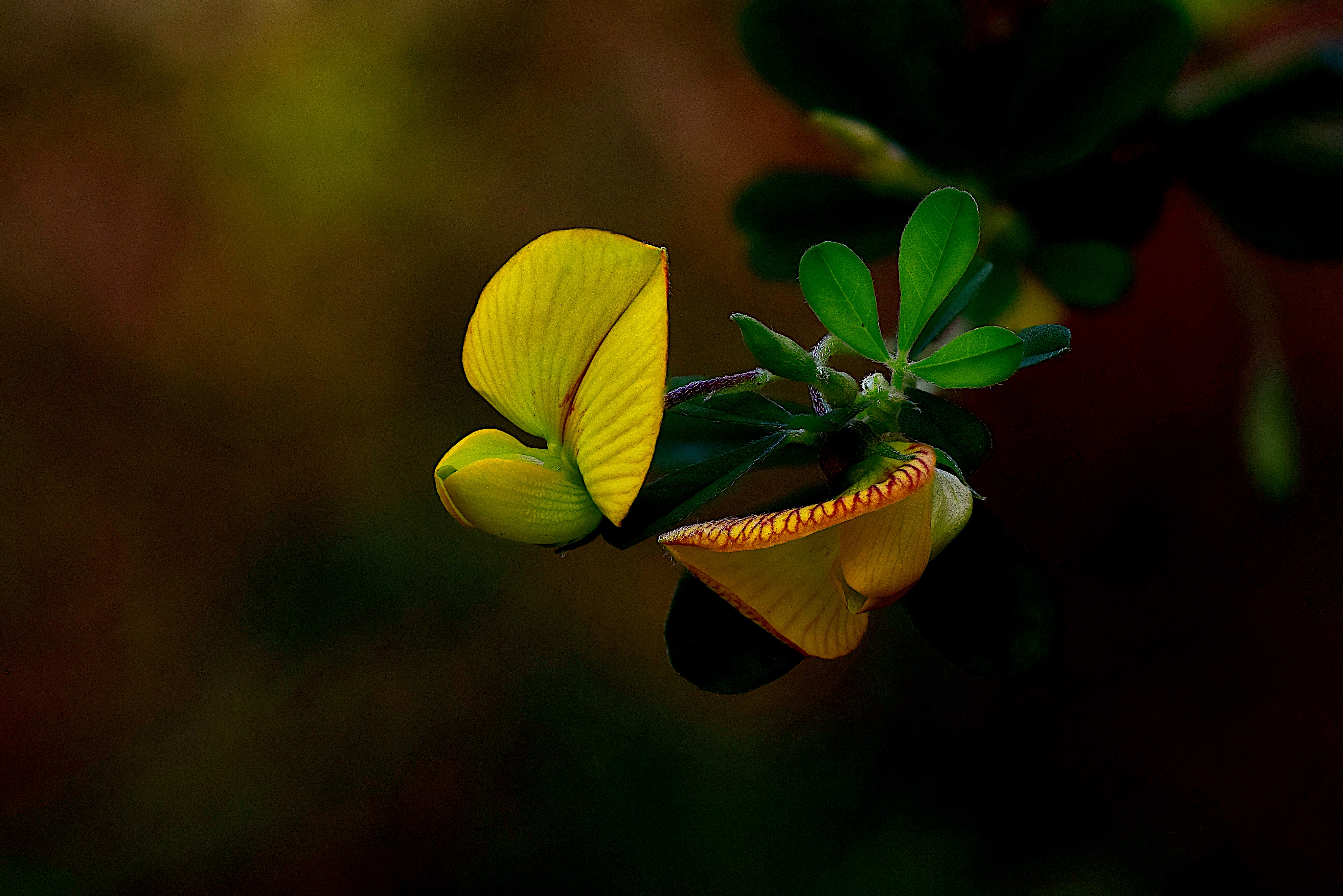
Low rattlebox, Crotalaria pumila. 2.5 cm across. Native. The map in the article linked here is incomplete and does not reflect the herbarium records for Alachua County, where I took this picture.

Showy rattlebox. C. spectabilis. 3.5 cm across. Native to southern and southeast Asia, now widely naturalized in southeastern North America:

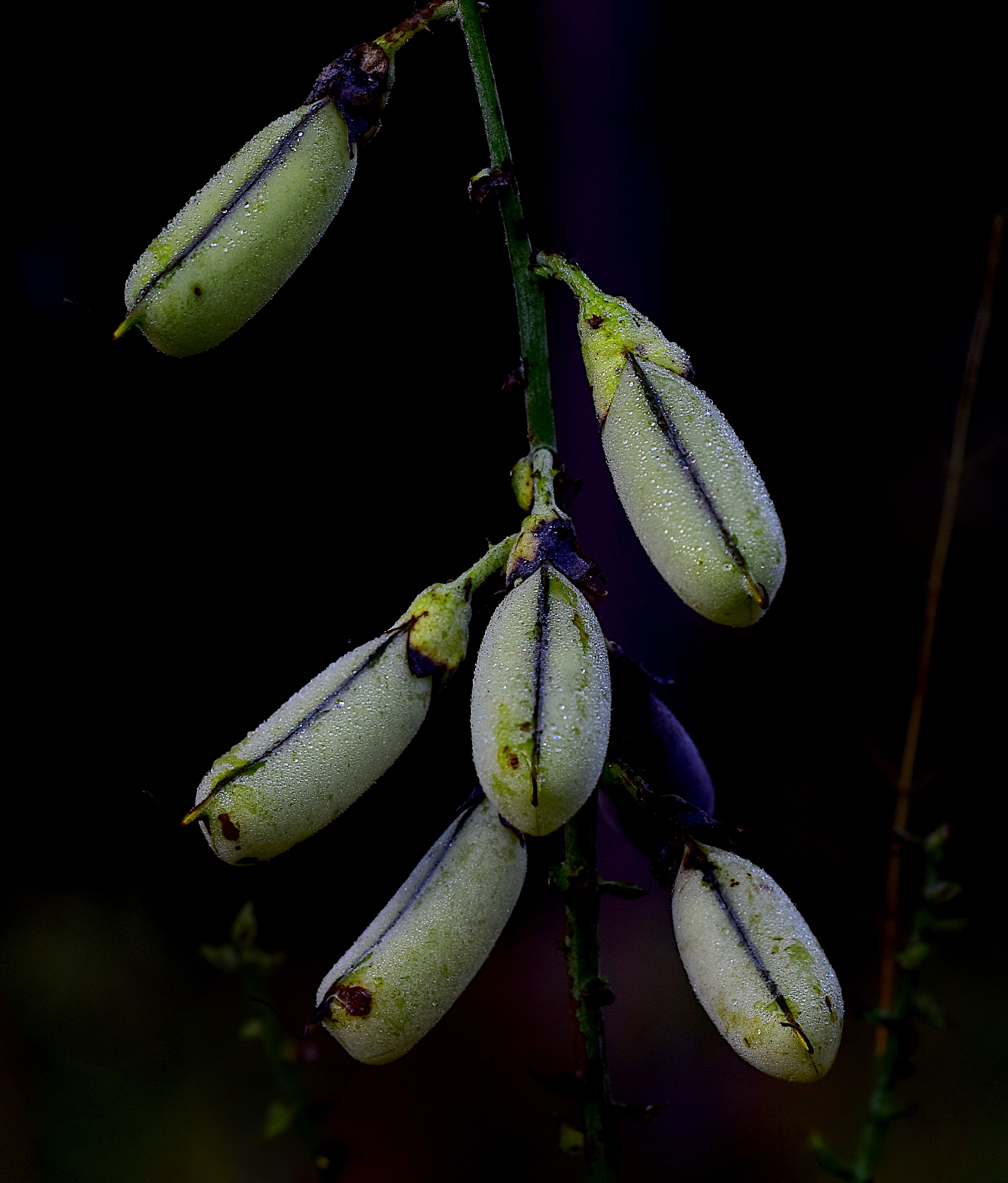
C. spectabilis seed pods. 4 cm long. The pods of C. pumila look similar but are smaller. Crotalaria, and especially their seeds, are laden with toxic alkaloids. Larvae of the rattlebox moth, Utetheisa ornatrix, bore through the walls of the pods and feed on the seeds. Somehow the caterpillars manage to detoxify the alkaloids enough so they aren’t poisoned, while remaining poisonous enough to deter most animals that might try to eat them. The larvae retain the toxins into the flying-moth stage, and at both stages their distinctive vivid color pattern warns predators to leave them alone.

A rattlebox-moth caterpillar. About 3 cm. I doubt that I could have found any of these if I’d gone looking for them, but this one crawled right in front of me while I tried to get a picture of the low rattlebox. It held fairly steady for a few seconds, letting me capture enough detail to identify it. I didn’t have my choice of background:

Tropical sage, Salvia coccinea. 3 cm. Native. At this latitude these remain at their peak through late December:

All that’s left in late February are these cones called calyces, which are fused sepals:

Spanish needles, Bidens alba. 2.5 cm. Native. This is the king weed of these parts, growing everywhere and sometimes in great masses; one dense bunch covers an acre of a low damp lot in the middle of Gainesville:

Seeds of Spanish needles. 1 cm long. The name of the genus, meaning two-teeth, derives from the forks at the tips of the seeds. The barbs on these projections are part of an impressive example of convergent biological and cultural evolution, and have turned out to be just the thing for attaching the seeds to socks and shoelaces:

Dotted horsemint, Monarda punctata. Whole flower head 2.5 cm wide. Native. The most complicated flowers I find around here:

All of that elaborate presentation goes to produce seeds 1 mm in diameter, too small to show well with my basic macro gear. At this stage you can still shake a few of them from the calyces. Thanks to Mark Frank of the Florida Museum of Natural History herbarium for a remedial lesson in the difference between calyces and phyllaries:

Beggarweed, Desmodium incanum. 1 cm across. Native to Central- and South America, naturalized in the southeastern U.S. This year, by means unknown, a few of them showed up for the first time in what passes for my lawn:

Beggarweed pea-pods, 3 cm long:

Scarlet morning glory, Ipomoea hederifolia. 4 cm long. Native:

Morning-glory seed pods, 7 mm. The hard little capsules cleave along their sutures and split open to release black seeds the shape of orange sections, exposing the translucent porcelain-like septa that divided them:

Readers’ wildlife photos

February 24, 2026 • 8:15 am

We have a timely contribution, and a bit of duck-related drama in New Jersey, from Jan Malik, whose captions and story are indented below. (The duck was, in the end, unharmed.) You can enlarge the photos by clicking on them.

Here is a short series of pictures from Barnegat Light that I took about twelve years ago. I was sitting on the rock jetty one February day, scanning for any passing seabirds, when something in the corner of my eye caught my attention: a commotion farther out in the inlet channel. A duck was being attacked by a large gull.

Trigger warning and spoiler alert: the gull went hungry— the duck escaped that morning.

The prey: Long‑tailed Duck (Clangula hyemalis)

This isn’t the actual bird that was attacked; I think I photographed this one later that day. But like the victim, it was probably an immature male. Long‑tailed Ducks form large flocks outside the breeding season, wintering offshore from the Arctic Ocean, Norway, Greenland, and Canada, and reaching New Jersey when the weather turns especially cold. Unfortunately, their IUCN status is Vulnerable, and based on my very unscientific observations over twenty years of winter trips to the Jersey shore, their numbers seem to be declining.

The drama begins: the duck is caught by a Great Black‑backed Gull (Larus marinus).

These gulls—the largest species in the family Laridae—are powerful scavengers and opportunistic predators. I don’t see them often at Barnegat Light or other exposed coastal areas; they seem to prefer city dumps and places with more edible refuse than the clean, wind‑swept inlet.

Each bird pulls in a different direction.  The duck tries to dive, while the gull attempts to lift its prey and carry it to land, where it can kill it properly by violent shaking.

Given the size difference, the duck can’t fight back All it can do is try to slip free:

A second gull arrives The possibility of a meal attracts another gull, which immediately tries to steal the catch. This actually helps the duck—when raptors (if we can stretch the term to include gulls) quarrel over prey, they often drop it:

The gull’s grip is weak.  Here it’s clear that not all is lost for the duck. The gull’s smooth, non‑serrated bill has only a tenuous hold on the duck’s feathers, and it’s far from securing a proper grip:

The gull’s feet offer no help. Like other gulls, Great Black‑backed Gulls have webbed feet built for paddling, not grasping. Their only real weapon is the bill, and in this case it wasn’t placed well enough to subdue the duck:

The hunt ends unsuccessfully.  The duck breaks free and immediately dives. Long‑tailed Ducks can dive 100–200 feet (30–60 m) and swim underwater using both their feet and wings, much like penguins:

Another Long‑tailed Duck in flight.  I include this photo to show why the species is called “long‑tailed,” although this individual doesn’t have the longest tail I’ve seen. These ducks were once called “Oldsquaw” in the United States and “Old Wife” in parts of England, but in the early 2000s the name was changed because it was considered offensive. I agree with the change, though I sometimes wonder whether it marked the beginning of the slippery slope that later led to Audubon being “canceled” and many other biological names being flagged as candidates for revision.

JAC:  All’s well that ends well.

Readers’ wildlife photos

February 23, 2026 • 8:50 am

This is the last full batch of photos I have. 🙁

But today we have a glorious selection of water birds (starring DUCKS) from New Zealand, where reader David Riddell lives. His commentary and IDs are indented, and you can enlarge the photos by clicking on them. Be sure to read the notes; you’ll see that several of these species are endangered.

Knowing how much our host likes ducks, I thought I’d put together a few images of water birds from around New Zealand.  Most of these are from the North Island, where I live, but there are a couple of South Islanders in here as well.

The blue duck (Hymenolaimus malacorhynchos) is one of only two duck species in the world that are mountain stream specialists, the other being the torrent duck (Merganetta armata) of South America. Males have a breathy whistle, which gives them their Maori name, whio, while the female call is a harsh, growling croak.  Like many New Zealand birds they’ve been badly impacted by introduced mammalian predators, but with management they’re holding their own and even expanding in some areas, such as the Volcanic Plateau in the central North Island.  For Tolkien fans, this pair was just below Tawhai Falls in Tongariro National Park, which doubled as the Forbidden Pool where Gollum was captured by Faramir’s men in The Two Towers:

Brown teal (Anas chlorotis) used to be the most abundant waterfowl in the country, but again have declined markedly, although numbers have increased in recent years in a few places. They occupied a wide range of habitats, not all of them aquatic.  This pair (male on the right) is part of a population introduced to Tawharanui Regional Park north of Auckland, which has a predator-proof fence across the base of a peninsula, protecting a 588 ha park from rats, cats, possums, mustelids and other exotic predators:

New Zealand scaup (Aythya novaeseelandiae) is a diving duck with a cute, “rubber duckie” profile. They mostly live in deep, clear waters where they feed on submerged water weeds, though this one was on a eutrophic (nutrient-enriched) lake in the small town of Cambridge:

Pacific black duck (Anas superciliosa) can cope quite well with introduced mammalian predators, but is perhaps now the country’s most endangered duck, as it is being genetically swamped by mallards (Anas platyrhynchos), with which it readily hybridises. This one, on the shore of a remote lake on the Volcanic Plateau, has the typically stripy face, and the green speculum with no white band on its upper margin, but the slight smudging of the facial stripes and orange tinge to the legs suggests that even this one has some mallard ancestry.  Fortunately they are still widespread elsewhere in the Pacific:

Mallards have also been in the news here lately as a few individuals on a high country lake in the South Island recently started preying on the chicks of Australasian crested grebes (Podiceps cristatus australis) and had to be “euthanised” as the local media euphemistically put it. The concern was that, being such adaptable creatures, other ducks would learn the habit and it would spread.  The grebes (a subspecies of the great crested grebe, from which it differs mainly by not having a distinct non-breeding plumage) are considered threatened, although their numbers have increased from a couple of hundred in the 1980s to perhaps a thousand today, with more in Australia.  Once almost entirely confined to the high country they are now well established on many lowland lakes, though they have not yet repopulated the North Island, from which they disappeared in the 19th century.  In 2023 the bird’s international profile was lifted dramatically when it was crowned New Zealand’s Bird of the Century after being championed by comedian John Oliver. “After all, this is what democracy is all about,” he said on his show, “America interfering in foreign elections.”  This one was photographed from the footbridge over the outlet of Lake Tekapo – the lake is fed by glacial meltwater, hence the pale blue colour:

While the crested grebe retreated to the South Island, another grebe, the New Zealand dabchick (Poliocephalus rufopectus) went the other way, becoming restricted to the North Island from the 1940s. More recently it’s been expanding again, and recolonised the South Island in 2012.  This is a pair engaging in a courtship dance:

And another dabchick:

Another small grebe, the Australasian grebe (Tachybaptus novaehollandiae) has been colonising New Zealand since the 1970s, though numbers nationwide are still low. Adults have a prominent yellow spot at the base of the bill that looks almost like a second eye, though the colour hasn’t fully developed on this juvenile:

Pied shags (Phalacrocorax varius) are one of 13 currently recognised New Zealand species of shags and cormorants (all usually called shags in New Zealand), making the country a centre of diversity for the family. The same species in Australia is generally a freshwater bird, although in this country they’re most commonly found on the coast.  This one however was nesting alongside the Karamea River in the north-west of the South Island:

Here are two other shag species, at a small lake near my home in the Waikato region of the North Island. On the left is a black shag (Phalacrocorax carbo novaehollandiae), the local subspecies of the widespread great cormorant, while on the right is a little pied cormorant (Microcarbo melanoleucos).  This is a highly variable species; juveniles are entirely black, while adults can range from a white-throated form through to completely pied.  This individual has a rather unusual motley appearance – I suspect it’s an older juvenile moulting into adult plumage:

American readers may be wondering why I’ve put in a picture of such a common species as a laughing gull (Leucophaeus atricilla) – and one in scruffy non-breeding plumage at that. But this was the first individual of the species ever seen in New Zealand, which my wife, daughter and I found two days before Christmas in 2016, when we stopped for a picnic lunch at a beachside reserve near the small east coast town of Opotiki.  It created huge interest among the local birding community, hanging around for several weeks and allowing many people to see it, eventually moulting into its much more handsome breeding colours, with black head and white-ringed eye.  It eventually moved southwards down the coast as far as Cape Kidnappers in Hawkes Bay, and was reported intermittently until October 2018:

Here’s another shot of it, next to a red-billed gull (Chroicocephalus novaehollandiae scopulinus), which is the species you would expect to see in such a place:

Black-billed gulls (Chroicocephalus bulleri) are our only endemic gull (the southern black-backed or kelp gull, Larus dominicanus, also occurs here). Until recently they were classified as critically endangered due to rapid declines at some of their main breeding colonies on South Island river beds, but they’re holding their own elsewhere, and establishing new colonies in the North Island.  These ones are roosting on an old wharf at the southern end of Lake Taupo, the large lake in the centre of the North Island:

Readers’ wildlife photos

February 22, 2026 • 8:15 am

Thanks to kind and diligent readers, I have a few batches left.

Today’s photos come from Ephraim Heller, who sends us today the birds of Little Tobago. Ephraim’s captions and IDs are indented, and you can enlarge his photos by clicking on the.

Jerry’s pathetic plea for photos activated my guilt neuron, so I composed the following story. It is all true, apart from the moral judgments and anthropomorphism.

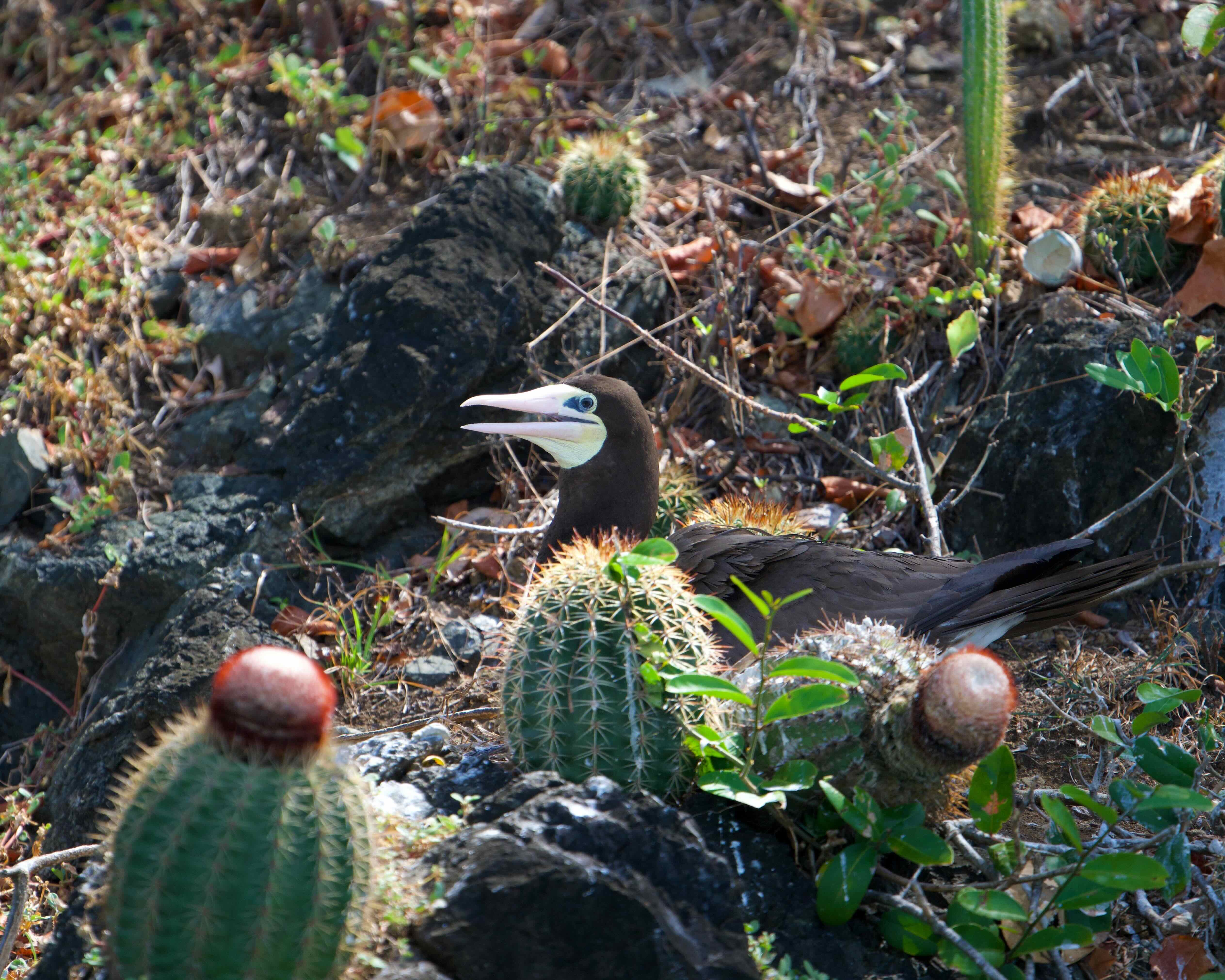
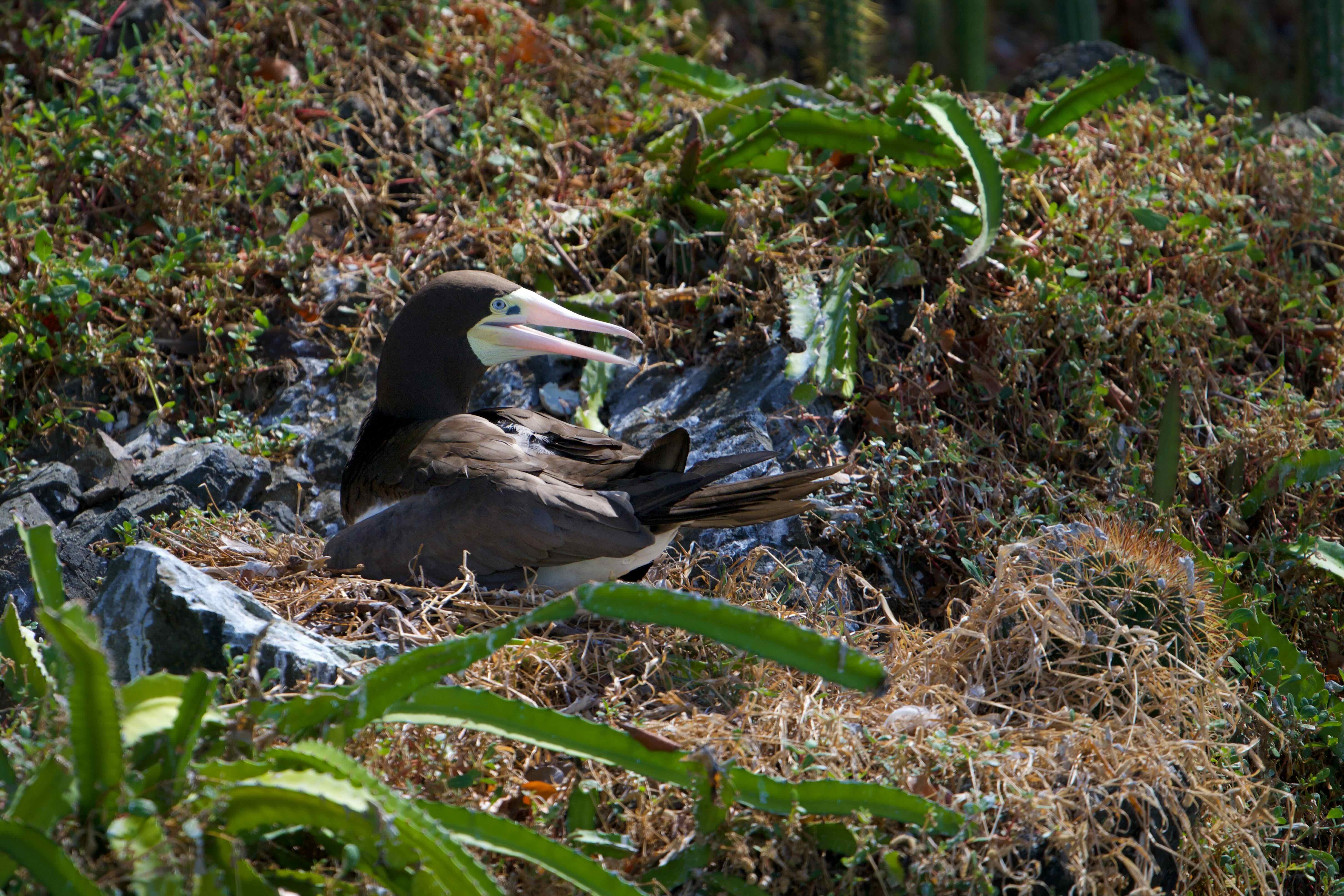
About 100 miles off the coast of Venezuela lies the island of Tobago, and just off its coast lies the wildlife sanctuary island of Little Tobago. Once upon a time, there lived on the island peaceful colonies of brown boobies (Sula leucogaster) and red-billed tropicbirds (Phaethon aethereus).

The boobies happily sat on their nests:


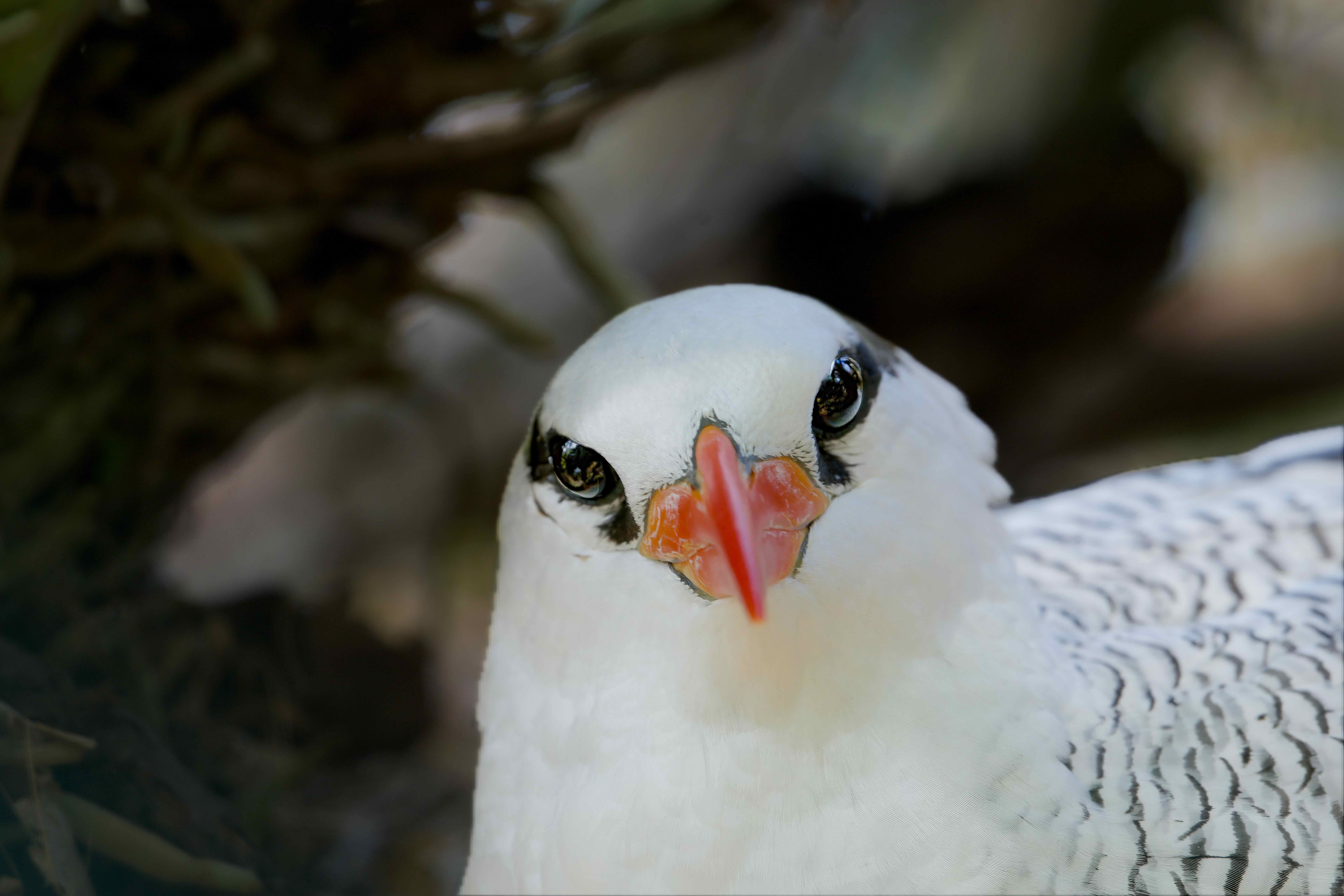
The tropicbirds, too, spent their days in domestic bliss on their nests:

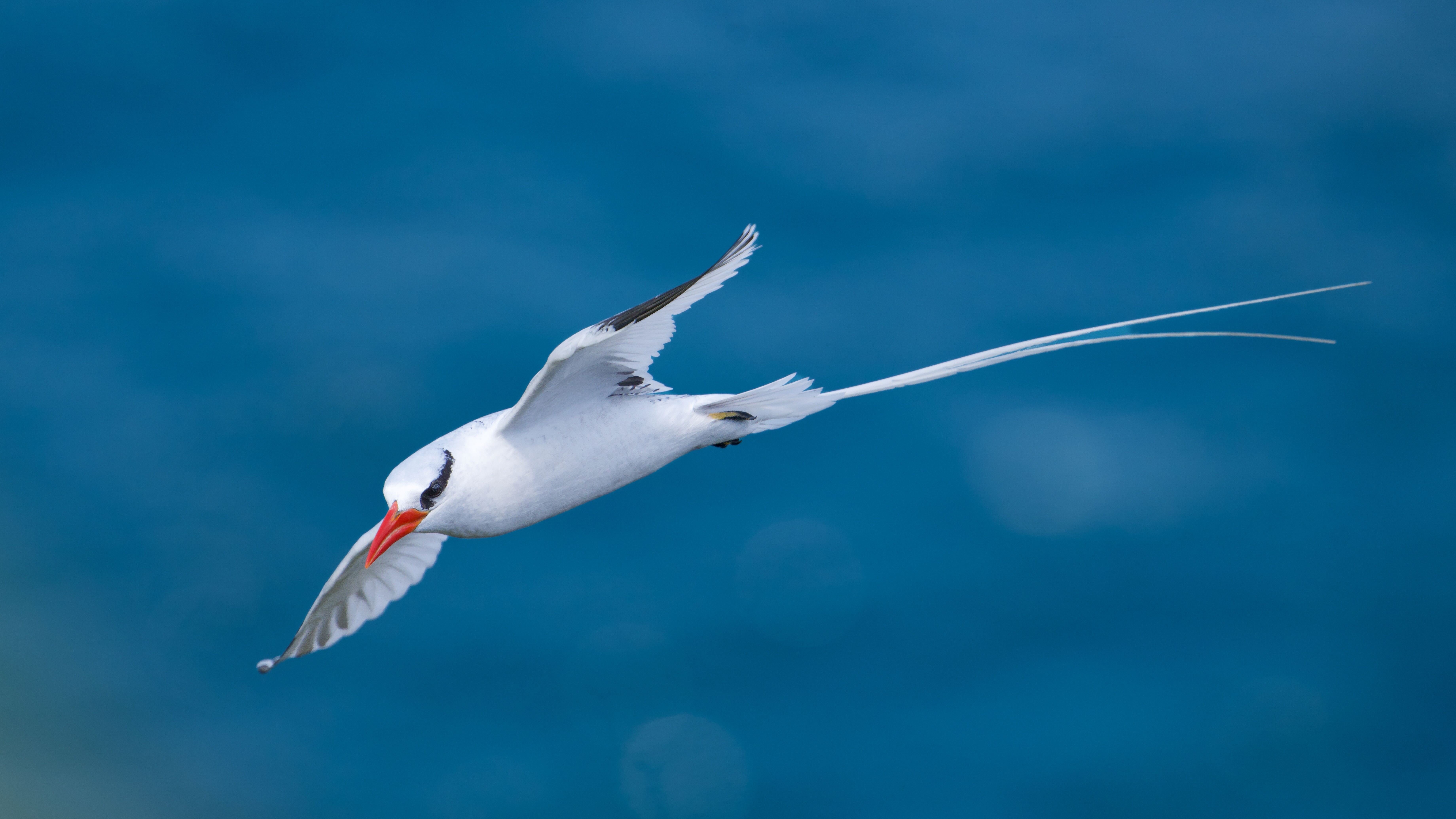
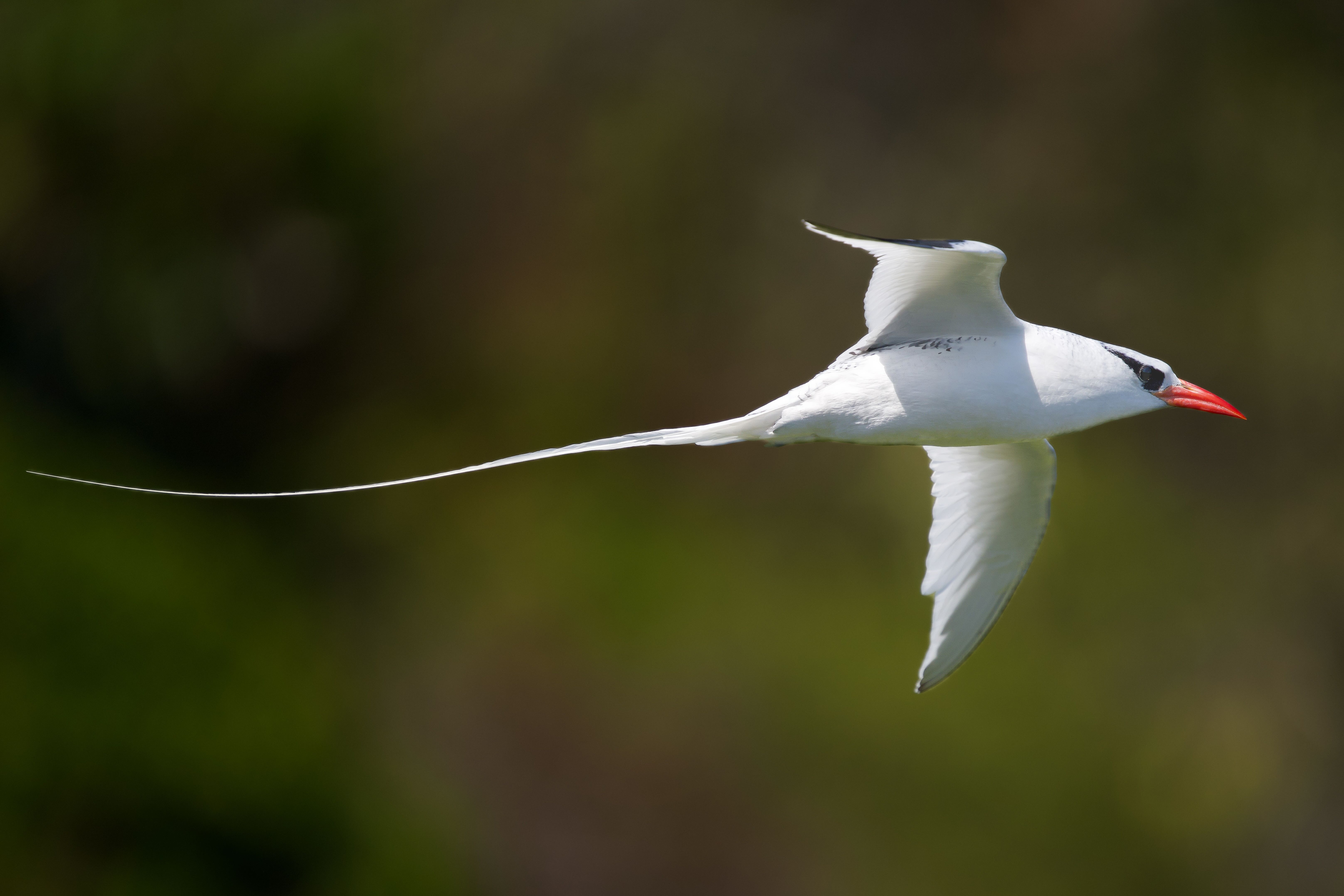
Just for the joy of it, the tropicbirds would sail through the air, riding the thermals and admiring their splendid tail feathers:

Whenever they were hungry, the boobies and tropicbirds would roam the seas for many miles around Little Tobago, scooping up small fish. When their eggs hatched, they would fill their crops with fish to carry back to their nests and regurgitate for their chicks.

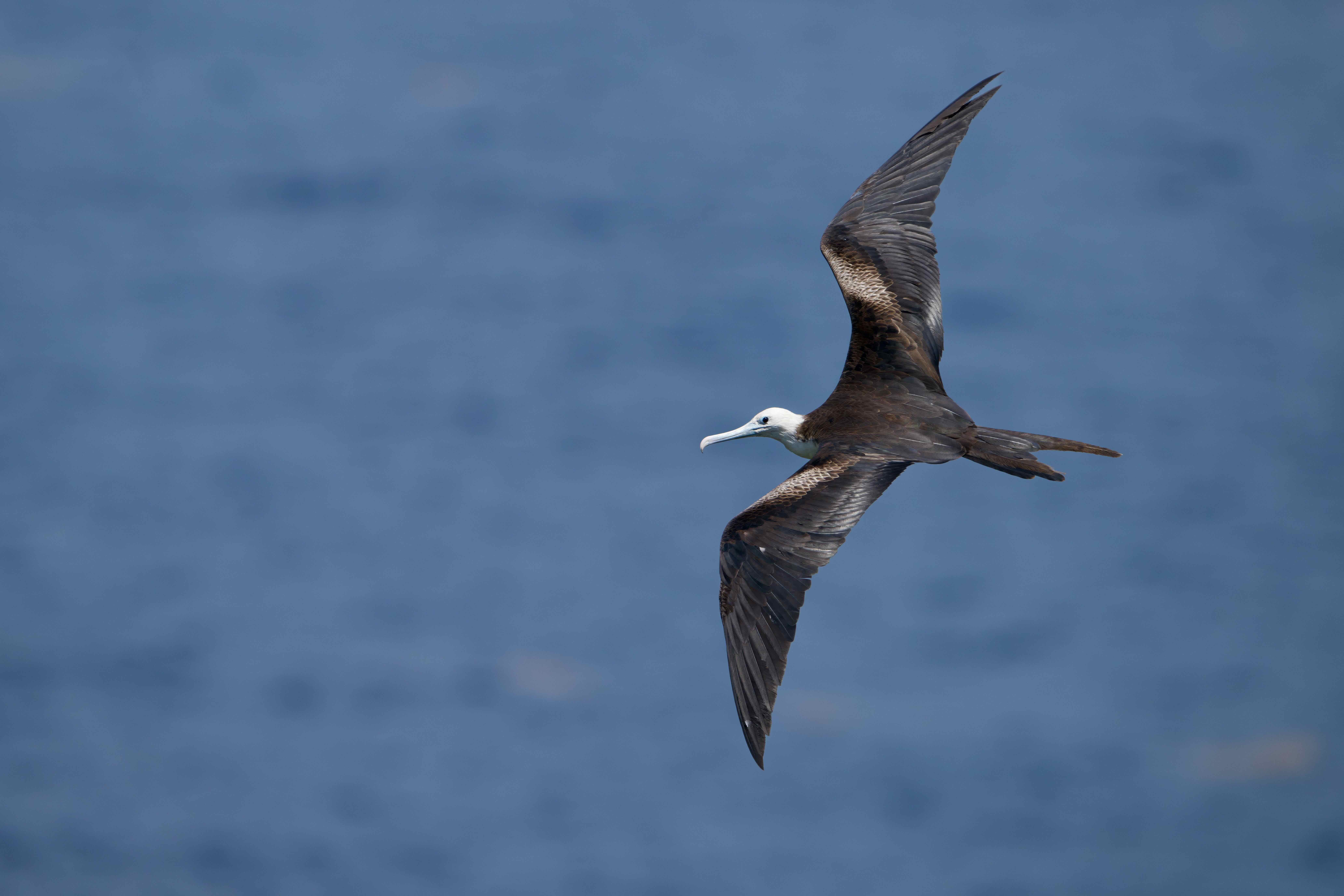
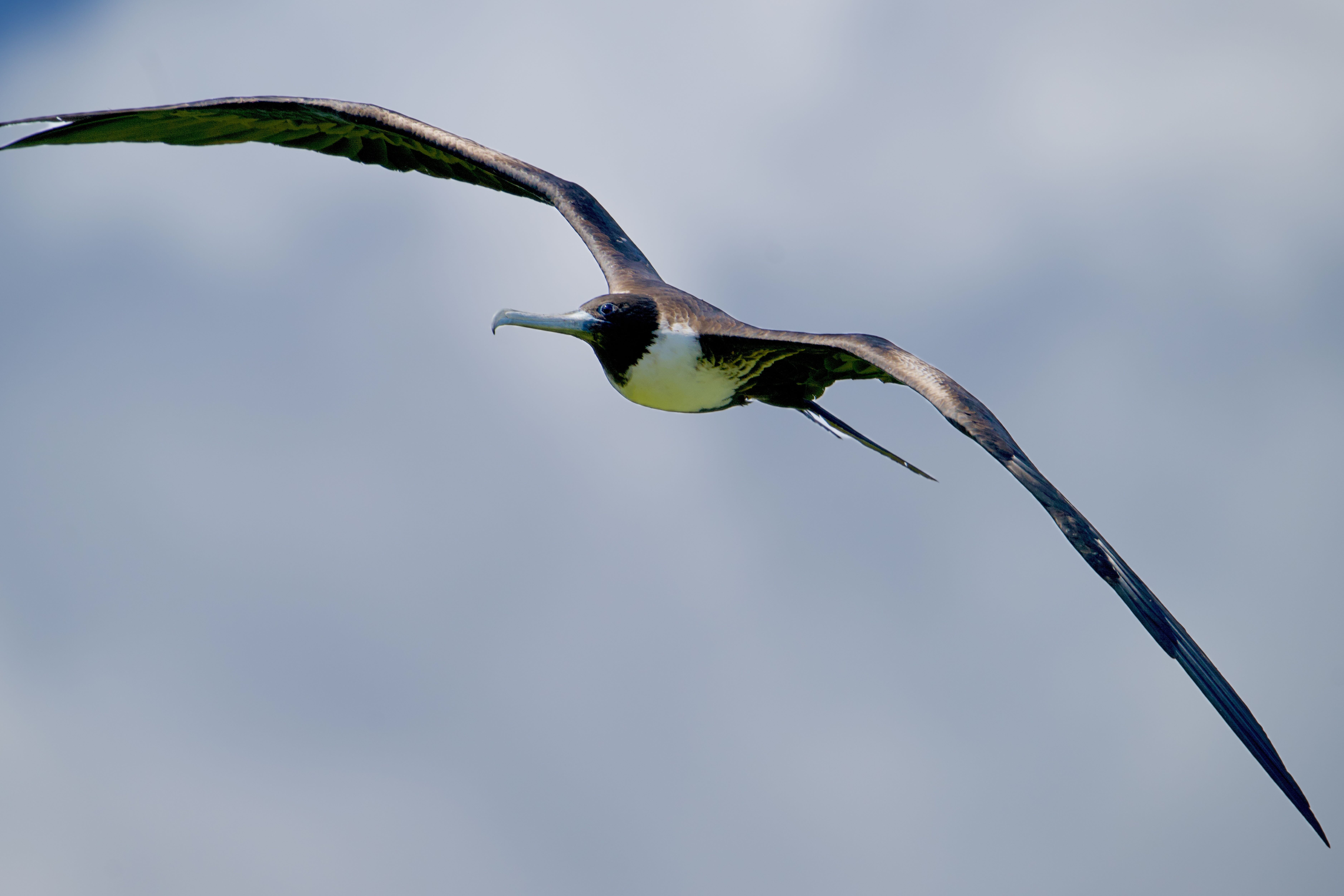
But one day evil entered Little Tobago’s Eden in the form of the Magnificent Frigatebirds (Fregata magnificens):

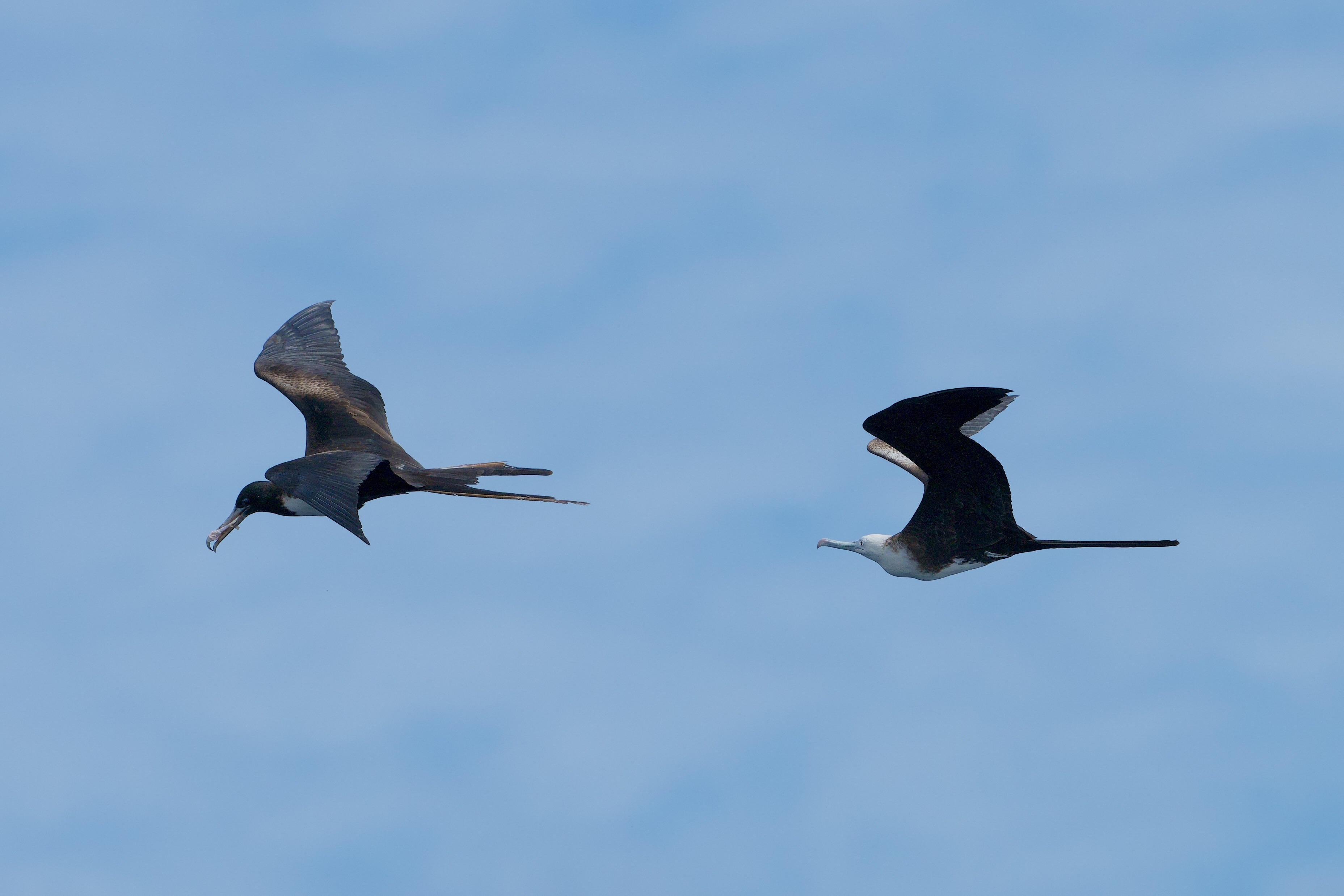
Frigatebirds live in the air, feeding and sleeping while aloft. The word frigatebird derives from the French mariners’ name for the bird: La Frégate– a frigate or fast warship. These mean, nasty frigatebirds were indeed warlike, as they were the worst class of birds: kleptoparasites. Because they were named magnificent frigatebirds, they felt themselves entitled to everyone else’s food. In fact, they were so mean that they would even steal food from each other:

While frigatebirds could scoop up their own food or eat carrion, the frigatebirds of Little Tobago attacked the boobies and tropicbirds when they were most vulnerable, as they returned to the island with their crops full of food for their babies. The frigatebirds grabbed the boobies and tropicbirds and shook them and pecked at them until they regurgitated their food in midair. The frigatebirds then swooped down and caught the regurgitated food before it hit the ocean surface.

These Frigatebirds had one weakness: their feathers are not waterproof, so they could not float on the ocean surface because if their feathers became waterlogged they drowned. The boobies often evaded the frigatebirds by diving into the ocean water, where the frigatebirds could not follow.

Sadly, the poor little tropicbirds had no such defense. To add insult to injury, the frigatebirds shook the tropicbirds so hard that many of them lost their beautiful tail feathers, which hurt their feelings as they were rather vain avians:

Will the cute tropicbird chicks go hungry?

Won’t you help us?

Readers’ wildlife photos

February 21, 2026 • 8:35 am

We have yet another batch of photos, this time from reader Jan Malik. Jan’s captions and IDs are indented, and you can enlarge the photos by clicking on them.

During the recent bout of cold weather, I made a short trip to the New Jersey shore—Barnegat Light, a location known for wintering sea ducks. Most of the time it is a great place to see birds (and often harbor seals), but this time, with temperatures around 5°F and an exposed jetty blasted by incessant wind, animals were few and far between. Standing with the sun behind you—the usual orientation for decent photographs—meant exposing your face to the arctic wind, something tolerable only for a few seconds at a time. In these conditions I didn’t stay long, so what I have is a small set of photographs that could be titled: How birds survive bitterly cold weather.

American Herring Gulls (Larus smithsonianus). The sitting bird found a fish (in the lower right corner), but it was completely frozen, and even a perpetually hungry gull couldn’t swallow it. Instead, it was using it as “bait” to lure what I imagine is a female (judging by her slightly smaller size). Gulls normally defend their food aggressively, but they may share it with potential mates as the breeding season approaches. Note that the vocalizing gull is squatting to hide its bare feet and is facing into the wind—both strategies to minimize heat loss:

Barnegat Light lighthouse, built in 1859 and still functional. Note the frozen brackish water at the rock jetty, the result of prolonged low temperatures—a rare sight in New Jersey:

Distant Red‑breasted Merganser (Mergus serrator).  The second part of its scientific name refers to its serrated bill. This is a diving duck, so as long as some water remains open it should have access to food. The problem was that the channel was almost frozen solid near the jetty, where the shallow water normally suits these ducks best. In the center of the channel the water was full of drifting ice, and it was there—in deeper water, where catching fish is harder—that this bird had to feed:

A flock of ducks, probably Greater Scaup (Aythya marila).  Many birds in the flock were airborne, likely migrating locally in search of warmer weather and ice‑free water. None landed on the ice floes:

A Long‑tailed Duck (Clangula hyemalis) resting on a drifting ice floe and trying to limit heat loss by turning its body into the numbing wind.  This one is probably an immature male: it has extensive white plumage but has not yet developed the long tail feathers. Like mergansers and scaup, it is a diving duck that prefers relatively shallow water to the open ocean:

Wintering birds near the lighthouse, likely Yellow‑rumped Warblers (Setophaga coronata).  Despite the meaning of the first part of their scientific name (“insect eater”), they are unique among warblers in being able to survive harsh winters by feeding on berries. These birds were staying close to a pine–juniper thicket rich in waxy fruit. It is a small bird, as you can judge by the one perched on an average pinecone. They were puffing up their feathers to maximize insulation and staying low to the ground in sunny spots. This reduced wind exposure somewhat, but even so, with temperatures well below freezing, heat loss for such a small animal must have been substantial:

Another warbler, probably a female or a transitional male:

A large flock of American Robins (Turdus migratorius) near the parking lot. In New Jersey they are “migratorius” only in the sense that they vacate inland areas and winter closer to the barrier islands. This bird also puffs up its feathers considerably, appearing plumper than it really is:

All freshwater sources were frozen. Gulls could drink brackish water, but for songbirds it was a difficult time. A male robin began eating chunks of ice from a nearby snow pile. This is a last resort for birds—usually even in winter some freshwater is available, but not in this weather. Eating snow and ice carries an energy penalty because melting ice requires heat, which birds must then replace by finding more food:

Another wintering songbird, a common year‑round resident, the White‑throated Sparrow (Zonotrichia albicollis).  It was searching for anything edible in a snow‑and‑dirt pile left by a snowplow. After spending a little over an hour on the seashore, my face was numb and I retreated to my car. The birds stayed—they were far better prepared to brave the cold than a hairless ape:

Readers’ wildlife photos

February 20, 2026 • 8:15 am

Among those who sent in photos in response to my self-abasing plea was UC Davis math professor Abby Thompson, who specializes in tide-pool invertebrates. We have some of those today; Abby’s captions and IDs are indented, and you can enlarge the photos by clicking on them.

Family Littorinidae (periwinkle) (tentative ID) This snail is decorated with bryozoans – here he’s upside down, and here. . . .

. . . he’s right side up, so you can see the bryozoans:

Tectura paleacea (surfgrass limpet), Surfgrass is about 1/8” wide.   This tiny skinny limpet fits perfectly on it:

Doris montereyensis (nudibranch):

Rostanga pulchra (nudibranch). I have several photos from this set of tides with disturbing clear threads in them, which I think must be plastic:”

Family Ammotheidae (sea spider):

Genus Doryteuthis (squid) eggs- in a bunch on the beach:

Squid eggs close up, so you can see the eggs inside one sack:

An unusually colored Epiactis prolifera (brooding anemone). Its babies are nestled into its shoulders:

Strongylocentrotus purpuratus (Pacific purple sea urchin). As juveniles these are green, and I’d only seen juveniles here before.   This was big enough to be turning its adult purple, though it still has lots of green spines: