Readers’ wildlife photos

January 24, 2026 • 8:15 am

Today Friend of the Website Greg Mayer contributes some photos from Britain.

by Greg Mayer

Since we’re awaiting a recharge of the tank of Readers’ Wildlife Photos, I thought I’d add a few wildlife photos from a recent trip to England. I did not bring my good camera with a telephoto lens, since the visit was focused on museums in London, and the photos reflect this constraint.

The only mammal we saw in London was the introduced Gray Squirrel, but in Oxfordshire we saw molehills (made by the European MoleTalpa europea) in and near the churchyard of St. Margaret of Antioch in Binsey. American moles most prominently make much less elevated runs or tracks, not distinct hillocks like these, so the phrase “making a mountain out of a molehill” makes more sense to me now.

Part of Oxford University, Wytham Woods (a famed area for ecological studies) had some Sheep (Ovis aries) in an enclosure. These are domesticated, and the species was brought to Britain thousands of years ago.

In London, we encountered two more corvids. The Carrion Crow (Corvus corone corone) is the most like what is, to an American, a “normal” crow. (During a brief stop in Copenhagen on the way to England, we also saw a Hooded Crow, Corvus corone cornix, which has a gray body, and has a long hybrid zone with the Carrion Crow, )

The other corvid was the Eurasian Magpie (Pica pica), which is much more “crow-y” looking than the jays in America (which are also corvids). We also saw Rooks (Corvus fragileus) on the trip, but got no photos.

Note the blue on the wings of this Magpie.

Like the Carrion Crow above, also on the Victoria Embankment was a Black-headed Gull (Chroicocephalus ribundus); this is an adult in winter plumage. We saw quite a few gulls all around London. Most were larger than this (Larus sp. or spp.), but we could not ID them.

On the way to Greenwich by boat on the Thames, we saw Mute Swans (Cygnus olor), which I include here to show the great tidal range of the Thames, ca. 7 m, evident from the algal growth on the bulkhead behind the pair of swans.

Also on the Thames we saw Great Cormorants (Phalacrocorax carbo), including a pale-bellied juvenile.

We were struck by how the apartments along the south bank of the Thames resembled scenes from movies, for example A Fish Called Wanda, and sure enough, the building at the left of the photo above is indeed where the Cleese-Curtis “canoodling” rendezvous took place!

The bird we saw more of than any other in England was the pigeon. Not the Common Wood Pigeon (Columba palumbus), like this one in Greenwich, which we saw a fair number of. . .

. . . but the Feral Pigeon or “rock dove” (Columba livia), which was everywhere, both city and country.  There were many of the highly variable domestic color forms, such as this one

. . . . and some of the “wild type”, which is the color pattern of the ancestral wild Rock Doves.

Wild Rock Doves persist in Scotland and western Ireland; all the pigeons we saw in London and Oxfordshire were feral.

Readers’ wildlife photos

January 22, 2026 • 9:15 am

Well, we’ve run out of photos from readers and I am heartbroken again. BUT we still have the third and final batch of photos from Cairns resident Scott Ritchie, summarizing his best photos of 2025.  Scott’s captions are indented, and you can enlarge the photos by clicking on them.  Scott’s Facebook page is here.

Warning cuteness ahead! Here’s a couple of mammals from my Western Australia trip. A Honey Possum [Tarsipes rostratus] feeding on a Scarlet Banksia at Cheynes Beach.

It even more cuteness. A numbat [Myrmecobius fasciatus] searches for his nest hollow. This was taken it Dryandra Forest National Park, Western Australia:

I like my ducks and he’s not the prettiest one, but I love his weirdness. The Musk Duck [Biziura lobata]. This male has this weird leather pouch under his chin and the tail feathers like a crown of the Statue of Liberty. And he likes laying on his back like a sea otter. Very cool beast. This was taken in Albany, Westerrn Australia:

I love my fairywrens. They’re usually extremely beautiful but before they grow up, they’re sort of brownish birds designed to blend in with the bush. This is a young male Splendid Fairywren [Malurus splendens] in eclipse phase, just starting to grow his beautiful blue feathers. You can just see them around his eye. This photo gives us a hint of what’s to come. Pemberton Western Australia:

And here’s the Splendid Fairyrwen in full eclipse mode singing is heart out. I love the blue and gray patchwork. It reminds me of a flannel shirt I have:

“in case you’re wondering what I look like in full costume, here it is!” Male Splendid Fairywren, Nannup, Western Australia.

I was really fortunate to run across a group of Baudin’s Black Cockatoos [Zanda baudinii] near Pemberton. A very endangered and magnificent parrot:

A Yellow-tailed Black Cockatoo [Zanda funerea] navigates through the forest. This bird was part of a group that had been warned to flee in response to an incoming sea-eagle. Most cockatoos post sentries to stand guard while the others feed:

A sentry male Crimson Rosella [Platycercus elegans] in a Gumtree forest in the Dandenong Ranges in Victoria:

I really taken to capturing wider views, “birdscapes”. They allow you to appreciate the birds and their natural environment. Here’s a group of Great Knots [Calidris tenuirostris] and a Great Egret [Ardea alba] at sunrise on the Cairns Esplanade:

I really love Red-tailed Black Cockatoos [Calyptorhynchus banksii]. It was great to get this male in flight with his tail spread so that you can appreciate his lovely red panels. It was also cool to get him flying across the rainforest in the rain. An iconic north Queensland moment:

Spring is rebirth. And here a group of Radjah Shelducks [Radjah radjah], mother, father and their nine little ducklings, cruise across Freshwater Lake in Cairns. I call this a duck love train:

And finally, our local Rufus Owls, after several nest failures, managed to produce a chick. This young fledgling Rufous Owl [Ninox rufa] cautiously sticks his head out the late evening light, looking for his parents to come and feed him. These birds had survived harassment by waves of Sulphur-crested Cockatoos that wanted to take over the nesting hollow. However, the owls were staunch in their defense, and eventually the chick fledged and left the nest. A end of year treat for all us local birders!:

Readers’ wildlife photos

January 21, 2026 • 8:15 am

Well, this is the last batch of photos I have, so you know what to do.

Today’s contribution is from Ephraim Heller, this time with photos from America rather than Brazil. Ephraim’s captions and IDs are indented, and you can enlarge the photos by clicking on them.

It has been a busy January on the Snake River in Grand Teton National Park.

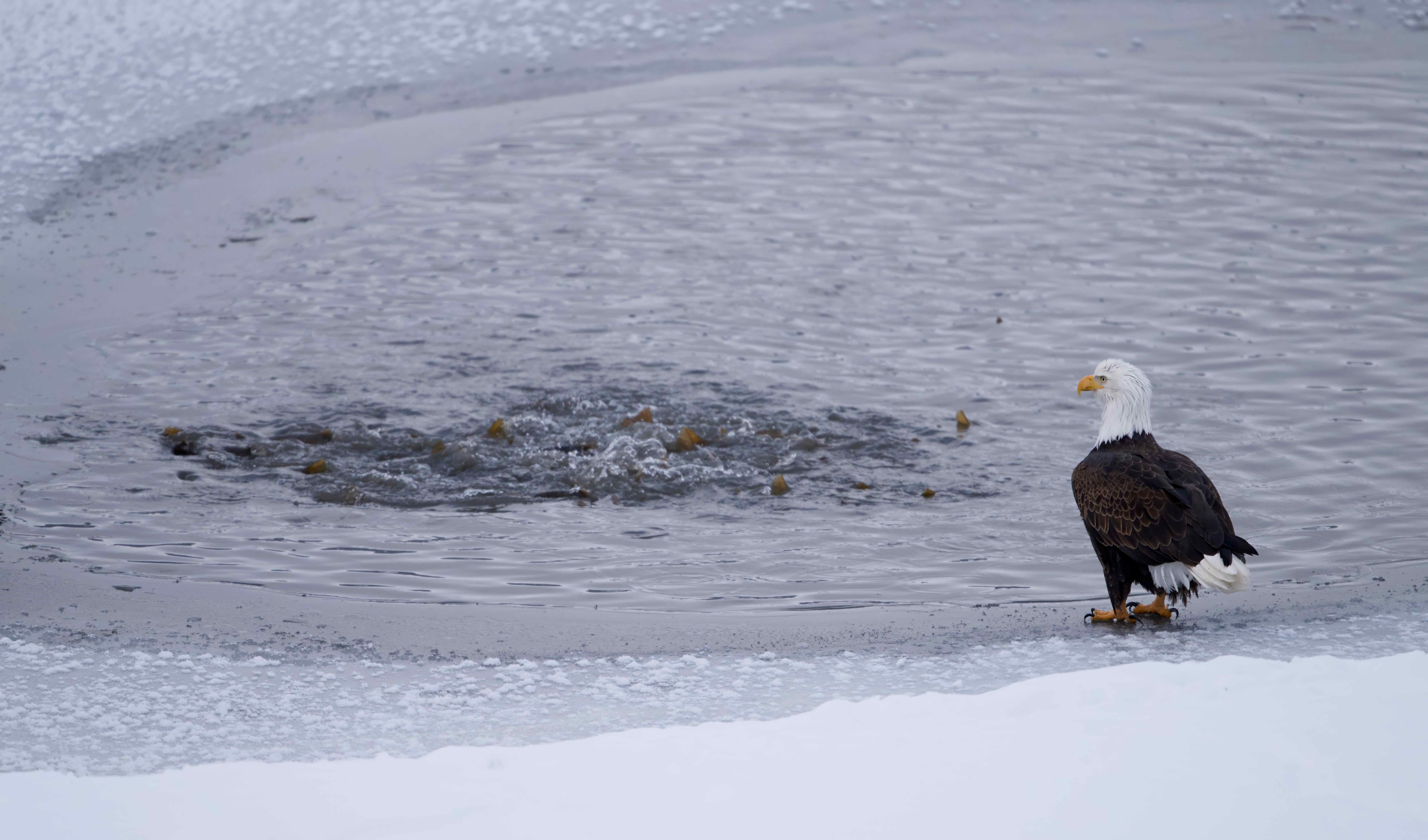
After a warm early winter, a few weeks ago we finally had a hard freeze. A branch of the Snake River froze solid. However, there is a location where a warm spring feeds into the branch and this inlet stayed open. Hundreds of Utah sucker fish (Catostomus ardens) were trapped in this area of open water surrounded by ice, isolated from the main body of the Snake River. Naturally, this provided a smorgasbord for the local bald eagles and coyotes.

As I observed the Utah suckers at various times of day, I noticed that in the late afternoon they would all rise to the surface and expose their dorsal fins. Intrigued, I queried my AI which informed me that this is a matter of oxygen dynamics:

  • The warm water holds less oxygen than cold water, and thermal springs typically have low dissolved oxygen content due to high temperatures.
  • In confined areas with high fish density, oxygen is rapidly depleted.
  • Fish respond to low oxygen levels by “piping” or “aquatic surface respiration” (ASR) when oxygen levels drop below critical thresholds. This behavior involves positioning at the water surface with mouths/dorsal fins exposed to access the oxygen-rich surface layer. This behavior indicates that the fish are stressed.

However, the AI also stated that “Aquatic plants produce oxygen through photosynthesis during daylight, with peak production in late afternoon. At night, plants consume oxygen through respiration. Dissolved oxygen levels are highest in late afternoon and lowest just before dawn.” This doesn’t seem consistent with the timing I observed.

I don’t know how much of this is true vs. AI hallucination, but it sounds plausible to me. I’d appreciate it if the ichthyologists and limnologists among the readers would confirm or refute this story.

Now for the photos:

Here are the Utah sucker fish at the surface of the open water pool in the evening, trapped by the surrounding ice:

Here is a close up of the fish at the surface:

Every so often the fish would go into a frenzy at the surface. I don’t know why. It was unrelated to anything I saw happening at the surface. Here is a bald eagle (Haliaeetus leucocephalus) watching the frenzy and assessing his menu options:

Having made up his mind, the eagle helps himself to a serving of fresh fish:

The common ravens (Corvus corax) have found a lovely rotting fish. Instead of exerting the effort to catch a fresh fish, this eagle has decided that it is easier to steal the carrion:

Bald eagles are kleptoparasites, so when an eagle with energy and initiative catches a fish the other eagles won’t let him dine in peace:

Ravens are smart birds. This one is surely thinking “If those eagle ignoramuses can catch a fish then surely I can do it better.” Unfortunately for him, the fish got away:

In spite of their inability to fish, common ravens are handsome birds:

To my surprise, the North American river otters (Lontra canadensis) who live half a mile downstream have not been dining at the buffet. I think it is because this branch of the river is frozen solid and the otters don’t like traveling on the ice surface for long distances without the safety of accessible water. So I donned my cross country skis and visited them at another, unfrozen branch of the Snake River. They, too, were feasting on Utah suckers:

Also on the river are trumpeter swans (Cygnus buccinator) in the morning mist:

Trumpeters need a long runway to take off. These four are just starting to accelerate:

Once airborne they are graceful:

Finally, this old-time general store sits adjacent to the Snake River in Grand Teton National Park. In this star trail time lapse, the stars are, of course, circling Polaris, the north star. The Tetons are to the left of the store:

Readers’ wildlife photos

January 20, 2026 • 8:15 am

Regular Mark Sturtevant (as opposed to Irregular Mark Sturtevant) has sent in some lovely insect photos to fill the nearly-empty reserve of pictures. Please send any good wildlife photos you have. Thanks!

Mark’s captions are indented, and you can enlarge his photos by clicking on them. Be sure to check out the female Tussock Moth caterpillar with vestigial wings (it’s the eighth photo).

Here is another dispatch of local insects and spiders, all photographed either in area parks near where I live in eastern Michigan, or as staged shots at home. Let’s start with a couple of dragonflies. First up is a Green Darner (Anax junius), which ranks pretty large among the dragonflies found here. As is almost always the case, this individual is a female, since they perch frequently and are much easier to approach than males, which I only rarely manage to photograph. Do you see the tiny yellow critter on the dragonfly? That is a Globular Springtail, and it must have walked or jumped onto the dragonfly from nearby foliage. There may be a few more of them in the picture as well, though I’m not certain. Springtails are tiny soil arthropods, and they are extremely abundant. When seen up close, Globular Springtails are arguably adorable, as you can see in the linked image. I’ve searched for them for some time but have only rarely encountered them, despite claims that they are exceedingly common. Perhaps our local species spends more time up on foliage rather than in the soil, meaning I’ve been looking in the wrong places!:

The next dragonfly is a male Skillet Clubtail (Gomphurus ventricosus), named for the large, pan-like club on the end of its abdomen. I have to drive a few hours south to a particular park to see them, and of course this one is perching on poison ivy which covers much of the area there. That park hosts 8 or 9 species of clubtails according to a dragonfly documentation site called Odonata Central. I’ve photographed most of those species with only two left to find:

A field near my workplace has a ridiculously high population of Chinese Praying Mantids (Tenodera sinensis). I suspect this is the lingering result of someone having released a large number of egg cases several years ago, combined with a robust population of grasshopper prey. Shown here is a young June nymph. I can return later in the summer to find several large adults in no time at all:

Next up are some lepidopterans. First is a Hackberry Emperor butterfly (Asterocampa celtis). They are often common along forest margins where their host Hackberry trees [Celtis occidentalis] are concentrated. Their caterpillars, however, seem to be quite secretive, as I’ve seen only a few of them:

Next is an inchworm caterpillar, though I don’t have an identification for it. Do you see the tiny mites?:

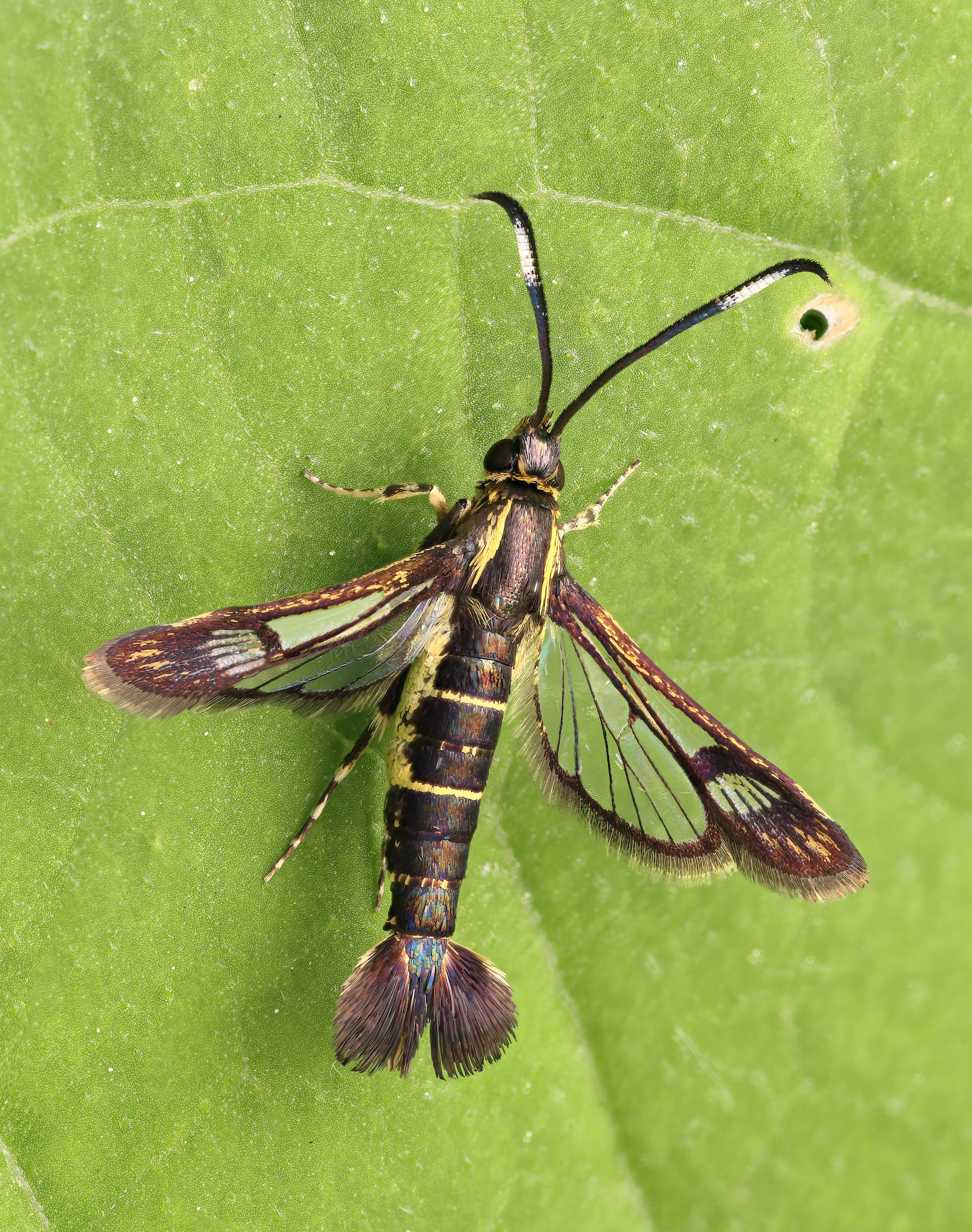
The insect shown next is a moth, although it makes a very convincing wasp mimic. This is the Eupatorium Borer Moth (Carmenta bassiformis). The larvae feed on the roots of Ironweed and Joe Pye Weed, both of which are highly valued native wildflowers because they are very much favored by butterflies:

The flamboyant caterpillar in the next image is a White-marked Tussock Caterpillar (Orgyia leucostigma). I’ve tried several times to get an acceptable focus-stacked image of one of these. What makes them difficult is the combination of all those oddly angled sticky-out bits, which challenge the shallow depth of field inherent in this kind of photography, along with the fact that these caterpillars absolutely will Not Hold Still. As a result, the stacking is done on the fly, followed later by long hours of manual reassembly of the jumbled focus stack. This image is by far my most successful attempt:

I kept this caterpillar in hopes that the moth emerging from the cocoon would be a female. Why? Well—check out what came out! It was a female! Females have barely visible vestigial wings, and I had never seen one before. She will sit here, unmoving, until a male finds her. This strategy saves a great deal of energy that can instead be used for laying eggs. The winged males are unremarkable, and while I’ve probably seen them, I don’t think I’ve ever photographed one:

Finally, here are three images of jumping spiders I’ve been wanting to share together for quite some time. The Dimorphic Jumping Spider (Maevia inclemens) is a species I regularly see around the outside of our house. The name refers to the males having two distinct color morphs. The images below are manual focus stacks, photographed in staged settings on the ‘ol dining room table. First is a female with long-legged fly prey, which conveniently provides a sense of scale since the fly is about the size of a mosquito:

Next are the two male color morphs. The first somewhat resembles the females, while the other is very different and comes with distinctive hair decorations. This is an older image, but I’m bringing it back so all three forms can finally be shown together. It’s surprising that they are all the same species!

I recently learned that the two male forms use different courtship displays for females, yet are considered equally successful in the mating game. I’m sure Jerry can steer things in the right direction if I am in error here, but having different male forms with different mating strategies does not seem unusual in the animal kingdom. Examples I’m familiar with include lizards, crustaceans, and fish, although in those cases the different males include those that are aggressive and territorial, and others that win by being sneaky. But here, I don’t see how either male is territorial, and apparently both have courtship displays for females.

One of my goals for next season will be to try to document their different courtship behaviors. That seems do-able, since I can expect to find several of them again next summer.

Readers’ wildlife photos

January 19, 2026 • 8:15 am

Today we have a photo-and-text submission from Athayde Tonhasca Júnior on fly migration. It’s a subject dear to my heart as I used to work on it, publishing three papers on migration in Drosophila.  Athayde’s subject, though, is hoverflies, not fruit flies. His captions are indented, and you can enlarge his photos by clicking on them. Note: I changed Athayde’s words “hover flies” to the more common usage “hoverflies,” but Athayde notes that most entomologists use the two-word rather than one-word description.

On the road again, goin’ places that I’ve never been

Sometime between 1400 and 1200 BC, Yahweh (aka God) decided it was time to nudge the Egyptians to let their captive Israelites go. Yahweh could have tried diplomacy, but in his infinite wisdom he concluded that “The Egyptians shall know that I am the LORD”. And there was no better way to let the Pharaoh and his people know who the bigwig was around there than by punishing them with a series of plagues. Of the ten celestial disasters inflicted upon the Egyptians, two involved mosquitoes (or midges) and flies, which probably were also the agents behind another two plagues manifested as infectious diseases of people and livestock. Yahweh understood very well the efficacy of some flies (order Diptera) and pathogens to wreck revenge – after all, he created them.

Fig 1. The Third Plague of Egypt, by William de Brailes, circa 1250. Aaron strikes his rod on the ground, transforming dust into gnats (kinnim in Hebrew). In the King James version of the Bible, lice are the culprits, but today most scholars accept that kinnim should be translated as ‘gnats’ or ‘mosquitoes’ © Jan Luyken, 1712, Wikimedia Commons:

The tales of pestilent flies depicted in the book of Exodus could have been inspired by real events, as pest infestations and epidemics were recurrent in the ancient world. Fly outbreaks are facilitated by these insects’ capability to disperse for long distances and arrive at new locations suddenly and in massive numbers. There are no better examples of these efficient colonisers than hoverflies or syrphid flies (family Syrphidae) such as the marmalade (Episyrphus balteatus) and the migrant (Eupeodes corollae) hoverflies. Each autumn, they leave Britain and head south to spend the winter in southern Europe and the Mediterranean. Their offspring move northwards in the spring, lay eggs, and the new generation sets out on the cycle again. Researchers have estimated that up to four billion marmalade and migrant hoverflies cross the English Channel to and from Great Britain every year. This represents 80 tons of biomass. If you are impressed by these figures, you should know that hoverflies account for a fraction of insects’ latitudinal migrations known as ‘bioflows’: about 3.5 trillion insects, or 3200 tons of biomass, migrate into southern Britain annually (Wotton et al., 2019). Insect bioflows pour vast amounts of nutrients (particularly nitrogen and phosphorus) and countless prey, predators, parasites and herbivores into ecosystems, but we have only a vague understanding of their impact on food webs and local species.

Fig 2. A female marmalade hoverfly, a long distance frequent flier © Guido Gerding, Wikimedia Commons:

These hardy wanderers have another particularity of significant ecological importance: they transport pollen grains.

Most flies have no pollen-collecting structures and have few ‘hairs’ (setae), which are important pollen gatherers. These are negative marks for candidates to the pollinators’ club, but some flies compensate their shortcomings by their massive numbers. Each marmalade and migrant hoverfly carries an average of 10 pollen grains from up to three plant species on their journey into Britain. That’s paltry compared to a bee, but altogether, those flies bring in 3 to 8 billion pollen grains on each inward journey.

Pollen importation via flies is a recurrent phenomenon. In Cyprus, warm temperatures and favourable winds bring millions of insect migrants from the Middle East region, more than 100 km to the east. Flies make up nearly 90% of these bioflows, and many of them are loaded with pollen (Hawkes et al., 2022).

Fig 3. A common drone fly (Eristalis tenax) (A) and a blowfly (Calliphora sp.) (B) with orchid pollinia attached to their heads after a > 100-km sea crossing to Cyprus © Hawkes et al., 2022:

Pollen-loaded flies can turn up anywhere the wind takes them, even to specks of dry ground in the middle of nowhere. Over a two-month period, 121 marmaladehover flies reached a North Sea oil rig approximately 200 km from Aberdeen, UK. Over 90% of these flies had pollen attached to them, sometimes from eight plant species. Based on pollen barcoding and wind trajectory modelling, it was estimated that these flies traversed from 265 to 500 km of open water in a single journey, probably from the Netherlands, Germany and Denmark (Doyle et al., 2025).

Fig 4. (a) Location of an oil rig visited by hoverflies (b), and its aerial view © Doyle et al., 2025:

Flies’ long-distance pollen transfers may help connect isolated plant populations, such as in fragmented habitats, but we don’t know much about the ecological implications. However we do know that their contribution can be important. In continental Europe, wild carrot (Daucus carota) depends on a range of insects for pollinators, especially bees. But bees are absent from La Foradada, a 1,6 ha Mediterranean islet about 50 km off the Spanish coast. In this solitary spot of land, D. carota subsp. commutatus relies on the accidental arrival of common drone flies for its pollination (Pérez-Bañón et al., 2007).

Fi 5. La Foradada, devoid of bees and humans, is visited by pollinating drone flies © JavierValencia2005  Wikimedia Commons:

Butterflies, bumble bees, moths and dragonflies are known travellers, but we know much less about migrant flies, which may have significant roles in pollination ecology. We just have to pay more attention to these unpretentious pilgrims.

References

Doyle, T.D. et al. 2025. Long-range pollen transport across the North Sea: Insights from migratory hoverflies landing on a remote oil rig. Journal of Animal Ecology 94: 2267–2281.
Hawkes, W.S.L. et al. 2022. Huge spring migrations of insects from the Middle East to Europe: quantifying the migratory assemblage and ecosystem services. Ecography e06288.
Pérez-Bañón, C. et al., 2007. Pollination in small islands by occasional visitors: The case of Daucus carota subsp. commutatus (Apiaceae) in the Columbretes archipelago, Spain. Plant Ecology 192: 133-151.
Wotton, K.R. et al. 2019. Mass seasonal migrations of hoverflies provide extensive pollination and crop protection services. Current Biology 29: 2167–2173.

Readers’ wildlife photos

January 18, 2026 • 8:15 am

I now have two sets of photos after this one, but I’m still nervous. If you have good wildlife photos, please sent them in. Thanks!

It’s been a cold week in Chicago (right now it’s 9°F or -13°C), and it’s going to be cold this coming week as well. I hope the turtles at the bottom of Botany Pond are okay. But given the weather it’s appropriate that today we have photographs of Antarctica from reader Paul Turpin.  Paul’s captions are indented, and you can enlarge the photos by clicking on them.

My brother Mark recently returned from a cruise to the Antarctic on the Scenic Eclipse. I told him you loved penguins and he gave me permission to send you these photos.  I believe these are all gentoo penguins [Pygoscelis papua] except for one which included a chinstrap friend [Pygoscelis antarcticus].  The open water photo is when they were at the Antarctic Circle. 

Readers’ wildlife photos

January 17, 2026 • 8:15 am

Thank Ceiling Cat that two readers came through with photos yesterday. Today’s batch includes not butterflies but vertebrates, and is from  Pratyaydipta Rudra, a statistics professor at Oklahoma State University, and his wife Sreemala. The pair share a big bird-and-butterfly website called Wingmates. Their captions and IDs are indented, and you can enlarge the photos by clicking on them.

The river otter images from a recent reader’s wildlife photos section inspired me to put together this batch of photos from our fall trip to Southeast Oklahoma when we stumbled upon a group of river otters. Otters, in general, are my favorites due to their fun characters and cool behaviors. However, I was never been able to see North American river otters (Lontra canadensis) close enough to get good enough photos until this encounter.

We (my wife Sreemala and I) were hiking along the river just after sunrise with the hope of finding some cool critters while also enjoying the beautiful foggy atmosphere and the fall foliage. Only a few other people were out at that time. A lady who was coming back greeted us, and noticing our long telephoto lenses, told us that she saw some animals floating on the water that looked like rats. We immediately got excited thinking they must be otters since the other “rat-like” animals such as muskrats or beavers would be pretty unlikely in the fast-flowing stream in that area. River otters, on the other hand, especially enjoy the fast flow and the cascades. Within a few minutes, we were able to locate a group of at least six of them fishing next to the cascades.

Some of them soon moved up on a rock (across the river from us) for resting and doing some morning yoga as we snapped a few photos:

The river otters are quite social, and it’s fun to watch them interact with each other. We watched them for a while and they were quite aware of our presence, but they went about with their own business of grooming, catching fish and crawdads, etc.:

Here are a couple of them swimming in a relatively calmer stretch of the river with reflection of fall foliage:

But, most of the time, the otters stayed close to the cascades. I think it is easier to catch the fishes there as they pop up more, but I might be wrong. You can also see a human (Homo sapiens) fishing in the distance:

Another image of the fast-flowing river with the light of the rising sun on the trees bordering it:

Most of these wider images are captured using my cellphone. I clearly remember that this was the day I figured out that I could capture slow shutter photos using my cellphone and got so excited that I kept taking photos of the stream with different compositions:

These next images are all from one of my favorite parts of Oklahoma. This region in the southeast part of the state features beautiful hilly areas and several small rivers and creeks flowing through them, creating some wonderful scenery— especially during the fall. The two things that make these fall experiences absolutely wonderful are bald cypress (Taxodium distichum) trees and fog along the rivers.

The fall colors on the bald cypress are very different from what most people think of when they think of fall foliage. The fine textures along with the burnt orange coloration make them quite unique. Add to that the fact that these trees can stand right in the water developing “knees” that grow upwards from their roots. There are different theories on what utility they might provide. I am not a biologist so, I will stay away from claiming I understand them:

Here is another creek in the same area that had calmer water allowing for nice reflections of the bald cypresses along it:

Lights and shadows along the creek…:

A White-tailed Deer (Odocoileus virginianus) peaked through the forest:

A handsome Black Vulture (Coragyps atratus) against the fall foliage:

Great Blue Heron (Ardea herodias) in a bald cypress:

Great Blue Herons are abundant here, and they can add to the magical scenes with morning fog along the river. Here’s one sitting on a bald cypress while a group of Double-crested Cormorants (Nannopterum auritum) swim by:

Another magical scene. The birds (cormorants) again add to the already beautiful scene. The fog makes the scene look like a painting:

This particular tree from the previous photo and this photo is a famous one in the park and a good photography subject during the fall. On this particular morning, I was lucky to capture this scene with a tiny amount of sunlight on the foggy scene when a Great Blue Heron flew in. This image won me an international photography contest award. It was just about being at the right place at the right time:

Sreemala was standing to my left shooting birds in flight using her telephoto lens while I was trying to get the tree with its reflection using a wide lens. She also noticed the heron flying in and captured her own version with her telephoto lens. This resulting image has its own flavor with the bird bigger in the frame, but she was unlucky to be holding the telephoto at that moment as she missed out on the reflection and the full view of the tree. It turns out that it’s really about being at the right place at the right time with the right lens!:

It’s totally possible for someone to like Sreemala’s image more, but my rule would still work as you can then say that she ended up having the “right” lens at that moment.

Oklahoma may not have the same reputation as Texas or Louisiana for the bald cypress fall colors, but we have our own nook around this corner of the state, and I absolutely cherish every trip down there.