
Today we have an educational text-and-photo post by Athayde Tonhasca Júnior; the subject is fire and bees. Athayde’s text is indented, and you can enlarge the photos by clicking on them.
Bees and the Goldilocks’ principle
If we were asked about our impression of what Israel looks like, chances are that most people would mention ‘desert’. Indeed, over 60% of the country is covered by inhospitable, barren land. But Israel is quite diverse for its size, accommodating fertile plains, grassland, mountains and woodland. And, perhaps to the surprise of many, the country is a haven to bees, the members of the clade (a group of organisms sharing an ancestor) Anthophila. With 1,500 to 2,000 species—estimates vary because the taxonomy of local bees is poorly known—Israel is the world’s most bee-rich nation per unit of area. That’s unsurprising, as parts of the country have plenty of what most bees need: dry, sunny and open habitats with enough water and an abundance of flowers. These features are well represented in Mount Carmel National Park, a typical Mediterranean ecosystem of pine and oak woodland and maquis – a plant community composed of dense thickets of leathery, thorny shrubs and small trees.
Maquis vegetation at Mount Carmel, Israel’s largest (10,000 ha) conservation unit and a UNESCO biosphere reserve © netanel_h, Wikimedia Commons:

Mount Carmel is particularly dear to Israelis for its biodiversity, archaeological sites, geological formations and cultural heritage. Nonetheless, the park has a history of setbacks in the form of forest fires. Some of them are expected: a habitat with lengthy and intense dry seasons, high temperatures and a build up of plant biomass (fire fuel) is likely to go up in flames now and then after lightning strikes. But many wildfires have resulted from arson, an inevitable upshot of human encroachment and agriculture expansion.
Fire at Mount Carmel © Israel Police Air Unit, Wikimedia Commons:
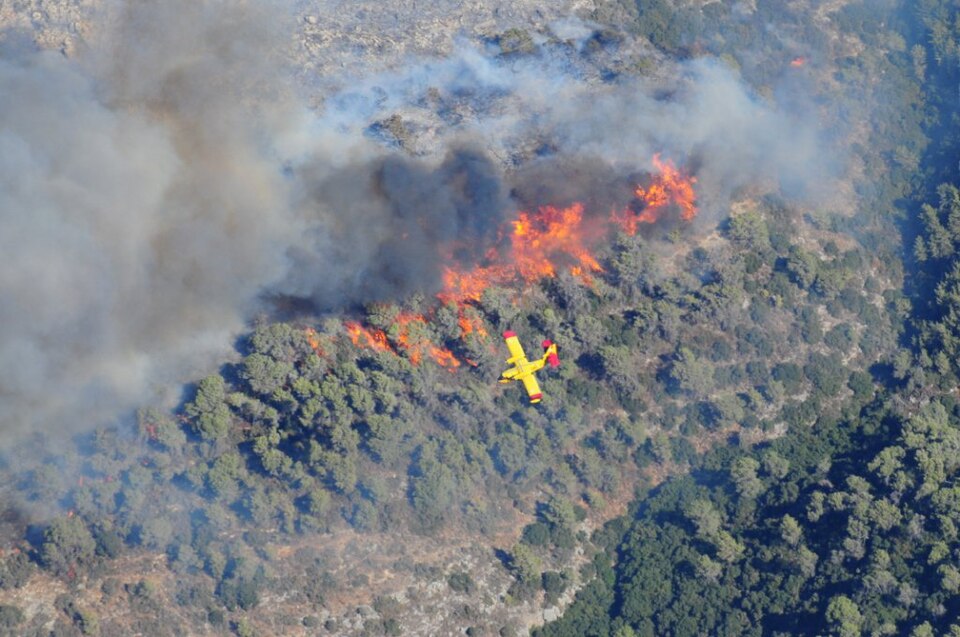
We may see natural or manmade fires as ecological disasters, but that’s not necessarily the case. Wildfires have been part of the natural cycle of many ecosystems for millennia, and have a rejuvenating effect. Fire promotes plant diversity by clearing thick overgrowth and dead vegetation, opening areas to sunlight so that seedlings can germinate, curbing dominant species that outcompete others, and releasing plant nutrients into the soil. Many fire-adapted plants bloom and grow quickly after a fire, taking advantage of the sudden and welcoming changes.
Ecological succession one year (L) and two years after a wildfire in an Estonian pine forest © Hannu, Wikimedia Commons:
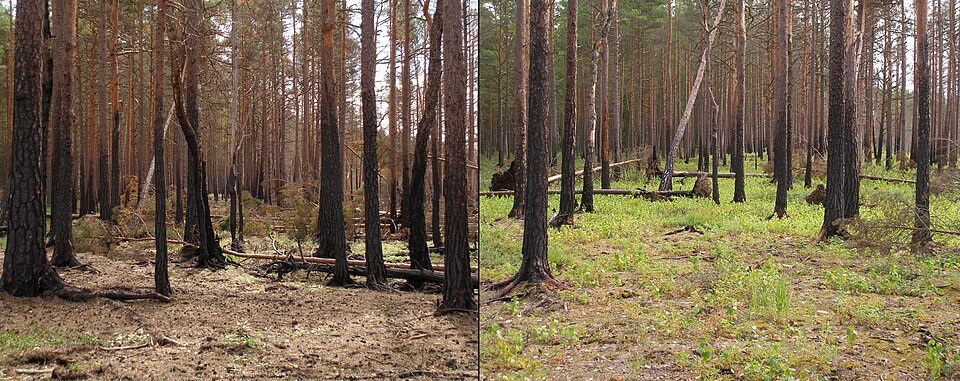
Mediterranean woodland and maquis are well-adapted to the fire regime, and some animals also benefit from periodic conflagrations. Bees are a case in point.
The vegetation in Mount Carmel recovers promptly after a fire by re-sprouting and seed germination, resulting in a profusion of blooming. Bees from surrounding areas quickly move in to exploit the sudden bonanza of pollen and nectar, and also of nesting sites made available by the recently exposed soil. The diversity of flowering plants and bees are the highest during the first two years after a fire, with both declining steadily as plant succession takes place – until another fire strikes (Potts et al., 2003). These periodic, small scale cataclysms suit the bee fauna very well, so much so that some 600 to 700 species have Mount Carmel as their home.
Mount Carmel is not an isolated case of a fire-friendly bee habitat. At McLaughlin Reserve in northern California, grassland recovering from a fire showed increased floral density and a prolonged flowering season. These effects were well-received by the area’s main pollinator, the yellow-faced bumble bee (Bombus vosnesenskii), as burned patches were foraged more intensively than intact patches (Mola & Williams, 2018).
The rightly named yellow-faced bumble bee, a wildfire opportunist © Kevin Cole, Wikimedia Commons:
At Great Smoky Mountains National Park, Tennessee, post-fire plots had increased abundance of wingstem (Verbesina alternifolia), a favourite of bees, butterflies and other insects. As a result, insect visitation to wingstem flowers was about 50% greater in burned plots than in intact plots (Van Nuland et al., 2013). Other studies have found similar trends: bees and other pollinators are not only resilient to wildfires, but tend to be more abundant and diverse after a fire (Carbone et al., 2019). Those findings have far-reaching implications because many bee-rich habitats, including the world’s hotspots of bee biodiversity such as the Mediterranean Basin, southwestern USA, eastern South Africa and southeastern Australia (Orr et al., 2021) burn down regularly.Wingstem, a source of nectar for insects and seeds for birds, is helped by wildfires © Fritzflohrreynolds, Wikimedia Commons.


We may be tempted to conclude that habitats catching fire willy-nilly is a good thing, but that would be a catastrophically wrong conclusion. Just as for many situations in the natural world and even for our choices in life, it’s all a matter of proportion. Fires that are too frequent, too extensive, last for too long or start too early in the season, are not at all beneficial. Intense fire regimes curb the re‐establishment of plant and animal species, promote soil erosion and deplete the soil of nutrients. With time, habitats become drastically altered and impoverished.
The positive side of wildfires is best understood through the Goldilocks principle of ‘just right’ predicted by the Intermediate Disturbance Hypothesis. According to this model, cyclic, moderate fire regimes foster plant diversity, which benefits bees. Out of control fires destroy everything, while the absence of fires reduces plant diversity because of competition.
The Intermediate Disturbance Hypothesis. At low levels of disturbance (I), species richness is low because the strong competitors eliminate weaker ones; at high levels (III), species richness is also low because all species are affected; at moderate levels (II), competition is abated, so diversity is maximized © Wikimedia Commons:

Moderated levels of habitat burning seem to have worked well for bees and other species, but the future is bleak. Extreme heat waves and droughts are becoming more frequent as the planet continues to warm. Higher temperatures and drier landscapes help create ideal conditions for increased fire activity, as demonstrated by recent fierce, destructive wildfires around the world. These changes are bound to impact pollinators, pollination systems and biodiversity in general, but we can only guess to what extent. Goldilocks wouldn’t be happy about that.
Fireweed (Chamaenerion angustifolium) and other flowers growing back after the devastating 1988 Yellowstone fire. Such recoveries may become increasingly rare as wildfires intensify © U.S. National Park Service, Wikimedia Commons.









.jpg)
