Facial surgeons wanted in New Zealand, must be intimately familiar with all things Māori

March 25, 2025 • 10:00 am

Here’s an archived link to an ad for a consultant oral maxillofacial surgeon at Dunedin Hospital. The curious thing—well, not so curious given that it’s New Zealand,—is the list of required qualifications. Click to read (a New Zealand dollar is worth about 57¢ in U.S. currency):

Some of the details:

About the role

In this newly created role that will be hospital based, we are seeking an Oral Maxillofacial Surgeon for a fulltime, permanent position at Dunedin Public Hospital. We would also welcome candidates with sub-specialty interests.

The successful applicant will be expected to provide the full scope of general Oral and Maxillofacial surgery including but not limited to the management of  facial trauma, pathology, infections and orthognathic surgery.  Duties includes active participation in inpatient and outpatient clinics, clinical audit, quality, clinical guidelines/pathways, professional development, appraisal and risk management.

Given the catchment area Te Whatu Ora Southern services, you will be able to take on cases that are diverse and complex; providing you with a rewarding role. There will be an on-call roster in place, this is set at 1:3. Our links with the University of Otago and affiliation with the Faculty of Dentistry means that you may be involved in the teaching of Dental and Medical Students.

Mōu ake | About you
  • Eligibility for vocational registration with the Dental Council of New Zealand
  • We would also welcome applications from advanced trainees.
  • FRACDS (OMS) or equivalent board certification
  • Excellent communication and time management skills

Here’s the part that stamps it as “from New Zealand”. I’ve added links and the translation from Māori, the latter in brackets:

You will also need:
    • Competency with te ao Māori [the Māori worldview], tikanga [the “right way to doing things” according to the Māori], and te reo Māori [the Māori language] or a commitment to starting your journey and taking ownership of your learning and growth
    • Experience in projects / initiatives which give effect to Te Tiriti [the 1840 Treaty of Waitangi] principals [sic] and frameworks, and the application of Mātauranga Māori [Māori “ways of knowing”] and Kaupapa Māori  [“Māori customary practices”] approaches, particularly as they apply in healthcare settings.

In other words, you need to know a great deal about Māori culture and also speak or be learning the language (however, out of 978,000 Māori in NZ, only 55% say they have “some knowledge” of the language and only about 5% say they can speak the language well.  This doesn’t say how many Māori understand English, but it’s surely close to 100%. The requirement that you either know the language or are learning it is, then, largely superfluous; in this way the ad is looking for people who can signal their virtue.

Finally, we have the ubiquitous but ambiguous requirement that the applicant have engaged in “projects/initiatives” that “give effect to the Treaty of Waitangi,” another completely superfluous requirement. “Te Tiriti,” as it’s called, has nothing to do with surgery; it simply specified in 1840 that the Māori would surrender sovereignty to England, but would keep and rule over their lands and villages, and would also acquire all the rights of a British citizen.  If you can tell me which “Te Tiriti-themed” projects are essential to have engaged in for this surgeon’s job, and why those projects are necessarily, I’d be glad to hear it.

The is once again an example of how indigenous people leverage their supposed modern oppression to get more “stuff,” how New Zealand has surrendered to that “victimhood” approach, and, above all, how merit is given at least equal priority to indigeneity. (If you’re a great surgeon but know squat about Te Tiriti and can’t speak Māori, I doubt you’d even be considered for the job.)

Over at Point of Order, which is consistently critical of this kind of stuff, Yvonne van Dongen takes the ad apart. Click below to read her snarky but accurate critique:

An excerpt:

If you had impacted wisdom teeth requiring surgery, would it comfort you to know the consultant surgeon was competent in te ao Māori?

Or, say, if you needed oral cancer surgery, is it a bonus if the person operating on your mouth has had experience in projects and initiatives which give effect to Te Tiriti principles?

How about if you had to go under the knife for facial trauma – does it ease your anxiety knowing that the consultant surgeon is steeped in the application of Mātauranga Māori and Kaupapa Māori approaches, particularly as they apply in healthcare settings?

Southern Health thinks the answer is yes to all the above.

This week an advertisement on their careers website for a consultant oral maxillofacial surgeon at Dunedin Hospital stated that competency in te ao Māori, tikanga, and te reo Māori was a requirement. Or at the very least “a commitment to starting your journey and taking ownership of your learning and growth.”

As well, they asked for

“Experience in projects / initiatives which give effect to Te Tiriti principals (sic) and frameworks, and the application of Mātauranga Māori and Kaupapa Māori approaches, particularly as they apply in healthcare settings.”

Apart from spelling principles incorrectly, Southern Health clearly thinks they know what the principles of the Treaty are, even though this is a topic hotly debated thanks to Act’s Treaty Principles Bill.

Apparently, after inquiries from the press, New Zealand Health is reassessing these requirements, and pondering that wondering whether, after all, just merit and experience should be the qualifications. The answer, of course, is “yes.”

Shakespeare gets decolonized

March 21, 2025 • 9:30 am

Yep, it was inevitable that the greatest writer in the English language, but one who wrote several centuries ago, would have to be “decolonized.”  You know, of course, that Shakespeare’s plays are full of stereotypes, dirty jokes, and filthy words, and that can’t be allowed to stand. But it’s worse than that: he’s made out to be a white bigot: a sixteenth-century Nazi.

And so, according to this new piece in Spiked (click below to read), the Pecksniffs have decided to place the Bard in perspective for the public, including the fact he adhered to the ideology of white supremacy. But read Johanna Williams’s article below, largely riffing on a Torygraph article that seems credible:

Some excerpts:

What is it with Britain’s cultural custodians and their hatred of everything British? National self-loathing drips from curators and directors alike, revealed in a Tourette’s-like compulsion to blurt out ‘Decolonise!’ at everything they see. They are currently getting hot under the collar  [JAC: archived here] in the sleepy town of Stratford-upon-Avon, where they have Shakespeare’s birthplace in their sights.

The links above and in the three paragraphs below the next excerpt go to a Torygraph piece (archived here) that says this:

The claims were made in a 2022 collaborative research project between the trust and Dr Helen Hopkins, an academic at the University of Birmingham.

The research took issue with the trust’s quaint Stratford attractions, comprising the supposed childhood homes and shared family home of Shakespeare and Anne Hathaway, his wife, because the Bard was presented as a “universal” genius.

This idea of Shakespeare’s universal genius “benefits the ideology of white European supremacy”, it was claimed.

This is because it presents European culture as the world standard for high art, a standard which was pushed through “colonial inculcation” and the use of Shakespeare as a symbol of “British cultural superiority” and “Anglo-cultural supremacy”.

Veneration of Shakespeare is therefore part of a “white Anglo-centric, Eurocentric, and increasingly ‘West-centric’ worldviews that continue to do harm in the world today”.

. . . The project recommended that Shakespeare’s Birthplace Trust recognise that “the narrative of Shakespeare’s greatness has caused harm – through the epistemic violence”.

The project also recommended that the trust present Shakespeare not as the “greatest”, but as “part of a community of equal and different writers and artists from around the world”.

And as the Pecksniffs kvetch, so the Birthplace Trust follows:

. . . The trust will continue looking at updating the “current and future interpretation” of objects in its collection. It will also explore how objects could be used as the focus for new interpretations which tell more international stories, in order to appeal to a more diverse audience.

It has additionally pledged to remove offensive language from its collections information, as part of a “long, thoughtful” process.

. . . The Globe Theatre in London ran a series of seminars titled Anti-Racist Shakespeare which promoted scholarship focused on the idea of race in his plays.

Academies taking part in the series made a number of claims, including that King Lear was about “whiteness”, and that the character of Prince Hamlet holds “racist” views of black people.

Back to Spiked:

Where normal people admire timber-framed houses and marvel at the schoolroom where Shakespeare learnt the classics, our cultural elites see ‘white supremacy’. Where you and I see genius in plays like King LearHamlet and Othello, they see a symbol of ‘British cultural superiority’. They seem to imagine that racist thugs have swapped sharing memes on Telegram for watching Macbeth at the local theatre. Labelling the Bard as a vehicle for white supremacy really is that insane.

With hatred comes flagellation. As such, Shakespeare’s Birthplace Trust – the charity tasked with preserving Shakespeare-related heritage sites in historic Stratford-upon-Avon – is now ‘decolonising’ its vast collection. This means that, just as in practically every other museum and art gallery across the UK, exhibits will be labelled to make clear ‘the continued impact of Empire’ or the ‘impact of colonialism’. In Stratford-upon-Avon, the special twist will be to show how Shakepeare’s legacy has allegedly played a part in this litany of sin.

Shakespeare’s Birthplace Trust has also warned visitors that some items in its collections may contain ‘language or depictions that are racist, sexist, homophobic or otherwise harmful’. Of course they will. The past was a different time, with different attitudes and values. Shakespeare was not subjected to training in diversity, equity and inclusion. Nor was he presented with a style guide advising him as to the correct pronouns to use for his many crossdressing characters. Thank goodness.

And Williams’s conclusion, the first paragraph of which is spot on:

Just as Shakespeare is integral to being British, his work also absolutely has universal value. He portrays emotions such as joy, grief and anger, and experiences like being young, falling in love and growing old that are fundamental not to being British or even European, but to being human. This is why his legacy endures. His genius is to transcend racial, national and generational differences and point to what we have in common, rather than what divides us. That Shakespeare is English is incidental to the common humanity in his work, but it is entirely relevant to the historical circumstances that made his prodigious talent possible. To boil all this down to ‘white supremacy’ is ridiculous.

The Birthplace Trust’s real concern is to stop British people taking pride in Shakespeare and seeing his work as a symbol of ‘British cultural superiority’. It wants him to be viewed not as the ‘greatest’, but as ‘part of a community of equal and different writers and artists from around the world’. But if academics and curators really cannot say that Shakespeare’s plays are better than a Nigerian soap opera or a Brazilian drag-queen performance, then we really are in trouble. If even Shakespeare’s custodians cannot say that his work is the pinnacle of human achievement, then the Bard has no need of enemies. The barbarians are not at the gate, they are sitting in the stalls.

There is no older work that cannot be scrutinized for violations of wokeness, and they inevitably find it.  Now Shakespeare must always be put in “context” when his works are taught in schools—if they’re taught at all. After all, do we really want our kids to read plays written by a Nazi?

h/t: Ginger K.

Nature Human Behavior is back, this time touting “allyship”

February 24, 2025 • 12:15 pm

In the summer of 2022, the journal Nature Human Behavior put out a notice that it could reject articles that were “stigmatizing” or “harmful” to different groups, regardless of the scientific content. The problems with this stand, which were immediately called out by Steve Pinker, Michael Shermer, and others, is that what is seen as stigmatizing or harmful is pretty much a subjective matter, and, as Pinker tweeted:

I think the journal and its editor were taken aback by this and similar reactions to their statements, and on Day 2 of our USC conference on Science and Ideology in January, the Chief Editor of the journal, Stavroula Kousta, walked back their statement a bit in here 24-minute talk (go here to here her talk; it’s the first one on the video).

But the walking-back didn’t mean that Nature Human Behavior was becoming less woke. Indeed, it just published a ridiculously repetitive and trite paper about how science needs “allyship” to produce a “diverse, equitable, and inclusive academia.” It’s not that STEM isn’t seeking a diversity of groups and viewpoints—though, inevitably, “diversity” in their sense means “diversity of race or sex”—but that this article says absolutely nothing new about the issue. What the journal published now is a prime example of virtue-flaunting that, in the end accomplish nothing.  You can read it by clicking on the screenshot below (it should be free with the legal Unpaywall app), and you can get the pdf here.

The piece begins with the usual claim of “harm”: the same issue that the same journal discussed before:

In academia, despite recent progress towards diversity, biases and microaggressions can still exclude and harm members of disadvantaged social groups.

The person who sent me this article wrote “No citations are given for this claim about bigotry and discrimination at the most liberal, open, welcoming institutions that have ever existed in human history. Amazing.”

The article then gives these figures, which are baffling because one would expect younger women to drop out more rather than less frequently. But they may be correct; I am just not sure that they reflect misogyny:

Such patterns of marginalization are not specific to students. Among US faculty members, for example, women are 6%, 10% and 19% more likely to leave each year than their men counterparts as assistant, associate and full professors, respectively.

I suspect that these departures have little to do with ongoing “structural bias” against women academics, not only because no instances of inbuilt structural bias are actually given, but also, at least for women, a big and recent review by Ceci et al. found either no bias against women’s achievements in academic science or a female advantage—save for teaching evaluations and a slight difference in salary, about 3.6% lower salary for women.   However, the authors do not dismiss the possibility and importance of bias against women.

At any rate, if you haven’t heard come across this advice about “allyship” before, and are an academic, you must be blind and deaf. I’m not going to reprise the paper for you, as you’ve heard it all before.

I’m assuming that well-meaning people agree with me that marginalized scientists should be treated just like everyone else.  But how many times do we need to hear that? At any rate, this paper rings the chimes again, singling out six areas where we’re told how to behave. These are direct quotes.

1.) Listen to and centre marginalized voices.

2.) Reflect on and challenge your own biases (I guess you determine them by taking an “implicit bias” test, a procedure that’s been severely criticized

3.)  Speak up to include and support disadvantaged groups

4.)  Speak out against bias when it happens

5.)  Advocate for institutional initiatives to promote equity and inclusion

6.)  Dismantle institutional policies and procedures of exclusion

#4 and #6 are no-brainers, though, speaking personally, I don’t know of any institutional policies and procedures of exclusion in biology.  The rest are ideological statements assuming that everyone except for the marginalized is biased, and that the way to achieve inclusion is to promote “equity” (do they even know what “equity” means?) And, of course, the entire program reflects the tenets of DEI, which are on the chopping block in the U.S.

Now this article isn’t as bad as ones on feminist glaciology or ones maintaining that Einstein’s principle of covariance supports the view that minorities have an equal claim to objectivity..  No, it’s just superfluous, a farrago of what decent human beings already do, misleading assertions about bias, mixed with patronizing advice that we already follow. It accomplishes nothing save further erode the credibility of editor Kousta.

Here’s the conclusion:

For allyship to be effective in academia, it must be grounded in a deep commitment to DEI. This means recognizing that allyship is not a one-time event, but an ongoing process of learning, reflection and action. Moreover, it needs to go above and beyond symbolic or superficial acts (performative allyship) to demonstrate substantial and meaningful support that is recognized as beneficial by those it is meant to serve (substantive allyship). It is noteworthy to understand and accept that we will make mistakes along the way. No one is perfect, and as explained above, allyship requires a willingness to engage in humility and self-reflection. When mistakes are made, it is important to listen to feedback from disadvantaged groups, take responsibility for any harm caused, and commit to doing better in the future.

In conclusion, everyone can engage in allyship and work to challenge and dismantle systemic bias, creating a more just, equitable and inclusive academic community for all.

At least they used “equitable” properly, meaning “treating people fairly.”  But couldn’t the whole article have consisted of just that sentence?

Konstantin Kisin: “The tide is turning”

February 24, 2025 • 10:00 am

Trigger(nometry) warning: semi-conservative video.

I can’t remember who recommended I watch this video, which features satirist, author, and Triggernometry co-host Konstantin Kisin speaking for 15 minutes at a meeting of the Alliance for Responsible Citizenship (ARC). The group is described by Wikipedia as “an international organisation whose aim is to unite conservative voices and propose policy based on traditional Western values.”

The talk is laced with humor, but the message is serious:  Kisin argues that societies based on “Western values” are the most attractive, as shown by the number of potential immigrants; but they are endangered by the negativity and “lies” of those who tell us that “our history is all bad and our country is plagued by prejudice and intolerance.” To that he replies that people espousing such sentiments still prefer to live in the West. (But of course that doesn’t mean that these factors still aren’t at play in the West!)  Kisin then touts both Elon Musk (for “building big things”) and (oy) Jordan Peterson for “reminding us that our lives will improve if we accept that “honesty is better than lies, that responsibility is better than blame, and strength is better than weakness.”

He continues characterizing the West as special: “the most free and prosperous societies in the history of humanity, and we are going to keep them that way.” To accomplish that, he promotes free speech as the highest of Western values, and rejects identity politics, arguing that “multiethnic societies can work; multicultural societies cannot.” Finally, he claims that human beings are good, denying (as he avers) the woke view that “human beings are a pestilence on the planet.”  Kisin calls for more reproduction and making energy “as cheap and abundant as possible.”

The talk finishes with the most inspiring thing Kising says he’s ever heard: that we’re going to die; ergo, we have nothing to lose. “We might as well speak the truth, we might as well reach for the stars, we might as well fight like our lives depended on it—because they do.”  I’m not exactly sure what he means, nor do I feel uplifted or inspired by these words, which don’t really tell us why he thinks the tide is turning. And, at the end, I could see where this optimistic word salad came from: it’s in Wikipedia, too:

[The ARC] is associated with psychologist and political commentator Jordan Peterson. One Australian journalist identified the purpose of ARC as follows: “to replace a sense of division and drift within conservatism, and Western society at large, with a renewed cohesion and purpose”.

Do any readers get inspired by this kind of chest-pounding?  I have to add that I do like Triggernometry, one of the few podcasts I can listen to, but I’m not especially energized by the co-host’s speech.

FIRE rebukes U Conn’s medical school for compelled speech by confecting and forcing on students a social-justice Hippocratic oath.

January 31, 2025 • 11:00 am

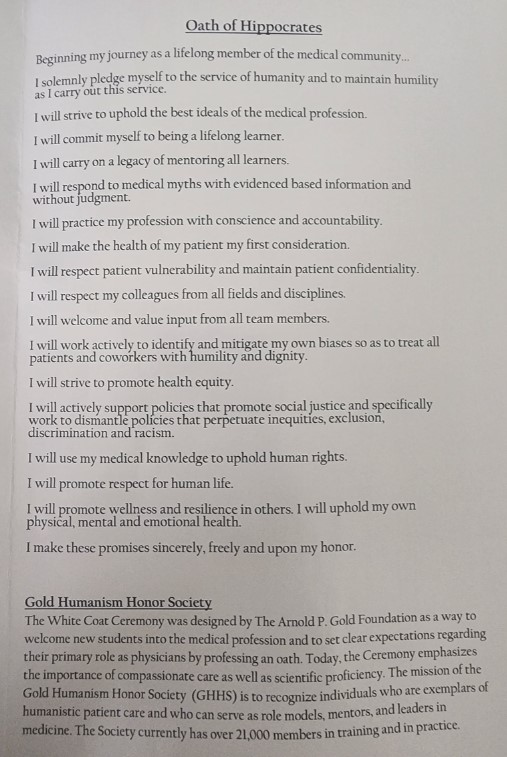
Speaking of FIRE and free speech, I got an email from that organization this morning about how The University of Connecticut has altered the traditional Hippocratic Oath to reflect Social Justice considerations. (It’s far from the only med school that has done this.)  This can be considered compelled speech, which students are supposed to recite even if they disagree with it. You can see the traditional forms of the oath here, and hear the newer one here, starting at 44:12. The students are asked to repeat the oath after the speaker.

The new oath is also transcribed below at the Do No Harm site; I’ve put in a red box the parts that disturbed FIRE:

Here’s the email I got from FIRE:

Incoming medical students typically recite the Hippocratic Oath, a pledge to do no harm to patients. But last August, the University of Connecticut required freshmen medical students to recite an ideologically-charged version of the Hippocratic Oath that reads, in part, 

“I will strive to promote health equity.
I will actively support policies that promote social justice and specifically work to dismantle policies that perpetuate inequities, exclusion, discrimination and racism.”

The school violated students’ First Amendment rights against compelled speech by forcing them to affirm contested political viewpoints. The oath effectively emboldens administrators to punish students who, in their opinion, failed to uphold these nebulous commitments. What, exactly, must a medical student do to “support policies that promote social justice”? If a student disagrees with UConn’s definition of “social justice” or chooses not to promote it in the prescribed way, could she be dismissed for violating her oath?

Today, free speech group FIRE called on UConn to make clear that students may refrain from reciting all or part of the oath without any threat of penalty and will not have to affirm any political viewpoints as a condition of their education at the school.

FIRE Program Officer Ross Marchand: “The constant threat of discipline hangs over UConn students. At any time, administrators could decide that a student has broken the vague, partisan oath that she was forced to take. Even an insufficient commitment to ‘social justice’ could land a student in trouble. UConn prioritized politics and ideology above education and the First Amendment, creating a culture of compulsion and fear.”

Thanks! Check out our letter to the school and our blog post.

The blog post notes this:

In August, UConn required the incoming class of 2028 to pledge allegiance not simply to patient care, but to support diversity, equity, and inclusion. The revised oath, which was finalized in 2022, includes a promise to “actively support policies that promote social justice and specifically work to dismantle policies that perpetuate inequities, exclusion, discrimination and racism.”

This practice is a grave affront to students’ free speech rights. In January, FIRE called the medical school to confirm that the oath is mandatory; an admissions staff member told us it was. We are asking them to confirm this in writing.

As a public university, UConn is strictly bound by the First Amendment and cannot compel students to voice beliefs they do not hold. Public institutions have every right to use educational measures to try to address biases they believe stymie the healthcare system. But forcing students to pledge themselves to DEI policies — or any other ideological construct — with which they may disagree is First Amendment malpractice. This is no different than forcing students to pledge their allegiance to a political figure or the American flag.

. . .   and adds that these “Social Justice Oaths” are not uncommon:

UConn isn’t alone in making such changes to the Hippocratic Oath. Other prestigious medical schools, including those at HarvardColumbiaWashington UniversityPitt Med, and the Icahn School of Medicine, have adopted similar oaths in recent years. However, not all schools compel students to recite such oaths. When we raised concerns in 2022 about the University of Minnesota Medical School’s oath, which includes affirming that the school is on indigenous land and a vow to fight “white supremacy,” the university confirmed that students were not obligated to recite it. That’s the very least UConn could do to make clear that it puts medical education — and the law — ahead of politics.

The letter suggests that taking this oath is not optional but mandatory. From FIRE’s letter from Marchand to Dean Bruce Liang of the UConn Medical School:

FIRE called the UConn School of Medicine Admissions Office to clarify whether the oath, including these additions, is mandatory for students participating in the ceremony. A staff member confirmed that this oath is required for all incoming students. We have also emailed the admissions office to confirm the mandatory nature of the oath but have yet to receive a
written response.

. . . While UConn may encourage students to adopt the views contained in the oath, the First Amendment bars the university from requiring them to do so.  The First Amendment protects not only the right to speak but the right to refrain from speaking. As the Supreme Court has notably held, public institutions may not compel individuals to “declare a belief [and] … to utter what is not in [their] mind.”8 Requiring new students to pledge their loyalty to a particular ideology violates students’ expressive rights, is inconsistent with the role of the university as a bastion of free inquiry, and cannot lawfully be enforced at a public institution. UConn can require students to adhere to established medical standards, but this authority cannot be abused to demand allegiance to a prescribed set of political views—even ones that many students may hold.  Specifically, the school may not compel students to pledge to support or promote concepts such as “social justice” and “equity,” notions that have long been the subject of intense political polarization and debate

You’d think that these deans would know something about the prohibition about compelled speech, but of course they cannot conceive that anybody would opopose the social justice-y bits of their new Oath. They clearly need a lesson in the First Amendment!

Finally FIRE asks for a response in two weeks:

FIRE calls on UConn to make clear that students may refrain from reciting all or part of the oath without any threat of penalty and will not have to affirm any political viewpoints as a condition of their education at the school.
We request receipt of a response to this letter no later than the close of business on February 14, 2025

You can go to this page to send a quick fill-in-the-form letter. I did.

More wokeness in biology

January 28, 2025 • 12:15 pm

I thought I was clever when I decided that an alternative word for a woke person could be a “Passive Progressive”, but then was told that woke people aren’t passive because they create a lot of noise and kerfuffle. I still like my new term, though, as by “passivity” I meant “performativeness”.  That is, a woke person espouses progressive Leftist ideals but does not do anything to enact them, ergo the passivity.

But I digress. While poring through some scientific literature yesterday, I came upon an issue of The American Naturalist from July 2022. This used to be one of the go-to journals for publishing evolutionary biology, and I was a corresponding editor for a while, but in my view it’s slipped a bit. This issue, with its special section on “Nature, data, and power” is about as ideologically captured as you can get. And this was three years ago! Well, capture started well before that. If you want to read any of these articles, just click on the screenshots below (there are two because the section is so long. There are other real science papers not soaked in politics, but I haven’t put them down.

Which paper is your favorite?


The scandal of English grooming gangs

January 7, 2025 • 11:15 am

UPDATE:  A UK government report from 2020 suggests that there are conflicting data on the ethnicity of the offending “grooming gangs”. Click below to see the study and I quote from page 10 of the Executive Summary (bolding is mine):

17. A number of high-profile cases – including the offending in Rotherham investigated by Professor Alexis Jay,3 the Rochdale group convicted as a result of Operation Span, and convictions in Telford – have mainly involved men of Pakistani ethnicity. Beyond specific high-profile cases, the academic literature highlights significant limitations to what can be said about links between ethnicity and this form of offending. Research has found that group-based CSE offenders are most commonly White.4 Some studies suggest an over-representation of Black and Asian offenders relative to the demographics of national populations.5 However, it is not possible to conclude that this is representative of all group-based CSE offending. This is due to issues such as data quality problems, the way the samples were selected in studies, and the potential for bias and inaccuracies in the way that ethnicity data is collected.6 During our conversations with police forces, we have found that in the operations reflected, offender groups come from diverse backgrounds, with each group being broadly ethnically homogenous. However, there are cases where offenders within groups come from different backgrounds.7

Stay tuned, and if you know of more dispositive data, place it in the comments. If this be true,  then even bringing in the element of race is misguided. But as I say below, it doesn’t matter what color or ethnicity the pedophiles were, for nearly everyone agrees that the whole issue of grooming gangs has been grossly mishandled by the UK authorities, and largely swept under the rug.

UPDATE 2: A reader calls attention to this NYT article claiming that Musk’s tactics in exposing the grooming gangs are dishonest and politically motivated.


The Free Press headline below may be exaggerated, but it comes close to the truth.  For it’s about the “grooming gangs” that have plagued England for several decades.  They involve groups of men—most often of Pakistani or Bangladesi ancestry—whose goal is to subjugate and rape young children of both sexes. Some children have been killed.  But because the perps are usually people of color, the government, the police, and the public have largely ignored the issue.  This is a huge scandal involving, once again, a clash of ideologies that came down the wrong way. The warring ideologies are to avoid denigrating immigrants of color versus protecting children against pedophiles.

Yes, some of these gangs have been broken up and the perps sent to prison, but only now, with the prompting of Elon Musk, is it being publicized as the heinous crime it is. (The fact that Musk is widely hated makes it hard for people to accept the situation, but his actions in this case are right.) For the grooming is still going on, and not just in the UK but in other places in Europe.  Unfortunately, calling attention to these gangs is seen not only as racist, but as anti-immigrant, both characterizations being horrible to liberals.

I’m not going to describe these crimes in detail, as they makes me sick, but you need to know about them, and the UK needs to start taking the issue VERY seriously.

First, a piece from the Free Press, which you can access by clicking on the headline.

There’s a thread of incidents tweeted by Elon Musk you can find at the link, and of course everybody is festooning them with community notes because Musk. This first one, for example, happened five years ago, and the perps are in jail. But it tells you the kind of things that can happen. Here are the first two tweets, apparently both from 2013.  But as the article above notes, this is still going on,

A quote from the Free Press piece:

The grooming and serial rape of thousands of English girls by men of mostly Pakistani Muslim background over several decades is the biggest peacetime crime in the history of modern Europe. It went on for many years. It is still going on. And there has been no justice for the vast majority of the victims.

British governments, both Conservative and Labour, hoped that they had buried the story after a few symbolic prosecutions in the 2010s. And it looked like they had succeeded—until Elon Musk read some of the court papers and tweeted his disgust and bafflement on X over the new year.

Britain now stands shamed before the world. The public’s suppressed wrath is bubbling to the surface in petitions, calls for a public inquiry, and demands for accountability.

The scandal is already reshaping British politics. It’s not just about the heinous nature of the crimes. It’s that every level of the British system is implicated in the cover-up.

Social workers were intimidated into silence. Local police ignored, excused, and even abetted pedophile rapists across dozens of cities. Senior police and Home Office officials deliberately avoided action in the name of maintaining what they called “community relations.” Local councilors and Members of Parliament rejected pleas for help from the parents of raped children. Charities, NGOs, and Labour MPs accused those who discussed the scandal of racism and Islamophobia. The media mostly ignored or downplayed the biggest story of their lifetimes. Zealous in their incuriosity, much of Britain’s media elite remained barnacled to the bubble of Westminster politics and its self-serving priorities.

They did this to defend a failed model of multiculturalism, and to avoid asking hard questions about failures of immigration policy and assimilation. They did this because they were afraid of being called racist or Islamophobic. They did this because Britain’s traditional class snobbery had fused with the new snobbery of political correctness.

All of which is why no one knows precisely how many thousands of young girls were raped in how many towns across Britain since the 1970s.

Although some have said that this is no longer a problem, and the perps are all in jail, that’s simply not true. The first link above goes to a UK government site about the Grooming Gangs Taskforce, and was published in May of last year:

In the last 12 months the crack team of expert investigators and analysts has helped police forces arrest over 550 suspects, identify and protect over 4,000 victims, and build up robust cases to get justice for these appalling crimes.

Established by Prime Minister Rishi Sunak in April 2023, the Grooming Gangs Taskforce of specialist officers has worked with all 43 police forces in England and Wales to support child sexual exploitation and grooming investigations.

Led by the National Police Chiefs’ Council and supported by the National Crime Agency, the taskforce is a full time, operational police unit funded by the Home Office to improve how the police investigate grooming gangs and identify and protect children from abuse. It is staffed by experienced and qualified officers and data analysts who have long-term, practical on-the-ground experience of undertaking investigations into grooming gangs.

Finally, from Unherd, an article about how the cops are complicit in not going after grooming gangs. It’s written by a former detective :


The answer is pretty much what you would expect: going after grooming gangs that largely comprise people of color is seen as racist, and you know how the British cops are with “hate speech”:

The statistics behind the rape gang scandal — let’s banish the wholly inadequate word “grooming” — are staggering. For over 25 years, networks of men, predominantly from Pakistani Muslim backgrounds, abused young white girls from Yeovil to London to Glasgow. The victims’ accounts are beyond depravity, unthinkable in a supposedly advanced Western democracy.

That, of course, immediately raises a simple, shocking question: why did British police services turn a blind eye to the gang rape of tens of thousands of young girls? I should have a fair idea. I was a police officer for 25 years, including five as a detective in the Met’s anticorruption command. Working on sensitive investigations into police wrongdoing, I saw first-hand how law enforcement responds to scandals and crises. I’ve watched senior officers, faced with uncomfortable truths, wriggle like greased piglets. I’ve witnessed logic-defying decisions for nakedly political reasons. I am firmly of the view, then, that the whole scandal has unambiguously revealed rank cowardice by constabularies across the UK, where the most senior whistleblower in the entire country was a lowly detective constable.

The answer, in the end, is simple. Racism, for police services from Chester to Penzance, remains the original sin. From the Scarman Report to the Macpherson Inquiry, the police have long served as Britain’s sin-eaters, devouring social problems on our behalf. As former Met Commissioner Sir Robert Mark famously wrote: “The police are the anvil on which society beats out the problems and abrasions of social inequality, racial prejudice, weak laws and ineffective legislation.” That was over 40 years ago, and little has changed since. This institutional reticence over race goes beyond the police themselves: even the Independent Office for Police Conduct’s (IOPC) review of the rape gang scandal tiptoed around the heritage and religion of offenders.

The second reason why race is a third rail issue for police? Public order. The raison d’etre of British policing, imprinted into its DNA, is Keeping the King’s Peace. And as we saw in Southport and elsewhere last summer, austerity-ravaged services are ill-equipped to deal with large-scale disorder. Riots, especially those with a racial element, are the ultimate manifestation of police failure, even as forces like Greater Manchester and South Yorkshire are petrified of seeing a repeat of the 2001 disturbances in Oldham. I suspect, then, that chief constables were inclined to see the rape gang scandal as another intractable problem, confined to a marginalised section of the white underclass. To pick at that particular scab might risk public disorder. Better to speak to “community leaders” — to keep the peace, even at the price of allowing organised paedophile networks to operate in plain sight.

It is incomprehensible to me how the police, government, and general public prefer to brush this issue under the rug: it’s pedophilia, for crying out loud, and the abuse is both horrible and pervasive. But I’ll close with the observation that again we see a clash of two opposing views: one in which people of color should be treated fairly, which is good, and the other in which children should not be sexually abused, completely incontestable.  But when people of color begin mass sexual abuse of children, and those children appear to be mostly white, you can see how it poses a conflict for the woke. Yet it should not be a conflict, for no matter what color the abusers and rapists are, they are violating the law big time and should be taken off the streets. That has happened to some extent, but not nearly to the extent that should be the case.

h/t: Luana