Why Evolution is True is a blog written by Jerry Coyne, centered on evolution and biology but also dealing with diverse topics like politics, culture, and cats.
I have to confess that I’ve never read The Hitchhiker’s Guide to the Galaxy. I really want to, but I’m terribly pressed for time and the only copy in the University of Chicago Library is the last volume—and it’s far away in the law library, of all places. But I’ve watched Douglas Adams’s wonderful talks on YouTube, and have read his engrossing book written with Mark Carwardine, Last Chance to See, a hilarious and touching paean to vanishing species (highly recommended).
Today’s Google Doodle, which is animated (see it here), honors Adams, taken far too young by a heart attack (he would have been 61 today had he lived, but he died in 2001).
We all know Adams’s famous refutation of the anthropic principle involving a puddle that fits nicely in its hole. He was of course a “militant” atheist. This morning the Freedom from Religion Foundation sent around some information as part of its “Freethought of the Day”.
Adams called himself a “committed Christian” as a teenager, who began to rethink his beliefs at age 18 after listening to the nonsense of a street preacher. He credited books by his friend, Richard Dawkins, including The Selfish Gene and The Blind Watchmaker, for helping to cement his views on religion. In one of his speeches, Dawkins quotes Adams, who said: “Now, the invention of the scientific method is, I’m sure we’ll all agree, the most powerful intellectual idea, the most powerful framework for thinking and investigating and understanding and challenging the world around us that there is, and it rests on the premise that any idea is there to be attacked. If it withstands the attack then it lives to fight another day and if it doesn’t withstand the attack then down it goes. Religion doesn’t seem to work like that. It has certain ideas at the heart of it which we call sacred or holy or whatever. (“Emperor Has No Clothes” Award acceptance speech, reprinted in Freethought Today, October 2001.) In The Salmon of Doubt, a compilation of Adams’ writings published posthumously in 2002, Adams wrote of religion: “But it does mystify me that otherwise intelligent people take it seriously.”
And Adams’s “thought:
“If you describe yourself as ‘Atheist,’ some people will say, ‘Don’t you mean “Agnostic’?” ‘ I have to reply that I really do mean Atheist. I really do not believe that there is a god—in fact I am convinced that there is not a god (a subtle difference). I see not a shred of evidence to suggest that there is one. It’s easier to say that I am a radical Atheist, just to signal that I really mean it, have thought about it a great deal, and that it’s an opinion I hold seriously. It’s funny how many people are genuinely surprised to hear a view expressed so strongly. In England we seem to have drifted from vague wishy-washy Anglicanism to vague wishy-washy Agnosticism—both of which I think betoken a desire not to have to think about things too much.”
—Douglas Adams, interview, American Atheist (Winter 1998-99)
Farish A. Jenkins, Jr., Curator of Vertebrate Paleontology and Alexander Agassiz Professor in the Museum of Comparative Zoology at Harvard University, died on November 11, 2012. Farish made major contributions to vertebrate paleontology, functional morphology, and evolutionary biology. He had been ill with cancer for some time, but had continued to work productively, and his death came quickly following a recent reverse. (See update below.)
Farish Jenkins in the vertebrate paleontology collection of the Museum of Comparative Zoology, holding a skull of Massetognathus, a Triassic cynodont (an advanced mammal-like reptile) from the Chanares Formation, Argentina. Photo by Hilary Rosner, Tooth & Claw.
Although Farish published on many subjects, the part of his work likely to be of most interest to WEIT readers is that on transitional forms. Farish worked on three great transformations in the history of tetrapods, including two that have become classic case studies in the origin of higher taxa. First, he worked on the origin of mammals, often in collaboration with his MCZ colleague, A.W. “Fuzz” Crompton. That the ancestors of mammals were to be sought among a particular group of fossil reptiles known as synapsids had been known since the 19th century. What Farish, Fuzz, and many colleagues helped to show was how this transition occurred, and how the bones of the reptilian jaw joint of synapsids moved in to the middle ear of mammals to become ear ossicles, while a new jaw joint, the mammalian jaw joint, evolved. It is a favorite tactic of creationists, even today, to ask how possibly could the jaw of a reptile come unhinged, and a new joint develop, with the reptile bones passing into the ear? Well, the answer is, we know exactly how they did it, because we have the fossils- read Crompton and Jenkins, and look at the pictures! (For the latest on mammalian ear evolution, see this paper by Luo Zhe Xi.)
Farish was one of the triumvirate who, along with Neil Shubin and Ted Daeschler, described Tiktaalik, the fish-tetrapod intermediate from Arctic Canada that made the front pages of newspapers around the world when it’s discovery was publicly announced in 2006. Neil and Ted got most of the media appearances, but it was Farish who was the old hand at arctic paleontological exploration (in the video below, look for Farish at 1:45). Although describing Tiktaalik taxonomically and morphologically was but a small part of his copious output, Farish may be best remembered for this work.
Most recently, Farish and colleagues completed a monographic account of Eocaecilia, a caecilian with limbs (which they had named and briefly described years earlier). Caecilians (not to be confused with the edible variety) are a group of tropical amphibians which today lack limbs, and Eocaecilia is a form that is transitional from fully-limbed ancestors to the modern condition.
Eocaecilia micropodia (‘the tiny-footed dawn caecilian’) from Jenkins and Walsh, 1993.
Both Jerry and I knew Farish from our days at the MCZ. I last saw him on a visit a year or two ago, after he was diagnosed with cancer, but he was his usual voluble self; Jerry saw him at the MCZ just a few months ago. Always impeccably dressed and charming, he had the demeanor of what I imagine a retired officer of the Royal Horse Guards would be like. He helped organize and lead a superb graduate course on vertebrate paleontology (I cannot recall now whether I enrolled or just attended) in the comfortable environs of the Romer Library, named for one of his distinguished predecessors at the MCZ, Alfred Sherwood Romer. I do recall stories of Arctic fossil hunting, with high powered rifles a necessity, as one man stood guard for polar bears, while others peered at the rocks. In addition to his teaching duties in the Faculty of Arts and Sciences, Farish taught human anatomy at the medical school. His comparative and evolutionary approach was not only appreciated by medical students, but also provided an opportunity for vertebrate morphology graduate students, by either taking the course or assisting in its teaching (or both), to gain the experience and background in human anatomy that would allow them to go on and train generations of physicians, as well as commanding the much higher salaries found in medical school anatomy departments. The Nature News Blog has some nice recollections of Farish by Hopi Hoekstra, the MCZ’s curator of mammals. The science writer Hilary Rosner has posted an endearing reminiscence of her encounters with Farish, along with a number of fine photographs, at her blog, Tooth & Claw. As another MCZ colleague put it to me earlier today, “His lectures were legendary…He was a scholar and a gentleman, and truly one of kind.”
A symposium in Farish’s honor, Great Transformations, was held last June. Like Ernst Mayr, also of the MCZ, who got to attend and speak at his 100th birthday symposium, Farish too was able to attend and speak at this gathering to celebrate his achievements. I understand there is a festschrift of the contributions in the works, but unfortunately Farish will now not see it.
Crompton, A.W. and F.A. Jenkins, Jr. 1973. Mammals from reptiles: a review of mammalian origins. Annual Review of Earth and Planetary Sciences 1:131-155.
Crompton, A.W. and F.A. Jenkins, Jr. 1979. Origin of mammals. Pp. 59-73 in J.A. Lillegraven, Z. Kielan-Jaworowska, and W.A. Clemens, eds., Mesozoic Mammals: The First Two-Thirds of Mammal History. University of California Press, Berkeley.
Daeschler, E.B., N.H. Shubin, and F.A. Jenkins, Jr. 2006. A Devonian tetrapod-like fish and the evolution of the tetrapod body plan. Nature 440:757-763.
Downs, Jason P., Edward B. Daeschler, Farish A. Jenkins, Jr., and Neil H. Shubin, 2008. The cranial endoskeleton of Tiktaalik roseae. Nature 456: 925-929.
Jenkins, Jr., F.A and A.W. Crompton. 1979. Triconodonta. Pp. 74-90 in J.A. Lillegraven, Z. Kielan-Jaworowska, and W.A. Clemens, eds., Mesozoic Mammals: The First Two-Thirds of Mammal History. University of California Press, Berkeley.
Jenkins, F. A., Jr., and D. M. Walsh. 1993. An Early Jurassic caecilian with limbs. Nature 365:246-250.
Jenkins, F. A., Jr., D. M. Walsh, and R. L. Carrol, 2007. Anatomy of Eocaecilia micropodia, a Limbed Caecilian of the Early Jurassic. Bulletin of the Museum of Comparative Zoology, 158 (6): 285-365. pdf
Luo, Z.-X. 2011. Developmental patterns in Mesozoic evolution of mammal ears.Annual Review of Ecology, Evolution and Systematics 42: 355–80. pdf
Shubin N.H., E.B. Daeschler, and F.A. Jenkins, Jr. 2006. The pectoral fin of Tiktaalik roseae and the origin of the tetrapod limb. Nature 440: 764-77.
Over at The Guardian, Leo Hickman reminds us that 50 years ago today, Rachel Carson’s seminal book “Silent Spring” was published, with an amazing first print run of 150,000 copies. Carson’s dramatic ecological warning of the effects of insecticides on bird populations played an important part in bringing the problems of population, and the complexity of ecology, into the public domain.
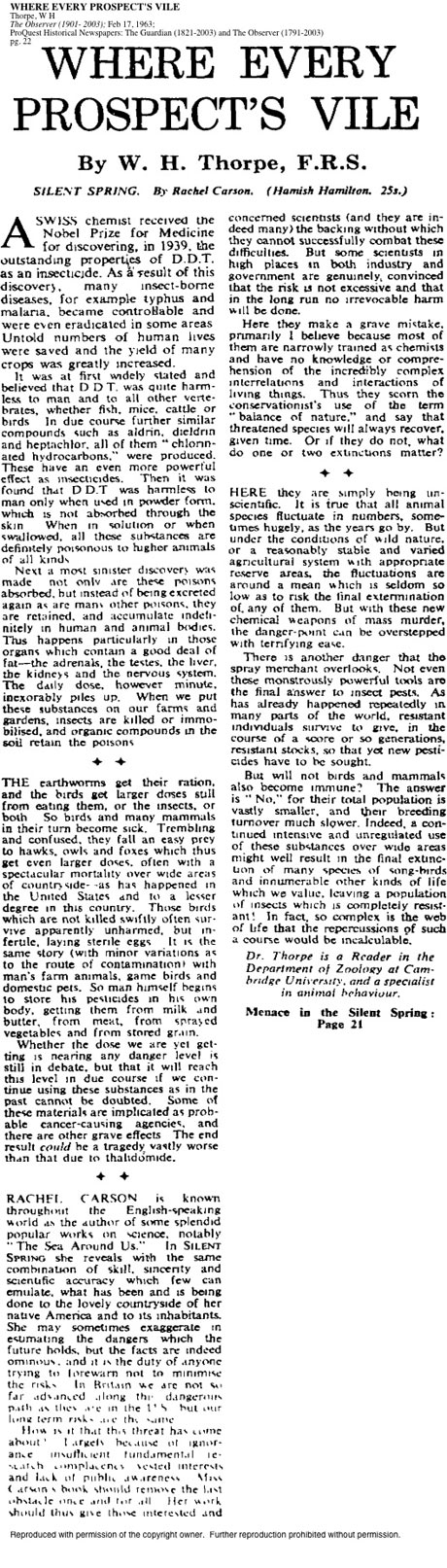
Hickman has asked the great and the good to send him their views of the influence of the book, which makes for pretty interesting reading. He also has some telling and perceptive contemporary reviews, including this one from a personal hero of mine, W. H. Thorpe, one of the early pioneers of animal behaviour, and in particular of the studies of insects.
So, readers of WEIT: what are your memories/knowledge of Silent Spring? At home we had one on our shelves, which my mother must have bought (my father died in 1961). I never spoke to her about why she bought it, and she’s too old to remember now. To my childish mind, it formed part of the catastrophic sci fi literature of the 1950s and 1960s (Day of the Triffids, Earth Abides, On the Beach, Canticle for Leibowitz etc), which I read and devoured. The difference was, this was real. And 50 years on, we can see the consequences, at least in the UK, where once-plentiful birds like sparrows and starlings have become rare, at the same time as many insects have declined. Correlation is not necessarily causation, but this link seems pretty compelling.
Rachel Carson herself I am amazed to learn, died in 1964, at the amazingly young age of 57 (she had a heart attack, but had been suffering from breast cancer). She was a marine biologist, who wrote popular books on conservation, and can be seen here doing field work in 1952:
Carson was also a cat person, as this great pic from 24 September 1962 shows. The cute kitteh is called Moppet.
The book – which had an amazing print run of 150,000 copies – is still in print, though bibliophiles might prefer to pick up a first edition, which go for upward of $700. The top price on Abebooks.com (keep away from the website if you want to keep your bank balance) is $5500 for this copy, complete with signed card:
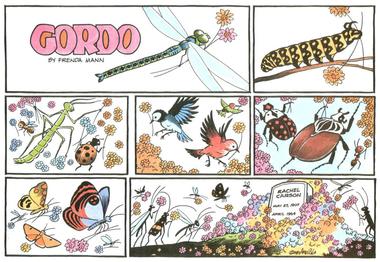
A Sunday newspaper cartoon marked Carson’s passing in a touching way in 1964:
Info and pics from Wikipedia, with the exception of the Moppet pic and the book pic (abebooks).
h/t to Bernard Leikind who pointed this out to Jerry, who asked me to post.
I don’t think I’ve ever seen Carol Blue, Christopher Hitchens’s wife, speaking about her husband, but she interviewed Charlie Rose on Friday’s “CBS This Morning” about Hitchens’s life and death. I can’t embed the 5.5-minute video, but you can see it here. There’s also a brief clip of Rose’s interview with Hitchens in August 2010, shortly after he was diagnosed with esophageal cancer.
This is sad but also heartening:
Of his final hours, Blue maintains that he knew he was very sick but expected to leave the hospital after “a couple of days.” During his last days, he held court at the hospital, receiving visitors and leading spirited debates about “various subjects,” but Blue firmly told Rose that “God never came up, if anyone is interested … it was a non-subject.”
Hitchens made much of his disbelief in God, refuting critiques from those who said he would “find God” in his final months.
Hitchens would certainly have objected to the banner running across the video, which says “Remembering Chris Hitchens.” I can hear his booming corrective, “Christopher!”
You can see the entire 1.75 hour Hitchens memorial at Cooper Union, featuring many speakers (short talks!) like Blue, Lawrence Krauss, Tom Stoppard, Salman Rushdie, and Sean Penn, at this link.
Those are the last words of Steve Jobs, as reported by his sister, Mona Simpson, in a lovely remembrance in yesterday’s New York Times, “A sister’s eulogy for Steve Jobs.” I’m fascinated with last words, and with the last meals of condemned prisoners—I suppose it’s because I want to know how people are dealing with imminent death.
None of us knows for certain how long we’ll be here. On Steve’s better days, even in the last year, he embarked upon projects and elicited promises from his friends at Apple to finish them. Some boat builders in the Netherlands have a gorgeous stainless steel hull ready to be covered with the finishing wood. His three daughters remain unmarried, his two youngest still girls, and he’d wanted to walk them down the aisle as he’d walked me the day of my wedding.
We all — in the end — die in medias res. In the middle of a story. Of many stories.
And Jobs’s last days, described in detail, are very moving.
I suppose it’s not quite accurate to call the death of someone who lived with cancer for years unexpected, but Steve’s death was unexpected for us.