The Apocalypse is here: Pennsylvania church to hold ceremony blessing AR-15s, nearby school to close during the blessing

February 27, 2018 • 1:00 pm

It’s bad enough that a semiautomatic rifle, the one used to slaughter 17 people (mostly kids) in Florida, is still on sale, but the wound is salted when a &(*&$+&!! (insert expletive here) church is going to bless those guns in a ceremony!  I am not making this up. Click on the screenshot from The Hill:

The church, identified below (it’s a Moonie church), is absolutely clueless: they see no connection between their ceremony and the mass slaughter of children, so they’re going on with the ceremony, scheduled for tomorrow:

A church in northeast Pennsylvania is telling couples to bring their semi-automatic rifles to a blessing ceremony next week.

The event is meant to give couples an opportunity “to show their willingness to defend their familiars [sic], communities and nation,” The Times-Tribune in Scranton reported.

It will take place at the World Peace and Unification Sanctuary in Newfoundland, Pa., on Wednesday.

“All of the weapons in the ceremony will be checked to make sure they are unloaded, with a zip tie so that no bullets can be inserted,” Sanctuary Church president Richard Panzer said in an email, according to the The Times-Tribune.

“We are inviting local and state police to be on the premises, so that everything goes safely.”

The blessing ceremony will be held just weeks after a gunman, using an AR-15, opened fire at a high school in Florida, killing 17 people.

Panzer noted the church has “no ill intent” and does not see any connection “since these firearms are for self-defense.”

I guess the nearby elementary school doesn’t quite believe Panzer’s assertion that “everything will go safely,” for this happened (click on screenshot):

The students, from the Wallenpaupack South Elementary School, won’t completely miss class, as they’ll simply be taken to a different school 15 miles away. As the Palm Beach Post reports, the school is trying to keep people calm:

On Friday, the superintendent of the Wallenpaupack Area School District wrote in a letter to parents that while “there is no direct threat to our school or community,” given concerns about parking, traffic and the “nature of the event,” students will be bused to schools about 15 miles (24 kilometers) away.

Superintendent Michael Silsby added there will be increased security at the school all week.

“We respect your decision if you choose to keep your children home for the day,” he wrote.

The parents shouldn’t just be keeping their children home: they should be raining criticism down on the “World Peace and Unification Sanctuary” (what an inappropriate name) and picketing the event. Imagine blessing a gun whose only purpose is to mow down people and inflict terrible gaping wounds! Is this supposed to imply that God loves AR-15s? What is the blessing supposed to confer? And even if the church wants to approve of couples “defending their familiars [sic], community and nation,” why do those couples have to bring their goddam guns to church?

It’s stuff like this that makes me deeply ashamed of this country, and makes other countries amazed at how far America has gone off the rails with respect to guns.

Here’s the contact information for the church, and you can be assured that they’ll be hearing from me. If you think this ceremony is insane, well, feel free to email or call them.

Unification Sanctuary
889 Main Street
Newfoundland, PA 18445
Tel: 570-832-4476 
Email: sanctuarychurch@sanctuary-pa.org

But wait! There’s more insanity (click on screenshot) at a Moonie church (not sure if it’s the same one). You can also read this at The Raw Story.

h/t: Thomas

Gun legislation turned down by Florida legislature; Dinesh D’Souza mocks students lobbying to get it passed

February 21, 2018 • 9:20 am

Over the past two days, the evening news has featured distraught, angry, and determined Florida students marching on the state legislature, stunned about the 17 students shot by Nikolas Cruz, but bent on ensuring that it won’t happen again. Many of the lobbyists were classmates of the slain students.  I thought to myself, “If anybody can change this country’s attitudes towards guns, it’ll be the young people who were the targets of those guns.” I hoped mightily that Florida, and then the country, would at last begin to respond. Dare I hope that this might be the turning point in the struggle against America’s senseless proliferation of weapons—especially assault weapons?

No chance. As I predicted, we’ll have a brief flurry of anger and calls for new gun laws, and then it’ll be business as usual. Far too many Americans see student lives as collateral damage to the necessary production and ownership of guns. That’s just sick.

Of course Florida turned a deaf ear to those students. As ABC 10 reports, just one day after the students from Marjory Stoneman Douglas High School went to Tallahassee, Florida to lobby for gun control at the state capitol, the House voted down a motion to ban assault weapons like the AR-15 used by Cruz. The vote wasn’t even close: 36-71.  And it’s ASSAULT WEAPONS!  There is no reason to allow these even if you think that the Second Amendment should permit personal possession of weapons for self defense.

The students were devastated, as they should be, watching a bunch of Republicans vote down sensible restrictions on the very gun that had shattered the bodies of their friends. They watched and wept:

And Dinesh D’Souza, odious human being that he is (he’s supposed to be a pious Christian), brutally and cruelly mocked these students on Twitter:

How lame a human being must you be to say things like this? Reader Pliny the in Between adds a comment:


h/t: Grania, Hempenstein

Another school shooting in Florida: At least 17 dead

February 14, 2018 • 5:39 pm

I’ve just heard on the news that at least 17 people (CNN says 16, but another has died) have been killed in a school in Parkland, Florida: the shooter was a former student who has apparently been taken into custody.

What can one say when school shootings like this become an everyday affair in America? (This is the 18th school shooting this year, and it’s only mid-February.) I can’t wish for the dead to come back. All I can do is hope for fewer guns in America, and express deep sorrow to the families, friends, and loved ones of those who were taken too soon.

UPDATE: CNN adds this:

The suspect, 19-year-old former student Nikolas Cruz, is in custody, Broward County Sheriff Scott Israel said. The sheriff said he was expelled for unspecified disciplinary reasons.

The serious stuff: autonomous weapons

November 16, 2017 • 9:48 am

by Matthew Cobb

Not really the usual WEIT fare, and certainly not what I normally post here, but I feel it is pretty important. This is a 7 minute video, ‘Slaughterbots’, about autonomous weapons and what the future could hold. Watch it and be chilled.

The video was made by the Campaign to Stop Killer Robots (once that might have sounded funny). On their webpage, they point out that an intergovernmental meeting is taking place right now:

“Representatives from more than 70 states are expected to attend the first meeting of the Convention on Conventional Weapons (CCW) Group of Governmental Experts (GGE) on lethal autonomous weapons systems on 13-17 November 2017, as well as participants from UN agencies such as UNIDIR, the International Committee of the Red Cross (ICRC)”

They made the video to draw attention to the problem and pressure the GGE meeting which “is not working towards a specific outcome or negotiating a new CCW protocol to ban or regulate lethal autonomous weapons”. Nevertheless, 19 nations have supported a ban on the development of such devices, and the European Parliament voted to ban “development, production and use of fully autonomous weapons which enable strikes to be carried out without human intervention.” Their website explains:

“More than 3000 artificial intelligence experts signed an open letter in 2015 affirming that they have “no interest in building AI weapons and do not want others to tarnish their field by doing so.” Another 17,000 individuals also endorsed this call. The signa tories include Tesla CEO Elon Musk, Apple co – founder Steve Wozniak, Skype co – founder Jaan Tallin, Professor Stephen Hawking, and Professor Noam Chomsky . They include more than14 current and past presidents of artificial intelligence and robotics organizations and professional associations such as AAAI, IEEE – RAS, IJCAI, ECC AI. They include Google DeepMindchief executive Demis Hassabis and 21 of his lab’s engineers, developers and research scientists.”

If the scientists potentially involved in making this stuff are worried, we should all be. How can we stop the future described in the video from coming to be?

Why is the U.S. uniquely prone to mass shootings? The New York Times says it’s guns.

November 8, 2017 • 1:00 pm

This article in the New York Times (click on screenshot to go there) says that the “answer” to the deeply worrisome problem of mass shootings lies in both the number of guns we have, the ease of procuring them, and the ability to get guns in the U.S., like semiautomatic weapons (or ones that can be converted easily to automatics), that can do far more damage than simple rifles or pistols. The article rests largely on a study done in 2005 by Adam Lankford at the University of Alabama, a study I haven’t read.

The study (and article’s conclusion: “The only variable that can explain the high rate of mass shootings in America is its astronomical number of guns.”  To demonstrate this, the author (and NYT) show some data, including this correlation between the number of guns (showing how much of an outlier the U.S. is) and the number of mass shooters:


Well, of course this is a correlation, and we all know that correlations don’t show causation, as there are third variables that could increase both, like an increased propensity of Americans to be criminals, which could prompt the acquisition and the using of guns. But that’s taken care of in data below.

Further, if you eliminate the U.S from the graph as an outlier, it’s hard to see much of a positive correlation for the rest of the countries (it may well be there, but you can’t really tell from the plot alone), which is what you need to establish to see if there’s a general relationship between gun ownership and number of mass shootings. You’d also want to control for population size, for what we want is not the number of guns and mass shootings, but the number of guns per person and the number of mass shootings per person.

All this appears to be taken care of in the next bit, which shows this figure:

As you see, the U.S is an outlier along with Yemen, the only country that has a higher number of mass shootings—and also has a high rate of gun ownership. If you remove these two countries, and look at the remaining dots, it’s not clear to me that there’s a correlation here, either, but it’s hard to tell (no statistics are given).  But the article also notes that the relationship holds even when you remove the U.S., so I’ll trust Lankford here.

Further, if you look at confounding factors that may explain a correlation without saying that the cause of mass shootings is guns, they don’t appear to be involved. Lankford found, for instance, that there is still a relationship when you control for homicide rates, general criminality (the U.S. “is not actually more prone to crime than other developed countries”) and the rate of mental illness, which doesn’t appear to be higher in the U.S. than in other “wealthy countries”. (How would that cause a spurious correlation? Well, if Americans were more mentally ill than inhabitants of other countries, the disturbed people might go out and get more guns and then use them to kill others, so that the causal factor wouldn’t be availability of guns, though it would still involve gun ownership.) At any rate, countries with higher suicide rates have lower rates of mass shootings, the opposite of what you expect if the rate of mass shootings were correlated with the type of mental illness that lead to suicide.

There are other data as well:

America’s gun homicide rate was 33 per million people in 2009, far exceeding the average among developed countries. In Canada and Britain, it was 5 per million and 0.7 per million, respectively, which also corresponds with differences in gun ownership.

Americans sometimes see this as an expression of deeper problems with crime, a notion ingrained, in part, by a series of films portraying urban gang violence in the early 1990s. But the United States is not actually more prone to crime than other developed countries, according to a landmark 1999 study by Franklin E. Zimring and Gordon Hawkins of the University of California, Berkeley.

Rather, they found, in data that has since been repeatedly confirmed, that American crime is simply more lethal. A New Yorker is just as likely to be robbed as a Londoner, for instance, but the New Yorker is 54 times more likely to be killed in the process.

They concluded that the discrepancy, like so many other anomalies of American violence, came down to guns.

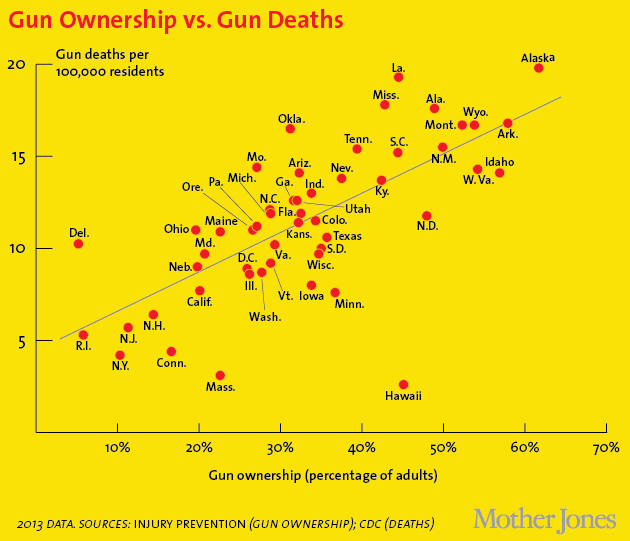
More gun ownership corresponds with more gun murders across virtually every axis: among developed countries, among American states, among American towns and cities and when controlling for crime rates. And gun control legislation tends to reduce gun murders, according to a recent analysis of 130 studies from 10 countries.

This suggests that the guns themselves cause the violence.

You can read the article for yourself, as I don’t want to simply regurgitate the data, but it all points to the fact that the easy accessibility of guns in America, the lack of gun controls, and the kind of guns that we can buy, are the variables that best explain the number (and rate) of mass shootings in America. (Note that this article doesn’t deal with individual homicides, but there are other data on those issues that implicate the accessibility of guns.)

In the end, the problem seems to come down to America’s Second Amendment, which was intended to allow arming of a militia, but has been interpreted (wrongly, I think) by U.S. courts as allowing fairly unrestricted individual ownership of guns—no militia needed. That Amendment appears to have fostered a sense of entitlement that we should have guns—that it’s our right. Barring the Second Amendment, you’d have a hard time justifying that we have a “right” to own such lethal weapons. (I’m always dubious when “rights” are asserted as arguments, but they become prima facie legal rights if they’re in our Constitution.)

Referring to the tighter gun laws of Switzerland (even though they’re second to the U.S. in the rate of gun ownership, the rate of Swiss gun homicides is far lower), the article notes this:

Swiss gun laws are more stringent, setting a higher bar for securing and keeping a license, for selling guns and for the types of guns that can be owned. Such laws reflect more than just tighter restrictions. They imply a different way of thinking about guns, as something that citizens must affirmatively earn the right to own.

The United States is one of only three countries, along with Mexico and Guatemala, that begin with the opposite assumption: that people have an inherent right to own guns.

The main reason American regulation of gun ownership is so weak may be the fact that the trade-offs are simply given a different weight in the United States than they are anywhere else.

After Britain had a mass shooting in 1987, the country instituted strict gun control laws. So did Australia after a 1996 shooting. But the United States has repeatedly faced the same calculus and determined that relatively unregulated gun ownership is worth the cost to society.

That choice, more than any statistic or regulation, is what most sets the United States apart.

And it is that Second Amendment that makes us think we have a right to own guns. Would that we could repeal that Amendment, but of course that wouldn’t end the problem, for we’d still have to legislate firearm laws for each state under the amended Constitution, and in a populace that largely thinks they have the right to have guns. The idea that we have such a right is alien to me, but it’s so deeply instilled in America that the problem seems harder to solve than that of Donald Trump himself, who, after all, will be gone in at most seven years. The article ends on a poignant note, one that shows how deeply sick we are with our guns fetish:

“In retrospect Sandy Hook marked the end of the US gun control debate,” Dan Hodges, a British journalist, wrote in a post on Twitter two years ago, referring to the 2012 attack that killed 20 young students at an elementary school in Connecticut. “Once America decided killing children was bearable, it was over.”


More on guns: Shermer advocates gun control in NYT; NRA and Congress back down a wee bit on bump stocks

October 6, 2017 • 9:45 am
 As you’ve probably heard if you’re in the U.S., both the National Rifle Association and some Congressional Republicans (as well as many Democrats) are now calling for either a ban on or tighter regulations of “bump stocks“—those substitute parts of guns that can convert semiautomatic weapons into automatic ones. The sale of automatic weapons (in which holding down the trigger produces continuous fire) is illegal in America save for those made before 1986, and those old weapons are extraordinarily expensive. However, the sale of “bump” devices, which can turn a semiautomatic into an automatic (these devices move the stock back and forth rapidly against the trigger finger, causing very rapid fire) are legal, and can be ordered online for less than $100.

Given that automatic weapon sales are illegal, I see no justification whatever for allowing the legal sale of devices that can convert a gun into a weapon that would be illegal to buy. Further, how can you even justify the private ownership of automatic weapons or semiautomatic weapons like assault rifles, whose only purpose is to kill as many people as possible in a short time? It seems a no-brainer that bump stocks should be outlawed now.

As I said, some in Congress are considering that, and even the demonic National Rifle Association (NRA) is saying Congress should “review” the regulations about these devices to see if they comply with federal law. Here’s the NRA’s statement issued after the Las Vegas shootings:

But this is all window dressing. Bump stocks are clearly things that should be banned, and the NRA’s calling for a “review” is not the same thing as calling for a ban. Once again, the NRA shows its unwillingness to seriously engage with gun control, and on an issue that has an obvious answer. Ban the damn bumpstocks!

More important, banning bump stocks—which of course are now selling like hotcakes to Americans who fear they won’t be able to buy them soon—is only the tiniest step in gun control. Far more needs to be done. In my view, all private ownership of guns should be banned except for those who can demonstrate a real need for them: perhaps hunters, farmers, hikers, or those who have been threatened.  I’ve long thought that the words of the Second Amendment clearly indicate what its authors meant when they said this:

A well regulated Militia, being necessary to the security of a free State, the right of the people to keep and bear Arms, shall not be infringed.

Is that not clear enough? The right of the people to “keep and bear Arms” is there for the purpose of allowing a “well regulated Militia”. Does Joe Sixpack with his Glock own his arms to participate in a well regulated Militia? While the courts, most particularly the Supreme Court, have interpreted this to mean that people should be able to own their own guns willy-nilly, I’m not at all sure that the Founders who wrote that Amendment would approve of how it’s been used. As for myself, I’d favor a total repeal of the Second Amendment and its replacement with other laws.

I believe Michael Shermer, who wrote the article below in yesterday’s New York Times (click on screenshot to see it), would agree.

Shermer’s op-ed makes two ponts. First, despite the loud claims of gun lovers, gun ownership doesn’t make people safer. While there are a few studies that contradict that conclusion, the bulk of the data say that private ownership of guns causes the death of innocent people at a much higher rate than it does the death of criminals at the hands of private gun owners (my emphasis):

Stories about the use of guns in self-defense — a good guy with a gun dispensing with a bad guy with a gun — are legion among gun enthusiasts and conservative talk radio hosts. But a 1998 study in The Journal of Trauma and Acute Care Surgery, to take one of many examples, found that “every time a gun in the home was used in a self-defense or legally justifiable shooting, there were four unintentional shootings, seven criminal assaults or homicides and 11 attempted or completed suicides.” That means a gun is 22 times more likely to be used in a criminal assault, an accidental death or injury, a suicide attempt or a homicide than it is for self-defense.

A 2003 study published in the journal Annals of Emergency Medicine, which examined gun ownership levels among thousands of murder and suicide victims and nonvictims, found that gun-owning households were 41 percent more likely to experience a homicide and 244 percent more like to experience a suicide. The Second Amendment protects your right to own a gun, but having one in your home involves a risk-benefit calculation you should seriously consider.

Before you go quoting the counter data, read a piece in this month’s Scientific American by Melinda Moyer, “More guns do not stop more crime, evidence shows“. Looking at all the studies, Moyer concludes that the bulk of the good ones show that restricting guns does indeed reduce deaths and crime. A quote:

A decade after laws relax, violent crime rates are 13 to 15 percent higher than they were before. And in 2004 the National Research Council, which provides independent advice on scientific issues, turned its attention to firearm research, including Lott’s findings [JAC: this is from a 1997 study by Lott and Mustard claiming to show that crime fell after it became easier to get gun permits]. It asked 15 scholars to reanalyze Lott’s data because “there was such a conflict in the field about the findings,” recalls panel chair and criminologist Charles Wellford, now a professor emeritus at the University of Maryland. Lott’s models, they found, could be tweaked in tiny ways to produce big changes in results. “The analyses that we did, and that others have done, show that these estimates are very fragile,” Wellford explains. “The committee, with one exception, concluded that you could not accept his conclusion that more guns meant less crime.” Wintemute summarized it this way: “There are a few studies that suggest that liberalizing access to concealed firearms has, on balance, beneficial effects. There are a far larger number of studies that suggest that it has, on balance, detrimental effects.” [JAC:  the article describes Garen Wintemute as “a physician and noted gun violence researcher at the University of California, Davis.”]

One problem with getting data is that the NRA has successfully lobbied to prevent the Centers for Disease Control and Prevention (CDC) from even investigating the question of guns and injuries, even though it is a public safety issue. This is one example of how the NRA is evil, for it prevents collecting empirical data—probably because it knows how those data will come out. As the Sci Am piece reports:

in the late 1990s [Mark] Rosenberg was the director of the CDC’s National Center for Injury Prevention and Control, which then funded and studied gun violence. He said he was fired from the agency in 1999 for pushing ahead with this research despite political opposition, although his boss at the time, whom I contacted, disagreed that Rosenberg’s actions on gun research caused his dismissal.

I asked Rosenberg what happened after the Kellermann studies came out. “The NRA started a multipronged attack on us,” he recounted. “They called the CDC a cesspool of junk science.” Indeed, soon after Kellermann’s early studies were published, the NRA ran an article in its official journal, the American Rifleman, encouraging readers to protest the CDC’s use of tax dollars to “conduct anti-gun pseudo-scientific studies disguised as research.” The association also asked the National Institute of Health’s Office of Scientific Integrity to investigate Kellermann and his colleagues, but it declined. Todd Adkins, current director of research and information at the NRA’s Institute for Legislative Action, told me via e-mail that the association was reacting because CDC scientists had started a campaign to persuade Americans that firearms are a menace to public health and ignored data that did not support this idea.

As the dispute continued, Representative Jay Dickey of Arkansas introduced a rider into the CDC’s 1996 spending bill mandating that none of its funding be used to advocate or promote gun control. Congress also cut out $2.6 million of the CDC’s budget, the exact amount that had been allocated for firearm research the previous year. (Later, that funding was restored but was earmarked for traumatic brain injury.) Harvard’s Hemenway says that the move “was a shot across the bow: ‘We’re watching you.’” He adds that “the CDC recognized that they better be really, really, really, really careful about guns if they wanted to have an Injury Center.”

Dickey’s addition to the CDC’s funding bill has been renewed every year since. In fact, in 2011 the language was extended to cover all Department of Health and Human Services agencies, including the NIH.

Note that that extension was under the Obama administration, which did little to stop gun proliferation (granted, they were dealing with a Republican Congress). Still:

The CDC’s hands are still tied. After the 2012 school shooting that took the lives of 20 children and six adults in Newtown, Conn., President Barack Obama signed an executive order requesting that the CDC spend $10 million on gun violence research. But Congress did not appropriate the funds. In fact, according to Linda DeGutis, who directed the CDC’s Injury Center from 2010 to 2014, agency employees weren’t even allowed to discuss Newtown. “We couldn’t talk to the media except on background. We couldn’t be quoted on anything,” she recalls. “There were CDC staff members who wouldn’t even mention the word ‘gun.’” (Current staffers declined to be interviewed for this article.)

This is reprehensible. What can possibly justify Congress (whose members have accrued millions of dollars in campaign contributions from the NRA) from preventing the CDC studying gun violence? Well, we know what chain of evil lurks here: the NRA doesn’t want that research to happen, because it could possibly—and we don’t know this—justify tighter restrictions on owning guns. And the Congress, many of whose Republican members get lots of campaign money from the NRA, don’t want to anger that organization. The result: research that could prevent deaths doesn’t get done. Congress would prefer people to die, so the members can keep their jobs, rather than appropriate a pittance to see if we could prevent those deaths.

Finally, Shermer notes the “militia” issue, which has made gun nuts do some fast talking to circumvent it. But how can you circumvent this?:

Gun-rights advocates also make the grandiose claim that gun ownership is a deterrent against tyrannical governments. Indeed, the wording of the Second Amendment makes this point explicitly: “A well regulated militia being necessary to the security of a free state, the right of the people to keep and bear arms shall not be infringed.” That may have made sense in the 1770s, when breech-loading flintlock muskets were the primary weapons tyrants used to conquer other peoples and subdue their own citizens who could, in turn, equalize the power equation by arming themselves with equivalent firepower. But that is no longer true.

If you think stock piling firearms from the local Guns and Guitars store, where the Las Vegas shooter purchased some of his many weapons, and dressing up in camouflage and body armor is going to protect you from an American military capable of delivering tanks and armored vehicles full Navy SEALs to your door, you’re delusional. The tragic incidents at Ruby Ridge, in Idaho, and Waco, Tex., in the 1990s, in which citizens armed to the teeth collided with government agencies and lost badly, is a case study for what would happen were the citizenry to rise up in violence against the state today.

And in any case, if you’re having trouble with the government, a lawyer is a much more potent weapon than a gun.

So bumpstocks get banned. That will have some effect on reducing deaths, if the ban happens, but it’s not going to stop the mass shootings, the gun suicides, the accidental shootings of children and family members, and so on, that constitute the bulk of unnecessary gun deaths.

Thanks, NRA!

A really dumb tweet about guns and a good answer

October 5, 2017 • 8:45 am

Here’s something that appeared on my Facebook feed: a tw**t by Fox Business and a response by someone pointing out the flaws. There’s one more difference between trucks, and guns, though. Trucks are not designed or built with the aim of hurting people, while assault weapons are. If we banned trucks, everything would come to a standstill. If we banned guns except for the police, we wouldn’t see much of a difference.

I’m sad because I already hear the calls for gun control dying out. They’re stimulated by mass murders, and then, after nothing happens, people go on to other things. We will not see meaningful gun control in America during my lifetime.

Finally, why haven’t they banned the sale of those devices that easily convert semiautomatic rifles into fully automatic ones (“bumps”, I think they call them). If the sale of new automatic weapons is illegal, which it is, why is it legal to sell devices that convert legal guns into illegal ones.

Here’s a bump (part of a gunstock) ordered legally for $99 from Bump Fire Systems; see how easy it is to install?