Why Evolution is True is a blog written by Jerry Coyne, centered on evolution and biology but also dealing with diverse topics like politics, culture, and cats.
Someone sent me this tweet a few days ago, and I was unsure about whether this was any kind of violation of University policy. As far as I gather, this was posted on the inside of a chemistry professor’s office, facing outwards.
University of Chicago – Outside a chemistry professor’s classroom, a sign filled with propaganda reads, “DEPORT ISRAELIS.”
This is blatant antisemitism and xenophobia which is completely unacceptable, @UChicago. An investigation is needed. pic.twitter.com/wGer8vjX9f
Here’s a photo from that tweet, but all I can make out in it is “Israel murdered 18,000 children” (Hamas’s figures, and probably grossly untrue) as well as “Israel must pay for the murders and destruction” and “DEPORT ISRAELIS.” If you can read more of it, please decipher in the comments.
Anyway, I sent the tweet around to our local free speech group and asked if this was a violation of University rules. This morning someone said that this kind of thing is indeed allowed, though you’re not allowed to display flags in your office (some wonky rule). A watermelon, though, does nicely as a substitute for the Palestinian flag. At any rate. I saw the tweet below this morning, indicating that the University of Chicago itself had apologized for the sign, which was “voluntarily” taken down, and said that it is being investigated as a possible violation of the “University’s non-discrimination policy.”
We sent a letter to the President of the University of Chicago. We’re working closely with students on the ground. This is the statement the University released today.
Let’s be clear: pressure works. Community matters. And transparency is everything.
— ChicagoJewishAlliance (@ChiJewishAllies) March 30, 2025
The statement:
If this is indeed allowed behavior, then putting a sign like this inside your office, facing out, is not a violation of free speech, which is part of the Chicago Principles. On the other hand, one could argue that such a sign creates a climate of harassment towards Jewish students, which is a Title VI violation. Now that Trump is threatening to withhold money from universities for condoning anti-semitic behavior, I can see where this kind of publicity could scare our university.
I don’t know if I’ll learn any more about this, but if I do I’ll impart it below. All I can say is that IF displaying this kind of sign is permitted by University regulations, then it’s not kosher to investigate the person who posted it (that’s chilling of speech) or to make a public statement about it. All of this hangs on the “time, place, and manner” restrictions of speech at the University here, and people aren’t sure what the policy is.
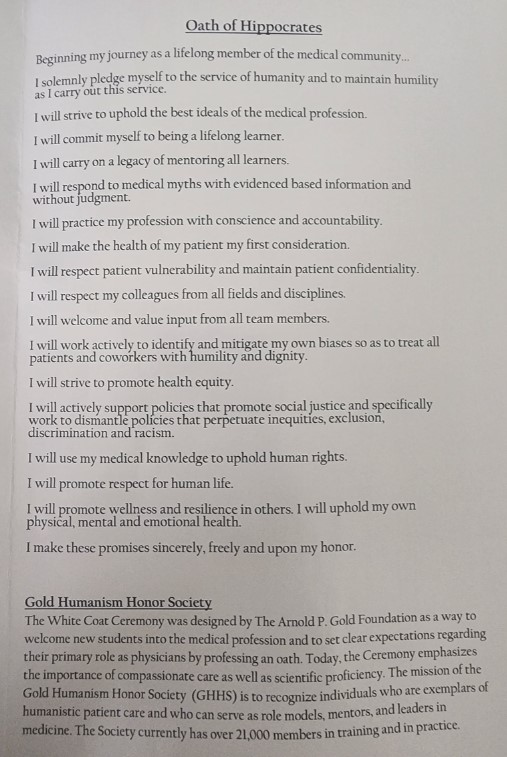
Speaking of FIRE and free speech, I got an email from that organization this morning about how The University of Connecticut has altered the traditional Hippocratic Oath to reflect Social Justice considerations. (It’s far from the only med school that has done this.) This can be considered compelled speech, which students are supposed to recite even if they disagree with it. You can see the traditional forms of the oath here, and hear the newer one here, starting at 44:12. The students are asked to repeat the oath after the speaker.
The new oath is also transcribed below at the Do No Harm site; I’ve put in a red box the parts that disturbed FIRE:
Here’s the email I got from FIRE:
Incoming medical students typically recite the Hippocratic Oath, a pledge to do no harm to patients. But last August, the University of Connecticut required freshmen medical students to recite an ideologically-charged version of the Hippocratic Oath that reads, in part,
“I will strive to promote health equity.
I will actively support policies that promote social justice and specifically work to dismantle policies that perpetuate inequities, exclusion, discrimination and racism.”
The school violated students’ First Amendment rights against compelled speech by forcing them to affirm contested political viewpoints. The oath effectively emboldens administrators to punish students who, in their opinion, failed to uphold these nebulous commitments. What, exactly, must a medical student do to “support policies that promote social justice”? If a student disagrees with UConn’s definition of “social justice” or chooses not to promote it in the prescribed way, could she be dismissed for violating her oath?
Today, free speech group FIRE called on UConn to make clear that students may refrain from reciting all or part of the oath without any threat of penalty and will not have to affirm any political viewpoints as a condition of their education at the school.
FIRE Program Officer Ross Marchand: “The constant threat of discipline hangs over UConn students. At any time, administrators could decide that a student has broken the vague, partisan oath that she was forced to take. Even an insufficient commitment to ‘social justice’ could land a student in trouble. UConn prioritized politics and ideology above education and the First Amendment, creating a culture of compulsion and fear.”
Thanks! Check out our letter to the school and our blog post.
The blog post notes this:
In August, UConn required the incoming class of 2028 to pledge allegiance not simply to patient care, but to support diversity, equity, and inclusion. The revised oath, which was finalized in 2022, includes a promise to “actively support policies that promote social justice and specifically work to dismantle policies that perpetuate inequities, exclusion, discrimination and racism.”
This practice is a grave affront to students’ free speech rights. In January, FIRE called the medical school to confirm that the oath is mandatory; an admissions staff member told us it was. We are asking them to confirm this in writing.
As a public university, UConn is strictly bound by the First Amendment and cannot compel students to voice beliefs they do not hold. Public institutions have every right to use educational measures to try to address biases they believe stymie the healthcare system. But forcing students to pledge themselves to DEI policies — or any other ideological construct — with which they may disagree is First Amendment malpractice. This is no different than forcing students to pledge their allegiance to a political figure or the American flag.
. . . and adds that these “Social Justice Oaths” are not uncommon:
UConn isn’t alone in making such changes to the Hippocratic Oath. Other prestigious medical schools, including those at Harvard, Columbia, Washington University, Pitt Med, and the Icahn School of Medicine, have adopted similar oaths in recent years. However, not all schools compel students to recite such oaths. When we raised concerns in 2022 about the University of Minnesota Medical School’s oath, which includes affirming that the school is on indigenous land and a vow to fight “white supremacy,” the university confirmed that students were not obligated to recite it. That’s the very least UConn could do to make clear that it puts medical education — and the law — ahead of politics.
FIRE called the UConn School of Medicine Admissions Office to clarify whether the oath, including these additions, is mandatory for students participating in the ceremony. A staff member confirmed that this oath is required for all incoming students.We have also emailed the admissions office to confirm the mandatory nature of the oath but have yet to receive a written response.
. . . While UConn may encourage students to adopt the views contained in the oath, the First Amendment bars the university from requiring them to do so. The First Amendment protects not only the right to speak but the right torefrainfrom speaking.As the Supreme Court has notably held, public institutions may not compel individuals to “declare a belief [and] … to utter what is not in [their] mind.”8Requiring new students to pledge their loyalty to a particular ideology violates students’ expressive rights, is inconsistent with the role of the university as a bastion of free inquiry, and cannot lawfully be enforced at a public institution. UConn can require students to adhere to established medical standards, but this authority cannot be abused to demand allegiance to a prescribed set of political views—even ones that many students may hold. Specifically, the school may not compel students to pledge to support or promote concepts such as “social justice” and “equity,” notions that have long been the subject of intense political polarization and debate
You’d think that these deans would know something about the prohibition about compelled speech, but of course they cannot conceive that anybody would opopose the social justice-y bits of their new Oath. They clearly need a lesson in the First Amendment!
Finally FIRE asks for a response in two weeks:
FIRE calls on UConn to make clear that students may refrain from reciting all or part of the oath without any threat of penalty and will not have to affirm any political viewpoints as a condition of their education at the school. We request receipt of a response to this letter no later than the close of business on February 14, 2025
You can go to this page to send a quick fill-in-the-form letter. I did.
The video of Day 1 of our “Censorship in the Sciences” conference is up (and down below), and this baby is nearly seven hours long. Few people have the patience to listen to the first day’s sessions all at 0ne go, but I want to single out a few talks. The first is by Jonathan Rauch, author of The Constitution of Knowledge: A Defense of Truth, an excellent book. His talk begins at 12:01, outlines how knowledge acquisition should work, and is quite eloquent.
Later, the four-member panel on “Examples of Censorship” gives a good account of how ideology has led to suppression of science. Luana introduces it at 2:43:26 and Lawrence Krauss kicks it off at 2:44:45 via Zoom. His examples are numerous and disturbing—and not just from physics. He pulls no punches, and even calls out America’s National Academy of Sciences (NAS), the most prestigious honorary organization of scientists in the U.S. It so happened that the NAS President (Marcia McNutt) was in the audience, and heard Krauss call out her organization for identity-based choosing of candidates for a supposedly meritocratic society (see 2:55:45). As Krauss shows, the NAS even admitted this explicitly in a quote from an executive of the organization, and it’s widely admitted by Academy members themselves. (Note that at the end of her later talk, at 4:39:30, President McNutt denies this. accusing Krauss implicitly of ignorance, but her own organization’s stated policies belie her words.) Finally, Krauss gives evidence that both the NSF and DOE have likewise been captured by ideology in their funding of grants.
If you want to hear about how indigenous peoples are preventing anthropologists and forensic scientists from studying relics likes bones and objects used by Native Americans, Elizabeth Weiss’s short talk in that panel, beginning at 3:23:43, gives a good idea. She has a new book about these issues.
I heard all the talks, and some of the others engaged me as well, but I’ve just mentioned the ones I enjoyed the most.
Rauch’s opening speech highlighted surveys which found that almost half of Americans think that colleges have a negative effect on the country.
“It really is a crisis,” he said, adding a combination of factors are to blame, including students’ emotional fragility, the politicization of hiring, tenure and funding based on ideology, and a newer trend of academic journals refusing to publish findings that allegedly harm some communities.
On the issue of censorship of research publication, many speakers at the conference objected to the idea that claims about potential harm to vulnerable populations should be used as a reason to stop, force changes to, or retract research reports. Some raised the question of the harms that arise from alleged-harm-reduction censorship–that is, the harms that arise from stopping valuable research out of fear of harm
In response to a Saturday morning presentation by Nature editor Stavroula Kousta, journalist Jesse Singal, also a speaker at our event, published a critique of some the ideas presented.
Conference organizer and panelist Lee Jussim wrote about the conference (and whether we should just burn academia down).
Panel chair Abhishek Saha wrote up excellent Twitter threads (in real time!) detailing conference proceedings. Here is one on the first day of conference.
As the article by Matt Taibbi below notes, Mark Zuckerberg is moving his Meta platform–notably Facebook and Instagram–away from censorship and more towards free speech (click the link to read):
The video in this post has vanished from YouTube, but I found it on Facebook and put it below. Do watch it.
Taibbi quotes a bit of it:
Meta CEO Mark Zuckerberg, in a video promising a shift toward free speech:
The US has the strongest constitutional protections for free expression in the world. Europe has an ever increasing number of laws institutionalizing censorship, and making it difficult to build anything innovative there. Latin American countries have secret courts that can order companies to quietly take things down. China has censored our apps from even working in the country. The only way that we can push back on this global trend is with the support of the US government, and that’s why it’s been so difficult over the past four years, when even the US government has pushed for censorship by going after us and other American companies.
In his message, Mr. Zuckerberg announced a series of steps he planned to take to grapple with false and misleading information on Facebook, such as working with fact-checkers.
“The bottom line is: we take misinformation seriously,” he wrote in a personal Facebook post. “There are many respected fact checking organizations,” he added, “and, while we have reached out to some, we plan to learn from many more.”
Eight years later, Mr. Zuckerberg is no longer apologizing. On Tuesday, he announced that Meta, the parent company of Facebook, Instagram, WhatsApp and Threads, was ending its fact-checking program and getting back to its roots around free expression. The fact-checking system had led to “too much censorship,” he said.
Now there is still an opportunity for counterspeech; fact-checkers will be replaced with “Community Notes,” similar to those used on X. There will be a policy to reduce “mistakes”, tackling “illegal and high severity violations” that are reported by others. People, rather than filters, will look for these violations and remove the ones deemed “not free speech.”
As I’ve said before, I would prefer large social-media platforms like Facebook and Twitter (now X) to adhere as strongly as possible to the First Amendment of the Constitution. That Amendment, of course, has carve-outs: truly prohibited speech. This includes defamation, harassment, false advertising, child pornography, obscenity, and speech liable to incite predictable and lawless violence.
So long as Facebook and X adhere to this policy, I think it’s a step in the right direction. The “Community Notes” will allow the counter-speech that advocates of free speech see as essential to promote the clash of ideas that, according to John Stuart Mill, will promote the emergence of truth. So I think this is a good step, regardless of what you think of Zuckerberg (or Elon Musk, who is running X this way).
I will be at meetings all day today, so I ask readers to discuss this new policy of Zuckerberg (and Musk). Yes, I know people say that Musk and Zuckerberg are pandering to Trump, and perhaps that is one motivation, but I do not want readers to concentrate on the people involved, but on the speech policy itself.
Please discuss below. Do you think places like Facebook and X should prohibit speech that is actually allowed by the First Amendment? If so, which speech?
After months of delay, President-elect Donald J. Trump on Friday became the first American president to be criminally sentenced.
He avoided jail or any other substantive punishment, but the proceeding carried symbolic importance: It formalized Mr. Trump’s status as a felon, making him the first to carry that dubious designation into the presidency.
“Never before has this court been presented with such a unique and remarkable set of circumstances,” said the judge overseeing the case, Juan M. Merchan. “This has been truly an extraordinary case.”
The judge then imposed a so-called unconditional discharge of Mr. Trump’s sentence, a rare and lenient alternative to jail or probation. Explaining the leniency, Justice Merchan acknowledged Mr. Trump’s inauguration 10 days hence.
“Donald Trump the ordinary citizen, Donald Trump the criminal defendant” would not be entitled to the protections of the presidency, Justice Merchan asserted, explaining that only the office shields him from the verdict’s gravity.
The judge then wished Mr. Trump “godspeed” and departed the bench.
Yesterday I mentioned this interview in the new Sapir quarterly magazine edited by Bret Stephens, who in this article interviews Daniel Diermeier, the Chancellor of Vanderbilt University. Diermeier was our provost from 2016 to 2020, but left to take the top job at Vanderbilt. I, among many, miss him, for at Vandy he’s turned the school into a model of academic freedom and free speech, but hasn’t neglected the enforcement of “time, place, and manner” restrictions on speech.
The discussion below shows how deeply Diermeier has pondered all the issues around freedom of expression and the purpose of a university. Combined with Stephens’s probing questions, it’s an excellent conversation.
Here are three excerpts from a longish discussion, which is worth reading in toto. First, the politicization of universities versus social inequality:
Bret Stephens: Until recently, surveys showed that Americans had high confidence in higher education. It was seen as an essential ticket to success in American life. In the past decade or so, that confidence has plummeted. The last survey I saw, from Gallup, showed a sharp decline, and that came out before October 7 and the protests that followed. What happened in the past 10 years to cause that decline?
Daniel Diermeier: We’ve seen the same data, and I’ve been very concerned about the drop in approval and trust in higher education. The decline has been larger among people on the conservative side of the political spectrum, but it’s across the board, from the Left and the Right. My sense is that it comes from two concerns. From the progressive side, the concern is that highly selective universities are perpetuating inequality. And the concern from the Right is that we’re woke factories.
Stephens: Both of them can be true.
Diermeier: One hundred percent. My own sense is that the concerns about the propagation of inequality are, on closer inspection, much overblown. I think the concerns on the politicization of higher education and the ideological drift are much more valid.
The question of the politicization of higher education has come into stark relief after what we’ve seen last year: the conflict in the Middle East and the drama on campus. These developments have elevated into the public consciousness concerns that have been present for years. They now are front and center, much more serious, and they require a course correction by many universities.
Stephens: A historian might say, “Go back to the University of Chicago or Yale in the 1950s and you’ll find conservative critics railing against higher education as hotbeds of radicalism.” Now we look back on that and sort of chuckle. Is the criticism more valid today? If so, why?
Diermeier: Yes, I think the criticism is more valid today. If you look back, there were three pillars of how a university thought about its role in society. If you look at the University of Chicago, one pillar was this commitment to free speech that goes back to the founding and then through a whole variety of presidents, reaffirmed, most recently, by the 2015 report, often referred to as the Chicago Principles. Universities need to be places for open debate.
Pillar two is what we call institutional neutrality, which means that the university will not get involved, will not take positions, on controversial political and social issues that bear no direct relevance to the university’s mission. The University of Chicago’s formulation of this policy was the Kalven Report from 1967, which so eloquently articulates that when the university formulates a party line on any issue, it creates a chilling effect for faculty and students to engage in debate and discourse.
And the third pillar, less appreciated but important, is a commitment to reason, to respect, to using arguments and evidence. Discourse and debate at the university shouldn’t be about shouting. That’s a more cultural aspect. All three have eroded, and they have eroded over the past 10 years in significant fashion. Now we see the consequences of that.
I’m not sure how institutional neutrality has eroded, since it was really only embraced by the University of Chicago until very recently. Now, as FIRE reports, 25 colleges and universities have adopted the position. It seems to me that institutional neutrality has expanded, not “eroded.”
Finally, the ambit of institutional neutrality, how it differs from propagandizing classrooms, and why the question of “affirmative action for conservative faculty” is not a major issue:
Stephens: Let me ask you about the role of university leaders. One thing you sometimes hear from presidents is I have no power. The faculty rule the institution. There’s a limit to what I can do in terms of what happens on my own campus. Tell us about governance structures. How can university leadership effectively use its position within those structures to set a tone, create a culture, have a set of rules and expectations for how the student and faculty behave? If you were speaking to first-time university presidents from across the country, what would you advise them?
Diermeier:
. . . . Institutional neutrality does not constrain faculty or students. It does constrain administrators. So the second concern that you pointed out, which I’m going to call the politicization of the classroom, is a separate one. That, to me, is a question of professionalism. If you’re using your classroom for indoctrination or propaganda, you’re fundamentally not doing your job. You’re not creating an effective learning environment for your students. So I think these are two separate issues that should not be commingled, because the point of institutional neutrality is to create freedom for faculty and students. If that freedom and responsibility are abused, that’s a different conversation.
. . . .If [faculty are] using their classroom for political propaganda, it’s a different conversation. The right way to think about hiring and promotions is that they should be based on expertise and merit. I’ve cited a couple of these University of Chicago reports before, but there’s one called the Shils Report that makes that very clear: We do not want to have political litmus tests for whom we hire and promote.
That said, there is an important role for the university, including its curriculum, in a society that investigates and reflects on itself, its values, its history. A lot of that is in humanities, the social sciences, divinity schools, law schools, and so forth. There are multiple perspectives, and to have them in the classroom is vitally important. If you have a class on ethics, you want the students to deal with virtue ethics, deontological ethics, and consequential ethics. You want these perspectives well represented, so that they are challenged, and then students can make up their own mind about what they think. If that does not happen because of the ideological capture of a department or program, we’ve got a problem.
I’m very doubtful that the solution is affirmative action for conservatives. I’m also not convinced that these movements to create new centers are the solution, either. I think the challenge goes a little deeper than where people are on political orientation — it has to do with how fields of study are structured and how certain fields have evolved. But we cannot have an ideological monoculture in these types of classes. It’s a disservice to our students.
And, if you don’t want to read, here’s a 45-minute conversation between Diermeir and Dan Senor (Senor’s “Call Me Back” show) that covers much of the same ground as the Sapir article. Senor notes how happy Vandy’s students are compared to students at other places, and Diermeier tries to explain it (note: it has something to do with football, too). Diermeier does credit a lot of Vanderbilt’s academic policies to what he absorbed at the University of Chicago.
Note at about 30 minutes in, Diermeier describes the sit-in in the administration building which led to disciplining the pro-Palestinian protestors. The University of Chicago doesn’t go nearly this far in disciplining protestors that do exactly the same thing. At Vandy, there was suspensions, probation, and even arrests for assault. Diermeier also explains why he would not accede to the demonstrators’ demands for divestment of the university’s endowment from Israel, and explains why he considers encampments a violation of the school’s policy. At the end, he muses about what to do free speech crosses the borderline into illegal harassment or threats.
In my view, Diermeier is the best university President in America, for his policies are the best and are based on considerable thought (and of course, his experience at The University of Chicago).
Well, Princeton, via its president Christopher Eisgruber, has wussed out of adopting a crucial plank in a university free-speech platform: institutional neutrality. The man simply can’t hold back his ideological or political opinions, even if they chill the speech of faculty and students.
As you’ll know if you read here, the University of Chicago was the first college in America to adopt an official posture of institutional neutrality in the form of the Kalven Report of 1967. That report, expanded on in 2020 by the late President Robert Zimmer, specified that no units of our University could make ideological, political, or moral statements save those that had a direct bearing on the mission of the University. The object was to allow people to speak freely without worrying about being punished by contradicting “official” university statements. By and large, we’ve hewed to its dictates with a few exceptions, like this one, which involves clear and multiple violations of Kalven.
FIRE’s list of institutions adopting a Kalven-like policy has expanded exponentially, now numbering 22 (23 including Chicago). Sadly, according to the Daily Princetonian article below (click to read), Princeton will not be joining them.
An excerpt (my bolding):
President Christopher Eisgruber ’83 shared in an interview with The Daily Princetonian that the University will not consider institutional neutrality. The University administration will maintain the current policy of institutional restraint although Eisgruber expressed plans to issue statements “less frequently.”
“No.” Eisgruber responded when asked if the University is considering implementing institutional neutrality.
“You can’t be neutral about everything,” Eisgruber continued. He specifically noted speaking on behalf of diversity, inclusivity, free speech, academic freedom, and sustainability. “We got to do it … We’re speaking out on behalf of those things. So I think institutional neutrality is just a misleading formulation.”
This selective approach to issuing statements is called institutional restraint, the principle that universities are not neutral but instead value-laden institutions that can take positions in rare cases concerning the core values of the University.
“We have to stand up for our values … I’ve spoken, and will continue to speak boldly for those values, where that’s required, for the institution, and at times beyond the way in which other university presidents are doing that,” Eisgruber said in defense of maintaining institutional restraint.
Nobody says that a university has to be “neutral about everything”; Kalven specifies that universities can speak up officially when there’s an issue that impacts the ability of the school to fulfill its mission (defending DACA was one of those, which would have taken students away from the school). So, you ask, what is the difference between Kalven and “institutional restraint”? The bold bit above implies that they’re really the same.
But they’re not, and Eisgruber makes that clear:
Still, on certain topics, Eisgruber believes he has an “institutional responsibility” not to speak out.
“Something I share with the people who embrace the idea of institutional neutrality [is that] the University is first and foremost, not itself the critic. It’s the sponsor of critics,” Eisgruber said.
He specifically referenced the Dobbs v. Jackson decision reversing Roe v. Wade as a moment when he felt he should not speak out, despite his expertise in law and other university presidents doing so.
Despite holding back on certain issues, Eisgruber has issued statements on current events to recognize their “momentous character” and “the way in which they are affecting people on campus.” Recent examples include statements on the War in Ukraine and a condemnation of the Oct. 7 attacks by Hamas. In these statements, Eisgruber shared that he makes sure to use the first person.
The University has also taken actions which would be considered violations of institutional neutrality, most notably divestments from South Africa and companies in Sudan and partial divestment from the fossil fuels sector during Eisgruber’s presidency. Eisgruber pointed out that the University of Chicago, which created and follows the Kalven Report, a guideline to institutional neutrality, never divested from South Africa.
These issues really have nothing to do with the core values of a university. Ergo, there should not be statements about them. These issues are political and ideological, and should be debated without restraint. Granted, there are people, however misguided, who support Russia’s incursion into Ukraine and even the October 7 attacks of Hamas. These folks should feel free to make their arguments about these issues without being chilled by official statements. The same goes for divestment and Sudan (see Geoff Stone‘s pro-Kalven statement about divestment from Darfur in Sudan).
While Eisgruber recognizes in the article that he’s probably made too many political statements on behalf of Princeton (duh!), he still won’t commit the school to keeping its institutional yap shut. And that is a shame. The prestigious Ivy League schools should be promoting institutional neutrality, and, so far, the only ones that have are Harvard and the University of Pennsylvania. Even Yale hasn’t joined the side of the angels.
Some good news about free speech for the University of Chicago. This morning all of us got this message from the University President:
Dear Members of the University Community,
Today, I am thrilled to announce that an anonymous donor has committed $100 million in support of free inquiry and expression at the University of Chicago. Last year, the University launched the Chicago Forum for Free Inquiry and Expression, and it will mark its first anniversary next week. With this extraordinary gift, the Chicago Forum will thrive and endure for years to come.
Successfully upholding free inquiry and expression in a university requires a long-term commitment to building a culture that supports it, that flourishes from it, that even demands it. This is fundamental to a university that is truth seeking. Each generation of UChicago’s community has contributed new layers to the institution in protection of free inquiry and expression, from founding president William Rainey Harper’s vocal defense of academic freedom to the adoption of the Kalven Report and on to the Chicago Principles.
The Chicago Forum is the newest layer–an environment set aside for us and others to grapple with important issues related to the preservation of academic freedom and the practice of free expression. The historic framing documents and the Chicago Principles summarize our institution’s best thinking on our philosophy and policies over time. But the actual practice of free expression takes place every day–in classrooms in every department and school, in dormitories and dining halls, and on the quads. This living culture and the norms we create by it involves engagement from each of us in our varied roles: tradeoffs and decisions and the cultivation of habits of mind and attitudes. In my view, the collective culture we build is so important that it deserves to have a place where it can be continuously discussed across the University and with partners from other universities and sectors of society.
The magnitude of this gift mirrors the conviction of its donor. It was not made in furtherance of any ideology or political agenda. Rather, it is in the belief that this university has a calling to be principled and effective. The donor’s generosity represents a strong endorsement of the potential for the Chicago Forum to serve as the next step in our living commitment to upholding free inquiry and expression. It is to be the venue for the whole of the University community to come together and undertake the study and practice of all aspects of free inquiry and expression, and to do so in partnership with others beyond the University.
Already in its first year, the Chicago Forum has made a strong case for itself during this highly contested period for higher education. On many occasions student groups sought the support of the Chicago Forum as they were reflecting on the practice of the Chicago Principles as issues they cared about deeply were unfolding. It also sponsored more than a dozen events on challenging topics ranging from the conflict in Israel and Gaza to significant Supreme Court rulings, as well as one with the University’s faculty about my decision to end the encampment last spring. Through the Academic Freedom Institute it formed, the Chicago Forum convened leaders from more than 20 colleges and universities to participate in workshops and explore how to strengthen academic freedom at their institutions. We live in an era marked by intense polarization, and having a place where rigorous inquiry and reason are exercised through the mechanisms of dialogue is important. With this gift, the University will expand the depth and reach of such vital work.
In the near term, the gift will enable the Chicago Forum to launch a variety of initiatives, including those that will allow it to expand its work on orientation programming, to offer support for faculty to explore free expression through a diversity of academic lenses, to establish a fellowship program for junior scholars, and to provide resources that will allow the University to bring prominent figures, including leading public intellectuals, to campus to engage in dialogue with the broader community. You can learn more about the gift and its impact at UChicago News.
I want to extend my deepest gratitude for the visionary support of the gift’s benefactor, which will ensure that the University remains at the forefront of defending and promoting the principles of free inquiry and expression. As we continue to navigate a world that increasingly demands thoughtful, courageous engagement with important issues, this gift will not only help empower our community to meet the moment with integrity and intellectual rigor, but also inspire others by our example.
Sincerely,
Paul
—
Paul Alivisatos
President
$100 million bucks! And all for free speech! It’s amazing. The Chicago Forum, a new initiative, is poised to ensure that the University community knows about (and follows) the Chicago Principles of Free Speech and the Kalven Principle of institutional neutrality. Look at the link above to see what it does.
Now nobody knows the donor, but he or she must have been loaded to give us all that dosh. Right now I’m fighting to get one particular unit of the University to obey Kalven, and the University has been sitting on its hands about my report for three months. Maybe I can use this grant as leverage to get our school to take action, or at least set up a process to report violations of institutional neutrality. Right now, the unit responsible for reporting those violations happens to be ME.