Readers’ wildlife photos

January 21, 2026 • 8:15 am

Well, this is the last batch of photos I have, so you know what to do.

Today’s contribution is from Ephraim Heller, this time with photos from America rather than Brazil. Ephraim’s captions and IDs are indented, and you can enlarge the photos by clicking on them.

It has been a busy January on the Snake River in Grand Teton National Park.

After a warm early winter, a few weeks ago we finally had a hard freeze. A branch of the Snake River froze solid. However, there is a location where a warm spring feeds into the branch and this inlet stayed open. Hundreds of Utah sucker fish (Catostomus ardens) were trapped in this area of open water surrounded by ice, isolated from the main body of the Snake River. Naturally, this provided a smorgasbord for the local bald eagles and coyotes.

As I observed the Utah suckers at various times of day, I noticed that in the late afternoon they would all rise to the surface and expose their dorsal fins. Intrigued, I queried my AI which informed me that this is a matter of oxygen dynamics:

  • The warm water holds less oxygen than cold water, and thermal springs typically have low dissolved oxygen content due to high temperatures.
  • In confined areas with high fish density, oxygen is rapidly depleted.
  • Fish respond to low oxygen levels by “piping” or “aquatic surface respiration” (ASR) when oxygen levels drop below critical thresholds. This behavior involves positioning at the water surface with mouths/dorsal fins exposed to access the oxygen-rich surface layer. This behavior indicates that the fish are stressed.

However, the AI also stated that “Aquatic plants produce oxygen through photosynthesis during daylight, with peak production in late afternoon. At night, plants consume oxygen through respiration. Dissolved oxygen levels are highest in late afternoon and lowest just before dawn.” This doesn’t seem consistent with the timing I observed.

I don’t know how much of this is true vs. AI hallucination, but it sounds plausible to me. I’d appreciate it if the ichthyologists and limnologists among the readers would confirm or refute this story.

Now for the photos:

Here are the Utah sucker fish at the surface of the open water pool in the evening, trapped by the surrounding ice:

Here is a close up of the fish at the surface:

Every so often the fish would go into a frenzy at the surface. I don’t know why. It was unrelated to anything I saw happening at the surface. Here is a bald eagle (Haliaeetus leucocephalus) watching the frenzy and assessing his menu options:
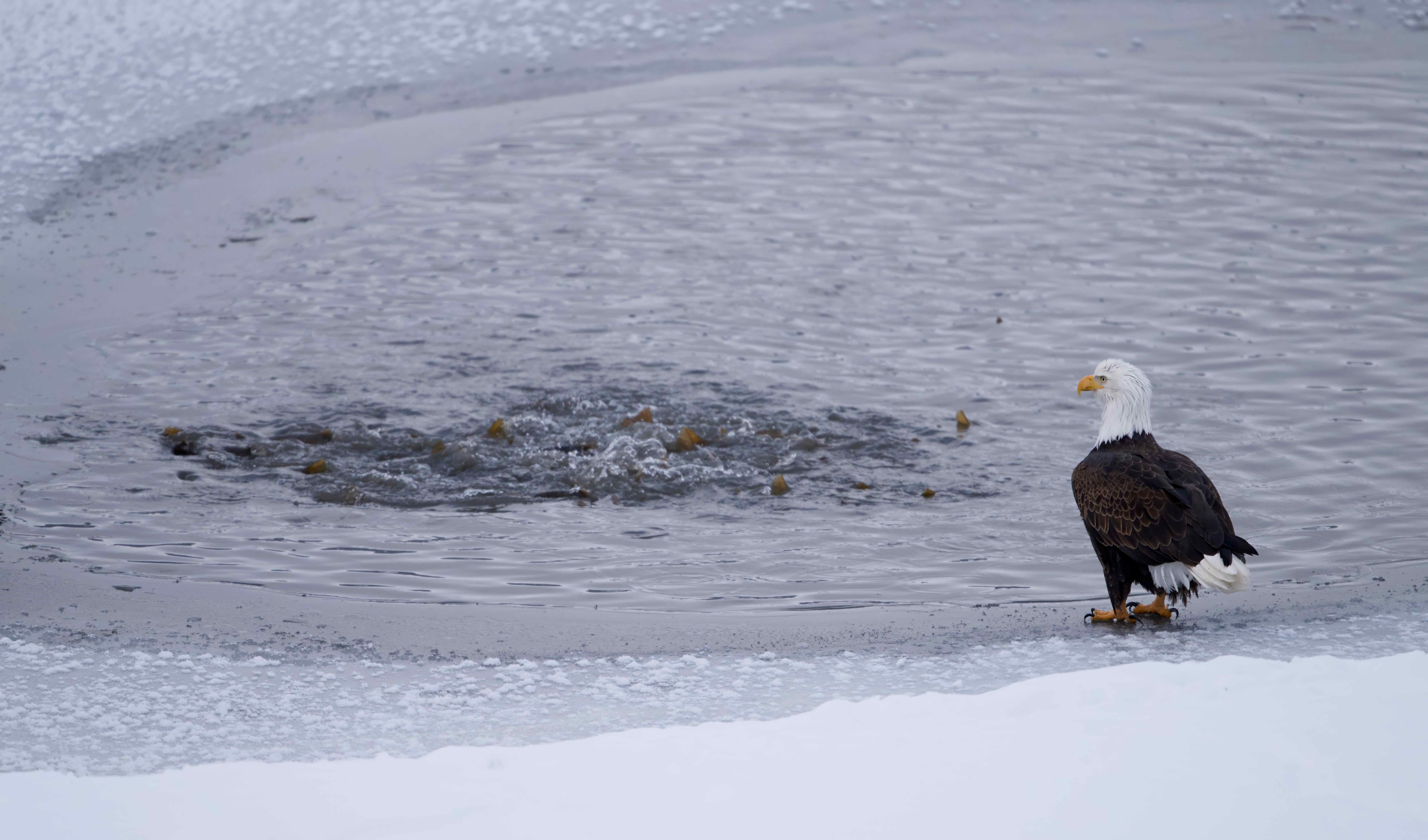
Having made up his mind, the eagle helps himself to a serving of fresh fish:

The common ravens (Corvus corax) have found a lovely rotting fish. Instead of exerting the effort to catch a fresh fish, this eagle has decided that it is easier to steal the carrion:

Bald eagles are kleptoparasites, so when an eagle with energy and initiative catches a fish the other eagles won’t let him dine in peace:

Ravens are smart birds. This one is surely thinking “If those eagle ignoramuses can catch a fish then surely I can do it better.” Unfortunately for him, the fish got away:

In spite of their inability to fish, common ravens are handsome birds:

To my surprise, the North American river otters (Lontra canadensis) who live half a mile downstream have not been dining at the buffet. I think it is because this branch of the river is frozen solid and the otters don’t like traveling on the ice surface for long distances without the safety of accessible water. So I donned my cross country skis and visited them at another, unfrozen branch of the Snake River. They, too, were feasting on Utah suckers:

Also on the river are trumpeter swans (Cygnus buccinator) in the morning mist:

Trumpeters need a long runway to take off. These four are just starting to accelerate:

Once airborne they are graceful:

Finally, this old-time general store sits adjacent to the Snake River in Grand Teton National Park. In this star trail time lapse, the stars are, of course, circling Polaris, the north star. The Tetons are to the left of the store:

Readers’ wildlife photos

December 18, 2025 • 8:30 am

We are back today with a series of underwater photos of SHARKS taken by Peter Klaver. Peter’s captions are indented, and you can enlarge the photos by clicking on them.

During scuba diving off Bimini, Bahamas my scuba diving buddies and I went on two hammerhead shark feeding dives. The waters around Bimini are home to the Great hammerheadSphyrna mokarran, that typically grows to over 4m and over 400 kg. We saw several smaller ones and a large female that one of our dive guides said was ~14 feet long.

While the shark feed dives are not a very natural setting, such objections quickly disappeared from my mind as I saw a nearly half metric ton shark sometimes pass by less than 1 foot away from me. Below are some video frames, with a few divers (further away from the camera than the shark admittedly, making the shark look bigger) included in the last frame for size.

Readers’ wildlife photos

December 5, 2025 • 8:15 am

Send in your photos, please!

Today mathematician Abby Thompson from UC Davis graces us with tidepool pictures from California. Her captions and IDs are indented, and you can enlarge her photos by clicking on them.

A few more photos from November tidepools in Northern California:

Subfamily Syllinae (family Syllidae)I like the red eyes on the worms in this family:

Heptacarpus sitchensis (Red-banded transparent shrimp):

Oligocottus snyderi (fluffy sculpin)  This is one of the tidepool fish that gets transfixed by a flashlight:

A close-up of the fluffy sculpin’s eye:

There are two species of worms in this photo.   One I’ve posted before is the feathery one, from the family SabellidaeThe other is possibly some species of ribbon worm.  I like the photo because it looks kind-of balletic:

Aeolidia loui (nudibranch) Those two small black dots may be eye spots, I’m not sure. There are two much fainter spots further forward and farther apart which are also contenders.   They have primitive eyes, not usually very visible, which are believed only to distinguish light and dark:

Fissurellidea bimaculata (Two-spotted keyhole limpet) The “keyhole” is the hole in the top of the animal.   There’s a small shell surrounding the hole.  The shell is always much smaller than the body in this species, but in this one the shell is entirely covered by the mantle:

Ophiothrix spiculata (Western spiny brittle star):

Genus Littorina (periwinkle) There are several species of periwinkles in the high intertidal zone. I’m not sure which this is, but he posed nicely:

Sunset over the Point Reyes peninsula:

The first picture was taken through a microscope on an iphone and the last was also with an iphone.   For the rest I used an Olympus TG-7, in microscope mode, with a lot of extra lights.  I got some help with IDs from inaturalist.

Readers’ wildlife photos

November 17, 2025 • 6:15 am

Intellectual hero and UC Davis math professor Abby Thompson again has a batch of lovely intertidal photos for us. Abby’s captions and IDs are indented, and you can enlarge her photos by clicking on them:

The first two pictures were taken on my cellphone at the Berkeley marina, where a friend was taking us sailing. Fortunately for me, the boat needed more than an hour of preparation, which I got to spend lying flat on the dock looking at the marine life growing underneath it. There’s an entire community on inaturalist devoted to observations of such “dock fouling”; it’s an incredibly rich environment. Because all I had was my phone, only a couple of the pictures I took were legible- next time I’ll bring a camera (and hope the boat needs even more work).

Clathria prolifera (red beard sponge). Most sponges can’t be identified from a photo, but apparently this brilliant one is an exception:

Genus Ciona (tunicate). Pretty much any blobby thing you see lying around the beach is some kind of tunicate, an animal with an inflow and an outflow, and usually not too much else to recommend them (unlike, say, clams, which are at least delicious). These at the marina were lovely, however, looking flower-like:

The rest of the pictures were taken in my usual spot on the coast, near or after sunset (that’s when the great winter low tides happen). At night it’s cold, wet, slippery and, of course, dark, which makes things a bit tricky.

Genus Crepidula; Slipper snail – this clings to the rock looking almost like a limpet:

Slipper snail top view:

Order Amphipoda; I liked this guy’s eyes:

   Genus Polycirrus; Spaghetti worm- it’s one worm, with many tentacles. The main body of the worm is curled up and coated in sand:

Dirona picta:  A nudibranch, munching on some matching bryozoans:

Cebidichthys violaceus (Monkeyface eel, or monkeyface prickleback) Despite its common name and looks, this is a fish, not an eel (all eels are fish, but not vice versa). Supposedly delicious, it’s one of the creatures for which I regularly see people foraging. They’re caught by “poke-poling”; a baited wire hook is just stuck into the end of a long pole, and the fishing method is to poke the hook into crevices under the rocks.    One of the advantages of nighttime tide-pooling is that there are a few creatures- this was one- that seem to get stunned by a flashlight, and they stay completely still.  In the daylight you seldom see one of these, and they’re gone in a flash, too quick to photograph:

Anthopleura xanthogrammica (tentative) (giant green anemone) Several species of anemone fluoresce like this under UV light:

For the second group of pictures [after number 4] the camera was my Olympus TG-7, in microscope mode, with a lot of extra lights.

Readers’ wildlife photos

September 6, 2025 • 8:15 am

We’re running low on photos, folks, and I know some of you out there are hoarding them.  Send ’em in, please!

Today we have some boids (and one fish and one mammal) from reader Susan Harrison, an ecologist at UC Davis who is having entirely too much fun. Susan’s IDs and captions are indented, and you can enlarge her photos by clicking on them.

Albatrosses and more

Pelagic seabirds are those that forage across the oceans and seldom either stand or sit still, approach the shore, or even flap their wings.  Albatrosses, to take one of the most spectacular examples, soar hundreds of miles a day with barely a wingbeat. Petrels, Storm-petrels, Jaegers and Shearwaters are similarly long-winged wanderers of the wide blue spaces.  To see these birds, one takes a boat trip to a productive marine area such as the upwelling zones just off the California Coast.  It helps if there are experts on the boat, for ‘pelagics’ are often seen from far away and don’t sport many colors beyond the black-gray-brown-white range.  And it also helps to be seasickness-resistant, which I’m not.

Nonetheless, in August 2025 I joined a trip with Noyo Pelagics out of Fort Bragg, California headed for the underwater Noyo Canyon six miles offshore.  Our boat, the fifty-foot Kraken, was absolutely loaded with seabird experts.  So loaded, in fact, that I had to pick one spot to stand for most of the ten-hour trip. Luckily, my spot was clinging to the stern rail right between “the guy who wrote The Book” and who was generous in helping novices, and the deckhand who was tossing chum overboard to attract birds.  The stern rail was also the right place for me for other reasons, but enough said.

It was a sunny and windy day with six- to 12-foot swells most of the time.  My success in even raising my camera to my face was relatively low.  If it’s any consolation, the handful of species I managed to photograph gives a fairly full sense of the range of phenotypic variation.

We were delighted to see a couple of Laysan Albatross (Phoebastria immutabilis), which nest on tropical Pacific islands and wander across the entire Pacific to feed.

Laysan Albatross: [JAC: Note that the oldest known wild bird is a Laysan Albatross named “Wisdom”, who is 73 or 74 years old, breeds on Midway Atoll, and has had about three dozen chicks.]

Another source of excitement was a South Polar Skua (Stercorarius maccormicki), which breed in Antarctica further south than almost any other bird, and range across all of the world’s oceans. They are known for a bad habit of eating penguin chicks. They love their own kids, though, so if you approach their nests (according to ornithologists) “They will pound on you. They will hit you right in the face.”

South Polar Skua:

A fun non-bird sighting was an Ocean Sunfish (Mola mola), one of the world’s largest fishes, reaching 250- 1,000 kg.  The common English name refers to its habit of sunbathing at the surface, but other names allude to its weird shape:  “moon fish” in many European languages, “swimming head” or “only head” in German and Polish, “lump fish” in the Nordic languages, and best of all “toppled wheel fish” in Chinese. The Latin epithet mola means “millstone”.  It’s in the order Tetraodontiformes along with pufferfish, porcupinefish, and filefish, which all have beaks formed from four fused teeth.

Ocean Sunfish:

We saw a Hawaiian Petrel (Pterodroma sandwichensis), a Manx Shearwater (Puffinus puffinus), Ashy Storm-Petrels (Hydrobates homochroa), and multiple other Petrels, Jaegers, and Shearwaters, but I was unable to take decent photos of them.  Toward midafternoon we entered calmer conditions where I took many photos of Black-footed Albatrosses (Phoebastria nigripes).  These delightful, ravenous piscivores with their permanent smiles are long-lived (60 years), monogamous, and famous for elaborate mating dances.  They are “tubenosed” seabirds, with nasal labyrinths allowing them to scent seafood from enormous distances, and with special glands above the eyes for excreting salt.  Most endearingly, they run awkwardly on the water to take off and land, and seem to love riding the waves.

Black-footed Albatrosses going for the chum:

Black-footed Albatrosses running on the water:

Black-footed Albatrosses surfing:

Black-footed Albatrosses at rest:

California Sea Lions (Zalophus californianus) on buoys were a welcome sign that the harbor was just ahead:

Readers’ wildlife photos

June 20, 2025 • 8:15 am

There may not be any wildlife photos for a week or so given my absence, but that shouldn’t stop you from sending them to me.

Today we have some photos by Jim Blilie taken in Oregon. There are many flowers, but also some landscapes and a chonky sturgeon.  Jim’s captions and IDs are indented, and you can enlarge the photos by clicking on them.

These photos are from two locations near our home.  The one an old standard for us and the other a new discovery.

First the old friend:  The Bonneville Fish Hatchery and Sturgeon Center.  This facility is an operating salmon hatchery; but it also has ponds of Rainbow Trout (Oncorhynchus mykiss) where you can feed the fish and two large ponds with White Sturgeon (Sinosturio transmontanus), including a very large one named Herman (Herman the Sturgeon).  In addition, it has beautifully gardened grounds that make it feel like an arboretum.  My photos are almost all of the flowers.

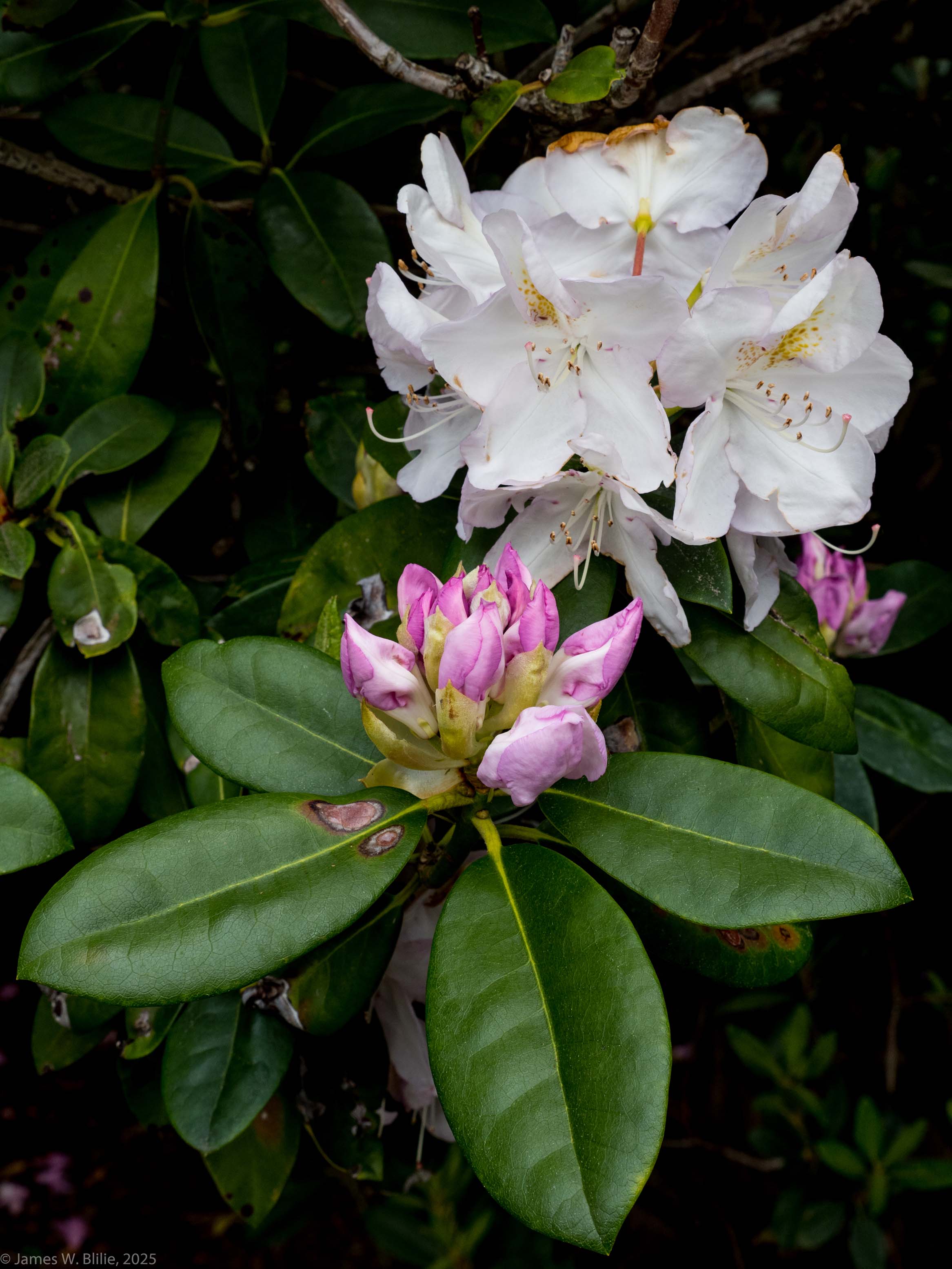
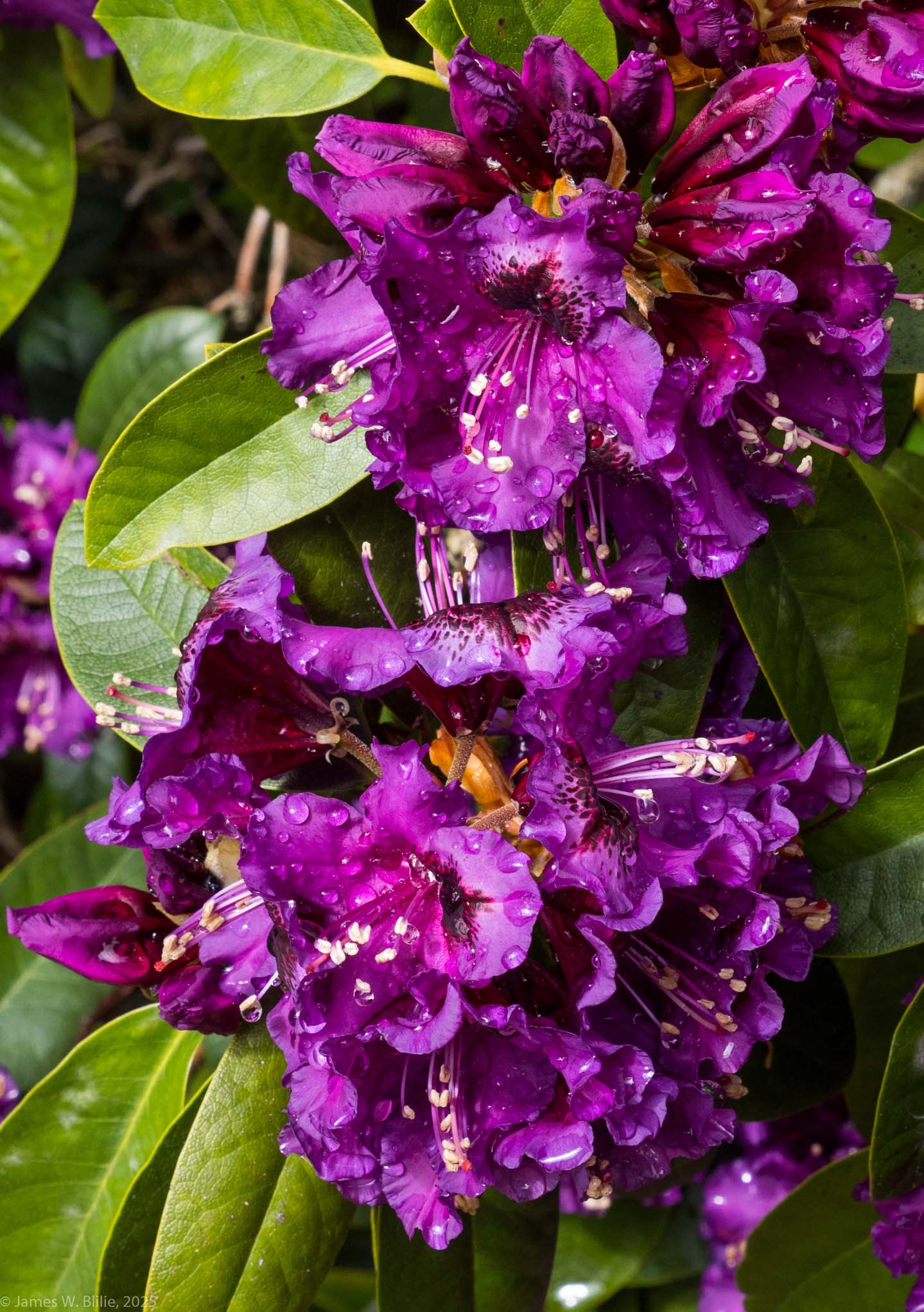
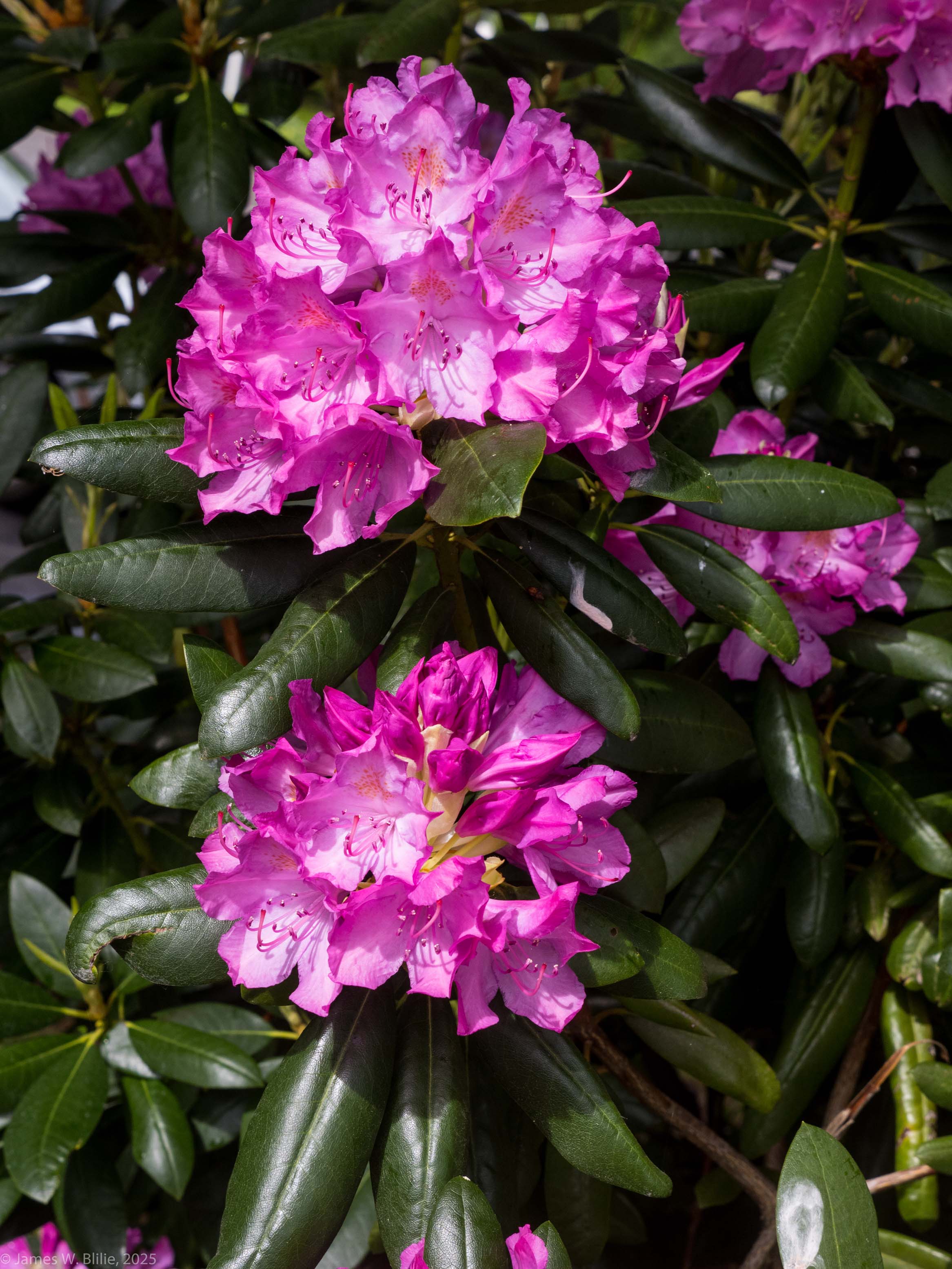
These were taken a couple of weeks ago during the peak of the rhododendron (Rhododendron spp.) flowering (one of my favorite flowers) so these concentrate on the rhodies.

Many iris (Iris spp.) and roses (Rosa spp.) were also blooming:

And one image of Herman the Sturgeon from the viewing window of the main pond:

Next is our new discovery:  The Mill Creek Ridge Natural Area, above The Dalles, Oregon, owned by the Columbia Land Trust.  This is a beautiful ridge that provides a rolling walk with 360-degree views of the Columbia RiverMount Hood, and Mount Adams (on a clearer day), once you make a stiff ascent of a few hundred vertical feet from the parking area.  Another draw are the profuse wildflowers.  We missed the peak wildflowers by a couple of weeks (another hiker reported identifying 26 species).  We went on a weekday and had the entire place to ourselves.

The Columbia Land Trust does wonderful work in Oregon and Washington:  They purchase key lands for habitat and recreation and preserve it undisturbed for present enjoyment and for the future.  We have given them individual donations in the past and I just started a monthly donation to them.  I ask your readers to please donate, if they can.

First, some of the general views from the ridge.  Looking south:

Then looking northeast, including the city of The Dalles, Oregon and The Dalles Dam on the Columbia River:

Next are just a few of the flowers we saw.

Sticky-stem Penstemon (Penstemon glandulosus var. chelanensis):

I think this is: Frasera albicaulis, commonly known as whitestem Frasera or white-stemmed elkweed:

I think this is: Common Stork’s Bill (Erodium cicutarium:

Paintbrush (Castilleja sp.):

Finally, the signpost at the parking area, giving general information:

Male seahorse gives birth

April 17, 2025 • 2:02 pm

Seahorses (Hippocampus spp.) which are fish, have an unusual reproductive system. The males get “pregnant”, meaning that they carry the eggs, which are deposited in the male’s pouch by the female and then fertilized there. (Note: this doesn’t mean that seahorse males are “females”, or that there are more than two sexes!)  We don’t really know why males gestate the eggs, but we do know that females produce eggs faster than males can gestate them. This means that, unlike most animals, females compete for the attention of males.  Here’s a birth; National Geographic says that 2,000 babies are being born. Wikipedia says that the babies can be as few as 5 or as many as 25.

That’s your biology of the day; and I am sorry that for the next few days I won’t be posting much.