Why Evolution is True is a blog written by Jerry Coyne, centered on evolution and biology but also dealing with diverse topics like politics, culture, and cats.
Okay, so as this website slowly circles the drain, we’re still going to have cats on Caturday, and three items to boot.
First on deck is Larry, the Chief Mouser to the Cabinet Office at 10 Downing Street; he just turned 19, and served 15 of those years in the service of the Prime Minister. He’s in remarkably good shape for such an old cat, and here’s a two-minute video, in his own words, recounting how a careless photographer nearly tripped over him. Fortunately, Larry skittered away, perhaps losing half a life or so:
********************
From Bored Panda we have another large selection of cat memes. I’ll choose a few for your delectation. Click the screenshot to read; the intro says this:
Last year, the estimated expenses of owning a cat were between $830 and $3,000. Clearly, no expense is spared for cat owners when it comes to their beloved fluffballs.
Bored Panda loves cats too. That’s why we are blessing you with a collection of wholesome and cute cat memes, courtesy of the “happycat318” Instagram page. Check out the times kitties cracked up their owners with some diabolical shenanigans!
More info: Instagram [the happycat 218 Instagram Page], the source of all the memes:
. . . And this is a true cat lover:
********************
A persistent moggy described by the UPI; click on screenshot to read:
The tail:
A cat escaped from his owners’ camper during a stop at a gas station in Spain and reappeared months later less than a mile from their home in France.
Patrick and Evelyne Sire, who live in Olonzac, in the Hérault region of France, said their cat, Filou apparently jumped out of an open window in their camper during an Aug. 9, 2025, stop at a gas station in Maçanet de la Selva, Spain, located near the French border about 155 miles from home.
Patrick Sire said Filou’s absence wasn’t noticed until the next morning.
Sire said he returned to the gas station twice in the ensuing days and weeks, but no one in the area had seen any signs of the missing feline.
The couple said they started to give up hope as the months passed, but they received a call Jan. 9 from a resident in Homps, less than a mile from their home, reporting Filou had been found.
The woman said she had been feeding the cat outdoors since December, and noticed he was very thin and appeared to be coughing. She took the feline to a local veterinarian, where a microchip scan identified him as Filou.
“Filou traveled all that way to get to us. But how did he do it? Did he follow the highway? Did he go through towns? Did he follow the rivers?” Patrick Sire told France3 News. “We’ll never know.”
Here’s a video in French, which shows the GPS cat and his staff. If you know a bit of French you can probably understand it, but if not you can still see how happy the staff is!:
We’re back with the Caturday felids: three items and several more for lagniappe.
First, an 18-minute video from Meowtopia about how cats see humans. It’s designed to prove that cats aren’t just using us, but that we are “their secure base.” It’s a mixture of true facts mixed with some dry humor, somewhat like a toned-down ZeFrank video. The them is cat psychology: “What are cats thinking?”
It turns out that we are actually “Super Providers” whose purpose is to provide food; in other words, we are vending machines made of meat. But we also mean one thing to them: “Safety.”
The video invokes a lot of scientific research on cats, is full of interesting results, and is well worth watching.
*********************
Click below to see an article from the Washington Post showing that “pet-friendly” hotels are actually biased against cats. (The article is archived here.) What gives?
An excerpt; the article begins with cat staff checking into a “pet friendl” hotel in Amsterdam.
“Hotels will say they’re pet-friendly, but they really mean dogs,” said Erin Geldermans, who adopted “Liebs” in Colorado. “So we’ll show up with our cat, and they’re like, ‘Oh, sorry, cats aren’t allowed.’”
Cast into the night without a room, Geldermans and [their tabby cat Liebchen] landed on their feet, finding more inclusive accommodations at the Jan Luyken Amsterdam next door. The hotel didn’t even charge them a pet fee. However, the experience was a stark reminder that, for jet-setting cats, it’s a dog’s world.
Travelers who vacation with their feline companions say they have encountered an anti-cat bias around the world. They come across it in airports and on planes, at hotels and vacation rentals. The owners say they must often overcome hurdles to earn the same trust and acceptance granted to dogs.
“This is discrimination,” said Anna Karsten, a France-based travel blogger who has faced a double standard when traveling with her Ragdoll, Poofy. “It’s a higher risk, apparently, which, if you think about it, is outrageous. The cat is literally going to sleep, but the dog might destroy the entire room if it’s stressed.”
During check-in at a rental in the Dutch city of Leiden, Karsten had to provide references that Poofy was a model guest. Stung by a previous incident involving cat pee, the apartment’s owner said the family would have to keep Poofy in a “cage.”
After several minutes of negotiations, the two sides agreed to sequester the cat in the bathroom whenever the family was out. Karsten abided by the rule the first day but eventually left the door ajar. By the end of the week-long stay, the host had experienced a change of heart.
“She loved the cat,” Karsten said triumphantly.
REFERENCES?? The lesson is that if you travel with your cat, be sure that any “pet friendly” accommodations your reserve consider cats as adequate “pets.” Actually, cats are not pets but owners, and we are their staff.
*********************
We all know of Larry, the Chief Mouser to the Cabinet Office . He was rescued from the Battersea Dogs & Cats Home, and has lived at 10 Downing Street for 15 years. Larry is now 19: technically an old cat, but still quite spry, running about outside the Prime Minister’s home and the object of many photographs. He’s gone through five Prime Ministers!
Here’s a 15-minute BBC News video showing seven times that Larry caused mischief. He’s not a very good mouser; he’s said to have caught only 3 in his 15-year tenure. Don’t miss Obama’s meeting Larry at 5:40. There are many comments about Larry from Prime Ministers, journalists, and so on.
This too is an excellent video. If you want more Larry, his Twitter feed is here. Don’t miss the BBC journalist Helen Catt (that’s right!), who comments throughout.
Lagniappe: Larry turned 19 a few weeks ago. Here is what he wants to tell us on his birthday, including how old he’d be in human years.
Extra lagniappe: Japanese road signs. Slow down for cats!
Still more lagniappe from the Facebook group Cats that Have Had Enough of Your Shit: A new and excellent Swedish law. If we have any Swedish readers, please confirm this.
We’re back with Caturday felids again, but I ask readers to help me out by sending me good cat-related news items when you see them. I may not use some, but I will look at all of them. Thanks.
Today we have three short items. The first, from History.com, describes a 1960 attempt by the CIA to turn cats into spies. In principle it was a good idea, but not so much in practice. Click the screenshot to read:
Here’s a description of “Operation Acoustic Kitty”:
The Acoustic Kitty was a sort of feline-android hybrid—a cyborg cat. A surgeon implanted a microphone in its ear and a radio transmitter at the base of its skull. The surgeon also wove an antenna into the cat’s fur, writes science journalist Emily Anthes in Frankenstein’s Cat: Cuddling Up to Biotech’s Brave New Beasts.
CIA operatives hoped they could train the cat to sit near foreign officials. That way, the cat could secretly transmit their private conversations to CIA operatives.
“For its first official test, CIA staffers drove Acoustic Kitty to the park and tasked it with capturing the conversation of two men sitting on a bench,” Anthes writes. “Instead, the cat wandered into the street, where it was promptly squashed by a taxi”—not the outcome they were expecting.
Oy! I bet the microphone contributed to its death.
“The problem was that cats are not especially trainable,” she writes. In a heavily redacted memo, the CIA concluded: “Our final examination of trained cats…convinced us that the program would not lend itself in a practical sense to our highly specialized needs.”
Here’s the conclusion, with credit given to the CIA:
There’s more: they tried to create spy insects:
With DARPA’s support, researchers at the University of California Berkeley successfully created a cyborg beetle whose movements they could remotely control. They reported their results in Frontiers in Integrative Neuroscience in October 2009.
“Berkeley scientists appear to have demonstrated an impressive degree of control over their insect’s flight; they report being able to use an implant for neural stimulation of the beetle’s brain to start, stop, and control the insect in flight,” reported Wired the month these findings came out. “They could even command turns by stimulating the basalar muscles.”
Well, to use the radio-controlled bugs as spies, they’d also have to equip them with microphones, which they didn’t, but they could be used for another purpose. The Wired article quotes the Berkeley researchers:
Eventually, the mind-controlled insects could be used to “serve as couriers to locations not easily accessible to humans or terrestrial robots,”
What about pigeons, for crying out loud? They were used in WW1? Anyway, this is your tax dollars at work.
********************
Here’s a post from Facebook (see also here) that I tried to check. It seems accurate in that it’s replicated elsewhere, including a newspaper (below), but information is scant. In this case, however, the cats detected spying, probably because cats have a broader hearing range than humans, especially at high frequencies, and their hearing is more sensitive than ours.
The article, titled “Cats Finger ‘Bugs'”, reports on the discovery of 30 hidden microphones in the Dutch Embassy in Moscow. The listening devices were reportedly found after two Siamese cats reacted to the imperceptible sound of a microphone being switched on.
The article:
And an AI response to my question about the incident:
Discovery: Two Siamese cats alerted the ambassador to the hidden microphones by scratching a wall.
Technology: The microphones were wireless, activated by electronic beams, and produced a sound inaudible to humans.
Diplomatic Response: Instead of protesting, embassy staff used the bugs to their advantage, staging dialogues that resulted in the Soviet authorities unknowingly fixing an embassy sewer issue.
Current Status: The newspaper reported that the microphones remained in place, and the diplomats had grown accustomed to their presence.
********************
Finally, in a 5-minute video, actor Jeremy Irons describes artistic depiction of lions, from ancient Egypt through ancient China, Greece, and Rome up to Rembrandt and beyond. Six drawings of lions by Rembrandt survive, and below you can see that one of them is up for auction.
On February 4, one of the most significant drawings by Rembrandt ever to reach auction will be sold at Sotheby’s, with 100% of proceeds protecting wild cats worldwide — art giving back to the animals that inspired it. While lions dominate culture, their real-world populations have declined by nearly 90%, and this historic auction directly supports Panthera’s work to reverse that trend.
Here’s Rembrandt’s drawing, of “Young Lion Resting” created between 1638 and 1642, and I hope it brings a lot of money for Panthera:
*********************
Lagniappe: A short video of three bobcats having fun in someone’s swimming pool:
And riceball cats from Facebook: cats made out of rice:
Here, from the Express Tribunein Pakistan, is an article about the world’s oldest cat, who just turned 30 years old. (Also see the story at the New York Post.)
An excerpt (Flossie has had a checkered career):
Flossie, a British domestic short-haired tortoiseshell cat, has turned 30 years old, extending her Guinness World Record as the world’s oldest living cat.
Born on December 29, 1995, Flossie reached the milestone birthday in 2025, further cementing her place in record books. Her age was officially verified by Guinness World Records in November 2022, when she was confirmed to be 26 years and 316 days old. At the time, her age was estimated to be equivalent to around 120 human years.
Flossie’s early life began in a feral colony near St Helens Hospital in Merseyside, England, where she was rescued as a kitten. Over the years, she lived with several owners before eventually coming under the care of the UK animal welfare charity Cats Protection.
In 2022, Cats Protection arranged for Flossie to be adopted by Victoria Green, who lives in Orpington, England. The charity worked closely with veterinarians to verify Flossie’s date of birth using historical records, enabling Guinness World Records to formally certify her age.
At the time of her record confirmation, Guinness World Records noted that Flossie was deaf and had limited eyesight. Despite these age-related conditions, she was otherwise considered to be in good health. The organisation said she maintained a stable daily routine that included regular meals, extended periods of sleep and gentle play.
Flossie is currently recognised as the oldest living cat in the world and ranks among the seven oldest verified cats in recorded history. While other cats, including Creme Puff, are documented to have lived longer in the past, Flossie remains the oldest confirmed feline alive today.
Here’s another tweet:
Flossie, the world’s oldest living cat, will celebrate her 30th birthday on December 29, 2025. pic.twitter.com/NoZ42sBby2
Of course Flossie is a long way from the offical World’s Oldest Cat Ever, the famous Creme Puff, who lived to an astonishing 38 years and 3 days. This was verified by Guinness, and what amazes me is this:
Creme Puff’s owner, Jake Perry, said her diet consisted of dry cat food and claimed he supplemented it with broccoli, eggs, turkey bacon, coffee with cream, and every two days “an eyedropper full of red wine.” Perry claimed that this diet was key to her longevity, and that the wine “circulated the arteries.
Coffee and wine!
***********************
James Fell’s website says he’s a historian, and he gives some (yes, sweary) history about a heroic moggy. Click the screenshots to read:
Some excerpts:
Plenty of hero dog stories, but what about hero cats? Some say if a house cat was as large as a big dog, no one would want them because they’d death murder the shit you. Not Masha though. She used her body to keep an abandoned baby warm against the Russian winter cold.
. . . .on January 10, 2015, Masha rescued an infant.
It happened in the city of Obninsk, about 50 miles southwest of Moscow. Russia in January is not terribly hospitable. Just ask Napoleon. Or the fucking Nazis. Oh, wait. You can’t. Because most of them froze to death. Anyway, Masha was a “stray” that was beloved by residents of an apartment building where she made her home. They fed Masha well; this was one fat ass cat. Good thing too. The extra padding probably kept the baby alive.
. . . . Late that Saturday, building resident Nadezhda Makhovikova knew something was amiss. Masha was normally a quiet cat, but she sounded like she was being murdered. Nadezhda went to investigate and found Masha lying in a box in the entranceway to the building. The big fluffy cat was lying atop a crying baby to keep it warm and howling S O Fucking S.
The baby boy was dressed in warm clothes and had a pacifier, bottle, and spare diapers. But this was the Russian winter, and it was already late. The child would not have survived the night. So, yeah. Shitty thing to leave a baby out like that. I just googled “abandoned baby freeze to death” and there are plenty of horrific stories. Sometimes I hate my job.
But this story has a happy ending. Masha was a good girl, and she saved the day. An ambulance was called, and Masha tried to jump in the back to continue her vigil. Vera Ivanina, one of the attending paramedics, explained that Masha even chased them. “She was so worried about where we were taking the baby,” Vera said. “She ran right behind us, meowing.”
The boy was about two months old, clean and well fed, with no signs of abuse. Other than being abandoned in the Russian winter, that is. The hospital asserted the little boy was in good health, suffering no ill effects from the cold thanks to Masha keeping him warm. The story made international news and there were many offers to adopt the young boy, as well as to adopt Masha. Masha was all fuck that I like my freedom.
Here’s a video showing Masha, who seems quite fluffy and insulated:
All’s well that ends well!
*****************************
This story comes from LifeWise Insights (click headline to read). I’m not sure that cats are capable of gratitude but of course do prefer some situations more than others. If a rescuer gets purred at and sat on, well, that could simply be the actions of a well-cared-for cat and not what we think of as “gratitude.” But let’s see what the article has to say:
I can’t embed the text but I do append two screenshots from a longer article:
The problem is that a change in patterns and a reduction in alertness when a cat learns that food, warmth, and safety is now constant does no mean it’s grateful. In fact, we have no way of knowing whether a cat feels the same things as a grateful human. This is equivalent to the vexing and unanswerable question, “What is it like to be a bat?” Now we can guess, based on some behaviors, that cats do feel emotions similar to humans, like fear, but “gratitude”? I don’t know.
And a Google translation from the Spanish for the video below. But why did they let the cat inside in the first place? Wasn’t this result predictable? Was it staged?
He entered as a customer… he left as a professional thief 😂 They couldn’t catch him 😅 #cat #cats #catpranks #funny moment #supermarket #viral #animals
The meme below, from Cats Doing Cat Stuff: implies that Thaland has declared all cats as official national symbols. Well, as the articles below say, that’s not exactly true. Some cats have become national symbols, but only breeds from Thailand. Read on:
Here are two articles, the first from the Singapore-based cna news organization and the second from the Bangkok Post. Click on either to read, though the first is more informative:
x
x
From cna:
Five cat breeds native to Thailand were approved as national pet symbols by the government on Nov 18, joining the Thai elephant, fighting fish and Naga among other nationally recognised emblems.
The pure Thai breeds – Suphalak, Korat, Siamese, Konja and Khao Manee – possess distinctive physical and behavioral traits that clearly differentiate them from other breeds, according to Thailand’s National Identity Committee, which had proposed their designations as national pets.
“Their uniqueness has gained international recognition, with some foreign breeders attempting to register purebred Thai cat lines and establish global breed standards,” the Thai government’s public relations department said in a report on Nov 20.
A drawing of the five lucky breeds from cna graphics:
More from cna:
Preecha Vadhana, a cat breeder who operates Bangrak Cat Farm in Bangkok, said that each of the five breeds has very distinct features, making them easily distinguishable from one another.
“But they also share similarities, particularly their structure and short coat.”
The Suphalak has a distinct copper coat and is considered a symbol of prestige and fortune. The Korat is a bluish-grey cat with large, vivid green eyes, while the Khao Manee – a rare, white species – often has eyes with two strikingly different colours such as gold and blue.
The Konja is known as a lucky black cat, unlike its foreign counterparts which are often infamous for the opposite.
Finally, the “king of cats”, the Siamese or Wichienmas, is marked by its distinct dark spots and treasured for its intelligence. It is typically the most expensive of the breeds and can cost 15,000-20,000 baht (US$465-US$620) from a local breeder, while others cost 7,000-15,000 baht.
. . . . The decision to elevate these species is not just symbolic: It is meant to help conserve rare native breeds, standardise them and protect Thailand’s ownership of them. The species will also be used more in creative-economy and tourism branding, according to the government.
Then there’s some grousing about how this recognition won’t help the hundreds of thousands of feral Thai street cats. That’s probably true, but this is just symbolic. I think the USA needs a National Cat too, and give the genetic admixture that is America, it should be a regular moggy, like a tabby.
Here’s a 4½-minute video about the recognition of National Cats:
***************************
This article from artnet (click to read) describes a new exhibition of medieval manuscripts with cat drawings at Baltimore’s Walters Art Museum. The title of the exhibit is cute: “Paws on Parchment”. Click to read, and go to the site to see some of those medieval cat drawings, none of which look like real cats!
Note that if you live near Baltimore, the exhibit runs only through February 22, so get your tuches there soon. If I lived nearby, I’d sure go.
An excerpt:
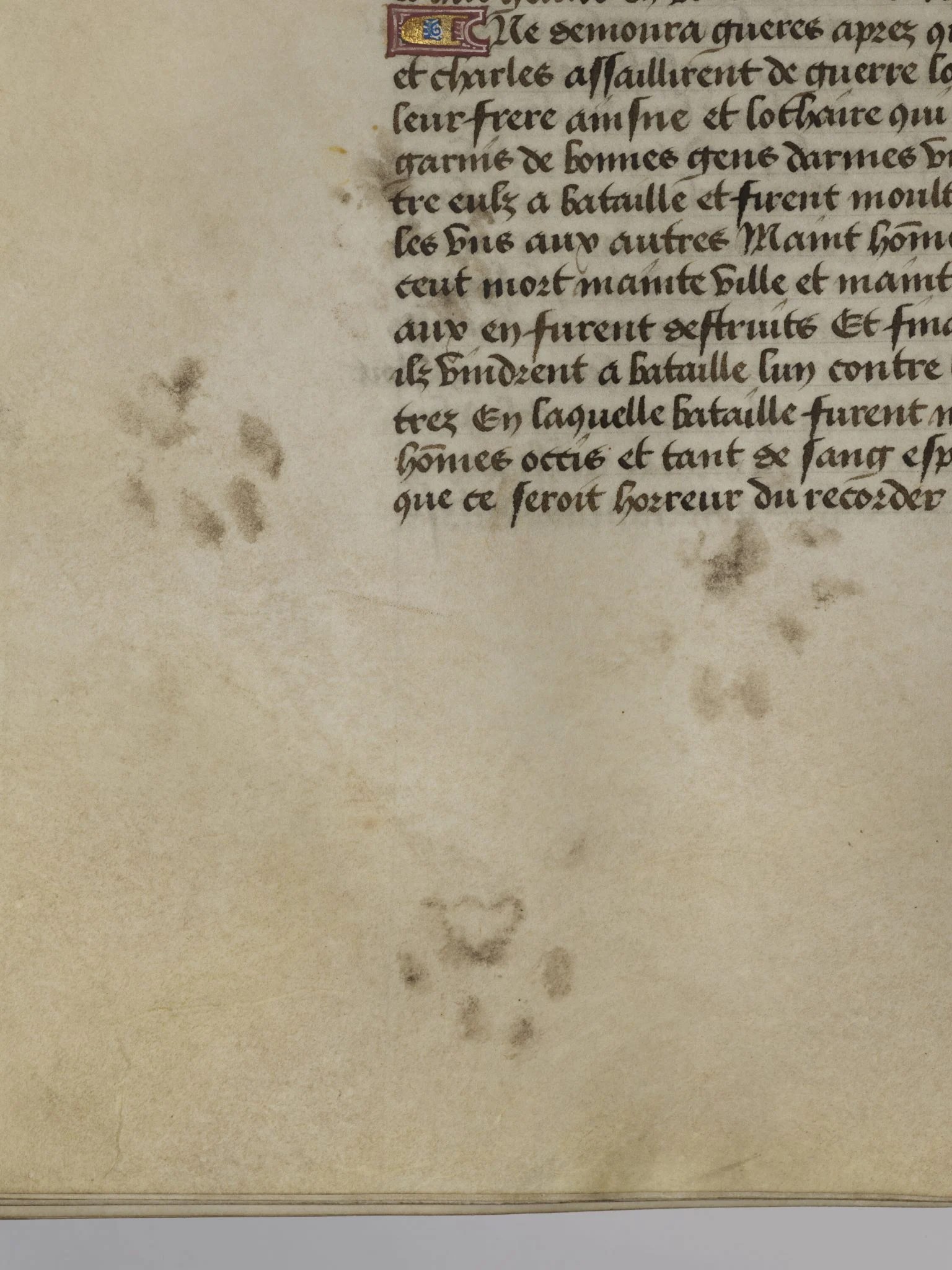
In the 1470s, a Flemish scribe left some meticulously drafted pages of an illuminated manuscript out to dry, only to find out the next day that his cat had trod over them, leaving inky paw prints on the parchment. (Contemporary writers will know the similar pain of typos and elisions wrought by a feline friend’s frenzied scamper across a keyboard.)
Now, more than 500 years later, those pattered pages are the “cat”-alyst for an exhibition at Baltimore’s Walters Art Museum. Aptly titled “Paws on Parchment,” the show explores how medieval illustrators in Europe, Asia, and the Islamic world celebrated cats in the marginalia of their manuscripts and beyond. On view through February 22, 2026, it’s the first of three exhibitions over the next two years dedicated to the depiction of animals in art.
Here is that page with the cat print on it, a cat that lived over 550 years ago!
(from artnet): A 15th-century manuscript bearing the tell-tale marks of a frisky feline. Photo: courtesy of the Walters Art Museum.
Herbert researched the works from a lot of different angles to better understand how people felt about cats. This included primary sources like medieval poetry, moral and cautionary tales, recorded pet names, and discussions of cats in encyclopedic works like Isidore of Seville’s Etymology, from the 7th century, and in medieval bestiaries.
Pets with Purpose
She was surprised by what she found. “Many medieval people loved their cats just as much as we do,” she said. However, the reason people kept them in homes, churches, and libraries was less for company and more for the practical reason of rodent control. Their skills at hunting mice and rats were critical to protecting food stores, valuable books, and textiles—and of course, preserving their owners from the plague and other diseases carried by vermin. “Because this was their key purpose in people’s lives, they are most often shown hunting mice,” Herbert said. “While this is still something a house cat might do today, our lives and livelihoods generally don’t depend on their success.”
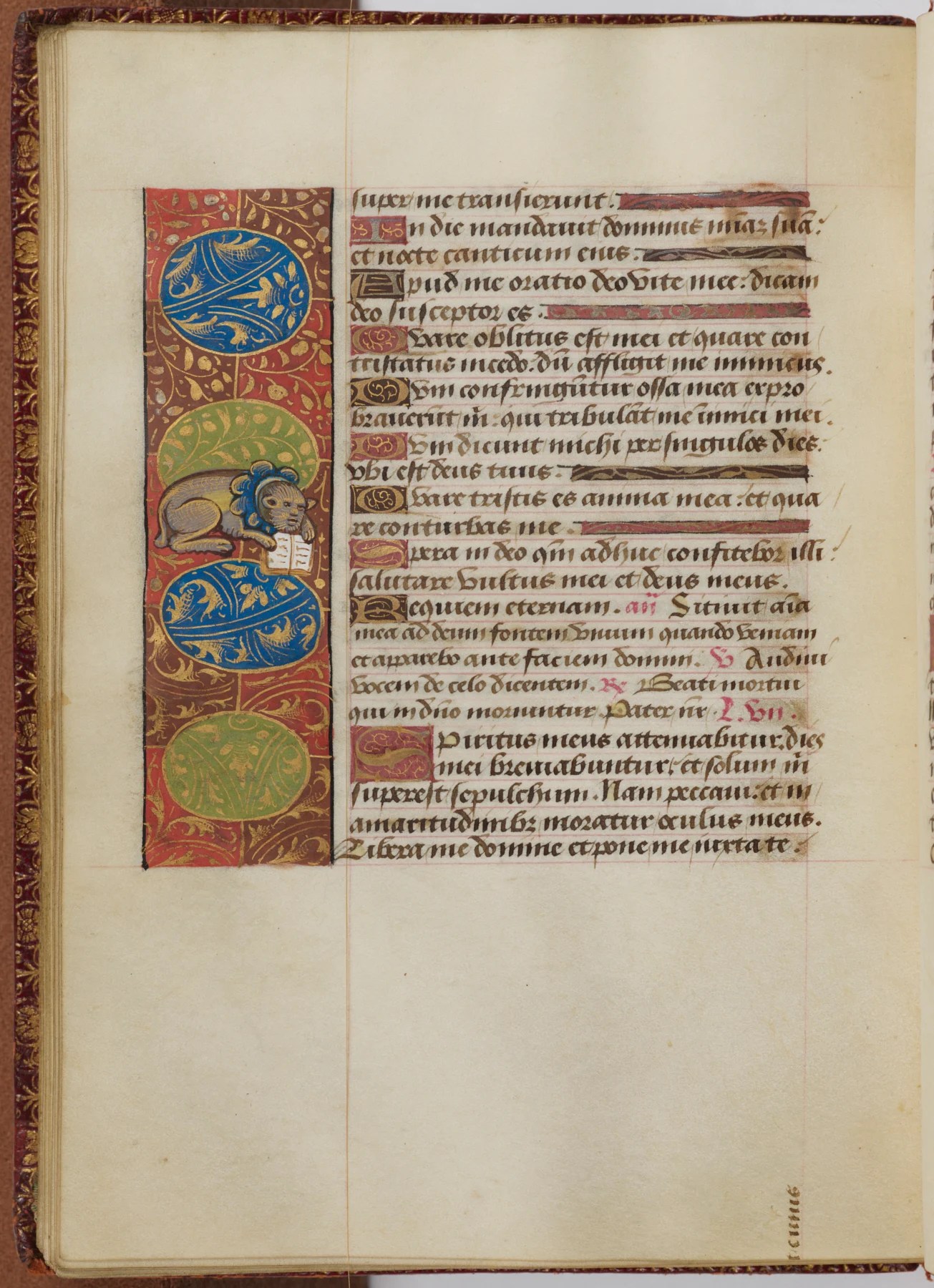
A manuscript cat that was on display. Does this look like a cat? Go to the artnet page or the Walters Museum page to see other illustrations and photos. This exhibit has been running since last August, and you have about six weeks to see it.
Here’s a FB video of cats that didn’t make the cut for the exhibit.
********************
We all know about Larry, the Chief Mouser to the Cabinet Office, who roams around in and around 10 Downing Street, but did you know that there’s an equivalent cat in Belgium. He belongs to the Prime Minister, and has the lovely name of “Maximus”, short for his full name, “Maximus Textoris Pulcher”. Click below to read the Guardian article about him:
An excerpt:
For nearly 15 years, Britain’s Larry the Cat has charmed visitors to 10 Downing Street. Now another prime ministerial pet is proving a social media hit in Belgium.
Maximus Textoris Pulcher was announced in August as an official resident at the Belgian prime minister’s office, Rue de la Loi 16 in central Brussels.
The grey rescue cat is now thought to have the second most popular political account on Belgian social media, with more than 142,000 followers on Instagram – second only to his master, Bart De Wever, who became Belgium’s prime minister in February.
The cat’s full name is a mock-grandiose title rooted in the prime minister’s love of Latin and Roman history, conveying the meaning “De Wever’s beautiful Maximus” (textoris being “of the weaver”, or De Wever).
De Wever adopted the cat, an abandoned Scottish fold, from a refuge. “I have a cat in my office, it is grey and it does not catch … mice, but I love it anyway,” he told journalists during a recent press conference.
Maximus’s posts on Instagram have lit up the Belgian internet, whether he is stretching for a toy, lolling on a windowsill or being tickled on his chest to an electropopsoundtrack.
. . . Unlike Larry, officially an apolitical cat, Maximus offers subtle observations on his country’s political life. “Another strike,” reads one Maximus thought bubble on the day Belgium began a three-day national action in November against proposed spending cuts, hinting at the exasperation of his master. In another post when De Wever’s eclectic five-party coalition was locked in budget talks, a grumpy-looking Maximus lies on the floor with a thought bubble reading: “Even on Sunday, these nuisances [cabinet ministers] are here.”
A source close to De Wever – described as “a cat person all his life” – said the account was a low-effort part of his team’s work and offered the public a behind-the-scenes glimpse of Rue de la Loi 16.
My friend Maarten Boudry, a Belgian philosopher, tells me that everybody in Belgium knows who Maximus is, and many people follow him.
Here are a couple of Instagram entries showing Maximus making pronouncements. I’ll put a translation for each:
From yahoo! news we hear about the rediscovery of the flat-headed cat, but the headline is a bit misleading, for the flat-headed cat was thought extinct in Thailan, but it’s still present in other places. Click below to read; you may not know about flat-headed cats (Prionailurus planiceps)) anyway. Here’s the range given by Wikipedia, and Thailand does extend partway into the Malay Peninsula.
An elusive wild cat long feared extinct in Thailand has been rediscovered three decades after the last recorded sighting, conservation authorities and an NGO said Friday.
Flat-headed cats are among the world’s rarest and most threatened wild felines. Their range is limited to Southeast Asia and they are endangered because of dwindling habitat.
The domestic cat-sized feline with its distinctive round and close-set eyes was last spotted in a documented sighting in Thailand in 1995.
But an ecological survey that began last year, using camera traps in southern Thailand’s Princess Sirindhorn Wildlife Sanctuary, recorded 29 detections, according to the country’s Department of National Parks, Wildlife and Plant Conservation and wild cat conservation organisation Panthera.
“The rediscovery is exciting, yet concerning at the same time,” veterinarian and researcher Kaset Sutasha of Kasetsart University told AFP, noting that habitat fragmentation has left the species increasingly “isolated”.
It was not immediately clear how many individuals the detections represent, as the species lacks distinctive markings so counting is tricky.
But the findings suggest a relatively high concentration of the species, Panthera conservation programme manager Rattapan Pattanarangsan told AFP.
The footage included a female flat-headed cat with her cub — a rare and encouraging sign for a species that typically produces only one offspring at a time.
Nocturnal and elusive, the flat-headed cat typically lives in dense wetland ecosystems such as peat swamps and freshwater mangroves, environments that are extremely difficult for researchers to access, Rattapan said.
Globally, the International Union for Conservation of Nature estimates that around 2,500 adult flat-headed cats remain in the wild, classifying the species as endangered.
In Thailand, it has long been listed as “possibly extinct”.
THE CAT CAME BACK! Here’s a video showing the cats filmed in southern Thailand. Their hats are indeed flat!
********************
I have had the next article verified by my friend Catherine who lives in Amsterdam, who has see these cat stairs. Click to read the article from Vice.
The nooz:
Amsterdam is world-renowned for its canals. They’re a UNESCO World Heritage Site. You might already know that. You might not realize, however, that Amsterdam is crazy for cats, and now it’s trying to protect them.
Amsterdam is spending €100,000 to build tiny wooden staircases along its canals as part of a cat safety initiative. After 19 cats drowned in the city’s elaborate network of waterways over the past six months, city officials finally decided that enough is enough. It’s time to start saving these kitties.
The plan was put forward by Judith Krom of the Party for the Animals. While other political parties in the Netherlands bicker about human needs, the Party for the Animals represents the political interests, rights, and welfare of wildlife.
That includes the Netherlands’ massive population of stray cats.
The cash comes from a forgotten biodiversity budget fund, and the staircases (nicknamed “cat traps”) are designed to give cats (and any other critters) a way out of the canals when their curiosity leads them into a waterway they’re not evolutionarily equipped to thrive within.
Animal welfare group Dierenambulance Amsterdam is collaborating with the city to identify the locations where the most accidental cat water plunges have occurred. Then, they’ll install the stairs at high-risk sites later this year.
This story was written in August of 2025 but some stairs have already gone up. And not just in Amsterdam:
Not to be outdone, the city of Amersfoort already started installing around 300 of its cat stairs as part of its 2024 animal welfare program. The local council even collaborated with residents to identify trouble spots.
Krom called it a “simple measure” that can “prevent enormous animal suffering.” As the world spins ever faster into absurdity, it’s heartening to hear such empathy being extended in our age of callousness.
I found a video showing the cat stairs:
You have to hand it to the Dutch; you have to have a big heart to do something like this.
*****************
An article in Current Biology answers a provocative question with an untested hypothesis. The question is this: why do most cats, at least according to the survey, sleep on their left sides? While individual cats are left-pawed or right-pawed, domestic cats as a whole are—unlike humans—about 50% of each type. But not so for the way they sleep. Most moggies sleep on their left sides, at least in this sample, which was actually taken by watching YouTube videos.
To address this question, we included 301 publicly available YouTube videos in our analysis based on our defined criteria, featuring a cat that is visible from head to hind legs with a full-body sleeping position lying on one side, with this sleep side not changing for at least 10 seconds. Only original, unaltered videos were included, while low-resolution, obscured, duplicated, or modified (e.g., mirrored/selfie) videos were excluded (Supplemental information). Our results revealed a statistically significant leftward bias at the population level (χ2 = 22.9, df = 1, p < 0.001) with n = 192 cats (63.8%) showing a leftward sleeping position and n = 109 cats a rightward one (36.2%) (Figure 1). Thus, on average, about two-thirds of cats preferred to sleep on the left side of their body with their left shoulder down.
A figure with the data. They imply that individual cats always sleep on the same side, but I doubt that. And readers can check that themselves. It’s just that a random snapshot of cats on YouTube are mostly sleeping on their left side:
Now the sample isn’t huge, and perhaps people tend to photograph their cats when they lie on their left sides, but I think this is probably a real phenomenon, In fact, if your cat is sleeping now, go look at what side it’s lying on and answer the poll below (a one-time observation).
The question then arises, of course: WHY do they sleep on their left side? Well, we could say we don’t know, just as we don’t know why most people are right-handed (maybe they’ve figured it out by now). But biologists want THEORIES, and one suggestion involves the lateralization of the cat brain. In short, right side of the brain, which contains the predator detection “module”, is connected by nerves to the left eye. (We have the same crossover between our eyes and the brain hemispheres, which many of you probably know.) The theory, then, which is the authors’, is that sleeping this way allows the left eye to see the predator and activate the right side of the brai, and this causes a quicker response. Or, to put it as the authors do:
This finding is not only interesting from the perspective that cats show a significant population-level bias for the left side but also fits very well with previous findings on functional specialization in the mammalian right hemisphere. The right hemisphere is dominant for threat processing, and in most species, animals react faster when a predator is approaching from the left side. Moreover, the right hemisphere is dominant for spatial attention and the right amygdala in the processing of fear in response to a threat. Upon awakening, a leftward sleeping position would provide a fast left visual field view of objects that approach from below or from similarly elevated positions, thus allowing optimal conditions for fast processing of external stimuli in the right hemisphere of the brain.
Well, as someone said, “all this is as plausible as anything else.” But it could be tested by having mock predators approach sleeping cats and see if the ones sleeping on their left become aware or flee faster than the right-sided sleepers. Pity the authors did not test this!
So go look at your moggie now and take this poll if you have a cat (answer for each cat separately if you have more than one).
[poll id=”51″]
**************************
Lagniappe. A tweet from the Chief Mouser to the Cabinet Office:
Well, at least we still have Caturday felids, as there is never any end to cats appearing on the Internet. But the dearth of comments always makes me think about dispensing with this feature, too.
. . . . . a huge and vicious cat from Icelandic folklore that is said to lurk in the snowy countryside during the Yule season and eat people who do not receive new clothing. In other versions of the story, the cat only eats the food of the people who had not received new clothing.
Here’s a short holiday ad for Icelandair featuring an interview with Jólakötturinn. He is not a crook! Sadly, Yule cat resents the lack of credit he gets for looming so large in the Icelandic psyche and for ensuring that many Icelandic children get new clothes.
. . . and one more, also from Icelandair. Here Yule cat, at first rejected by a family, is finally accepted—and allowed to go on a trip with them—after he gets cleaned up and has a shrimp dinner.
**********************
Here is a happy Christmas tail that appeared in the Torygraph on Christmas Day. I’ve linked the screenshot below to an archived site, so click below to read about the reappearing Bindi.
The story:
Bindi the cat has been reunited with its family for Christmas, five years after it went missing.
The black feline “vanished into thin air” from its home in Haddenham, Cambridgeshire in August 2020.
Jilly Fretwell, Bindi’s owner, had moved house since the disappearance but thanks to microchip technology, vets were able to pull off “a real Christmas miracle”.
Ms Fretwell, 29, said: “She used to go out for a couple of hours and then come straight back, so it was really odd for her to be missing for more than a day.”
Despite posting appeals on social media and searching local walking routes for several months, the software project manager was unable to find her pet.
She had become convinced Bindi would never come home until a phone call from vets on Dec 18 brought welcome news.
Ms Fretwell said there were “no clues” about where Bindi may have been over the last five years, but that she had clearly been “looked after by someone” as she was in “great shape”.
She described her cat as “the most cuddly”, adding that it will “put her paws on either of your shoulders to give you a real cuddle”
Ms Fretwell said: “I think she’s been looked after by someone, she looks in great shape.”
Describing the moment they got the phone call, she said: “We were just in complete disbelief. It wasn’t really until we saw her that we believed it was her.
“We’re just so glad we had her microchipped and that she was alive and well. I’ve never heard of anyone’s cat going missing for so long and turning up absolutely fine.”
The cat, now 10, was in good health and had been ‘well looked after’ and ‘instantly’ recognised her family.
Jilly told the BBC: ‘She’s been missing for five years and we got a call on Thursday from the lovely vets in Witchford to say they had scanned her microchip and she was coming back home to us.
‘She had a couple of little scratches on her that the vet wanted to see to, but other than that, she looks great. She’s lovely and glossy, well-fed and has been looked after somewhere. But we have absolutely no idea where she has been the last five years.’
Bindi disappeared during the Covid pandemic and Jilly spent her daily walks searching for her, sharing appeals on social media and asking people across Haddenham to keep an eye out.
Despite being 10 years old and having spent so long away from her family, Bindi remains affectionate, happily cuddling up to Jilly and settling on her lap.
Other stories frequently use the word “miracle” to refer to Bindi’s reappearance. What tails she could tell, but nobody will ever know. (I suppose the vet could reveal who turned her in, but that may be unethical for vets.). We send Bindi and her staff thoughts and prayers for the holiday season.
Be sure to get your cat chipped, even if it’s an indoor cat.
******************************
Finally, we have a story from the Guardian about Sylvia Townsend Warner (1973-1978), a lesbian writer described by Wikipedia as:
Warner was a bit of a polymath, and you can read about her accomplishments in several fields here, or in her biography at the Sylvia Townsend Warner Society (with more pictures).
But today we’re featuring her role as an ailurophile, and of a new and wonderful statue of Warner—avec chatte—that has just been produced and unveiled.
Click headline to read:
An excerpt:
The thing all women hate is to be thought dull,” says the title character of Sylvia Townsend Warner’s 1926 novel, Lolly Willowes, an early feminist classic about a middle-aged woman who moves to the countryside, sells her soul to the devil and becomes a witch.
Although women’s lives are so limited by society, Lolly observes, they “know they are dynamite … know in their hearts how dangerous, how incalculable, how extraordinary they are”.
Warner herself was anything but dull: a writer, translator, musicologist and political activist who wrote seven novels, extensive poetry and contributed more than 150 short stories to the New Yorker, more than any other female writer. She was also a communist who volunteered for the Red Cross during the Spanish civil war and an LGBTQ+ pioneer, living with the poet Valentine Ackland for decades in a quiet Dorset village, in a partnership they described as a marriage.
In the 1930s, Warner was described as “famous in two continents for numerous and brilliant contributions to literature”, but though many of her works remain in print, her name has faded from widespread recognition, even in the county where she lived.
That is due to change this weekend, when a statue of Warner will be unveiled in Dorchester. The sculpture by Denise Dutton shows Warner sitting on a bench accompanied by a cat, in a nod to the creatures she loved and the witch’s companion in her best-known novel.
Anya Pearson, who led the campaign to erect the statue, said that by placing the lifesize figure in the town’s main shopping area, “we are saying very clearly that women’s stories and queer women’s stories belong in our public spaces”. “Sylvia pushed boundaries, wrote without fear and lived authentically. This statue finally allows us to celebrate her as her authentic self, proudly and openly, in the town she called home.”
Pearson is a veteran of this kind of thing, having previously been the force behind a statue of the Victorian fossil hunter and palaeontologist Mary Anning in nearby Lyme Regis. After that statue was unveiled to great local enthusiasm in 2022, Pearson set her sights on her home town of Dorchester, where statues commemorate the writers Thomas Hardy and William Barnes – but until now, no non-royal women.
The campaign, which asked for nominations of overlooked women, received more than 50 names that were shortlisted then put to a vote. Warner “won by a landslide”, says Pearson, who works at Arts University Bournemouth. The £60,000 cost was raised through crowdsourcing and a number of significant international donations.
Here’s a video of the appeal for funds for the statue, and gives more photos (a couple with cats) and info about Townsend:
Warner apparently loved cats, and had several. Like many artists, she tended to favor Siamese cats (some day I’ll figure out this correlation), and you can see two photos of her with her felids at the gallery section of her society.
It was hard to find a good picture of the statue that doesn’t appear to be copyrighted, and here is one, from Discover Dorchester., which has no photographer attribution. It’s a great statue, with Townsend sitting on a bench with books at her feet and a cat rubbing against her leg:
********************
Lagniappe: Four lion cubs and mom. It appears that there are more, but they are being taken care of by other lionesses in the pride (it’s not clear whether that mother had nine cubs, which would be a LOT for a single mother). This was shot at Maasai Mara National Reserve in Kenya, adjacent to the Serengeti.