
Well, as 0ne reader commented, the Arday affair may have died down, but the Cofnas affair, closely connected to it, is in full swing. Read the JustTheNews article below (click on screenshot) to see what’s happening, but it’s not much more than this: Nathan Cofnas, who uncovered plagiarism in Jason Arday‘s Ph.D. thesis, igniting a series of investigations of Arday’s fabulism and ultimately his death, moved to the University of Ghent after he left Cambridge University. Apparently because of Arday’s death (likely a suicide), Ghent has just suspended Cofnas and will probably fire him.

The story from the site:
Ghent University has suspended Nathan Cofnas, the academic who uncovered former Cambridge Professor Jason Arday’s fraudulent activities.
“I was just suspended by Ghent University. They will almost certainly fire me.
The decision was made by rector Petra De Sutter, a former leader of the Green Party,” Cofnas announced on X.
University Rector Petra De Sutter issued a statement on the matter, confirming that the school had chosen to “take appropriate action,” but did not mention Cofnas by name.
“[T]he University takes the recent public statements made by a postdoctoral researcher at Ghent University regarding this matter very seriously,” De Sutter wrote. “Ghent University has decided to take appropriate action within its powers and the applicable framework.”
Jason Arday was the youngest professor at Cambridge University. He died this month in an apparent suicide after revelations that he had fabricated much of his academic work, plagiarized much of his writings, made consistently false claims about his life store, and much more.
Here is a a copy of the letter to Cofnas from the Rector of Ghent University. Cofnas apparently doesn’t mind if it’s disseminated. Click screenshots to enlarge them:
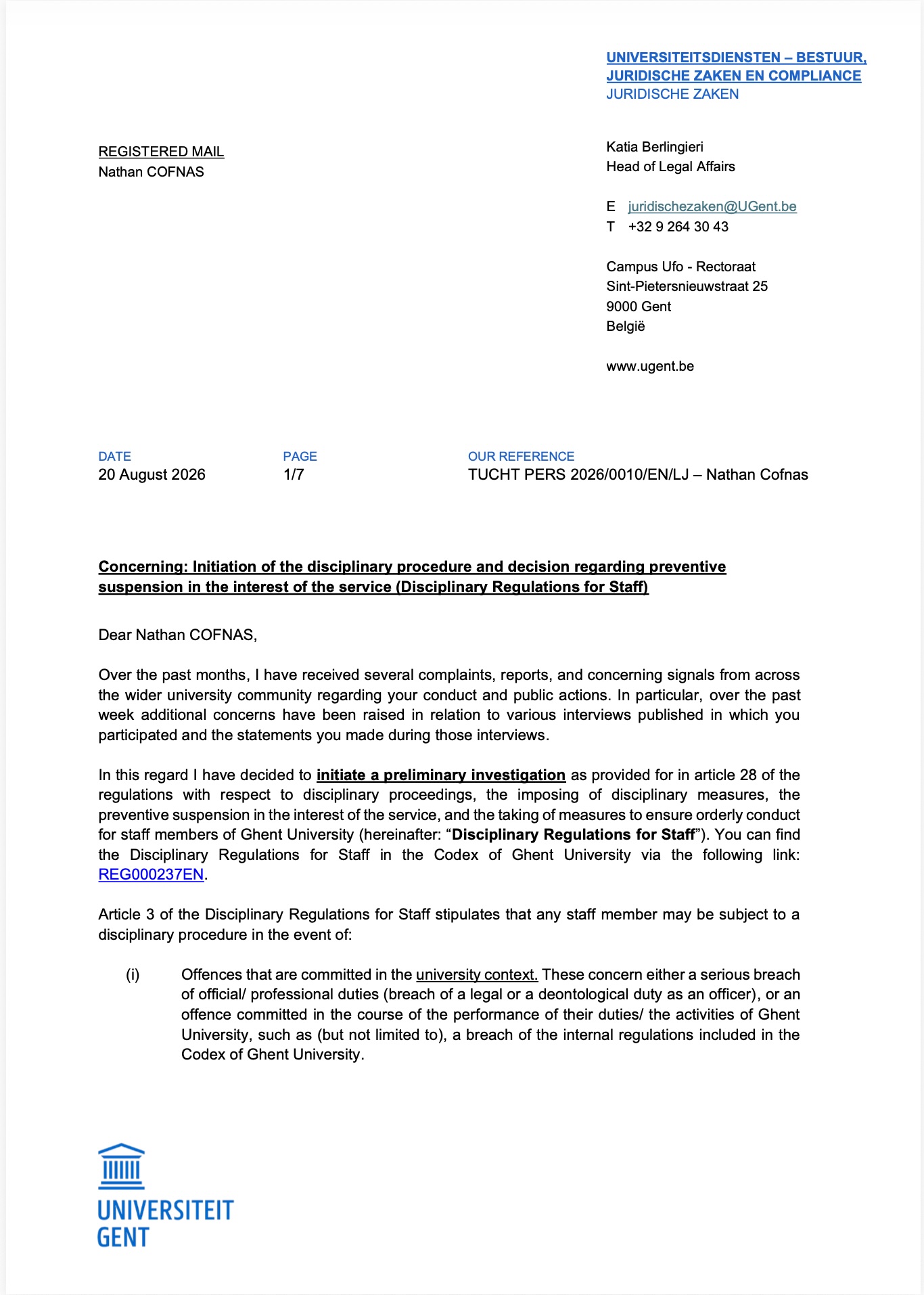
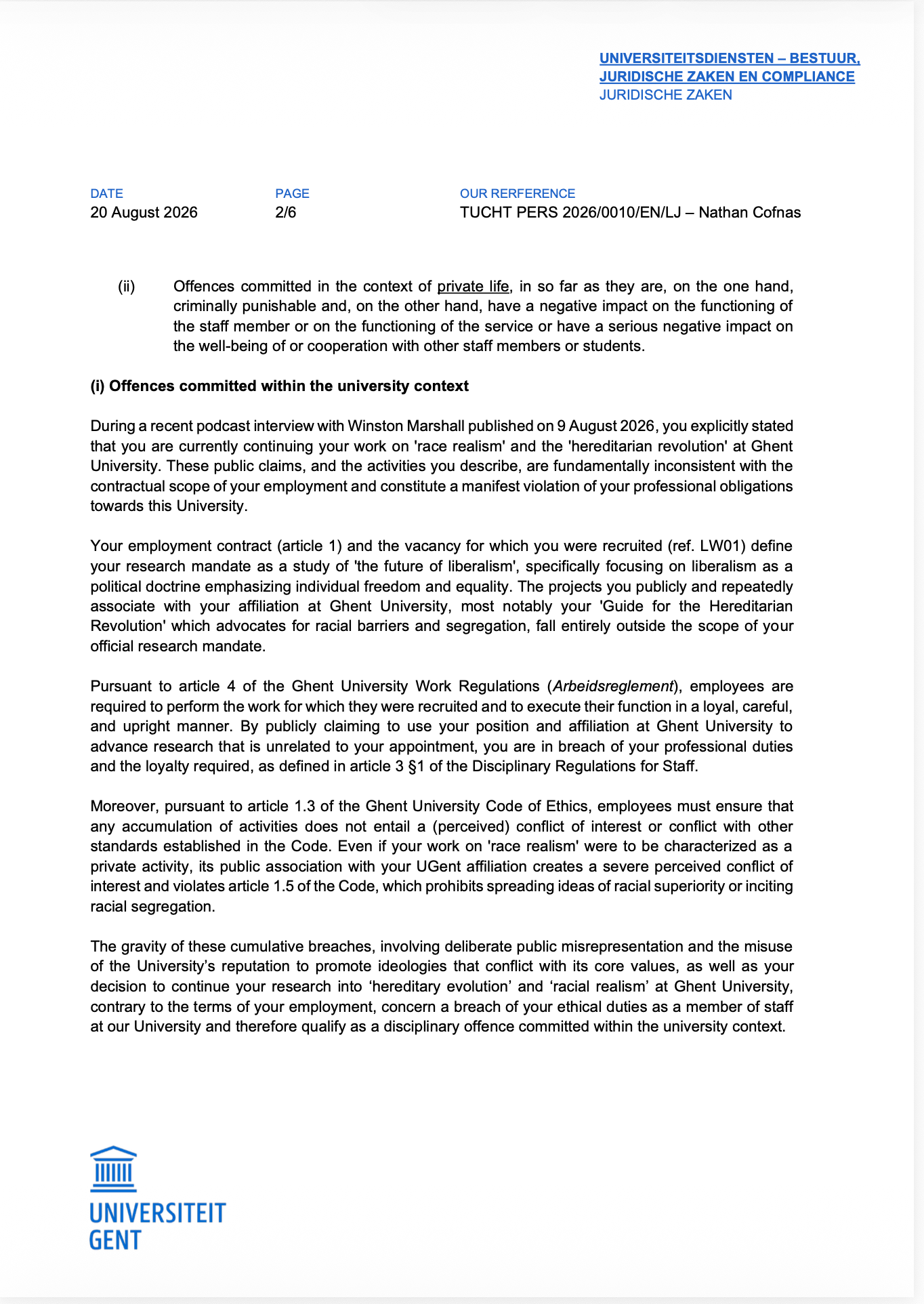
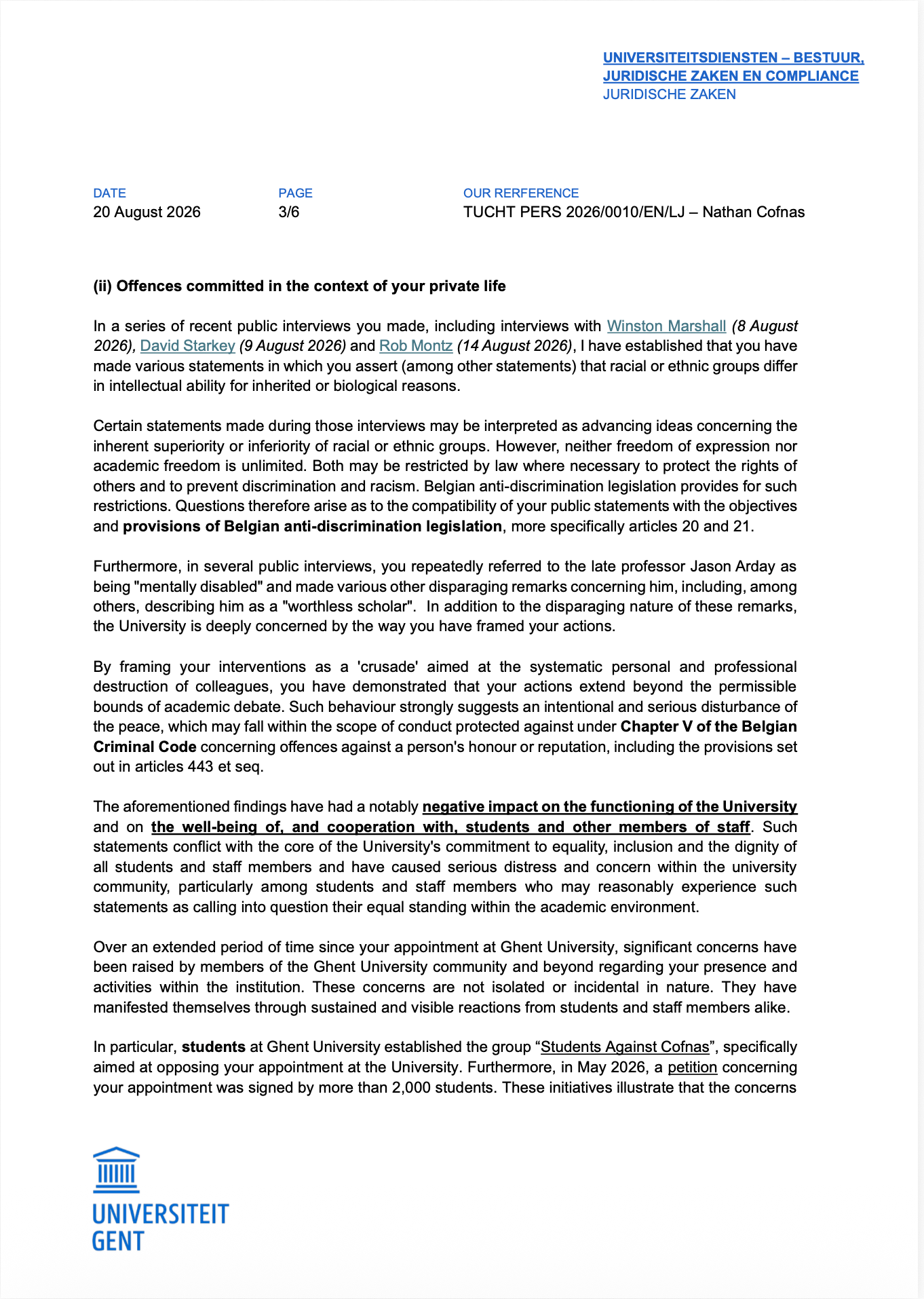
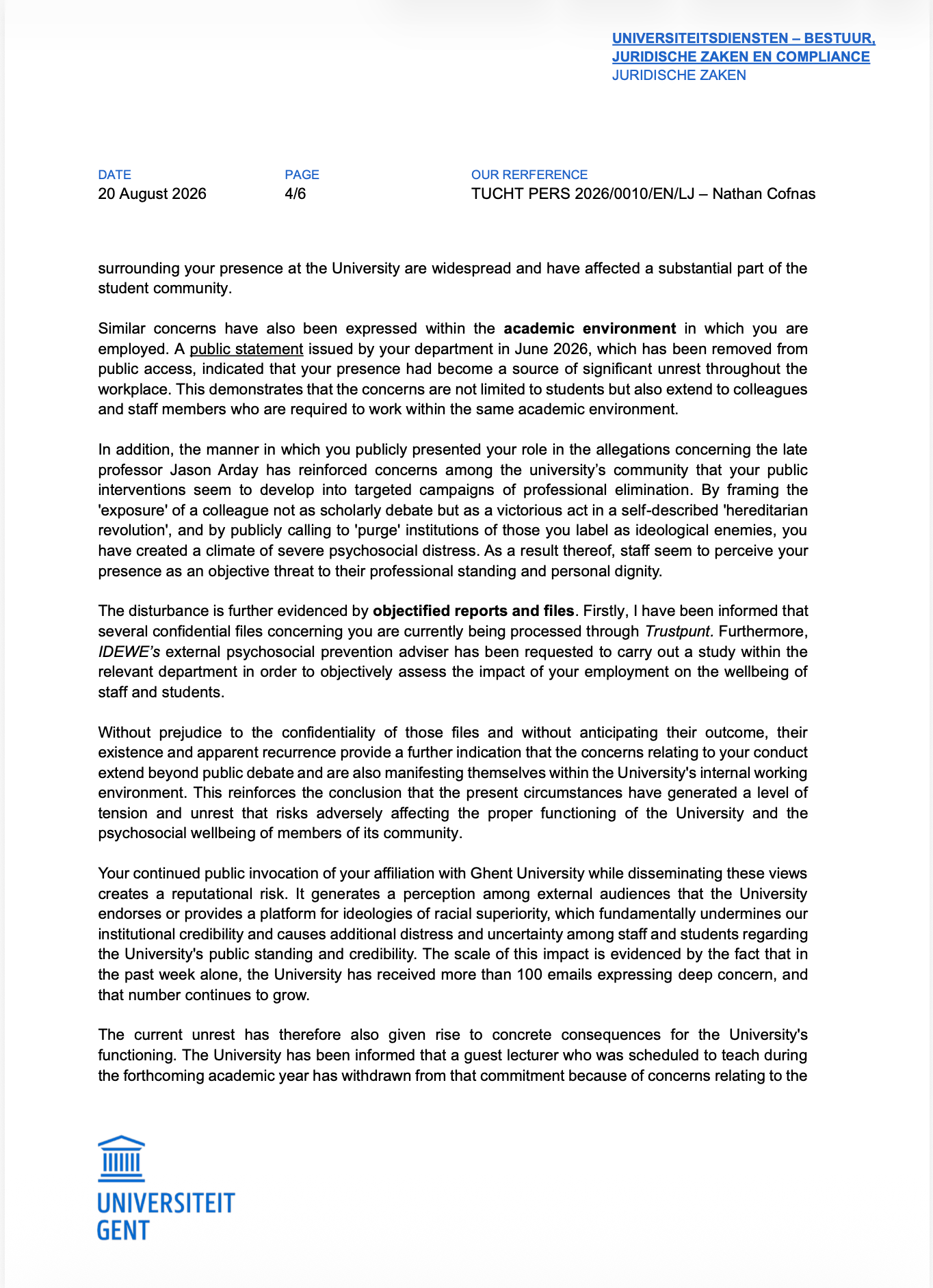
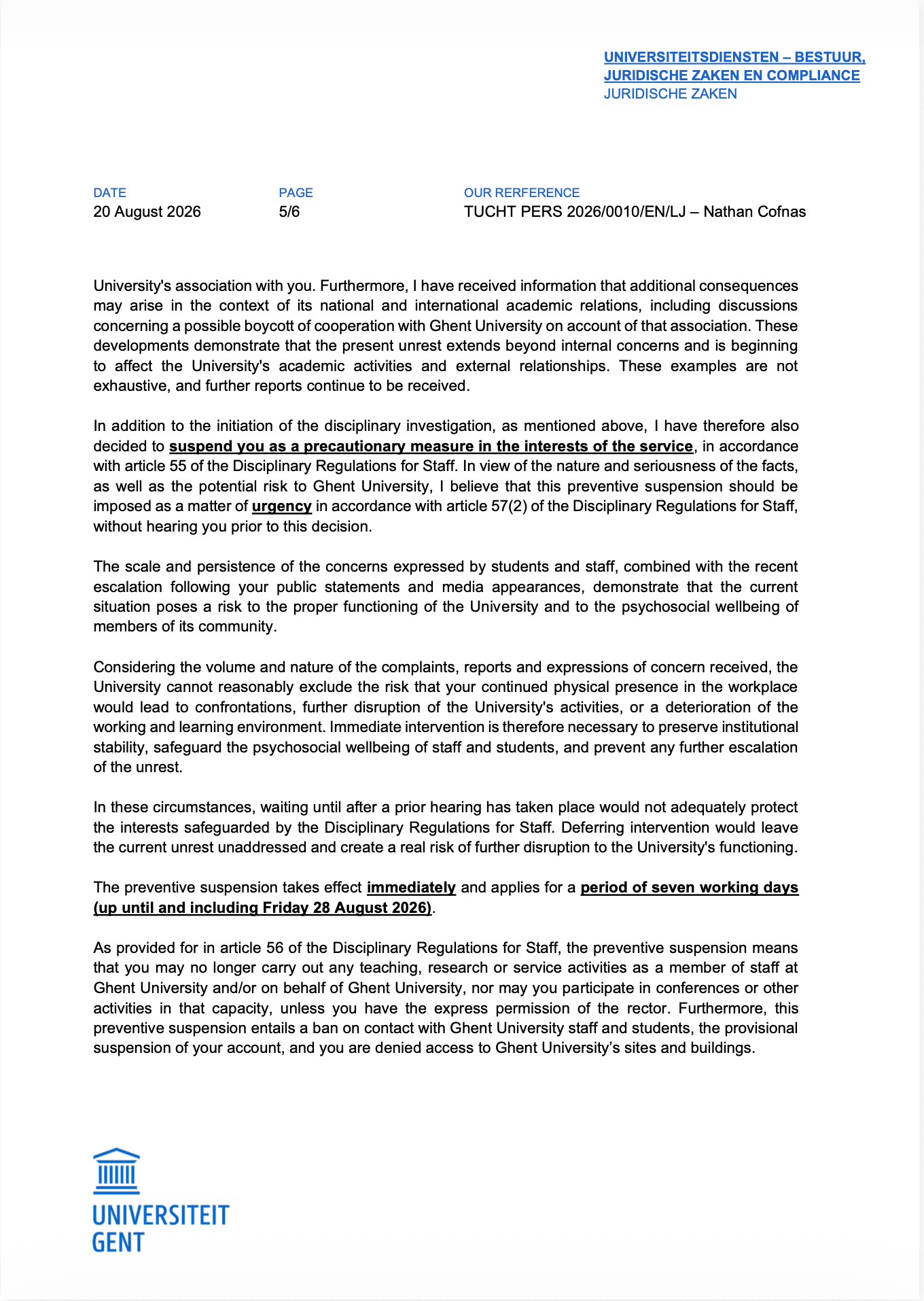
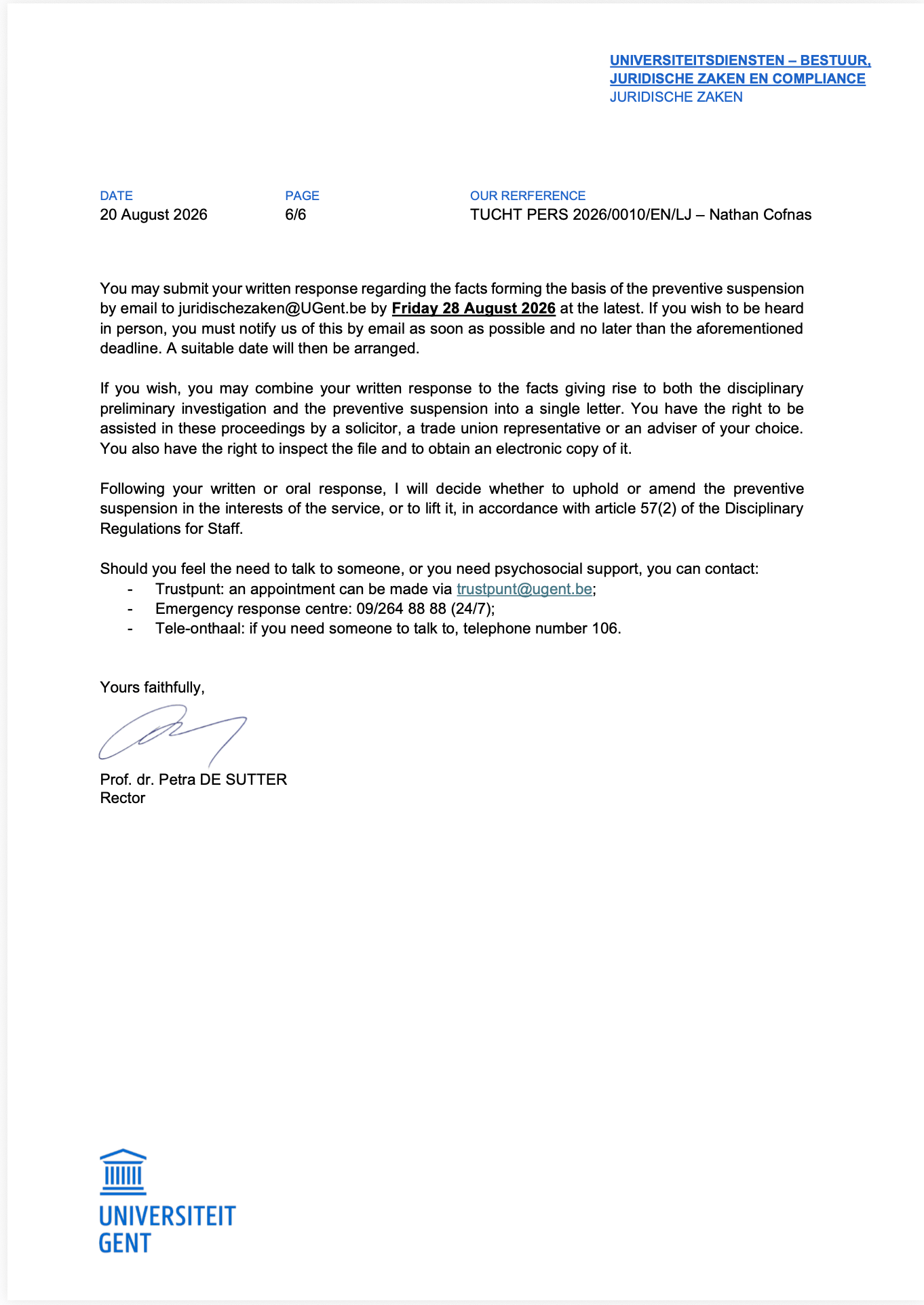
There are several things worth noting here:
- One of the accusations of Cofnas is that he was doing work that was “inconsistent with the contractual scope of [his] employment” and was therefore a “manifest violation of [his] professional obligations towards the University. That work was Cofnas’s work on race and IQ that, as an intellectual taboo, let to his leaving a research associate position at Emmanuel College at the University of Cambridge in 2025, and taking up a position as a postdoctoral fellow at the University of Ghent.
What strikes me here are two things. First, though I haven’t read Cofnas’s views and can’t say I sign onto them, I haven’t seen signs he’s an arrant racist. Rather, he’s engaged in academic work of a kind that is not supposed to be pursued. But if you work on this stuff, you’re deemed de facto a racist. Second, regardless of what Ghent told Cofnas to work on, few academics sign on to do specific things, and often pursue a variety of things. Maarten Boudry, who was at the same University but left because of its authoritarianism and anti-Semitism, worked on many things, including two papers with me on the nature of religious “knowledge.” This was just one of the many areas of philosophy that Maarten works and publishes on.
Surely Ghent knew that Cofnas would continue work that he’d been doing for several years. It seems that the nature of this work was not the real reason for his suspension, but that it was part of a chain of events that culminated in Arday’s death—a tragic event for which Cofnas bears no responsibility. The letter mentions several times the objections that were raised by others within and without the University against Cofnas’s hiring. These are irrelevant to issues of academic freedom but appear to have weighed heavily in his suspension.
- Ghent explicitly abrogates academic freedom and free speech by saying that his work violated the law against “discrimination”. Read this pitiful excuse for abrogating his freedom (bolding is by the Rector).
In a series of recent public interviews you made, including interviews with Winston Marshall (8 August 2026), David Starkey (9 August 2026) and Rob Montz (14 August 2026), I have established that you have made various statements in which you assert (among other statements) that racial or ethnic groups differ in intellectual ability for inherited or biological reasons.
Certain statements made during those interviews may be interpreted as advancing ideas concerning the inherent superiority or inferiority of racial or ethnic groups. However, neither freedom of expression nor academic freedom is unlimited. Both may be restricted by law where necessary to protect the rights of others and to prevent discrimination and racism. Belgian anti-discrimination legislation provides for such restrictions. Questions therefore arise as to the compatibility of your public statements with the objectives and provisions of Belgian anti-discrimination legislation, more specifically articles 20 and 21.
This is a “we support free speech and academic freedom, but. . . ” kind of statement. ” Apparently Belgium has “hate speech” laws, and Ghent decided to go ahead and suspend Cofnas because his work supposedly violated those laws. They didn’t wait for government charges.
- Finally, the Rector’s letter interprets the objections to Cofnas’s presence as substantial evidence that it will cause harm to the members of the university and impede its functioning. From the letter:
By framing your interventions as a ‘crusade’ aimed at the systematic personal and professional destruction of colleagues, you have demonstrated that your actions extend beyond the permissible bounds of academic debate. Such behaviour strongly suggests an intentional and serious disturbance of the peace, which may fall within the scope of conduct protected against under Chapter V of the Belgian Criminal Code concerning offences against a person’s honour or reputation, including the provisions set out in articles 443 et seq.
. . . Considering the volume and nature of the complaints, reports and expressions of concern received, the University cannot reasonably exclude the risk that your continued physical presence in the workplace would lead to confrontations, further disruption of the University’s activities, or a deterioration of the working and learning environment. Immediate intervention is therefore necessary to preserve institutional stability, safeguard the psychosocial wellbeing of staff and students, and prevent any further escalation of the unrest.
The upshot is that Ghent fired Cofnas supposedly because the nature of his work (which they well knew about when hiring him) was such as to wreck the “psychosocial wellbeing of staff and students”. I don’t believe that; what I believe is that Arday’s death inflamed opposition to Cofnas’s hereditarian views, and it was outside pressure got the cowardly rector to let Cofnas go. To me, regardless of Belgian law—and I don’t believe the Belgian police would have done anything to him—this is a violation of free speech (of course Belgium doesn’t mandate that), and certainly a violation of academic freedom. Regardless of Cofnas’s work or whether I agree with his conclusions (again I emphasize that I know almost nothing about his work), the work I do know about isn’t bizarre or crazy. It simply violates a common academic taboo. And once they’ve hired him, they can’t suspend him for doing the work they knew he’d do.
Here is a series of tweets. First, one from Cofnas himself:
I was just suspended by Ghent University. They will almost certainly fire me.
The decision was made by rector Petra De Sutter, a former leader of the Green Party.
— Nathan Cofnas (@nathancofnas) August 20, 2026
Maarten Boudry had earlier pointed out that De Sutter had made up quotes (or rather, used at least three AI-made-up quotes) in her inaugural speech at Ghent. Part of the letter to Cofnas was apparently AI-generated as well. That doesn’t mean De Sutter isn’t responsible for the letter’s content, as she is—completely. It just shows that she can’t trust her own words and has to use a bot, something I consider unethical if she doesn’t disclose it (she doesn’t). Further, as Boudry points out, De Sutter lied about what she did, saying that she just “paraphrased” the quotes (see below).
Btw, how fitting that rector Petra De Sutter, who previously used AI-hallucinated quotes in her inaugural speech (see here: https://t.co/NZfvqiUsyu), has apparently recruited AI again to produce this letter.
According to Pangram, the word salad below about a “targeted campaigns… pic.twitter.com/PCUonHPdoI
— Maarten Boudry (@mboudry) August 20, 2026
Jesse Singal can’t believe that the rector used fabricated quotes in her inaugural speech, but Maarten sets him straight:
Yup, Nathan Cofnas is not hallucinating, @jessesingal. Three out of four quotes in rector Petra De Sutter’s inaugural speech were AI hallucinations:
– A fake Einstein quote supposedly delivered at the Sorbonne (in English, lol).
– A fake quote from a nonexistent speech by Hans… https://t.co/DvPEwpye1A pic.twitter.com/kXkqiSfXEK— Maarten Boudry (@mboudry) August 20, 2026
While Ghent apparently sees Arday as the victim of a hate campaign by Cofnas, it’s ironic that the rector is pursuing a campaign against Cofnas.
I wrote a letter to Ghent University about the academic persecution of Nathan Cofnas.
Their complaints email is currently getting flooded by Wokes.
I think it is worthwhile to ensure they are aware that there is a heterodoxy of views on this issue. Feel free to copy my points. pic.twitter.com/ONTwMqIfcn
— Anatoly Karlin 🧲💯 (@akarlin) August 20, 2026
Finally, here’s an excellent tweet from the Committee for Academic Freedom about why Cofnas should not be suspended. Do read the whole statement.
STATEMENT: The Committee for Academic Freedom (CAF) is deeply concerned by Ghent University’s (@ugent’s) suspension of Dr Nathan Cofnas. While we take no view on the merits of Dr Cofnas’s — or any other scholar’s — views beyond the question of whether they are lawful, the reasons… pic.twitter.com/kSpBb60w5w
— Committee for Academic Freedom (@ComAcFreedom) August 20, 2026
Isn’t Veritas typically found inscribed somewhere at most every academic institution?
While I agree with the sentiments of those writing protest letters over the firing, I don’t think that I would bother. The Rector of Ghent (sounds like a good title for a play) knows exactly what she is doing. she knows that she will receive support from the indignant students demanding Cofnas’ firing, as well as the woke academics demanding the same. The opinions of those who believe that academic freedom of inquiry and academic honesty are irrelevant to her—and she has demonstrated (by her use of AI while forbidding it to students) that she does not care one whit for the latter. And clearly, the last thing that she wants in her university is an academic investigating dishonesty among his peers.
The rector of Ghent University knows what he is doing. The rector is a male cosplaying as a woman. He has no trouble pretending that false things are true (quotes from Einstein, transwomen are women, Cofnas is a racist, etc.).
The Rector of Ghent is a man who began identifying as a woman in 2004. He has previously been both a professor of gynaecology (also at Ghent) and a deputy prime minister of Belgium.
It’s rich that someone who was found to have used fabricated quotes hallucinated by AI in their inaugural speech has now suspended the person who was the first to put an analysis of Arday’s egregious plagiarism into the public domain.
Yes not only is he a fabricated woman, he is incompetent. He was a Minister in a Green party linked coalition government. As a Minister, the two government companies he was in charge of four years (Bpost & Proximus) lost much of their value.
The WSJ has an article about Cofnas this morning. It quotes Steven Pinker calling Cofnas tactless and saying of the race – IQ question, just don’t go there.
Gift link:
https://www.wsj.com/world/uk/the-controversial-academic-who-ignited-the-jason-arday-furor-1071e7fc?st=JfWrwn&reflink=desktopwebshare_permalink
I wonder how many of the quotes used in these allegations and articles deserve further context – nobody seems to be coming off well, and that seems deliberate.
It’s true that Cofnas is somewhat tactless (perhaps he has a slightly autistic attitude of saying what he thinks regardless of social niceties), but we need that sort of tactless person to break taboos, since everyone else is too afraid of ostracism.
As for “going there” over race and IQ, well, society really has no choice. The issue of why different racial groups succeed at school exams at markedly different average rates is not going to go away; you can’t expect people to not notice or not care. So we need to understand it. It’s either “systemic racism” — in which case we need to understand the mechanisms by which that operates and overturn them — or we need another explanation, of which the main contender is genetics, the idea that there are one-standard-deviation differences in cognitive traits in populations that have been largely separated for ~ 30,000 years (which, if you think about it, is actually a rather mundane possibility).
I agree. I was surprised to see the Pinker quotes.
I think the main contender is culture (though I don’t think we’re supposed to talk about that either). According to Perplexity.ai (unverified), in the U.S., Black children of foreign-born parents outperform Black children of American-born parents in math and reading by the time they reach kindergarten:
I quite like Prof Cofnas and have followed his work, and I know Anatoly Karlin (above).
Prof Cofnas is working on being the most unemployable man in Europe. And doing a bang up job!
I told him to apply to the Manhattan Institute and I have a spare bedroom if he needs it. 🙂
I’m not in 100% agreement with some of his conclusions but I don’t believe he is a racist. He’s smart.
The green troon persecuting him is, as you and Maaten write, …. a known quantity. That’s all I’ll say.
D.A.
NYC
Above all, one must not say that the Emperor has no clothes.
“Btw, how fitting that rector Petra De Sutter, who previously used AI-hallucinated quotes in her inaugural speech, has apparently recruited AI again to produce this letter.”
Wait, an administrator at a university is a spineless intellectual lightweight? No way! Usually these people are not allowed into such important positions of responsibility.
It’s almost as if many academic institutions are having issues with competence and commitment to core principles.
Here’s Cofnas’s Philosophical Psychology article. Racist? Judge for yourselves: https://www.tandfonline.com/doi/full/10.1080/09515089.2019.1697803
It doesn’t matter. He’s getting the James Damore treatment, as in “we are not going to address to the substance of your assertions…rather, they are considered de facto incorrect and problematic because they cause some people to feel bad.” Damore’s firing from Google might be defended on the grounds that Google is a company that exists to make money and not explore knowledge just for the sake of it, with a certain company culture, and that Damore was an “at will” employee who was expected to toe the line of that culture.
But this is completely indefensible for a university, which ostensibly does exist to increase human knowledge, which necessarily will involve some degree of “making people feel uncomfortable.” So to do this to a professor is inexcusable.
We continue to see the values of nursery school take over academia.
Totally agree. To “increase human knowledge” a university must explore different points of view on different subjects from different people. Instead they’re too often doing the opposite — and making it clear what happens to people who express unapproved points of view, or even ask unapproved questions.
Excellent points Jeff. Still and all it makes me wonder: if Google fires a truth telling employee who annoys other employees because he expresses heterodox views, how can we trust the company’s search engine algorithms to provide a list of accurate but possibly controversial answers? I couldn’t so switched to DuckDuckGo after his firing and have seldom used Google since.
That might be an improvement. At least nursery schools (preschools) have for the most part stayed true to their purported reasons for being, which does speak well for their administrators. Maybe Ghent would be managed better as an adult subsidiary of one. Certainly the make-believe and tantrums would be handled better, by people competent to do so.
And suzi, I too am a post-Google big fan of DuckDuckGo, both the search engine and the Duck.ai interface.
[Oy. Again with the moderation?? What, have I suddenly become more of a nuissance?]
The University of Ghent, specifically outlawing Dr. Cofnas’ hereditarian position, follows the academic example of the Holy Inquisition’s 1616 theological committee. The latter academic body ruled that a different scientific hypothesis was “foolish and absurd in philosophy, and formally heretical since it explicitly contradicts in many places the sense of Holy Scripture”. In the present case, Holy Scripture comprises numerous DEI assertions and bureaucratic rulings. In 1616, the Holy Inquisition did not bar Galileo from any specific academic posts (he held a titular professorship at the U. of Pisa), so the U. of Ghent today represents what Progressives view as Progress, since 1616.
The US Ambassador to Belgium has just condemned Ghent University (Cofnas is American).
https://x.com/usambtobelgium/status/2090820596632289384?s=61&t=GsMBiQuZcmIkqfCB_uBONw
Wow! But so what? Real question: what effect does a diplomatic condemnation have?
It isn’t clear to me that the rector is acting primarily due to external pressures. She might be but the tone of her letter suggests that Dr. Cofnas’ conduct has offended her deeply and personally. And, as others have suggested, his behavior may have made her fear that his pursuit of and communications about inconvenient truths might continue to roil up controversies in the future. Wikipedia’s description of her resume suggests that she might well have strong feelings about her notion of a just society. If she does, those feelings may have played an important part in her decision and in the tone of her communication to Dr. Cofnas.
“It isn’t clear to me that the rector is acting primarily due to external pressures.” It’s even worse than you think. As our host’s friend Maarten Boudry reports,
“This internal email from a tenured professor at Nathan Cofnas’ department shows…that the ‘barrage’ of complaints…was perfectly coordinated [and] was explicitly encouraged by rector Petra De Sutter herself. If this is true, she was actively egging on the hecklers in order to grant them a veto.”
https://x.com/mboudry/status/2090767747365896519
I wanted to read Cofna’s views for myself and found his apparently notorious essay “A Guide for the Hereditarian Revolution” here:
https://open.substack.com/pub/nathancofnas/p/a-guide-for-the-hereditarian-revolution?r=4rnl3g&utm_medium=ios
It’s an interesting argument, and I’m about halfway through at the moment. So far I agree with some of his views, but am skeptical of many of his assertions. Even if I disagreed with all of it vehemently, though — and had receipts— I think it’s still worthy of a careful reading and open access.
I don’t know if I really believe that Black people would really disappear from academia if academia were purely merit-based. I’ve met a ton of very smart and accomplished Nigerian people in my life. One former doctor of mine started medical school at age 15 in Nigeria. I remember reading, although Wikipedia disputes this, that the Igbo people of Nigeria have a high proportion of gifted, high IQ individuals. And I believe that the Caribbean produces some intellectuals and accomplished artists as well. I also believe he is overstating the importance of IQ in general. Emotional intelligence and interpersonal skills also contribute to one’s ability to succeed.
My other hesitation about “race realism” is that, even if true, I fear it would do more harm than good if widely embraced. Just as fetal protection laws have been weaponized against pregnant women, despite assurances they wouldn’t be, race realism would be used to hurt and hold back allegedly lower IQ groups, I’m sure.
Are you American, encountering Nigerians who have migrated to the US (as opposed to having lived in Nigeria)? The Nigerians who migrate to the US are indeed elite and capable, it’s hard to do (else the entire population of Nigeria would do it!), and that produces a strong selection effect.
Even if the mean IQs of populations are different, it’s important to realise that the distributions are still very broad, and all groups have a right-tail with lots of people 1, 2 or 3 standard deviations above average.
In a country like Nigeria, with a population of 240 million, there would be hundreds of thousands who are more than 3 standard deviations above that country’s average.
“Part of the letter to Cofnas was apparently AI-generated as well.”
And the rest was likely written by legal counsel. The Rector signed it; he owns it. Is that a problem? This letter was an administrative product, not an exercise in thinking or an attempt to acquire intellectual property rights. I wonder how much aversion to (or acceptance of) AI stems from varying professional cultures, the nature of the tasks most frequently at hand within a profession, and the currency of peer approval.
To the academics here, would you use AI to review what you consider your final product? Consider that exercise in absolution called the “Acknowledgments” page. How is using AI for a review different from using accommodating friends and colleagues? How many authors have thanked those who refined one’s thinking, offered suggestions for better framing, drew attention to alternatives, caught infelicitous phrases, provided substantive evidence, and so on? These are not mere typos being corrected.
Is there not a way to ensure the work is still your own despite any offered AI help—just as you can after suggestions from a colleague, editor, or friend? Yes, I understand it would be embarrassing to thank Grok or ChatGPT in a book that consumed five years of life. But why does the use of a machine seem to puncture the illusion of “sole” authorship and suggest lower competence when relying on the extraordinarily helpful insights of perhaps four or five leading scholars does not?
The trouble with using AI is that it becomes more difficult to fix its output than to write the thing yourself. I recently had Google translate an article (published on onet.pl) from Polish to English, to send to some friends. Good that I paid attention because in the translation, a statement was inserted that did not occur in the original at all. I cannot be sure if there was another one or more issue that I just missed. It looked PLAUSIBLE but that’s not why I translated the article. It requires a kind of “proofreading” that is really prone to “seeing what one wants to see.” If translations have such issues, how much worse it must be with academic papers that are supposed to be unique and contain assertions that were not made ever before?
“To the academics here…”. I use Claude to do data transformations and other quantitative chores that would otherwise involve a lot of error-prone copy/paste/type actions by my fat fingers. And I use Claude to supplement my literature searches in Web of Science and Google Scholar (Claude sometimes comes up with things my keyword searches fail to find). I don’t use any AI to write text or to do cleanup or review of the text I wrote.
ISTM from my use of LLMs that “reference librarian” should be added to the list of endagered jobs.
Short TED clip from the rector Petra De Sutter discussing genetically enhancing humans !!
https://x.com/WomenReadWomen/status/1710365844340179002/video/1
I can see why Pinker would refer to “race realism” is an example of “don’t go there” research and theory. Sorting people into racial identity groups, then assessing various characteristics correlated with such group classifications, can promote a tendency to regard individuals as mere representatives of those identity groups rather than as unique individuals. Such group-based thinking can easily lead to stereotyping, racism, and even (gasp) wokeness. People should be judged by the content of their character, not the color of their skin. Of course I would not stop Cofnas or any other academic from doing “don’t go there” research if they want to do so, but as others have pointed out, it would be rather risky to one’s career.
de Sutter is a man. He, not she, used AI inventions in a speech to the university. Please don’t insult women and distort reality by pretending he is one out, of fear, perhaps, of offending him. Think of your readers instead, please, who are offended by his presentation as a woman.
I did not know that de Sutter is a man; I just found out. So do not accuse me of insulting women. You might have asked before you raised accusations. You have two choices. You can apologize for me for jumping in before getting information, apologizing on this thread, or you can be banned. You have 24 hours to answer.
Of course I apologise! I am very sorry I assumed you had known and took you to task without clarifying it.
Even so, do not tell me what pronouns to use. That is a personal choice.
I am offended by your assertive, judgemental comment. Think of the readers instead of your own bloated self-importance.
And her is a link to the lecture Cofnas gave to a somewhat hostile audience at Ghent University some months ago: https://www.youtube.com/watch?v=nZsKQvaTku4
Being tactless is not a disqualifying trait for an academic. Being dilusional and dishonest are definitely disqualifying traits for a rector.
Yeah. So says the tactless academic.
I have to add here that this is not a Roolz violation because Jay and Anna are a couple!
Nice work — the step-by-step order makes this much easier to follow. Off topic, but when I need the text out of a TikTok clip I run it through TikTok transcript extractor and get an .srt in a few seconds.
I think there may be an irony here. Using AI to determine whether an AI has been used.
I routinely use Grammarly to check my composition. Is that ethical? In the olden days, I used Gregg or Strunk and White?