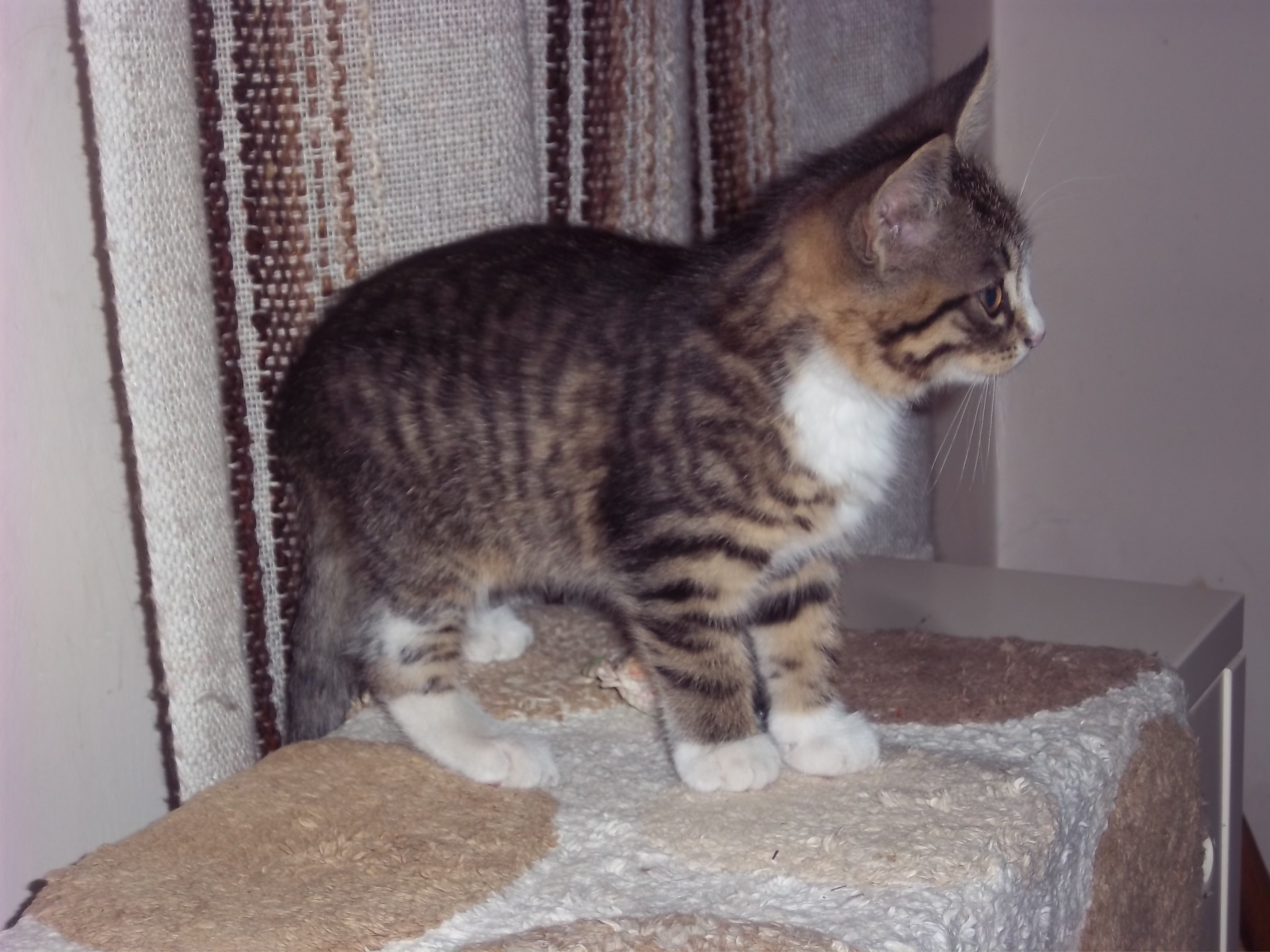
Caturday felid trifecta: Brian Cox vs. Robin Ince: Which is better, cats or dogs?; three-legged lion and brother swim across dangerous waters; scientific tails about cats; and lagniappe

October 19, 2024 • 9:50 am

Here’s a 45-minute BBC podcast of The Infinite Monkey Cage featuring physicist Brian Cox and comedian/actor Robin Ince, joined by others, arguing about the relative merits of cats and d*gs.  Here’s the BBC summary.

Brian Cox and Robin Ince sniff and paw their way through the evidence to put to rest the age-old debate of whether cats are better than dogs. They’re joined by TV dragon and dog devotee Deborah Meaden, comedian and cat compadre David Baddiel, evolutionary scientist Ben Garrod and veterinarian Jess French. They learn how the domestication of our four-legged companions by humans has had a profound impact on their physiology, temperament and methods of communication. They debate which species is the most intelligent and skilled and try to lay to rest the most important question of all – which one really loves you?

Click on the title below to access the podcast.

Veterinarian Jess French is, in my view, the most eloquent exponent for cats, which, of course, is the best of the two species. The voice vote at the beginning shows, as it did during our Cat-vs-D*g debate for the New Yorker, that the audience is biased towards cats, for people want to be constantly loved by an animal.

But Listen to Jess French at 7:01, giving the reason she favors cats, which comports with my own view. Dogs are obsequious, while cats decide when to spend time with you—and that is more like what humans do. (French is also a television presenter and a well known author of children’s books on nature and animals).There is plenty of biology (and some evolution) involved, but of course it being the Monkey Cage, there’s plenty of humor as well.

In the end the participants have to choose. One person equivocates, one votes for cats, and one points out that cat owners don’t live as long as d*g owners. But a voice vote again is for d*gs, which is sad. In the end, they talk about their favorite other species, and you’ll want to hear French talk about the scariest animals she’s ever treated.

It’s a good episode and well worth listening to for a Saturday morning laugh-and-learn

************************

From ScienceAlert we have a story and a video about two lion brothers, one with a missing leg, crossing a crocodile- and hippo-infested river in Uganda. Click the headline to see, and there’s a video below:

Excerpts:

A pair of lion brothers have been captured on video taking a death-defying 1-kilometer (0.6-mile) swim across a Ugandan river packed with predators – a sign of increasing human-caused pressures forcing animals to take more risks.

The brothers, Jacob and Tibu, crossed the Kazinga Channel at night. It’s the first visually documented long-distance swim for African lions (Panthera leo), and it involved a couple of false starts.

Researchers recorded potential predators possibly trailing the lion duo before they successfully made it across. In collaboration with the Uganda Wildlife Authority, the international team tracked their movements using heat-detecting drone cameras.

“Lions are known to hunt both crocodiles and hippos on occasion, but when in water they themselves become vulnerable,” the researchers write in their published paper.

“River crossings in Africa come with considerable risk of injury, or even death, from encounters with the much larger Nile crocodile or hippopotamus.”

The video (there is not much video of the swim, so watch carefully near the end):

They made it! A bit more:

“The fact that he and his brother Tibu have managed to survive as long as they have in a national park that has experienced significant human pressures and high poaching rates is a feat in itself,” Braczkowski adds.

The reason for Jacob and Tibu’s adventure? Most likely, finding females to mate with. However, this is less a story of romantic courage, and more a sobering tale about a lion population that has been decimated by poaching and expanding human activity across Queen Elizabeth National Park.

“Our science has shown this population has nearly halved in just five years,” says Braczkowski.

Indeed, there is a road bridge that the lions could’ve used more safely – but conservationists think that the presence of people on and around the bridge, which is currently being guarded by the Uganda Peoples’ Defense Force, would’ve put the brothers off using it.

Instead, researchers have observed lions choose the far-riskier, croc- and hippo-infested lake channel crossing six times.

. . . “Competition for lionesses in the park is fierce and they lost a fight for female affection in the hours leading up to the swim, so it’s likely the duo mounted the risky journey to get to the females on the other side of the channel,” says Braczkowski.

The research has been published in Ecology & Evolution.

Here’s the paper: click to read:

****************************

ListVerse gives 10 heartwarming and “scientific” stories about cats, many accompanied by videos. Click below to read, and I’ll show a few of the videos:

A contraceptive vaccine for feral cats, easier than trapping and neutering:

Cats sitting in squares:

Exceptional visual perception and brain wiring are why cats love sitting in 2D squares or other shapes, even if those shapes are incomplete (i.e., four cut-outs placed apart from each other in the shape of a square).

The fact that these appear to create an enclosed form is the Kanizsa square illusion, exploiting our brain’s tendency to fill the gaps and see contours that aren’t there. The same thing occurs in the cat’s mind, meaning your kitty will likely love a flat, incomplete square as much (or almost as much) as a fresh, cozy box.

If you have a cat, you may have noticed that they have whiskers on their legs. But what are whiskers for?

Cats don’t just have whiskers on the whiskers part of their bodies. They also have whiskers on the non-whiskers part of their bodies, including the back of their legs. These are called carpal vibrissae because carpus means wrist, and vibrissae is the fancy Latin scientific word for whiskers, or technically nose hairs.

Like the whiskers around their snouts, these vibrissae aren’t just to tickle you; they’re sensory organs used for sensing a cat’s surroundings. They can detect tiny movements, such as air pressure changes and the surrounding environment, to help cats navigate their world and achieve their superb feline agility. By using these wrist whiskers, as it were, cats can feel surfaces and objects, giving them better spatial awareness, environmental orientation, and hunting skills.

And a new breed of cat with unusual fur:

The universe released a new cat type, recently described by science, in May 2024. This rare, domestic Finnish feline has a novel coat pattern called “salmiak,” and it’s kind of a cookies-and-cream vibe. People in Finland began noticing the pattern emerging around 2007, noting that instead of conventional tuxedos, these black-and-whites rocked a color gradation, like a sprinkling of salt and pepper. The ombré effect occurs as the fur grows lighter from root to tip, from black to white.

To make it official, scientists identified the genetic mechanics in the journal Animal Genetics as “a 95-kb deletion downstream of the KIT gene.” Ah, of course, that makes so much sense! In more understandable terms, a missing piece of DNA leads to the “salmiak” coat type, named after a popular type of Finnish salty licorice. Because Finnish people love licorice for some reason. But they love cats, too, so it evens out

********************

Lagniappe:  Cats in a Japanese cat cafe react to a 2018 earthquake. I’m betting they started reacting before humans detected the quake, and they flee quickly.

h/t Barry, Bill


Caturday felid trifecta: Cat named Squishy rescued from trash compacter; four-eared rescue kitten named Audio; Minneapolis’s popular Cat Walk; and lagniappe

October 5, 2024 • 8:45 am

We’ll begin Caturday with my favorite: a cat rescue story from the Washington Post (click on headline below, or find it archived here).  This cat squeaked through, but acquired a rather grim name:

An excerpt:

Mark Motta was checking the hydraulics on a recycling truck just past 7 a.m. when he noticed two shiny eyes looking at him from behind the compactor’s crushing mechanism.

Motta took a close look and saw that a tiny gray and white kitten was stuck in the hopper, where recyclable materials are loaded and compacted. The kitten was covered in oil and shaking in fright.

The driver of the truck, Moses White, had already started the engine to head out on his rounds in Burlington County, N.J., that day, July 8. Motta told White to turn off the engine, then he climbed into the truck’s bin and delicately pried the kitten free from the hopper.

“I’ve had cats my whole life, and I know that when they’re babies, if you grab them by the skin on their necks, it makes them think they’re being carried by their mother,” he said. “So that’s what I did.”

The kitten didn’t fight him.

“She was really scared, but she seemed happy to be rescued,” he said.

Motta used his bright yellow safety shirt to wipe the kitten off the best he could, then he called safety officer Samantha Stamile to let her know what had happened.

Stamile told Motta to put the kitten in a box, then she rushed to her office.

“I got there, and there’s this sweet little kitten, absolutely saturated in some kind of oil from inside the truck,” she said. “She also had a green eye discharge, and she was wheezing. We decided to clean her up right away.”

Stamile and Motta took the kitten to the fleet mechanic shop and gave her several baths with Dawn dish soap to remove the oil.

“The first bath did nothing — she needed quite a few,” said Stamile, noting that she also cleaned the kitten’s eyes with a saline solution and gauze.

Motta decided there was only one name that suited the cat: Squishy.

“I thought it was perfect, because if I hadn’t seen her that morning, there would have been no saving her,” he said.

And so the nice man rescued Squishy!

Stamile gave Squishy some cat food, then took her to All Creatures Veterinary Care Center in Sewell, N.J., where she was examined at no charge and given antibiotics for an upper respiratory infection. The vet said she appeared to be about 2 months old.

Otherwise, the kitten was fine, Stamile said, so she contacted Rise Again Animal Rescue, a New Jersey animal foster and adoption nonprofit. The Asbury Park Press was among several local news organizations to cover the happy rescue.

“I told them I’d like to foster Squishy until she’s old enough to be spayed, vaccinated and put up for adoption,” said Stamile, 30, who has fostered cats for four years for the animal rescue.

Ekaterina Sedia, a founder of Rise Again Animal Rescue, said she added Squishy to her adoption list.

And the safety officer rescued the cat:

Stamile said her two daughters, Arabella, 7, and Adelyn, 2, were delighted when she brought Squishy home and introduced her to the family’s other cat, Rascal.

“My kids have always loved fostering cats, and it instills the importance of treating all life kindly and with respect,” Stamile said.

Squishy is a good fit with the household, and she now enjoys romping around with Rascal and playfully jumping on everyone’s bare feet when they wiggle their toes, she said.

The story from Facebook’s Rise Again Animal Rescue:

And here’s a similar story from California, this time in a recycling plant:

************************

A kitten with four ears was found in Tennessee. Click to read:

An excerpt (story is from July 31):

A Mt. Juliet shelter is now the temporary home of a four-eared kitten, whose presence at the facility is shedding a light on a growing need for support.

True Rescue in Mt. Juliet said it’s the largest communal cat recue in the South.

The shelter recently welcomed a new litter found abandoned in a box, including a four-eared feline that staff members have named “Audio.”

They’re really creative with the names, aren’t they?

Kristin Condite, the director of operations for True Rescue, told News 2 that employees first noticed the extra pair of ears during an exam: “Whenever we took him out of his carrier, my counterpart said, ‘What’s on his ear?’ And when we looked closer, it appears as if Audio has actually four ears on his head, so he has two right facing and two rear facing. It’s extremely abnormal.”

Audio:

Eight-week-old Audio and his ear-resistible charm are garnering a lot of attention on social media, which is putting the shelter in the spotlight at a time when it’s most needed.

“We’ve had ongoing issues with drainage problems and foundation issues, but this past Sunday, a week from Sunday and Monday, back-to-back evenings we had water in the building. Sunday night, it was four inches from the rear wall to the front doors,” said Condite.

. . .Eight-week-old Audio and his ear-resistible charm are garnering a lot of attention on social media, which is putting the shelter in the spotlight at a time when it’s most needed.

“We’ve had ongoing issues with drainage problems and foundation issues, but this past Sunday, a week from Sunday and Monday, back-to-back evenings we had water in the building. Sunday night, it was four inches from the rear wall to the front doors,” said Condite.

As for Audio, shelter employees said they will not remove his extra ears unless they start to harm him.

If you want to adopt Audio, you’ll have to wait a few more weeks as he continues to be monitored by doctors. In the meantime, the four-eared feline is bringing extra joy to True Rescue.

“A really frustrating week. There have been a lot of setbacks since the flooding that have been going on in our world, and for Audio to come at this time…it really does feel like a good luck charm,” Condite said.

To check out all of the adoptable animals at True Rescue, click here.

x

And a video of Audio. It’s not clear whether he’s been adopted (if you want to find out, you’ll have to click above and fill out a form, though I didn’t get a response when I searched for “Audio”. I’m betting he was adopted!


**********************

The Dodo reports on an annual Cat Walk that started innocuously in Minneapolis, but now has become a big annual event. It’s now happened seven times, and hundreds of people go on the two-hour Cat Tour.

If you live there, you may want to participate:

An excerpt:

Small cats. Big cats. Young cats. Old cats.

Whatever kind of cat you have, the people of Wedge, a neighborhood in Minneapolis, Minnesota, want to see them.

In 2017, John Edwards, the editor and publisher of Wedge Live, an online publication, started the town’s first annual cat tour, taking participants through Wedge to admire the neighborhood cats.

Edwards said the idea sprang from two things: One was his habit of going on long walks by himself, during which he took photos of neighborhood cats and posted them to Wedge’s X (formerly Twitter) page. The other was the town’s preexisting walking tours of historic homes.

“I combined the popularity of the cat photos on Twitter with making fun of the idea of historic home tours,” Edwards told The Dodo. “The first tour we held was called the ‘Historic cat walking tour’ or something like that.”

The first cat tour was small. Edwards only remembers about 20 to 30 people in attendance. But over the years, the tour has grown tremendously — both in size and popularity.

“It’s gotten so large at this point that it’s difficult to interact with people on the tour and say, ‘Hey, you know, this is this cat’s name, and they are this many years old,’ and stuff like that,” Edwards said. “Now it’s basically a mob of people walking around the neighborhood, following me at the head of the line — but the crowd is so big that I can’t really see the back of the line. It’s organized chaos, flowing through the neighborhood, spilling off the sidewalk. Street traffic gets blocked.”

Cat lovers eager to show off their felines can register in advance for the tour to pass by their house. However, according to Edwards, many cat owners spontaneously join the tour by showcasing their cats as the crowd wanders by.

“Cat owners realize the cat tour’s coming through, and they’ll bring their cats up to the window,” Edwards said. “We end up with maybe twice as many cats as the ones who are pre-registered.”

While some people simply bring their cats to the window, others take them outside on leashes or in  shopping bags, backpacks and strollers. Some go the theatrical route, presenting their cats “Lion King”-style on their balconies, which results in loud cheers from the crowd of walkers, Edwards said.

“It shocks me each year that people love it,” Edwards said. “It just started as a concept and interesting theme, and those don’t always work out to be great in reality, but this is beyond anyone’s wildest expectations for how successful something like this could be.”

Here’s a news report on the Cat Walk:

********************

Lagniappe from Simon: Happy Caturday!

e3dsx3erfgvve32`12`1dc 2c

h/t: Gregory

Caturday felid trifecta: The top ten Kiffness songs; Find the Cat picture; cat lost in Yellowstone travels 800 miles to get home

September 28, 2024 • 10:00 am

The Kiffness is the screen name of David Scott, a South African famous for his cat videos accompanied by original music.  Wikipedia says that his videos are mostly political, criticizing the government, but of course we know him as The Cat Composer. Here are his top ten “cat jams”, courtesy of reader Divy. She likes #2, but my favorite is #7. the “num num” song.

Wikipedia adds this:

In September 2024, Scott produced a video satirising a claim made by the American Republican presidential candidate Donald Trump in the Trump-Harris presidential debate. Trump repeated unverified reports that Haitian immigrants in Springfield, Ohio were eating cats and dogs kept as pets by members of the local community. The claim was subsequently denied by the mayor of Springfield, Rob Rue, and widely ridiculed in the media. Scott’s video, “Eating the Cats”, has since gone viral on social media.

And here’s that video, which is awesome. Its proceeds go to the SPCA in Springfield, Ohio, where the cat rumor started:


*********************

Can you find 20 cats in this picture? I found nineteen. Click to enlarge:

*********************

Finally, the NYT has a good cat story (click on screenshot below, or find it archived here), reporting that a two-year-old Siamese cat, who escaped on a family visit to Yellowstone National Park, has made its way home after an 800-mile journey:

When a cat dashed into the woods of Yellowstone National Park during a camping trip in June, his California owners, Benny and Susanne Anguiano, thought they’d never see him again.

The couple searched for five days through the woods near their campground at Fishing Bridge R.V. Park but never found their 2-year-old male Siamese cat, Rayne Beau, pronounced “rainbow.” Mrs. Anguiano said that Rayne Beau’s sister, Starr, started to meow through the screen door of the trailer. Eventually, when the couple made the tough decision to drive home to Salinas, Calif., Starr, who had never been away from her brother, meowed all the way back.

“Leaving him was unthinkable,” Mrs. Anguiano said. “I felt like I was abandoning him.”

But almost two months later, Rayne Beau was found wandering the streets of Roseville, Calif., three hours north of where the Anguianos live and more than 800 miles away from Yellowstone National Park, as first reported by the news station KSBW.

When a worker from a local Society for the Prevention of Cruelty to Animals notified the couple that rescuers had identified Rayne Beau from his microchip, Mr. Anguiano said they were shocked that the cat had made it back to California.

. . . . When a cat dashed into the woods of Yellowstone National Park during a camping trip in June, his California owners, Benny and Susanne Anguiano, thought they’d never see him again.

The couple searched for five days through the woods near their campground at Fishing Bridge R.V. Park but never found their 2-year-old male Siamese cat, Rayne Beau, pronounced “rainbow.” Mrs. Anguiano said that Rayne Beau’s sister, Starr, started to meow through the screen door of the trailer. Eventually, when the couple made the tough decision to drive home to Salinas, Calif., Starr, who had never been away from her brother, meowed all the way back.

“Leaving him was unthinkable,” Mrs. Anguiano said. “I felt like I was abandoning him.”

But almost two months later, Rayne Beau was found wandering the streets of Roseville, Calif., three hours north of where the Anguianos live and more than 800 miles away from Yellowstone National Park, as first reported by the news station KSBW.

When a worker from a local Society for the Prevention of Cruelty to Animals notified the couple that rescuers had identified Rayne Beau from his microchip, Mr. Anguiano said they were shocked that the cat had made it back to California.

. . . Both Mr. and Mrs. Anguiano believe at some point that their cat had hitched a ride or was picked up by a driver heading toward California for part of his journey, but they do not know for sure. The couple is hoping that someone who might recognize their cat could help explain how he made it back.

“The fact that he was in California and just three hours north of us — I think that proves more that Rayne Beau was the one trying to get towards his home,” Mrs. Anguiano said.

While not common, it’s not the first time a pet has inexplicably traveled hundreds of miles to return home. The distance from their campsite in Yellowstone National Park to Roseville, Calif., where Rayne Beau was found, is more than 800 miles, and a journey would have taken him through four states in mountainous and desertlike conditions.

When the couple reunited with him, they said that Rayne Beau had lost 40 percent of his body weight. He was restless in his carrier, but once they released him in the car he calmed down.

“He just looked at me, and then he put his head down and just fell fast asleep,” Mrs. Anguiano said. “He was so exhausted.”

Here’s an AP video of the rescued moggie:

h/t: Divy, Ginger K.

Caturday felid trifecta: Dude the Museum Cat; Cat who helped trafficked women is honored; cat hates cat-sitter; and lagniappe

September 21, 2024 • 9:30 am

This ginger tom, “Dude” is quite famous on the Internet. He helps run the Delaware Museum of Nature and Science, and he’s now sixteen, a Senior Cat. But the Dude abides.

The Museum has put up a number of videos of Dude at work, which are below:

Rescue Cat Goes To Work At A Museum With His Dad Every Day (The Dodo)
Rescue Cat Goes to Work At A Museum With His Dad Every Day (The Dodo on Facebook)
This cat runs a museum (The Dodo on TikTok)
‘Dude the Cat’ has earned many titles at the Delaware Museum of Nature and Science (6ABC)
Cat Goes to Work Daily With His Human at a Museum (Laughing Squid)
Delaware Museum resident Dude, the rescue cat, goes viral on YouTube (Delawareonline)
Hear about Dude the museum rescue cat from his cat dad Chris Hayden (Delawareonline)
The Dodo fell in love with ‘Dude,’ a famous museum cat in Delaware (Delawareonline, subscribers only)
These cute animal ambassadors will make you smile (10 Best)

Dude also has a Facebook Page and an Instagram Page. His story is in the short video below

***********************

The BBC (click the picture) has the story of Marley, who at the time was a competitor in the National Cat Awards given by Cats Protection in four categories, Family Cats, Incredible Cats, Connected Cats, and Senior Cats (click the link to see the winners. Now, I find, Marley won the category of Incredible Cats. Click below to see the pre-award description of Marley

From the BBC:

A cat who helps women who have been trafficked is a finalist in this year’s National Cat Awards.

The event, organised by charity Cats Protection, highlights the “incredible bond” between cats and people.

Black and white Marley lives at Caritas Bakhita House, a safehouse in London for women who have been enslaved, exploited and trafficked.

Karen Anstiss, 59, the head of the house, said Marley was the “fluffy heart of our home”.

. . . . Marley is a finalist in the Incredible Cats category.

Ms Anstiss said seven-year-old Marley had helped bring comfort and hope to the 11 women who currently live at the safehouse.

“Often Marley placing a gentle paw on our guests’ legs is the first kindness they’ve experienced in years,” she said.

“He has this incredible gift of empathy, knowing instinctively who needs him.

“We adopted Marley four years ago and I think he’d suffered abuse as he is terrified of men aged around 30. So he recognises our guests’ trauma.”

And from Cats Protection:

. . . . One woman was in such distress she couldn’t speak to us, only to Marley. But, because she trusted him, over time we were able to build a bridge and reach her.

Marley, who is seven, is also staff supervisor, security guard, patrolling the grounds, and chief gardener. Nobody is allowed to touch his patch of daisies! In art therapy he’s a popular muse and one guest even composed a song for him. At 7pm staff and guests sit down for dinner together, like a family, and Marley joins us. He’s the fluffy heart of our home.”

Here’s a YouTube video of Marley, and it will make you tear up:

***********************

From Parade Pets we have a TikTok video of cat being chastised by the cat-sitter, whom it apparently hates. Click below to read; I’ve embedded the video.

The text:

Cats aren’t big fans of change. This can be a problem if you go out of town and leave them with a sitter—especially if they aren’t a fan of that person. One kitty knows this all too well, and she’s not afraid to let her feelings be known (hisses and all)!

In a September 2 TikTok video shared by The Burton Bunch (@uvacase), the gray cat gives her sitter a piece of her mind and she’s not holding back. It’s so hard not to LOL at this.

Sound up, of course:

@uvacase

My BFFs cat still hates me. Bless her heart. ❤️😬😾#angrycat #catsoftiktok

♬ original sound – TheBurtonBunch

The 38-second clip captioned, “My BFFs cat still hates me. Bless her heart,” shows the cat’s angry conversation with her temporary sitter. Though the woman explains the feline’s parents will be home soon, the kitty meows and hisses in response. If we had to guess, she’s not saying anything nice!

With more than 25,000 likes, many people are shocked the cat seems to understand the sitter’s words.

“The hissing at ‘May the Lord have mercy on your soul’ is wild,” one person. wrote. “The way its responses changed with each of your questions was crazy! That cat knows exactly what you’re saying!” another noted. “I was hoping for one last hiss, and the cat delivered,” another added.

Many had a lot of feelings over the cat’s hissing almost on demand and shared similar stories of their own interactions with angry cats.

“I watched my sister’s cat while she was on a ski trip in the 90s. I’m still scarred, emotionally and physically,” one person commented.

“That’s like my son’s cat. Even though I’m the one who found him, he always hisses at me when I go feed him when my son’s away. Can’t figure

************************

Lagniappe: Hili’s rescue. This picture of baby Hili was, says Malgorzata, “taken a day or two after we got her.” Hili was born in June of 2012, part of a litter of cats in Dobrzyn.  The staff of the kittens contacted the father of Paulina, the present lodger upstairs (Paulina was young and didn’t live upstairs yet), and that father decided that Andrzej and Malgorzata needed a cat after their beloved Pia, a very small tabby, died.  (There used to be “Pia dialogues” on this site. In October Paulina and her sister came over to Andrzej and Malgorzata’s house with one of the kittens, and said tht they needed this cat. And that is how Hili came to be adopted.

h/t: Malcolm, Ginger K.

Caturday felid trifecta: The Lion Whisperer visits his friends; why your cat follows you to the bathroom; and hero cats

September 14, 2024 • 8:30 am

Kevin Richardson (born 1974) is known as “The Lion Whisperer” because he develops a personal relationship with the semi-feral lions at his Welgedacht Private Game Reserve near Pretoria. (His YouTube channel is here.)  He’s been criticized for not really contributing to lion conservation, but I find myself mesmerized by the plethora of videos showing his interactions with lions, many whom he has known since birth. Here he makes the rounds of several groups, giving some of the lions eggs and even catnip, as well as scritches and brushing.

**************************

If you have a cat, chances are that it’s followed you to the bathroom and watched you when you were seated on the throne.  Some people even find this embarrassing, though I’ve never understood why. Do they think their cat is a voyeur, or is judging their behavior?

At any rate, the question remains about why they do it.  This short article in Yahoo argues that SCIENCE has the answer.  But before giving an answer, SCIENCE should have answered this question, which it didn’t: do cats follow you to the bathroom more often than they follow you to other rooms?  That would take only a simple test, but they didn’t do it.

Let’s accept for the moment that cats do indeed preferentially follow people to the bathroom to watch them excrete.  Here are some suggestions from SCIENCE:

Excerpts:

If you’re not a cat owner, it’s hard to explain the situation, but here’s the gist: You go to the bathroom, and your cat rushes in next to you. It then proceeds to watch you pee, like a fluffy little gargoyle. [JAC: Of course it’s not just peeing!] It then proceeds to watch you pee, like a fluffy little gargoyle. If you try to lock the kitty out, it wails and scratches the door like a maniac. It’s a phenomenon science has produced little to no explanation for.

“I have two cats, and if I don’t keep the door open when I use the bathroom one will yowl like her entire heart is broken,” cat owner Phoebe Seiders tells Inverse. “The other I can only assume tries to free me because she, like, flings herself against the door as high up as she can jump. When I do keep the door open they like to come in and jump in the tub (as long as it’s dry).”

It turns out that, of course SCIENCE doesn’t even have answers that might be correct, but it does have some suggestions:

There are tons of stories like Phoebe’s, but no concrete evidence to explain them. According to cat researcher Mikel Delgado, a postdoctoral fellow at the School of Veterinary Medicine at UC Davis, scientists don’t have answers but certainly some ideas.

“There might be various reasons cats like to join people in the bathroom,” she tells Inverse. “Their litter box might be in there, so it could be a room that smells very familiar. Cats also probably know that when we are on the toilet, we are a captive audience — nowadays we are so busy and distracted that many cats are probably looking for an opportunity to have our undivided attention!”

Cats also might enjoy the “cool, smooth surfaces of sinks and tiles,” or even water, Delgado adds. This can make for some seriously priceless photo ops.

. . . Since cats in the wild are pretty solitary creatures, wildlife biologist Imogene Cancellare says domestic cats’ bathroom obsessions are pretty obscure.

“Lap sitting is really popular in the loo — I assume this is characteristic opportunist behavior to find the warmest spot in the house and exploit the attention of their human servants,” Cancellare tells Inverse. “I think they want to be the center of the universe and have learned that humans don’t do much when sitting in the small room with the strange water chair.”

I like the “captive audience” theory, for cats can surely associate a bathroom with a human trapped in place.  About the lap stuff, well. . . .

And then SCIENCE, after proffering a few lame theories, punts in favor of extolling moggies:

We may never fully understand why cats do the things they do. But we do know they make our lives complete, in mildly terrifying, infinitely inexplicable ways.

Photo of Nozka the cat by davynin, https://creativecommons.org/licenses/by/2.0/

*****************************

Here’s a 10-minute video showing “hero cats” protecting people from danger or confronting dangers in the wild, including cobras, bears, and coyotes!. That standoff with dogs are amazing.  Did you know that cats were this courageous? No worries: no cats appear to have been harmed.

The last bit of the video also highlights cats’ athletic abilities.

h/t: Merilee, Ginger K.

Caturday felid trifecta: Larry, the world’s most-cited cat; testing a cat’s agility limits; why cats steal; and lagniappe

July 27, 2024 • 10:30 am

This will be the last Caturday felid for a while because I’ll be in the air heading to Africa a week from today.  I’ll be gone for a month, and don’t know how often I’ll have internet.  However, Matthew has vowed to continue Hili’s daily dialogue.

Cat posts will resume when I return. As always, I do my best.

The first item today reports a well-cited cat but also demonstrates the weakness of the scientific citation system against scams.  The article below (see also this article from ZME Science)  is from the website of Reese Richardson, a “a PhD candidate working in metascience and computational biology at Northwestern University.”

Click to read how Reese used this scam to get his cat to have a huge rate of citation as author of scientific papers:

Reese saw the ad above on Google Scholar and it turned out to advertise a service that “helped” scientists to manufacture fake citations of their papers—for a price. As Richardson notes:

The advertisement links to several success stories consisting of unredacted “before” and “after” screenshots of clients’ Google Scholar profiles. These clients had apparently bought anywhere between 50 and 500 citations each. Of 18 apparent previous clients, 11 still had active Google Scholar profiles that we could visit. All identifiable clients were affiliated with Indian universities except for two: one client affiliated with a university in Oman and one client in the United States. Although the advertisement also mentions Scopus, we did not find evidence of this company successfully boosting these clients’ Scopus citation counts.

Here’s how it worked:

How was this company so effective at manipulating citation counts? For some clients, a wealth of citations came from dozens of papers in the same suspicious journal. These were probably papers on which the company had sold authorship. In one instance, the highest numbered reference in the text of the paper was Reference 40, while the reference list extended up to Reference 53. References 48 through 53 were to the client.

For most other clients, the scheme was more brazen. Inspecting citations to these clients revealed dozens of papers authored by such celebrated names as Pythagoras, Galileo, Taylor and Kolmogorov. The papers were not published in any journal or pre-print server, only uploaded as PDF files to ResearchGate, the academic social networking site. They had since been deleted from ResearchGate, but Google Scholar kept them indexed. Although the abstracts contain text relevant to their titles, the rest of the paper was usually complete mathematical gibberish. We quickly recognized that these papers had been generated by Mathgen (a few years back, Guillaume Cabanac and Cyril Labbé flagged hundreds of ostensibly peer-reviewed papers generated by Mathgen and its relative SCIgen).

At this realization, this company’s citation-boosting procedure fell into sharp focus:

  1. Get contracted by a client.
  2. Auto-generate several nonsense papers with Mathgen [Optional: change the titles and abstracts to something more plausible for the citation context].
  3. Insert citations to several of the client’s papers at a random point in the nonsense paper.
  4. Upload the nonsense papers to ResearchGate.
  5. Wait for Google Scholar to index the nonsense papers and their citations to the client.
  6. Congratulate the client on their newfound academic clout [Optional: delete the nonsense papers from ResearchGate].

The upshot: Richardson, knowing how to do this for free, decided to make Larry, his grandmother’s cat, a highly cited researcher.  In fact, for a short while Larry was the most highly-cited cat in the world. Here he is with Reese’s dad (photo from website):

Out of all the cats with human-ish names in our lives, “Larry Richardson” sounded the most like a tweedy academic and thus was a natural candidate for the title of world’s highest cited cat. As far as we could tell, the standing record-holder was F.D.C. Willard, a Siamese cat named Chester whose owner Jack H. Hetherington added him as an author on a physics paper because he had accidentally written the paper in the first person plural (“we, our”) instead of the first person singular (“I, my”). Chester went on to author one more paper and a book chapter under this name, which have since accumulated 107 citations according to Google Scholar. This was the bar to clear.

And so Reese fabricated 12 papers with his cat namesake as author and went through the procedure above, uploading the fake papers to ResearchGate. Eventually, Larry got 132 citations!:

Larry Richardson is officially history’s highest cited cat (according to Google Scholar, at least).

Notice the cat photo, which should have been a giveaway:

And the point:

Of course, this isn’t about making a cat a highly cited researcher. Our efforts (about an hour of non-automated work) were to make the same point as the authors of this aptly titled pre-print: Google Scholar is manipulatable. Despite the conspicuous vulnerabilities of Google Scholar (and ResearchGate), the quantitative metrics calculated by these services are routinely used to evaluate scientists.

Of course revealing the scam had the predictable consequences: Google removed all of Larry’s citations, though not the fake papers in which he was cited. As Reese says, “Larry held the title of world’s highest cited cat for exactly one week.”  Who knows how many other fake cat authors lurk in the crannies of Google Scholar?

***********************

Here’s a video from FB of an agile cat. It didn’t make it through the 5 cm (about two-inch) slot, but simply jumped over the whole apparatus.

********************

As you’ve seen on this site several times, cats sometimes take up a life of crime, purloining socks, toys, shoes, and even underwear, and stashing the goods or bringing them home. The Guardian takes up the vexing questions of Why Cats Steal (click on screenshot below):

The answer: “We don’t know”:

The thieves went for particular items. Day after day, they roamed the neighbourhood and returned home to dump their loot. Before long they had amassed an impressive haul: socks, underpants, a baby’s cardigan, gloves and yet more socks.

It’s not unusual for cats to bring in dead or petrified mice and birds, but turning up with random objects is harder to explain. Researchers suspect a number of causes, but tend to agree on one point: the pilfered items are not presents.\

“We are not sure why cats behave like this,” says Auke-Florian Hiemstra, a biologist at the Naturalis Biodiversity Center, a museum in Leiden. “All around the world there are cats doing this, yet it has never been studied.” He now hopes that will change.

Apparently a cat mom can even teach their offspring to steal, something that’s new to me:

The clothing crime spree, perpetrated this year by a mother and her two offspring in the small town of Frigiliana in Spain, has made neighbourly interactions somewhat awkward for their keeper, Rachel Womack. But for scientists such as Hiemstra, it has provided fresh impetus to study the animals. “I want to know exactly why they do it,” he says. “And documenting cases like this could be the start of more research in the future.”

And theft can be on a grand (larceny) scale:

More pressing for Womack is how to return the stolen stuff. Daisy, Dora and Manchita can bring in more than 100 items a month. One recent arrival was a little stuffed bear. Before that, a baby’s shoe. Returning the items, without knowing the rightful owners, isn’t proving easy. “She’s just annoyed,” says Geene. “There are so many, she doesn’t know how to give them back.”

The Frigiliana three are repeat offenders, but they are not the only cats to be rumbled. Charlie, a rescue cat from Bristol, was dubbed the most prolific cat burglar in Britain after bringing home plastic toys, clothes pegs, a rubber duck, glasses and cutlery. His owner, Alice Bigge, once woke to a plastic diplodocus, one of many nabbed from a nearby nursery, next to her head on the pillow. It reminded her of the infamous scene in The Godfather. She puts the items on a wall outside for owners to reclaim.

Another cat, Dusty from San Mateo in California, had more than 600 known thefts, once returning with 11 items on one night. His haul included Crocs, a baseball cap and a pair of swimming trunks. The bra found in the house was fortunately spotted on a video of Dusty coming in. In a feat of accidental social commentary, another cat, Cleo from Texas, came home with a computer mouse.

Several theories are floated, including cats liking the smell, disliking the smell and wanting to remove stinky objects form their territories, looking for attention, engaging in mock hunting, or simply playing.  I can see how to test some of these theories, but not all, and the ultimate explanation is untestable:

Jemma Forman, a doctoral researcher at the University of Sussex who has studied cats playing fetch, agrees that the pets do not come bearing gifts. She says: “When it comes to cats, normally the explanation is they’re doing it for themselves.”

That’s a bit tautological, as there must be some “reason” embedded in the cat’s neurons, but it could be inaccessible.

**********************

From Letters of Note, here’s a cat-related missive from the famous Nikola Tesla of electricity fame.

I must tell you a strange and unforgettable experience that stayed with me all my life. . .

It happened that one day the cold was drier than ever before. People walking in the snow left a luminous trail behind them, and a snowball thrown against an obstacle gave a flare of light like a loaf of sugar cut with a knife. In the dusk of the evening, as I stroked [my cat] Macak’s back, I saw a miracle that made me speechless with amazement. Macak’s back was a sheet of light and my hand produced a shower of sparks loud enough to be heard all over the house.

My father was a very learned man; he had an answer for every question. But this phenomenon was new even to him. “Well,” he finally remarked, “this is nothing but electricity, the same thing you see through the trees in a storm.”

My mother seemed charmed. “Stop playing with this cat,” she said. “He might start a fire.” But I was thinking abstractedly. Is nature a gigantic cat? If so, who strokes its back? It can only be God, I concluded. Here I was, only three years old and already philosophising.

However stupefying the first observation, something still more wonderful was to come. It was getting darker, and soon the candles were lighted. Macak took a few steps through the room. He shook his paws as though he were treading on wet ground. I looked at him attentively. Did I see something or was it an illusion? I strained my eyes and perceived distinctly that his body was surrounded by a halo like the aureola of a saint!

I cannot exaggerate the effect of this marvellous night on my childish imagination. Day after day I have asked myself “what is electricity?” and found no answer. Eighty years have gone by since that time and I still ask the same question, unable to answer it.

Nikola Tesla
Letter to Pola Fotić4
23rd July 1938

This reminds me of a line from the best cat poem ever written, “For I will consider my cat Jeoffry,” by Christopher Smart:

For by stroking of him I have found out electricity.

Read that poem if you haven’t yet. It may have been written in the throes of mental illness, as Smart was confined in an asylum when he wrote it, but I haven’t seen a better paean to cats.

h/t: Ginger K., Gregory

Caturday felid trifecta: College cat gets doctoral degree after four years; “Catland,” a new book; Cala the viral Internet cat dies; and lagniappe

July 20, 2024 • 9:40 am

From the Washington Post, we hear of a cat named Max who’s become a fixture at the Carleton campus of Vermont State University, So much a fixture, in fact, that he got a Ph.D.

Click to read:

Max the cat has hitched rides on top of students’ backpacks, participated in campus tours and more than once has sauntered into a psychology lecture at Vermont State University’s Castleton campus.

The 5-year-old tabby is even listed on the staff roster at the university, where he has his own email address.

So it seemed like an obvious next step when the university bestowed an honorary doctor of ‘litter-ature’ degree upon him, making him officially part of the graduating class of 2024, in addition to being a staff member. Max wears many hats, said Rob Franklin, a photographer and social media manager for Vermont State University.

Last spring, Franklin had just started working at the university when he noticed the cat was everywhere, and he was treated like a celebrity.

“I was talking to a colleague outside Woodruff Hall – the main building on campus – when I noticed this cat wandering around and everyone greeting him,” Franklin said.

“I said, ‘What’s the deal with the cat?’ and I was told he came to the campus every day to socialize, then students would take him home when it got dark,” he said.

Max lives down the street from the main entrance to campus with Ashley Dow and her family, but he rarely hangs out at home, Dow said.

Ever since she started letting Max outside when he was 1, he’d head straight to the college campus and soak up the attention from students.

“He usually goes over in the morning about 8 when I go to work, and he’ll come home in time for dinner, or one of the students will come over and drop him off,” said Dow, a special-education teacher.

. . .Max had been roaming around campus and its 4,000 undergraduate students for four years – the same amount of time it takes to earn a bachelor’s degree, he said.

“We don’t hand out doctoral degrees here, but I thought it would be fun to give Max one,” Franklin said, noting that Vermont Public Radio covered the story.

He had a diploma made with corny cat puns, then posted it on Instagram in advance of the university’s commencement ceremonies on May 18. The photo in the post showed Max wearing a cat-sized graduation cap.

“With a resounding purr of approval from the faculty, the Board of Trustees of the Vermont State Cat-leges has bestowed upon Max Dow the prestigious title of Doctor of Litter-ature, complete with all the catnip perks, scratching post privileges, and litter box responsibilities that come with it,” the diploma reads.

He’ll have to be called “Dr. Max” now! Here’s a screenshot of his degree taken from the video below, which shows Max and his staff:

A one-minute video from Channel 10. What a great cat!

************************

The NYT has a piece on a new book about Louis Wain (1860-1939), the famous cat artist who supposedly went mad, and whose drawings of cats got more and more bizarre as his sanity waned.  Here’s a group of his pictures, not in chronological order, but the most bizarre ones are from later in his life. (He spent the last 15 years of it in a mental hospital.)

And the piece about the book, called Catland: Louis Wain and the Great Cat Mania. Click headline to read:

An excerpt from Reich’s review:

Arriving to explore this mystery — and to complicate it further — is “Catland,” by the writer and critic Kathryn Hughes. The title is both literal and metaphorical, a nod to the intertwined worlds the book explores: the imaginary place invented by the Victorian cat illustrator Louis Wain, and the lived landscape we continue to inhabit some 150 years later.

“Catland” is, at its core, an examination of a quickly modernizing, post-Industrial Revolution Britain, where everything was transforming, including cats — who went “from anonymous background furniture into individual actors.” In short order, cats lost their “weaselly faces and ratty tails” as their faces and eyes became rounder. (While Hughes refers to the quick genetic turnaround possible given cats’ reproductive behaviors, it is not entirely clear whether cats really looked like this or were simply represented as such by artists.)

. . . The commercial artist and illustrator Louis Wain’s art evolved alongside this emerging feline paradise, and his cats also grew both rounder in face and elevated in status — until, eventually, their society was as weird and complex as their owners’. At the height of his popularity, Wain’s cats were everywhere, doing everything — selling soap and boots in advertisements, being patriotic on postcards, riding bikes or bickering with spouses in newspapers and magazines.

Unfortunately, Wain’s business acumen was virtually nonexistent. His fortunes, like those of the cats and cat fanciers of his era, had significant highs and lows. (His worsening mental illness did not help financial matters, but it also did not seem to hamper his productivity or creativity.)

How much did Wain actually influence the new cat aesthetic? Despite the author’s claims to the contrary, his work seems less a propellant than a reflection of the zeitgeist — as seen through his own increasingly eccentric perspective.

Indeed, “Catland” is populated by other characters who, in the author’s own telling, were at least as deeply involved in shaping the emerging cat world. There’s Harrison Weir, who organized the first Crystal Palace cat show in 1871, and “kick-started the modern cat-fancy,” and the clergyman’s daughter Frances Simpson, who had enormous influence on cat culture. Alongside her involvement in breeding, showing and judging, she became an authority whose feline-adjacent endorsements, pronouncements and opinions appeared in countless publications and in a column called “Practical Pussyology” (a lost Prince B-side if ever there were one).

. . . The sensitive should brace themselves: Stories of cruelty, violence and animal hoarding abound — difficult, but necessary, context. (Hughes does not bring us to the present moment, but the perceptive reader, particularly one well-versed in cat rescue, TNR and animal welfare, will find plenty of parallels to our current moment.)

Similarly, those looking for a straightforward biography may at first be disappointed, but cat lovers, and even the cat-indifferent, are encouraged to put their trust in Hughes. “Catland” is a delight. This is history as told by someone whose knowledge of and infectious enthusiasm for her subject is matched by obvious delight and warm, expressive writing.

In Louis Wain’s last illustrations of cats, his favorite subjects were freed from their constrained Edwardian interiors, romping through imagined landscapes and, in some kaleidoscopic, almost psychedelic instances, freed from their own forms. Perhaps Wain truly was both of and ahead of his time. In either case, it’s easy to see how much has changed — and strangely, how little.

It’s $25.59 in hardcover (Amazon link above), and would make a great Christmas present for the cat lover with a penchant for the bizarre. Here’s the cover:

************************

From SK Pop, a Website, we learn of the passing of a beloved cat whose existence I didn’t know about. I can’t copy most of the text, so I’ve put a few screenshots and tweets below. Click the headline to read:

Screenshots of text:

“I am devastated to share that Cala has passed away. I adopted Cala thinking she was young and full of life ahead of her, however, Cala had gotten sick and was not recovering.”

Here’s that video, which explains her passing:

@cala_and_elizabeth

Cala will live on forever thanks to all of you 🧡🐱 #RIPCala #igomeow #catsoftiktok #cattok #orangecatbehavior

♬ Night Trouble – Petit Biscuit

Cala’s popularity:

A tribute from The Kifeness:

. . . and a few Instagram comments by Cala lovers (her Instagram page is here):

“I wonder if she was meowing so much because she felt her time coming or felt the pain,” @pomkckase stated.

“Her meow did seem like it came from a place of experience. She was a wise old cat,” @woldprospect stated.

“She will stay my favorite singer forever,” @edanmore_ said.

The cat’s official Instagram page, under the username cala_and_elizabeth, had amassed over 500K followers. Other comments online read:

“She will always be remembered, her beautiful voice will live on. Sending you all so much love right now,” @louietheraccoon stated.

“This is the kind of news that really breaks my heart I send my love to her family,” @uriel.calderone said on Instagram.

Multiple Instagram users also attached gifs of people crying. Others also shared loving tributes, which read:

“Thank you so much for the legacy you’ve imprinted on my heart,” @dougggdimmadome said.

“You finally crossed that bridge kitty,” @mikejamesb3 stated online.

RIP Cala:

*********************

Lagniappe from a news site (click to read and see a one-minute video:

Can artificial intelligence tell when your cat is in pain? The Japanese app CatsMe! claims it can. Tokyo resident Mayumi Kitakata, concerned for her 14-year-old cat Chi, turned to CatsMe! in March to help decide when to visit the vet. Buzz60’s Maria Mercedes Galuppo has the story.

The video will tell you that the app uses facial expressions correlated with pain to give an idea whether the cat is in pain. It’s not using pain itself, but something correlated with pain, so I’m a bit dubious. If it worked, vets all over the world would be using it.

h/t: Divy, Karl, Winnie