
Fat Bear Week is here!

September 21, 2025 • 8:30 am

NPR reports on one of my favorite weeks of the year: Fat Bear Week, which extends from September 23-30. (see Wikipedia article here). As you may know, the bears at issue are those in Katmai National Park, and Wikipedia tells us how the ursids qualify:

In order to qualify for Fat Bear Week, brown bears of the Katmai National Park must have been spotted catching sockeye salmon at the Brooks River.  A 1.5-mile (2.4 km) section of the river, which has webcams, is used to choose eligible bears. Bears must be seen not just in the fall but also in the summer season as well.[27]

The subjective contest is a single-elimination tournament. Each day, two bears are presented in a match-up, identified by numbers. The bear with the most votes advances to the next round. In order to evaluate which bears have gained the most weight in preparation for hibernation, the public is able to view before and after photos of specific bears, watch them on livestream feeds, and read their biographies. The biographies include information on their feeding habits, personality traits, and physical features. The winner of the final match-up is named the tournament champion.

The contest was started in 2014, and Otis has won three times, while Grazer won twice.  (Otis wasn’t there last year and he may have crossed the Rainbow Bridge.

The bears are brown bears (Ursus arctos), sometimes known as grizzly bears or “grizzlies”: a subspecies from further south.  The only larger land predator is a close relative, the polar bear, which you saw in the last post.

Click below to read more about the contest:

An excerpt:

Fat Bear Week, when people get to pick their favorite Alaskan brown bear bulking up for hibernation, is coming early this year. The annual online competition that normally starts in early October will instead start on Sept. 23. Katmai National Park and Preserve officials say the bears are magnificently plump ahead of the tournament.

The bracket for Fat Bear Week 2025 will be revealed on Sept. 22, when fans will see where familiar names of past champions, such as 128 Grazer, 480 Otis and 747— aka Bear Force One, estimated to weigh a whopping 1,400 pounds — stack up against new challengers. The single-elimination tournament starts on Sept. 23 and runs through Sept. 30, when a new champion will emerge. Fat Bear Junior, for bear cubs, started on Thursday.

Organizers expect votes to come from across the planet.

“Over one million votes were cast for the bears in 2024 from one hundred countries,” the park said as it announced this year’s dates.

The brown bears of Katmai occupy the rarest strata of celebrity: captivating and oblivious, thanks to the “bearcams” that beam their activities in the scenic Brooks Falls and other areas to online viewers around the world.

. . .The abundance of salmon in Katmai National Park and Bristol Bay in southern Alaska is contributing to a drop in conflict among the bears this year compared to the 2024 competition, which was delayed when one large bear killed another. Voters then propelled Grazer to a landslide win over the massive 32 Chunk, a bear that, months earlier, had killed one of Grazer’s cubs.

“This year there was less congregating at Brooks Falls, less fighting, and — astonishingly — noticeably more playtime with each other,” Johnson said.

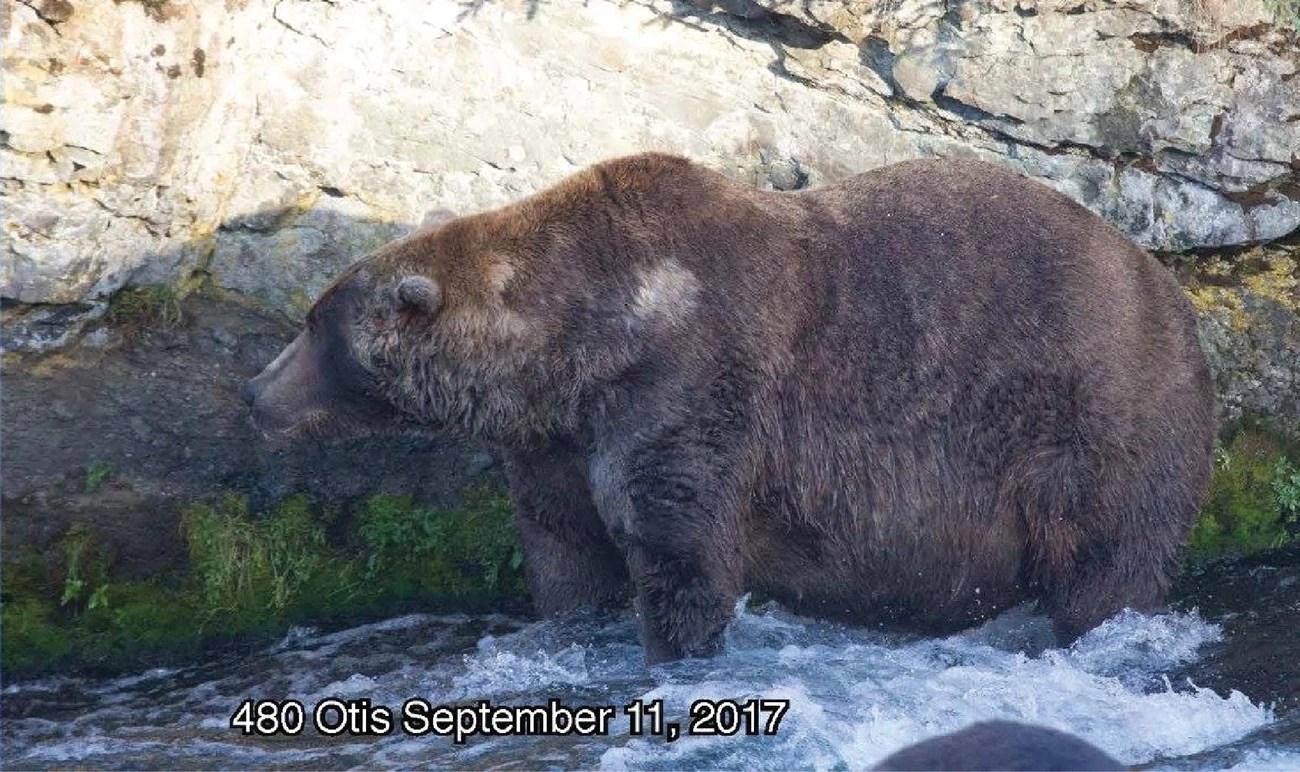
Here’s a photo of Otis, four-time winner for gaining the most weight. Photo from the National Park Service:
And the Explore Live livecam of the bears fishing. Right now they’re showing highlights, which are awesome enough by alone, but wait until it goes live!

I suggest that when September 23 rolls around, you go to the Fat Bear site below (click on icon) to see the contestants and cast your vote. (There’s already been a fat cub contest, in which yearlings compete for weight gain. The winner is unnamed.)  Here are Da Roolz for Bearz:

Matchups are open for voting September 23-30 between 12 – 9  p.m. Eastern / 9 a.m. – 6 p.m. Pacific.

This is a single elimination tournament. For each match-up, vote for the bear you believe best exemplifies fatness and success in brown bears. The bear with the most votes advances to the next round. Only one will be crowned Fat Bear Week champion. Meet the bears, fill out your bracket, predict your fat bear winner, and campaign for your candidate.

The contestants aren’t up yet, so have a look on September 23 between noon and 9 p.m. Eastern U.S. time. It’s enormous fun to vote, and of course the fatter bears have a better chance to make it through the winter.

I hope Otis shows up this year: he was a fatty, but may not have made it through the year.

Seal webcam!

August 3, 2024 • 10:00 am

Reader Patricia kindly left us with something to look at while I’m gone: the webcam of seals and other wildlife living on Año Nuevo Island off the coast of California. As you can read below, Patricia works here.

Here is the location from Wikipedia:

Patricia gives us the lowdown (indented), and the link to the webcam is below.

Año Nuevo Island is a small island (~9 acres) off the central coast of California, ~60 mi. south of San Francisco .  The webcam is supported by California State Park.  The camera shows the SE end of the island in 3 views, each about 30 sec.
View #1 is a sandy beach that extends toward the mainland with a collapsing catwalk across the center of the scene.  In winter hundreds of Northern elephant seals (Mirounga angustirostris) pup and mate here.  Currently (Aug.) the beach is used by thousands of California sea lions (Zalophus californianus) and a few molting male e-seals.  Sea lions sometimes sleep atop these king size ’Sealy Posturpedics’.  If there is a point break, the sea lions enjoy surfing it.  In the foreground there are some of the thousands of nesting Brandt’s cormorants (Urile penicillatus).  The chicks are almost full grown now, but still ‘fuzzy’
View #2 shows the top terrace of the island and the deteriorating light keeper’s house (built 1906, fog horn station began in 1872 – replaced by a buoy in 1948).  The terrace and house are occupied by thousands of sea lions and cormorants. A few Western gulls (Larus occidentalis) attempt to nest amidst the fray.  Fog allowing, the ridge on the mainland shows a very ragged tree line, the result of the 2020 CZU lightning complex fire.  It was dense forest pre-fire.
View #3 is a rocky cove on the ocean side of the island occupied by hundreds of sea lions and their pups can often be seen playing here.  Brown pelicans (Pelecanus occidentalis) can sometimes be seen roosting below the camera.
On a warm day, if you check the camera at midday and then again in the early evening, you can see a mass migration of the sea lions from down on the cooler, wetter beaches up to the dryer terrace.
I’ve been working at Año Nuevo for 30+ years including about a dozen when I spent a good part of the summer on the island.  It is often chilly and very windy there, necessitating watch cap plus hard hat (for gull strikes of both feet and guano, they have incredible aim and adjust for the wind), gloves, five layers on my torso and knee pads since most movement was on hands and knees.  If you have questions, ask in the comments and I’ll try to answer them.

Click on the screenshot and bookmark it for hours of fun and enlightenment. If your browser doesn’t work (I have trouble on Chrome), try another. The link is also here.

From the webcam’s site:

The Año Nuevo Island camera provides viewers with spectacular views of Año Nuevo Island live. Several angles are displayed for 30 seconds before the camera pans to the next position. The camera is live from 8:00 am – 5:00 pm.

Located 1/2 mile from the mainland, Año Nuevo Island is not accessible for the general public. It has been set aside with other sections of Año Nuevo State Park as a Natural Preserve, dedicated as habitat for a diversity of wildlife. Although now a home for marine mammals and nesting birds, evidence of human occupation is still evident from the historic light station buildings that began operation in 1872. These buildings were abandoned in 1948 and some still stand today.

The SquirrelCam is back up, and Snoozy is sleeping.

July 9, 2024 • 8:00 am

As I wrote the other day:

Don’t forget to bookmark the Snoozy the Squirrel animalcam so you can see her sleeping in the nest or coming and going. I’m pretty sure she’s pregnant and is going to have babies, so keep an eye on the nest.

Snoozy is an eastern gray squirrel (Scirus carolinensis), and their gestation period is about 40-45 days after mating. The young are born without fur, but quickly grow up and leave the nest within 50 days. In the meantime, they’re ineffably cute. With luck, they’ll be born and stay in this nest, though females often move their litters around to escape predation (they seem pretty safe on that ledge). Females have about two litters per year, and this must be the second.

Click on the screenshot below to see her, and don’t forget to click on the “forward” arrow at the lower left.

Snoozy’s cam was down for the weekend, as it has to be reset daily, but she’s back, though right now she’s out foraging. Click on screenshots to see her (or her empty nest. The first photo is from a few minutes ago. Some of her nest seems to have been displaced off the ledge, so perhaps she’s not pregnant after all (or perhaps Snoozy is a Man Squirrel!):

Here she was last evening:

Snoozy is still sleeping

July 5, 2024 • 8:12 am

Don’t forget to bookmark the Snoozy the Squirrel animal cam so you can see her sleeping in the nest or coming and going. I’m pretty sure she’s pregnant and is going to have babies, so keep an eye on the nest.

Snoozy is an eastern gray squirrel (Scirus carolinensis), and their gestation period is about 40-45 days after mating. The young are born without fur, but quickly grow up and leave the nest within 50 days. In the meantime, they’re ineffably cute. With luck, they’ll be born and stay in this nest, though females often move their litters around to escape predation (they seem pretty safe on that ledge). Females have about two litters per year, and this must be the second.

Click on the screenshot below to see her, and don’t forget to click on the “forward” arrow at the lower left.  This is what she’s doing right now, ergo her name.


University of Chicago library squirrelcam: watch Snoozy the Squirrel have babies!

July 4, 2024 • 12:30 pm

Amy the Library Duck returned to her window this year, but fortunately she didn’t nest there. (We had a hard time with her last year, finally having to remove her ducklings after they hatched and jumped and to take them to rehab after mom didn’t know how to get to the nearest water since Botany Pond was dry. The water is a long way away, across several busy roads, and we tried to show her the way.)

But there’s better news this year: a squirrel, presumably a female, has built a nest on the same ledge where Amy nested. And in this case we don’t have to do anything, for baby squirrels don’t have to walk 1.5 miles to get to water. The ledge is isolated and well protected, and the squirrel has been adding leaves, dried and fresh, to the nest.

The squirrel has been named Snoozy, as she sleeps through the heat of the day.  If you bookmark this webcam, look in once in a while as I’m pretty sure you’re shortly going to see baby squirrels: a vantage that few people get. And baby squirrels are adorable!

Click here or on the screenshot below. When you watch, be sure to press the “forward” arrow at the bottom left to see the live action (or lack of action).  You can scroll back to see the squirrel’s activity over the past day. Stuff right now: move the dot all the way to the right.

Snoozy is there right now, and may be there all day. Have a look! (She was gone most of the morning, and you can’t see anything at night.) I took this picture about three minutes ago.

UPDATE: If the camera doesn’t work, nere are the squirrel friend’s instructions:

 I just checked it a minute ago and it was fine. Snoozy is there snoozing away. The operator has it running on the Panopto service that I think is used for class stuff. I noticed it sometimes says “the webcast has ended” and then you have to push play again. Also on my browser it blocks autoplay so you have to push the play button to start it.
I’ll put it in the comments below, too.


DuckCam upgrade

June 19, 2023 • 1:12 pm

Amy, the duck nesting on a ledge at Regenstein library, now has an upgraded cam and a new website. It’s worth watching her, as all kinds of stuff can be seen.  For example:

a. Two days ago, someone saw a squirrel encounter the duck, supposedly trying to steal an egg (I don’t think it’s possible for a squirrel to run off with a duck egg). The duck pecked it, and the squirrel DIVED UNDERNEATH THE DUCK, so that the duck was plopped down on a belly-up squirrel. Apparently the squirrel ran off.

b. Someone saw at least five eggs in the nest. That means there are more buried in the leaves and feathers.

c. Yesterday someone watched her fly off for about 1.5 hours (they do this every few days for a drink and a bath). She probably went to a nearby pond or lake. But before leaving the nest, she carefully covered up all the eggs with her bill. This not only keeps them warm, but hides them from potential predators.  When she returned, she shuffled the leaf-father covering off the eggs, but using her feet.

If you click the picture below, you can go to the new duckcam. Say hi to Amy! Right now the sun is on the nest, so it’s not all that easy to see. At other times she’s clear as a bell. And you might get to see her cover or uncover her eggs. (She also turns them from time to time to ensure even incubation.)

Be sure to click the triangle to start the video (you can also scroll backwards).  There may be an annoying buzz that you’ll have to silence by muting the screen.

She’s always futzing with her nest, too.

More ducks: A new duck cam shows a nesting hen at our Regenstein Library

June 16, 2023 • 1:30 pm

I was informed yesterday, not to my huge delight, that a mallard hen is nesting across the street from my office—on a window ledge at Regenstein Library. This would not normally be a problem, for when her babies hatched and jumped down one floor, we could herd them to BotanyPond (we’ve done it before from this area). The problem, of course, is that there IS no Botany Pond this year, which leaves us with a dilemma. Let nature take its course and let the mother lead the babies to water? But the nearest water is well over a mile and a half away: large ponds and lakes to the east and west, and the family would have to cross big and busy streets.  Most of them would probably not make it.

The other solution is to get the ducklings as they drop, put them in a box, and take them to the rehab people. (This is what I did this morning.) While this assures complete survival of the brood, it requires breaking up the family, as it’s impossible to catch the mother duck and take the whole family to the water.  \

Well, you can see the duck, whom the library folks have named Amy, at this site (be sure to press the “play” triangle), or by clicking on the screenshot below. I’m told the camera and feed will be upgraded soon.

In the meantime, I have about a month to get anxious; she just started incubating, and it’ll be about 28 days to Hatch Time. I had hoped to have a duckling-free season while Botany Pond got renovated, but it doesn’t seem to be working out.

Note to U of C people: this ledge is in an office, so don’t try seeing her from inside the library. And please don’t disturb her from the outside. Thanks!