
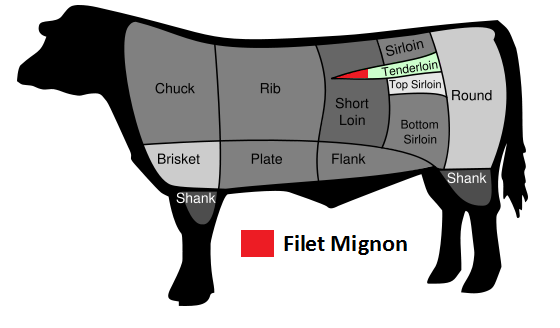
Welcome to Thursday, August 13, 2026 and National Filet Mignon Day. From Wikipedia, with a picture of where this cut of steak comes from:
Filet mignon (/ˌfiːleɪˈmiːnjɒ̃/;[1] French: [filɛ miɲɔ̃]; lit. ‘delicate, fine, or cute fillet‘) in North America, especially the United States refers solely to a cut of beef taken from the smaller end of a tenderloin, or psoas major of a cow. In France, filet mignon usually refers to cuts of pork tenderloin or veal tenderloin.
The tenderloin runs along both sides of the spine, and is usually butchered as two long snake-shaped cuts of meat. The tenderloin is sometimes sold whole. Filet mignon is usually presented as a round cut taken from the thinner end of a piece of tenderloin. It is often the most tender and lean cut. Filet mignon often has a milder flavour than other cuts of meat and as such is often garnished with a sauce or wrapped with bacon.
Due to the small amount of filet mignon able to be butchered from each animal, it is generally considered one of the most expensive cuts of beef.
Butchers can get from 10 to 16 filets per cow. I avoid this cut because while it’s tender, it doesn’t have the beefy flavor of, say, ribeye or other cuts, and it lacks marbling with fat, which is why, as they say, it’s often served wrapped with bacom. If you prize flavor over tenderness, as a good eater should, you’ll avoid this expensive steak.
It’s also National Prosecco Day and International Left Handers Day (the frequency of lefties across the globe is about 10.6%).
Readers are welcome to mark notable events, births, or deaths on this day by consulting the August 13 Wikipedia page.
Da Nooz:
*Amit Segal discusses the growing amity towards Israel of South America in an It’s Noon in Israel article called “¡Viva Israel, Carajo!”
It’s Wednesday, August 12, and Israel may never have had a better month diplomatically. Back in June, if Vice President JD Vance is to be believed, Israel had a single ally left in the world. Yet in the space of a few weeks it seems to have found several new ones, above all in South America.
Few leaders, Donald Trump included, can out-philosemite Argentina’s Javier Milei, the self-declared “most Zionist president in the world”—he has given even Isaac Herzog a run for his money. But Milei now has competition on his own continent.
Over the past month, Colombia’s new president, Abelardo de la Espriella, has moved to reverse wholesale the hostile posture of his predecessor, the leftist Gustavo Petro, who had severed ties with Israel and halted Israeli arms imports over the war in Gaza. In July and August 2026, Bogotá ordered the full restoration of diplomatic relations, pledged to move Colombia’s embassy to Jerusalem, and withdrew from South Africa’s genocide case against Israel at the International Court of Justice. Then, on Monday, Colombia became only the second country in the world, after the United States, to recognize Israeli sovereignty over the Golan Heights.
Venezuela, improbably, has moved in the same direction. On Tuesday, the two countries announced they had agreed to renew consular relations, 17 years after severing all diplomatic ties in 2009 under Hugo Chávez. The thaw followed Israel’s dispatch of an aid delegation—led by the Foreign Ministry and the IDF’s Home Front Command—after the double earthquake that killed thousands in Venezuela in late June.
Vance’s advice about not alienating Israel’s most important ally still holds. His claim that it was Israel’s only one is aging rather less well. As Milei would put it: ¡Viva la libertad, carajo! (“Long live freedom, goddamnit!”)
Well, that’s three countries only, but I’m not sure that Israel has no allies other than the United States. I’m told that Brazil remains steadfastly anti-Israel because it’s a “leftist country with a socialist mentality.”
*I was amazed that Dick Cheney lived to be 85 given his history of severe heart problems, but he soldiered on until death. Yesterday his cardiologist uses Cheney’s example to question Trump’s own health in a NYT op-ed. Trump, says, Dr. Jonathan Reiner, “has not looked well” (article archived here).
In June, President Trump celebrated his 80th birthday, and at the end of this term he will be the oldest person ever to serve as this nation’s leader. After Mr. Trump’s medical evaluation in May, Dr. Sean Barbabella, the physician to the president, wrote that Mr. Trump “remains in excellent health” and that his “demanding daily schedule, including multiple high-level meetings, public engagements and regular physical activity, continues to support his overall well-being.”
Despite reassurances from the White House to the contrary, at times over the past year, the president has not looked well. I am not Mr. Trump’s doctor, and have only reviewed his records that have been made public. But Mr. Trump is probably the most photographed president in American history, and a variety of physical ailments are easy to see. He’s had large bruises on both hands, swelling in his legs and episodes when it appears that he is struggling to stay awake. He’s also had advanced imaging performed for unclear reasons. The public is again left to wonder whether the nation’s leader is OK.
Despite the unparalleled power afforded to the president of the United States, there is no formal requirement for the commander in chief to certify his fitness for duty. That’s a mistake. Members of the military, Secret Service agents, commercial pilots, school bus drivers and air traffic controllers all must periodically demonstrate that they are well enough to perform their work. The current practice of reporting the results of a yearly medical examination for the president began in the Nixon administration, but it’s only a custom, not a formal obligation. And, as history has shown, it can be unreliable.
This does not mean that every detail about a president’s health must be disclosed. It’s appropriate to withhold elements of a medical history that could be exploited by an adversary. In 2007, when we replaced Mr. Cheney’s defibrillator, we didn’t share information about a new wireless feature of the device that I considered a security threat to the vice president. (We ultimately were able to get the manufacturer to disable that capacity.)
The 25th Amendment to the Constitution allows for the best solution to this problem: It permits Congress to establish a panel outside the executive branch to assess the health and fitness of the president. In April of this year, Representative Jamie Raskin introduced a bill to create a congressional commission that would do just that. Ideally, such a panel would be empowered to review data from routine presidential physical examinations, as well as assessments performed when medical concerns emerge.
Reiner gives a list of seven questions that the panel should ask Trump or his doctor; I’ll give just two:
1. Dr. Barbabella’s recent report states that the president was evaluated by 22 consultants, an extraordinary number of specialists for even the most extensive executive health evaluation. Why were so many physicians summoned, and what were their specialties?
5. In October 2025, Mr. Trump underwent advanced imaging of his heart and abdomen at Walter Reed National Military Medical Center. The president’s physician offered a vague description of the reason for the tests: “to identify issues early, confirm overall health and ensure he maintains long-term vitality and function.” He said the tests did not reveal any abnormalities. Was there a specific symptom or clinical event that prompted this testing?
Reiner concludes this way, and I agree:
But the United States does not have a king. In a representative democracy, the people must have confidence in the health of their leader, and in the leader’s capacity to guide the nation. We have been kept in the dark too long.
Don’t we have a right to know if our President has grievous medical ailments? Or should all his conditions be kept private—or even lied about?
*A Free Press article by Liel Leibovitz, “New York is not, a ‘Habibi City’,” discusses another viral piece published in the New Yorker, declaring that Islamist immigrants are turning New York into a city run on Muslim principles, and, this being the New Yorker, thinks that’s peachy. (You can find the New Yorker article mentioned in the story archived here.
I immigrated to the United States from the Middle East for the one and only reason anyone should ever come to America: Because I believe it, firmly and passionately, to be the greatest nation ever endowed by God with the mission of spreading liberty and light to a benighted world, and because I consider it the honor of a lifetime to partake in the solemn work of making America ever greater.
Apparently, my fellow Middle Eastern immigrants have very different feelings. In her now-viral cover story for New York magazine, journalist Zaina Arafat—who was born and raised in the suburbs of Washington, D.C., but identifies as SWANA, an acronym that previously stood for the Solid Waste Association of North America but now apparently means Southwest Asian and North African, and represents anyone who is vaguely Middle Eastern and dislikes capitalism, America, and the Jews—kicks things into high gear by celebrating the fact that New York is now “Habibi City,” a full-on SWANA enclave.
What does the average day look like in Habibi City? Arafat is all too happy to tell you: There’s a workshop for kids at a Lebanese bookstore dedicated to Middle Eastern culture, then a fundraiser for Gaza at a “women-run Syrian supper club.” Which, Arafat concluded, made her feel “like in the blād,” which means “back home, overseas.”
. . .Arafat, whose book You Exist Too Much won the 2021 Lambda Literary Award for Bisexual Fiction, herself attempts an answer, embodied in the name of one of her favorite SWANA-ese publications: it’s called Bidoun, meaning “without,” which is a name “meant to evoke existing without the concreteness of space.” In other words, because SWANA is really a state of mind, we must make sure America becomes its forever home.
It’s a perfect manifestation of a specific grad school sensibility, light on logic and high on pretense and self-importance. But it also captures the real tragedy—and threat—at hand: For Habibi City to be born, New York City must die.
. . .Here’s a thought experiment:
Imagine you are a magazine editor. A writer comes to you and suggests a piece revolving around a new term, SWANA, popularized by academics to protest against alleged American imperialism, colonialism, and white supremacy. The term, the writer explains, stands for South West Asia and North Africa, a very vast swath of the world that includes hundreds of millions of people and myriad cultures, nationalities, and belief systems.
Fret not, says the writer: These hundreds of millions of human beings stand as one, all sharing a singular and solid identity rooted pretty much exclusively in the belief that Israel is committing genocide in Gaza.
Would you allow such dross? Or would you argue that coming up with a ludicrous term like SWANA and then explaining it as “a decolonial framework and a way of moving through the world” may be arousing for those privileged enough, like Arafat, to idle away their days on Columbia University’s campus but of no real value to anyone seeking to make sense of the real world?
. . . Sadly, New York magazine chose door number one. It printed all of Arafat’s ramblings, including referring to October 7, 2023, as an attack on Palestinians alone and describing September 11, 2001, as the day Americans, for no particular reason whatsoever and without any provocation, decided to turn nastily suspicious of Middle Easterners. It ran a side column with the perfectly Third World-y title “When Eating Out Is Political” that referred to the Jewish state as “the land mass currently called Israel.” In other words, the magazine didn’t just report on the SWANA-fication of New York: It adopted its rhythms, its feverish and conspiratorial thinking, its senseless and illogical formulations, and its rank biases.
. . . It’s (still) a free country, and anyone, of course, is welcome to build power as they please. But in her helpful piece, Arafat gave us all the best glimpse yet into what this power is being used to achieve. Anyone content with magazines laundering logic and language to fit the prevalent ideology and with politicos using their office to advance the interests of one tribe over the other is welcome to retreat to their favorite women-run Syrian supper club. Everyone else should fight like hell to make sure New York never becomes Habibi City.
It’s curious that although the New Yorker is anti-DSA (or at least that what’s edotpr David Remnik’s interview with the co-chair of the DSA implies), it’s also anti-Israel: conflicting sentiments. But I stopped subscribing to The New Yorker because it got pretty much ideologically captured. And in this Free Press piece, they should have left out Leibovits’s statement, “If all you care about is your native culture, if you wish to fill every moment of your day with swell SWANA sensations, why not, ya know, go back to SWANA?” That smacks a bit of the love-it-or-leave it mentality, though I see what he’s getting at.
*Over on his Substack site, philosopher Maarten Boudry decries the “AI slop” infecting writing in a piece called “Show us the prompts.” He is surprised to find so much on the Internet that’s written with AI (he uses the Pangram detector, which I might subscribe to).
The problem of AI slop in writing has been bothering me for a while. As you know many of the earlier cases centered around hallucinated quotes, which are pretty much the only way to catch an author with their pants down, as there is simply no innocent explanation. But as LLMs have improved and trained through human feedback, their tendency to hallucinate sources and quotes has diminished (though not completely disappeared). So now we’re arriving at the stage when there are no longer any smoking guns – just probabilistic estimates from Pangram.
If AI writing becomes so good that it is no longer distinguishable from human writing (except by being far superior to it), should we care? Will we all be reading AI slop soon, with human writing becoming a niche artisanal craft for anti-AI snobs? That’s the question my essay is asking. My main inspiration was this recent piece by Tyler Cowen in The Free Press, which predicts that before long hardly anyone will care whether or not a text was written by a human. Likewise, Richard Hanania wrote that it doesn’t really matter if the author of a piece is human or not. With the possible exception of memoirs, which are inherently personal, he does not care one way or the other. I beg to differ.
Well, I care, too; I want to know that somebody whose name is on an article put in the thought and the work. I don’t even like AI correcting prose, though it’s not as bad (I see putting your name on something that was written by a bot as unethical). Here’s an article that several people sent both Maarten and I. I didn’t post it because it seemed too glib, and Maarten detected real signs of AI. Here you go:
Or take this viral piece by Israeli writer Nachum Kaplan (originally here) [the title is “I went to an anti-Israel dinner party. It did not go as planned.”]. It is also from “my” political side, lampooning the idiocy of pro-Palestinian discourse, so if anything it panders to my own views and tastes.
Multiple people sent it to me as a brilliant takedown of pro-Palestinian lunacy. But although I find the piece highly entertaining and incisive, I’ve always thought it’s a bit lame to recount an unverifiable conversation you supposedly had with other people, in which you portray your interlocutors as maximally moronic and yourself as maximally savvy and eloquent, delivering one witty riposte after another. In Yiddish, as it happens, they call this trepverter: the witty comeback you only think of when you’re already halfway down the stairs.
I didn’t share the piece online, as I found it a bit too smug, but I didn’t expect that it was written by AI. But you’re not fooling Pangram, which diagnoses it as 100% AI-generated. (But surely here there must have been extensive prompting describing the general outline of the dinner conversation, and some jokes and comebacks? Surely AI is not becoming that good?)
I see AI writing all over Facebook, and when I do I comment “This is AI writing and I’m unsubscribing.” Does that make me a bad person?
*A new world land speed record was set for a car powered by hydrogen:
The only person to break the sound barrier in a car earned another world record Tuesday in a show of force for hydrogen power.
British driver Andy Green reached 406.320 mph (653.908 kph) in a car powered by two hydrogen internal combustion engines with a combined 1,600 horsepower, setting the record for that vehicle category, according to the Fédération Internationale de l’Automobile, the international governing body of motor sports.
The 64-year-old retired Royal Air Force pilot rocketed across the crystalline crust at Utah’s famous Bonneville Salt Flats in a 32-foot (9.75-meter) car engineered by British construction equipment manufacturer JCB. The engines, adapted from those used in the company’s heavy machinery, mix pressurized hydrogen gas with air and ignite it to create bursts of power.
But that isn’t the overall record.
. . .To be clear, Tuesday’s feat didn’t come close to approaching the overall land-speed record, which Green set with jet power in 1997. That year, he climbed into the Thrust SSC, a black needle sandwiched between two cartoonishly large jet engines, and hit 763.035 mph (1,227.985 kph), breaking the sound barrier and achieving a feat no one has come close to matching. His runs in Nevada’s Black Rock Desert produced sonic booms that shook the nearby town of Gerlach.
In 2006, Green also set the land-speed record for a diesel-powered car — 350.092 mph (563.4 kph) — at the Bonneville Salt Flats. He returned there Tuesday with the goal of beating that mark using hydrogen power, which he has called the “fuel of the future.”
Here’s the latest record and the car in a video:
Meanwhile in Dobrzyn, Hili’s notion of reality is undercut:
Hili: Are you sure reality still exists?
Andrzej: Yes, but more and more often, it’s artificial.

In Polish:
Hili: Czy jesteś pewien, że rzeczywistość jeszcze istnieje?
Ja: Tak, ale coraz częściej jest sztuczna.
*******************
From CinEmma:

From Bad Spelling or Grammar on Signs and Notices:

From Meow Incorporated:

From Masih, another Iranian woman likely to be executed for protesting:
Zeinab went into the street to protest. To demand freedom. For that, the authority charged her with “Moharebeh”, which means; enmity against God, means execution.
If you ask me how you can help me and help Iranians save her life, to be honest, I don’t have an answer. 💔I don’t… https://t.co/4mm8ashWr3 pic.twitter.com/E0s6xgeBap
— Masih Alinejad (@AlinejadMasih) August 12, 2026
Speaking of fabulists, one from Michael Shermer via Steve Pinker:
My favorite example in the genre of fabulists is Nick Clark, the cyclist who was exposed by local riders for his exaggerated Strava KOM (King of the Mountain) times. For years he said he raced professionally in Europe, that he was also a military soldier/weapons instructor, a…
— Michael Shermer (@michaelshermer) August 11, 2026
From Simon, a sitting duck (clearly AI!) on Air Force One after Trump had been removed in a food container:
The press weren’t the only ones left on Airforce One. pic.twitter.com/LqU4wwzHWN
— Heather Thomas (@HeatherThomasAF) August 12, 2026
From Luana, a double standard for Muslims in Massachusetts (they are the beneficiaries):
Have you ever heard about people from Vietnam, Armenia, or Russia asking for such preferential treatment? No Seventh-Day Adventist Commission? No Shintoism Commission? No Hasidic Jewish Commission? Muslims are special. They deserve unique accommodations in America because… https://t.co/bSIh9SSRi6
— Gad Saad (@GadSaad) August 11, 2026
From Malcolm. It’s fake, of course, but I think it’s funny:
Have you ever heard about people from Vietnam, Armenia, or Russia asking for such preferential treatment? No Seventh-Day Adventist Commission? No Shintoism Commission? No Hasidic Jewish Commission? Muslims are special. They deserve unique accommodations in America because… https://t.co/bSIh9SSRi6
— Gad Saad (@GadSaad) August 11, 2026
Two from my freed: shameless groveling to Jason Arday by a Cambridge prof:
Diagnosed with autism spectrum disorder at the age of 3, Jason Arday learnt to read & write at 18. On Monday he’ll start work as @Cambridge_Uni’s youngest black Professor. It was a real privilege to help tell his story @BBCNews pic.twitter.com/8sCJnL26fb
— Celestina Olulode (@CelOlulode) March 2, 2023
. . . and a follow-up tweet; you can read the article about the fawning professor here. I’m afraid that Dr. Cremin, the head of Arday’s department, will never live this down.
1./ 🧵My latest article in @spikedonline is about Prof Hilary Cremin. The Cambridge academic who gushed over Jason Arday likes to berate people for their alleged racism. Yet her own intellectual inspiration is a notorious antisemite. Yes, really. 👉https://t.co/tjQWt3iu3E
— Malcolm Clark (@TwisterFilm) August 12, 2026
And one I reposted from The Auschwitz Memorial:
This Austrian Jewish boy died in Auschwitz. He was 12 years old. https://t.co/2jGuva3XNu
— Jerry Coyne (@Evolutionistrue) August 13, 2026
One from Doctor Cobb, who says this is “good news” but it’s also sad: the Great Synagogue of Vilna was destroyed by the Nazis in 1941 and the Russians in 1957. Note that this is a video. The bimah is the “pulpit”: the platform from which the Torah is read.
Archaeologists have uncovered the central dais, or bimah, of the Great Synagogue of Vilnius, Lithuania.The synagogue was ransacked by the Nazis in 1941 and then destroyed under the Soviet regime in 1957. http://www.timesofisrael.com/buried-for-7…
— Ticia Verveer (@ticiaverveer.bsky.social) 2026-08-08T21:06:35.071Z
Here’s what it looked like in 1920:

. . and here’s the Holy Ark, that held the Torah scrolls. The synagogue was built in 1633.

Regarding “left handers’ day”, has Burger King revived the left handed Whopper?
https://external-content.duckduckgo.com/iu/?u=https%3A%2F%2Fel-shai.com%2Fwp-content%2Fuploads%2F2023%2F04%2FThe-Left-Handed-Whopper.jpeg&f=1&nofb=1&ipt=8138aa0832601cdeb29c5499e98dd4fec2affcc0821b50de3e01f56e432afc12
Habibi City? (sigh) I think my opinions about this kind of stuff are well known enough here at WEIT for you to imagine my reaction to “Habibi City”, so I’ll spare you all the rant.
I’m charitable like that. 🙂
I’m with PCC(E) on the AI/writing debate. I’d never use it for my column, somehow it’d feel like fraud.
Claire Lehrman (sp) at Quillette says it is good for editing and polishing which is probably right, but I’m not going near it for my own work.
D.A.
NYC
I agree with Claire, but I would never submit a rough draft to AI for review and editing. It will likely make recommendations that one would be foolish to ignore. Get your work into what you consider final form before seeing whether it might catch something.
Aside from editing, it comes in quite handy for fact-checking, of course. That assortment of details once read but partially forgotten, those facts well known to you but for which you lack a ready source, the others that you might be misremembering—not that age has anything to do with that. (My em dash, Christopher! I am overly fond of them, too.) Again, discipline is in order—and a bit of pride. I can’t envision using AI-offered facts of which I was unaware; that feels far too much like co-authorship to me.
One use I don’t hear about quite so often is “tone” checking. Some of us can be unintentionally insensitive when left to our own devices. Think about those snide asides, dry jabs, full verbal frontal assaults, cutting remarks, or even the deadpan line that in person comes with a slight smile to disarm it. Okay, I use those with intent, but you get my meaning. I won’t go as far as to suggest AI serve as a “sensitivity reader,” but I am amazed at the strides LLMs have made in this regard. Even Grok still wants to soft-pedal more than I prefer, but I’ll admit that I come away from some of its recommendations thinking, “Yeah, that WAS kinda dickish.”
You should try it someday, David!
I find AI very useful as a thesaurus—more useful than an actual thesaurus—because AI takes the context of the sentence into account.
I used Pangram to judge the text of Exodus 12:36-37
It was 100% human written according to Pangram but there was a caveat because the text was short
So God didnot dictate these verses to Moses. [:)]
Pangram is completely free for limited amounts of text: 2000 words / day. Paid subscriptions buy you more text and additional features. I’m a new user (thanks to WEIT) and am impressed. It’s pleasing that it uses LLM techniques to detect LLMs.
Quillette subscribers can also read Boudry’s article.
One distressing thing I have learned is that use of the M-dash is taken to be a reliable sign of AI authorship. I happen to like the M-dash—it’s just a Shift-Option-hyphen away—having become accustomed to it in the novels of Anthony Trollope. So when you see it used under my name, know it is a product of wetware alone.
I also like the em dash. I’m suspicious of these programs that supposedly detect AI so accurately.
Pangram definitely does not use single-token hacks. It uses the same sorts of word, phrase, and theme statistical analyses that are used in copyright infringement cases, but the “authors” being compared against are Generic Human and Generic LLM, using a vast corpus from each.
(And FWIW, once I found out that dashes are considerd a tell, I’ve started using them – a lot. Ain’t I a stinker?)
The Habibi piece was in New York magazine, not the New Yorker. Though I agree that the piece is absolutely dire. Apparently all Israeli cuisine is actually stolen from Muslim countries. Which makes me wonder what they think Mizrahi Jews ate before they were expelled from SWANA/MENA (I actually do think it’s a useful acronym, at least for the geographical region) and had nowhere to go except Israel. Oh, wait – those people don’t exist.
On the topic of Middle-Eastern food, Hen Mazzig’s column on Substack is well worth reading.
And regarding filet mignon—as our host says, it is often served wrapped in bacon. Anyone who has eaten it that way understand why. However, El-Sayed, who may end up in the US Senate, has classified bacon alongside plutonium as a “Class 1 carcinogen”. I would classify El-Sayed as a Class 1 Islamist.
The Habibi article was in New York Magazine, not The New Yorker. The comments about The New Yorker may be saved for another time or issue, but here David Remnick has nothing to apologize about.
Alton Brown had an episode of Good Eats getting tenderloin the most efficient way – buy in bulk from Costco, prep them into various parts like the filet mignon,.. chain (?)…, and freeze it.
I’m just recalling from memory – but its supposed to be as good as it can get cost-wise.
But if any Costco customers out there are willing to do some field work, …
I think that epidode was called “Tender is the Loin”, wasn’t it?
LOL rings a bell – sounds like Alton!
🍽️
Heinz Klipper would have blown out 95 candles on his birthday cake on this very day.
“If you prize flavor over tenderness, as a good eater should, you’ll avoid this expensive steak.”
A good rule. But most rules have an exception or two, so I have two words:
Beef Wellington.
Now that we have so many superannuated leaders in government, asking them to pass some some sort of health test seems worth pursuing. In a representative democracy, the public should have reasonable access to the health status of their representatives. It might be going too far to specify rules whereby a politician is actually forced to leave office at a specified level of disability, but requiring a standardized annual health status report might be possible.
The trials and travails of Kentucky Senator Mitch McConnell come to mind, of course, but the same is true for the late California Senator Diane Feinstein, the late Supreme Court Justice Ruth Bader Ginsburg, and for that representative who disappeared for months only to turn up in a nursing home. Oh, and yes, there’s also President Trump, but he has yet to reach the sorry states reached by those just mentioned.
Maybe, maybe, maybe. How would such a thing ever become the law of the land or even a standard practice? Negotiating an agreement would be like negotiating with Iran.
On a totally different topic, my paternal grandparents and great grandparents were from Vilna (now Vilnius). They probably went to synagogue there and my great grandparents may even have been married there. It’s good to have unearthed parts of the synagogue but, ultimately, the story is a sad one. The Great Synagogue of Vilna exists only as an archeological artifact. Before World War II there were 60,000 Jews in Vilna. Today there are 3,000. What was once called the Jerusalem of the North is no more.
How would the problem of the health of politicians become the law of the land?
I suggest age limits. The problems are far more common among the elderly.
HA!
I suggest age limits on the other side. The lower boundary for President is, I believe, 35. Same should be true for the senate and the house, to keep those young ignorant whippersnappers in their place.
After I have more coffee, I won’t be as grouchy.
I see the logic of having some kind of required health assessment for aged politicians, justices, etc. One could also make the case for the same requirement for young ones. I might also add that mental health is just as important as physical health.
I would also make the case for a requirement for some sort of educational level for politicians, especially some of these 30-something socialists (and, to be fair, some of those right-wing 30-somethings as well). Perhaps a 7th grade reading comprehension test, or a test for composing a coherent paragraph. And maybe requiring a little knowledge of science, history, geography-(like knowing which hemisphere Venezuela is in, the history of their own country, how biological women are defined… you know, basic stuff).
If you’re going to require some sort of educational level for pols, I’d also then do the same for voters!
Wouldn’t a Muslim Commission violate the Establishment Clause? The state is showing a government preference for one faith over others and they’re using taxpayer money to do it. Also, they are coming very close to making a religious qualification for office.
Maybe it’s confirmation bias on my part, but it sure seems like Islamists are making tremendous inroads into the government, mainly through the Democratic Party. It’s really quite fascinating but also scary. I feel like I’m watching a Western version of Persepolis in slow motion.
So agree about filet Mignon being overpriced and underflavoured. I am also highly suspicious when it comes wrapped in a plastic log from the butcher. Meat glue may have been used.
https://x.com/valerieanne1970/status/2065781237256462637?s=46
This practice may not be limited to just that particular cut of meat either. I guess buyer beware is a good principle.
https://x.com/bgatesisapyscho/status/2080346914646577508?s=46
For several years in the late 1970s, I was a graduate student at the State University of New York at Binghamton (“SUNY Binghamton”), which now calls itself “Binghamton University”.
At the time, there was a “Southwest Asian – North African Area Studies Program”, which was generally referred to by the acronym “SWANA”.
The acronym is probably being used more widely now for political/ideological reasons, but it is not a brand-new coinage.
(The Binghamton program no longer seems to exist, and the only reference that I could find to it online was in an announcement in the September 1969 issue of the African Studies Review, online at “https://www.cambridge.org/core/journals/african-studies-review/article/abs/addition-to-african-studies-in-the-united-states/E058B3DA96200E7E350A7B6EBB5858F2”.)
If Dr. Jonathan Reiner didn’t publish a similar article about President Biden, I’m not interested in anything he has to say about President Trump.