
Okay we’ll have a Caturday this week, but we’ll see about forthcoming weeks. If you have a cat-related item for me to consider, by all means send it along.
First, we have an eight-minute video of a real “cat lady”, who has over a thousand moggies. She’s turned her house into a sanctuary/rescue center/adoption center, so that’s not so “crazy.” They’ve saved 28,000 cats.
You can read more about “The Cat House on the Kings” by clicking on the link below:

Here’s a seven-minute video of a day in the life of the Cat House on the Kings:
**********************
As you must know by now, Larry the Cat, the Chief Mouser to the Cabinet Office, turned nineteen, and has been at 10 Downing Street for 15 years, serving under seven Prime Ministers. Still he abides. Here’s a video of Larry “causing mischief,” though not everything it shows is “mischief”.
And here’s a short video of Larry chasing a rather emaciated fox from Downing Street. He may be a poor mouser and bad at catching birds, but he’s good at chasing off d*gs and other canids.
**********************
Now it’s time to learn some cat evolution by reading about Proailurus, the earliest known “true cat” (i.e., an animal placed in the family Felidae). We find its fossils from about 30 million years ago, and you can read about it in this article by Will Newton from Discover Wildlife. It may have been the common ancestor of all cats today, but I consider that unlikely; it was probably related to the ancestor of all living felids, but finding THE “missing cat link” would be nearly impossible. But it does show us what a very early felid was like.
Click the screenshot to read.

A few excerpts (indented):
What was Proailurus?
Proailurus is an extinct cat that lived in Europe and Asia from the Late Oligocene (30 million years ago) to the Early Miocene (25 million years ago). It’s widely considered to be the first ‘true’ cat and the ancestor of the entire cat family, which includes everything from extinct sabre toothed cats to living lions, tigers, and leopards.
Proailurus is known from three different species, two of which – P.lemanensis and P.bourbonnensis – were roughly the size as a house cat, weighing in at 7-10kg. The third species, P.major, is thought to have been more than twice as large, but it’s only known from a single specimen and, as a result, is shrouded in mystery.
What did Proailurus look like?
Looking somewhat like a miniature cougar, Proailurus had a lengthy, low-slung back, relatively short limbs and a long, flexible tail. These features suggest it lived an arboreal lifestyle, hunting, resting, and perhaps even playing high up in the tree canopy. It may have also hunted on the ground, just like the modern Geoffroy’s cat (Leopardus geoffroyi).
This bodyplan and arboreal behaviour bears remarkable similarity to the fossa (Cryptoprocta ferox) – a cat-like predator found only on Madagascar.
. . . Where did Proailurus live?
The first remains of Proailurus were described in 1879 by French naturalist Henri Filhol who found a handful of small, cat-like fossils at a site in Saint-Gérand-le-Puy, Central France.
Since this discovery in the late 19th century, fossils of Proailurus have been unearthed in neighbouring Spain and Germany and, surprisingly, Mongolia. This suggests Proailurus had a very wide range and occupied a niche that had very few, if any major competitors.
Several fossils believed to belong to Proailurus, or at least a Proailurus-like animal, have been found in North America, including the famous Ginn Quarry cat. This specimen is represented by a complete skull, which has dentition very similar to the type species (P.lemanensis) originally described by Filhol.
The jury’s still out on whether the Ginn Quarry cat was truly a Proailurus, but its discovery suggests that cats – or at least cat-like animals – had already dispersed from Eurasia into North America, establishing a lineage that, millions of years later, would give rise to some of the largest cats that ever lived.
What did Proailurus originate from?
Proailurus is widely considered the first ‘true’ cat and the basal member of a family known as Felidae. This furry family is nestled within a larger mammalian order known as Carnivora, which includes everything from cats and dogs, to bears,mustelids, hyenas, and seals.
The origins of Carnivora can be traced back to the Early Eocene, roughly 52 million years ago and just 12 million years after the extinction event that wiped the non-avian dinosaurs from the face of the Earth.
The earliest carnivorans would have resembled small weasels or genets and, like many living carnivorans, would have likely been nocturnal. From these small, stealthy predators, two large sub-groups emerged: the feliforms and the caniforms.
While the caniforms diversified into an astonishing array of shapes and lifestyles (just look at how different skunks are from walruses, for example), the feliforms largely retained a sleek, agile body plan and exhibited far less diversity in terms of their morphology, diet, and behaviour.
And it’s from Feliformia that Proailurus, and its lineage Felidae, eventually emerged 30 million years ago.
Again, we don’t know whether Proailurus is the ancestor of all living felids, or a pretty close relative of that common ancestor. Nor do we know that it was brownish and unmarked, as depicted in the drawing above. What we have are fossil skeletons, and that can’t tell us about color, or whether these animals were spotted or striped.
*********************
Lagniappe: Several items today, starting with this Facebook entry about a cat image being used to sell gin (see the text below the photo):
I’ve often shown medieval images of cats, asserting that for some reason artists of that era simply couldn’t draw even a decent moggy. Here’s a FB video showing some pathetic attempts to paint or draw cats. You can see more here and even more in the panoply of hilarious images at the Google Search page for “medieval cat paintings.”
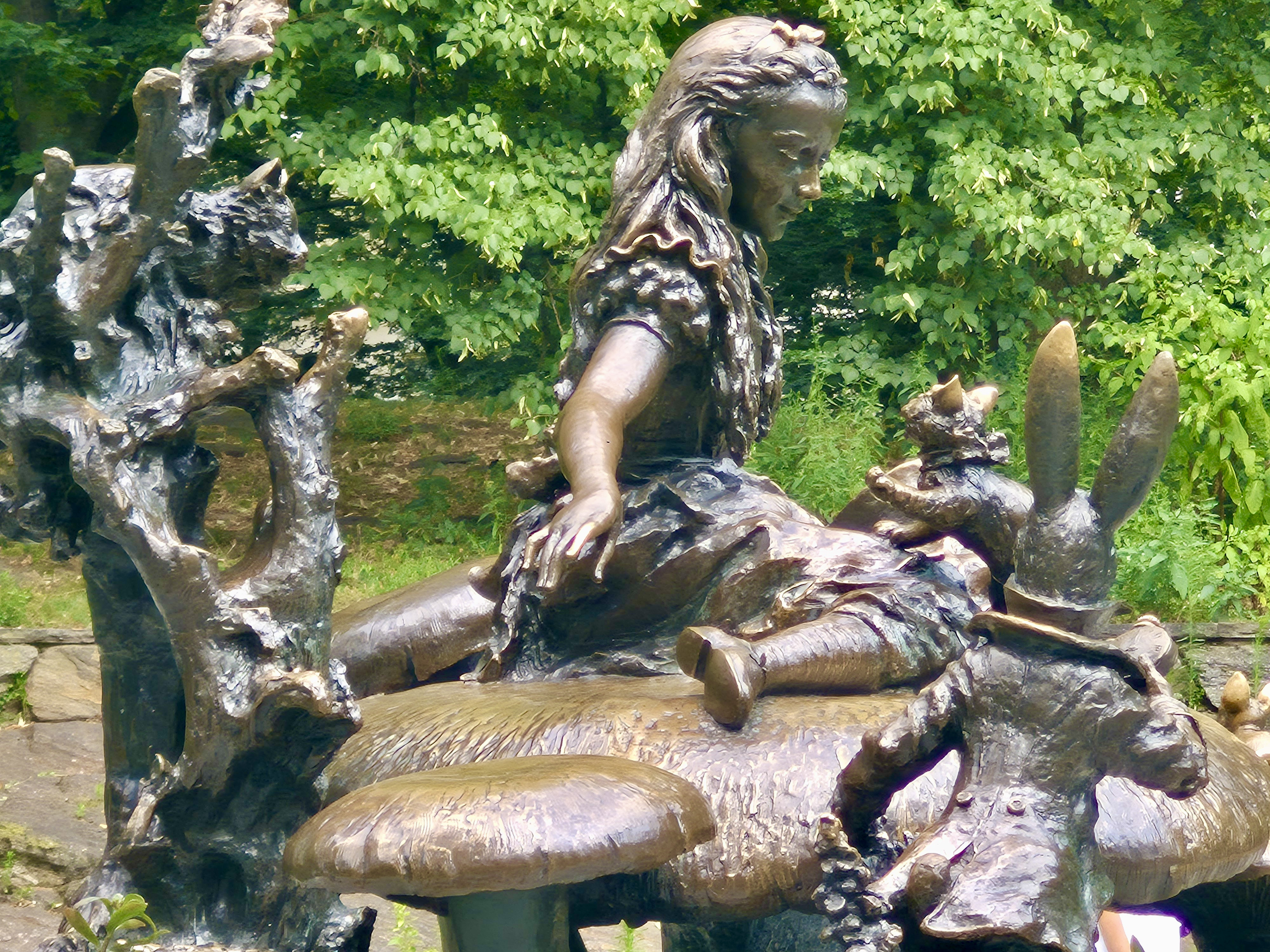
This statue of Alice in Wonderland was photographed by Jean Greenberg in Central Park. It shows two cats: Alice’s cat “Dinah” on her leg and the Cheshire Cat over her shoulder (see below).

h/t: Jean G., Ginger K.
Caturday!
Love the cat rescue guys most of all, which reminds me how we got our beloved kitten, Tobi (z’ll), to join our household. One day I came home from work briefly in the middle of the day, and I heard a kitten mewing. I didn’t think much of it and went back to work. But when I got home that night—it was already dark—the little kitten was still mewing, plaintively. So, my wife and I started looking around in the dark for the kitten and we found it, naturally, about 50 feet up a tree. It did not look like it was able to come down on its own. My wife called the fire department, but they wouldn’t come help. So, what we did was get a flashlight and pointed it at a spot just beneath the cat. And, sure enough, the cat edged down the tree into the light. So, we moved the flashlight beam lower, and lower, and lower, until—alas—my wife grabbed the cat! She was a tortoise shell tabby kitten, about three months old. She was ours for 19 years!
Proailurus: Science writers sometimes use the word “ancestor” carelessly. Probably more accurate to say that Proailurus was an early felid, close to the ancestry of all cats.
Cool gin dispenser! Are there actual, automated alcoholic drink dispensers? How can there not be?
That Alice in Wonderland bronze looks to me like a hot mess, but I’m no art critic. (Obviously!)
Thank you for today’s Caturday feature!
Great that you coaxed the cat out of the tree!
Totally agree that the Cat House is amazing.
You were blessed by the Cat Distribution System, Norman.
Enjoyed reading about early history of cat family. Don’t think I’ve ever seen that information before. I always enjoy Caterday on WEIT and will miss it if you have to drop it.
This is why the Caturday posts are so cool.
thanks, Jerry, for your efforts.
Thank you for this Caturday!
Enjoyed Caturday- thanks for putting this together-
The medieval painters had similar problems with lions (also felids), elephants, and sometimes even horses.
I can’t get enough of Larry. I meant to read this post later when I have more time, but when I saw Larry at the top, and that was it. I was hooked.
Thanks for another post about my favorite animals!
Thanks for Caturday! It’s always fun or educational or both. I hope you keep it going.
Thank you for another lovely Caturday!
The Cat House on Kings is amazing!