
Today we have a Friday Flashback fist published 20 years ago (!) The artist notes, “Bad pun. Sorry!”
The theological conundrum here is real, but of course theologians have weaseled their way to an answer (see here, for example). Mo tacitly admits, though, that there’s something to determinism.
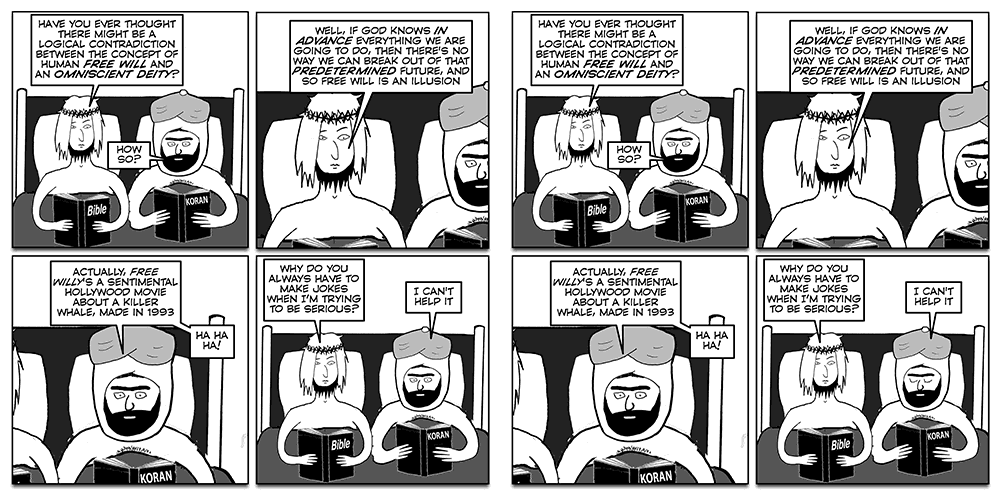
Love it!
OMG! I can’t help it either!
Just because God is a time traveler from the future doesn’t mean that free will doesn’t exist.
Seems to me that God couldn’t break out of that predetermined future either.
All-Knowing vs All-Powerful.
Back in 2022, philosopher Alasdair MacIntyre sparked a controversy at the University of Notre Dame when he argued to the standing-room-only crowd at his lecture closing a ethics and culture conference that when we say God is omniscient, we mean that he knows all that can be known, which excludes what he called “contingent singularities.” He used the examples of Hamlet and E=mc2. If Hamlet is really the work of Shakespeare, God cannot “know” about it “in advance” or the work isn’t really the Bard’s, it’s God’s; E=mc2 is a real insight, not just Einstein parroting God’s knowledge at the right time and place.
I was at this lecture, and found it fascinating. I’m a Byzantine Catholic with a deep commitment to Universalism (of the Gregory of Nyssa variety), so I’m already open to divergent theologies. I noted in the buzz after the lecture that those who were the most open to MacIntyre’s ideas were younger, including some of my young cousins in attendance, ND student (I’m 59). The baby boomers were incensed and began wringing their hands. Within hours, a rebuttal had been posted on a popular Catholic website.
I think a lot of the debate on this point suffers from the way we tend to think of knowledge today — as a key to power. The main thing about “God” is power — God as creator, God as moral authority, God as punisher, God as judge, God as the one who sees all, who knows just what you’ve done.
But that’s not the “main thing” about God you actually find in the New Testament, where the focus isn’t God’s power, but his love and mercy. Jesus uses his mysterious healing power to cure losers and outcasts, usually without them even asking. In the Gospels, God’s knowledge isn’t directed towards power and control, it’s directed towards serving others, especially the despised. Knowledge is the key to understanding, connecting, helping.
That view doesn’t resolve all the paradoxes, of course, but it recontextualizes the discussion, I think.
Re. “New Testament … where the focus isn’t God’s power, but his love and mercy.”
Well, that is a somewhat gracious interpretation of the NT. One could just as well point to the oft repeated dogged emphasis on the horrors awaiting those who do not believe in (or are not informed of) this wonderful love and mercy. Jesus, after all, spoke of hell more than any other character in the entire bible.
“Jesus, after all, spoke of hell more than any other character in the entire bible.”
That’s true, but it’s also true that he spoke more often about heaven, much more often, though not necessarily in eschatological terms — “the Kingdom of Heaven is at hand.” And Paul, who wrote or dictated or is the source of more than half of the New Testament, never once mentions hell, but says a lot of things that sound like universal salvation. His only mention of “fire” in the afterlife is of a fire that purifies.
Moreover, the concept of “hell” that we’ve inherited from modern Christianity is quite different from the ideas of sheol, gehenna, and hades that Jesus and his contemporaries would have had.
The “believe or go to hell” framing that is so familiar to us today — still fecklessly employed by some fundamentalists — just isn’t to be found in the New Testament. You’re not “saved” by pronouncing a formula or performing a ritual, but by attentively serving the least of our brothers and sisters with no strings attached. That’s it.
Then the New Testament must really have taken God by surprise. I bet He is still laughing.
She.
They. 🙂
It.
“While humans interpret God’s foreknowledge as knowing the future in advance, from God’s perspective, all times are equally real, leading some theologians to assert that it’s merely knowledge to God and not foreknowledge.”
A quotation from “Catholic Answers” – in the link you provided.
Hahaha – an example of religion twisting itself into pretzels attempting to explain the unexplainable. (Actually, the non-existent.)
Also, how the hell do theologians know what “God’s perspective” is”. Again, hahaha.
Twisting itself into pretzels is putting it mildly. Or they can talk about “recontextualizating”, which to me appears to be just another form of evasion. They’ve got some paradoxes all right, of their own creation, if I may. And as always their answer is to change the question.
Exactly.
As a former catholic, I am familiar with this charlatanism, masquerading as truth. It’s child abuse, as I think Christopher Hitchens said.
Though I think all beliefs relating to the supernatural are entirely loony, I really do not think that “child abuse” is the right term for sincere people trying to explain their religious convictions to their children. If a parent, e.g., sincerely believes in a real danger awaiting their child — such as hell –, is it not that parent’s duty to warn the child of it, as ill conceived as it may be? There are numerous significant differences between this and what we generally call child abuse, so that such usage rather cheapens the latter. It reminds me a bit of the wildy inflated use of the term “violence” one so often sees nowadays.
I don’t blame my parents for the terror that these doctrines visited upon a confused child. It’s the purveyors of this vile rubbish that should be held to account. It may not be the far too common physical (usually sexual) form of child abuse, something the Church also knows a great deal about, but it is abuse none the less.
So how many angels can fit on the head of a pin?
How many pins can fit on the head of an angel?
Actually, it depends on the order of dependence (or interdependence), not on the time-order.
Consider a closed timelike curve, which is allowed in general relativity. There is a chunk of metal (which we’ll name Denty) on the closed timelike curve, which is spherical except for a distinctive dent on one side. At a certain point on its trajectory, Denty collides with a spherical object from outside the closed timelike curve, fitting right into the dent, and therefore spreading the impact force enough to not permanently deform Denty. The impact sends Denty into yet another repeat of its trajectory, while the outsider bounces away, never (on the outsider’s timeline) to return.
Denty contains a record, one might even say “foreknowledge”, of its impact with the outsider – and that’s the only way the whole scenario is possible. (If Denty entered the collision undented, the internal consistency of the closed timelike curve would be violated.) But not because it made the outsider collide with it. Foreknowledge isn’t enslavement.
God is a fantasy. Determinism (as physicists understand it, not as most people overinterpret it) is real, the evidence suggests. Determinism doesn’t imply that anyone (or any One) knows the future, or even that the laws of physics in principle allow that anyone could. The “free will problem” is a fantasy. The solution is not to invent spooky metaphysics, but to stop imagining the imaginary problem.