
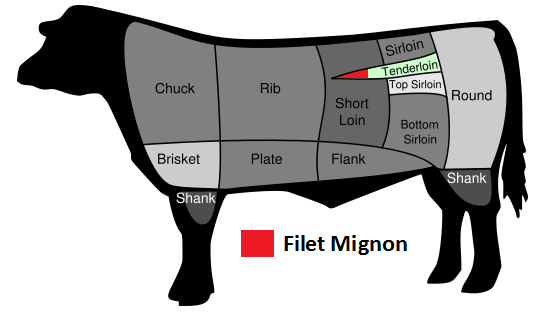
Welcome to a Hump Day (“ہمپ ڈے” in Punjabi), also August 13, 2025 and National Filet Mignon Day, honoring a cut of beef prized for its tenderness despite a lack of beefy flavor instantiated in, say, a ribeye steak. This comes from a small end of the cow’s tenderloin, also known as the “psoas major muscle ventral to the transverse processes of the lumbar vertebrae, near the kidneys”. Here’s where it is:
It’s also National Prosecco Day, International Left-Handers Day, and World Calligraphy Day. Here’s some lovely calligraphy, but I don’t know the language. Can anybody tell us? The Wikipedia caption says it was digitized in Georgia:

Readers are welcome to mark notable events, births, or deaths on this day by consulting the August 13 Wikipedia page.
Da Nooz:
*It looks as if Harvard, too, has caved after Trump’s withholding of federal funds: to the tune of half a billion dollars. The money won’t go directly to the government, but in general it looks like Harvard lost this one.
Harvard University is nearing a $500 million settlement with the Trump administration, in what would be the largest payout the White House has won so far in its campaign to punish universities that it says failed to stop antisemitism on campus.
Under the terms of a deal, which isn’t final, the university would pay $500 million to workforce and vocational programs, not to the federal government, a person familiar with the negotiations said. In turn, the Trump administration would restore billions in frozen federal dollars to the school for research and other programs.
The administration wouldn’t appoint a monitor to oversee Harvard’s compliance with the deal. The university would pledge to continue to abide by federal regulations around merit-based hiring and admissions as well as protecting students’ civil rights. In the deal that the Trump administration struck with Columbia University last month, an independent monitor is set to assess the school’s compliance.
An agreement with Harvard isn’t finalized, and negotiations are continuing this week. President Trump has attacked Harvard repeatedly in the past few months, and would need to approve a final deal.
The deal terms were reported earlier by the New York Times.
Harvard declined to comment.
Other schools on the chopping block:
Harvard has acknowledged that in the height of protests in 2024 its Jewish students felt unsafe and says it has made several substantive steps to address antisemitism in its community, including strengthening policies and disciplining students who violate them.
The Trump administration has been in talks with several universities, including the University of California, Los Angeles, Cornell and Northwestern, and sees striking a deal with Harvard as an essential mission. The White House has already reached a $200 million settlement with Columbia and a $50 million deal with Brown.
The administration is seeking a $1 billion settlement from UCLA, which university leaders have said would devastate the public-school system.
I think what Harvard is offering is pretty much what Trump asked for, including the university’s promise to engage in merit-based hiring and admissions. One thing is missing, the “government monitor” that would check on university compliance, something that the invertebrate school Columbia University agreed to. But have no doubt about it: the Administration will be checking Harvard’s compliance one way or another. So far the University of Chicago seems safe.
*I’ve previously discussed Abigail Shrier’s second book, Bad Therapy: Why the Kids Aren’t Growing Up (see here and here), and I thought it was excellent, making a good case that the “therapization” increasingly impinging on children is doing them serious damage. As I wrote:
. . . . the book is, in my view, superb, and should be read by every literate adult, whether or not you have children. For it offers not only guidelines for parenting, but also explains why young people in society (as well as adolescents, college students, and young adults) are showing higher rates of anxiety, depression, and mental illness. They are emotionally stuck at about age twelve. And that, says Shrier, is due to “bad therapy”: the rise of an American therapy culture in which every child is constantly assessed, supervised, and psychologized by parents, their schools, and doctors. (It is the schools and doctors, which include therapists, that have convinced parents that their children have psychological problems and need treatment.) The result is that we have one generation (I’d say two or more) that has grown up fragile, solipsistic, afraid to engage with the world, and socially inept.
Shrier has a new but related article at the Free Press, a piece called “Stop asking kids if they’re depressed.” It begins with a bit that makes me even more wary about endorsing our governor as a 2028 candidate for President:
llinois intends to crop-dust its public schools with mental-health diagnoses.
Last week, Illinois governor JB Pritzker signed into law mandatory annual mental-health screenings for all public school children in third through twelfth grades. “Illinois is now the first state in the nation to require mental health screenings in its public schools,” the governor trumpeted on X. “Our schools should be inclusive places where students are not just comfortable asking for help—they’re empowered to do it.”
Empowered to “ask” for help by submitting to mandatory and invasive mental-health surveys, that is. If basic literacy hadn’t already collapsed in Illinois, kids might pose spirited objections to Pritzker’s sales pitch.
In fact, far too many American children and adolescents without debilitating mental disorders have already been funneled into the slippery mental-health pipeline.
I know: I’ve spoken to hundreds of parents of such kids.
. . .Often that tragic descent [of “over-therapized kids into psychiatric treatment, drugs, and depression] begins with a simple mental health survey.
By chance, while I was writing the book, my middle school–age son returned home from sleepaway camp with a persistent stomachache. I took him to urgent care, where a nurse asked me to leave the room so he could administer a mental health screening tool put out by our National Institute of Mental Health. That turned out to be NIMH explicit protocol: ask parents to leave so that you can administer the following questions to kids who have not shown any signs of mental distress, aged eight and up.
I requested a copy of the survey and photographed it. Here, verbatim, are the five questions the nurse intended to put to my son in private:
1. In the past few weeks, have you wished you were dead?
2. In the past few weeks, have you felt that you or your family would be better off if you were dead?
3. In the past week, have you been having thoughts about killing yourself?
4. Have you ever tried to kill yourself? If yes, how? When?
5. Are you thinking of killing yourself right now? If yes, please describe.
Kids are wildly suggestible, especially where psychiatric symptoms are concerned. Ask a kid repeatedly if he might be depressed—how about now? Are you sure?—and he just might decide that he is.
In my view, if a kid shows no sign of having a mental disorder, then questionnaires like this should not be given. Parents can be educated about what signs to look for, but if you read Shrier’s last book, you’ll see the palpable harms that this kind of stuff can cause.
*For the time being, this article by Yascha Mounk at The Dispatch is free: “How we got the Internet all wrong“, with the subtitle: “The World Wide Web was supposed to connect us to people near and far. Instead, it has turned us into tribalist, neurotic homebodies.” He starts by describing the conflict between the view that social media is harmful, especially for kids (a view promulgated by Jon Haidt, among others), and the opposing view that those fears surface with every new technology and are overblown. Mounk’s take:
In this battle, I have until now chosen to be a non-combatant. While I always found Haidt’s worries to be plausible, I also felt that we didn’t yet have enough evidence to be confident that things were really as bad as he feared.
And then I came across a truly jaw-dropping chart.
That chart, published by Financial Times journalist John Burn-Murdoch and based on his analysis of data from the extensive Understanding America Study, shows how the traits measured by the personality test most widely used in academic psychology have changed over the past decade. The OCEAN test measures five things: openness to experience, conscientiousness, extraversion, agreeableness, and neuroticism. Decades of research have demonstrated that some of these traits are highly predictive of life outcomes; in particular, conscientiousness (“the tendency to be organized, responsible, and hardworking”) predicts everything from greater professional success to a lower likelihood of getting divorced. Extroversion (a tendency to be “outgoing, gregarious, sociable, and openly expressive”) is associated with better mental health, broader social networks, and greater life satisfaction. Meanwhile, neuroticism (understood as a propensity toward anxiety, emotional instability, and negative emotion) is strongly correlated with negative outcomes, such as higher rates of depression, lower life satisfaction, and poorer overall mental health.
With these facts in mind, you will quickly realize why Burn-Murdoch’s chart demonstrates that something very, very concerning has been happening to young people.
The chart is below, showing that those between 16 and 39 have gotten less conscientious, more neurotic, less agreeable, and less introverted in the last 8 years. Now granted, three of these trends also apply to geezers (60+), but it’s the younger kids that are more severely afflicted. But is it due to social media?
This data doesn’t prove that these shifts in personality are driven by social media. But two details do point in that direction. First, some of the most obvious alternative explanations don’t seem to hold water. Some experts, for example, have argued that the global pandemic is to blame for some of the alarming changes in young people. But while this is plausible, most of the worrying changes noted by Burn-Murdoch set in well before 2020. Second, young people spend much more time on social media; and while many of these changes in personality are evident across generations, they turn out to be concentrated precisely among that age group that spends the most time online. All in all, it is hard to imagine what social transformation other than the rise of social media could have caused these changes.

Also, the predictions that people would widen their circle of acquaintances hasn’t come true, nor has the prediction that online dating would lead to better and more relationships (it hasn’t). Mounk’s solution is more or less this: “Well, we’ve gotten stuff wrong before so maybe these effects of social media are only temporary.” If so, I won’t be around to see them reverse.
*An economics professor at Harvard has done something that, in retrospect, seems obvious: he figured out how to use geometry to divide up (“gerrymander”) states in a way that districts are more compact. And it appears to have no political bias (article archived here). Here’s the method:
After months huddled around a whiteboard with a sharp graduate student, Richard Holden, fueled by too much bad Harvard Square coffee, we created a measure we call the “Relative Proximity Index.”
Picture every voter as a dot on the state map. First, we pin down the geometric minimum — the most compact way to bundle those dots inside the state’s jagged borders into its exact number of congressional districts, each with equal population, whether that means wrapping around Florida’s panhandle or hugging Georgia’s slanted shoulder. Then we compare the map the legislature actually draws to that floor. The ratio is the Relative Proximity Index. An R.P.I. of 1 means you’ve hit the geometric ideal; an R.P.I. of 3 means voters within a district would live — on average — three times farther apart than necessary.
. . . But compactness should be the starting point because it is neutral, measurable and easy to audit.
It subsumes contiguity (tight districts are, by construction, connected), discourages gratuitous splits of counties and cities, and helps protect genuine communities by forcing mapmakers to justify every detour. Start with the tightest lawful plan; if you deviate, say why, in public. As a rule: the bigger the R.P.I., the heavier the mapmaker’s thumb on the scale.
. . .Two parts of the curve matter: Bias is the built-in tilt at a 50—50 vote. If each party gets half the votes, but one still wins 55 percent of the seats, that’s a +5-point bias for that party. Responsiveness is the slope — the number of seats that change hands when the statewide vote moves by one percentage point. High responsiveness means small shifts in public opinion cause more seats to flip; low responsiveness means the seat count hardly budges.
The results were striking: under maximally compact maps, responsiveness jumped in all four states, while bias stayed about the same. In other words, compactness doesn’t change which party starts with the advantage — it changes how many races are actually competitive, and how much voters’ choices can move the scoreboard. The empirical data show compactness is not cosmetic; it’s what turns a fixed match into a fair fight.
Okay, so I don’t understand it all. But science has been enlisted in the interest of political fairness: a rare event.
*And from the reliable A.P. “Oddities section,” we learn that the efficient Swiss have instituted a policy of traffic fines based on the violator’s income:
The driver was clocked going 27 kilometers per hour (17 mph) over the speed limit on a street in the Swiss city of Lausanne, and now he’s facing up to 90,000 Swiss francs (over $110,000) in fines as a result. But he can afford it.
Why the eye-popping penalty? Because the speedster, a repeat offender, is one of Switzerland’s wealthiest people, and the Vaud canton, or region, serves up fines based on factors like income, fortune or general family financial situation.
The Swiss are not alone. Germany, France, Austria and the Nordic countries all issue punishments based on a person’s wealth. The recent fine isn’t even a record in Switzerland. In 2010, a millionaire Ferrari driver got a ticket equal to about $290,000 for speeding in the eastern canton of St. Gallen.
Back then, the Swiss safety group Road Cross said rich drivers had been lightly punished until voters approved a penal law overhaul three years earlier that let judges hand down fines based on personal income and wealth for misdemeanors like speeding and drunk driving.
Under today’s rules, an indigent person might spend a night in jail instead of a fine, while the wealthiest in the rich Alpine country could be on the hook for tens of thousands.
I guess that sounds pretty fair. If a rich violator is fined a pittance, it’s not a deterrent. Income-based fining would seem to be more of a deterrent, no?
Meanwhile in Dobrzyn, Andrzej’s situation seems to be improving—though Hili had doubts:
Andrzej: I think I’m slowly beginning to emerge from the chaos.
Hili: At moments I have the impression you’re only now plunging into it.

In Polish:
Ja: Myślę, że powoli zaczynam wychodzić z chaosu.
Hili: Chwilami mam wrażenie, że dopiero w niego wpadasz.
*******************
From Jesus of the Day:

From Cat Memes:

From Now That’s Wild:

Masih is still doing podcasts (damn those things!) and not issuing tweets, so we’ll put in her substitute, J. K. Rowling. Rowling offered to review Nicola Sturgeon‘s book for free, and I couldn’t resist adding some extra tweets:
Thank you for your many kind offers, of which there were a considerable amount. Watch my website for my review of ‘Frankly’, the memoir of Scotland’s (checks notes) most persecuted, misunderstood, self-critical, open-to-debate, feminist-to-her-fingertips ex-First Minister. https://t.co/fCz1fD6QiJ
— J.K. Rowling (@jk_rowling) August 12, 2025
Pages 108-9, in which our heroine opines on the need to make the ‘public sphere’ safe for women and girls. pic.twitter.com/3sI9NtlRLq
— J.K. Rowling (@jk_rowling) August 12, 2025
From Luana. Even if you oppose Israel’s actions, this is not the way to do it:
A guy who spray-painted “Death to the IDF” and “the resistance…knows exactly where you work” on a lab building at MIT was found with homemade explosives.
But his mom says he’s being unjustly persecuted for expressing his views on Gaza.
Classic. https://t.co/RcGxhOCD0H
— Steve McGuire (@sfmcguire79) August 12, 2025
From Malcolm, two moggies watching Tom & Jerry cartoons. For real!
Watching Tom & Jerry’s pic.twitter.com/I3eHXGng00
— Cats with pawerful aura (@AuraWithCat) August 8, 2025
One I reposted from The Auschwitz Memorial:
This Hungarian Jewish girl was gassed upon arriving at Auschwitz. She was ten. https://t.co/q3FlQ46edr
— Jerry Coyne (@Evolutionistrue) August 13, 2025
Two posts from Dr. Cobb, Emeritus. About the first one he says this: “Your country’s institutions have utterly failed. This is a small disaster but a disaster none the less ” I told him that IT WAS NOT MY FAULT!
I just got the notice that all the FlyBase people at Harvard, including me, will be laid off on October 12. I'm devastated.
— Dr Sian Gramates (@drglam.bsky.social) 2025-08-11T18:12:45.920Z
And the last point is the kicker:
From a story about a new species of pseudoscorpion, this sort of highlighted the management of Australia in a nutshellau.news.yahoo.com/incredible-p…
A THOUGHT FOR TODAY:
There is no terror in the bang, only in the anticipation of it. -Alfred Hitchcock, film-maker (13 Aug 1899-1980)
The script is Georgian.
Wouldn’t it be fantastic if a publisher sold facsimiles of JKR’s annotated copy of Frankly, and it outsold the original?!
Great idea! I’d buy it. Could she get around copywrite issues with N.S. via a fair use argument?
Gerrymandering is the real threat to democracy. For years, I lived in a heavy Democrat district in North Carolina. My vote didn’t count.
Now I live in a heavy Republican district in Arizona. My vote doesn’t count here either.
In fact, the US as a whole is heavily gerrymandered. Only if one lives in one of ca. 5-7 states does one’s vote in a presidential election count.
One might suppose that Sirloin would be in-between Top Sirloin and Bottom Sirloin.
Re the piece about kids’ mental health, I heard a speaker ~ 20 years ago discuss the issue in conjunction with social media, and what she said rang very true to me. She started out describing the average neighborhood radius of a 12-year old’s play space/meandering ability some 100 years ago, which was several blocks or even miles at least. That kid’s children would have access to less space in the neighborhood, and by the time you get to kids of that age today, most of them don’t leave the confines of their house/yard. And in previous generations (I would include my own here), families were bigger, and older siblings played an important role in hearing about & handling bullying, petty crime & other problems, intervening & disciplining where necessary. Today’s 12-year old will often be an only child, whose only interaction outside of school is via social media, where bullying runs rampant. She also pointed out that in communities that still have larger families, e.g., Hispanic, you aren’t seeing as much of a social media/mental health issue (although this may have changed by now). She had lots more to say, but I found her remarks were certainly relevant to my own upbringing, coming from a large family in a community of large families, where a: you were largely free to do your own thing as long as you were home by the time the street lights came on, and b: any shenanigans you got into were quickly discovered by your own or a friend’s older siblings and you got your butt kicked about it long before (or if) your parents ever found out. Anyway, it’s a complex topic, of course, but I found it spot on in many ways.
I think problems may have started even before social media, with television.
Based on my experience. As a young child I lived in a town in central B.C. that didn’t have TV. We played outside constantly weather permitting and indoors in bad weather.
Then we moved to another town with TV. There was some outside play but an awful lot of time watching TV.
I will never forget how much better pre-TV was.
Social media is even more addictive than TV.
I’ve opined for years that there must be some non-partisan way for a computer to create voting districts. I don’t know if this method is the way, but, hopefully, it will spark a debate about how to do this.
The Swedes have done that income-adjusted speed fining for years. I don’t care for the idea.
Indeed, the idea of districting as per non-biased algorithm has been around for ages and is not a difficult thing to do. Neither party implements it, as both seek to game the system and are afraid to lose advantage where it feels it has such.
I’m a bit on the fence on the income-adjusted fines. On the surface, “fair” would seem to be that all receive the same punishment, i.e. the same fine, for the same infraction. But of course a $500 fine to one person can mean financial ruin, while to another it is entirely negligible. So which is “fair”? The latter, I suppose, but it’s not an unassailable position.
It all starts with disentangling the electoral system from political parties. For example, Elections Canada is a non-partisan governmental institution. It handles riding maps as well as the mechanics of elections such as counting votes. I think it’s one of the best, least corruptible systems in the world. Correct me if I am wrong.
Forget the districts. Your party gets 20% of the vote? You get 20% of the seats. It’s called proportional representation. Calling any other system “democratic” is a stretch.
“The World Wide Web was supposed to connect us to people near and far. Instead, it has turned us into tribalist, neurotic homebodies.” We ARE, by nature, tribalist, neurotic homebodies. It requires effort to go against that nature. The Web just enabled it on larger scales.
Re. “… granted, three of these trends also apply to geezers (60+).”
Wouldn’t this be a rather strong indication that social media might not be the/a principal cause?
As the downhill slide also coincides more or less with the advent of Trumpism, one could just as easily argue that this would be the cause.
Probably too many difficult-to-control-for factors to come to any robust conclusions on such an endlessly complex matter, as much as I despise both social media and Trumpism and thus would love to give them the blame.
I can well believe that young people in some enclaves are saturated with over-nurturing, given specific reported cases, plus the environment that Carol Hooven described in her recent interview about the coddling but also volatile climate at Harvard. But I don’t think that is true everywhere. The students where I work (at Medium-Sized U in Michigan) show no sign of that sort of delicacy. When I encounter students who are stressed, it is for very good reasons. So I also don’t see how Shrier’s book is a blanket description.
.
Widespread mental health screening of children without symptoms? Not that we have ever seen that model for other conditions in adults lead to broad complications, including false positives, overdiagnosis, mental stress, difficulty predicting relevance of the findings, overtreatment, treatment with limited evidence of benefit, and negligible effects on all-cause mortality.
I once found some psychiatry books on my Grandpa’s shelf (he was a doctor.) I was told that reading them might be dangerous for a kid due to the possibility of self-suggestion. I better NOT know. Also, kids in the 1960s and ’70s were NOT usually diagnosed with mental conditions, because (as I was told) growing up may give the APPEARANCE of mental problems that later go away.
But someone decided that there is money to be made by harming kids. And we can’t forego money can we?
Re suggestibility, in what possible world would it be a do-no-harm screening activity to prompt a child to consider how they would kill themselves? Can I use the word “retarded” here? How about “criminally negligent stupidity”?
💢💢
The therapeutic/therapizing culture has also been expanding in higher ed for years. At the University of Washington, for example, a Counseling Center lists the following services for students on its website:
Gender Affirming Care; Groups; Let’s Talk;
Ongoing Therapy and Psychiatry Resources; Psychiatric Services; Urgent Help [“Let’s Talk” connects UW students to 1-1 support from experienced mental health counselors without an appointment.]
And, of course, UW faculty members have the services, whatever they may be, of a “Well Being” staff (with several associate and assistant deans) in the Office of Faculty Affairs.
Since retiring, I have offered my services to this office as an Associate Dean for Restful Naps, but without success.
While Germany and some other countries does implement some income-based fines (often a choice of going to jail for a certain number of days or paying an amount equal to what one would have earned in those days), as far as I know, at least in Germany, not for traffic violations.
Once when Paul McCartney was busted for having cannabis at an airport in England, he said “OK, I’ll pay the fine”, which I’m sure he could afford. His few days in jail in Japan (the only time he was separated from his wife Linda) were a much harsher punishment.
Japan was (and is) crazy strict about drugs. Poor Paul. I was young but I remember that. They had a tiny bit of mj left accidentally in Linda’s makeup box. Real bad luck there.
When I travel internationally I go through my own luggage VEEERY carefully.
D.A.
NYC
Paul got off easy due to his fame. By contrast, you or I might still be in prison there.