
We have a new contributor, Amy Perry of Indiana, who sends us a panoply of photos from her area. Amy’s captions and IDs are indented, and you can enlarge her photos by clicking on them.
All of these were taken at Ritchey Woods Nature Preserve in Fishers, a suburb of Indianapolis. This a state-protected area that has the strictest protection of any type of land designation in that it needs to fill a pressing public need that cannot otherwise be filled plus the signature of the governor, if any of it is developed or taken. The land has been state-protected for 41 years and is an oasis of peace in the midst of suburban and light industrial development. The nature preserve is surrounded a conservation easement; the entire area is 120 acres and incudes three ecosystems: a swamp, prairie, and forest.
Some of these were taken by the former chief naturalist of Ritchey Woods Nature Preserve in Fishers, Indiana. Some were taken by me, with my iPhone 11.
Most of these photos are spring ephemerals, or short-lived plants. They bloom before the trees leaf out and they are gone by the end of May or so.
The spicebush (Lindera benzoin) photo was taken in the fall; the leaves turn yellow in the fall. If you crush a leaf you can smell a lemony-spicey aroma–very attractive. The spicebush swallowtail butterfly needs that plant.

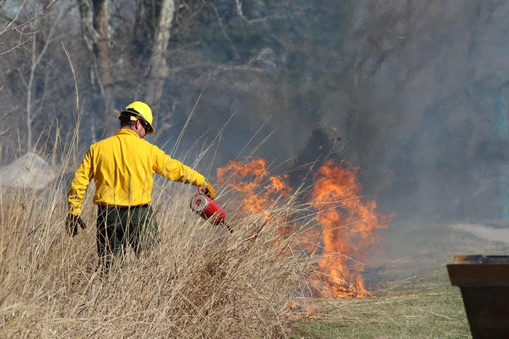
I included the drip torch photo because it illustrates a conservation technique used to manage prairies. It was taken during a controlled burn of a prairie. Controlled burns are performed to mimic what used to occur naturally (and the native Americans would burn prairies also). As you probably know, fire destroys shrubs and saplings, leaving the prairie plants free to grow by themselves unshaded.
Dutchmen’s breeches (Dicentra cucullaria) leaves look very similar to squirrel corn (Dicentra canadensis). But Dutchmen’s breeches flowers have two spreading spurs while squirrel corn’s blooms are rounded and connected (Michael Homoya, Wildflowers and Ferns of Indiana Forests.)


Rosinweed (Silphium integrifolium) stems and leaves are rough to the touch, like rosin. Rosinweed blooms in the summer.

Shagbark hickory (Carya ovata) trees are so named for obvious reasons.

Easatern skunk cabbage (Symplocarpus foetidus) has a foul odor. It looks like giant garlic cloves. It needs constantly moist soil. It flowers in January and February, generating so much heat that sometimes it melts the surrounding snow. The leaves can be reddish mottled or other colors. I love the giant leaves.

The thin pink stripes of spring beauties (Claytonia virginica) guide insects to the pollen at the center. I have seen spring beauties growing in lawns of houses built 40 years ago, remnants of the forest that was there before the home.

Trout lilies (Erythronium americanum):


Virginia bluebells (Mertensia virginica):

Splendid!
I am enjoying learning about actual real-life regions “behind” the wildlife …
RWP – Behind the Wildlife
Could be a “TV show”…. if they still exist…
Glad to hear this.
Ritchey Woods Nature Preserve looks like a lovely place to walk. I’m glad to hear it’s protected.
Thank you for the photos!
You’re welcome!
Beautiful! Looking forward to more!
I’ve lived on the east coast and the west coast and can say with some confidence that your Eastern Skunk Cabbage is stinkier than our Western Skunk Cabbage (Lysichiton americanus).
Thank you! So you’ve smelled both types of cabbage….
Great photos, and welcome to the site!
Thank you!
I love your spring ephemerals, which include some of the same ones I look for each year when the long winter is over at last.
Thank you!
Thanks Amy and welcome! A lovely addition to my mind’s eye view of Indianapolis which until you sent in these great pics, was limited to the speedway and its parking lot environs.
You’re welcome. Glad to hear this.
Very nice. Thanks.
You’re very welcome.
Thank you for this photo tour of a rich, little-known gem of biodiversity!
You’re welcome. Glad you like them.