
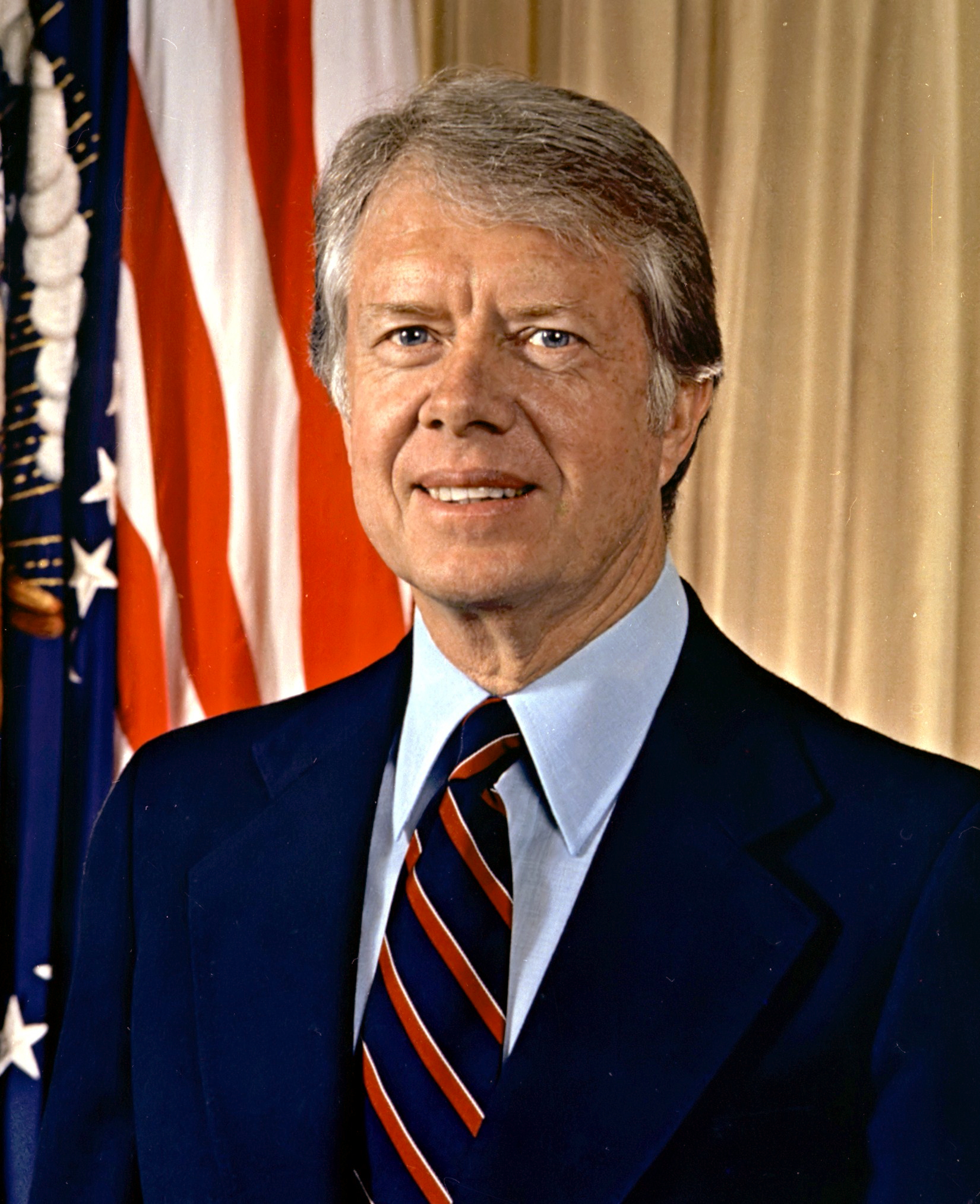
Welcome to Monday, September 30, 2024, and National Hot Mulled Cider Day. It’s also Jimmy Carter’s 100th birthday. He was supposed to be dead months ago, but is hanging on. Ceiling Cat bless him: one of the best ex-Presidents we ever had.
It’s also the first day of classes at the University of Chicago, and, for those already on campus it’s the beginning of the Students for Justice in Palestine’s “Week of Rage” marking a “year of genocide” (on Israel’s part, not Hamas’s!) The rage will be especially strong this year because the IDF has largely eliminated the ability of Hamas to wreak terror. Now if the UN and Western Europe would stop their unfounded accusations against Israel, the war would largely be over.
Expect trouble on campus. (I’ll be delighted if there isn’t any.)
The yelling and deplatforming has already started, and here’s a “celebration” of October 7 in Canada (I’m not convinced that the participants should be expelled if this doesn’t violate campus regulations. It’s still hateful and immoral, though.
Breaking: Students for Justice in Palestine at McGill University has announced their intention to celebrate Oct. 7th.
These students should be immediately expelled for supporting a mass terrorist attack. No more appeasement. pic.twitter.com/nzzzvTrytE
— Eyal Yakoby (@EYakoby) September 29, 2024
Protests at the University of Michigan; students demand that charges be dropped against protestors charged with felonies:
Michigan Attorney General Dana Nessel had her town hall interrupted by student protesters from the University of Michigan. They screamed and chanted at her while also demanding Nessel drop the charges against eleven students arrested at the UMich Encampment. pic.twitter.com/rkh5alisfd
— Stu (@thestustustudio) September 28, 2024
It’s also International Podcast Day, National Love People Day, Chewing Gum Day (I can’t abide it, but especially when people are being interviewed and chewing gum), Extra Virgin Olive Oil Day, International Translation Day, and International Blasphemy Rights Day.
Readers are welcome to mark notable events, births, or deaths on this day by consulting the September 29 Wikipedia page.
Da Nooz:
*Virtually all the headlines I can find in the MSM are about the war in the Middle East. The Wall Street Journal tells us, as far as it knows, “How Israel killed Hezbollah’s leader in underground bunker.”
Hassan Nasrallah and other senior leaders of Hezbollah were under siege as they gathered Friday in a bunker more than 60 feet beneath the surface of a bustling working- class neighborhood in southern Beirut.
Israel’s air force struck the bunker with about 80 tons of bombs, according to several people familiar with the situation. The attack used a series of timed, chained explosions to penetrate the subterranean bunker, a senior Israeli military official said.
When it was over, a pillar of orange smoke rose above Beirut. And Hassan Nasrallah, the fierce and charismatic Islamist who had led Hezbollah for more than three decades, was dead.
Israel’s operational planning for Friday’s strike began months ago, with military officials identifying how to pierce an underground bunker in southern Beirut with a series of timed explosions, with each blast paving the way for the next one. The attack was one of the largest single airstrikes on a major city in recent history.
Israeli officials began to discuss seriously the option of killing Nasrallah in recent days, according to a person briefed on the matter. The exact timing of the strike, Israeli officials said, was opportunistic, coming after Israeli intelligence learned about the meeting hours before it occurred.
. . . . It used eight 2,000-pound bombs to try to kill Hamas’s top military leader in July.
And, according to Lebanon’s own Health Ministry, only eleven people were killed in the strike in Beirut that killed Nasrallah and some top aides, and most of those must have been Hezbollah commanders. How is it possible that a tall building could be demolished with so few deaths? We do not know for sure, but perhaps the IDF had a subtle way of warning people in advance. Surely Hezbollah would want the buildings atop its underground bunker to be occupied so there would be more civilian deaths.
Regardless of the failures that led to October 7, Israel’s military planning and inside information that led to this attack (they must have moles everywhere) is pretty amazing. How did they learn about the meeting? At any rate, the killing of Hezbollah’s leaders, as well as Operation Grim Beeper, has surely made Iran reassess its policy of using proxies to destroy Israel:
“What Israel is doing with this campaign against Hezbollah has opened the door to a new era in which Iran’s influence in the Middle East is going to be significantly weakened,” said Lina Khatib, director of the SOAS Middle East Institute, a think tank based in London.
*The Saudi Crown Prince, Saudi Arabian Crown Prince Mohammed bin Salman, who runs the country, announced that he doesn’t really care if there’s a “two state solution” to the Gaza war”, and also says he has no objection to Israel conducting anti-terror operations in Gaza. This is somewhat of a surprise:
Saudi Arabian Crown Prince Mohammed bin Salman told US President Joe Biden that he does not actually care about whether Israel agrees to a two-state solution, The Atlantic reported.
Saudi Arabia and Israel had been close to a deal on the eve of the October 7, 2023 Hamas massacre in the Israeli towns bordering Gaza. The war put the deal on hold, but US Secretary of State Antony Blinken still believed that it was possible, even if the details had changed. Blinken also wanted Saudi Arabia to fund Gaza’s reconstruction following the end of the war.
According to The Atlantic, Bin Salman, for his part, told Blinken that the Biden administration stood the best chance of realizing a deal, and that he wanted to move quickly, before the November 2024 elections, which could precipitate US President Donald Trump’s return to power.
Bin Salman told Blinken that such a deal required “calm” in Gaza, but that Israel could periodically re-enter Gaza to conduct security operations. He stressed, however, that such operations could not take place in the near future: “They can come back in six months, a year, but not on the back end of my signing something like this.”
He also explained his insistence on any deal including a two-state solution.
“Seventy percent of my population is younger than me,” bin Salman, age 38, told Blinken. “For most of them, they never really knew much about the Palestinian issue. And so they’re being introduced to it for the first time through this conflict. It’s a huge problem. Do I care personally about the Palestinian issue? I don’t, but my people do, so I need to make sure this is meaningful.”
You might ask yourself, as I did, “well, if bin Salman thinks that the two-state solution has to be part of any peace deal, why is he saying that it’s no big deal to him”? And then I realized that bin Salman is in charge of the country, and doesn’t really have to care about what his people think about the solution. I believe he’s telegraphing what many Muslim states have said either explicitly or implicitly: they don’t want Hamas to win, and don’t want to harbor Palestinian refugees. And perhaps this is too much to hope for, but perhaps bin Salman’s words suggest that he might be in favor of joining the Abraham Accords that normalize relationships between Israel and Muslim countries like the (UAE, Kuwait, Sudan, and Morocco).
But of course bin Salman is no angel, as I’ve said repeatedly. Saudi Arabia is oppressive, has somewhat of a terroristic bent itself (remember the journalist they killed in Turkey?) and they execute dozens and dozens of dissidents yearly. But that country’s accord with Israel would still go a long way to promoting peace in the Middle East.
*There are two related columns in yesterday’s NYT with similar titles but by authors of differing political persuastions). The first is by Ashley Etienne, “The question Kamala Harris needs to answer to beat Donald Trump” (Etienne is identified as “a communications strategist currently serving as a senior adviser at Weber Shandwick. She was the communications director for Vice President Harris and former House Speaker Nancy Pelosi and a special assistant to President Barack Obama”). So what is the question? I
To win in 37 days, there is one question she needs to answer: Why? Why do you want to be the president, why are you the right leader for this moment and why does it matter to voters? She has proved her credentials, prosecuted the case against Mr. Trump and clarified some policy views, but not her why. That’s what the American people want to know about her.
It’s a fundamental question — and one that stumps too many political candidates.
How she answers will determine whether she can convince those undecided voters and drive record turnout among Democratic base voters. My suggestion for the vice president: Go big and take more calculated risks.
First, cut back on the incessant focus on Mr. Trump. By now, almost everyone who could be persuaded by the case against him has heard it.
Second, trade the massive rallies for smaller, town-hall-style events in battleground states. While rallies are meant to entertain, town halls create the conditions for Ms. Harris to dig into her why and directly address voters, without the pressure for applause lines.
I think this is about right, though Harris is leading the polls now (it’s a squeaker!). As far as I know, she has said only that she wants to be President so she can more forward, unburdened by the past. That’s a bit of an exaggeration, but Etienne knows whereof she speaks.
The second column is by Ross Douthat, “The most important question Kamala Harris hasn’t answered.” So what is his question? It’s “what will you do about Ukraine?”:
It is rather more important, on the other hand, to know what a President Harris would do about the war in Ukraine, the most significant crisis that she would immediately inherit.
With Volodymyr Zelensky in Washington this week, we were treated to a formal restatement of Harris’s support for the Biden administration’s position from early in the war, which envisioned Ukraine taking back most of its lost territory: Standing beside the Ukrainian leader, the vice president dismissed any deal making that involves territorial concessions as Putinist fellow-traveling and “proposals for surrender.” (The intended contrast with Donald Trump is obvious, since Trump is promising to immediately seek an armistice even as he declines to detail terms.)
But even as the vice president was issuing this statement, the administration was leaking doubts about Zelensky’s supposed plan for victory, dismissing it as “little more than a repackaged request for more weapons and the lifting of restrictions on long-range missiles,” to quote The Wall Street Journal. In other words, it’s a request for help to slow the grinding pace of Russian gains, but not a plan to actually deliver the victorious endgame that Kyiv and Washington have officially been seeking.
Harris has said the right things about Ukraine (here she simply slaughtered Trump in the debate), and I hope she gives as much aid as possible to Zelensky.
*The Washington Post has a piece called simply “The number“, and it gives a lot of diverse facts (e.g. 1 in 100 Americans die each year) before it gets to the number that, they say, really matters, the Consumer Price Index, or CPI.:
The other pieces published in this series have human protagonists. This one doesn’t: The main character of this piece is not a person but a number. Like all the facts and numbers cited above, it comes from the federal government. It’s a very important number, which has for a century described economic reality, shaped political debate and determined the fate of presidents: the consumer price index.
The CPI is crucial for multiple reasons, and one of them is not because of what it is but what it represents. The gathering of data exemplifies our ambition for a stable, coherent society. The United States is an Enlightenment project based on the supremacy of reason; on the idea that things can be empirically tested; that there are self-evident truths; that liberty, progress and constitutional government walk arm in arm and together form the recipe for the ideal state. Statistics — numbers created by the state to help it understand itself and ultimately to govern itself — are not some side effect of that project but a central part of what government is and does.
. . . . Like the democratic project itself, many of these numbers are imperfect. Gathering them — in many cases, creating them — gets more complicated over time. The CPI is a classic example of that.
The author argues that two numbers are very important in American social life and politics. The first is the census count. The other is the CPI:
The other number, equally important, is the main official measure of inflation, the consumer price index. At its simplest, the CPI is a vital number because it is used in multiple economic aspects of government: It is used to set levels of Social Security payments, access to payments in the Supplemental Nutrition Assistance Program (formerly food stamps), pensions and tax thresholds. It features in business contracts, in court orders and in divorce settlements. Many millions of workers have salary agreements that alter in direct relationship to the CPI. As the Bureau of Labor Statistics says, “Of all the economic statistics produced by the U.S. federal government, none has a direct impact on the lives of everyday Americans quite like the Consumer Price Index.”
Like travel and infrastructure and domestic security, the CPI has the particular characteristics of a thing that no one notices or thinks about when it’s going well but that everybody becomes obsessed with when it’s going badly. The CPI sounds simple enough: It measures how much prices have gone up. According to the official definition, it is “a measure of the average change over time in the prices paid by consumers for a representative basket of consumer goods and services.” But there is a large basket of loudly squirming devils in the details.
The simplest way to imagine how hard it is to come up with the CPI is to ask how you would do it for yourself. You would work out all the stuff you buy, determine how much of a portion of your total budget was absorbed by each specific item and then find out the change in prices for each of them across time. The most straightforward step would probably appear to be a like-for-like comparison of item prices. Take, say, cheese. (I could choose the example of olive oil, but, over the past couple of years, that has become too painful to contemplate. If you know, you know.) How much has the price of cheese changed over the past year? You would go through receipts from a year ago and from today, find the identical item, and do the math. But how would you find a number for, not your cheese, but all cheese? Across the entire United States? What’s the typical, representative cheese? Where would you buy it? How much would you buy?
The article is overlong but bits of it (look at how they calculate the CPI simply for cheese) are absorbing. And there’s no doubt that it does have immense influence. Although Americans may no know the CPI, they know whether they’re paying more than they think they should. Right now, I think, that’s exactly what they think. Sadly, even though my dad was an economist, much of this article was above my pay grade (or interest grade).
*Yesterday I wrote about Francis Ford Coppola’s new movie “Megalopolis,” which I intend to see. Sadly for him (he used a lot of his own money to finance it, including selling off a lot of his good vineyards), the movie appears to be a box-office flop:
Francis Ford Coppola’s decades-in-the-making, self-financed epic “Megalopolis” flopped with moviegoers, while the acclaimed DreamWorks Animation family film “The Wild Robot” soared to No. 1 at the weekend box office.
“The Wild Robot,” Chris Sanders’ adaptation of Peter Brown’s bestseller, outperformed expectations to launch with $35 million in ticket sales in U.S. and Canada theaters, according to studio estimates Sunday. “Wild Robot” was poised to do well after critics raved about the story of a shipwrecked robot who raises an orphan gosling. Audiences agreed, giving the film an A CinemaScore. “Wild Robot” is likely set up a long and lucrative run for the Universal Pictures release.
Paul Dergarabedian, senior media analyst for Comscore, predicts “The Wild Robot” “may take a page from the ‘Elemental’ playbook by opening to respectable box office and then looking toward long-term playability.” Pixar’s “Elemental,” which like “The Wild Robot” wasn’t a sequel, debuted with a modest $30 million but went on to gross nearly $500 million worldwide.
Family movies, led by the year’s biggest hit in “Inside Out 2,” have particularly powered the box office this year. David A. Gross, a film consultant who publishes a newsletter for Franchise Entertainment, said the genre should reach $6 billion worldwide in 2024 — which, he noted, “is back to pre-pandemic levels.”
And even on Rotten Tomatoes, you see that not even half the critics (and only 36% of the audience) like Coppola’s movie:

While both critics and the audience loved “The Wild Robot”. The tomatometer:

Here’s the trailer for “The Wild Robot”:
Meanwhile in Dobrzyn,n Hili is concerned again. When I asked Malgorzata why, she replied, “Because she gets tired after a few minutes when she spins after her own tail.”
Hili: How old is the Earth?A: Four and a half billion years.Hili: And it’s been spinning all this time?

Hili: Ile lat ma Ziemia?Ja: Cztery i pół miliarda.Hili: I cały czas się tak kręci?
*******************
From Cat Memes:

From The Dodo: From Reader Simon, who says that his yard has been heavily invaded by ducks. “We have an infestation,” he said. My advice: “FEED THEM!”

And duck lagniappe: a duck cake from The Great British Bakeoff (h/t Marie). Marie noted:
The cake was baked by an Sumayah, an eighteen-year-old girl, on the Great British Baking Show. It looks like her pet duck. Fortunately the judges cut a piece of cake from the stump that the duck is sitting on, and not from the duck. Sumayah did not win, but I think she should have. The winner made a cake that looked like folded-up blue jeans.
SHE SHOULD HAVE WON!

Masih applauds Israel’s elimination of Hezbollah’s leader and several subordinate leaders:
When terrorists fall, it is not a tragedy; it is a victory!
Did you mourn the killing of Osama bin Laden by U.S. forces in 2011? No! Many celebrated it as a significant victory against terrorism, a symbol of justice for the victims of the 9/11 attacks.
The deaths of ISIS leaders,… pic.twitter.com/D7zdogdyYi— Masih Alinejad 🏳️ (@AlinejadMasih) September 29, 2024
From Malcolm, a kitten rescue video. It turned out okay, so I’ll put it up here. I love kitten rescues!
From Simon. I’m sure it refers to federal assistance for hurricane damage:
Hello, President Biden, it’s Ron! May I please have some socialism? pic.twitter.com/u0BA0Yaing
— Alex Cole (@acnewsitics) September 27, 2024
Two from my feed. First, a censoring cat:
Very polite , very respectful very demure pic.twitter.com/P3ZSYYGIHT
— Why you should have a cat (@ShouldHaveCat) September 28, 2024
And remember, SJP’s “week of rage” begins today:
The UPenn Students for Justice in Palestine has posted that they are calling for the death to Israel.
This is a call for genocide. When will UPenn take action? pic.twitter.com/wARrrvupLu
— Eyal Yakoby (@EYakoby) September 29, 2024
From the Auschwitz Memorial. A huge mass murder of Jews took place 83 years ago:
September 29-30, 1941 | The massacre in Babi Yar.
Under the supervision of Einsatzgruppe C, a special team of German SS troops supported by other German units and local collaborators began the murder of Jews of Kyiv.In two days 33,771 Jews were murdered. And these were just the… pic.twitter.com/MinpfxCT8S
— Auschwitz Memorial (@AuschwitzMuseum) September 29, 2024
Two tweets from the eminent Professor Cobb. First, two of the many things Matthew found out while writing his biography of Francis Crick:
The man who wrote this film (and the successful eponymous saucy books) wrote the first attempt to film The Double Helix…. It was not a success. More about the films (but no mention of DNA) here: https://t.co/sjDJflGeAX pic.twitter.com/1o2BAPtE4f
— Matthew Cobb (@matthewcobb) July 19, 2024
And note the twists this cat makes to be able to land on its feet:
July 18 pic.twitter.com/Vaqk6GHNMy
— Irena Buzarewicz (@IrenaBuzarewicz) July 18, 2024
I do love Dana Nessel
I hope that your President Alivisatos shows some backbone this year in dealing with these little shits. Though it seems like it’s been years since “strength” has been on the requirements list of knowledge, skills, and other characteristics in uni president searches.
As someone who has studied mass violence for years and (real) genocides in particular, it infuriates me when that term is misapplied to the people who suffered the most paradigmatic case of genocide and are basically defending themselves from attacks that seek to complete that task.
There is something very perverse about all this and I am loosing my patience with the generic anti-Israel environment all around me. Maybe I am getting old and becoming cranky, but sometimes it’s difficult for me not to think that, unless there is some awakening, the West is doomed… Yeah, it’s a Monday.
It is said Jordan Peterson avoids getting protestors by giving talks in the morning. I found that funny.
Looking forward to the yearly reading tomorrow – I caught some beautiful fall sunlit leaves this AM and thought of it…
🍁🍂
But Fox News is different — I just checked. Their main stories tend to be more local. The current headline is about an economist throwing a curve ball in the race for the White House. I didn’t know you could throw curve balls in races.
Maybe they focus on a different demographic.
I’m going to take issue with the Ron DeSantis cartoon. As long as the Federal government takes a substantial portion of the income of the residents of the States, it is only appropriate that he ask for some of that back when the need arises. After all, that’s specifically what the money is appropriated for. That’s not Socialism.
That’s a perfectly good point, but I think the cartoon is based on the fact that, for conservatives, any government money spent to help citizens is “socialism”, regardless of the source of that money. The cartoon is a bit of humorous irony in that sense.
“the fact that, for conservatives, any government money spent to help citizens is “socialism””
So that’s what conservatives think.
It’s a frequent conservative claim, among others.
John Kerry, former Senator, for Presidential candidate, former Climate Czar, told a panel at the World Economic Forum last week that the First Amendment is a problem:
Kerry sees social media as an issue, and implies that people aren’t looking in the right place for their info. His solution, though, is to limit speech to approved sources. We are hearing this consistently from the Democratic leaders now. We should take them seriously.
“We are hearing this consistently from the Democratic leaders now.”
Do you have any other examples? Surely you must, as it is “consistent”. The one you gave is not convincing.
Thanks
TwistyCat is very impressive! It turned out, though, that if it hadn’t made any twists at all it would have landed in the same position. I’m sure it didn’t know that, and this way it also avoided ever being completely upside down.
I see the point. But I think that because the jump was mainly powered by its rear half, the rear half kept going upward while the front half started to head downward.
Hadn’t thought about it, but same could be said of Olympic gymnastics all-around gold medalist Simone Biles.
What kind of person “celebrates” Oct. 7, regardless of your views of what has happened after that?
Regarding Harris and town halls: her handlers are wise to keep her out of them. Her answers will provide fodder for Trump attack ads and be ridiculed by the right endlessly. She can’t put together a solid string of thoughts to answer questions, and comes across as not a deep thinker when she tries. Her campaign is also avoiding taking sides to avoid offending anyone. To me, this is not leadership, but it might be enough to win the presidency.
Kris Kristofferson died Saturday.
L
I believe that Jimmy Carter’s birthday is October 1, Tuesday.
I thought so too – also (with a bit more authority) so does Wikipedia
He’s done well to reach that age: both his parents and his siblings died much younger of cancer. He’s got cancer but it hasn’t killed him yet.
I wonder how that works: how did he escape?
https://twitter.com/japantimes/status/1840723880509333590 🇯🇵🗳
Japan’s prime minister will change. But we cannot expect much. 🇯🇵😔😿
“And, according to Lebanon’s own Health Ministry, only eleven people were killed in the strike in Beirut that killed Nasrallah and some top aides, and most of those must have been Hezbollah commanders. How is it possible that a tall building could be demolished with so few deaths?”
I believe I read somewhere that the operation was carried out during the day, when residents of the building would be out and about, leaving only the terrorists. It’s interesting how the IDF penetrated to the depths of the bunker, using explosives timed one after another, each one damaging deeper parts of the structure. When they don’t have the bunker buster bombs they need, the Israelis resort to technology and creativity. They explode smaller bombs in sequence. This means timers, computers, and brilliance: the stuff of Start-up Nation.
And I do think that the Saudis want to normalize relations with Israel. Saudi Arabia would benefit by having trade relations and probably technology exchange, and the partnership would bolster the defense against Iran. If the Saudis wanted a deal before October 7, they surely want a deal now that they’ve seen Iran flex its muscles in unleashing Hamas, Hezbollah, and the Houthis in Yemen. I expect Israel and Saudi to normalize relations in the not-to-distant future. The two countries are probably already cooperating covertly.
The Saudis (or at least the prince) are happy to have Hezbollah and the Houthis flattened by someone else who they can point the finger at officially, while celebrating behind closed doors.
I understand that the Houthis also attack Saudi Arabia: no love lost there.
There’s a pic of Netanyahu, when he was addressing the UN, holding maps showing Saudi Arabia, Egypt and Sudan as blessings, and in comments here a few months ago, Malgorzata said that the shops in Israel were suddenly full of things from Saudi Arabia, so bin Salman’s viewpoint seems consistent with that and the agreement that we’ve heard about that was close to complete just before Oct 7, strange as it seems.
Indeed MBS doesn’t care about the Pals, he’s been quite clear reading between the lines on this for a long time.
MOST Arab elites don’t either. They’ve sold anti-zionism/ antisemitism to their populations as a “unity” idea within their societies and in the larger Islamosphere.
So the proles in the Arab world DO care about Pals – despite few having ever met any. This can backfire on the leaders horribly as Anwar Sadat learned the hard way.
The assassin’s veto is the big player in the room here when it comes to peace with Israel and it has to be on MBS’s mind as he balances options.
The only silver lining to come out of Oct 7 was to instruct the world that the idea of a 2 state solution was always lunacy and suicide and anybody smart enough to read understands that – on the left in the west particularly.
You can’t give a people whose foundational ideology is killing another country… a state.
D.A.
NYC
+1
I’m copy/saving your last line, David. Succinct perfection.
The play-acting character of pop-Left activism is neatly displayed in SJP’s own breathless announcement: “…we, the students, have confronted the Zionist and imperialist forces in our OWN university…”. Gee whiz, how exciting.
The statement from that video that made me roll my eyes is the student yelling that the university is “brutalizing” the protestors. Really??? Like, how? Because the university didn’t deliver pizzas to the encampment?
https://youtube.com/watch?v=6kr_Hvw7Mmw
The “Mafia” is gathering! 🇺🇸🎬🐱
Ross “Dotard” – hehehe – as much as I dislike him – is right here.
We DO need to know what Harris’ position on Ukraine, and more terrifyingly Israel, is. What is she going to do – they’re important world shaking issues. If I’m going to vote for her or just sit this one out for the first time in my American citizen life (2002)… I need to know.
Whatever Trump says is irrelevant b/c his psychopathy negates any plans or promises he could make. I tell that to my Jewish friends.
D.A.
NYC
Can we just start calling SJP “Nazis”?
If they want to protest, fine, but let’s use the right name when describing them.